SIMPLE AND
COMPOUND
INTEREST
A Presentation
By Himansu S M / 31-Jul-2013
What is Interest?
 When you borrow Money from someone
 Or use somebody else’s Money
 You have to pay a service charge to him.
 This amount is paid back to the Lender
along with the original amount borrowed.
 This is sometimes known as the cost of
Money which doesn’t belong to you, but
you have used it.
31-Jul-2013 2(C) Himansu S M
What is Interest?
 This extra amount is called the
“INTEREST”
 The original amount borrowed is known as
the “PRINCIPAL” or “CAPITAL” in different
situations
 The sum of both Principal and the interest
is known as “AMOUNT”
31-Jul-2013 3(C) Himansu S M
Types of Interest
 There are basically TWO types of Interest
 They are:
 SIMPLE INTEREST
 COMPOUND INTEREST
31-Jul-2013 4(C) Himansu S M
Interest Calculation
 To estimate or calculate the Interest we
must have the following parameters as
input:
 A rate known as the Rate of Interest (RI or
RoI) which is expressed in Percent per
Year
 A time period expressed in Years or
Months or Days
31-Jul-2013 5(C) Himansu S M
Interest Calculation
 The Principal on which the Interest is to be
calculated
 And finally the Type of Interest (Methods
of calculation are different)
 For advance Business Applications the
“Number of times of Interest Accrual in a
year” is required
 This is known as Compounding
31-Jul-2013 6(C) Himansu S M
Simple Interest
 Simple Interest is dependent on:
 Rate of Interest
 Time Period
 Principal
 And the Principal remains the same at the
beginning of all the Periods
 It means that the accrual of Interest is
linear
31-Jul-2013 7(C) Himansu S M
Compound Interest
 Compound Interest is dependent on:
 Rate of Interest
 Time Period
 Principal
 And the Principal increases by the interest
amount at the end of each Period
 Interest for the next period is calculated on
this increased Principal
31-Jul-2013 8(C) Himansu S M
Compound Interest
 It means that the Principal plus Interest of
one period becomes the Principal for the
next period
 This goes on till the total time period for
which the compound interest is calculated
 This Period is called the period of
compounding or the compounding interval
31-Jul-2013 9(C) Himansu S M
Compound Interest
 At the end of each such period the
accrued interest is added to the Principal
and this becomes the Principal for the next
interval
 In other words, the interest earns interest
 Some call it reinvesting or cumulative
31-Jul-2013 © Himansu S M 10
Compound Interest
 It means that the accrual of Interest is
NOT linear, but exponential
 The compounding may be
 Yearly, Half-Yearly,
 Quarterly, Monthly,
 Weekly, Daily,
 Continuous (Infinitely Compounded)
31-Jul-2013 11(C) Himansu S M
Comparison [ @ 10% pa ]
Simple Interest
Year Principal Interest
1 100 10
2 100 10
3 100 10
4 100 10
5 100 10
6 100 10
7 100 10
8 100 10
TOTAL 100 80
Compound Interest
Year Principal Interest
1 100 10
2 110 11
3 121 12.1
4 133.1 13.3
5 146.4 14.6
6 161.1 16.1
7 177.2 17.7
8 194.9 19.5
TOTAL 100 114.5
31-Jul-2013 12(C) Himansu S M
Interests Graph
0
5
10
15
20
25
30
35
40
45
Year1
Year2
Year3
Year4
Year5
Year6
Year7
Year8
Year9
Year10
Year11
Year12
Year13
Year14
Year15
Year16
Simple
Compound
31-Jul-2013 13(C) Himansu S M
Amount Graph
0
50
100
150
200
250
300
350
400
450
500
Year0
Year1
Year2
Year3
Year4
Year5
Year6
Year7
Year8
Year9
Year10
Year11
Year12
Year13
Year14
Year15
Year16
Simple
Compound
31-Jul-2013 14(C) Himansu S M
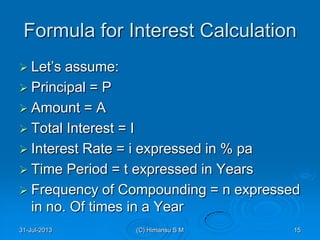
Formula for Interest Calculation
 Let’s assume:
 Principal = P
 Amount = A
 Total Interest = I
 Interest Rate = i expressed in % pa
 Time Period = t expressed in Years
 Frequency of Compounding = n expressed
in no. Of times in a Year
31-Jul-2013 15(C) Himansu S M
Formula for Simple Interest
 A = P + I
 Example:
 If P = 100,
 I = 50
 Then A = 100 + 50 = 150
31-Jul-2013 16(C) Himansu S M
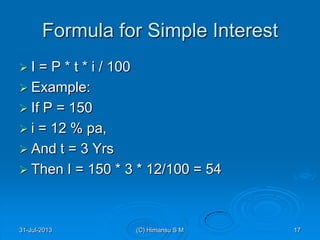
Formula for Simple Interest
 I = P * t * i / 100
 Example:
 If P = 150
 i = 12 % pa,
 And t = 3 Yrs
 Then I = 150 * 3 * 12/100 = 54
31-Jul-2013 17(C) Himansu S M
Formula for Simple Interest
 A = P * (1 + t * i / 100)
 Example:
 If P = 150
 i = 12 % pa,
 And t = 3 Yrs
 Then A = 150 * (1 + 3 * 12 / 100)
 150 * 1.36 = 204
31-Jul-2013 18(C) Himansu S M
Formula for Simple Interest
 Out of the Five Basic Variables:
 Principal
 Amount
 Interest
 Time Period and
 Rate of Interest,
 If we know any Three, then rest can be
calculated by manipulating the formula
31-Jul-2013 19(C) Himansu S M
Formula for Compound Interest
 Pls note that the “Simple Interest” CAN be
directly calculated, but the “Compound
Interest” CAN’T be directly calculated.
 First the Amount is calculated and then the
difference of Amount & Principal is the
“Interest”
 A = P + I
 I = A – P
31-Jul-2013 20(C) Himansu S M
Formula for Compound Interest
 A = P * ( 1 + i / 100 / n ) ^ ( t * n )
 [ the symbol ^ denotes “to the power of” or
“raised to” ]
 i = Rate of interest
 t = Time period
 n = Compounding frequency
 P = Principal
 A = Amount
31-Jul-2013 21(C) Himansu S M
Formula for Compound Interest
 Example: let’s take the same example as
our previous slide – the graph of
comparison
 P = 100
 t = 8 yrs
 i = 10 % pa.
 n = 1 time every Year
 See next slide-
31-Jul-2013 22(C) Himansu S M
Formula for Compound Interest
 A = 100 * ( 1 + 10 / 100 / 1 ) ^ ( 8 * 1 )
 = 100 * ( 1.10 ) ^ 8
 = 100 * 2.144
 = 214.4
 So I = A – P = 214.4 – 100 = 114.4
 Which matches our result.
31-Jul-2013 23(C) Himansu S M
Formula for Compound Interest
 How to find Rate of Interest:
 If A, P, t are given
 For simplicity let’s assume n=1
 Then the formula is:
 i = [ { ( A / P ) ^ (1 / t ) } – 1 ] * 100
31-Jul-2013 24(C) Himansu S M
Formula for Compound Interest
 Example: Let’s take the Last example
 A = 214.4
 P = 100
 t = 8
 n = 1
 i = [{( 214.4 / 100 ) ^ ( 1 / 8 )} – 1 ] * 100
 = ( 2.144 ^ 0.125 – 1 ) * 100
 = ( 1.10 -1 ) * 100 = 0.10 * 100 = 10 % pa
31-Jul-2013 25(C) Himansu S M
Some Norms
 Simple Interest is rarely used in today’s
world
 Business, Banks, Statistics, Finance, Dem
-ography, Population, Accounting, every-
where the Compounding Interest / Growth
/ Increase are used.
31-Jul-2013 26(C) Himansu S M
Some Norms
 If the compounding interval is not
mentioned then it is assumed to be
“Yearly”
 The compounding interval is NEVER more
than a Year, it means the value “n” is
never less than 1
 So mentioning only the rate of interest
without the compounding interval is
incomlete information
31-Jul-2013 27(C) Himansu S M
Compounding Interval
 The more the Compounding Frequency,
 Or the less the Compounding Interval,
 The more is the Effective Annual Interest.
 The Formula for Calculation is:
 A = P * ( 1 + i / 100 / n ) ^ ( t * n )
 And the Effective Annual Interest is:
 I = A - P
31-Jul-2013 28(C) Himansu S M
Compounding Interval
 Example: Let’s Say:
 P = 100
 i = 12 % pa
 t = 1 Year
 n = 1 (Yearly), 2 (Half-Yearly), 4
(Quarterly), 12 (Monthly), 52
(Weekly), 365 (Daily), etc.
 Let’s Calculate:
31-Jul-2013 29(C) Himansu S M
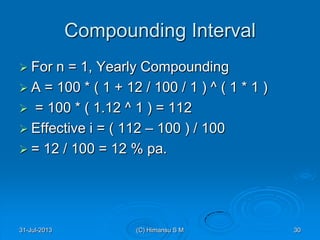
Compounding Interval
 For n = 1, Yearly Compounding
 A = 100 * ( 1 + 12 / 100 / 1 ) ^ ( 1 * 1 )
 = 100 * ( 1.12 ^ 1 ) = 112
 Effective i = ( 112 – 100 ) / 100
 = 12 / 100 = 12 % pa.
31-Jul-2013 30(C) Himansu S M
Compounding Interval
 For n = 2, Half-Yearly Compounding
 A = 100 * ( 1 + 12 / 100 / 2 ) ^ ( 1 * 2 )
 = 100 * ( 1.06 ^ 2 ) = 112.36
 Effective i = ( 112.36 – 100 ) / 100
 = 12.36 / 100 = 12.36 % pa.
31-Jul-2013 31(C) Himansu S M
Compounding Interval
 For n = 4, Quarterly Compounding
 A = 100 * ( 1 + 12 / 100 / 4 ) ^ ( 1 * 4 )
 = 100 * ( 1.03 ^ 4 ) = 112.55
 Effective i = ( 112.55 – 100 ) / 100
 = 12.55 / 100 = 12.55 % pa.
31-Jul-2013 32(C) Himansu S M
Compounding Interval
 For n = 12, Monthly Compounding
 A = 100 * ( 1 + 12 / 100 / 12 ) ^ ( 1 * 12 )
 = 100 * ( 1.01 ^ 12 ) = 112.68
 Effective i = ( 112.68 – 100 ) / 100
 = 12.68 / 100 = 12.68 % pa.
31-Jul-2013 33(C) Himansu S M
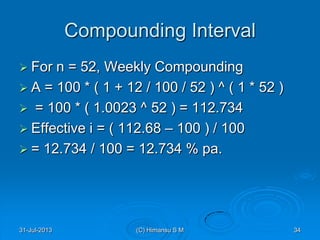
Compounding Interval
 For n = 52, Weekly Compounding
 A = 100 * ( 1 + 12 / 100 / 52 ) ^ ( 1 * 52 )
 = 100 * ( 1.0023 ^ 52 ) = 112.734
 Effective i = ( 112.68 – 100 ) / 100
 = 12.734 / 100 = 12.734 % pa.
31-Jul-2013 34(C) Himansu S M
Compounding Interval
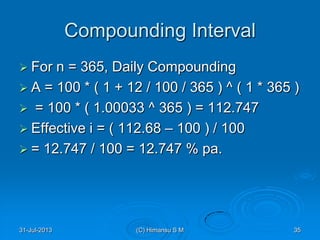
 For n = 365, Daily Compounding
 A = 100 * ( 1 + 12 / 100 / 365 ) ^ ( 1 * 365 )
 = 100 * ( 1.00033 ^ 365 ) = 112.747
 Effective i = ( 112.68 – 100 ) / 100
 = 12.747 / 100 = 12.747 % pa.
31-Jul-2013 35(C) Himansu S M
Continuous Compounding
 What if we keep increasing value of “n”
further to say very high no. or infinity,
 That means the interval getting smaller
and smaller to say zero.
 This is known as Infinitely
compounding, for which the formula is:
 A = P * e ^ ( i * t )
31-Jul-2013 36(C) Himansu S M
Continuous Compounding
 Where e = base of natural logarithm =
2.71828
 But there are a few tricks:
 The “ I ” is expressed in decimal –
 Example: 12 % is 0.12
 The “ t ” is expressed in multiples of the
period of interest rate –
 Example: if RoI is per annum then 3 yrs 6
months shall be 3.5 yrs.
31-Jul-2013 37(C) Himansu S M
Continuous Compounding
 Calculation Example:
 Let’s take same example of P = 100 & i =
12 % pa. If t = 1 yr what is I?
 A = P * e ^ ( i * t )
 = 100 * 2.71828 ^ (0.12 * 1 )
 = 100 * 2.71828 ^ 0.12
 = 100 * 1.127497 = 112.7497
 So I = 112.7497 – 100 = 12.7497
31-Jul-2013 38(C) Himansu S M
Continuous Compounding
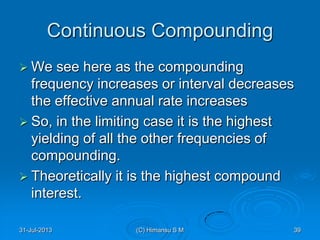
 We see here as the compounding
frequency increases or interval decreases
the effective annual rate increases
 So, in the limiting case it is the highest
yielding of all the other frequencies of
compounding.
 Theoretically it is the highest compound
interest.
31-Jul-2013 39(C) Himansu S M
Continuous Compounding
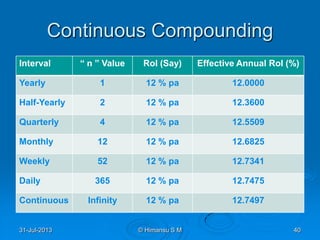
Interval “ n ” Value RoI (Say) Effective Annual RoI (%)
Yearly 1 12 % pa 12.0000
Half-Yearly 2 12 % pa 12.3600
Quarterly 4 12 % pa 12.5509
Monthly 12 12 % pa 12.6825
Weekly 52 12 % pa 12.7341
Daily 365 12 % pa 12.7475
Continuous Infinity 12 % pa 12.7497
31-Jul-2013 © Himansu S M 40
Exercise
 You might have seen Bank Ads depicting
14 – 17 % effective annualised yield after
say 5-7-10 yrs. Let’s calculate that as an
exercise and see how they do it.
 Let’s say ABCD Bank gives 10% pa to
Senior citizens for Fixed Deposits (all bank
interests are quarterly compounded). Now
let’s calculate the effective annualised
yield for 5-7-10 yrs:
31-Jul-2013 © Himansu S M 41
Exercise
 t = 5 yrs
 n = 4 Quarterly Compounded
 i = 10 % pa.
 So A = ( 1 + 10% / 100 / 4 ) ^ ( 5 * 4 )
 = ( 1 + 0.025 ) ^ 20 = 1.025 ^ 20
 = 1.6386 So I = 0.6386 in 5 yrs.
 Effective i = 0.6386 / 5
 = 12.772 % pa
31-Jul-2013 © Himansu S M 42
Exercise
 t = 7 yrs
 n = 4 Quarterly Compounded
 i = 10 % pa.
 So A = ( 1 + 10% / 100 / 4 ) ^ ( 7 * 4 )
 = ( 1 + 0.025 ) ^ 20 = 1.025 ^ 28
 = 1.9965 So I = 0.9965 in 7 yrs.
 Effective i = 0.9965 / 7
 = 14.236 % pa
31-Jul-2013 © Himansu S M 43
Exercise
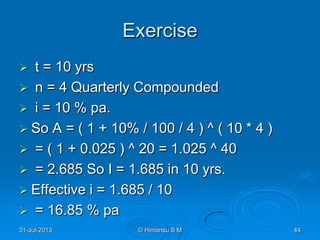
 t = 10 yrs
 n = 4 Quarterly Compounded
 i = 10 % pa.
 So A = ( 1 + 10% / 100 / 4 ) ^ ( 10 * 4 )
 = ( 1 + 0.025 ) ^ 20 = 1.025 ^ 40
 = 2.685 So I = 1.685 in 10 yrs.
 Effective i = 1.685 / 10
 = 16.85 % pa
31-Jul-2013 © Himansu S M 44
Conclusion
 With the help of Compound Interest one
can trick others.
 Compound interest can give very high
returns after longer periods.
 Example: Say a young man gets a
lumpsum from his father at the age of 25.
If he puts it for 12 % pa till he retires at
60, let’s compare the Simple & Compound
Interest
31-Jul-2013 © Himansu S M 45
Conclusion
 Simple Interest:
 12 % pa * 35 yrs = 420 % or 4.2 times
 The Amount will be 1 + 4.2 = 5.2 times
 Compound Interest:
 ( 1 + 12 / 100 ) ^ 35 = 52.8 times
 Hence the return is 10 times in 35 yrs.
 Such is the POWER OF COMPOUNDING!
31-Jul-2013 © Himansu S M 46
Disclaimer!
 This is my sincere effort to guide the
interested persons how to calculate the
compound interest.
 Anyone can use a scientific calculator or
any calculator where “x^y” function is built-
in.
 One can use a PC with excel worksheet to
do complex calculations.
31-Jul-2013 © Himansu S M 47
THANK YOU
Himansu S M / 31-Jul-2013
31-Jul-2013 (C) Himansu S M 48

Simple and Compound Interest

  • 1.
  • 2.
    What is Interest? When you borrow Money from someone  Or use somebody else’s Money  You have to pay a service charge to him.  This amount is paid back to the Lender along with the original amount borrowed.  This is sometimes known as the cost of Money which doesn’t belong to you, but you have used it. 31-Jul-2013 2(C) Himansu S M
  • 3.
    What is Interest? This extra amount is called the “INTEREST”  The original amount borrowed is known as the “PRINCIPAL” or “CAPITAL” in different situations  The sum of both Principal and the interest is known as “AMOUNT” 31-Jul-2013 3(C) Himansu S M
  • 4.
    Types of Interest There are basically TWO types of Interest  They are:  SIMPLE INTEREST  COMPOUND INTEREST 31-Jul-2013 4(C) Himansu S M
  • 5.
    Interest Calculation  Toestimate or calculate the Interest we must have the following parameters as input:  A rate known as the Rate of Interest (RI or RoI) which is expressed in Percent per Year  A time period expressed in Years or Months or Days 31-Jul-2013 5(C) Himansu S M
  • 6.
    Interest Calculation  ThePrincipal on which the Interest is to be calculated  And finally the Type of Interest (Methods of calculation are different)  For advance Business Applications the “Number of times of Interest Accrual in a year” is required  This is known as Compounding 31-Jul-2013 6(C) Himansu S M
  • 7.
    Simple Interest  SimpleInterest is dependent on:  Rate of Interest  Time Period  Principal  And the Principal remains the same at the beginning of all the Periods  It means that the accrual of Interest is linear 31-Jul-2013 7(C) Himansu S M
  • 8.
    Compound Interest  CompoundInterest is dependent on:  Rate of Interest  Time Period  Principal  And the Principal increases by the interest amount at the end of each Period  Interest for the next period is calculated on this increased Principal 31-Jul-2013 8(C) Himansu S M
  • 9.
    Compound Interest  Itmeans that the Principal plus Interest of one period becomes the Principal for the next period  This goes on till the total time period for which the compound interest is calculated  This Period is called the period of compounding or the compounding interval 31-Jul-2013 9(C) Himansu S M
  • 10.
    Compound Interest  Atthe end of each such period the accrued interest is added to the Principal and this becomes the Principal for the next interval  In other words, the interest earns interest  Some call it reinvesting or cumulative 31-Jul-2013 © Himansu S M 10
  • 11.
    Compound Interest  Itmeans that the accrual of Interest is NOT linear, but exponential  The compounding may be  Yearly, Half-Yearly,  Quarterly, Monthly,  Weekly, Daily,  Continuous (Infinitely Compounded) 31-Jul-2013 11(C) Himansu S M
  • 12.
    Comparison [ @10% pa ] Simple Interest Year Principal Interest 1 100 10 2 100 10 3 100 10 4 100 10 5 100 10 6 100 10 7 100 10 8 100 10 TOTAL 100 80 Compound Interest Year Principal Interest 1 100 10 2 110 11 3 121 12.1 4 133.1 13.3 5 146.4 14.6 6 161.1 16.1 7 177.2 17.7 8 194.9 19.5 TOTAL 100 114.5 31-Jul-2013 12(C) Himansu S M
  • 13.
  • 14.
  • 15.
    Formula for InterestCalculation  Let’s assume:  Principal = P  Amount = A  Total Interest = I  Interest Rate = i expressed in % pa  Time Period = t expressed in Years  Frequency of Compounding = n expressed in no. Of times in a Year 31-Jul-2013 15(C) Himansu S M
  • 16.
    Formula for SimpleInterest  A = P + I  Example:  If P = 100,  I = 50  Then A = 100 + 50 = 150 31-Jul-2013 16(C) Himansu S M
  • 17.
    Formula for SimpleInterest  I = P * t * i / 100  Example:  If P = 150  i = 12 % pa,  And t = 3 Yrs  Then I = 150 * 3 * 12/100 = 54 31-Jul-2013 17(C) Himansu S M
  • 18.
    Formula for SimpleInterest  A = P * (1 + t * i / 100)  Example:  If P = 150  i = 12 % pa,  And t = 3 Yrs  Then A = 150 * (1 + 3 * 12 / 100)  150 * 1.36 = 204 31-Jul-2013 18(C) Himansu S M
  • 19.
    Formula for SimpleInterest  Out of the Five Basic Variables:  Principal  Amount  Interest  Time Period and  Rate of Interest,  If we know any Three, then rest can be calculated by manipulating the formula 31-Jul-2013 19(C) Himansu S M
  • 20.
    Formula for CompoundInterest  Pls note that the “Simple Interest” CAN be directly calculated, but the “Compound Interest” CAN’T be directly calculated.  First the Amount is calculated and then the difference of Amount & Principal is the “Interest”  A = P + I  I = A – P 31-Jul-2013 20(C) Himansu S M
  • 21.
    Formula for CompoundInterest  A = P * ( 1 + i / 100 / n ) ^ ( t * n )  [ the symbol ^ denotes “to the power of” or “raised to” ]  i = Rate of interest  t = Time period  n = Compounding frequency  P = Principal  A = Amount 31-Jul-2013 21(C) Himansu S M
  • 22.
    Formula for CompoundInterest  Example: let’s take the same example as our previous slide – the graph of comparison  P = 100  t = 8 yrs  i = 10 % pa.  n = 1 time every Year  See next slide- 31-Jul-2013 22(C) Himansu S M
  • 23.
    Formula for CompoundInterest  A = 100 * ( 1 + 10 / 100 / 1 ) ^ ( 8 * 1 )  = 100 * ( 1.10 ) ^ 8  = 100 * 2.144  = 214.4  So I = A – P = 214.4 – 100 = 114.4  Which matches our result. 31-Jul-2013 23(C) Himansu S M
  • 24.
    Formula for CompoundInterest  How to find Rate of Interest:  If A, P, t are given  For simplicity let’s assume n=1  Then the formula is:  i = [ { ( A / P ) ^ (1 / t ) } – 1 ] * 100 31-Jul-2013 24(C) Himansu S M
  • 25.
    Formula for CompoundInterest  Example: Let’s take the Last example  A = 214.4  P = 100  t = 8  n = 1  i = [{( 214.4 / 100 ) ^ ( 1 / 8 )} – 1 ] * 100  = ( 2.144 ^ 0.125 – 1 ) * 100  = ( 1.10 -1 ) * 100 = 0.10 * 100 = 10 % pa 31-Jul-2013 25(C) Himansu S M
  • 26.
    Some Norms  SimpleInterest is rarely used in today’s world  Business, Banks, Statistics, Finance, Dem -ography, Population, Accounting, every- where the Compounding Interest / Growth / Increase are used. 31-Jul-2013 26(C) Himansu S M
  • 27.
    Some Norms  Ifthe compounding interval is not mentioned then it is assumed to be “Yearly”  The compounding interval is NEVER more than a Year, it means the value “n” is never less than 1  So mentioning only the rate of interest without the compounding interval is incomlete information 31-Jul-2013 27(C) Himansu S M
  • 28.
    Compounding Interval  Themore the Compounding Frequency,  Or the less the Compounding Interval,  The more is the Effective Annual Interest.  The Formula for Calculation is:  A = P * ( 1 + i / 100 / n ) ^ ( t * n )  And the Effective Annual Interest is:  I = A - P 31-Jul-2013 28(C) Himansu S M
  • 29.
    Compounding Interval  Example:Let’s Say:  P = 100  i = 12 % pa  t = 1 Year  n = 1 (Yearly), 2 (Half-Yearly), 4 (Quarterly), 12 (Monthly), 52 (Weekly), 365 (Daily), etc.  Let’s Calculate: 31-Jul-2013 29(C) Himansu S M
  • 30.
    Compounding Interval  Forn = 1, Yearly Compounding  A = 100 * ( 1 + 12 / 100 / 1 ) ^ ( 1 * 1 )  = 100 * ( 1.12 ^ 1 ) = 112  Effective i = ( 112 – 100 ) / 100  = 12 / 100 = 12 % pa. 31-Jul-2013 30(C) Himansu S M
  • 31.
    Compounding Interval  Forn = 2, Half-Yearly Compounding  A = 100 * ( 1 + 12 / 100 / 2 ) ^ ( 1 * 2 )  = 100 * ( 1.06 ^ 2 ) = 112.36  Effective i = ( 112.36 – 100 ) / 100  = 12.36 / 100 = 12.36 % pa. 31-Jul-2013 31(C) Himansu S M
  • 32.
    Compounding Interval  Forn = 4, Quarterly Compounding  A = 100 * ( 1 + 12 / 100 / 4 ) ^ ( 1 * 4 )  = 100 * ( 1.03 ^ 4 ) = 112.55  Effective i = ( 112.55 – 100 ) / 100  = 12.55 / 100 = 12.55 % pa. 31-Jul-2013 32(C) Himansu S M
  • 33.
    Compounding Interval  Forn = 12, Monthly Compounding  A = 100 * ( 1 + 12 / 100 / 12 ) ^ ( 1 * 12 )  = 100 * ( 1.01 ^ 12 ) = 112.68  Effective i = ( 112.68 – 100 ) / 100  = 12.68 / 100 = 12.68 % pa. 31-Jul-2013 33(C) Himansu S M
  • 34.
    Compounding Interval  Forn = 52, Weekly Compounding  A = 100 * ( 1 + 12 / 100 / 52 ) ^ ( 1 * 52 )  = 100 * ( 1.0023 ^ 52 ) = 112.734  Effective i = ( 112.68 – 100 ) / 100  = 12.734 / 100 = 12.734 % pa. 31-Jul-2013 34(C) Himansu S M
  • 35.
    Compounding Interval  Forn = 365, Daily Compounding  A = 100 * ( 1 + 12 / 100 / 365 ) ^ ( 1 * 365 )  = 100 * ( 1.00033 ^ 365 ) = 112.747  Effective i = ( 112.68 – 100 ) / 100  = 12.747 / 100 = 12.747 % pa. 31-Jul-2013 35(C) Himansu S M
  • 36.
    Continuous Compounding  Whatif we keep increasing value of “n” further to say very high no. or infinity,  That means the interval getting smaller and smaller to say zero.  This is known as Infinitely compounding, for which the formula is:  A = P * e ^ ( i * t ) 31-Jul-2013 36(C) Himansu S M
  • 37.
    Continuous Compounding  Wheree = base of natural logarithm = 2.71828  But there are a few tricks:  The “ I ” is expressed in decimal –  Example: 12 % is 0.12  The “ t ” is expressed in multiples of the period of interest rate –  Example: if RoI is per annum then 3 yrs 6 months shall be 3.5 yrs. 31-Jul-2013 37(C) Himansu S M
  • 38.
    Continuous Compounding  CalculationExample:  Let’s take same example of P = 100 & i = 12 % pa. If t = 1 yr what is I?  A = P * e ^ ( i * t )  = 100 * 2.71828 ^ (0.12 * 1 )  = 100 * 2.71828 ^ 0.12  = 100 * 1.127497 = 112.7497  So I = 112.7497 – 100 = 12.7497 31-Jul-2013 38(C) Himansu S M
  • 39.
    Continuous Compounding  Wesee here as the compounding frequency increases or interval decreases the effective annual rate increases  So, in the limiting case it is the highest yielding of all the other frequencies of compounding.  Theoretically it is the highest compound interest. 31-Jul-2013 39(C) Himansu S M
  • 40.
    Continuous Compounding Interval “n ” Value RoI (Say) Effective Annual RoI (%) Yearly 1 12 % pa 12.0000 Half-Yearly 2 12 % pa 12.3600 Quarterly 4 12 % pa 12.5509 Monthly 12 12 % pa 12.6825 Weekly 52 12 % pa 12.7341 Daily 365 12 % pa 12.7475 Continuous Infinity 12 % pa 12.7497 31-Jul-2013 © Himansu S M 40
  • 41.
    Exercise  You mighthave seen Bank Ads depicting 14 – 17 % effective annualised yield after say 5-7-10 yrs. Let’s calculate that as an exercise and see how they do it.  Let’s say ABCD Bank gives 10% pa to Senior citizens for Fixed Deposits (all bank interests are quarterly compounded). Now let’s calculate the effective annualised yield for 5-7-10 yrs: 31-Jul-2013 © Himansu S M 41
  • 42.
    Exercise  t =5 yrs  n = 4 Quarterly Compounded  i = 10 % pa.  So A = ( 1 + 10% / 100 / 4 ) ^ ( 5 * 4 )  = ( 1 + 0.025 ) ^ 20 = 1.025 ^ 20  = 1.6386 So I = 0.6386 in 5 yrs.  Effective i = 0.6386 / 5  = 12.772 % pa 31-Jul-2013 © Himansu S M 42
  • 43.
    Exercise  t =7 yrs  n = 4 Quarterly Compounded  i = 10 % pa.  So A = ( 1 + 10% / 100 / 4 ) ^ ( 7 * 4 )  = ( 1 + 0.025 ) ^ 20 = 1.025 ^ 28  = 1.9965 So I = 0.9965 in 7 yrs.  Effective i = 0.9965 / 7  = 14.236 % pa 31-Jul-2013 © Himansu S M 43
  • 44.
    Exercise  t =10 yrs  n = 4 Quarterly Compounded  i = 10 % pa.  So A = ( 1 + 10% / 100 / 4 ) ^ ( 10 * 4 )  = ( 1 + 0.025 ) ^ 20 = 1.025 ^ 40  = 2.685 So I = 1.685 in 10 yrs.  Effective i = 1.685 / 10  = 16.85 % pa 31-Jul-2013 © Himansu S M 44
  • 45.
    Conclusion  With thehelp of Compound Interest one can trick others.  Compound interest can give very high returns after longer periods.  Example: Say a young man gets a lumpsum from his father at the age of 25. If he puts it for 12 % pa till he retires at 60, let’s compare the Simple & Compound Interest 31-Jul-2013 © Himansu S M 45
  • 46.
    Conclusion  Simple Interest: 12 % pa * 35 yrs = 420 % or 4.2 times  The Amount will be 1 + 4.2 = 5.2 times  Compound Interest:  ( 1 + 12 / 100 ) ^ 35 = 52.8 times  Hence the return is 10 times in 35 yrs.  Such is the POWER OF COMPOUNDING! 31-Jul-2013 © Himansu S M 46
  • 47.
    Disclaimer!  This ismy sincere effort to guide the interested persons how to calculate the compound interest.  Anyone can use a scientific calculator or any calculator where “x^y” function is built- in.  One can use a PC with excel worksheet to do complex calculations. 31-Jul-2013 © Himansu S M 47
  • 48.
    THANK YOU Himansu SM / 31-Jul-2013 31-Jul-2013 (C) Himansu S M 48