CostsDirect and Opportunity Costs1
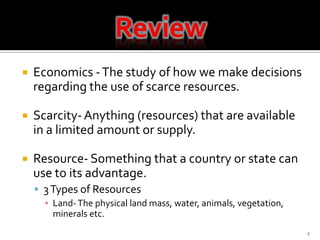
Economics - The study of how we make decisions regarding the use of scarce resources.Scarcity- Anything (resources) that are available in a limited amount or supply.Resource- Something that a country or state can use to its advantage. 3 Types of ResourcesLand- The physical land mass, water, animals, vegetation, minerals etc. 2Review
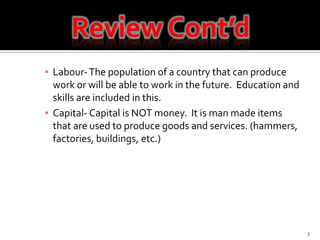
Labour- The population of a country that can produce work or will be able to work in the future.  Education and skills are included in this.Capital- Capital is NOT money.  It is man made items that are used to produce goods and services. (hammers, factories, buildings, etc.)3Review Cont’d
There are two different types of costs in Economics'.Direct Costsand;Opportunity Costs4Economic Costs
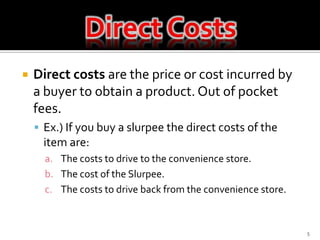
Direct Costs5Direct costs are the price or cost incurred by a buyer to obtain a product. Out of pocket fees.  Ex.) If you buy a slurpee the direct costs of the item are:The costs to drive to the convenience store.The cost of the Slurpee.The costs to drive back from the convenience store.Direct Costs
Opportunity CostsOpportunity Cost- the value of the next best possible alternative that is sacrificed when resources are allocated to a specific use.OrWhat you would have done if you did not make the choice that you did.
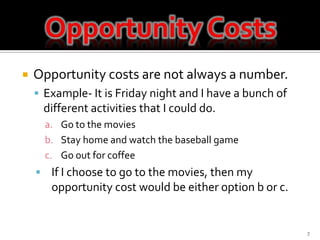
Opportunity costs are not always a number.Example- It is Friday night and I have a bunch of different activities that I could do.Go to the moviesStay home and watch the baseball gameGo out for coffeeIf I choose to go to the movies, then my opportunity cost would be either option b or c.7Opportunity Costs
Opportunity costs analyzes only the next best alternative not a whole set of alternatives.8Opportunity Costs
Suppose  that you are a ship wrecked sailor on a deserted island.  Each day that you go out you can catch either 10 fish or gather 5 coconuts.  The opportunity cost of catching 2 fish is one coconut. 10/5=29Opportunity Costs Using Numbers
Suppose that you work for a company that produces Butter and Milk.  Each day a factory worker is able to produce 100 gallons of milk or 50 sticks of butter.  What is the opportunity cost, if the worker chooses to produce  50 sticks of butter?10Opportunity Costs Using Numbers
Calculation100 Gallons of Milk /50 Sticks of butter=2The opportunity cost to produce 1 stick of butter is 2 gallons of milk.The opportunity cost to produce 2 gallons of milk is 1 stick of butter.What would the opportunity cost be if they wanted to produce 30 sticks of butter?11Opportunity Costs Using Numbers
ExamplesA person who has $15 can either buy a CD or a shirt. If he buys the shirt the opportunity cost is the CD and if he buys the CD the opportunity cost is the shirt. If there are more choices than two, the opportunity cost is still only one item, never all of them.A person who invests $10,000 in a stock denies himself or herself the interest that could have accrued by leaving the $10,000 in a bank account instead. The opportunity cost of the decision to invest in stock is the value of the interest. 12
If a city decides to build a hospital on vacant land it owns. In building the hospital, the city had the opportunity to build a sports center on that land, or a parking lot, or the ability to sell the land to reduce the city's debt. 13Examples
60 Gallons of milk will be used to make 30 sticks of butter. 14Opportunity Costs Using Numbers
The total costs of both the direct costs and opportunity costs.Total Cost = Direct Costs + Opportunity CostsTC= DC+OC15Total Costs

Economic Costs

  • 1.
  • 2.
    Economics - Thestudy of how we make decisions regarding the use of scarce resources.Scarcity- Anything (resources) that are available in a limited amount or supply.Resource- Something that a country or state can use to its advantage. 3 Types of ResourcesLand- The physical land mass, water, animals, vegetation, minerals etc. 2Review
  • 3.
    Labour- The populationof a country that can produce work or will be able to work in the future. Education and skills are included in this.Capital- Capital is NOT money. It is man made items that are used to produce goods and services. (hammers, factories, buildings, etc.)3Review Cont’d
  • 4.
    There are twodifferent types of costs in Economics'.Direct Costsand;Opportunity Costs4Economic Costs
  • 5.
    Direct Costs5Direct costsare the price or cost incurred by a buyer to obtain a product. Out of pocket fees. Ex.) If you buy a slurpee the direct costs of the item are:The costs to drive to the convenience store.The cost of the Slurpee.The costs to drive back from the convenience store.Direct Costs
  • 6.
    Opportunity CostsOpportunity Cost-the value of the next best possible alternative that is sacrificed when resources are allocated to a specific use.OrWhat you would have done if you did not make the choice that you did.
  • 7.
    Opportunity costs arenot always a number.Example- It is Friday night and I have a bunch of different activities that I could do.Go to the moviesStay home and watch the baseball gameGo out for coffeeIf I choose to go to the movies, then my opportunity cost would be either option b or c.7Opportunity Costs
  • 8.
    Opportunity costs analyzesonly the next best alternative not a whole set of alternatives.8Opportunity Costs
  • 9.
    Suppose thatyou are a ship wrecked sailor on a deserted island. Each day that you go out you can catch either 10 fish or gather 5 coconuts. The opportunity cost of catching 2 fish is one coconut. 10/5=29Opportunity Costs Using Numbers
  • 10.
    Suppose that youwork for a company that produces Butter and Milk. Each day a factory worker is able to produce 100 gallons of milk or 50 sticks of butter. What is the opportunity cost, if the worker chooses to produce 50 sticks of butter?10Opportunity Costs Using Numbers
  • 11.
    Calculation100 Gallons ofMilk /50 Sticks of butter=2The opportunity cost to produce 1 stick of butter is 2 gallons of milk.The opportunity cost to produce 2 gallons of milk is 1 stick of butter.What would the opportunity cost be if they wanted to produce 30 sticks of butter?11Opportunity Costs Using Numbers
  • 12.
    ExamplesA person whohas $15 can either buy a CD or a shirt. If he buys the shirt the opportunity cost is the CD and if he buys the CD the opportunity cost is the shirt. If there are more choices than two, the opportunity cost is still only one item, never all of them.A person who invests $10,000 in a stock denies himself or herself the interest that could have accrued by leaving the $10,000 in a bank account instead. The opportunity cost of the decision to invest in stock is the value of the interest. 12
  • 13.
    If a citydecides to build a hospital on vacant land it owns. In building the hospital, the city had the opportunity to build a sports center on that land, or a parking lot, or the ability to sell the land to reduce the city's debt. 13Examples
  • 14.
    60 Gallons ofmilk will be used to make 30 sticks of butter. 14Opportunity Costs Using Numbers
  • 15.
    The total costsof both the direct costs and opportunity costs.Total Cost = Direct Costs + Opportunity CostsTC= DC+OC15Total Costs