Building Economy ARE 431
Dr. Mohammad A. Hassanain 1
Time Value of Money
Simple versus Compound Interest
2
Simple Interest.
Example Illustrating Simple Interest Calculations.
Compound Interest.
Example Illustrating Compound Interest Calculations.
Today’s Lecture
Building Economy ARE 431
Dr. Mohammad A. Hassanain 2
3
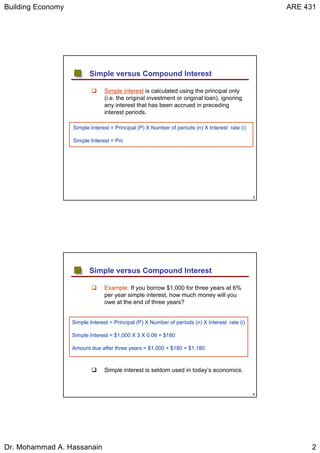
Simple versus Compound Interest
Simple interest is calculated using the principal only
(i.e. the original investment or original loan), ignoring
any interest that has been accrued in preceding
interest periods.
Simple Interest = Principal (P) X Number of periods (n) X Interest rate (i)
Simple Interest = Pni
4
Simple versus Compound Interest
Example: If you borrow $1,000 for three years at 6%
per year simple interest, how much money will you
owe at the end of three years?
Simple Interest = Principal (P) X Number of periods (n) X Interest rate (i)
Simple Interest = $1,000 X 3 X 0.06 = $180
Amount due after three years = $1,000 + $180 = $1,180
Simple interest is seldom used in today’s economics.
Building Economy ARE 431
Dr. Mohammad A. Hassanain 3
5
Simple versus Compound Interest
Compound interest is calculated using the principal
plus the total amount of interest accumulated in
previous periods.
Thus, compound interest means “interest on top of
interest”.
Example: If you borrow $1,000 at 6% per year
compound interest, compute the total amount owed
after three year period?
6
Simple versus Compound Interest
Interest for Year 1 = $1,000 X 0.06 = $60
Total amount due after year 1 = $1,000 + $60 = $1,060
Interest for year 2 = $1,060 X 0.06 = $63.60
Total amount due after year 2 = $1,060 + $63,60 = $1,123.60
Interest for year 3 = $1,123.60 X 0.06 = $67.42
Total amount due after year 3 = $1,123.60 + $67.42 = $1,191.02
Thus, with compound interest, the original $1,000
would accumulate an extra $1,191.02 - $1,180 =
$11.02 compared to simple interest in the three year
period.
Building Economy ARE 431
Dr. Mohammad A. Hassanain 4
7
Simple versus Compound Interest
Therefore, if an amount of money P is invested at
some time t=0, the total amount of money (F) that
would be accumulated after one year would be:
F1 = P + Pi
F1 = P(1 + i)
Where F1 = The total amount accumulated after one year
8
Simple versus Compound Interest
F2 = F1 + F1 i
F2 = P(1 + i) + P(1 + i)i
F2 = P(1 + i + i +i2)
F2 = P(1 + 2i + i2)
F2 = P(1 + i)2
At the end of the second year, the total amount of
money accumulated (F2) would be equal to the total
amount that had accumulated after year 1 plus interest
from the end of year 1 to the end of year 2.
Building Economy ARE 431
Dr. Mohammad A. Hassanain 5
9
Simple versus Compound Interest
F3 = F2 + F2 i
F3 = [P(1 + i) + P(1 + i) i] + [P(1 + i) + P(1 + i) i] i
Factoring out P(1 + i) we have:
F3 = P(1+ i) (1 + 2i + i2)
F3 = P(1 + i)(1 + i)2
F3 = P(1 + i)3
Similarly, the total amount of money accumulated at
the end of year 3 (F3) would be equal to the total
amount that had accumulated after year 2 plus interest
from the end of year 2 to the end of year 3.
10
Simple versus Compound Interest
Fn = P(1 + i)n
From the preceding values, it is evident that by
mathematical induction that the formula for calculating
the total amount of money (F) after (n) number of
years, using compound interest (i) would be:

6.1 simple versus compound interest

  • 1.
    Building Economy ARE431 Dr. Mohammad A. Hassanain 1 Time Value of Money Simple versus Compound Interest 2 Simple Interest. Example Illustrating Simple Interest Calculations. Compound Interest. Example Illustrating Compound Interest Calculations. Today’s Lecture
  • 2.
    Building Economy ARE431 Dr. Mohammad A. Hassanain 2 3 Simple versus Compound Interest Simple interest is calculated using the principal only (i.e. the original investment or original loan), ignoring any interest that has been accrued in preceding interest periods. Simple Interest = Principal (P) X Number of periods (n) X Interest rate (i) Simple Interest = Pni 4 Simple versus Compound Interest Example: If you borrow $1,000 for three years at 6% per year simple interest, how much money will you owe at the end of three years? Simple Interest = Principal (P) X Number of periods (n) X Interest rate (i) Simple Interest = $1,000 X 3 X 0.06 = $180 Amount due after three years = $1,000 + $180 = $1,180 Simple interest is seldom used in today’s economics.
  • 3.
    Building Economy ARE431 Dr. Mohammad A. Hassanain 3 5 Simple versus Compound Interest Compound interest is calculated using the principal plus the total amount of interest accumulated in previous periods. Thus, compound interest means “interest on top of interest”. Example: If you borrow $1,000 at 6% per year compound interest, compute the total amount owed after three year period? 6 Simple versus Compound Interest Interest for Year 1 = $1,000 X 0.06 = $60 Total amount due after year 1 = $1,000 + $60 = $1,060 Interest for year 2 = $1,060 X 0.06 = $63.60 Total amount due after year 2 = $1,060 + $63,60 = $1,123.60 Interest for year 3 = $1,123.60 X 0.06 = $67.42 Total amount due after year 3 = $1,123.60 + $67.42 = $1,191.02 Thus, with compound interest, the original $1,000 would accumulate an extra $1,191.02 - $1,180 = $11.02 compared to simple interest in the three year period.
  • 4.
    Building Economy ARE431 Dr. Mohammad A. Hassanain 4 7 Simple versus Compound Interest Therefore, if an amount of money P is invested at some time t=0, the total amount of money (F) that would be accumulated after one year would be: F1 = P + Pi F1 = P(1 + i) Where F1 = The total amount accumulated after one year 8 Simple versus Compound Interest F2 = F1 + F1 i F2 = P(1 + i) + P(1 + i)i F2 = P(1 + i + i +i2) F2 = P(1 + 2i + i2) F2 = P(1 + i)2 At the end of the second year, the total amount of money accumulated (F2) would be equal to the total amount that had accumulated after year 1 plus interest from the end of year 1 to the end of year 2.
  • 5.
    Building Economy ARE431 Dr. Mohammad A. Hassanain 5 9 Simple versus Compound Interest F3 = F2 + F2 i F3 = [P(1 + i) + P(1 + i) i] + [P(1 + i) + P(1 + i) i] i Factoring out P(1 + i) we have: F3 = P(1+ i) (1 + 2i + i2) F3 = P(1 + i)(1 + i)2 F3 = P(1 + i)3 Similarly, the total amount of money accumulated at the end of year 3 (F3) would be equal to the total amount that had accumulated after year 2 plus interest from the end of year 2 to the end of year 3. 10 Simple versus Compound Interest Fn = P(1 + i)n From the preceding values, it is evident that by mathematical induction that the formula for calculating the total amount of money (F) after (n) number of years, using compound interest (i) would be: