Compound Interest
10/17/2013Ashish Jaiswal MBA (Section A) Sem I- 2013-15
1
Definition
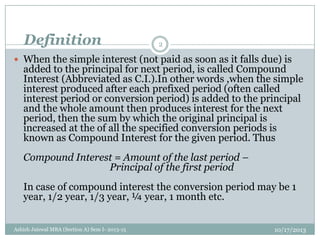
 When the simple interest (not paid as soon as it falls due) is
added to the principal for next period, is called Compound
Interest (Abbreviated as C.I.).In other words ,when the simple
interest produced after each prefixed period (often called
interest period or conversion period) is added to the principal
and the whole amount then produces interest for the next
period, then the sum by which the original principal is
increased at the of all the specified conversion periods is
known as Compound Interest for the given period. Thus
Compound Interest = Amount of the last period –
Principal of the first period
In case of compound interest the conversion period may be 1
year, 1/2 year, 1/3 year, ¼ year, 1 month etc.
10/17/2013Ashish Jaiswal MBA (Section A) Sem I- 2013-15
2
Formula Of Compound Interest
 The amount of Rs. P at R% per annum for n years is
obtained by the formula (often called the formula for
compound interest) given below:
Amount = Principal ,Symbolically, A = P
Compound Interest = A-P or P - P or P
where A= Amount, P= Principal, R= Rate, n= Time
Time
Rate
100
1
n
R
100
1
n
R
100
1 1
100
1
n
R
10/17/2013Ashish Jaiswal MBA (Section A) Sem I- 2013-15
3
Illustration 1
Find compound
interest of Rs.
10,000 at rate of
10% for three
years.
 Solution:
Amount = Principal
= 10,000
= 10,000
=10,000
=10,000 × 11/10 × 11/10 × 11/10 = Rs. 13,310
Compound Interest = Amount – Principal
= 13,310 – 10,000 = Rs. 3,310.
Time
Rate
100
1
3
100
10
1
3
10
1
1
3
10
11
10/17/2013Ashish Jaiswal MBA (Section A) Sem I- 2013-15
4
Illustration 2
When Anshu is
born Rs. 5,000 is
placed by his
mother in an
account that pays
interest at the rate
of 10% p.a.
Compound
interest. What
amount will there
be to his credit on
Anshu’s 18th
birthday?
 Solution:
Amount = Principal
A = P
A = 5,000
=5,000 on substitute the values
Taking logarithm on both sides
log A = log 5,000 + 18log 1.1
= 3.6990 + 18(.0414)
= 3.6990 + 0.7452 = 4.4442
A = antilog (4.4442) = 27,810
Amount to Anshu’s credit on his 18th birthday
= Rs. 27,810
Time
Rate
100
1
n
R
100
1
18
100
10
1
18
1.1
10/17/2013Ashish Jaiswal MBA (Section A) Sem I- 2013-15
5
To Compute Compound Interest when the number of
Conversion. Periods (Years, say) is not an integer:
 Method I
(i) Calculate Amount and/or compound interest for the whole
years by any method.
(ii) Assuming this amount as principal, find simple interest for the
rest fractional part at the same rate.
(iii) Add this interest to the amount obtained in (i) to get the final
amount.
(iv) Subtract original Principal from this final amount to compute
compound interest.
OR
Add the two interests [obtained in (i) and (ii) to find the required
compound interest and add this compound interest to the original
principal to find the required amount.
10/17/2013Ashish Jaiswal MBA (Section A) Sem I- 2013-15
6
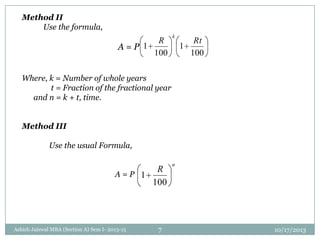
Method II
Use the formula,
A = P
Where, k = Number of whole years
t = Fraction of the fractional year
and n = k + t, time.
Method III
Use the usual Formula,
A = P
100
1
100
1
RtR
k
n
R
100
1
10/17/2013Ashish Jaiswal MBA (Section A) Sem I- 2013-15 7
Illustration
Find the
compound interest
on Rs. 2,500 in 2½
years at 4% p.a.
Compounded
annually. Find the
amount also.
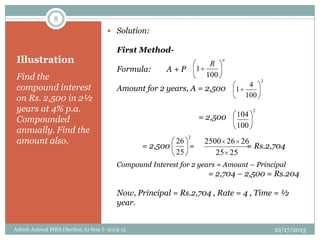
 Solution:
First Method-
Formula: A + P
Amount for 2 years, A = 2,500
= 2,500
= 2,500 = = Rs.2,704
Compound Interest for 2 years = Amount – Principal
= 2,704 – 2,500 = Rs.204
Now, Principal = Rs.2,704 , Rate = 4 , Time = ½
year.
n
R
100
1
2
100
4
1
2
100
104
2
25
26
2525
26262500
10/17/2013Ashish Jaiswal MBA (Section A) Sem I- 2013-15
8
Simple Interest = = = Rs. 54.08
Compound Interest for 2½ years = 204 + 54.08 = Rs.258.08
and Amount = P + C.I
= 2,500 + 258.08 = Rs.2,758.08
Second Method-
Formula: A + P
Where k = number of whole years = 2
t = fraction of the fractional year = ½
A = 2,500
= 2,500
= antilog [log 2,500 + 2 log (1.04) + log 1.02]
= antilog [3.3979 + 2(.0170) + .0086]
100
PRT
100
2/142704
100
1
100
1
RtR
k
100
2/14
1
100
4
1
2
02.104.1
2
10/17/2013Ashish Jaiswal MBA (Section A) Sem I- 2013-15 9
= antilog [3.3979 + .0340 + .0086]
A = antilog [3.4405] = 2,757
Compound Interest = A – P = 2,757 – 2,500 = Rs. 257
Third Method:
Formula: A = P
where P = 2,500 , R = 4 , n = 2½ = 5/2
=> A = 2,500 = 2,500
Taking logarithm on both sides,
log A = log 2,500 + 5/2 ( log 104 – log 100)
= 3.3979 + 5/2 (2.0170 – 2.0000)
= 3.3979 +
n
R
100
1
2/5
100
4
1
2/5
100
104
2
0170.5
10/17/2013Ashish Jaiswal MBA (Section A) Sem I- 2013-15 10
= 3.3979 + .0425 = 3.4404
A = antilog (3.4404) = Rs. 2,757
Compound Interest = A – P = 2,757 – 2,500 = Rs.257
Remark: The difference between the result of method I and method II is
due to the use of logarithm. In general, the method II should be
preferred.
10/17/2013Ashish Jaiswal MBA (Section A) Sem I- 2013-15 11
Computation of Compound Interest when interest is
compounded monthly, quarterly, half-yearly
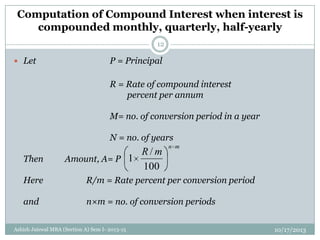
 Let P = Principal
R = Rate of compound interest
percent per annum
M= no. of conversion period in a year
N = no. of years
Then Amount, A= P
Here R/m = Rate percent per conversion period
and n×m = no. of conversion periods
mn
mR
100
/
1
10/17/2013Ashish Jaiswal MBA (Section A) Sem I- 2013-15
12
Illustration
Find the compound
Interest on Rs.1,200
@ 8% annually for
two years if:
1) the interest is
calculated
annually.
2)the interest is
calculated half-
yearly.
3) the interest is
calculated
quarterly.
4) the interest is
calculated monthly.
 Solution:
1) Interest is compounded annually:
A = P , where P = 1,200 , R = 8, n = 2
= 1,200
= 1,200 × = 1,200 ×
Using logarithm table,
log A = log 1,200 + (log 27 – log 25)
= 3.0792 + 2[1.4314 – 1.3979]
= 3.0792 + 2(.0335)
= 3.0792 + .0670 = 3.1462
A = antilog (3.1462) = Rs. 1,401
that is, Compound Interest = A – P = 1,401 – 1,200
= Rs. 201
n
R
100
1
2
100
8
1
2
100
108
2
25
27
10/17/2013Ashish Jaiswal MBA (Section A) Sem I- 2013-15
13
2) Interest is compounded half-yearly:
A = P , where Rate = R/2 = 8/2 = 4
Conversion Period = 2n = 2×2 = 4
=> A = 1,200
= 1,200
= 1,200
log A = log 1,200 + 4 log (1.04)1,200 =
= 3.0792 + 4(.0170)
= 3.0792 + .0680 = 3.1472
A = antilog (3.1472) = Rs. 1,404
Compound Interest = 1,404 – 1,200 = Rs.204
[ if = 1.16985865 then
A = 1,403.830272 = Rs. 1,403.83]
n
R
2
100
2/
1
4
100
4
1
4
04.1
4
04.1
4
04.1
10/17/2013Ashish Jaiswal MBA (Section A) Sem I- 2013-15 14
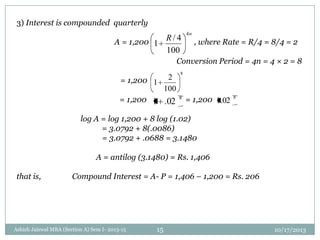
3) Interest is compounded quarterly
A = 1,200 , where Rate = R/4 = 8/4 = 2
Conversion Period = 4n = 4 × 2 = 8
= 1,200
= 1,200 = 1,200
log A = log 1,200 + 8 log (1.02)
= 3.0792 + 8(.0086)
= 3.0792 + .0688 = 3.1480
A = antilog (3.1480) = Rs. 1,406
that is, Compound Interest = A- P = 1,406 – 1,200 = Rs. 206
8
100
2
1
n
R
4
100
4/
1
8
02.1
8
02.1
10/17/2013Ashish Jaiswal MBA (Section A) Sem I- 2013-15 15
4) Interest is compounded monthly:
A = P , where Rate = R/12 = 8/12
Conversion Period = 12n = 12 × 2 = 24
=> A = 1,200
= 1,200
= 1,200 = 1,200
log A = log 1,200 + 24 [log 302 – log 300]
= 3.0792 + 24 [2.4800 = 2.4771]
A = 3.0792 + 24 [0.0029]
= 3.0792 + .0696 = 3.1488
A = antilog (3.1488) = Rs. 1,409
Compound Interest = A – P = 1,409 – 1,200 = Rs. 209
n
R
12
100
12/
1
24
100
12/8
1
24
10012
8
1
24
300
2
1
24
300
302
10/17/2013Ashish Jaiswal MBA (Section A) Sem I- 2013-15 16
Illustration
Find Compound
Interest of Rs.
10,000 for 2 years
@ 8% per annum
compounding
monthly.
 Solution:
Formula: Amount = Principal
Here Principal = 10,000
Time = 2 years = 2 × 12 months = 24 months
Rate = 8/12 per month
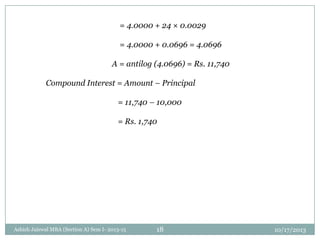
Amount, A = 10,000
= 10,000
= 10,000
log A = log (10,000) + 24 [log 151 – log 150]
= 4.0000 + 24[2.1790 – 2.1761]
time
Rate
100
1
24
100
12/8
1
24
100
12/8
1
24
150
151
10/17/2013Ashish Jaiswal MBA (Section A) Sem I- 2013-15
17
= 4.0000 + 24 × 0.0029
= 4.0000 + 0.0696 = 4.0696
A = antilog (4.0696) = Rs. 11,740
Compound Interest = Amount – Principal
= 11,740 – 10,000
= Rs. 1,740
10/17/2013Ashish Jaiswal MBA (Section A) Sem I- 2013-15 18
To Find The
Principal and
Rate
Illustration
A sum of money
given at
compound interest
becomes Rs. 2,420
in 2 years and Rs.
2,662 in 3 years.
Find the money
and rate of
interest.
 Solution:
Amount of 2 years = Rs. 2,420
Amount of 3 years = Rs. 2,662
Interest of third year = 2,662 – 2,420 = Rs. 242
Now Principal = Rs. 2,420 , Interest = Rs. 242, Rate
= R, Time = 1 year.
Formula: Rate = Simple Interest × 100/
Principal × Time
= 242 × 100/ 2,420 ×1 = 10
Again Principal = P, Time = 2 years, Rate = 10% p.a.,
Amount = Rs. 2,420
10/17/2013Ashish Jaiswal MBA (Section A) Sem I- 2013-15
19
Unsolved Illustration
A Father desires to distribute Rs. 51,783 amongst his two sons who are
respectively 12 and 15 years old, in such a way that the sums invested @
5% p.a. compound interest will give the same amount to both of them
When they attain the age of 18. How should he divide the sum?
Answer: 27,783
10/17/2013Ashish Jaiswal MBA (Section A) Sem I- 2013-15
20
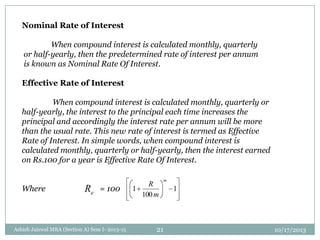
Nominal Rate of Interest
When compound interest is calculated monthly, quarterly
or half-yearly, then the predetermined rate of interest per annum
is known as Nominal Rate Of Interest.
Effective Rate of Interest
When compound interest is calculated monthly, quarterly or
half-yearly, the interest to the principal each time increases the
principal and accordingly the interest rate per annum will be more
than the usual rate. This new rate of interest is termed as Effective
Rate of Interest. In simple words, when compound interest is
calculated monthly, quarterly or half-yearly, then the interest earned
on Rs.100 for a year is Effective Rate Of Interest.
Where = 100eR 1
100
1
m
m
R
10/17/2013Ashish Jaiswal MBA (Section A) Sem I- 2013-15 21
Relationship between Effective and Nominal Rates
Let 1 + j = => j = - 1
where, i = nominal rate of interest per rupee per annum
m = the number of times interest is compounded in a year
and i + j = Amount of rupee 1 after one year
j = effective rate of interest per rupee per annum.
Remark 1: When compound interest is calculated yearly, the concept of
effective rate or ‘Nominal Rate’ does not arise.
Remark 2: The two rates of interest are said to be identical if the compound
interest is different conversion periods but after one year they
yield the same compound interest.
m
m
i
1
m
m
i
1
10/17/2013Ashish Jaiswal MBA (Section A) Sem I- 2013-15 22
Illustration
 Solution:
Interest on Rs. 100 for 1 year = Rs.4 .......(i)
Amount = 100 + 4 = Rs. 104
When interest is compounded quarterly, then
Amount = 100
Amount = 100 = 100
Amount = 100 = 100 × 1.041 = 104.10
( Using log tables)
Compound Interest = 104.10 – 100 = Rs. 4.10 .....(ii)
Thus, the effective rate of interest is 4.10% per
annum.
If nominal rate
of interest is 4%
per annum and
interest is
compounded
quarterly, then
find the
effective rate of
interest
41
100
4/4
1
4
10
1
1
4
100
101
4
01.1
10/17/2013Ashish Jaiswal MBA (Section A) Sem I- 2013-15
23

Compound Interest

  • 1.
    Compound Interest 10/17/2013Ashish JaiswalMBA (Section A) Sem I- 2013-15 1
  • 2.
    Definition  When thesimple interest (not paid as soon as it falls due) is added to the principal for next period, is called Compound Interest (Abbreviated as C.I.).In other words ,when the simple interest produced after each prefixed period (often called interest period or conversion period) is added to the principal and the whole amount then produces interest for the next period, then the sum by which the original principal is increased at the of all the specified conversion periods is known as Compound Interest for the given period. Thus Compound Interest = Amount of the last period – Principal of the first period In case of compound interest the conversion period may be 1 year, 1/2 year, 1/3 year, ¼ year, 1 month etc. 10/17/2013Ashish Jaiswal MBA (Section A) Sem I- 2013-15 2
  • 3.
    Formula Of CompoundInterest  The amount of Rs. P at R% per annum for n years is obtained by the formula (often called the formula for compound interest) given below: Amount = Principal ,Symbolically, A = P Compound Interest = A-P or P - P or P where A= Amount, P= Principal, R= Rate, n= Time Time Rate 100 1 n R 100 1 n R 100 1 1 100 1 n R 10/17/2013Ashish Jaiswal MBA (Section A) Sem I- 2013-15 3
  • 4.
    Illustration 1 Find compound interestof Rs. 10,000 at rate of 10% for three years.  Solution: Amount = Principal = 10,000 = 10,000 =10,000 =10,000 × 11/10 × 11/10 × 11/10 = Rs. 13,310 Compound Interest = Amount – Principal = 13,310 – 10,000 = Rs. 3,310. Time Rate 100 1 3 100 10 1 3 10 1 1 3 10 11 10/17/2013Ashish Jaiswal MBA (Section A) Sem I- 2013-15 4
  • 5.
    Illustration 2 When Anshuis born Rs. 5,000 is placed by his mother in an account that pays interest at the rate of 10% p.a. Compound interest. What amount will there be to his credit on Anshu’s 18th birthday?  Solution: Amount = Principal A = P A = 5,000 =5,000 on substitute the values Taking logarithm on both sides log A = log 5,000 + 18log 1.1 = 3.6990 + 18(.0414) = 3.6990 + 0.7452 = 4.4442 A = antilog (4.4442) = 27,810 Amount to Anshu’s credit on his 18th birthday = Rs. 27,810 Time Rate 100 1 n R 100 1 18 100 10 1 18 1.1 10/17/2013Ashish Jaiswal MBA (Section A) Sem I- 2013-15 5
  • 6.
    To Compute CompoundInterest when the number of Conversion. Periods (Years, say) is not an integer:  Method I (i) Calculate Amount and/or compound interest for the whole years by any method. (ii) Assuming this amount as principal, find simple interest for the rest fractional part at the same rate. (iii) Add this interest to the amount obtained in (i) to get the final amount. (iv) Subtract original Principal from this final amount to compute compound interest. OR Add the two interests [obtained in (i) and (ii) to find the required compound interest and add this compound interest to the original principal to find the required amount. 10/17/2013Ashish Jaiswal MBA (Section A) Sem I- 2013-15 6
  • 7.
    Method II Use theformula, A = P Where, k = Number of whole years t = Fraction of the fractional year and n = k + t, time. Method III Use the usual Formula, A = P 100 1 100 1 RtR k n R 100 1 10/17/2013Ashish Jaiswal MBA (Section A) Sem I- 2013-15 7
  • 8.
    Illustration Find the compound interest onRs. 2,500 in 2½ years at 4% p.a. Compounded annually. Find the amount also.  Solution: First Method- Formula: A + P Amount for 2 years, A = 2,500 = 2,500 = 2,500 = = Rs.2,704 Compound Interest for 2 years = Amount – Principal = 2,704 – 2,500 = Rs.204 Now, Principal = Rs.2,704 , Rate = 4 , Time = ½ year. n R 100 1 2 100 4 1 2 100 104 2 25 26 2525 26262500 10/17/2013Ashish Jaiswal MBA (Section A) Sem I- 2013-15 8
  • 9.
    Simple Interest == = Rs. 54.08 Compound Interest for 2½ years = 204 + 54.08 = Rs.258.08 and Amount = P + C.I = 2,500 + 258.08 = Rs.2,758.08 Second Method- Formula: A + P Where k = number of whole years = 2 t = fraction of the fractional year = ½ A = 2,500 = 2,500 = antilog [log 2,500 + 2 log (1.04) + log 1.02] = antilog [3.3979 + 2(.0170) + .0086] 100 PRT 100 2/142704 100 1 100 1 RtR k 100 2/14 1 100 4 1 2 02.104.1 2 10/17/2013Ashish Jaiswal MBA (Section A) Sem I- 2013-15 9
  • 10.
    = antilog [3.3979+ .0340 + .0086] A = antilog [3.4405] = 2,757 Compound Interest = A – P = 2,757 – 2,500 = Rs. 257 Third Method: Formula: A = P where P = 2,500 , R = 4 , n = 2½ = 5/2 => A = 2,500 = 2,500 Taking logarithm on both sides, log A = log 2,500 + 5/2 ( log 104 – log 100) = 3.3979 + 5/2 (2.0170 – 2.0000) = 3.3979 + n R 100 1 2/5 100 4 1 2/5 100 104 2 0170.5 10/17/2013Ashish Jaiswal MBA (Section A) Sem I- 2013-15 10
  • 11.
    = 3.3979 +.0425 = 3.4404 A = antilog (3.4404) = Rs. 2,757 Compound Interest = A – P = 2,757 – 2,500 = Rs.257 Remark: The difference between the result of method I and method II is due to the use of logarithm. In general, the method II should be preferred. 10/17/2013Ashish Jaiswal MBA (Section A) Sem I- 2013-15 11
  • 12.
    Computation of CompoundInterest when interest is compounded monthly, quarterly, half-yearly  Let P = Principal R = Rate of compound interest percent per annum M= no. of conversion period in a year N = no. of years Then Amount, A= P Here R/m = Rate percent per conversion period and n×m = no. of conversion periods mn mR 100 / 1 10/17/2013Ashish Jaiswal MBA (Section A) Sem I- 2013-15 12
  • 13.
    Illustration Find the compound Intereston Rs.1,200 @ 8% annually for two years if: 1) the interest is calculated annually. 2)the interest is calculated half- yearly. 3) the interest is calculated quarterly. 4) the interest is calculated monthly.  Solution: 1) Interest is compounded annually: A = P , where P = 1,200 , R = 8, n = 2 = 1,200 = 1,200 × = 1,200 × Using logarithm table, log A = log 1,200 + (log 27 – log 25) = 3.0792 + 2[1.4314 – 1.3979] = 3.0792 + 2(.0335) = 3.0792 + .0670 = 3.1462 A = antilog (3.1462) = Rs. 1,401 that is, Compound Interest = A – P = 1,401 – 1,200 = Rs. 201 n R 100 1 2 100 8 1 2 100 108 2 25 27 10/17/2013Ashish Jaiswal MBA (Section A) Sem I- 2013-15 13
  • 14.
    2) Interest iscompounded half-yearly: A = P , where Rate = R/2 = 8/2 = 4 Conversion Period = 2n = 2×2 = 4 => A = 1,200 = 1,200 = 1,200 log A = log 1,200 + 4 log (1.04)1,200 = = 3.0792 + 4(.0170) = 3.0792 + .0680 = 3.1472 A = antilog (3.1472) = Rs. 1,404 Compound Interest = 1,404 – 1,200 = Rs.204 [ if = 1.16985865 then A = 1,403.830272 = Rs. 1,403.83] n R 2 100 2/ 1 4 100 4 1 4 04.1 4 04.1 4 04.1 10/17/2013Ashish Jaiswal MBA (Section A) Sem I- 2013-15 14
  • 15.
    3) Interest iscompounded quarterly A = 1,200 , where Rate = R/4 = 8/4 = 2 Conversion Period = 4n = 4 × 2 = 8 = 1,200 = 1,200 = 1,200 log A = log 1,200 + 8 log (1.02) = 3.0792 + 8(.0086) = 3.0792 + .0688 = 3.1480 A = antilog (3.1480) = Rs. 1,406 that is, Compound Interest = A- P = 1,406 – 1,200 = Rs. 206 8 100 2 1 n R 4 100 4/ 1 8 02.1 8 02.1 10/17/2013Ashish Jaiswal MBA (Section A) Sem I- 2013-15 15
  • 16.
    4) Interest iscompounded monthly: A = P , where Rate = R/12 = 8/12 Conversion Period = 12n = 12 × 2 = 24 => A = 1,200 = 1,200 = 1,200 = 1,200 log A = log 1,200 + 24 [log 302 – log 300] = 3.0792 + 24 [2.4800 = 2.4771] A = 3.0792 + 24 [0.0029] = 3.0792 + .0696 = 3.1488 A = antilog (3.1488) = Rs. 1,409 Compound Interest = A – P = 1,409 – 1,200 = Rs. 209 n R 12 100 12/ 1 24 100 12/8 1 24 10012 8 1 24 300 2 1 24 300 302 10/17/2013Ashish Jaiswal MBA (Section A) Sem I- 2013-15 16
  • 17.
    Illustration Find Compound Interest ofRs. 10,000 for 2 years @ 8% per annum compounding monthly.  Solution: Formula: Amount = Principal Here Principal = 10,000 Time = 2 years = 2 × 12 months = 24 months Rate = 8/12 per month Amount, A = 10,000 = 10,000 = 10,000 log A = log (10,000) + 24 [log 151 – log 150] = 4.0000 + 24[2.1790 – 2.1761] time Rate 100 1 24 100 12/8 1 24 100 12/8 1 24 150 151 10/17/2013Ashish Jaiswal MBA (Section A) Sem I- 2013-15 17
  • 18.
    = 4.0000 +24 × 0.0029 = 4.0000 + 0.0696 = 4.0696 A = antilog (4.0696) = Rs. 11,740 Compound Interest = Amount – Principal = 11,740 – 10,000 = Rs. 1,740 10/17/2013Ashish Jaiswal MBA (Section A) Sem I- 2013-15 18
  • 19.
    To Find The Principaland Rate Illustration A sum of money given at compound interest becomes Rs. 2,420 in 2 years and Rs. 2,662 in 3 years. Find the money and rate of interest.  Solution: Amount of 2 years = Rs. 2,420 Amount of 3 years = Rs. 2,662 Interest of third year = 2,662 – 2,420 = Rs. 242 Now Principal = Rs. 2,420 , Interest = Rs. 242, Rate = R, Time = 1 year. Formula: Rate = Simple Interest × 100/ Principal × Time = 242 × 100/ 2,420 ×1 = 10 Again Principal = P, Time = 2 years, Rate = 10% p.a., Amount = Rs. 2,420 10/17/2013Ashish Jaiswal MBA (Section A) Sem I- 2013-15 19
  • 20.
    Unsolved Illustration A Fatherdesires to distribute Rs. 51,783 amongst his two sons who are respectively 12 and 15 years old, in such a way that the sums invested @ 5% p.a. compound interest will give the same amount to both of them When they attain the age of 18. How should he divide the sum? Answer: 27,783 10/17/2013Ashish Jaiswal MBA (Section A) Sem I- 2013-15 20
  • 21.
    Nominal Rate ofInterest When compound interest is calculated monthly, quarterly or half-yearly, then the predetermined rate of interest per annum is known as Nominal Rate Of Interest. Effective Rate of Interest When compound interest is calculated monthly, quarterly or half-yearly, the interest to the principal each time increases the principal and accordingly the interest rate per annum will be more than the usual rate. This new rate of interest is termed as Effective Rate of Interest. In simple words, when compound interest is calculated monthly, quarterly or half-yearly, then the interest earned on Rs.100 for a year is Effective Rate Of Interest. Where = 100eR 1 100 1 m m R 10/17/2013Ashish Jaiswal MBA (Section A) Sem I- 2013-15 21
  • 22.
    Relationship between Effectiveand Nominal Rates Let 1 + j = => j = - 1 where, i = nominal rate of interest per rupee per annum m = the number of times interest is compounded in a year and i + j = Amount of rupee 1 after one year j = effective rate of interest per rupee per annum. Remark 1: When compound interest is calculated yearly, the concept of effective rate or ‘Nominal Rate’ does not arise. Remark 2: The two rates of interest are said to be identical if the compound interest is different conversion periods but after one year they yield the same compound interest. m m i 1 m m i 1 10/17/2013Ashish Jaiswal MBA (Section A) Sem I- 2013-15 22
  • 23.
    Illustration  Solution: Interest onRs. 100 for 1 year = Rs.4 .......(i) Amount = 100 + 4 = Rs. 104 When interest is compounded quarterly, then Amount = 100 Amount = 100 = 100 Amount = 100 = 100 × 1.041 = 104.10 ( Using log tables) Compound Interest = 104.10 – 100 = Rs. 4.10 .....(ii) Thus, the effective rate of interest is 4.10% per annum. If nominal rate of interest is 4% per annum and interest is compounded quarterly, then find the effective rate of interest 41 100 4/4 1 4 10 1 1 4 100 101 4 01.1 10/17/2013Ashish Jaiswal MBA (Section A) Sem I- 2013-15 23