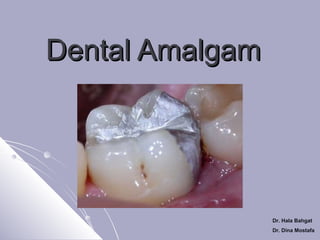
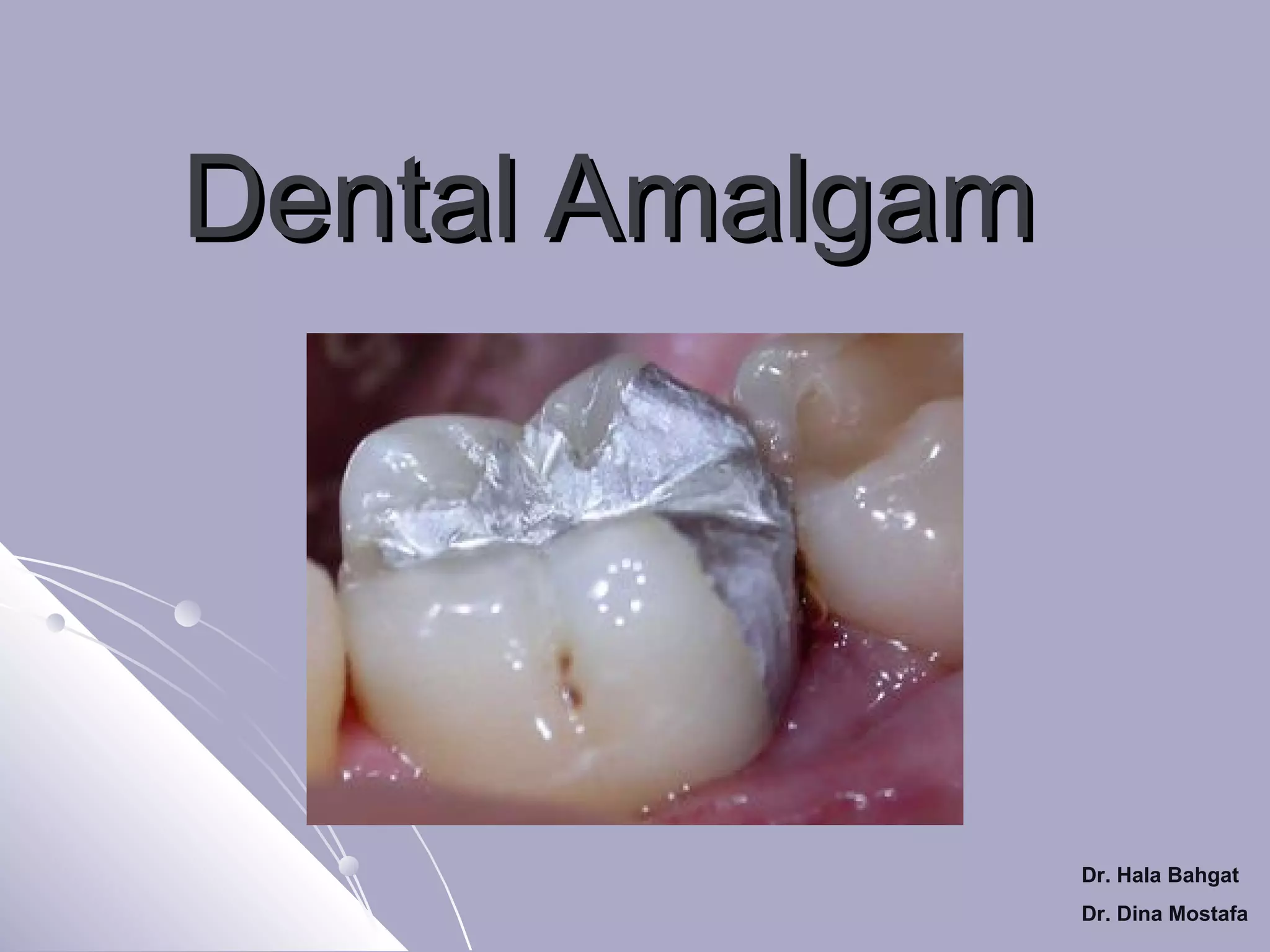
Dental Amalgam

Dr. Hala Bahgat
Dr. Dina Mostafa
Amalgam:
Any alloy + Mercury (Hg)

Dental Amalgam:
Dental alloy + Mercury (Hg)

Alloy for Dental Amalgam :
Alloy powder used in dental amalgam
Ag , Sn , Cu

and

Zn

Amalgamation reaction:
Chemical reaction between dental alloy and mercury at room
Dr. Hala Bahgat
temperature
Dr. Dina Mostafa
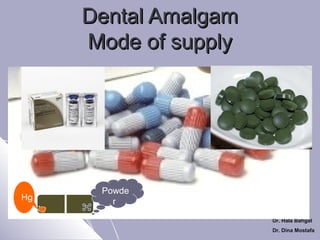
Dental Amalgam
Mode of supply

Hg

Powde
r
Dr. Hala Bahgat
Dr. Dina Mostafa
Dental Amalgam
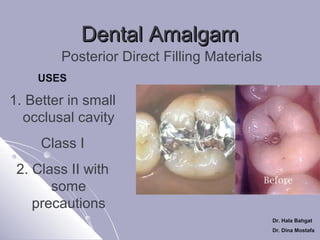
Posterior Direct Filling Materials
USES

1. Better in small
occlusal cavity
Class I
2. Class II with
some
precautions
Dr. Hala Bahgat
Dr. Dina Mostafa
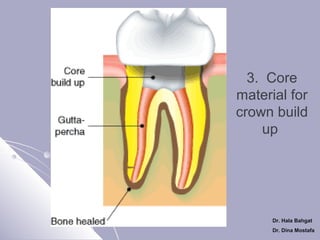
3. Core
material for
crown build
up

Dr. Hala Bahgat
Dr. Dina Mostafa
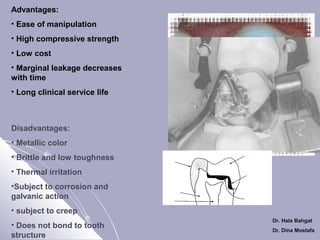
Advantages:
• Ease of manipulation
• High compressive strength
• Low cost
• Marginal leakage decreases
with time
• Long clinical service life

Disadvantages:
• Metallic color
• Brittle and low toughness
• Thermal irritation
•Subject to corrosion and
galvanic action
• subject to creep
• Does not bond to tooth
structure

Dr. Hala Bahgat
Dr. Dina Mostafa
Dr. Hala Bahgat
Dr. Dina Mostafa
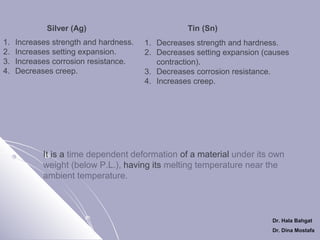
Silver (Ag)
1.
2.
3.
4.

Increases strength and hardness.
Increases setting expansion.
Increases corrosion resistance.
Decreases creep.

Tin (Sn)
1. Decreases strength and hardness.
2. Decreases setting expansion (causes
contraction).
3. Decreases corrosion resistance.
4. Increases creep.

It is a time dependent deformation of a material under its own
weight (below P.L.), having its melting temperature near the
ambient temperature.

Dr. Hala Bahgat
Dr. Dina Mostafa
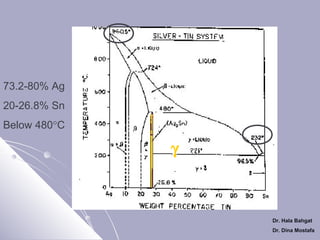
73.2-80% Ag
20-26.8% Sn
Below 480°C

γ

Dr. Hala Bahgat
Dr. Dina Mostafa
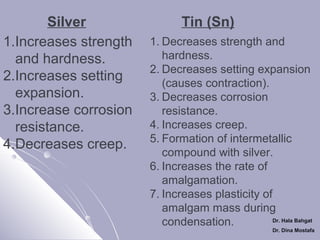
Silver
1.Increases strength
and hardness.
2.Increases setting
expansion.
3.Increase corrosion
resistance.
4.Decreases creep.

Tin (Sn)
1. Decreases strength and
hardness.
2. Decreases setting expansion
(causes contraction).
3. Decreases corrosion
resistance.
4. Increases creep.
5. Formation of intermetallic
compound with silver.
6. Increases the rate of
amalgamation.
7. Increases plasticity of
amalgam mass during
Dr. Hala Bahgat
condensation.

Dr. Dina Mostafa
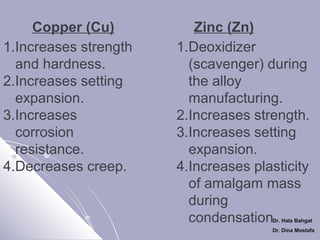
Copper (Cu)
1.Increases strength
and hardness.
2.Increases setting
expansion.
3.Increases
corrosion
resistance.
4.Decreases creep.

Zinc (Zn)
1.Deoxidizer
(scavenger) during
the alloy
manufacturing.
2.Increases strength.
3.Increases setting
expansion.
4.Increases plasticity
of amalgam mass
during
condensation.

Dr. Hala Bahgat
Dr. Dina Mostafa
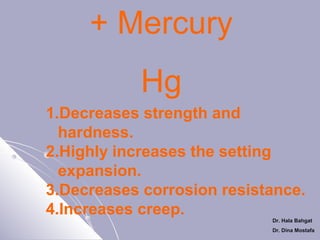
+ Mercury
Hg
1.Decreases strength and
hardness.
2.Highly increases the setting
expansion.
3.Decreases corrosion resistance.
4.Increases creep.

Dr. Hala Bahgat
Dr. Dina Mostafa
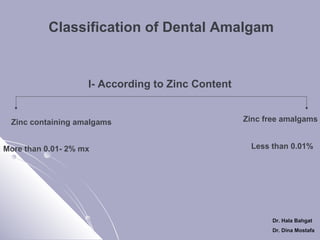
Classification of Dental Amalgam

I- According to Zinc Content

Zinc containing amalgams
More than 0.01- 2% mx

Zinc free amalgams
Less than 0.01%

Dr. Hala Bahgat
Dr. Dina Mostafa
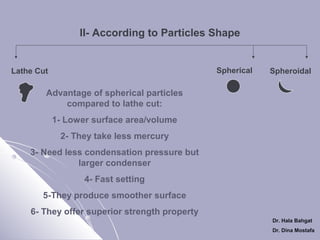
II- According to Particles Shape

Spherical

Lathe Cut

Spheroidal

Advantage of spherical particles
compared to lathe cut:
1- Lower surface area/volume
2- They take less mercury
3- Need less condensation pressure but
larger condenser
4- Fast setting
5-They produce smoother surface
6- They offer superior strength property
Dr. Hala Bahgat
Dr. Dina Mostafa
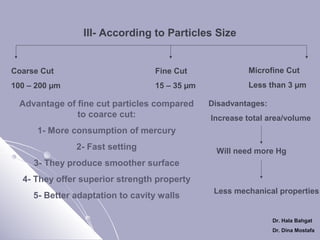
III- According to Particles Size

Coarse Cut

Fine Cut

Microfine Cut

100 – 200 µm

15 – 35 µm

Less than 3 µm

Advantage of fine cut particles compared
to coarce cut:

Disadvantages:
Increase total area/volume

1- More consumption of mercury
2- Fast setting

Will need more Hg

3- They produce smoother surface
4- They offer superior strength property
5- Better adaptation to cavity walls

Less mechanical properties

Dr. Hala Bahgat
Dr. Dina Mostafa
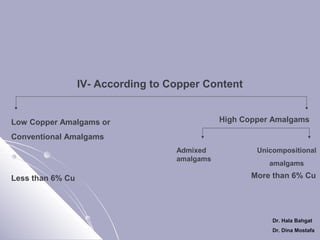
IV- According to Copper Content
High Copper Amalgams

Low Copper Amalgams or
Conventional Amalgams
Admixed
amalgams

Less than 6% Cu

Unicompositional
amalgams

More than 6% Cu

Dr. Hala Bahgat
Dr. Dina Mostafa
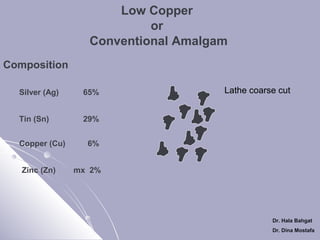
Low Copper
or
Conventional Amalgam
Composition
Silver (Ag)

65%

Tin (Sn)

Lathe coarse cut

29%

Copper (Cu)
Zinc (Zn)

6%
mx 2%

Dr. Hala Bahgat
Dr. Dina Mostafa
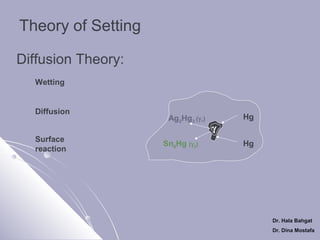
Theory of Setting
Diffusion Theory:
Wetting

Diffusion
Surface
reaction

Ag2Hg3 (γ 1)
Sn8Hg (γ 2)

Hg

γ
Hg

Dr. Hala Bahgat
Dr. Dina Mostafa
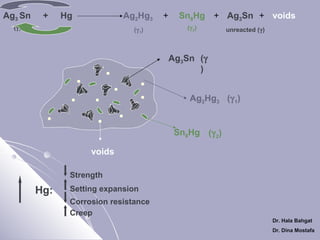
Ag3 Sn

+

Hg

Ag2Hg3

(γ)

(γ 1)

+

Sn8Hg + Ag3Sn + voids
(γ 2)

unreacted (γ)

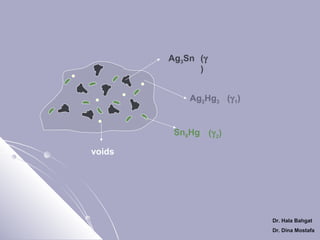
Ag3Sn (γ
)
Ag2Hg3 (γ 1)

Sn8Hg (γ 2)
voids
Strength

Hg:

Setting expansion
Corrosion resistance
Creep
Dr. Hala Bahgat
Dr. Dina Mostafa
Ag3Sn (γ
)
Ag2Hg3 (γ 1)

Sn8Hg (γ 2)
voids

Dr. Hala Bahgat
Dr. Dina Mostafa
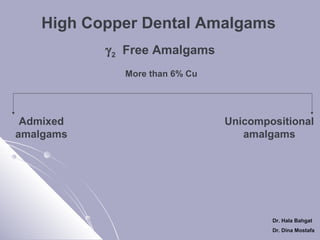
High Copper Dental Amalgams
γ 2 Free Amalgams
More than 6% Cu

Admixed
amalgams

Unicompositional
amalgams

Dr. Hala Bahgat
Dr. Dina Mostafa
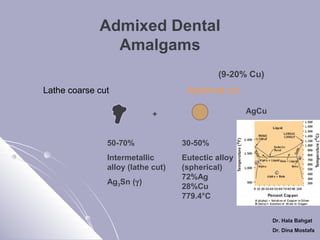
Admixed Dental
Amalgams
(9-20% Cu)
Lathe coarse cut

Spherical cut
AgCu

+
50-70%

30-50%

Intermetallic
alloy (lathe cut)

Eutectic alloy
(spherical)
72%Ag
28%Cu
779.4°C

Ag3Sn (γ)

Dr. Hala Bahgat
Dr. Dina Mostafa
Setting Reactions of Admixed Amalgam
1- Dissolution of mercury in the alloy powder
[Ag3Sn+ Ag - Cu] + Hg → Ag2Hg3
γ
(eutectic)
(γ )

+ Sn8Hg + [Ag3Sn+ Ag - Cu] + voids
(γ 2)

1

Ag3Sn
Cu6Sn5

(γ
)

Ag2Hg3

(γ 1)

AgCu

Sn8Hg (γ 2)
voids

2- Elimination of γ 2 (Solid State Reaction)

Ag – Cu +

Sn8Hg
(γ 2)

Cu6Sn5 + Ag2Hg3 + Ag-cu unreacted + voids
η
(γ 1)
(eutectic)

Dr. Hala Bahgat
Dr. Dina Mostafa
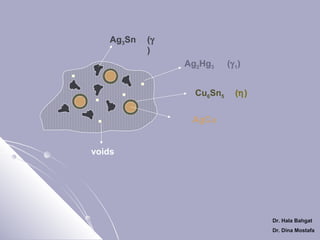
Ag3Sn

(γ
)
Ag2Hg3
Cu6Sn5

(γ 1)
(η)

AgCu
voids

Dr. Hala Bahgat
Dr. Dina Mostafa
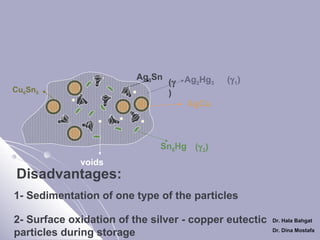
Ag3Sn
Cu6Sn5

(γ
)

Ag2Hg3

(γ 1)

AgCu

Sn8Hg (γ 2)
voids

Disadvantages:
1- Sedimentation of one type of the particles
2- Surface oxidation of the silver - copper eutectic
particles during storage

Dr. Hala Bahgat
Dr. Dina Mostafa
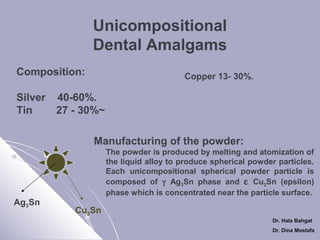
Unicompositional
Dental Amalgams
Composition:
Silver
Tin

Copper 13- 30%.

40-60%.
27 - 30%~
Manufacturing of the powder:
The powder is produced by melting and atomization of
the liquid alloy to produce spherical powder particles.
Each unicompositional spherical powder particle is
composed of γ Ag3Sn phase and ε Cu3Sn (epsilon)
phase which is concentrated near the particle surface.

Ag3Sn

Cu3Sn
Dr. Hala Bahgat
Dr. Dina Mostafa
Setting Reaction
[Ag3Sn + Cu3Sn] +

ε

γ

Hg → Ag2Hg3 + Cu6Sn5+ Unreacted Ag Sn + voids
3

Cu6Sn5 γ 1

η

γ

Cu3Sn

Ag2Hg3 (γ 1)

Ag3Sn

Strength

Voids

Corrosion resistance
Creep
Dr. Hala Bahgat
Dr. Dina Mostafa
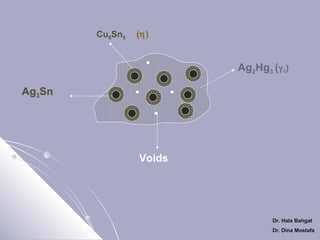
Cu6Sn5

(η)

Ag2Hg3 (γ 1)
Ag3Sn

Voids

Dr. Hala Bahgat
Dr. Dina Mostafa

Amalgum I

  • 1.
    Dental Amalgam Dr. HalaBahgat Dr. Dina Mostafa
  • 2.
    Amalgam: Any alloy +Mercury (Hg) Dental Amalgam: Dental alloy + Mercury (Hg) Alloy for Dental Amalgam : Alloy powder used in dental amalgam Ag , Sn , Cu and Zn Amalgamation reaction: Chemical reaction between dental alloy and mercury at room Dr. Hala Bahgat temperature Dr. Dina Mostafa
  • 3.
    Dental Amalgam Mode ofsupply Hg Powde r Dr. Hala Bahgat Dr. Dina Mostafa
  • 4.
    Dental Amalgam Posterior DirectFilling Materials USES 1. Better in small occlusal cavity Class I 2. Class II with some precautions Dr. Hala Bahgat Dr. Dina Mostafa
  • 5.
    3. Core material for crownbuild up Dr. Hala Bahgat Dr. Dina Mostafa
  • 6.
    Advantages: • Ease ofmanipulation • High compressive strength • Low cost • Marginal leakage decreases with time • Long clinical service life Disadvantages: • Metallic color • Brittle and low toughness • Thermal irritation •Subject to corrosion and galvanic action • subject to creep • Does not bond to tooth structure Dr. Hala Bahgat Dr. Dina Mostafa
  • 7.
    Dr. Hala Bahgat Dr.Dina Mostafa
  • 8.
    Silver (Ag) 1. 2. 3. 4. Increases strengthand hardness. Increases setting expansion. Increases corrosion resistance. Decreases creep. Tin (Sn) 1. Decreases strength and hardness. 2. Decreases setting expansion (causes contraction). 3. Decreases corrosion resistance. 4. Increases creep. It is a time dependent deformation of a material under its own weight (below P.L.), having its melting temperature near the ambient temperature. Dr. Hala Bahgat Dr. Dina Mostafa
  • 9.
    73.2-80% Ag 20-26.8% Sn Below480°C γ Dr. Hala Bahgat Dr. Dina Mostafa
  • 10.
    Silver 1.Increases strength and hardness. 2.Increasessetting expansion. 3.Increase corrosion resistance. 4.Decreases creep. Tin (Sn) 1. Decreases strength and hardness. 2. Decreases setting expansion (causes contraction). 3. Decreases corrosion resistance. 4. Increases creep. 5. Formation of intermetallic compound with silver. 6. Increases the rate of amalgamation. 7. Increases plasticity of amalgam mass during Dr. Hala Bahgat condensation. Dr. Dina Mostafa
  • 11.
    Copper (Cu) 1.Increases strength andhardness. 2.Increases setting expansion. 3.Increases corrosion resistance. 4.Decreases creep. Zinc (Zn) 1.Deoxidizer (scavenger) during the alloy manufacturing. 2.Increases strength. 3.Increases setting expansion. 4.Increases plasticity of amalgam mass during condensation. Dr. Hala Bahgat Dr. Dina Mostafa
  • 12.
    + Mercury Hg 1.Decreases strengthand hardness. 2.Highly increases the setting expansion. 3.Decreases corrosion resistance. 4.Increases creep. Dr. Hala Bahgat Dr. Dina Mostafa
  • 13.
    Classification of DentalAmalgam I- According to Zinc Content Zinc containing amalgams More than 0.01- 2% mx Zinc free amalgams Less than 0.01% Dr. Hala Bahgat Dr. Dina Mostafa
  • 14.
    II- According toParticles Shape Spherical Lathe Cut Spheroidal Advantage of spherical particles compared to lathe cut: 1- Lower surface area/volume 2- They take less mercury 3- Need less condensation pressure but larger condenser 4- Fast setting 5-They produce smoother surface 6- They offer superior strength property Dr. Hala Bahgat Dr. Dina Mostafa
  • 15.
    III- According toParticles Size Coarse Cut Fine Cut Microfine Cut 100 – 200 µm 15 – 35 µm Less than 3 µm Advantage of fine cut particles compared to coarce cut: Disadvantages: Increase total area/volume 1- More consumption of mercury 2- Fast setting Will need more Hg 3- They produce smoother surface 4- They offer superior strength property 5- Better adaptation to cavity walls Less mechanical properties Dr. Hala Bahgat Dr. Dina Mostafa
  • 16.
    IV- According toCopper Content High Copper Amalgams Low Copper Amalgams or Conventional Amalgams Admixed amalgams Less than 6% Cu Unicompositional amalgams More than 6% Cu Dr. Hala Bahgat Dr. Dina Mostafa
  • 17.
    Low Copper or Conventional Amalgam Composition Silver(Ag) 65% Tin (Sn) Lathe coarse cut 29% Copper (Cu) Zinc (Zn) 6% mx 2% Dr. Hala Bahgat Dr. Dina Mostafa
  • 18.
    Theory of Setting DiffusionTheory: Wetting Diffusion Surface reaction Ag2Hg3 (γ 1) Sn8Hg (γ 2) Hg γ Hg Dr. Hala Bahgat Dr. Dina Mostafa
  • 19.
    Ag3 Sn + Hg Ag2Hg3 (γ) (γ 1) + Sn8Hg+ Ag3Sn + voids (γ 2) unreacted (γ) Ag3Sn (γ ) Ag2Hg3 (γ 1) Sn8Hg (γ 2) voids Strength Hg: Setting expansion Corrosion resistance Creep Dr. Hala Bahgat Dr. Dina Mostafa
  • 20.
    Ag3Sn (γ ) Ag2Hg3 (γ1) Sn8Hg (γ 2) voids Dr. Hala Bahgat Dr. Dina Mostafa
  • 21.
    High Copper DentalAmalgams γ 2 Free Amalgams More than 6% Cu Admixed amalgams Unicompositional amalgams Dr. Hala Bahgat Dr. Dina Mostafa
  • 22.
    Admixed Dental Amalgams (9-20% Cu) Lathecoarse cut Spherical cut AgCu + 50-70% 30-50% Intermetallic alloy (lathe cut) Eutectic alloy (spherical) 72%Ag 28%Cu 779.4°C Ag3Sn (γ) Dr. Hala Bahgat Dr. Dina Mostafa
  • 23.
    Setting Reactions ofAdmixed Amalgam 1- Dissolution of mercury in the alloy powder [Ag3Sn+ Ag - Cu] + Hg → Ag2Hg3 γ (eutectic) (γ ) + Sn8Hg + [Ag3Sn+ Ag - Cu] + voids (γ 2) 1 Ag3Sn Cu6Sn5 (γ ) Ag2Hg3 (γ 1) AgCu Sn8Hg (γ 2) voids 2- Elimination of γ 2 (Solid State Reaction) Ag – Cu + Sn8Hg (γ 2) Cu6Sn5 + Ag2Hg3 + Ag-cu unreacted + voids η (γ 1) (eutectic) Dr. Hala Bahgat Dr. Dina Mostafa
  • 24.
  • 25.
    Ag3Sn Cu6Sn5 (γ ) Ag2Hg3 (γ 1) AgCu Sn8Hg (γ2) voids Disadvantages: 1- Sedimentation of one type of the particles 2- Surface oxidation of the silver - copper eutectic particles during storage Dr. Hala Bahgat Dr. Dina Mostafa
  • 26.
    Unicompositional Dental Amalgams Composition: Silver Tin Copper 13-30%. 40-60%. 27 - 30%~ Manufacturing of the powder: The powder is produced by melting and atomization of the liquid alloy to produce spherical powder particles. Each unicompositional spherical powder particle is composed of γ Ag3Sn phase and ε Cu3Sn (epsilon) phase which is concentrated near the particle surface. Ag3Sn Cu3Sn Dr. Hala Bahgat Dr. Dina Mostafa
  • 27.
    Setting Reaction [Ag3Sn +Cu3Sn] + ε γ Hg → Ag2Hg3 + Cu6Sn5+ Unreacted Ag Sn + voids 3 Cu6Sn5 γ 1 η γ Cu3Sn Ag2Hg3 (γ 1) Ag3Sn Strength Voids Corrosion resistance Creep Dr. Hala Bahgat Dr. Dina Mostafa
  • 28.
    Cu6Sn5 (η) Ag2Hg3 (γ 1) Ag3Sn Voids Dr.Hala Bahgat Dr. Dina Mostafa