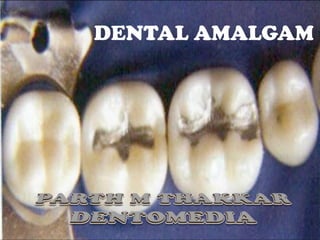




DENTAL AMALGAM
DEFINITION

“Amalgam is a special type of alloy in
    which mercury is one of the
            component”
   Mercury is liquid at room temperature , it
    reacts with other metals that are in solid
    state, to form a plastic mass, which can be
    conveniently packed into a prepared
    tooth preparation. This plastic mass
    hardens by the formation of solid reaction
    product phases.
INDICATIONS
   As a permanent restorative material in
    class I, class II, class V, class VI caries
   Cuspal restorations
   Pin retained restorations
   As a foundation
   Post-endodontic access filling and core
   Die preparation
   Retrograde root canal filling material
   Teeth with questionable prognosis
    (interim restoration)
   Economic status
CONTRAINDICATIONS

   Esthetics
   Extensive loss of tooth structure
   Small class I and class II cavities
ADVANTAGES
   Ease of use
   High compressive strength
   Excellent wear resistance
   Favorable long-term clinical results
   Economic
   Can be bonded to tooth structure
   Self-sealing ability
DISADVANTAGES

   Lack of esthetics
   Less conservative
   Non-insulating
   Corrosion and galvanism
   Lack of reinforcement of weakened tooth
    structure
   Difficulty in restoring proper tooth
    anatomy
COMPOSITION
   (I) LOW COPPER ALLOYS:
        Silver -- 63-70%
        Tin     -- 26-28%
        Copper -- 2-5%
        Zinc-- 0 -2%

              Setting reaction :
    Ag3Sn + Hg = Ag2Hg3 + Sn8Hg+ Ag3Sn
                               (unreacted)
   (II) HIGH COPPER ALLOYS :
         Silver -- 69%
         Tin    -- 17%
         Copper -- 13%
         Zinc   -- 1%

                Setting reaction :
    Ag3Sn + Ag-Cu + Hg = Ag2Hg + Sn8Hg
    +Ag3Sn (unreacted)
CLASSIFICATION
Based on copper content :
 Low copper alloy -- < 6% copper
  (conventional alloy)
 High copper -- 6-30% copper
  (1) admixed alloy
  (2) single composition alloy

Based on zinc content :
    (1) zinc containing alloy -- > 0.01% zinc
    (2) zinc free alloy -- < 0.01 zinc
Based on shape of alloy particles :
(1) lathe cut alloy
(2) spherical alloy
(3) admixed alloy


Based on size of alloy particles :
(1) microcut
(2) fine-cut
(3) coarse-cut
Based on number of alloy metals :
  (1) binary alloy (silver-tin)
  (2) ternary alloy (silver-tin-copper)
  (3) quaternary alloy
      (silver-tin-copper-indium)

 Based on presence of noble metals
  :
(1) noble metal alloys (palladium,
 platinum, gold)
  (2) non-noble metal alloys
   Based on the generations :
    (1) Basic silver-tin alloy
    (2) Low copper alloys (silver, tin, copper and
    zinc, Cu<4%)
    (3) High copper alloys (admixed alloys)
    (4) High copper alloys (single composition
    alloys)
    (5) Gallium based alloys
    (6) Noble metal alloys
FUNCTION OF EACH CONSTITUENT

              SILVER
           Whitens the alloy
            Decreases creep
          Increases strength
   Increases the expantion on setting
     Increases resistance to tarnis
TIN
Reduce tarnish and corrosion
Reduce strength and hardness


            COPPER
Increases hardness and strength
  Increases setting expansion
ZINC
 Acts as a deoxidizer and scavenger
Causes delayed expansion in amalgam
PROPERTIES
      DIMENSIONAL CHANGES :
   Most modern amalgams exhibit a very minor
    degree of contraction or expansion on
    hardening if they are properly handled
    By ensuring proper mercury
    content, plasticity of the mix, good
    condensation, burnishing, the amalgam can
    be well adapted to the prepared cavity
    Excessive contraction can lead to
    microleakage and secondary caries
    Excessive expansion can produce pressure on
    the pulp and post-operative sensitivity,or
    protrusion of restoration
Excessive delayed expansion can occur if a
zinc-containing amalgam is contaminated
by saliva or moisture during trituration
or condensation
This delayed expansion can start 3-5days
after the restoration is placed and
continue for several months
(400micronm)
Zn+H2O=ZnO+H2(gas)
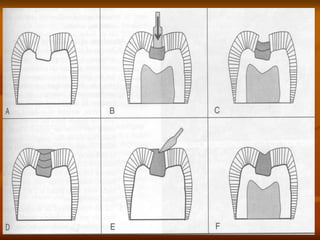
MICROLEAKAGE :

Dental amalgam has a tendency to
 minimize microleakage
If the restoration is properly
 inserted, leakage decreases as the
 restoration ages in the mouth
This is due to the formation of corrosion
 products which forms at the interface
 between the tooth and the restoration.
 (copper and tin corrosion products)
This corrosion products seals the interface
 and prevent the microleakage
STRENGTH
Exhibits high compressive strength and
poor tensile and shear strength
Compressive strength – 380 to 550 Mpa
Tensile strength – 48 to 64 Mpa
Amalgam is brittle when placed inn thin
sections, because of its low edge strength
Hence amalgam should have adequate
bulk
Increase in mercury , decreases the
strength of amalgam
CREEP
   Creep is progressive permanent
    deformation of set amalgam under
    dynamic loading during function
   Low copper amalgam – 2.5% creep (>Y2)
   High copper amalgam – 0.2% creep (<Y2)
   Clinically creep lead to protrusion of
    restoration making the amalgam more
    prone to fracture, overhangs
THERMAL PROPERTIES

   LCTE of amalgam is 2.5 times more than
    the tooth and amalgam is a good thermal
    conductor
   Hence pulp should be protected with
    either varnish, liners or bases
RIGIDITY
   MOE of high copper amalgam is 55
    GPa(close to enamel). This increases the
    longivity of amalgam restoration
BIOCOMPATIBILITY
   It is related to the mercury vapour
    released during manipulation, placement
    and removal of amalgam
   However the amount is minimal and the
    possibility of toxic reactions in patients is
    less
   Careful handling of mercury reduces the
    risk to dentist or dental assistant
METALLURGIC REACTIONS
   (AMALGAMATION
     REACTIONS)
LATHE CUT LOW COPPER AMALGAM


   Y(Ag3Sn)+Hg----
    Y1(Ag2Hg3)+Y2(Sn7Hg8)+unconsumed
    alloy particles +unreacted mercury
ADMIXED HIGH COPPER AMALGAM

   Stage 1
    Y(Ag3Sn)+Ag-Cu(eutectic)+Hg----
    Y1(Ag2Hg3)+Y2(Sn7Hg8)+Ag-
    Cu(unreacted)+Y(Ag3Sn)excess

Stage 2
Y2(Sn7Hg8)+Ag-Cu(eutectic)----
  n(Cu6Sn5)+Y1(Ag2Hg3)+Ag-Cu excess
SINGLE COMPOSITION ALLOYS


(Ag-Sn-Cu)alloy particles+Hg----
  Y1(Ag2Hg3)+n(Cu6Sn5)+unconsumed alloy
  particles
MANIPULATION OF AMALGAM
(1) Selection of alloy and mercury
(2) Mercury alloy ratio (Proportioning)
(3) Trituration (Mechanical and hand)
(4) Mulling
(5) Condensation (Hand and mechanical)
(6) Pre-carve burnishing
(7) Carving
(8) Post-carve burnishing
(9) Polishing
THANK YOU

Dental amalgam

  • 1.
  • 2.
    DEFINITION “Amalgam is aspecial type of alloy in which mercury is one of the component”
  • 3.
    Mercury is liquid at room temperature , it reacts with other metals that are in solid state, to form a plastic mass, which can be conveniently packed into a prepared tooth preparation. This plastic mass hardens by the formation of solid reaction product phases.
  • 4.
    INDICATIONS  As a permanent restorative material in class I, class II, class V, class VI caries  Cuspal restorations  Pin retained restorations  As a foundation  Post-endodontic access filling and core  Die preparation  Retrograde root canal filling material  Teeth with questionable prognosis (interim restoration)  Economic status
  • 5.
    CONTRAINDICATIONS  Esthetics  Extensive loss of tooth structure  Small class I and class II cavities
  • 6.
    ADVANTAGES  Ease of use  High compressive strength  Excellent wear resistance  Favorable long-term clinical results  Economic  Can be bonded to tooth structure  Self-sealing ability
  • 7.
    DISADVANTAGES  Lack of esthetics  Less conservative  Non-insulating  Corrosion and galvanism  Lack of reinforcement of weakened tooth structure  Difficulty in restoring proper tooth anatomy
  • 8.
    COMPOSITION  (I) LOW COPPER ALLOYS: Silver -- 63-70% Tin -- 26-28% Copper -- 2-5% Zinc-- 0 -2% Setting reaction : Ag3Sn + Hg = Ag2Hg3 + Sn8Hg+ Ag3Sn (unreacted)
  • 9.
    (II) HIGH COPPER ALLOYS : Silver -- 69% Tin -- 17% Copper -- 13% Zinc -- 1% Setting reaction : Ag3Sn + Ag-Cu + Hg = Ag2Hg + Sn8Hg +Ag3Sn (unreacted)
  • 10.
    CLASSIFICATION Based on coppercontent :  Low copper alloy -- < 6% copper (conventional alloy)  High copper -- 6-30% copper (1) admixed alloy (2) single composition alloy Based on zinc content : (1) zinc containing alloy -- > 0.01% zinc (2) zinc free alloy -- < 0.01 zinc
  • 11.
    Based on shapeof alloy particles : (1) lathe cut alloy (2) spherical alloy (3) admixed alloy Based on size of alloy particles : (1) microcut (2) fine-cut (3) coarse-cut
  • 13.
    Based on numberof alloy metals : (1) binary alloy (silver-tin) (2) ternary alloy (silver-tin-copper) (3) quaternary alloy (silver-tin-copper-indium) Based on presence of noble metals : (1) noble metal alloys (palladium, platinum, gold) (2) non-noble metal alloys
  • 14.
    Based on the generations : (1) Basic silver-tin alloy (2) Low copper alloys (silver, tin, copper and zinc, Cu<4%) (3) High copper alloys (admixed alloys) (4) High copper alloys (single composition alloys) (5) Gallium based alloys (6) Noble metal alloys
  • 15.
    FUNCTION OF EACHCONSTITUENT SILVER Whitens the alloy Decreases creep Increases strength Increases the expantion on setting Increases resistance to tarnis
  • 16.
    TIN Reduce tarnish andcorrosion Reduce strength and hardness COPPER Increases hardness and strength Increases setting expansion
  • 17.
    ZINC Acts asa deoxidizer and scavenger Causes delayed expansion in amalgam
  • 18.
    PROPERTIES DIMENSIONAL CHANGES :  Most modern amalgams exhibit a very minor degree of contraction or expansion on hardening if they are properly handled By ensuring proper mercury content, plasticity of the mix, good condensation, burnishing, the amalgam can be well adapted to the prepared cavity Excessive contraction can lead to microleakage and secondary caries Excessive expansion can produce pressure on the pulp and post-operative sensitivity,or protrusion of restoration
  • 19.
    Excessive delayed expansioncan occur if a zinc-containing amalgam is contaminated by saliva or moisture during trituration or condensation This delayed expansion can start 3-5days after the restoration is placed and continue for several months (400micronm) Zn+H2O=ZnO+H2(gas)
  • 20.
    MICROLEAKAGE : Dental amalgamhas a tendency to minimize microleakage If the restoration is properly inserted, leakage decreases as the restoration ages in the mouth This is due to the formation of corrosion products which forms at the interface between the tooth and the restoration. (copper and tin corrosion products) This corrosion products seals the interface and prevent the microleakage
  • 21.
    STRENGTH Exhibits high compressivestrength and poor tensile and shear strength Compressive strength – 380 to 550 Mpa Tensile strength – 48 to 64 Mpa Amalgam is brittle when placed inn thin sections, because of its low edge strength Hence amalgam should have adequate bulk Increase in mercury , decreases the strength of amalgam
  • 22.
    CREEP  Creep is progressive permanent deformation of set amalgam under dynamic loading during function  Low copper amalgam – 2.5% creep (>Y2)  High copper amalgam – 0.2% creep (<Y2)  Clinically creep lead to protrusion of restoration making the amalgam more prone to fracture, overhangs
  • 23.
    THERMAL PROPERTIES  LCTE of amalgam is 2.5 times more than the tooth and amalgam is a good thermal conductor  Hence pulp should be protected with either varnish, liners or bases
  • 24.
    RIGIDITY  MOE of high copper amalgam is 55 GPa(close to enamel). This increases the longivity of amalgam restoration
  • 25.
    BIOCOMPATIBILITY  It is related to the mercury vapour released during manipulation, placement and removal of amalgam  However the amount is minimal and the possibility of toxic reactions in patients is less  Careful handling of mercury reduces the risk to dentist or dental assistant
  • 26.
    METALLURGIC REACTIONS (AMALGAMATION REACTIONS)
  • 27.
    LATHE CUT LOWCOPPER AMALGAM  Y(Ag3Sn)+Hg---- Y1(Ag2Hg3)+Y2(Sn7Hg8)+unconsumed alloy particles +unreacted mercury
  • 30.
    ADMIXED HIGH COPPERAMALGAM  Stage 1 Y(Ag3Sn)+Ag-Cu(eutectic)+Hg---- Y1(Ag2Hg3)+Y2(Sn7Hg8)+Ag- Cu(unreacted)+Y(Ag3Sn)excess Stage 2 Y2(Sn7Hg8)+Ag-Cu(eutectic)---- n(Cu6Sn5)+Y1(Ag2Hg3)+Ag-Cu excess
  • 32.
    SINGLE COMPOSITION ALLOYS (Ag-Sn-Cu)alloyparticles+Hg---- Y1(Ag2Hg3)+n(Cu6Sn5)+unconsumed alloy particles
  • 33.
    MANIPULATION OF AMALGAM (1)Selection of alloy and mercury (2) Mercury alloy ratio (Proportioning) (3) Trituration (Mechanical and hand) (4) Mulling (5) Condensation (Hand and mechanical) (6) Pre-carve burnishing (7) Carving (8) Post-carve burnishing (9) Polishing
  • 38.