Dental Amalgams
Lecturer : Mohsin sakhi zada (MD)
SECTION TWO
Clinical Dental Materials
 A wide variety of materials are used in the
Dentistry
 Important how to handle
 clinical application
 failure of restorations
 Understanding : composition
 chemistry properties
 Physical properties
 mechanical properties
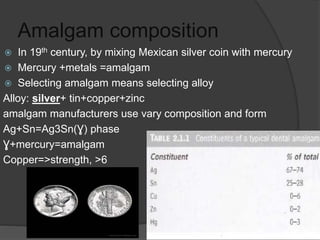
Amalgam composition
 In 19th century, by mixing Mexican silver coin with mercury
 Mercury +metals =amalgam
 Selecting amalgam means selecting alloy
Alloy: silver+ tin+copper+zinc
amalgam manufacturers use vary composition and form
Ag+Sn=Ag3Sn(Ɣ) phase
Ɣ+mercury=amalgam
Copper=>strength, >6
The Alloy
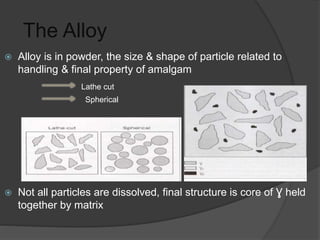
 Alloy is in powder, the size & shape of particle related to
handling & final property of amalgam
 Not all particles are dissolved, final structure is core of Ɣ held
together by matrix
Lathe cut
Spherical
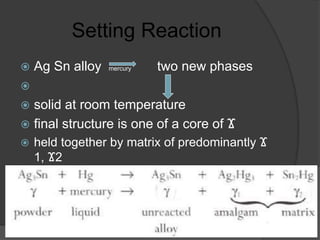
Setting Reaction
 Ag Sn alloy mercury two new phases

 solid at room temperature
 final structure is one of a core of Ϫ
 held together by matrix of predominantly Ϫ
1, Ϫ2
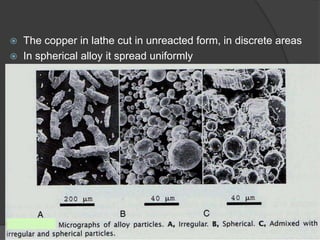
 The copper in lathe cut in unreacted form, in discrete areas
 In spherical alloy it spread uniformly
Mercury
 mercury used in the preparation of
amalgam
 needs to be very pure
 surface layer of contaminant
 interferes setting reaction
Properties of traditional amalgam
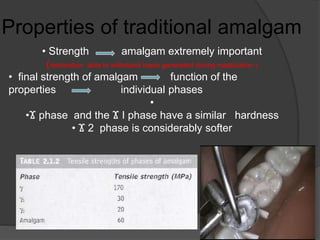
• Strength amalgam extremely important
(restoration able to withstand loads generated during mastication )
• final strength of amalgam function of the
properties individual phases
•
•Ϫ phase and the Ϫ I phase have a similar hardness
• Ϫ 2 phase is considerably softer
Properties of traditional amalgam
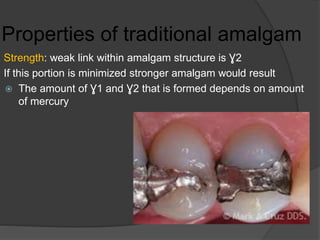
Strength: weak link within amalgam structure is Ɣ2
If this portion is minimized stronger amalgam would result
 The amount of Ɣ1 and Ɣ2 that is formed depends on amount
of mercury
Strength
• The higher the mercury the weaker the
phases
• The final mercury contents depends on
condensation technique, size & shape of
particle
• In spherical alloy the ratio of mercury is
less than lathe cut due to easily
condensation
Strength
 small particle size is contraindicated
 more of alloy surface being exposed to mercury
 more of the alloy will dissolve in the mercury
removal of excess mercury during the
placement of a restoration is Vitally important
Properties of traditional amalgam
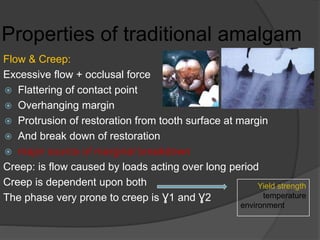
Flow & Creep:
Excessive flow + occlusal force
 Flattering of contact point
 Overhanging margin
 Protrusion of restoration from tooth surface at margin
 And break down of restoration
 major source of marginal breakdown
Creep: is flow caused by loads acting over long period
Creep is dependent upon both
The phase very prone to creep is Ɣ1 and Ɣ2
Yield strength
temperature
environment
Properties of traditional amalgam
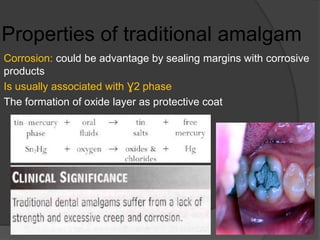
Corrosion: could be advantage by sealing margins with corrosive
products
Is usually associated with Ɣ2 phase
The formation of oxide layer as protective coat
High copper content Amalgam
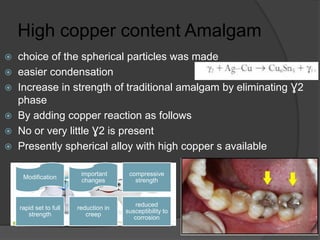
 choice of the spherical particles was made
 easier condensation
 Increase in strength of traditional amalgam by eliminating Ɣ2
phase
 By adding copper reaction as follows
 No or very little Ɣ2 is present
 Presently spherical alloy with high copper s available
Modification
important
changes
compressive
strength
rapid set to full
strength
reduction in
creep
reduced
susceptibility to
corrosion
Selection & using Amalgam
Two major factors:
 Variable under control of manufacturer
 composition
 size, shape
 Profound effect on amalgam properties
 Handling property
 Clinical performance
 selection of alloy
 operative procedure
Selection & using Amalgam
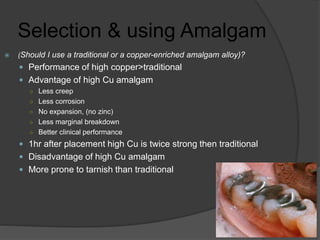
 (Should I use a traditional or a copper-enriched amalgam alloy)?
 Performance of high copper>traditional
 Advantage of high Cu amalgam
○ Less creep
○ Less corrosion
○ No expansion, (no zinc)
○ Less marginal breakdown
○ Better clinical performance
 1hr after placement high Cu is twice strong then traditional
 Disadvantage of high Cu amalgam
 More prone to tarnish than traditional
Selection & using Amalgam
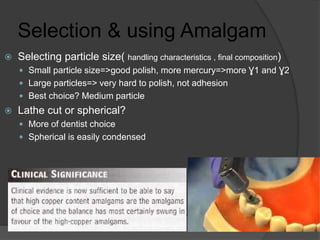
 Selecting particle size( handling characteristics , final composition)
 Small particle size=>good polish, more mercury=>more Ɣ1 and Ɣ2
 Large particles=> very hard to polish, not adhesion
 Best choice? Medium particle
 Lathe cut or spherical?
 More of dentist choice
 Spherical is easily condensed
Operator Variables
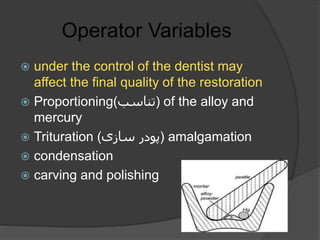
 under the control of the dentist may
affect the final quality of the restoration
 Proportioning(‫)تناسب‬ of the alloy and
mercury
 Trituration (‫سازى‬ ‫)پودر‬ amalgamation
 condensation
 carving and polishing
Selection & using Amalgam
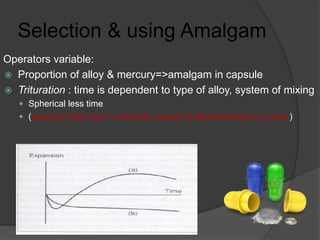
Operators variable:
 Proportion of alloy & mercury=>amalgam in capsule
 Trituration : time is dependent to type of alloy, system of mixing
 Spherical less time
 (speed of 4000 rpm/ 5 seconds- speed of 2600rpm/20sec or more )
Condensation
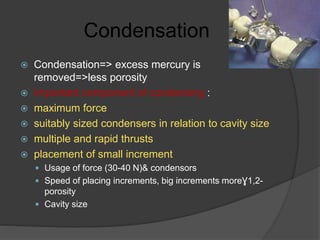
 Condensation=> excess mercury is
removed=>less porosity
 Important component of condensing :
 maximum force
 suitably sized condensers in relation to cavity size
 multiple and rapid thrusts
 placement of small increment
 Usage of force (30-40 N)& condensors
 Speed of placing increments, big increments moreƔ1,2-
porosity
 Cavity size
Carving & polishing
 shape & size of particle
 better initial surface spherical
 polishing second visit is a matter
 improves the aesthetics , remove mercury
 recent studies on burnishing
 increase surface hardness
 improve marginal adaptation
 reduce porosity
 decrease corrosion
Second lecture of dental
amalgam
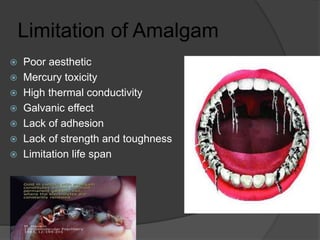
Limitation of Amalgam
 Poor aesthetic
 Mercury toxicity
 High thermal conductivity
 Galvanic effect
 Lack of adhesion
 Lack of strength and toughness
 Limitation life span
signs of mercury poisoning
 leg cramps
 itching
 Rashes
 Excessive perspiration( ‫)تعرق‬
 Rapid heartbeat
 low-grade fevers
 Irritability
 Personality change
 Insomnia(‫خوابي‬ ‫)بي‬, headaches, hypertension
 chronic fatigue and nerve dysfunction
Limitation of Amalgam
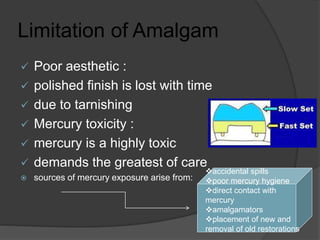
 Poor aesthetic :
 polished finish is lost with time
 due to tarnishing
 Mercury toxicity :
 mercury is a highly toxic
 demands the greatest of care
 sources of mercury exposure arise from:
accidental spills
poor mercury hygiene
direct contact with
mercury
amalgamators
placement of new and
removal of old restorations
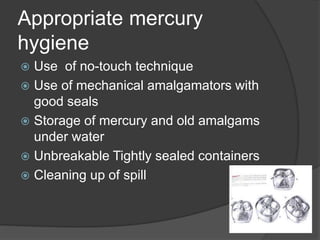
Appropriate mercury
hygiene
 Use of no-touch technique
 Use of mechanical amalgamators with
good seals
 Storage of mercury and old amalgams
under water
 Unbreakable Tightly sealed containers
 Cleaning up of spill
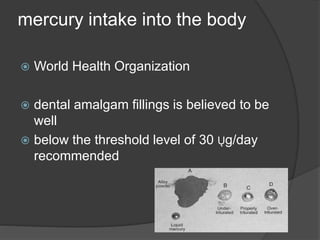
mercury intake into the body
 World Health Organization
 dental amalgam fillings is believed to be
well
 below the threshold level of 30 Ųg/day
recommended
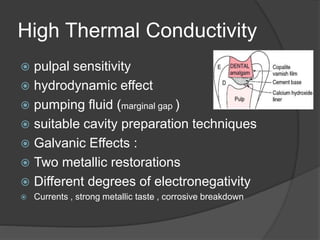
High Thermal Conductivity
 pulpal sensitivity
 hydrodynamic effect
 pumping fluid (marginal gap )
 suitable cavity preparation techniques
 Galvanic Effects :
 Two metallic restorations
 Different degrees of electronegativity
 Currents , strong metallic taste , corrosive breakdown
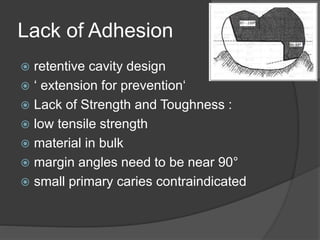
Lack of Adhesion
 retentive cavity design
 ‘ extension for prevention‘
 Lack of Strength and Toughness :
 low tensile strength
 material in bulk
 margin angles need to be near 90°
 small primary caries contraindicated
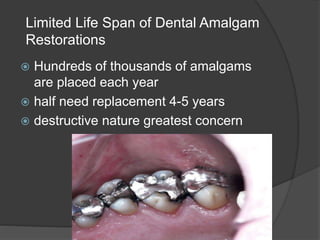
Limited Life Span of Dental Amalgam
Restorations
 Hundreds of thousands of amalgams
are placed each year
 half need replacement 4-5 years
 destructive nature greatest concern
IMPROVING THE LONGEVITY OF AMALGAM
RESTORATIONS
 reasons for replacement of amalgam restorations are
usually associated with:
 tooth fracture
 recurrent caries
 gross amalgam fracture
 marginal breakdown
 Some of the failures are unavoidable properties
 other can be avoided adopting appropriate technique
 avoiding faults in cavity design
 poor clinical technique
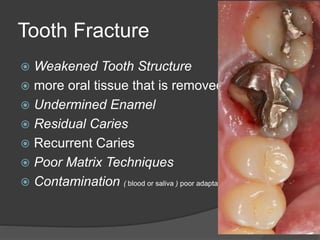
Tooth Fracture
 Weakened Tooth Structure
 more oral tissue that is removed
 Undermined Enamel
 Residual Caries
 Recurrent Caries
 Poor Matrix Techniques
 Contamination ( blood or saliva ) poor adaptation
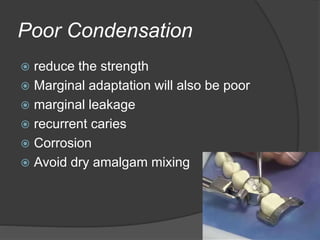
Poor Condensation
 reduce the strength
 Marginal adaptation will also be poor
 marginal leakage
 recurrent caries
 Corrosion
 Avoid dry amalgam mixing
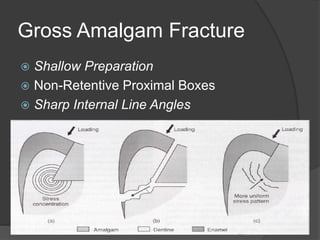
Gross Amalgam Fracture
 Shallow Preparation
 Non-Retentive Proximal Boxes
 Sharp Internal Line Angles
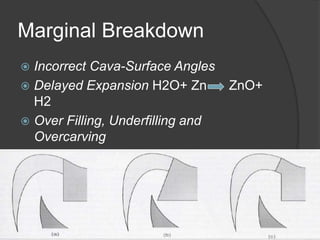
Marginal Breakdown
 Incorrect Cava-Surface Angles
 Delayed Expansion H2O+ Zn ZnO+
H2
 Over Filling, Underfilling and
Overcarving
Creep and Corrosion of the
Amalgam
 limitations of mechanical, physical properties
 avoidable if the previous factors observe
 careful attention detail of cavity preparation,
handling
 longer term, amalgams will eventually fail
 creep or corrosion
 has caused marginal breakdown
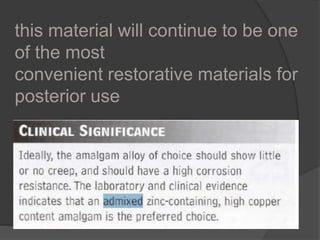
this material will continue to be one
of the most
convenient restorative materials for
posterior use
Amalgam newest.pptx

Amalgam newest.pptx

  • 1.
    Dental Amalgams Lecturer :Mohsin sakhi zada (MD)
  • 2.
    SECTION TWO Clinical DentalMaterials  A wide variety of materials are used in the Dentistry  Important how to handle  clinical application  failure of restorations  Understanding : composition  chemistry properties  Physical properties  mechanical properties
  • 3.
    Amalgam composition  In19th century, by mixing Mexican silver coin with mercury  Mercury +metals =amalgam  Selecting amalgam means selecting alloy Alloy: silver+ tin+copper+zinc amalgam manufacturers use vary composition and form Ag+Sn=Ag3Sn(Ɣ) phase Ɣ+mercury=amalgam Copper=>strength, >6
  • 4.
    The Alloy  Alloyis in powder, the size & shape of particle related to handling & final property of amalgam  Not all particles are dissolved, final structure is core of Ɣ held together by matrix Lathe cut Spherical
  • 5.
    Setting Reaction  AgSn alloy mercury two new phases   solid at room temperature  final structure is one of a core of Ϫ  held together by matrix of predominantly Ϫ 1, Ϫ2
  • 6.
     The copperin lathe cut in unreacted form, in discrete areas  In spherical alloy it spread uniformly
  • 7.
    Mercury  mercury usedin the preparation of amalgam  needs to be very pure  surface layer of contaminant  interferes setting reaction
  • 8.
    Properties of traditionalamalgam • Strength amalgam extremely important (restoration able to withstand loads generated during mastication ) • final strength of amalgam function of the properties individual phases • •Ϫ phase and the Ϫ I phase have a similar hardness • Ϫ 2 phase is considerably softer
  • 9.
    Properties of traditionalamalgam Strength: weak link within amalgam structure is Ɣ2 If this portion is minimized stronger amalgam would result  The amount of Ɣ1 and Ɣ2 that is formed depends on amount of mercury
  • 10.
    Strength • The higherthe mercury the weaker the phases • The final mercury contents depends on condensation technique, size & shape of particle • In spherical alloy the ratio of mercury is less than lathe cut due to easily condensation
  • 11.
    Strength  small particlesize is contraindicated  more of alloy surface being exposed to mercury  more of the alloy will dissolve in the mercury removal of excess mercury during the placement of a restoration is Vitally important
  • 12.
    Properties of traditionalamalgam Flow & Creep: Excessive flow + occlusal force  Flattering of contact point  Overhanging margin  Protrusion of restoration from tooth surface at margin  And break down of restoration  major source of marginal breakdown Creep: is flow caused by loads acting over long period Creep is dependent upon both The phase very prone to creep is Ɣ1 and Ɣ2 Yield strength temperature environment
  • 13.
    Properties of traditionalamalgam Corrosion: could be advantage by sealing margins with corrosive products Is usually associated with Ɣ2 phase The formation of oxide layer as protective coat
  • 14.
    High copper contentAmalgam  choice of the spherical particles was made  easier condensation  Increase in strength of traditional amalgam by eliminating Ɣ2 phase  By adding copper reaction as follows  No or very little Ɣ2 is present  Presently spherical alloy with high copper s available Modification important changes compressive strength rapid set to full strength reduction in creep reduced susceptibility to corrosion
  • 15.
    Selection & usingAmalgam Two major factors:  Variable under control of manufacturer  composition  size, shape  Profound effect on amalgam properties  Handling property  Clinical performance  selection of alloy  operative procedure
  • 16.
    Selection & usingAmalgam  (Should I use a traditional or a copper-enriched amalgam alloy)?  Performance of high copper>traditional  Advantage of high Cu amalgam ○ Less creep ○ Less corrosion ○ No expansion, (no zinc) ○ Less marginal breakdown ○ Better clinical performance  1hr after placement high Cu is twice strong then traditional  Disadvantage of high Cu amalgam  More prone to tarnish than traditional
  • 17.
    Selection & usingAmalgam  Selecting particle size( handling characteristics , final composition)  Small particle size=>good polish, more mercury=>more Ɣ1 and Ɣ2  Large particles=> very hard to polish, not adhesion  Best choice? Medium particle  Lathe cut or spherical?  More of dentist choice  Spherical is easily condensed
  • 18.
    Operator Variables  underthe control of the dentist may affect the final quality of the restoration  Proportioning(‫)تناسب‬ of the alloy and mercury  Trituration (‫سازى‬ ‫)پودر‬ amalgamation  condensation  carving and polishing
  • 19.
    Selection & usingAmalgam Operators variable:  Proportion of alloy & mercury=>amalgam in capsule  Trituration : time is dependent to type of alloy, system of mixing  Spherical less time  (speed of 4000 rpm/ 5 seconds- speed of 2600rpm/20sec or more )
  • 20.
    Condensation  Condensation=> excessmercury is removed=>less porosity  Important component of condensing :  maximum force  suitably sized condensers in relation to cavity size  multiple and rapid thrusts  placement of small increment  Usage of force (30-40 N)& condensors  Speed of placing increments, big increments moreƔ1,2- porosity  Cavity size
  • 21.
    Carving & polishing shape & size of particle  better initial surface spherical  polishing second visit is a matter  improves the aesthetics , remove mercury  recent studies on burnishing  increase surface hardness  improve marginal adaptation  reduce porosity  decrease corrosion
  • 23.
    Second lecture ofdental amalgam
  • 24.
    Limitation of Amalgam Poor aesthetic  Mercury toxicity  High thermal conductivity  Galvanic effect  Lack of adhesion  Lack of strength and toughness  Limitation life span
  • 25.
    signs of mercurypoisoning  leg cramps  itching  Rashes  Excessive perspiration( ‫)تعرق‬  Rapid heartbeat  low-grade fevers  Irritability  Personality change  Insomnia(‫خوابي‬ ‫)بي‬, headaches, hypertension  chronic fatigue and nerve dysfunction
  • 26.
    Limitation of Amalgam Poor aesthetic :  polished finish is lost with time  due to tarnishing  Mercury toxicity :  mercury is a highly toxic  demands the greatest of care  sources of mercury exposure arise from: accidental spills poor mercury hygiene direct contact with mercury amalgamators placement of new and removal of old restorations
  • 27.
    Appropriate mercury hygiene  Useof no-touch technique  Use of mechanical amalgamators with good seals  Storage of mercury and old amalgams under water  Unbreakable Tightly sealed containers  Cleaning up of spill
  • 28.
    mercury intake intothe body  World Health Organization  dental amalgam fillings is believed to be well  below the threshold level of 30 Ųg/day recommended
  • 29.
    High Thermal Conductivity pulpal sensitivity  hydrodynamic effect  pumping fluid (marginal gap )  suitable cavity preparation techniques  Galvanic Effects :  Two metallic restorations  Different degrees of electronegativity  Currents , strong metallic taste , corrosive breakdown
  • 30.
    Lack of Adhesion retentive cavity design  ‘ extension for prevention‘  Lack of Strength and Toughness :  low tensile strength  material in bulk  margin angles need to be near 90°  small primary caries contraindicated
  • 31.
    Limited Life Spanof Dental Amalgam Restorations  Hundreds of thousands of amalgams are placed each year  half need replacement 4-5 years  destructive nature greatest concern
  • 32.
    IMPROVING THE LONGEVITYOF AMALGAM RESTORATIONS  reasons for replacement of amalgam restorations are usually associated with:  tooth fracture  recurrent caries  gross amalgam fracture  marginal breakdown  Some of the failures are unavoidable properties  other can be avoided adopting appropriate technique  avoiding faults in cavity design  poor clinical technique
  • 33.
    Tooth Fracture  WeakenedTooth Structure  more oral tissue that is removed  Undermined Enamel  Residual Caries  Recurrent Caries  Poor Matrix Techniques  Contamination ( blood or saliva ) poor adaptation
  • 34.
    Poor Condensation  reducethe strength  Marginal adaptation will also be poor  marginal leakage  recurrent caries  Corrosion  Avoid dry amalgam mixing
  • 35.
    Gross Amalgam Fracture Shallow Preparation  Non-Retentive Proximal Boxes  Sharp Internal Line Angles
  • 36.
    Marginal Breakdown  IncorrectCava-Surface Angles  Delayed Expansion H2O+ Zn ZnO+ H2  Over Filling, Underfilling and Overcarving
  • 37.
    Creep and Corrosionof the Amalgam  limitations of mechanical, physical properties  avoidable if the previous factors observe  careful attention detail of cavity preparation, handling  longer term, amalgams will eventually fail  creep or corrosion  has caused marginal breakdown
  • 38.
    this material willcontinue to be one of the most convenient restorative materials for posterior use