GOOD MORNING
TARNISH AND
CORROSION
PRESENTED BY
Partha Pratim Kalita
Roll No. - 37
BDS 3rd year
Guided by
Dr. Mukut Seal
CONTENTS
• Introduction
• Tarnish
• Corrosion
• Fundamental basis of corrosion
• Classification of corrosion
• Protection against corrosion
• conclusion
INTRODUCTION
Dentistry uses a wide variety of metals for restorations and
prosthetic devices, the successful clinical performance and long term
durability of which require adequate corrosion resistance in the oral
environment. The oral environment is highly conductive to
electrochemical action. It is warm, moist and subjected to wide
fluctuations in temperature and pH. So we need to understand the
corrosion to minimise it and corrosion induced problems in dentistry.
Tarnish
• It is a surface discoloration on a metal or a slight loss of alteration of
the surface finish or luster.
• It occur due to formation of thin films of oxides, sulphides or
chlorides.
• This may be only a surface deposit
• Tarnish may even be protective
• It is often an early indication and precursor of corrosion
Corrosion
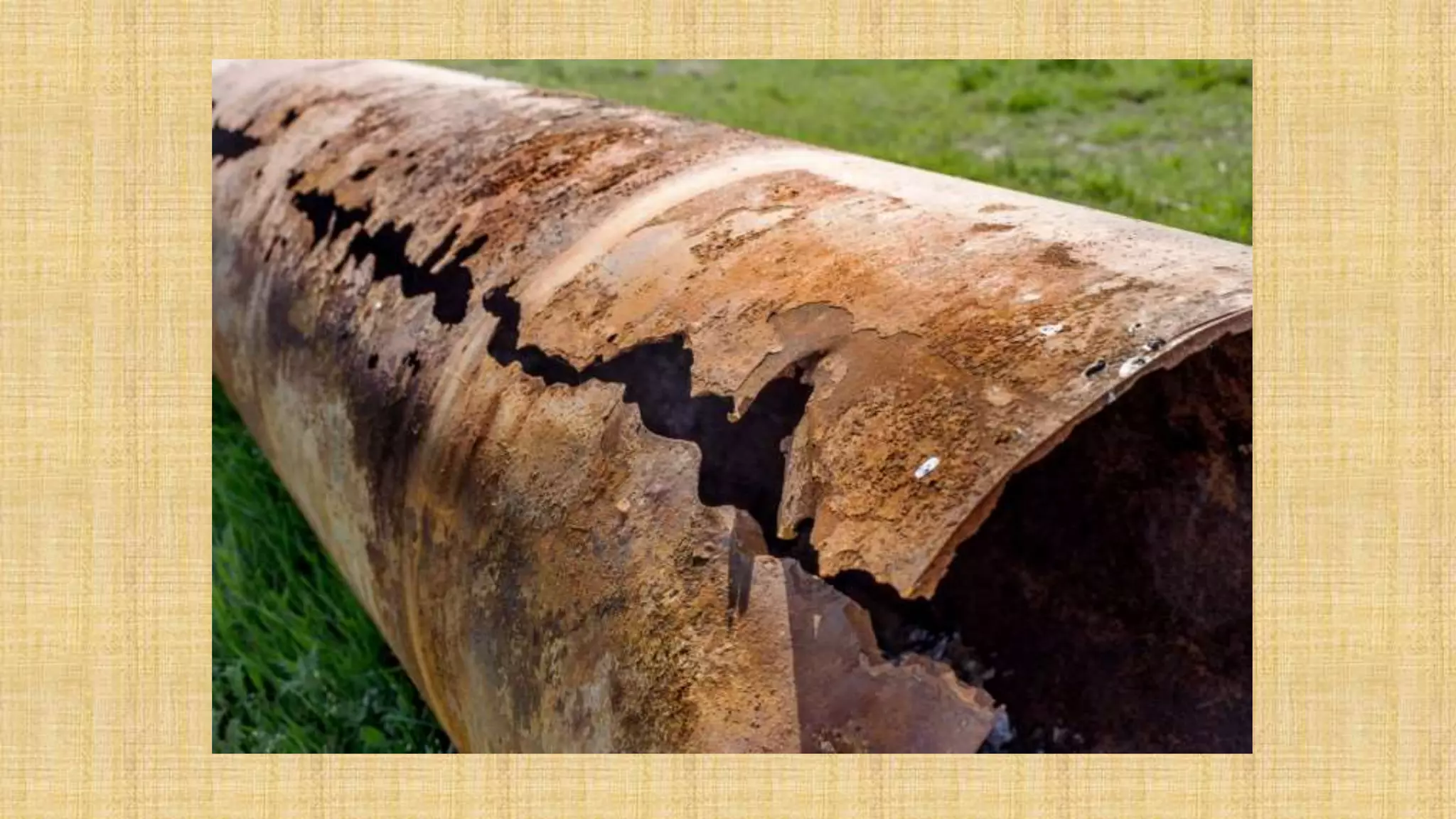
• It is a process whereby deterioration of the actual metal is caused by
reaction with its environment.
• Corrosion may cause mechanical failure of a structure.
• Corrosion takes place due to the action of certain chemicals,
moisture, atmosphere etc.
• Chemicals such as ammonium or hydrogen sulphides initially tarnish
and eventually corrode silver, Coper, tin, mercury etc. present in their
alloys.
• Acids such as Phosphoric, acetic and lactic acids are present in a
proper concentration and pH, can promote corrosion.
Tarnish of amalgam
restoration
Corrosion of an amalgam
restoration
FUNDAMENTAL BASIS OF
CORROSION
• Corrosion occurs because most commonly used metals and alloys are
NOT in their lowest energy state.
• Lowest energy state is thermodynamically the most stable state.
• Thus pure metals spontaneously convert to a highly reacted, oxidised
state by reacting with, for example oxygen, sulphur, or chlorine in
order to revert to their lowest energy state.
• Corrosion of a metal is either Chemical or Electrochemical process.
Classification of corrosion
• Chemical or dry corrosion
• Electrochemical or wet corrosion
1. Galvanic corrosion or dissimilar metals corrosion
2. Heterogenous composition
3. Stress corrosion
4. Concentration cell corrosion
Chemical Corrosion
• It is the direct combination of metallic and non metallic elements to
yield a chemical compound through oxidation reactions.
• It occurs in the absence of water or fluid electrolyte.
• So it is also known as Dry corrosion.
Electrochemical Corrosion
• It is also known as Wet corrosion
• It requires the presence of water or some other fluid electrolyte
• Electrochemical corrosion is seldom isolated and almost invariably is
accompanied by chemical corrosion
ELECTROCHEMICAL MECHANISM OF
CORROSION
• The electrolyte serves to supply the ions needed at the
cathode, and to carry away the corrosion products at the
anode
• These processes are referred to as reduction reactions.
• For corrosion to be an ongoing process the production of
electrons by the oxidation reactions at the anode must be
exactly balanced by the consumption of electrons in the
reduction reaction at the cathode.
1. Galvanic Corrosion
• Galvanic corrosion occurs when dissimilar metals are in direct contact
with each other.
• Here the dental reference is to, two separate restorations in which
the metal surface are chemically dissimilar.
• Due to this a electrochemical cell generates with saliva as a
electrolyte and corrodes the metal.
• The metallic combinations may produce electrogalvanism or galvanic
currents.
Galvanic currents
• This current is created due to the dissimilar metallic restorations.
• Because the both restorations are wet in saliva, an electrical couple
exists, with a difference in potential between the dissimilar
restorations.
• When the two restorations are bought into contact, the potential is
suddenly short-circuited through two alloys.
• This may result in sharp pain.
saliva
Tissue fluid
Tissue fluid
Dissimilar metals
2. Heterogenous Composition
• This type of corrosion occurs due to the heterogenous composition of
the metal surface.
• Examples of this type are eutectic and peritectic alloys.
• when an alloy containing a eutectic is immersed in an electrolyte, the
metallic grains with lower electrode potential are attacked and
corrosion results.
3. Stress Corrosion
• This type of corrosion is seen due to the deleterious effects of stress in
combination with a corrosive environment.
• Slight surface irregularities such as notch or pit, can accelerate the process
so that ordinary fatigue starts below the normal limit and failure results.
• If stressed and unstressed metals are in contact in an electrolyte, the
stressed metal will become anode of a galvanic cell and will corrode.
• Any cold working of an alloy by bending, burnishing, or malleting localizes
stress in some parts of the structure.
• The stressed area is readily dissolved by the electrolyte.
• That is why unnecessary burnishing of the margins of metallic restorations
is contraindicated.
4. Concentration Cell Corrosion
• This situation exists whenever there is variations in the electrolytes or
in the composition of the given electrolyte within the system.
• For example, there are often accumulation of food debris in the
interproximal areas of the mouth, this debris produce one type of
electrolyte in that area , and the normal saliva provides another type
of electrolyte at the occlusal surface.
• Therefore electrochemical corrosion occurs, with preferential attack
of the metal surface occurring underneath the layer of food debris
Different
electrolytes
• A similar type of attack may be produced due to difference in oxygen tension
between parts of the same restoration.
• A cell is produced with the greatest activity occurring around the areas
containing the least oxygen.
• Irregularities such as pits, contribute to this phenomenon.
• The areas at the bottom of the surface concavities do not have oxygen
because they are covered with food debris and mucin.
• The material at the bottom of the pit then becomes the anode and the
material at the periphery the cathode.
• in this manner, metal atoms at the base of the pit ionize and go into the
solution, causing the pit to deepen.
• Generally two or more mechanism act simultaneously and thus exaggerating
the corrosion.
Protection against corrosion
Mainly there are four ways by which we can protect the metal
against corrosion
 Passivation
 Increasing noble metal content
 Polishing
 Other method
 PASIVATION
• The formation of a film which is passive to oxidative chemical attacks,
their formation is called passivation
• Adding more then 12% Cr to iron or cobalt produces a chromic oxide
layer on the surface of stainless steel or cobalt chromium alloys which
is highly resistant.
• Examples of some passive alloys are chromium, titanium and
aluminium
 INCREASING NOBLE METAL CONTENT
• Alloys with a noble metal content below 65% may tarnish, so it has
been suggested that at least 50% of the atoms in a dental alloys
should be gold, platinum or palladium to ensure against corrosion.
• Noble metals resist corrosion because their EMF is positive with
regard to any of the common reduction reactions found in the oral
environment.
 POLISHING
• Polishing metallic restorations like amalgam and cast metal to a high
lustre minimizes corrosion.
• It happens because of the reduction of surface irregularities.
• The patient should also maintain good oral hygiene.
 OHER METHODS
• Dissimilar metal restorations should be avoided.
• High mercury containing amalgam should be avoided as it is more
susceptible to corrosion.
• Mercury tarnishes gold , thus, care must be taken to protect gold
ornaments worn by the operator, assistant or patient.
Conclusion
Tarnish and corrosion are inevitable phenomenon. They can’t be
stopped, but certainly they can be controlled to some extent, With the
help of some new techniques and technology. We find that with the
help of tarnish also we can control corrosion. If we have thorough
knowledge of tarnish and corrosion we can surely increase the
durability of the metallic restoration.
THANK YOU

Tarnish and corrosion

  • 1.
  • 2.
    TARNISH AND CORROSION PRESENTED BY ParthaPratim Kalita Roll No. - 37 BDS 3rd year Guided by Dr. Mukut Seal
  • 3.
    CONTENTS • Introduction • Tarnish •Corrosion • Fundamental basis of corrosion • Classification of corrosion • Protection against corrosion • conclusion
  • 4.
    INTRODUCTION Dentistry uses awide variety of metals for restorations and prosthetic devices, the successful clinical performance and long term durability of which require adequate corrosion resistance in the oral environment. The oral environment is highly conductive to electrochemical action. It is warm, moist and subjected to wide fluctuations in temperature and pH. So we need to understand the corrosion to minimise it and corrosion induced problems in dentistry.
  • 5.
    Tarnish • It isa surface discoloration on a metal or a slight loss of alteration of the surface finish or luster. • It occur due to formation of thin films of oxides, sulphides or chlorides. • This may be only a surface deposit • Tarnish may even be protective • It is often an early indication and precursor of corrosion
  • 7.
    Corrosion • It isa process whereby deterioration of the actual metal is caused by reaction with its environment. • Corrosion may cause mechanical failure of a structure. • Corrosion takes place due to the action of certain chemicals, moisture, atmosphere etc. • Chemicals such as ammonium or hydrogen sulphides initially tarnish and eventually corrode silver, Coper, tin, mercury etc. present in their alloys. • Acids such as Phosphoric, acetic and lactic acids are present in a proper concentration and pH, can promote corrosion.
  • 9.
  • 10.
    FUNDAMENTAL BASIS OF CORROSION •Corrosion occurs because most commonly used metals and alloys are NOT in their lowest energy state. • Lowest energy state is thermodynamically the most stable state. • Thus pure metals spontaneously convert to a highly reacted, oxidised state by reacting with, for example oxygen, sulphur, or chlorine in order to revert to their lowest energy state. • Corrosion of a metal is either Chemical or Electrochemical process.
  • 11.
    Classification of corrosion •Chemical or dry corrosion • Electrochemical or wet corrosion 1. Galvanic corrosion or dissimilar metals corrosion 2. Heterogenous composition 3. Stress corrosion 4. Concentration cell corrosion
  • 12.
    Chemical Corrosion • Itis the direct combination of metallic and non metallic elements to yield a chemical compound through oxidation reactions. • It occurs in the absence of water or fluid electrolyte. • So it is also known as Dry corrosion.
  • 13.
    Electrochemical Corrosion • Itis also known as Wet corrosion • It requires the presence of water or some other fluid electrolyte • Electrochemical corrosion is seldom isolated and almost invariably is accompanied by chemical corrosion
  • 15.
    ELECTROCHEMICAL MECHANISM OF CORROSION •The electrolyte serves to supply the ions needed at the cathode, and to carry away the corrosion products at the anode • These processes are referred to as reduction reactions. • For corrosion to be an ongoing process the production of electrons by the oxidation reactions at the anode must be exactly balanced by the consumption of electrons in the reduction reaction at the cathode.
  • 16.
    1. Galvanic Corrosion •Galvanic corrosion occurs when dissimilar metals are in direct contact with each other. • Here the dental reference is to, two separate restorations in which the metal surface are chemically dissimilar. • Due to this a electrochemical cell generates with saliva as a electrolyte and corrodes the metal. • The metallic combinations may produce electrogalvanism or galvanic currents.
  • 17.
    Galvanic currents • Thiscurrent is created due to the dissimilar metallic restorations. • Because the both restorations are wet in saliva, an electrical couple exists, with a difference in potential between the dissimilar restorations. • When the two restorations are bought into contact, the potential is suddenly short-circuited through two alloys. • This may result in sharp pain.
  • 18.
  • 19.
    2. Heterogenous Composition •This type of corrosion occurs due to the heterogenous composition of the metal surface. • Examples of this type are eutectic and peritectic alloys. • when an alloy containing a eutectic is immersed in an electrolyte, the metallic grains with lower electrode potential are attacked and corrosion results.
  • 21.
    3. Stress Corrosion •This type of corrosion is seen due to the deleterious effects of stress in combination with a corrosive environment. • Slight surface irregularities such as notch or pit, can accelerate the process so that ordinary fatigue starts below the normal limit and failure results. • If stressed and unstressed metals are in contact in an electrolyte, the stressed metal will become anode of a galvanic cell and will corrode. • Any cold working of an alloy by bending, burnishing, or malleting localizes stress in some parts of the structure. • The stressed area is readily dissolved by the electrolyte. • That is why unnecessary burnishing of the margins of metallic restorations is contraindicated.
  • 22.
    4. Concentration CellCorrosion • This situation exists whenever there is variations in the electrolytes or in the composition of the given electrolyte within the system. • For example, there are often accumulation of food debris in the interproximal areas of the mouth, this debris produce one type of electrolyte in that area , and the normal saliva provides another type of electrolyte at the occlusal surface. • Therefore electrochemical corrosion occurs, with preferential attack of the metal surface occurring underneath the layer of food debris
  • 23.
  • 24.
    • A similartype of attack may be produced due to difference in oxygen tension between parts of the same restoration. • A cell is produced with the greatest activity occurring around the areas containing the least oxygen. • Irregularities such as pits, contribute to this phenomenon. • The areas at the bottom of the surface concavities do not have oxygen because they are covered with food debris and mucin. • The material at the bottom of the pit then becomes the anode and the material at the periphery the cathode. • in this manner, metal atoms at the base of the pit ionize and go into the solution, causing the pit to deepen. • Generally two or more mechanism act simultaneously and thus exaggerating the corrosion.
  • 25.
    Protection against corrosion Mainlythere are four ways by which we can protect the metal against corrosion  Passivation  Increasing noble metal content  Polishing  Other method
  • 26.
     PASIVATION • Theformation of a film which is passive to oxidative chemical attacks, their formation is called passivation • Adding more then 12% Cr to iron or cobalt produces a chromic oxide layer on the surface of stainless steel or cobalt chromium alloys which is highly resistant. • Examples of some passive alloys are chromium, titanium and aluminium
  • 27.
     INCREASING NOBLEMETAL CONTENT • Alloys with a noble metal content below 65% may tarnish, so it has been suggested that at least 50% of the atoms in a dental alloys should be gold, platinum or palladium to ensure against corrosion. • Noble metals resist corrosion because their EMF is positive with regard to any of the common reduction reactions found in the oral environment.
  • 28.
     POLISHING • Polishingmetallic restorations like amalgam and cast metal to a high lustre minimizes corrosion. • It happens because of the reduction of surface irregularities. • The patient should also maintain good oral hygiene.
  • 29.
     OHER METHODS •Dissimilar metal restorations should be avoided. • High mercury containing amalgam should be avoided as it is more susceptible to corrosion. • Mercury tarnishes gold , thus, care must be taken to protect gold ornaments worn by the operator, assistant or patient.
  • 30.
    Conclusion Tarnish and corrosionare inevitable phenomenon. They can’t be stopped, but certainly they can be controlled to some extent, With the help of some new techniques and technology. We find that with the help of tarnish also we can control corrosion. If we have thorough knowledge of tarnish and corrosion we can surely increase the durability of the metallic restoration.
  • 31.