DENTAL AMALGAM
Guided by –
Dr. Vivek Hegde
Presented by –
Hussain Mookhtiar
1st year Post-graduate
Contents
 Introduction
 History
 Definitions
 Classifications
 Indication and contraindication
 Alloy composition
 Amalgamation Reactions
 Technical consideration
 Clinical consideration
 Advantages & disadvantages.
 Limitations
 Failure
 Mercury toxicity
 Alternatives to amalgam
 Conclusion.
Introduction
Ag
Sn
CuZn
The word AMALGAM is of Greek origin
Derived from MALAGMA , which means an emollient or
poultice.
ADA specification no of AMALGAM ALLOY is 1 which
includes the requirement of its composition.
HISTORY
 Su Kung (659 AD) mentioned silver-mercury paste in the Chinese
materia medica.
 1578-Li Shitichen used 100parts of Hg, 45parts of Ag & 100
parts of Sn
 1819 - Charles Bell a chemist (England) produced silver amalgam
(spanish & mexican coin filings + mercury) & distributed as Bell’s
cement & later known as “mineral succedaneum”(replacement
mineral).
The 1st “Amalgam War”:
 1833 – Frenchmen known as the Crawcour brothers came to
USA. They advertised silver amalgam as ‘Royal Mineral
Succedaneum’ hoping to add a greater esteem to the material
by adding the prefix ‘royal’.
 However they did not make any attempt to remove the caries
from the teeth they were filling. They advertised in the
newspapers that they could fill teeth in about two minutes
without the slightest pain inconvenience or pressure.
 They made a fortune with their new amalgam.
 The Organisation of that time, represented by the newly formed
American Society of Dental Surgeons began a campaign against
the use of amalgam and this drive soon assumed the tone of a
religious crusade.
 Members of the ASDS were required to sign a pledge. Those
who refused to sign were summararily expelled.
 However, soon a number of highly reputed dentists, found in
amalgam the answer to many of the problems faced with gold.
Thus they used it to treat the poor who could not afford gold and
also to compete with the quacks who were using amalgam
widely.
 1895 – Chicago’s prominent teacher of dentistry,
the great G.V Black, using instruments of his own
design to measure hardness and flow, hit upon a
mixture of metals which has remained essentially
unchanged
 Ag-68.5%
 Sn-25.5%
 Cu-5%
 Zn-1%.
 The 2nd Amalgam War:
 1920 - second amalgam war by Alfred Stock of
Germany who published “The Dangers of
Mercury Fumes”.
 1928 - Putt Kamer suggested Gallium alloy as
substitute for Hg
 1930 - ADA specification no.1 for amalgam alloy
 The 3rd Amalgam War
1980 - Hal Huggins publically condemned use of amalgam
as he promoted the theory that amalgam restoration cause
wide variety of diseases like multiple sclerosis, depression,
high low blood pressure, tachycardia, arthritis, lupus,
scleroderma, leukemia, Crohns disease, ulcers and other
digestive problems
Thus the third amalgam war.
Definition
 An amalgam is an alloy that contains mercury as
one of it’s constituents
(Phillips’ science of dental materials- 11th edition)
 Dental amalgam is a metal like restorative
material composed of a mixture of silver-tin-
copper alloy & mercury
( Sturdevant-5th Edition)
Classification
Sturdevant
 Acc. to particle shape
A) Spherical B) Irregular C) Combined
 Acc. to particle size
A) Micro cut B) Fine cut C) Coarse cut
 Acc. to copper content
A) Low copper alloy B) High copper alloy
 Acc. to zinc content
A) Zinc alloys B) Non-zinc alloys
Marzouk
Acc. to the no. of alloyed metals
A) Binary alloys (eg: silver-tin)
B) Ternary alloys (eg: silver-tin-copper)
C) Quaternary alloys (eg: silver-tin-copper-indium)
Acc. to whether the powder consists of unmixed or
admixed alloys
A) Made of one alloy
B) One or more alloys
Clinical indications
 Moderate to large class I & class II restorations
 Class V restorations -non esthetic
non isolated on the root surface
 Temporary caries control restorations
 Retrograde root canal filling
Contraindications
 In more prominent esthetic areas of the mouth
 Small to moderate class I & class II restorations (
well isolated )
 Small class VI restorations
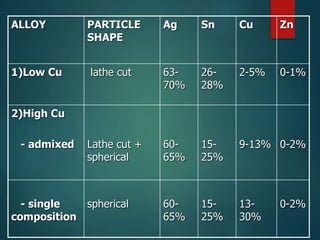
Alloy composition
-ADA specification no.1 requires that amalgam alloy predominantly
contain Ag & Sn.
ALLOY PARTICLE
SHAPE
Ag Sn Cu Zn
1)Low Cu lathe cut 63-
70%
26-
28%
2-5% 0-1%
2)High Cu
- admixed Lathe cut +
spherical
60-
65%
15-
25%
9-13% 0-2%
- single
composition
spherical 60-
65%
15-
25%
13-
30%
0-2%
Constituents of amalgam alloy &
functions of each ingredient
 Silver:-
-Increases strength, expansion
-Decreases flow, setting time
-Resists tarnish & corrosion
 Tin :-
- Decreases strength , expansion
- Increases flow
- Greater affinity for Hg
 Copper:-
-Hardens & strengthens Ag-Sn alloy
-Decreases flow
-Increases setting expansion
 Zinc:-
-Acts as a deoxidiser
 Platinum
-Hardens the alloy
-Increases corrosion resistance
 Palladium
-Hardens & whitens the alloy
 Mercury:-
-The preamalgamation produces a more rapid reaction
 Indium :-
-Improvement in plasticity & compressive strength
-Slow setting
-Good anti-bacterial activity
Amalgamation Reaction
Low copper Alloys: -
Reaction: -
AgSn (β+γ) + Hg = γ1+γ2 + AgSn (unreacted)
High copper amalgams
Setting Reaction:
 AgSn(β+γ) + Ag-Cu eutectic + Hg = γ1(Ag2Hg3)+ γ2 (Sn8Hg)+ AgSn(unreacted)
 γ2 (Sn8Hg) +Ag-Cu eutectic = Cu6Sn5 (η)+ Ag2Hg3 (γ1)
b) Single composition
Setting reaction
Ag-Sn-Cu + Hg = γ1+η+unconsumed Ag-Sn-Cu
Microstructure of set amalgam:
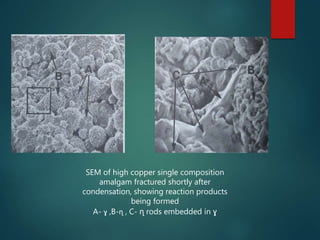
SEM of high copper single composition
amalgam fractured shortly after
condensation, showing reaction products
being formed
A- ɣ ,B-ɳ , C- ɳ rods embedded in ɣ
TECHNICAL CONSIDERATIONS
Proportioning: -
There are different ways of proportioning:
 Weighing and triturating:
Ideal but time consuming
 Volume dispensing (Graviometry):
Widely used-however it is difficult to dispense
any powder accurately by volume
 Pre-weighed capsules of alloy powder and Hg
seperated by a membrane:
Disposable capsules containing pre-proportioned
amounts of mercury and alloy are widely used. Just
before the mix is triturated the membrane is ruptured
by compression of the capsule.
DISPENSING: -
Precapsulated Amalgam:
Some alloys are now available in self-
activating capsules, which
automatically release the mercury
into the alloy chamber during the first
few oscillations of the amalgamator.
Mechanism of action:
mercury and powder seperated by
septum that must be perforated before
mixing .
Fig: Schematic representation of
preproportioned capsule
Eames technique(1959) :
 The method for reducing the mercury content of the
restoration  reduce the original mercury / alloy ratio.
 The present day alloys are designated for manipulation with
reduced mercury / alloy ratios just enough to get a coherent
plastic mass.
 Also known as the 1:1 or minimal mercury technique
 Mercury content of the finished restoration to original
mercury / alloy ratio, usually about 50 wt%
 With lesser amounts (~42 wt%) being used with spherical
alloys.
TRITURATION: -
It is the process of mixing the amalgam alloy particles with mercury.
Originally the alloy and mercury were triturated, by hand with a mortar
and pestle
Today mechanical amalgamation saves time and standardizes the
procedure.
Objectives of the trituration : -
o To achieve a workable mass
o To remove oxides
o To pulverize pellets into particles
o To increase the surface area by reducing particle size.
o To dissolve the particles in mercury
There are two methods of trituration:-
a) Hand Trituration
b)Mechanical trituration
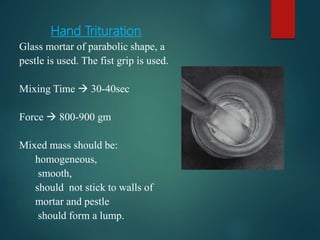
Hand Trituration
Glass mortar of parabolic shape, a
pestle is used. The fist grip is used.
Mixing Time  30-40sec
Force  800-900 gm
Mixed mass should be:
homogeneous,
smooth,
should not stick to walls of
mortar and pestle
should form a lump.
 Mechanical trituration:
- The alloy & mercury are dispensed into the capsule & when
this is secured in the machine, it is turned on & the arms
holding the capsule oscillate at high speed to accomplish
trituration.
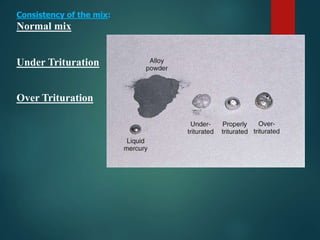
Consistency of the mix:
Normal mix
Under Trituration
Over Trituration
Mulling:
 Mulling is a continuation of trituration.
 It can be accomplished in two ways;
- rubbed between the first finger and thumb or
- the thumb of one hand and palm of another hand.
The process should not exceed 2 to 5 seconds.
Condensation
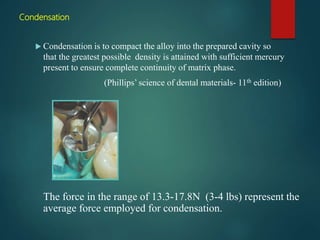
 Condensation is to compact the alloy into the prepared cavity so
that the greatest possible density is attained with sufficient mercury
present to ensure complete continuity of matrix phase.
(Phillips’ science of dental materials- 11th edition)
The force in the range of 13.3-17.8N (3-4 lbs) represent the
average force employed for condensation.
Goals of condensation:-
•Compact the alloy  greatest possible density is attained
with sufficient mercury present to ensure complete
continuity of the matrix phase (Ag2Hg3) between the
remaining alloy particles.
•To remove any excess mercury from each increment as it
is worked to the top by the condensing procedure.
•Field of operation should be kept absolutely dry 
incorporation of the slightest moisture in a zinc containing
amalgam delayed expansion corrosion, loss of
strength and ultimately premature failure of the
restoration.
•The initial condenser should be small enough to condense
into the line angles but large enough not to poke holes into the
amalgam mass.
•When the first portion has been condensed, the successive
portions of the divided amalgam are added after first
squeezing the excess mercury away.
•It is noted that successive portions require more force to
squeeze away mercury. This is because more free mercury is
reacting with the alloy particles.
• Condensation is usually started at the center
and then the condenser point is stepped little
by little towards the cavity walls.
• After condensation of an increment, the surface
should be shiny in appearance.
Indicating that there is sufficient mercury
present at the surface to diffuse into the next
increment so that each increment, as it is added,
bonds to the preceding one.
This is done until the cavity is overfilled by
around 1mm.Any mercury rich material at the
surface of the last increment is removed
when the restoration is carved.
If the cavity is larger and extra time is required for condensation,
another mix should be made just before the original one loses its
plasticity.
Burnishing
It is a process of rubbing usually performed to make a
surface shiny and lustrous
It is an adjunct to condensation as it further adapts and
compacts the amalgam mass along the walls of the
cavity.
 The objectives of burnishing are: (Marzouk)
1. It further reduces the size and number of voids on the
critical surface and marginal areas of the amalgam.
2. It brings any excess mercury to the surface,to be discarded
during carving.
3. It will adapt the amalgam further to cavosurface anatomy.
4. It conditions the surface amalgam to the carving step.
Precarve burnishing
 After condensing with amalgam condensers, the amalgam
maybe further condensed and shaping of the occlusal
anatomy is done with a large burnisher such as an ovoid
burnisher.
 This is done with use of heavy strokes, made in mesiodistal
and faciolingual directions.
 This produces denser amalgam at the margins of the
restorations.
 Mainly useful for high copper amalgams.
CARVING
 Carving is the anatomical sculpturing of the amalgam
material.
Objectives-
-To produce a restoration with no undercuts
-To produce a restoration with the proper physiological contours.
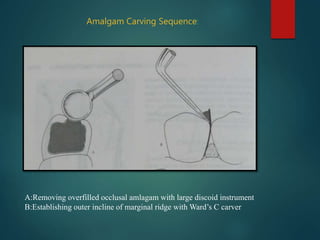
Amalgam Carving Sequence:
A:Removing overfilled occlusal amlagam with large discoid instrument
B:Establishing outer incline of marginal ridge with Ward’s C carver
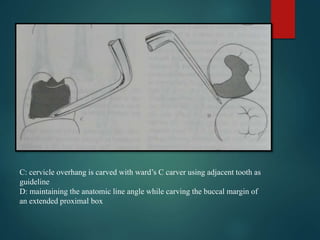
C: cervicle overhang is carved with ward’s C carver using adjacent tooth as
guideline
D: maintaining the anatomic line angle while carving the buccal margin of
an extended proximal box
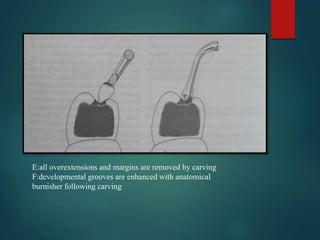
E:all overextensions and margins are removed by carving
F:developmental grooves are enhanced with anatomical
burnisher following carving
FINISHING AND POLISHING
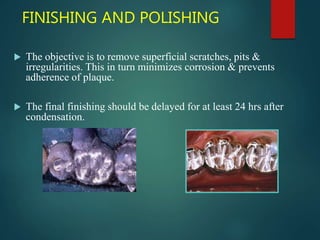
 The objective is to remove superficial scratches, pits &
irregularities. This in turn minimizes corrosion & prevents
adherence of plaque.
 The final finishing should be delayed for at least 24 hrs after
condensation.
Post Carve Burnishing
After carving to burnish the surface and margins
of the restoration lightly to produce a smooth and
satin appearance.
Burnishing of the occlusal anatomy can be
accomplished with a ball burnisher. One should
not rub the surface hard enough to produce
grooves on the restoration.
Final smoothening can be concluded by rubbing
the surface with a moist cotton pellet or by lightly
smoothing the surface with a rubber polishing cup
and an extremely fine polishing or prophylaxis
paste.
CLINICAL CONSIDERATIONS
Microleakage :
Dental amalgam has tendency to minimize marginal leakage
due to the corrosion products that forms in the interface between
the tooth and the restoration which seals the interface and there
by prevents leakage
Dimensional Change:-
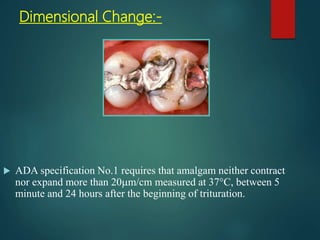
 ADA specification No.1 requires that amalgam neither contract
nor expand more than 20m/cm measured at 37°C, between 5
minute and 24 hours after the beginning of trituration.
 Effect of moisture contamination:
Delayed expansion is associated with zinc in the amalgam. It
has been demonstrated that the contaminating substance is
water.
H2O+Zn = ZnO+H2
The contamination can occur at trituration and condensation
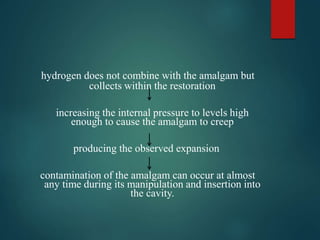
hydrogen does not combine with the amalgam but
collects within the restoration
increasing the internal pressure to levels high
enough to cause the amalgam to creep
producing the observed expansion
contamination of the amalgam can occur at almost
any time during its manipulation and insertion into
the cavity.
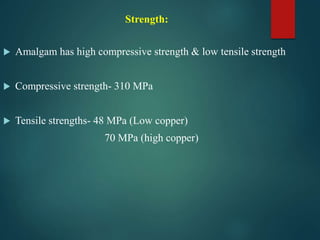
Strength:
 Amalgam has high compressive strength & low tensile strength
 Compressive strength- 310 MPa
 Tensile strengths- 48 MPa (Low copper)
70 MPa (high copper)
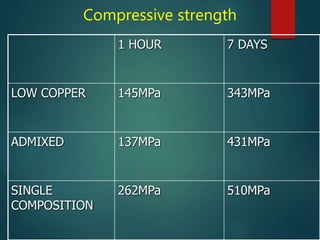
Compressive strength
1 HOUR 7 DAYS
LOW COPPER 145MPa 343MPa
ADMIXED 137MPa 431MPa
SINGLE
COMPOSITION
262MPa 510MPa
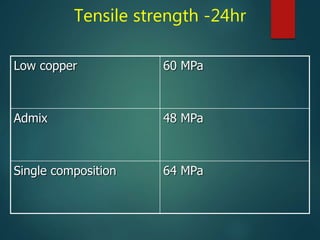
Tensile strength -24hr
Low copper 60 MPa
Admix 48 MPa
Single composition 64 MPa
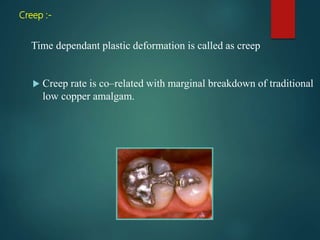
Creep :-
Time dependant plastic deformation is called as creep
 Creep rate is co–related with marginal breakdown of traditional
low copper amalgam.
According to A.D.A specification no. 1 selection of amalgam
alloys should be such that the creep rate is below 3%.
Creep Values:-
 Low copper amalgam - 0.8 to 8.0%
 High copper amalgam - 0.4 to 0.1%
Influence of microstructure on creep :–
Large gamma1 volume fractions-increases creep
Large gamma1 grain size-decreases creep
TARNISH AND CORROSION:-
Tarnish is a surface discoloration of on a metal, or as a slight
loss or alteration of the surface finish or luster.
Corrosion is a process in which deterioration of a metal is
caused by reaction with its environment.
(Phillips’ science of dental materials- 11th edition)
 The space between the alloy and the tooth allows the microleakage
of electrolytes and a classic concentration cell (crevice corrosion)
process results. The build up of corrosion products gradually seals
this space, making dental amalgam a self sealing restoration.
 The most common corrosion products found with traditional
amalgam alloys & high copper amalgams are oxides and chlorides
of tin.
 Corrosion products containing copper can also be found in high
copper amalgams (corrosion process is more limited because the η
phase is less susceptible to corrosion)
 Every effort should be made to produce a smooth, homogeneous
surface on a restoration to minimize tarnish and corrosion.
Corrosion can lead to:
 Reduced strength
 Marginal degradation
 Dimensional changes
 Increased internal porosities and surface roughness
 Discoloration
Sites Susceptible To
Electrochemical And
Chemical Corrosion On
Amalgam
ADVANTAGES
 Excellent wear resistance
 Lower cost
 Ease of use
 Sealing ability improves
 Relatively not technique sensitive
 Bonded amalgams have bonding effects
DISADVANTAGES:
 Non insulating
 Non esthetic
 Less conservative
 Weakens the tooth structure
 More technique sensitive if bonded & more difficult tooth
preparation
LIMITATIONS
 POOR ESTHETICS
-polished finish lost with time, due to tarnishing.
 MERCURY TOXICITY
Main sources of mercury exposure arise from:
-Accidental spills
-Poor mercury hygiene
-Direct contact with mercury
-Removing old restorations
HIGH THERMAL CONDUCTIVITY
-Amalgam has very high thermal conductivity.
These are dealt with by involving the use of varnishes or liners.
 GALVANIC EFFECTS
-causes patient discomfort
-leaves strong metallic taste in mouth
-accelerate electro-corrosive breakdown of more electronegative
material
 LACK OF ADHESION
Because of this need for retentive cavity designs imposes often
removal of large amount of sound tooth structure.
Mercury toxicity
 For the diagnosis of mercury exposure maximum allowable
level of mercury-
Blood Hg – 1.5  0.5  g/L
Urine Hg – 1.6  0.9  g/L
Saliva Hg – 41  35  g/L (range 5 – 450 Mg/L)
 A daily intake of mercury in individuals with amalgam fillings is
8-30 g/day has been estimated & a provisional tolerable weekly
intake is 300 g Hg.
 Threshold limit value (TLV) for exposure to mercury vapour for
a 40-hour work in a week is 50µg/m3.
Mercury poisoning from amalgam fillings
Patient’s signs and symptoms:
 Concentration disturbances
 Memory disturbances
 Headache
 Arthritic pain
 Muscular pain and weakness
 Skin and mucosal changes
 Stomatitis
 tendency to cry
CLASSIFICATION OF MATERIALS USED AS
ALTERNATIVES TO AMALGAM;
 A. Metallic alternatives;
 Gallium alloy
 Direct filling silver
 Direct gold restorations
 Cast metal restorations
 B. Non metallic amalgam alternatives;
1. Composite resins
2. Ceramic
3. Glass lonomer cements
a) Metallic inclusions
b) Resin modified glass ionomer
c) Highly viscous glass ionomer
CONCLUSION
 While there are some concerns about its use,
Amalgam is a safe & effective direct restorative
material.
 A successful amalgam restoration is still relatively
easy to accomplish & adherence to tooth
preparation & material handling requirements will
result in a successful restoration.
References :-
 Anusavice: Phillips’ science of dental materials- 11th edition.
 Eames WB: Preparation and condensation of amalgam with a low mercury/alloy ratio. J Am
Dent Assoc 58:78, 1959.
 Federation Dentaire Internationale, Technical Report 33: Safety of dental amalgam. Int Dent
39:217, 1989.
 Leinfelder KF: Clinical evaluation of High-copper amalgam. Gen Dent March-April, 1983, p
105.
 Mahler DB, Adey JD, and Marek M: Creep and corrosion of amalgam. J Dent Res 61:33, 1982.
 Marshall GW, Marshall SJ, Letzel H: Mercury content of amalgam restorations. Gen Dent,
Nov-Dec, 1989, p-473.
 Mitchell RJ and Okabe T: Setting reactions in dental amalgam. Crit Rev Biol Med7:12-
22,1996.
 Mjor IA: The safe and effective use of dental amalgam. Int Dent J 37:147, 1987.
 Schoonover JC, and Souder W: Corrosion of dental alloys.J Am Dent Assoc 28:1278, 1941.
 Sturdevant’s – Art and science of operative dentistry- 5th Edition.
THANK
YOU

Amalgam

  • 1.
    DENTAL AMALGAM Guided by– Dr. Vivek Hegde Presented by – Hussain Mookhtiar 1st year Post-graduate
  • 2.
    Contents  Introduction  History Definitions  Classifications  Indication and contraindication  Alloy composition  Amalgamation Reactions  Technical consideration
  • 3.
     Clinical consideration Advantages & disadvantages.  Limitations  Failure  Mercury toxicity  Alternatives to amalgam  Conclusion.
  • 4.
    Introduction Ag Sn CuZn The word AMALGAMis of Greek origin Derived from MALAGMA , which means an emollient or poultice. ADA specification no of AMALGAM ALLOY is 1 which includes the requirement of its composition.
  • 5.
    HISTORY  Su Kung(659 AD) mentioned silver-mercury paste in the Chinese materia medica.  1578-Li Shitichen used 100parts of Hg, 45parts of Ag & 100 parts of Sn  1819 - Charles Bell a chemist (England) produced silver amalgam (spanish & mexican coin filings + mercury) & distributed as Bell’s cement & later known as “mineral succedaneum”(replacement mineral).
  • 6.
    The 1st “AmalgamWar”:  1833 – Frenchmen known as the Crawcour brothers came to USA. They advertised silver amalgam as ‘Royal Mineral Succedaneum’ hoping to add a greater esteem to the material by adding the prefix ‘royal’.  However they did not make any attempt to remove the caries from the teeth they were filling. They advertised in the newspapers that they could fill teeth in about two minutes without the slightest pain inconvenience or pressure.  They made a fortune with their new amalgam.
  • 7.
     The Organisationof that time, represented by the newly formed American Society of Dental Surgeons began a campaign against the use of amalgam and this drive soon assumed the tone of a religious crusade.  Members of the ASDS were required to sign a pledge. Those who refused to sign were summararily expelled.  However, soon a number of highly reputed dentists, found in amalgam the answer to many of the problems faced with gold. Thus they used it to treat the poor who could not afford gold and also to compete with the quacks who were using amalgam widely.
  • 8.
     1895 –Chicago’s prominent teacher of dentistry, the great G.V Black, using instruments of his own design to measure hardness and flow, hit upon a mixture of metals which has remained essentially unchanged  Ag-68.5%  Sn-25.5%  Cu-5%  Zn-1%.
  • 9.
     The 2ndAmalgam War:  1920 - second amalgam war by Alfred Stock of Germany who published “The Dangers of Mercury Fumes”.  1928 - Putt Kamer suggested Gallium alloy as substitute for Hg  1930 - ADA specification no.1 for amalgam alloy
  • 10.
     The 3rdAmalgam War 1980 - Hal Huggins publically condemned use of amalgam as he promoted the theory that amalgam restoration cause wide variety of diseases like multiple sclerosis, depression, high low blood pressure, tachycardia, arthritis, lupus, scleroderma, leukemia, Crohns disease, ulcers and other digestive problems Thus the third amalgam war.
  • 11.
    Definition  An amalgamis an alloy that contains mercury as one of it’s constituents (Phillips’ science of dental materials- 11th edition)  Dental amalgam is a metal like restorative material composed of a mixture of silver-tin- copper alloy & mercury ( Sturdevant-5th Edition)
  • 12.
    Classification Sturdevant  Acc. toparticle shape A) Spherical B) Irregular C) Combined  Acc. to particle size A) Micro cut B) Fine cut C) Coarse cut  Acc. to copper content A) Low copper alloy B) High copper alloy  Acc. to zinc content A) Zinc alloys B) Non-zinc alloys
  • 13.
    Marzouk Acc. to theno. of alloyed metals A) Binary alloys (eg: silver-tin) B) Ternary alloys (eg: silver-tin-copper) C) Quaternary alloys (eg: silver-tin-copper-indium) Acc. to whether the powder consists of unmixed or admixed alloys A) Made of one alloy B) One or more alloys
  • 14.
    Clinical indications  Moderateto large class I & class II restorations  Class V restorations -non esthetic non isolated on the root surface  Temporary caries control restorations  Retrograde root canal filling
  • 15.
    Contraindications  In moreprominent esthetic areas of the mouth  Small to moderate class I & class II restorations ( well isolated )  Small class VI restorations
  • 16.
    Alloy composition -ADA specificationno.1 requires that amalgam alloy predominantly contain Ag & Sn.
  • 17.
    ALLOY PARTICLE SHAPE Ag SnCu Zn 1)Low Cu lathe cut 63- 70% 26- 28% 2-5% 0-1% 2)High Cu - admixed Lathe cut + spherical 60- 65% 15- 25% 9-13% 0-2% - single composition spherical 60- 65% 15- 25% 13- 30% 0-2%
  • 18.
    Constituents of amalgamalloy & functions of each ingredient  Silver:- -Increases strength, expansion -Decreases flow, setting time -Resists tarnish & corrosion  Tin :- - Decreases strength , expansion - Increases flow - Greater affinity for Hg
  • 19.
     Copper:- -Hardens &strengthens Ag-Sn alloy -Decreases flow -Increases setting expansion  Zinc:- -Acts as a deoxidiser  Platinum -Hardens the alloy -Increases corrosion resistance  Palladium -Hardens & whitens the alloy
  • 20.
     Mercury:- -The preamalgamationproduces a more rapid reaction  Indium :- -Improvement in plasticity & compressive strength -Slow setting -Good anti-bacterial activity
  • 21.
  • 22.
    Low copper Alloys:- Reaction: - AgSn (β+γ) + Hg = γ1+γ2 + AgSn (unreacted) High copper amalgams Setting Reaction:  AgSn(β+γ) + Ag-Cu eutectic + Hg = γ1(Ag2Hg3)+ γ2 (Sn8Hg)+ AgSn(unreacted)  γ2 (Sn8Hg) +Ag-Cu eutectic = Cu6Sn5 (η)+ Ag2Hg3 (γ1) b) Single composition Setting reaction Ag-Sn-Cu + Hg = γ1+η+unconsumed Ag-Sn-Cu
  • 23.
  • 24.
  • 25.
    SEM of highcopper single composition amalgam fractured shortly after condensation, showing reaction products being formed A- ɣ ,B-ɳ , C- ɳ rods embedded in ɣ
  • 26.
  • 27.
    Proportioning: - There aredifferent ways of proportioning:  Weighing and triturating: Ideal but time consuming  Volume dispensing (Graviometry): Widely used-however it is difficult to dispense any powder accurately by volume  Pre-weighed capsules of alloy powder and Hg seperated by a membrane: Disposable capsules containing pre-proportioned amounts of mercury and alloy are widely used. Just before the mix is triturated the membrane is ruptured by compression of the capsule.
  • 28.
    DISPENSING: - Precapsulated Amalgam: Somealloys are now available in self- activating capsules, which automatically release the mercury into the alloy chamber during the first few oscillations of the amalgamator. Mechanism of action: mercury and powder seperated by septum that must be perforated before mixing . Fig: Schematic representation of preproportioned capsule
  • 29.
    Eames technique(1959) : The method for reducing the mercury content of the restoration  reduce the original mercury / alloy ratio.  The present day alloys are designated for manipulation with reduced mercury / alloy ratios just enough to get a coherent plastic mass.  Also known as the 1:1 or minimal mercury technique  Mercury content of the finished restoration to original mercury / alloy ratio, usually about 50 wt%  With lesser amounts (~42 wt%) being used with spherical alloys.
  • 30.
    TRITURATION: - It isthe process of mixing the amalgam alloy particles with mercury. Originally the alloy and mercury were triturated, by hand with a mortar and pestle Today mechanical amalgamation saves time and standardizes the procedure. Objectives of the trituration : - o To achieve a workable mass o To remove oxides o To pulverize pellets into particles o To increase the surface area by reducing particle size. o To dissolve the particles in mercury
  • 31.
    There are twomethods of trituration:- a) Hand Trituration b)Mechanical trituration
  • 32.
    Hand Trituration Glass mortarof parabolic shape, a pestle is used. The fist grip is used. Mixing Time  30-40sec Force  800-900 gm Mixed mass should be: homogeneous, smooth, should not stick to walls of mortar and pestle should form a lump.
  • 33.
     Mechanical trituration: -The alloy & mercury are dispensed into the capsule & when this is secured in the machine, it is turned on & the arms holding the capsule oscillate at high speed to accomplish trituration.
  • 34.
    Consistency of themix: Normal mix Under Trituration Over Trituration
  • 35.
    Mulling:  Mulling isa continuation of trituration.  It can be accomplished in two ways; - rubbed between the first finger and thumb or - the thumb of one hand and palm of another hand. The process should not exceed 2 to 5 seconds.
  • 36.
    Condensation  Condensation isto compact the alloy into the prepared cavity so that the greatest possible density is attained with sufficient mercury present to ensure complete continuity of matrix phase. (Phillips’ science of dental materials- 11th edition) The force in the range of 13.3-17.8N (3-4 lbs) represent the average force employed for condensation.
  • 37.
    Goals of condensation:- •Compactthe alloy  greatest possible density is attained with sufficient mercury present to ensure complete continuity of the matrix phase (Ag2Hg3) between the remaining alloy particles. •To remove any excess mercury from each increment as it is worked to the top by the condensing procedure. •Field of operation should be kept absolutely dry  incorporation of the slightest moisture in a zinc containing amalgam delayed expansion corrosion, loss of strength and ultimately premature failure of the restoration.
  • 38.
    •The initial condensershould be small enough to condense into the line angles but large enough not to poke holes into the amalgam mass. •When the first portion has been condensed, the successive portions of the divided amalgam are added after first squeezing the excess mercury away. •It is noted that successive portions require more force to squeeze away mercury. This is because more free mercury is reacting with the alloy particles.
  • 39.
    • Condensation isusually started at the center and then the condenser point is stepped little by little towards the cavity walls. • After condensation of an increment, the surface should be shiny in appearance. Indicating that there is sufficient mercury present at the surface to diffuse into the next increment so that each increment, as it is added, bonds to the preceding one.
  • 40.
    This is doneuntil the cavity is overfilled by around 1mm.Any mercury rich material at the surface of the last increment is removed when the restoration is carved. If the cavity is larger and extra time is required for condensation, another mix should be made just before the original one loses its plasticity.
  • 41.
    Burnishing It is aprocess of rubbing usually performed to make a surface shiny and lustrous It is an adjunct to condensation as it further adapts and compacts the amalgam mass along the walls of the cavity.  The objectives of burnishing are: (Marzouk) 1. It further reduces the size and number of voids on the critical surface and marginal areas of the amalgam. 2. It brings any excess mercury to the surface,to be discarded during carving. 3. It will adapt the amalgam further to cavosurface anatomy. 4. It conditions the surface amalgam to the carving step.
  • 42.
    Precarve burnishing  Aftercondensing with amalgam condensers, the amalgam maybe further condensed and shaping of the occlusal anatomy is done with a large burnisher such as an ovoid burnisher.  This is done with use of heavy strokes, made in mesiodistal and faciolingual directions.  This produces denser amalgam at the margins of the restorations.  Mainly useful for high copper amalgams.
  • 43.
    CARVING  Carving isthe anatomical sculpturing of the amalgam material. Objectives- -To produce a restoration with no undercuts -To produce a restoration with the proper physiological contours.
  • 44.
    Amalgam Carving Sequence: A:Removingoverfilled occlusal amlagam with large discoid instrument B:Establishing outer incline of marginal ridge with Ward’s C carver
  • 45.
    C: cervicle overhangis carved with ward’s C carver using adjacent tooth as guideline D: maintaining the anatomic line angle while carving the buccal margin of an extended proximal box
  • 46.
    E:all overextensions andmargins are removed by carving F:developmental grooves are enhanced with anatomical burnisher following carving
  • 47.
    FINISHING AND POLISHING The objective is to remove superficial scratches, pits & irregularities. This in turn minimizes corrosion & prevents adherence of plaque.  The final finishing should be delayed for at least 24 hrs after condensation.
  • 48.
    Post Carve Burnishing Aftercarving to burnish the surface and margins of the restoration lightly to produce a smooth and satin appearance. Burnishing of the occlusal anatomy can be accomplished with a ball burnisher. One should not rub the surface hard enough to produce grooves on the restoration. Final smoothening can be concluded by rubbing the surface with a moist cotton pellet or by lightly smoothing the surface with a rubber polishing cup and an extremely fine polishing or prophylaxis paste.
  • 49.
  • 50.
    Microleakage : Dental amalgamhas tendency to minimize marginal leakage due to the corrosion products that forms in the interface between the tooth and the restoration which seals the interface and there by prevents leakage
  • 51.
    Dimensional Change:-  ADAspecification No.1 requires that amalgam neither contract nor expand more than 20m/cm measured at 37°C, between 5 minute and 24 hours after the beginning of trituration.
  • 52.
     Effect ofmoisture contamination: Delayed expansion is associated with zinc in the amalgam. It has been demonstrated that the contaminating substance is water. H2O+Zn = ZnO+H2 The contamination can occur at trituration and condensation
  • 53.
    hydrogen does notcombine with the amalgam but collects within the restoration increasing the internal pressure to levels high enough to cause the amalgam to creep producing the observed expansion contamination of the amalgam can occur at almost any time during its manipulation and insertion into the cavity.
  • 54.
    Strength:  Amalgam hashigh compressive strength & low tensile strength  Compressive strength- 310 MPa  Tensile strengths- 48 MPa (Low copper) 70 MPa (high copper)
  • 55.
    Compressive strength 1 HOUR7 DAYS LOW COPPER 145MPa 343MPa ADMIXED 137MPa 431MPa SINGLE COMPOSITION 262MPa 510MPa
  • 56.
    Tensile strength -24hr Lowcopper 60 MPa Admix 48 MPa Single composition 64 MPa
  • 57.
    Creep :- Time dependantplastic deformation is called as creep  Creep rate is co–related with marginal breakdown of traditional low copper amalgam.
  • 58.
    According to A.D.Aspecification no. 1 selection of amalgam alloys should be such that the creep rate is below 3%. Creep Values:-  Low copper amalgam - 0.8 to 8.0%  High copper amalgam - 0.4 to 0.1% Influence of microstructure on creep :– Large gamma1 volume fractions-increases creep Large gamma1 grain size-decreases creep
  • 59.
    TARNISH AND CORROSION:- Tarnishis a surface discoloration of on a metal, or as a slight loss or alteration of the surface finish or luster. Corrosion is a process in which deterioration of a metal is caused by reaction with its environment. (Phillips’ science of dental materials- 11th edition)
  • 60.
     The spacebetween the alloy and the tooth allows the microleakage of electrolytes and a classic concentration cell (crevice corrosion) process results. The build up of corrosion products gradually seals this space, making dental amalgam a self sealing restoration.  The most common corrosion products found with traditional amalgam alloys & high copper amalgams are oxides and chlorides of tin.  Corrosion products containing copper can also be found in high copper amalgams (corrosion process is more limited because the η phase is less susceptible to corrosion)  Every effort should be made to produce a smooth, homogeneous surface on a restoration to minimize tarnish and corrosion.
  • 61.
    Corrosion can leadto:  Reduced strength  Marginal degradation  Dimensional changes  Increased internal porosities and surface roughness  Discoloration
  • 62.
    Sites Susceptible To ElectrochemicalAnd Chemical Corrosion On Amalgam
  • 63.
    ADVANTAGES  Excellent wearresistance  Lower cost  Ease of use  Sealing ability improves  Relatively not technique sensitive  Bonded amalgams have bonding effects
  • 64.
    DISADVANTAGES:  Non insulating Non esthetic  Less conservative  Weakens the tooth structure  More technique sensitive if bonded & more difficult tooth preparation
  • 65.
    LIMITATIONS  POOR ESTHETICS -polishedfinish lost with time, due to tarnishing.  MERCURY TOXICITY Main sources of mercury exposure arise from: -Accidental spills -Poor mercury hygiene -Direct contact with mercury -Removing old restorations
  • 66.
    HIGH THERMAL CONDUCTIVITY -Amalgamhas very high thermal conductivity. These are dealt with by involving the use of varnishes or liners.  GALVANIC EFFECTS -causes patient discomfort -leaves strong metallic taste in mouth -accelerate electro-corrosive breakdown of more electronegative material
  • 67.
     LACK OFADHESION Because of this need for retentive cavity designs imposes often removal of large amount of sound tooth structure.
  • 68.
    Mercury toxicity  Forthe diagnosis of mercury exposure maximum allowable level of mercury- Blood Hg – 1.5  0.5  g/L Urine Hg – 1.6  0.9  g/L Saliva Hg – 41  35  g/L (range 5 – 450 Mg/L)
  • 69.
     A dailyintake of mercury in individuals with amalgam fillings is 8-30 g/day has been estimated & a provisional tolerable weekly intake is 300 g Hg.  Threshold limit value (TLV) for exposure to mercury vapour for a 40-hour work in a week is 50µg/m3.
  • 70.
    Mercury poisoning fromamalgam fillings Patient’s signs and symptoms:  Concentration disturbances  Memory disturbances  Headache  Arthritic pain  Muscular pain and weakness  Skin and mucosal changes  Stomatitis  tendency to cry
  • 71.
    CLASSIFICATION OF MATERIALSUSED AS ALTERNATIVES TO AMALGAM;  A. Metallic alternatives;  Gallium alloy  Direct filling silver  Direct gold restorations  Cast metal restorations
  • 72.
     B. Nonmetallic amalgam alternatives; 1. Composite resins 2. Ceramic 3. Glass lonomer cements a) Metallic inclusions b) Resin modified glass ionomer c) Highly viscous glass ionomer
  • 73.
    CONCLUSION  While thereare some concerns about its use, Amalgam is a safe & effective direct restorative material.  A successful amalgam restoration is still relatively easy to accomplish & adherence to tooth preparation & material handling requirements will result in a successful restoration.
  • 74.
    References :-  Anusavice:Phillips’ science of dental materials- 11th edition.  Eames WB: Preparation and condensation of amalgam with a low mercury/alloy ratio. J Am Dent Assoc 58:78, 1959.  Federation Dentaire Internationale, Technical Report 33: Safety of dental amalgam. Int Dent 39:217, 1989.  Leinfelder KF: Clinical evaluation of High-copper amalgam. Gen Dent March-April, 1983, p 105.  Mahler DB, Adey JD, and Marek M: Creep and corrosion of amalgam. J Dent Res 61:33, 1982.  Marshall GW, Marshall SJ, Letzel H: Mercury content of amalgam restorations. Gen Dent, Nov-Dec, 1989, p-473.  Mitchell RJ and Okabe T: Setting reactions in dental amalgam. Crit Rev Biol Med7:12- 22,1996.  Mjor IA: The safe and effective use of dental amalgam. Int Dent J 37:147, 1987.  Schoonover JC, and Souder W: Corrosion of dental alloys.J Am Dent Assoc 28:1278, 1941.  Sturdevant’s – Art and science of operative dentistry- 5th Edition.
  • 75.