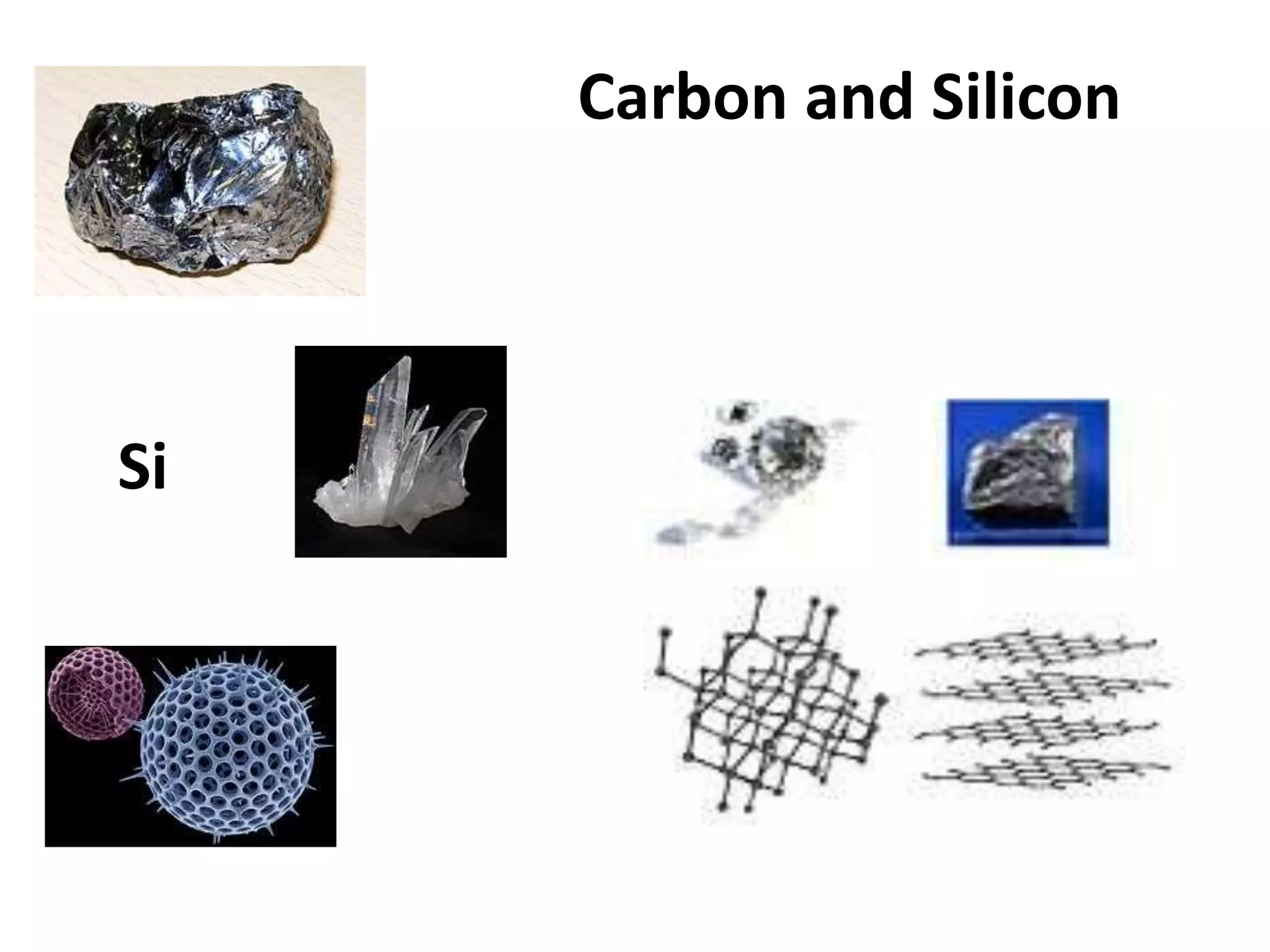
Si
Carbon and Silicon
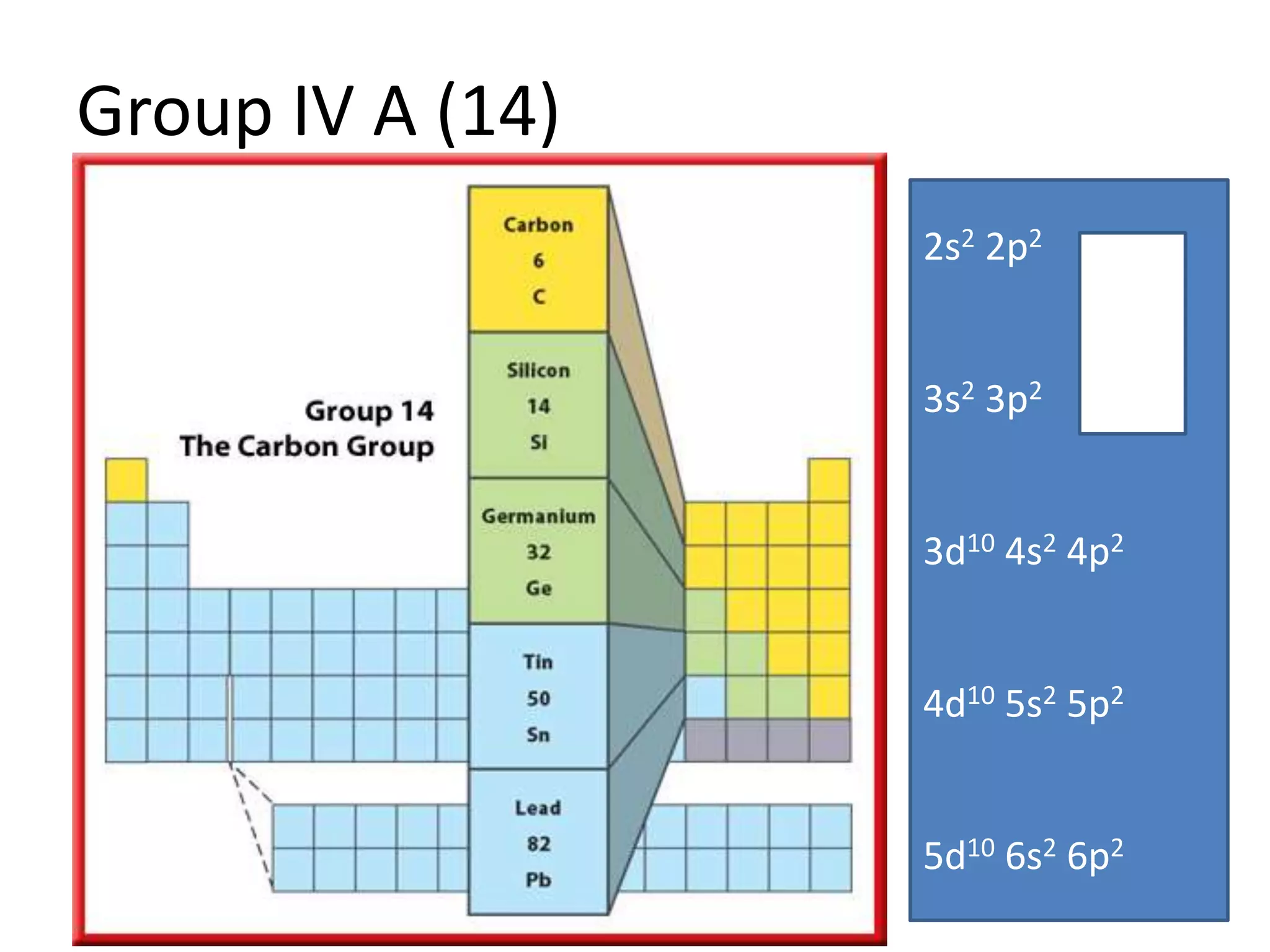
Group IV A (14)
2s2 2p2
3s2 3p2
3d10 4s2 4p2
4d10 5s2 5p2
5d10 6s2 6p2
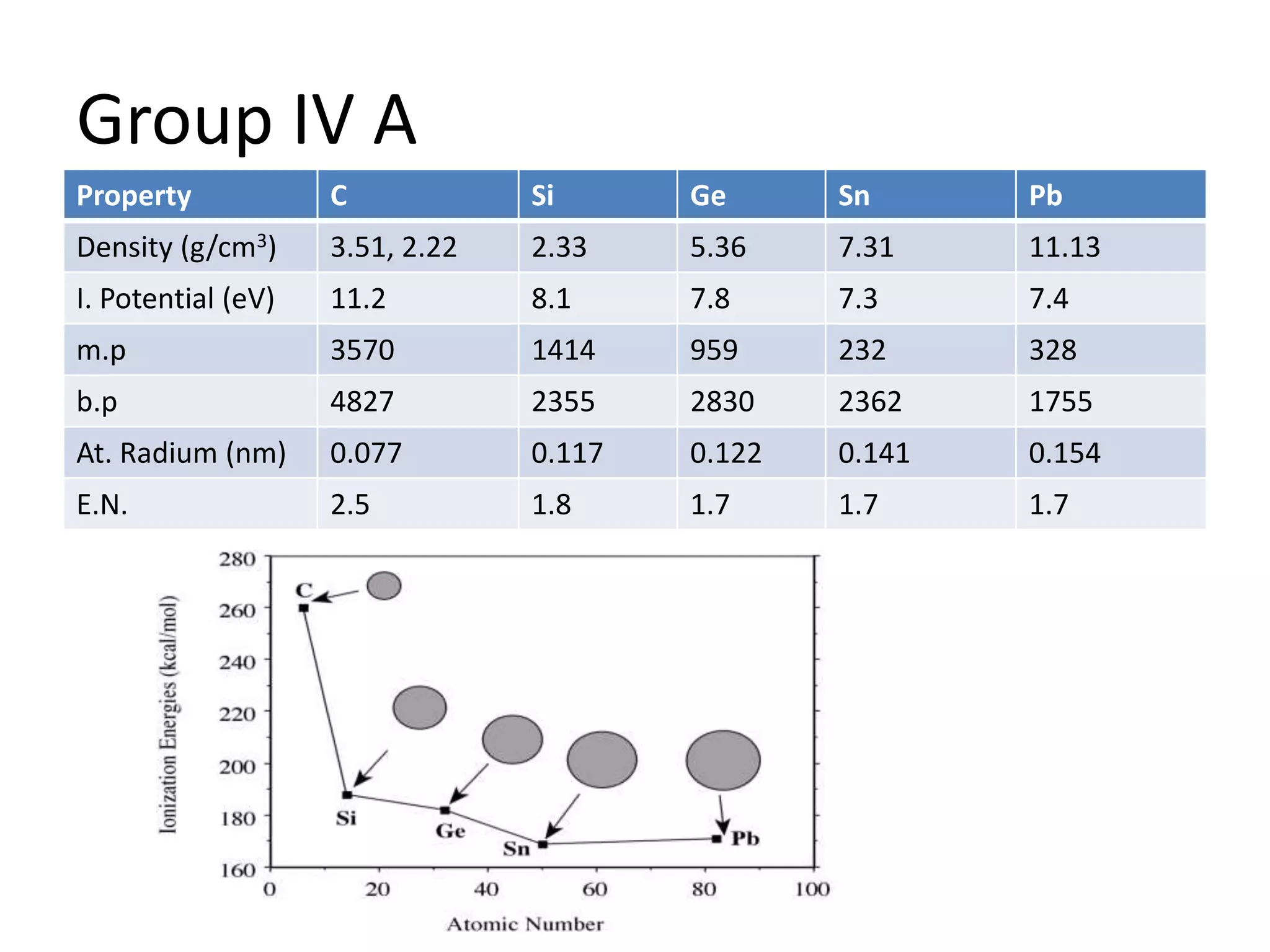
Group IV A
Property C Si Ge Sn Pb
Density (g/cm3) 3.51, 2.22 2.33 5.36 7.31 11.13
I. Potential (eV) 11.2 8.1 7.8 7.3 7.4
m.p 3570 1414 959 232 328
b.p 4827 2355 2830 2362 1755
At. Radium (nm) 0.077 0.117 0.122 0.141 0.154
E.N. 2.5 1.8 1.7 1.7 1.7
Properties
• At. radius, volume and density increase down the group
• m.p. and b.p. generally decrease. Inter atomic forces.
• Metallic character increases with increase in atomic number
• I.E. (C to Sn decreases, Pb higher, due to screening of d orbital)
• EN
• Allotropy – all elements except Pb
• Oxidation states C , Si +4, Ge, Sn, Pb +2, +4, inert pair effect increases
down the group, so M (+4) stability decreases
• Catenation decreases down the group. Due to decreases in energy of M-M
bond C-C 348, Si-Si 222, Ge-Ge 167, Sn-Sn 155, Pb-Pb 0
Carbon and Silicon
Similarities
• In nature
• Tetravalent
• Allotropy
• Oxygen –burn
• Covalent hydrides
• Similar halides
Differences
• 2 e, 8 e in penultimate shell
• Black solid , reddish brown
solid
• Catenation strong, weak
• No effect of alkali, aqueous
and fused alkali H2
• Covalency 4, 6
• CCl4 stable, SiCl4 less stable
Allotropy or allotropism is the property of
some chemical elements to exist in two or
more different forms, known as allotropes
of these elements. Allotropes are different
structural modifications of an element;
the atoms of the element are bonded
together in a different manner.
Carbon
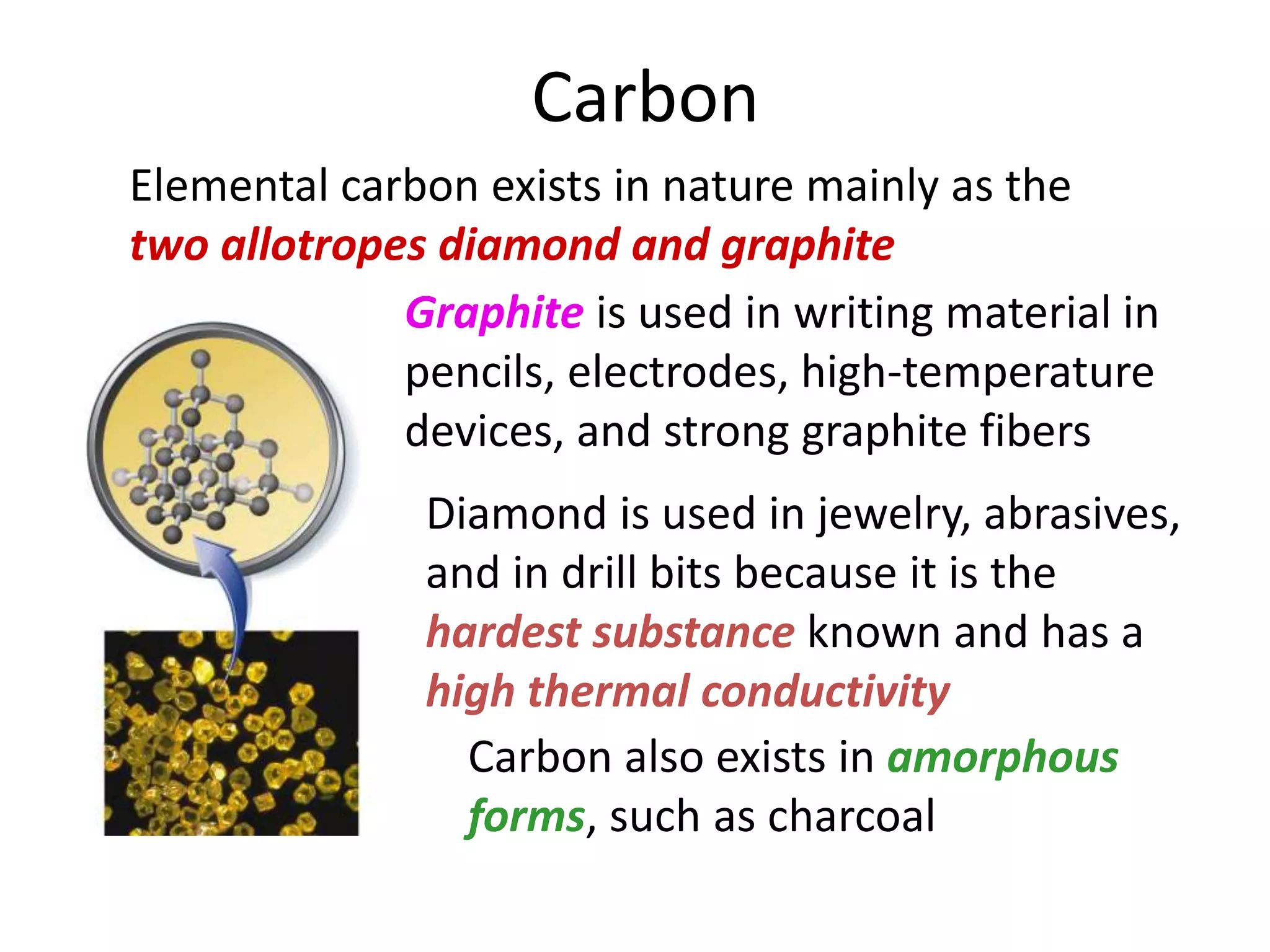
Elemental carbon exists in nature mainly as the
two allotropes diamond and graphite
Graphite is used in writing material in
pencils, electrodes, high-temperature
devices, and strong graphite fibers
Carbon also exists in amorphous
forms, such as charcoal
Diamond is used in jewelry, abrasives,
and in drill bits because it is the
hardest substance known and has a
high thermal conductivity
Green-house effect
The greenhouse effect is a
process by which thermal
radiation from a planetary
surface is absorbed by
atmospheric greenhouse gases,
and is re-radiated in all
directions. Since part of this re-
radiation is back towards the
surface, energy is transferred to
the surface and the lower
atmosphere. As a result, the
average surface temperature is
higher than it would be if direct
heating by solar radiation were
the only warming mechanism
Silicon
• 2nd most abundant element, found with
Oxygen
• 27.6% by weight of Earth Crust
• SiO2 – quartz, flintz, agate and sand
• Silicon – hard, brittle, solid
• Diamond like structure
Silicones
• RSiCl3, R2SiCl2 hydrolize to give silicols
• Condensation of silicols with elimination of
water gives silicones
Silicones
Oils, viscous fluids, resins, rubber like solids
• Silicon-oil highly stable, non volatile. Vacuum pumps
• Not too viscous on cooling – low T lubrication
• Vaseline like greases – aeroplanes -40 – 200 C
• Water-repellents – water proof paper
• Insulating materials
Silicates
• Metal derivatives of silicic acid
• Meta- (H2SiO3) ortho- (H4SiO4) and pyro-silicic
acid (H6Si2O7)
• Fusing metal oxide or carbonate with sand
Na2CO3 + SiO2 Na2SiO4, (Na2SiO3)n etc
• Some silicates of Alkali metals are soluble in
water. Na, K silicates are soluble glass
Silicates
• XRD – silicates have SiO4
4- anions – sp3
hybridization, tetrahedral geometry
• Orthosilicates
• Pyrosilicates
• Ring or cyclic silicates
• Metasilicates of chain silicates
• Sheet silicates
• Three dimensional silicates
Carbon and silicon1

Carbon and silicon1

  • 1.
  • 2.
    Group IV A(14) 2s2 2p2 3s2 3p2 3d10 4s2 4p2 4d10 5s2 5p2 5d10 6s2 6p2
  • 3.
    Group IV A PropertyC Si Ge Sn Pb Density (g/cm3) 3.51, 2.22 2.33 5.36 7.31 11.13 I. Potential (eV) 11.2 8.1 7.8 7.3 7.4 m.p 3570 1414 959 232 328 b.p 4827 2355 2830 2362 1755 At. Radium (nm) 0.077 0.117 0.122 0.141 0.154 E.N. 2.5 1.8 1.7 1.7 1.7
  • 4.
    Properties • At. radius,volume and density increase down the group • m.p. and b.p. generally decrease. Inter atomic forces. • Metallic character increases with increase in atomic number • I.E. (C to Sn decreases, Pb higher, due to screening of d orbital) • EN • Allotropy – all elements except Pb • Oxidation states C , Si +4, Ge, Sn, Pb +2, +4, inert pair effect increases down the group, so M (+4) stability decreases • Catenation decreases down the group. Due to decreases in energy of M-M bond C-C 348, Si-Si 222, Ge-Ge 167, Sn-Sn 155, Pb-Pb 0
  • 5.
    Carbon and Silicon Similarities •In nature • Tetravalent • Allotropy • Oxygen –burn • Covalent hydrides • Similar halides Differences • 2 e, 8 e in penultimate shell • Black solid , reddish brown solid • Catenation strong, weak • No effect of alkali, aqueous and fused alkali H2 • Covalency 4, 6 • CCl4 stable, SiCl4 less stable
  • 6.
    Allotropy or allotropismis the property of some chemical elements to exist in two or more different forms, known as allotropes of these elements. Allotropes are different structural modifications of an element; the atoms of the element are bonded together in a different manner.
  • 8.
    Carbon Elemental carbon existsin nature mainly as the two allotropes diamond and graphite Graphite is used in writing material in pencils, electrodes, high-temperature devices, and strong graphite fibers Carbon also exists in amorphous forms, such as charcoal Diamond is used in jewelry, abrasives, and in drill bits because it is the hardest substance known and has a high thermal conductivity
  • 13.
    Green-house effect The greenhouseeffect is a process by which thermal radiation from a planetary surface is absorbed by atmospheric greenhouse gases, and is re-radiated in all directions. Since part of this re- radiation is back towards the surface, energy is transferred to the surface and the lower atmosphere. As a result, the average surface temperature is higher than it would be if direct heating by solar radiation were the only warming mechanism
  • 14.
    Silicon • 2nd mostabundant element, found with Oxygen • 27.6% by weight of Earth Crust • SiO2 – quartz, flintz, agate and sand • Silicon – hard, brittle, solid • Diamond like structure
  • 15.
    Silicones • RSiCl3, R2SiCl2hydrolize to give silicols • Condensation of silicols with elimination of water gives silicones
  • 16.
    Silicones Oils, viscous fluids,resins, rubber like solids • Silicon-oil highly stable, non volatile. Vacuum pumps • Not too viscous on cooling – low T lubrication • Vaseline like greases – aeroplanes -40 – 200 C • Water-repellents – water proof paper • Insulating materials
  • 17.
    Silicates • Metal derivativesof silicic acid • Meta- (H2SiO3) ortho- (H4SiO4) and pyro-silicic acid (H6Si2O7) • Fusing metal oxide or carbonate with sand Na2CO3 + SiO2 Na2SiO4, (Na2SiO3)n etc • Some silicates of Alkali metals are soluble in water. Na, K silicates are soluble glass
  • 18.
    Silicates • XRD –silicates have SiO4 4- anions – sp3 hybridization, tetrahedral geometry • Orthosilicates • Pyrosilicates • Ring or cyclic silicates • Metasilicates of chain silicates • Sheet silicates • Three dimensional silicates