Sikkim Manipal University
                              Assignment BLOO43
                   Roll No-621132459(Vipin Pant)4rh semester


1) What are acid-base disorders? Explain its biochemical findings. Add a
   note on regulation of acid-base balance

       Ans- Acid–base imbalance is an abnormality of the human body's normal balance of
       acids and bases that causes the plasma pH to deviate out of the normal range (7.35 to
       7.45). In the fetus, the normal range differs based on which umbilical vessel is
       sampled (umbilical vein pH is normally 7.25 to 7.45; umbilical artery pH is normally
       7.18 to 7.38).[1] It can exist in varying levels of severity, some life-threatening.
       Classification


       A Davenport diagram illustrates acid–base imbalance graphically.
       An excess of acid is called acidosis and an excess in bases is called alkalosis. The
       process that causes the imbalance is classified based on theetiology of the disturbance
       (respiratory or metabolic) and the direction of change in pH (acidosis or alkalosis).
       This yields the following four basic processes:

       process              pH     carbon dioxide compensation


       metabolic acidosis   down down               respiratory


       respiratory acidosis down up                 renal


       metabolic alkalosis up      up               respiratory


       respiratory alkalosis up    down             renal

       ]Mixed disorders
       The presence of only one of the above derangements is called a simple acid–base
       disorder. In a mixed disorder more than one is occurring at the same time.[2] Mixed
       disorders may feature an acidosis and alkosis at the same time that partially counteract
       each other, or there can be two different conditions affecting the pH in the same
       direction. The phrase "mixed acidosis", for example, refers to metabolic acidosis in
       conjunction withrespiratory acidosis. Any combination is possible, except concurrent
       respiratory acidosis and respiratory alkalosis, since a person cannot breathe too fast
       and too slow at the same time.
Explain its biochemical findings-:
Biochemists usually discuss acids and bases in terms of their ability to donate and
accept protons; that is, they use the Brønsted definition of acids and bases. A few
concepts from general chemistry are important to help organize your thoughts about
biochemical acids and bases:
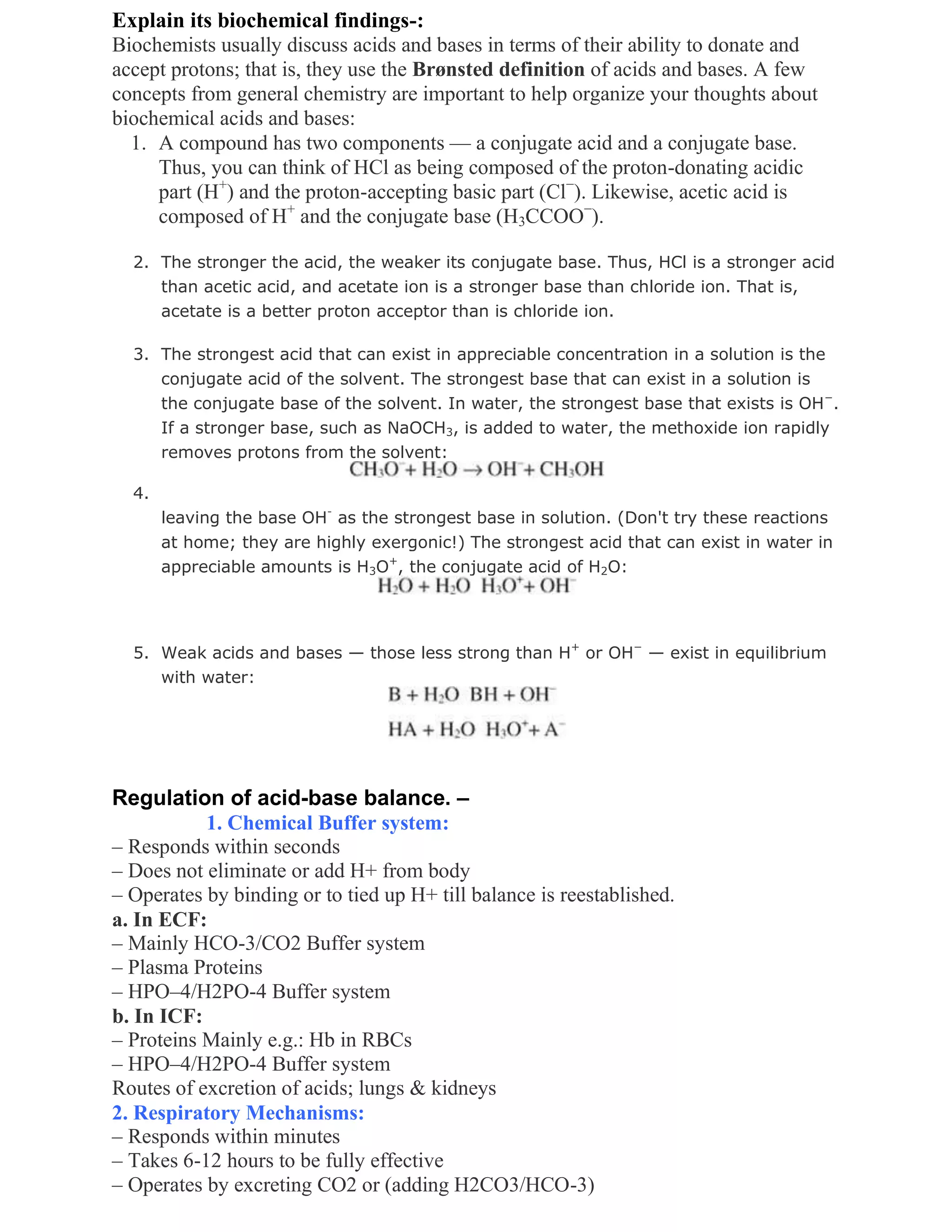
  1. A compound has two components — a conjugate acid and a conjugate base.
     Thus, you can think of HCl as being composed of the proton-donating acidic
     part (H+) and the proton-accepting basic part (Cl−). Likewise, acetic acid is
     composed of H+ and the conjugate base (H3CCOO−).

  2. The stronger the acid, the weaker its conjugate base. Thus, HCl is a stronger acid
     than acetic acid, and acetate ion is a stronger base than chloride ion. That is,
     acetate is a better proton acceptor than is chloride ion.

  3. The strongest acid that can exist in appreciable concentration in a solution is the
     conjugate acid of the solvent. The strongest base that can exist in a solution is
     the conjugate base of the solvent. In water, the strongest base that exists is OH−.
     If a stronger base, such as NaOCH3, is added to water, the methoxide ion rapidly
     removes protons from the solvent:

  4.
       leaving the base OH- as the strongest base in solution. (Don't try these reactions
       at home; they are highly exergonic!) The strongest acid that can exist in water in
       appreciable amounts is H3O+, the conjugate acid of H2O:


  5. Weak acids and bases — those less strong than H+ or OH− — exist in equilibrium
     with water:


Regulation of acid-base balance. –
           1. Chemical Buffer system:
– Responds within seconds
– Does not eliminate or add H+ from body
– Operates by binding or to tied up H+ till balance is reestablished.
a. In ECF:
– Mainly HCO-3/CO2 Buffer system
– Plasma Proteins
– HPO–4/H2PO-4 Buffer system
b. In ICF:
– Proteins Mainly e.g.: Hb in RBCs
– HPO–4/H2PO-4 Buffer system
Routes of excretion of acids; lungs & kidneys
2. Respiratory Mechanisms:
– Responds within minutes
– Takes 6-12 hours to be fully effective
– Operates by excreting CO2 or (adding H2CO3/HCO-3)
3. Renal Mechanisms:
    • Responds slowly (effectively in 3-5 days)
    • Eliminates excess Acids or Base from body
    • The most powerful mechanism
    e.g. i. HCO-3/CO2 Buffer system
    ii. NH3/NH+4 Buffer system
    iii. HPO–4/H2PO-4 Buffer system
    Chemical Buffer System
    • Consists of a ‗pair of substances‘ present in a mixture of a solution that ‗minimizes
    pH changes‘ when an ‗acid or base‘ is ‗added or removed‘ from the solution.
    • Consists of;
    1. Carbonic Acid – Bicarbonate Buffer System
    2. Phosphate Buffer system
    3. Protein Buffer system
    Chemical Buffer System of ECF
    1. Bicarbonate Buffer System: H2CO3/NaHCO3
    consists of H2CO3 (weak Acid) + NaHCO3 (Bicarbonate salt)
    – CO2 + H2O ↔H2CO3 ↔ H+ + HCO-3
    – NaHCO3 ↔ Na+ + HCO-3 → H2CO3 → CO2 + H2O
    Bicarbonate buffer system is quantitatively the most powerful ECF buffer system
    Its two components HCO-3 & CO2 are precisely regulated by kidneys & lungs.

    2. Phosphate Buffer System:
    – Not of major importance in ECF
    – Only 8% of the conc. of HCO-3 Buffer system
    – Comprised of HPO–4/H2PO-4
    – Plays major role in ICF & in Renal tubules
    3. Proteins: (ICF proteins, Hb, Plasma proteins)
    – Excellent buffers as proteins contain both Acidic & Basic groups.
    – More important in ICF H2CO3 ← H2O + CO2
    HCO-3 + H+ + HbO2 ↔ H.Hb + O2
    – In RBCs, Hb is important
    – 60-70% of total chemical buffering of body fluids inside the
    cells & in ICF is by proteins.
    – Hb buffers H+ ions generated by H2CO3
    – Proteins are the most abundant buffers in cells & in blood
    – Histidine and Cysteine are the two A. Acids that contribute
    most of the buffering capacity of proteins
    Respiratory Mechanisms in Regulation of Acid-Base
    • Second line of defense against acid base disturbances
    • Operates through regulation of ECF CO2 concentration by lungs
    • Effectiveness between 50-75% [feedback gain is 1-3 i.e. fall in pH
    from 7.4 to 7.0 is returned by Resp System to 7.2 to 7.3 within 3-12
    minutes]


       2) Discuss the advantages of automation in clinical biochemistry
laboratory. Make a list of few (at least five) automated instruments
available for biochemical analysis. Discuss the principle of each .
Ans- Automation in clinical biochemistry laboratory- Clinical pathology or
laboratory medicine has a great influence on clinical decisions and 60–70% of the
most important decisions on admission, discharge, and medication are based on
laboratory results.1 As we learn more about clinical laboratory results and incorporate
them in outcome optimization schemes, the laboratory will play a more pivotal role in
management of patients and the eventual outcomes.2 It has been stated that the
development of information technology and automation in laboratory medicine has
allowed laboratory professionals to keep in pace with the growth in workload.3 In a
paper on ―robotics into the millennium,‖ the various types of automation have been
outlined4 while other authors have classified laboratory automation into total
laboratory automation, modular laboratory automation, and workcell/workstation
automation.5,6
This article evaluates the relationship of scientific staff, automation, and expert
systems in clinical chemistry with particular reference to the core laboratory and
ascertains staff requirements. The changes in work practices due to the introduction of
automation and computers in other industries are discussed and similarities with
clinical chemistry elucidated as it has been noted that the original total laboratory
automation was based on the manufacturing/factory model of production.7 Others
have also written on automation in various industries over the last century and how
the patterns of its implementation and effects can be applied to pathology.8 The goal
of a successful automation must be to change the way in which work is done in the
laboratory and this involves changing not only the tools and processes, but also the
job structure and ultimately the way people think about their work.7 The progress in
automation and convergence of technologies are two key factors, which particularly
affect how we think about the future of clinical chemistry.9 The role of the scientific
staff, use of automation and expert systems shall be discussed for a core laboratory
focusing on the Monash Medical Centre, Melbourne, Victoria, Australia where one of
the authors is based. It is our belief that to consolidate changes that are advocated,7 it
is important to look at skill requirements and training of the operatives in clinical
chemistry.

Four, flow type automatic biochemical analyzer
Flow type automatic biochemical analyzer can be divided into air staging system and
non segmented system. The former is a most typical flow analyzer.


(a) air staging system

The analyzer is through proportional pump extrusion elastic sample tube, air pipe and
the reagent tube (commonly known as the "tube"), the sample sequentially inhalation
and transported along the sample tube, on the other hand, by the air pipe into the
bubble will be determined by the same principle of inhalation and reagent
continuously flowing in pipeline is divided into segments of the reagent uniform,
sample and reagent flow in the process of continuous flow forward encounter, mixing,
absorption through (when necessary), thermal insulation, reaction and measured. The
analysis process is the flow process of continuous flow in the pipeline.


(two) non segmented system
Non segmented system is the reaction liquid, depending on the reagent blank or buffer
    to interval of each sample, the continuous flow in the pipeline liquid can not be
    segmented. Non segmented system can be divided into system and space system for
    flow.


    1, flow injection system

    The system composition and air segmentation system is similar, but some structure
    and working principle of different, air staging system is the use of the bubble to
    prevent cross contamination of the reaction liquid in the pipeline in the flow process
    of segmentation, and flow injection system is through the sample are injected to
    prevent cross contamination to continuous flow reagent flow in a pipe.


    2, clearance system

    The system structure, composition and working principle and flow injection system is
    similar, but its characteristic is each sample must be in the analysis process after the
    end of the previous samples (including pipeline cleaning) to start, but not
    continuously in turn into the sample, a time gap between each sample, it is person is
    not continuous flow analyzer.

          Principle-:
           air staging system
       With increasing use of biomass in combustion processes, the reduction of the
       related NOx
          emissions which originate mainly from the fuel nitrogen becomes more and
more important.
          Efficient primary measures for NOx reduction are staged combustion
techniques. Air staging
          has been investigated earlier and has found its way into practice. Since fuel
staging has not
          been applied with nonpulverized biomass yet, the aim of the present work was
to investigate the
          potential of fuel staging for NOx reduction in fixed bed systems. For this
purpose, a prototype
          understoker furnace of 75 kW thermal input with two fuel beds in series was
developed.
          Experiments were performed with wood chips (low nitrogen content) and UF-
chipboards (high
          nitrogen content) to investigate the influences of the main process parameters,
i.e., stoichiometric
          ratio, temperatures, residence time, and fuel properties on the conversion of
fuel nitrogen to
          N-species. The most important parameters were found to be the temperature
and the stoichiometric ratio in the reburn zone. The potential of fuel staging was
measured and compared with
          air staging and unstaged combustion. The experiments show that low NOx
emissions are already
achievable with fuel staging at lower temperatures than with air staging, i.e.,
900-1000 °C, and
         at a stoichiometric ratio of 0.85 in the reduction zone. The NOx reduction
achieved under optimum
         conditions for UF-chipboard as main fuel was 78% which is higher than with
air staging, where
         72% NOx reduction was measured. For wood chips both measures attained
about 66%. The
         nitrogen conversion during air and fuel staging has also been simulated using
a furnace model
         based on ideal flow patterns as perfectly stirred reactors and plug flow
reactors. A detailed reaction
         mechanism including the nitrogen chemistry (GRI-Mech 2.11) was
implemented. The trends found
         with this model are in good agreement with the experiments and they indicate
that even higher
         NOx reduction may be reached with improved process design. The
investigations show that fuel
         staging is a promising technology for NOx reduction also for fixed bed
biomass furnac


3) What is quality control? What are its components? Add a note on
implementation of external quality control in various biochemical tests
    Ans- quality control-:
    The automated analyzers in clinical laboratories Nowadays, the overwhelming
    majority of laboratory results in clinical laboratories is being generated by automated
    analyzers. Modern automated analyzers are highly sophisticated instruments which
    can produce a tremendous number of laboratory results in a very short time. This is
    achieved thanks to the integration of technologies from three different scientific
    fields: analytical chemistry, computer science and robotics. The combination of these
    technologies substitutes a huge number of glassware equipment and tedious, repetitive
    laboratory work. As a matter of fact, the laboratory routine work has diminished
    significantly. Today laboratory personnel‘s duties have been shifted from manual
    work to the maintenance of the equipment, internal and external quality control,
    instrument calibration and data management of the generated results.

    Components-:

    The purpose of a control is to aid the operator in deciding whether an analytical
    system is producing reliable results for a given assay, and ultimately whether to
    release the results. This unit presents information on the techniques for determining
    when results are in control or out of control.

    External quality assessment
This is the evaluation by an outside agency of the performance by a number of
   laboratories on specially supplied samples. Analysis of performance is retrospective.
   The objective is to achieve between lab and between method compatibility, but this
   doesn‘t guarantee accuracy unless the specimens have been assayed by a reference lab
   alongside a reference preparation of known value. Schemes are usually organized on a
   national or regional basis. Hence, EQA is mainly concerned with analytical part of the
   test.


4) List various methods used for estimation of serum calcium. Explain
the principle and procedure of any one method

   Ans- estimation of serum calcium-:

   Calcium is the most abundant mineral1
    and fifth
   most common element in the body.2 Almost all blood calcium is present in
   plasma and reference range
   is 2.10 to 2.65 mmol/L. It is present as free or ionized (50%), protein bound
   usually with albumin
   (40%) and complexes with small anions (10%). Calcium is needed for bone
   mineralisation, blood coagulation and influences the permeability and excitation
   of plasma membranes. It is usually monitored
   for hypoparathyroidism, hyperparathyroidism, vitamin D deficiency,
   malnutrition, cancers, enhanced
   renal retention, osteoporosis, etc.
    There are many different methods for estimation of serum calcium like
   spectrophotometeric, ion
   selective electrode (ISE) and atomic absorption methods. The
   spectrophotometric techniques use metallochromic indicators which change
   color when
   they bind to calcium. Arsenazo III and o-Cresolphthalein Complexone (CPC)
   methods are the two spectrophotometric techniques frequently used.
    Aim of our study was to compare serum calcium
   estimation by CPC method using direct colorimetric
   and volume / volume colorimeteric (v/v) methods.
   The principle of CPC method is that calcium reacts
   with CPC in an alkaline medium to form a red coloured complex. This complex
   is measured at a wavelength at 570 nm. Sample is diluted with aci to release
   protein bound and complexed calcium. Diethylamine, 2-amino-2-methyl-1-
   propranolol or 2-
   ethylaminoethanol is added to buffer the solution
   and provide an alkaline medium.3 Effect of magnesium can be minimised either
   by adding 8-hydroxyquinolone, buffering the solution to pH of around
   12 or by measuring absorbance at 580 nm.

   MATERIALS AND METHODS

   The study was performed in a tertiary care laboratory in Rawalpindi from
   March to June ‘2011. It was
a prospective comparative study. Seventy quality
control samples of Randox laboratories were used of
these thirty five were normal controls while thirty
five were abnormal controls. Controls were tested
simultaneously on both the kits provided by SS diagnostics using a fully
automated chemistry analyser
(Selectra E). Data was recorded using specially designed proformas and results
were analysed using
SPSS version 17.
RESULTS
Our results showed that in normal control samples
with a target of 2.33 mmol/L where the range of
calcium was 2.10 to 2.56 mmol/L. The v/v method
kit gave the mean result of 2.34 mmol/L ± 0.04
with a CV of 1.70%. With the direct calorimetric

Principle of GOD-POD-

Intended Use
The reagents are used for the quantitative determination of
Glucose in serum or plasma. For in-vitro diagnostic use only.
Introduction
Glucose is the reducing monosaccharide that serves as the
principal source of cellular energy in the body. It enters into the
cell under the influence of insulin and undergoes a series of
chemical reactions to produce energy. Lack of insulin or
resistance to its action at the cellular level causes diabetes.
Therefore, in diabetes mellitus the blood glucose level are
very high. However, high blood glucose level is also observed
in the pancreatitis, pituitary or thyroid dysfunction, renal
failure and liver disease whereas low glucose level is
associated with starvation, hyperinsulinaemia, neopalasms
or insulin induced hypoglycemia.
Method
GOD-POD method, End Point.

Principle

Glucose is oxidized by glucose oxidase(GOD) to produce
gluconate and hydrogen peroxide. The hydrogen peroxide is
then oxidatively coupled with 4 amino- antipyrene(4-AAP)
and phenol in the presence of peroxidase(POD) to yield a red
quinoeimine dye that is measured at 505nm. The absorbance
at 505 nm is proportional to concentration of glucose in the
sample.
Glucose +2H2O + O2
 Gluconate + H2O2
2H O + 4-AAP + Phenol Quinoeimine Dye 2 2
Absorbance of the colored solution is directly proportional to
the glucose concentration, when measured at 505nm
Sikkim manipal   university.. secoun

Sikkim manipal university.. secoun

  • 1.
    Sikkim Manipal University Assignment BLOO43 Roll No-621132459(Vipin Pant)4rh semester 1) What are acid-base disorders? Explain its biochemical findings. Add a note on regulation of acid-base balance Ans- Acid–base imbalance is an abnormality of the human body's normal balance of acids and bases that causes the plasma pH to deviate out of the normal range (7.35 to 7.45). In the fetus, the normal range differs based on which umbilical vessel is sampled (umbilical vein pH is normally 7.25 to 7.45; umbilical artery pH is normally 7.18 to 7.38).[1] It can exist in varying levels of severity, some life-threatening. Classification A Davenport diagram illustrates acid–base imbalance graphically. An excess of acid is called acidosis and an excess in bases is called alkalosis. The process that causes the imbalance is classified based on theetiology of the disturbance (respiratory or metabolic) and the direction of change in pH (acidosis or alkalosis). This yields the following four basic processes: process pH carbon dioxide compensation metabolic acidosis down down respiratory respiratory acidosis down up renal metabolic alkalosis up up respiratory respiratory alkalosis up down renal ]Mixed disorders The presence of only one of the above derangements is called a simple acid–base disorder. In a mixed disorder more than one is occurring at the same time.[2] Mixed disorders may feature an acidosis and alkosis at the same time that partially counteract each other, or there can be two different conditions affecting the pH in the same direction. The phrase "mixed acidosis", for example, refers to metabolic acidosis in conjunction withrespiratory acidosis. Any combination is possible, except concurrent respiratory acidosis and respiratory alkalosis, since a person cannot breathe too fast and too slow at the same time.
  • 2.
    Explain its biochemicalfindings-: Biochemists usually discuss acids and bases in terms of their ability to donate and accept protons; that is, they use the Brønsted definition of acids and bases. A few concepts from general chemistry are important to help organize your thoughts about biochemical acids and bases: 1. A compound has two components — a conjugate acid and a conjugate base. Thus, you can think of HCl as being composed of the proton-donating acidic part (H+) and the proton-accepting basic part (Cl−). Likewise, acetic acid is composed of H+ and the conjugate base (H3CCOO−). 2. The stronger the acid, the weaker its conjugate base. Thus, HCl is a stronger acid than acetic acid, and acetate ion is a stronger base than chloride ion. That is, acetate is a better proton acceptor than is chloride ion. 3. The strongest acid that can exist in appreciable concentration in a solution is the conjugate acid of the solvent. The strongest base that can exist in a solution is the conjugate base of the solvent. In water, the strongest base that exists is OH−. If a stronger base, such as NaOCH3, is added to water, the methoxide ion rapidly removes protons from the solvent: 4. leaving the base OH- as the strongest base in solution. (Don't try these reactions at home; they are highly exergonic!) The strongest acid that can exist in water in appreciable amounts is H3O+, the conjugate acid of H2O: 5. Weak acids and bases — those less strong than H+ or OH− — exist in equilibrium with water: Regulation of acid-base balance. – 1. Chemical Buffer system: – Responds within seconds – Does not eliminate or add H+ from body – Operates by binding or to tied up H+ till balance is reestablished. a. In ECF: – Mainly HCO-3/CO2 Buffer system – Plasma Proteins – HPO–4/H2PO-4 Buffer system b. In ICF: – Proteins Mainly e.g.: Hb in RBCs – HPO–4/H2PO-4 Buffer system Routes of excretion of acids; lungs & kidneys 2. Respiratory Mechanisms: – Responds within minutes – Takes 6-12 hours to be fully effective – Operates by excreting CO2 or (adding H2CO3/HCO-3)
  • 3.
    3. Renal Mechanisms: • Responds slowly (effectively in 3-5 days) • Eliminates excess Acids or Base from body • The most powerful mechanism e.g. i. HCO-3/CO2 Buffer system ii. NH3/NH+4 Buffer system iii. HPO–4/H2PO-4 Buffer system Chemical Buffer System • Consists of a ‗pair of substances‘ present in a mixture of a solution that ‗minimizes pH changes‘ when an ‗acid or base‘ is ‗added or removed‘ from the solution. • Consists of; 1. Carbonic Acid – Bicarbonate Buffer System 2. Phosphate Buffer system 3. Protein Buffer system Chemical Buffer System of ECF 1. Bicarbonate Buffer System: H2CO3/NaHCO3 consists of H2CO3 (weak Acid) + NaHCO3 (Bicarbonate salt) – CO2 + H2O ↔H2CO3 ↔ H+ + HCO-3 – NaHCO3 ↔ Na+ + HCO-3 → H2CO3 → CO2 + H2O Bicarbonate buffer system is quantitatively the most powerful ECF buffer system Its two components HCO-3 & CO2 are precisely regulated by kidneys & lungs. 2. Phosphate Buffer System: – Not of major importance in ECF – Only 8% of the conc. of HCO-3 Buffer system – Comprised of HPO–4/H2PO-4 – Plays major role in ICF & in Renal tubules 3. Proteins: (ICF proteins, Hb, Plasma proteins) – Excellent buffers as proteins contain both Acidic & Basic groups. – More important in ICF H2CO3 ← H2O + CO2 HCO-3 + H+ + HbO2 ↔ H.Hb + O2 – In RBCs, Hb is important – 60-70% of total chemical buffering of body fluids inside the cells & in ICF is by proteins. – Hb buffers H+ ions generated by H2CO3 – Proteins are the most abundant buffers in cells & in blood – Histidine and Cysteine are the two A. Acids that contribute most of the buffering capacity of proteins Respiratory Mechanisms in Regulation of Acid-Base • Second line of defense against acid base disturbances • Operates through regulation of ECF CO2 concentration by lungs • Effectiveness between 50-75% [feedback gain is 1-3 i.e. fall in pH from 7.4 to 7.0 is returned by Resp System to 7.2 to 7.3 within 3-12 minutes] 2) Discuss the advantages of automation in clinical biochemistry laboratory. Make a list of few (at least five) automated instruments available for biochemical analysis. Discuss the principle of each .
  • 4.
    Ans- Automation inclinical biochemistry laboratory- Clinical pathology or laboratory medicine has a great influence on clinical decisions and 60–70% of the most important decisions on admission, discharge, and medication are based on laboratory results.1 As we learn more about clinical laboratory results and incorporate them in outcome optimization schemes, the laboratory will play a more pivotal role in management of patients and the eventual outcomes.2 It has been stated that the development of information technology and automation in laboratory medicine has allowed laboratory professionals to keep in pace with the growth in workload.3 In a paper on ―robotics into the millennium,‖ the various types of automation have been outlined4 while other authors have classified laboratory automation into total laboratory automation, modular laboratory automation, and workcell/workstation automation.5,6 This article evaluates the relationship of scientific staff, automation, and expert systems in clinical chemistry with particular reference to the core laboratory and ascertains staff requirements. The changes in work practices due to the introduction of automation and computers in other industries are discussed and similarities with clinical chemistry elucidated as it has been noted that the original total laboratory automation was based on the manufacturing/factory model of production.7 Others have also written on automation in various industries over the last century and how the patterns of its implementation and effects can be applied to pathology.8 The goal of a successful automation must be to change the way in which work is done in the laboratory and this involves changing not only the tools and processes, but also the job structure and ultimately the way people think about their work.7 The progress in automation and convergence of technologies are two key factors, which particularly affect how we think about the future of clinical chemistry.9 The role of the scientific staff, use of automation and expert systems shall be discussed for a core laboratory focusing on the Monash Medical Centre, Melbourne, Victoria, Australia where one of the authors is based. It is our belief that to consolidate changes that are advocated,7 it is important to look at skill requirements and training of the operatives in clinical chemistry. Four, flow type automatic biochemical analyzer Flow type automatic biochemical analyzer can be divided into air staging system and non segmented system. The former is a most typical flow analyzer. (a) air staging system The analyzer is through proportional pump extrusion elastic sample tube, air pipe and the reagent tube (commonly known as the "tube"), the sample sequentially inhalation and transported along the sample tube, on the other hand, by the air pipe into the bubble will be determined by the same principle of inhalation and reagent continuously flowing in pipeline is divided into segments of the reagent uniform, sample and reagent flow in the process of continuous flow forward encounter, mixing, absorption through (when necessary), thermal insulation, reaction and measured. The analysis process is the flow process of continuous flow in the pipeline. (two) non segmented system
  • 5.
    Non segmented systemis the reaction liquid, depending on the reagent blank or buffer to interval of each sample, the continuous flow in the pipeline liquid can not be segmented. Non segmented system can be divided into system and space system for flow. 1, flow injection system The system composition and air segmentation system is similar, but some structure and working principle of different, air staging system is the use of the bubble to prevent cross contamination of the reaction liquid in the pipeline in the flow process of segmentation, and flow injection system is through the sample are injected to prevent cross contamination to continuous flow reagent flow in a pipe. 2, clearance system The system structure, composition and working principle and flow injection system is similar, but its characteristic is each sample must be in the analysis process after the end of the previous samples (including pipeline cleaning) to start, but not continuously in turn into the sample, a time gap between each sample, it is person is not continuous flow analyzer. Principle-: air staging system With increasing use of biomass in combustion processes, the reduction of the related NOx emissions which originate mainly from the fuel nitrogen becomes more and more important. Efficient primary measures for NOx reduction are staged combustion techniques. Air staging has been investigated earlier and has found its way into practice. Since fuel staging has not been applied with nonpulverized biomass yet, the aim of the present work was to investigate the potential of fuel staging for NOx reduction in fixed bed systems. For this purpose, a prototype understoker furnace of 75 kW thermal input with two fuel beds in series was developed. Experiments were performed with wood chips (low nitrogen content) and UF- chipboards (high nitrogen content) to investigate the influences of the main process parameters, i.e., stoichiometric ratio, temperatures, residence time, and fuel properties on the conversion of fuel nitrogen to N-species. The most important parameters were found to be the temperature and the stoichiometric ratio in the reburn zone. The potential of fuel staging was measured and compared with air staging and unstaged combustion. The experiments show that low NOx emissions are already
  • 6.
    achievable with fuelstaging at lower temperatures than with air staging, i.e., 900-1000 °C, and at a stoichiometric ratio of 0.85 in the reduction zone. The NOx reduction achieved under optimum conditions for UF-chipboard as main fuel was 78% which is higher than with air staging, where 72% NOx reduction was measured. For wood chips both measures attained about 66%. The nitrogen conversion during air and fuel staging has also been simulated using a furnace model based on ideal flow patterns as perfectly stirred reactors and plug flow reactors. A detailed reaction mechanism including the nitrogen chemistry (GRI-Mech 2.11) was implemented. The trends found with this model are in good agreement with the experiments and they indicate that even higher NOx reduction may be reached with improved process design. The investigations show that fuel staging is a promising technology for NOx reduction also for fixed bed biomass furnac 3) What is quality control? What are its components? Add a note on implementation of external quality control in various biochemical tests Ans- quality control-: The automated analyzers in clinical laboratories Nowadays, the overwhelming majority of laboratory results in clinical laboratories is being generated by automated analyzers. Modern automated analyzers are highly sophisticated instruments which can produce a tremendous number of laboratory results in a very short time. This is achieved thanks to the integration of technologies from three different scientific fields: analytical chemistry, computer science and robotics. The combination of these technologies substitutes a huge number of glassware equipment and tedious, repetitive laboratory work. As a matter of fact, the laboratory routine work has diminished significantly. Today laboratory personnel‘s duties have been shifted from manual work to the maintenance of the equipment, internal and external quality control, instrument calibration and data management of the generated results. Components-: The purpose of a control is to aid the operator in deciding whether an analytical system is producing reliable results for a given assay, and ultimately whether to release the results. This unit presents information on the techniques for determining when results are in control or out of control. External quality assessment
  • 7.
    This is theevaluation by an outside agency of the performance by a number of laboratories on specially supplied samples. Analysis of performance is retrospective. The objective is to achieve between lab and between method compatibility, but this doesn‘t guarantee accuracy unless the specimens have been assayed by a reference lab alongside a reference preparation of known value. Schemes are usually organized on a national or regional basis. Hence, EQA is mainly concerned with analytical part of the test. 4) List various methods used for estimation of serum calcium. Explain the principle and procedure of any one method Ans- estimation of serum calcium-: Calcium is the most abundant mineral1 and fifth most common element in the body.2 Almost all blood calcium is present in plasma and reference range is 2.10 to 2.65 mmol/L. It is present as free or ionized (50%), protein bound usually with albumin (40%) and complexes with small anions (10%). Calcium is needed for bone mineralisation, blood coagulation and influences the permeability and excitation of plasma membranes. It is usually monitored for hypoparathyroidism, hyperparathyroidism, vitamin D deficiency, malnutrition, cancers, enhanced renal retention, osteoporosis, etc. There are many different methods for estimation of serum calcium like spectrophotometeric, ion selective electrode (ISE) and atomic absorption methods. The spectrophotometric techniques use metallochromic indicators which change color when they bind to calcium. Arsenazo III and o-Cresolphthalein Complexone (CPC) methods are the two spectrophotometric techniques frequently used. Aim of our study was to compare serum calcium estimation by CPC method using direct colorimetric and volume / volume colorimeteric (v/v) methods. The principle of CPC method is that calcium reacts with CPC in an alkaline medium to form a red coloured complex. This complex is measured at a wavelength at 570 nm. Sample is diluted with aci to release protein bound and complexed calcium. Diethylamine, 2-amino-2-methyl-1- propranolol or 2- ethylaminoethanol is added to buffer the solution and provide an alkaline medium.3 Effect of magnesium can be minimised either by adding 8-hydroxyquinolone, buffering the solution to pH of around 12 or by measuring absorbance at 580 nm. MATERIALS AND METHODS The study was performed in a tertiary care laboratory in Rawalpindi from March to June ‘2011. It was
  • 8.
    a prospective comparativestudy. Seventy quality control samples of Randox laboratories were used of these thirty five were normal controls while thirty five were abnormal controls. Controls were tested simultaneously on both the kits provided by SS diagnostics using a fully automated chemistry analyser (Selectra E). Data was recorded using specially designed proformas and results were analysed using SPSS version 17. RESULTS Our results showed that in normal control samples with a target of 2.33 mmol/L where the range of calcium was 2.10 to 2.56 mmol/L. The v/v method kit gave the mean result of 2.34 mmol/L ± 0.04 with a CV of 1.70%. With the direct calorimetric Principle of GOD-POD- Intended Use The reagents are used for the quantitative determination of Glucose in serum or plasma. For in-vitro diagnostic use only. Introduction Glucose is the reducing monosaccharide that serves as the principal source of cellular energy in the body. It enters into the cell under the influence of insulin and undergoes a series of chemical reactions to produce energy. Lack of insulin or resistance to its action at the cellular level causes diabetes. Therefore, in diabetes mellitus the blood glucose level are very high. However, high blood glucose level is also observed in the pancreatitis, pituitary or thyroid dysfunction, renal failure and liver disease whereas low glucose level is associated with starvation, hyperinsulinaemia, neopalasms or insulin induced hypoglycemia. Method GOD-POD method, End Point. Principle Glucose is oxidized by glucose oxidase(GOD) to produce gluconate and hydrogen peroxide. The hydrogen peroxide is then oxidatively coupled with 4 amino- antipyrene(4-AAP) and phenol in the presence of peroxidase(POD) to yield a red quinoeimine dye that is measured at 505nm. The absorbance at 505 nm is proportional to concentration of glucose in the sample. Glucose +2H2O + O2 Gluconate + H2O2 2H O + 4-AAP + Phenol Quinoeimine Dye 2 2 Absorbance of the colored solution is directly proportional to the glucose concentration, when measured at 505nm