BEHAVIOURAL
TRAITS UNDER
NATURAL SELECTION
SHWETA PATEL
Id no. - 42537
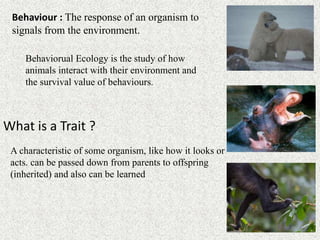
What is a Trait ?
A characteristic of some organism, like how it looks or
acts. can be passed down from parents to offspring
(inherited) and also can be learned
Behaviour : The response of an organism to
signals from the environment.
Behaviorual Ecology is the study of how
animals interact with their environment and
the survival value of behaviours.
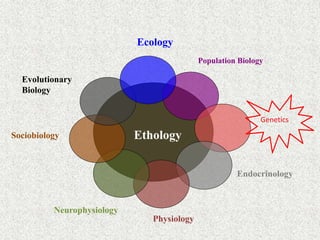
Ethology
Ecology
Population Biology
Genetics
Endocrinology
Physiology
Neurophysiology
Sociobiology
Evolutionary
Biology
Natural selection
Natural selection: organisms with the most favourable
traits survive in the natural environment and reproduce
most successfully.
The concept of selection is central to Darwin's theory of
evolution. Behaviours that increase mating
opportunities and survival will enhance reproductive
success.
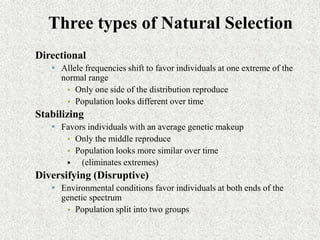
Three types of Natural Selection
Directional
 Allele frequencies shift to favor individuals at one extreme of the
normal range
 Only one side of the distribution reproduce
 Population looks different over time
Stabilizing
 Favors individuals with an average genetic makeup
 Only the middle reproduce
 Population looks more similar over time
 (eliminates extremes)
Diversifying (Disruptive)
 Environmental conditions favor individuals at both ends of the
genetic spectrum
 Population split into two groups
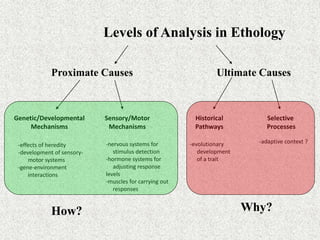
Levels of Analysis in Ethology
Proximate Causes Ultimate Causes
Genetic/Developmental
Mechanisms
Sensory/Motor
Mechanisms
Historical
Pathways
Selective
Processes
-effects of heredity
-development of sensory-
motor systems
-gene-environment
interactions
-nervous systems for
stimulus detection
-hormone systems for
adjusting response
levels
-muscles for carrying out
responses
-adaptive context ?-evolutionary
development
of a trait
How? Why?
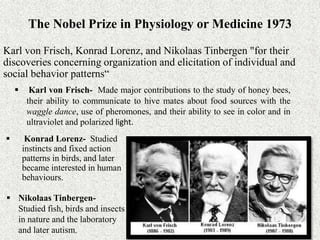
The Nobel Prize in Physiology or Medicine 1973
Karl von Frisch, Konrad Lorenz, and Nikolaas Tinbergen "for their
discoveries concerning organization and elicitation of individual and
social behavior patterns“
 Karl von Frisch- Made major contributions to the study of honey bees,
their ability to communicate to hive mates about food sources with the
waggle dance, use of pheromones, and their ability to see in color and in
ultraviolet and polarized light.
 Konrad Lorenz- Studied
instincts and fixed action
patterns in birds, and later
became interested in human
behaviours.
 Nikolaas Tinbergen-
Studied fish, birds and insects
in nature and the laboratory
and later autism.
Behaviour can Evolve through Natural
Selection
 There is variation in behaviours (feeding behaviours,
attack behaviours, Foraging behaviours etc).
 This variation depends on environment and animals
survival.
 Some behavioural components are genetic - passed
down from parent to offspring.
Two Categories of Behaviour
• Innate or Unlearned Behaviour
• Learned Behaviour or Conditioning
Innate Behaviour
Innate behaviour is genetically programmed. Individuals
inherit a suite of behaviours (often called an Ethogram).
innate behaviours will always be:
• Heritable -encoded in DNA and passed from generation to
generation
• Intrinsic - present in animals raised in isolation from others
• Stereotypic - performed in the same way each time by
each individual
• Inflexible - not modified by development or experience
• Consummate - fully developed or expressed at first
performance
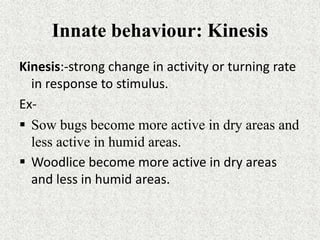
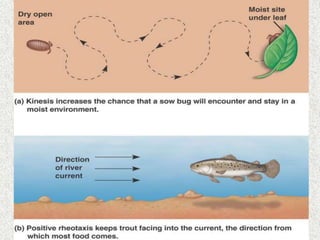
Innate behaviour: Kinesis
Kinesis:-strong change in activity or turning rate
in response to stimulus.
Ex-
 Sow bugs become more active in dry areas and
less active in humid areas.
 Woodlice become more active in dry areas
and less in humid areas.
• Fig 51.7a
Fixed action pattern (FAP)
A sequence of behavioral acts that is essentially
unchangeable and usually carried to completion once
initiated.
 FAP is triggered by an external sensory stimulus known as a sign
stimulus
 FAP usually occurs in a series of actions the same way every time.
 Releaser is used for stimuli that have evolved to facilitate
communication between animals of the same species
 Sign stimuli are features of an animal's environment to which
it reacts in a particular way
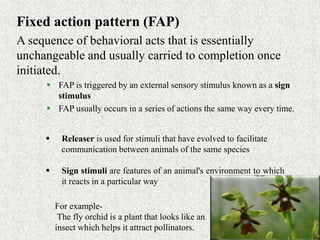
For example-
The fly orchid is a plant that looks like an
insect which helps it attract pollinators.
Learned Behaviour
Learning as a persistent change in behaviour that occurs as a
result of experience. Since a new born nymph or larva has no
prior experience, its first behaviours will be entirely innate.
learned behaviours will always be-
• Non heritable -- acquired only through observation or experience
• Extrinsic -- absent in animals raised in isolation from others
• Per mutable -- pattern or sequence may change over time
• Adaptable -- capable of modification to suit changing conditions
• Progressive -- subject to improvement through practice
Habituation - Loss of responsiveness to stimuli that do
not convey useful information (“cry wolf” effect).
Ex-
 A puff of air on the cerci of a cockroach will cause the animal
to scamper away. But repeating the same stimulus over and
over will lead to a decrease in the response and eventually to
no response at all.
 In some insect populations, widespread use of sex pheromone
will disrupt mating behaviour. smell like a virgin female,
males become habituated to the odour and stop responding to
the signal.
Classical Conditioning - Is learning to associate one
stimulus with another, unrelated stimulus.
for example-
Honey bees, learn to associate floral colours and fragrances with
the presence of nectar. They can be "trained" to collect sugar
water from coloured dishes on a feeding table. If a blue dish with
pure water sits next to a yellow dish with sugar water, worker bees
will quickly learn to associate "yellow" with "food“.When
solutions in the two dishes are suddenly swapped , the bees will
ignore blue and continue to forage at yellow until they eventually
"learn" (by trial and error) to look for the blue dish.
Latent Learning involves memory of patterns or events
when there is no apparent reward or punishment
associated with the behaviour.
for example-
• A sand wasp learns the location of her nest site by taking a
short reconnaissance flight each time she leaves the nest. She
remembers the pattern of surrounding landmarks to help her
find the nest when she returns.
• worker ants can remember a series of landmarks along a trail
and follow them (in reverse order) back home to the nest site.
• Honey bees also show latent learning when they follow the
waggle dance of a forager and then use that information to find
the reported nectar source.
Imprinting- Is a special case of programmed learning that occurs
early in life and only within a short time-window known as the
"critical period".
Ex-
Fruit fly larvae will imprint on the taste and smell of their food. If reared
on a diet that contains apple extract, adult females will show a strong
preference for apples when they eventually search for a place to lay their
own eggs.
Operant Conditioning - learning in which an animal is rewarded
or punished for performing a behaviour.
Ex-
Cockroaches learning to run through a simple maize to find food
is a simple example of operant conditioning (also known as
instrumental learning).
Rats in Skinner box trial by error learning
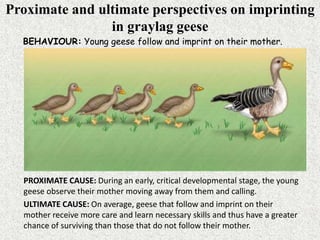
Proximate and ultimate perspectives on imprinting
in graylag geese
BEHAVIOUR: Young geese follow and imprint on their mother.
PROXIMATE CAUSE: During an early, critical developmental stage, the young
geese observe their mother moving away from them and calling.
ULTIMATE CAUSE: On average, geese that follow and imprint on their
mother receive more care and learn necessary skills and thus have a greater
chance of surviving than those that do not follow their mother.
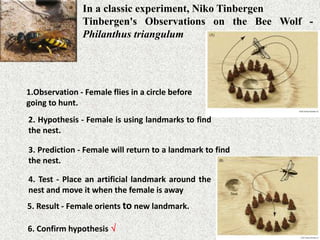
In a classic experiment, Niko Tinbergen
Tinbergen's Observations on the Bee Wolf -
Philanthus triangulum
6. Confirm hypothesis 
1.Observation - Female flies in a circle before
going to hunt.
3. Prediction - Female will return to a landmark to find
the nest.
4. Test - Place an artificial landmark around the
nest and move it when the female is away
5. Result - Female orients to new landmark.
2. Hypothesis - Female is using landmarks to find
the nest.
Auditory Communication
• Experiments with various insects
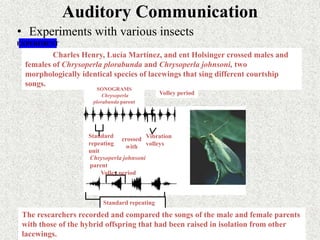
Charles Henry, Lucía Martínez, and ent Holsinger crossed males and
females of Chrysoperla plorabunda and Chrysoperla johnsoni, two
morphologically identical species of lacewings that sing different courtship
songs.
EXPERIMENT
SONOGRAMS
Chrysoperla
plorabunda parent
Vibration
volleys
Standard
repeating
unit
Chrysoperla johnsoni
parent
Volley period
crossed
with
Standard repeating
unit
The researchers recorded and compared the songs of the male and female parents
with those of the hybrid offspring that had been raised in isolation from other
lacewings.
Volley period
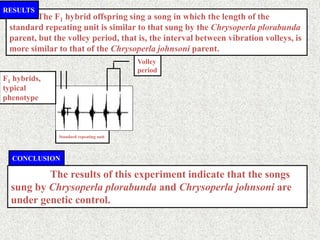
The F1 hybrid offspring sing a song in which the length of the
standard repeating unit is similar to that sung by the Chrysoperla plorabunda
parent, but the volley period, that is, the interval between vibration volleys, is
more similar to that of the Chrysoperla johnsoni parent.
RESULTS
The results of this experiment indicate that the songs
sung by Chrysoperla plorabunda and Chrysoperla johnsoni are
under genetic control.
CONCLUSION
Standard repeating unit
Volley
period
F1 hybrids,
typical
phenotype
Behavioural traits evolve by natural
selection
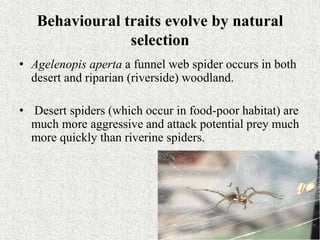
• Agelenopis aperta a funnel web spider occurs in both
desert and riparian (riverside) woodland.
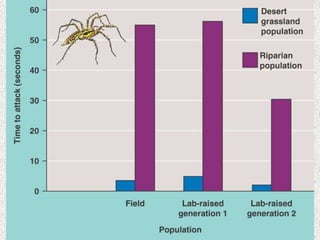
• Desert spiders (which occur in food-poor habitat) are
much more aggressive and attack potential prey much
more quickly than riverine spiders.
• 51.19
Zach’s crow work
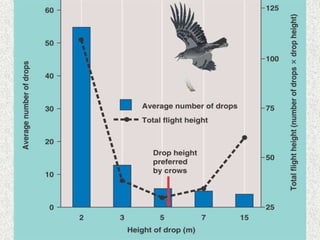
• Crows feeding on whelks (marine snails) fly up and drop the
whelks on rocks to break them.
• Height from which a shell is dropped affects its probability of
breaking.
• Dropping from greater height increases probability of breaking
shell, but it costs energy to fly up.
Optimal foraging
In optimal foraging organisms maximize their food
intake while minimizing their energy expenditure and
risk of mortality.
• Fig 51.22
Risk of predation is one of the most
significant potential costs to a forager
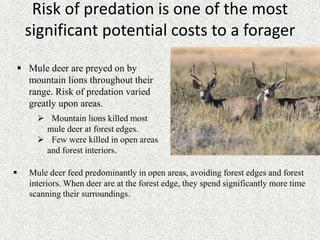
 Mule deer are preyed on by
mountain lions throughout their
range. Risk of predation varied
greatly upon areas.
 Mule deer feed predominantly in open areas, avoiding forest edges and forest
interiors. When deer are at the forest edge, they spend significantly more time
scanning their surroundings.
 Mountain lions killed most
mule deer at forest edges.
 Few were killed in open areas
and forest interiors.
Risk of Predation
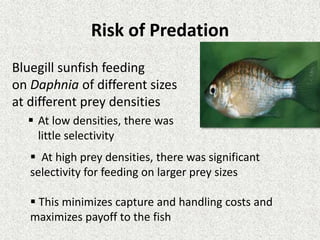
Bluegill sunfish feeding
on Daphnia of different sizes
at different prey densities
 At low densities, there was
little selectivity
 At high prey densities, there was significant
selectivity for feeding on larger prey sizes
 This minimizes capture and handling costs and
maximizes payoff to the fish
Environment influences the
behaviour
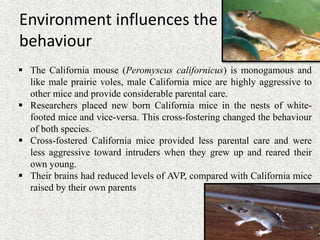
 The California mouse (Peromyscus californicus) is monogamous and
like male prairie voles, male California mice are highly aggressive to
other mice and provide considerable parental care.
 Researchers placed new born California mice in the nests of white-
footed mice and vice-versa. This cross-fostering changed the behaviour
of both species.
 Cross-fostered California mice provided less parental care and were
less aggressive toward intruders when they grew up and reared their
own young.
 Their brains had reduced levels of AVP, compared with California mice
raised by their own parents
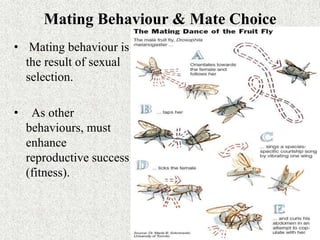
Mating Behaviour & Mate Choice
• Mating behaviour is
the result of sexual
selection.
• As other
behaviours, must
enhance
reproductive success
(fitness).
behaviour that appears to decrease individual fitness but
increases the fitness of others.
For example-
 Many animals give alarm calls that warn others of a predator but put the
caller at risk.
 In bees, ants and other social insects many individuals do not reproduce
themselves but assist another individual (the queen) to reproduce.
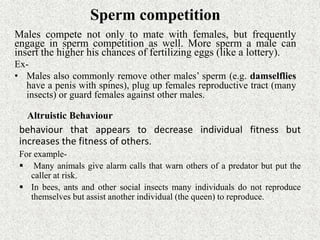
Sperm competition
Males compete not only to mate with females, but frequently
engage in sperm competition as well. More sperm a male can
insert the higher his chances of fertilizing eggs (like a lottery).
Ex-
• Males also commonly remove other males’ sperm (e.g. damselflies
have a penis with spines), plug up females reproductive tract (many
insects) or guard females against other males.
Altruistic Behaviour
Behavioural traits evolve by natural
selection Drosophila foraging
• In lab studies in low density populations of
Drosophila for S allele increased in frequency.
Opposite was true in high density populations.
• In low density populations for S individuals did not
waste energy traveling long distances for food. In
high-density populations for R allele caused larvae
to move beyond areas of food depletion.
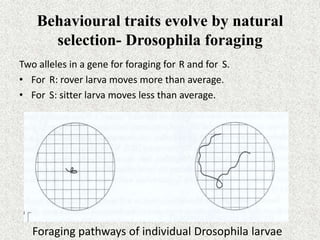
Behavioural traits evolve by natural
selection- Drosophila foraging
Two alleles in a gene for foraging for R and for S.
• For R: rover larva moves more than average.
• For S: sitter larva moves less than average.
Foraging pathways of individual Drosophila larvae
BEHAVIOURAL TRAITS UNDER NATURAL SELECTION

BEHAVIOURAL TRAITS UNDER NATURAL SELECTION

  • 1.
  • 2.
    What is aTrait ? A characteristic of some organism, like how it looks or acts. can be passed down from parents to offspring (inherited) and also can be learned Behaviour : The response of an organism to signals from the environment. Behaviorual Ecology is the study of how animals interact with their environment and the survival value of behaviours.
  • 3.
  • 4.
    Natural selection Natural selection:organisms with the most favourable traits survive in the natural environment and reproduce most successfully. The concept of selection is central to Darwin's theory of evolution. Behaviours that increase mating opportunities and survival will enhance reproductive success.
  • 5.
    Three types ofNatural Selection Directional  Allele frequencies shift to favor individuals at one extreme of the normal range  Only one side of the distribution reproduce  Population looks different over time Stabilizing  Favors individuals with an average genetic makeup  Only the middle reproduce  Population looks more similar over time  (eliminates extremes) Diversifying (Disruptive)  Environmental conditions favor individuals at both ends of the genetic spectrum  Population split into two groups
  • 6.
    Levels of Analysisin Ethology Proximate Causes Ultimate Causes Genetic/Developmental Mechanisms Sensory/Motor Mechanisms Historical Pathways Selective Processes -effects of heredity -development of sensory- motor systems -gene-environment interactions -nervous systems for stimulus detection -hormone systems for adjusting response levels -muscles for carrying out responses -adaptive context ?-evolutionary development of a trait How? Why?
  • 7.
    The Nobel Prizein Physiology or Medicine 1973 Karl von Frisch, Konrad Lorenz, and Nikolaas Tinbergen "for their discoveries concerning organization and elicitation of individual and social behavior patterns“  Karl von Frisch- Made major contributions to the study of honey bees, their ability to communicate to hive mates about food sources with the waggle dance, use of pheromones, and their ability to see in color and in ultraviolet and polarized light.  Konrad Lorenz- Studied instincts and fixed action patterns in birds, and later became interested in human behaviours.  Nikolaas Tinbergen- Studied fish, birds and insects in nature and the laboratory and later autism.
  • 8.
    Behaviour can Evolvethrough Natural Selection  There is variation in behaviours (feeding behaviours, attack behaviours, Foraging behaviours etc).  This variation depends on environment and animals survival.  Some behavioural components are genetic - passed down from parent to offspring. Two Categories of Behaviour • Innate or Unlearned Behaviour • Learned Behaviour or Conditioning
  • 9.
    Innate Behaviour Innate behaviouris genetically programmed. Individuals inherit a suite of behaviours (often called an Ethogram). innate behaviours will always be: • Heritable -encoded in DNA and passed from generation to generation • Intrinsic - present in animals raised in isolation from others • Stereotypic - performed in the same way each time by each individual • Inflexible - not modified by development or experience • Consummate - fully developed or expressed at first performance
  • 10.
    Innate behaviour: Kinesis Kinesis:-strongchange in activity or turning rate in response to stimulus. Ex-  Sow bugs become more active in dry areas and less active in humid areas.  Woodlice become more active in dry areas and less in humid areas.
  • 11.
  • 12.
    Fixed action pattern(FAP) A sequence of behavioral acts that is essentially unchangeable and usually carried to completion once initiated.  FAP is triggered by an external sensory stimulus known as a sign stimulus  FAP usually occurs in a series of actions the same way every time.  Releaser is used for stimuli that have evolved to facilitate communication between animals of the same species  Sign stimuli are features of an animal's environment to which it reacts in a particular way For example- The fly orchid is a plant that looks like an insect which helps it attract pollinators.
  • 13.
    Learned Behaviour Learning asa persistent change in behaviour that occurs as a result of experience. Since a new born nymph or larva has no prior experience, its first behaviours will be entirely innate. learned behaviours will always be- • Non heritable -- acquired only through observation or experience • Extrinsic -- absent in animals raised in isolation from others • Per mutable -- pattern or sequence may change over time • Adaptable -- capable of modification to suit changing conditions • Progressive -- subject to improvement through practice
  • 14.
    Habituation - Lossof responsiveness to stimuli that do not convey useful information (“cry wolf” effect). Ex-  A puff of air on the cerci of a cockroach will cause the animal to scamper away. But repeating the same stimulus over and over will lead to a decrease in the response and eventually to no response at all.  In some insect populations, widespread use of sex pheromone will disrupt mating behaviour. smell like a virgin female, males become habituated to the odour and stop responding to the signal.
  • 15.
    Classical Conditioning -Is learning to associate one stimulus with another, unrelated stimulus. for example- Honey bees, learn to associate floral colours and fragrances with the presence of nectar. They can be "trained" to collect sugar water from coloured dishes on a feeding table. If a blue dish with pure water sits next to a yellow dish with sugar water, worker bees will quickly learn to associate "yellow" with "food“.When solutions in the two dishes are suddenly swapped , the bees will ignore blue and continue to forage at yellow until they eventually "learn" (by trial and error) to look for the blue dish.
  • 16.
    Latent Learning involvesmemory of patterns or events when there is no apparent reward or punishment associated with the behaviour. for example- • A sand wasp learns the location of her nest site by taking a short reconnaissance flight each time she leaves the nest. She remembers the pattern of surrounding landmarks to help her find the nest when she returns. • worker ants can remember a series of landmarks along a trail and follow them (in reverse order) back home to the nest site. • Honey bees also show latent learning when they follow the waggle dance of a forager and then use that information to find the reported nectar source.
  • 17.
    Imprinting- Is aspecial case of programmed learning that occurs early in life and only within a short time-window known as the "critical period". Ex- Fruit fly larvae will imprint on the taste and smell of their food. If reared on a diet that contains apple extract, adult females will show a strong preference for apples when they eventually search for a place to lay their own eggs. Operant Conditioning - learning in which an animal is rewarded or punished for performing a behaviour. Ex- Cockroaches learning to run through a simple maize to find food is a simple example of operant conditioning (also known as instrumental learning). Rats in Skinner box trial by error learning
  • 18.
    Proximate and ultimateperspectives on imprinting in graylag geese BEHAVIOUR: Young geese follow and imprint on their mother. PROXIMATE CAUSE: During an early, critical developmental stage, the young geese observe their mother moving away from them and calling. ULTIMATE CAUSE: On average, geese that follow and imprint on their mother receive more care and learn necessary skills and thus have a greater chance of surviving than those that do not follow their mother.
  • 19.
    In a classicexperiment, Niko Tinbergen Tinbergen's Observations on the Bee Wolf - Philanthus triangulum 6. Confirm hypothesis  1.Observation - Female flies in a circle before going to hunt. 3. Prediction - Female will return to a landmark to find the nest. 4. Test - Place an artificial landmark around the nest and move it when the female is away 5. Result - Female orients to new landmark. 2. Hypothesis - Female is using landmarks to find the nest.
  • 20.
    Auditory Communication • Experimentswith various insects Charles Henry, Lucía Martínez, and ent Holsinger crossed males and females of Chrysoperla plorabunda and Chrysoperla johnsoni, two morphologically identical species of lacewings that sing different courtship songs. EXPERIMENT SONOGRAMS Chrysoperla plorabunda parent Vibration volleys Standard repeating unit Chrysoperla johnsoni parent Volley period crossed with Standard repeating unit The researchers recorded and compared the songs of the male and female parents with those of the hybrid offspring that had been raised in isolation from other lacewings. Volley period
  • 21.
    The F1 hybridoffspring sing a song in which the length of the standard repeating unit is similar to that sung by the Chrysoperla plorabunda parent, but the volley period, that is, the interval between vibration volleys, is more similar to that of the Chrysoperla johnsoni parent. RESULTS The results of this experiment indicate that the songs sung by Chrysoperla plorabunda and Chrysoperla johnsoni are under genetic control. CONCLUSION Standard repeating unit Volley period F1 hybrids, typical phenotype
  • 22.
    Behavioural traits evolveby natural selection • Agelenopis aperta a funnel web spider occurs in both desert and riparian (riverside) woodland. • Desert spiders (which occur in food-poor habitat) are much more aggressive and attack potential prey much more quickly than riverine spiders.
  • 23.
  • 24.
    Zach’s crow work •Crows feeding on whelks (marine snails) fly up and drop the whelks on rocks to break them. • Height from which a shell is dropped affects its probability of breaking. • Dropping from greater height increases probability of breaking shell, but it costs energy to fly up. Optimal foraging In optimal foraging organisms maximize their food intake while minimizing their energy expenditure and risk of mortality.
  • 25.
  • 26.
    Risk of predationis one of the most significant potential costs to a forager  Mule deer are preyed on by mountain lions throughout their range. Risk of predation varied greatly upon areas.  Mule deer feed predominantly in open areas, avoiding forest edges and forest interiors. When deer are at the forest edge, they spend significantly more time scanning their surroundings.  Mountain lions killed most mule deer at forest edges.  Few were killed in open areas and forest interiors.
  • 27.
    Risk of Predation Bluegillsunfish feeding on Daphnia of different sizes at different prey densities  At low densities, there was little selectivity  At high prey densities, there was significant selectivity for feeding on larger prey sizes  This minimizes capture and handling costs and maximizes payoff to the fish
  • 28.
    Environment influences the behaviour The California mouse (Peromyscus californicus) is monogamous and like male prairie voles, male California mice are highly aggressive to other mice and provide considerable parental care.  Researchers placed new born California mice in the nests of white- footed mice and vice-versa. This cross-fostering changed the behaviour of both species.  Cross-fostered California mice provided less parental care and were less aggressive toward intruders when they grew up and reared their own young.  Their brains had reduced levels of AVP, compared with California mice raised by their own parents
  • 29.
    Mating Behaviour &Mate Choice • Mating behaviour is the result of sexual selection. • As other behaviours, must enhance reproductive success (fitness).
  • 30.
    behaviour that appearsto decrease individual fitness but increases the fitness of others. For example-  Many animals give alarm calls that warn others of a predator but put the caller at risk.  In bees, ants and other social insects many individuals do not reproduce themselves but assist another individual (the queen) to reproduce. Sperm competition Males compete not only to mate with females, but frequently engage in sperm competition as well. More sperm a male can insert the higher his chances of fertilizing eggs (like a lottery). Ex- • Males also commonly remove other males’ sperm (e.g. damselflies have a penis with spines), plug up females reproductive tract (many insects) or guard females against other males. Altruistic Behaviour
  • 31.
    Behavioural traits evolveby natural selection Drosophila foraging • In lab studies in low density populations of Drosophila for S allele increased in frequency. Opposite was true in high density populations. • In low density populations for S individuals did not waste energy traveling long distances for food. In high-density populations for R allele caused larvae to move beyond areas of food depletion.
  • 32.
    Behavioural traits evolveby natural selection- Drosophila foraging Two alleles in a gene for foraging for R and for S. • For R: rover larva moves more than average. • For S: sitter larva moves less than average. Foraging pathways of individual Drosophila larvae