INSECT ANTENNAE:
STRUCTURE,
FUNCTIONS AND
MODIFICATIONS
Created and Edited by:-
Vikas Kumar
Student of B.Sc (Agriculture)
2
What is Antenna (Plural= Antennae)?
“Antennae are paired, freely mobile, segmented sensory
appendages articulated with the head in front of or between
the eyes. Antennae are also known as feelers.”
These are well developed in adults and poorly developed in
immature stages. Antennae are absent in order Protura and
Class Arachnida while 2 pairs of antennae present in Class
Crustacea.
3
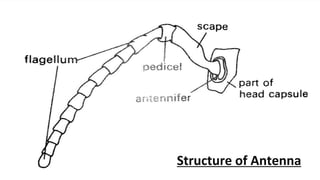
Structure of Antenna
“Antennae are multi segmented and may be divided into 3 parts:-
1. Scape:- It is the basal segment of a antenna, by which it is
attached with the head.
2. Pedicel:- It is the second segment of antenna which is shorter
than scape. This segment having a sensory apparatus named
‘Johnston organ’.
3. Flagellum:- It is the last segment of antenna which consists
the remaining divisions of antenna and it greatly varies in its
form and structure. It is also known as Clavola.
4
Structure of Antenna
5
Functions of Antennae
The main function of antenna is
sensory, which is modified
according to habit and habitat of
insect as given below:-
1. Organs of smell:- Some insects
have smell organs on their
antennae by which they
recognise their food. E.g. Ant,
Honey Bee and Jiant moths.
6
2. Organs of taste:- Some insects
have taste hairs on their
antennae by which they
recognise the taste of their
food. E.g. Cockroach.
3. Stridulatorial organs:- Some
insect bears sound producing
organs in their antennae
belonging order Orthroptera.
e.g. Cricket.
7
4. Chordotonal Organs:- Hearing organs
(Jhonston’s organ) found in second
segment (pedicel) of antenna. e.g.
Male mosquito, Green bottle fly and
Paper wasp etc.
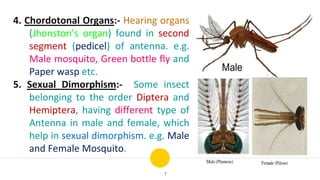
5. Sexual Dimorphism:- Some insect
belonging to the order Diptera and
Hemiptera, having different type of
Antenna in male and female, which
help in sexual dimorphism. e.g. Male
and Female Mosquito.
8
7. Other Functions:-
(a). Help the mandibles
for holding the prey.
(b). Useful for clasping the
female during copulation.
(c). Butterfly bears some
transmitting and receiving
organs in their antennae.
9
Modifications of Antennae
On the basis of shape and structure,
the antennae may be following type:-
1. Setaceous:- These are bristle like
antennae, in which segments
gradually decrease in size from
base to apex and tappering into a
point, presenting a whip like
structure.
e.g. Cockroach and Cricket.
10
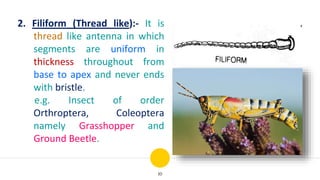
2. Filiform (Thread like):- It is
thread like antenna in which
segments are uniform in
thickness throughout from
base to apex and never ends
with bristle.
e.g. Insect of order
Orthroptera, Coleoptera
namely Grasshopper and
Ground Beetle.
11
3. Moniliform (Like string of
beads):- Such type of
antennae have globular or oval
shaped segments with uniform
thickness from base to apex,
by which it looks like string of
beads. It have constriction
between the joints.
e.g. Insect of order Isoptera
namely Termite.
12
4. Pectinate (Comb like):- This is a
comb like in structure in which
each segment of the antenna
possess long projection on one
side, giving comb like
appearance.
e.g. Insect of order Lepidoptera
namely Moth of Sugarcane root
borer.
13
5. Bipectinate (Double Comb
like):-In this type of
antenna, each segment has
the long projections on
both side, giving double
comb like appearance.
e.g. Insect of order
Lepidoptera namely Silk
Moth.
14
6. Serrate (Saw like):-In this type
of antenna, each segment is
more or less triangular and
projected on one side, which
giving teeth of saw like
appearance.
e.g. Insect of order
Coleoptera namely Pulse
beetle.
15
7. Flabellate (Feather like):- In
this type of antenna, in which
projections of the flagellum
become long and form a
feather like structure, which is
known as flabella.
e.g. Insect of order
Coleoptera namely Cedar
Beetle.
16
8. Plumose (bursh like with
dense hairs):- In this type of
antenna, each segment has
the whorls of hairs arise from
their joints and look like
plumose.
e.g. Insect of order Diptera
namely Male Mosquito.
17
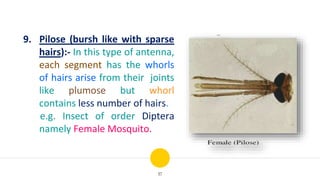
9. Pilose (bursh like with sparse
hairs):- In this type of antenna,
each segment has the whorls
of hairs arise from their joints
like plumose but whorl
contains less number of hairs.
e.g. Insect of order Diptera
namely Female Mosquito.
18
10. Whorled:- Basically these are
the setaceous, filiform or
moniliform type of antennae
in which each segment has a
whorl of bristle at every
joint.
e.g. Insect of order
Hemiptera namely Male of
Mango Mealy Bug.
19
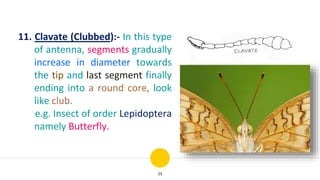
11. Clavate (Clubbed):- In this type
of antenna, segments gradually
increase in diameter towards
the tip and last segment finally
ending into a round core, look
like club.
e.g. Insect of order Lepidoptera
namely Butterfly.
20
12. Capitate (Clubbed with Knob):-
In this type of antenna,
segments gradually increase in
diameter towards the tip and
suddenly last 3-5 segments
enlarge to form a knob like
structure.
e.g. Red Rust Flour Beetle.
21
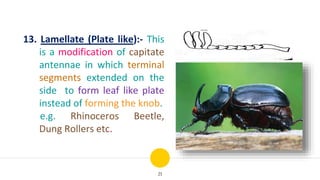
13. Lamellate (Plate like):- This
is a modification of capitate
antennae in which terminal
segments extended on the
side to form leaf like plate
instead of forming the knob.
e.g. Rhinoceros Beetle,
Dung Rollers etc.
22
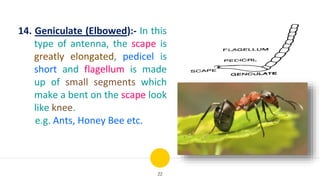
14. Geniculate (Elbowed):- In this
type of antenna, the scape is
greatly elongated, pedicel is
short and flagellum is made
up of small segments which
make a bent on the scape look
like knee.
e.g. Ants, Honey Bee etc.
23
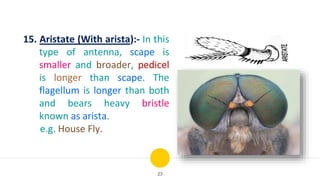
15. Aristate (With arista):- In this
type of antenna, scape is
smaller and broader, pedicel
is longer than scape. The
flagellum is longer than both
and bears heavy bristle
known as arista.
e.g. House Fly.
24
16. Stylate (With style):- In
this type of antenna, last
segment of flagellum is
modified into a long
bristle known as style.
e.g. Snipe fly, Robber
fly.
25
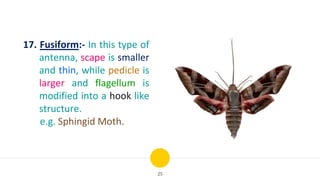
17. Fusiform:- In this type of
antenna, scape is smaller
and thin, while pedicle is
larger and flagellum is
modified into a hook like
structure.
e.g. Sphingid Moth.
Any doubts or suggestions ?
You can find me at:
◉ Twitter:- @vikaskashyap__
◉ Email:- Vikas Kashyap
Thanks!
26

Insect Antennae.pdf

  • 1.
    INSECT ANTENNAE: STRUCTURE, FUNCTIONS AND MODIFICATIONS Createdand Edited by:- Vikas Kumar Student of B.Sc (Agriculture)
  • 2.
    2 What is Antenna(Plural= Antennae)? “Antennae are paired, freely mobile, segmented sensory appendages articulated with the head in front of or between the eyes. Antennae are also known as feelers.” These are well developed in adults and poorly developed in immature stages. Antennae are absent in order Protura and Class Arachnida while 2 pairs of antennae present in Class Crustacea.
  • 3.
    3 Structure of Antenna “Antennaeare multi segmented and may be divided into 3 parts:- 1. Scape:- It is the basal segment of a antenna, by which it is attached with the head. 2. Pedicel:- It is the second segment of antenna which is shorter than scape. This segment having a sensory apparatus named ‘Johnston organ’. 3. Flagellum:- It is the last segment of antenna which consists the remaining divisions of antenna and it greatly varies in its form and structure. It is also known as Clavola.
  • 4.
  • 5.
    5 Functions of Antennae Themain function of antenna is sensory, which is modified according to habit and habitat of insect as given below:- 1. Organs of smell:- Some insects have smell organs on their antennae by which they recognise their food. E.g. Ant, Honey Bee and Jiant moths.
  • 6.
    6 2. Organs oftaste:- Some insects have taste hairs on their antennae by which they recognise the taste of their food. E.g. Cockroach. 3. Stridulatorial organs:- Some insect bears sound producing organs in their antennae belonging order Orthroptera. e.g. Cricket.
  • 7.
    7 4. Chordotonal Organs:-Hearing organs (Jhonston’s organ) found in second segment (pedicel) of antenna. e.g. Male mosquito, Green bottle fly and Paper wasp etc. 5. Sexual Dimorphism:- Some insect belonging to the order Diptera and Hemiptera, having different type of Antenna in male and female, which help in sexual dimorphism. e.g. Male and Female Mosquito.
  • 8.
    8 7. Other Functions:- (a).Help the mandibles for holding the prey. (b). Useful for clasping the female during copulation. (c). Butterfly bears some transmitting and receiving organs in their antennae.
  • 9.
    9 Modifications of Antennae Onthe basis of shape and structure, the antennae may be following type:- 1. Setaceous:- These are bristle like antennae, in which segments gradually decrease in size from base to apex and tappering into a point, presenting a whip like structure. e.g. Cockroach and Cricket.
  • 10.
    10 2. Filiform (Threadlike):- It is thread like antenna in which segments are uniform in thickness throughout from base to apex and never ends with bristle. e.g. Insect of order Orthroptera, Coleoptera namely Grasshopper and Ground Beetle.
  • 11.
    11 3. Moniliform (Likestring of beads):- Such type of antennae have globular or oval shaped segments with uniform thickness from base to apex, by which it looks like string of beads. It have constriction between the joints. e.g. Insect of order Isoptera namely Termite.
  • 12.
    12 4. Pectinate (Comblike):- This is a comb like in structure in which each segment of the antenna possess long projection on one side, giving comb like appearance. e.g. Insect of order Lepidoptera namely Moth of Sugarcane root borer.
  • 13.
    13 5. Bipectinate (DoubleComb like):-In this type of antenna, each segment has the long projections on both side, giving double comb like appearance. e.g. Insect of order Lepidoptera namely Silk Moth.
  • 14.
    14 6. Serrate (Sawlike):-In this type of antenna, each segment is more or less triangular and projected on one side, which giving teeth of saw like appearance. e.g. Insect of order Coleoptera namely Pulse beetle.
  • 15.
    15 7. Flabellate (Featherlike):- In this type of antenna, in which projections of the flagellum become long and form a feather like structure, which is known as flabella. e.g. Insect of order Coleoptera namely Cedar Beetle.
  • 16.
    16 8. Plumose (burshlike with dense hairs):- In this type of antenna, each segment has the whorls of hairs arise from their joints and look like plumose. e.g. Insect of order Diptera namely Male Mosquito.
  • 17.
    17 9. Pilose (burshlike with sparse hairs):- In this type of antenna, each segment has the whorls of hairs arise from their joints like plumose but whorl contains less number of hairs. e.g. Insect of order Diptera namely Female Mosquito.
  • 18.
    18 10. Whorled:- Basicallythese are the setaceous, filiform or moniliform type of antennae in which each segment has a whorl of bristle at every joint. e.g. Insect of order Hemiptera namely Male of Mango Mealy Bug.
  • 19.
    19 11. Clavate (Clubbed):-In this type of antenna, segments gradually increase in diameter towards the tip and last segment finally ending into a round core, look like club. e.g. Insect of order Lepidoptera namely Butterfly.
  • 20.
    20 12. Capitate (Clubbedwith Knob):- In this type of antenna, segments gradually increase in diameter towards the tip and suddenly last 3-5 segments enlarge to form a knob like structure. e.g. Red Rust Flour Beetle.
  • 21.
    21 13. Lamellate (Platelike):- This is a modification of capitate antennae in which terminal segments extended on the side to form leaf like plate instead of forming the knob. e.g. Rhinoceros Beetle, Dung Rollers etc.
  • 22.
    22 14. Geniculate (Elbowed):-In this type of antenna, the scape is greatly elongated, pedicel is short and flagellum is made up of small segments which make a bent on the scape look like knee. e.g. Ants, Honey Bee etc.
  • 23.
    23 15. Aristate (Witharista):- In this type of antenna, scape is smaller and broader, pedicel is longer than scape. The flagellum is longer than both and bears heavy bristle known as arista. e.g. House Fly.
  • 24.
    24 16. Stylate (Withstyle):- In this type of antenna, last segment of flagellum is modified into a long bristle known as style. e.g. Snipe fly, Robber fly.
  • 25.
    25 17. Fusiform:- Inthis type of antenna, scape is smaller and thin, while pedicle is larger and flagellum is modified into a hook like structure. e.g. Sphingid Moth.
  • 26.
    Any doubts orsuggestions ? You can find me at: ◉ Twitter:- @vikaskashyap__ ◉ Email:- Vikas Kashyap Thanks! 26