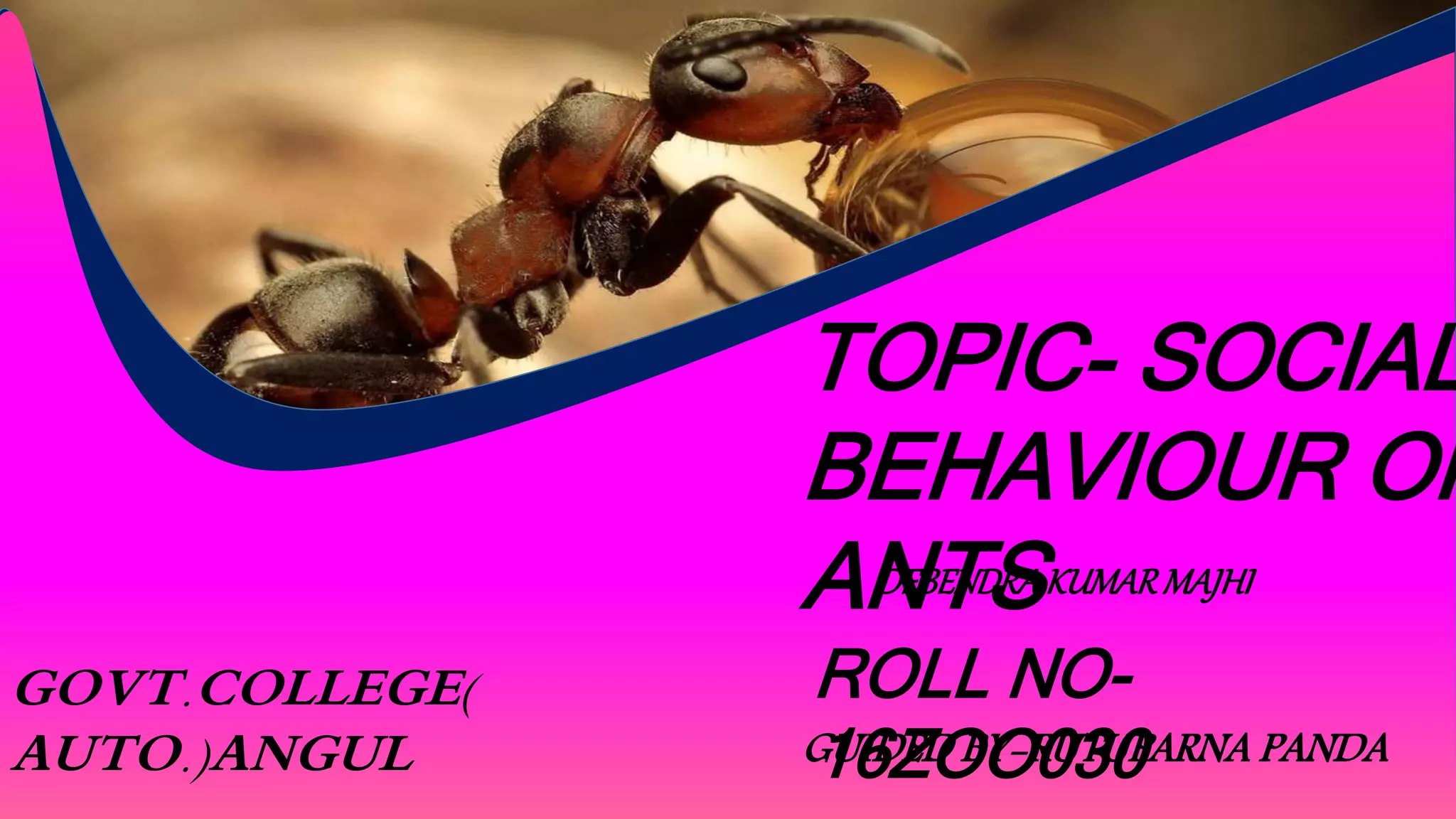
TOPIC- SOCIAL
BEHAVIOUR OF
ANTS
GOVT.COLLEGE(
AUTO.)ANGUL GUIDED BY-RUTUPARNA PANDA
DEBENDRAKUMARMAJHI
ROLL NO-
16ZOO030
CONTENTS
Introduction
Type of Indian ants
Nest Formation
Different forms of ants
Life cycle
Farmer ants
Honey collecter ant
Some Intresting facts about ants
2
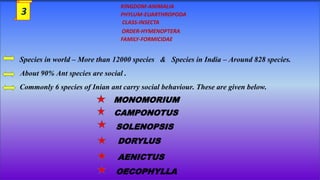
CLASS-INSECTA
ORDER-HYMENOPTERA
FAMILY-FORMICIDAE
PHYLUM-EUARTHROPODA
KINGDOM-ANIMALIA
Species in world – More than 12000 species & Species in India – Around 828 species.
About 90% Ant species are social .
Commonly 6 species of Inian ant carry social behaviour. These are given below.
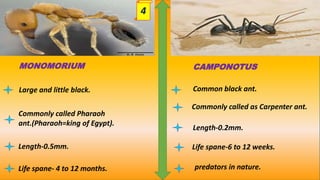
MONOMORIUM
CAMPONOTUS
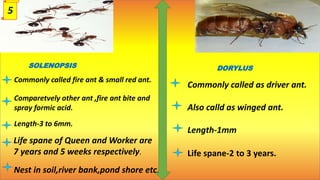
SOLENOPSIS
DORYLUS
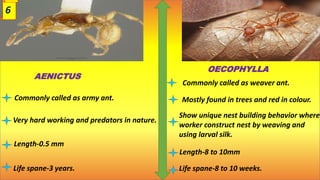
AENICTUS
OECOPHYLLA
3
Large and little black.
Commonly called Pharaoh
ant.(Pharaoh=king of Egypt).
Length-0.5mm.
Life spane- 4 to 12 months.
MONOMORIUM CAMPONOTUS
Common black ant.
Commonly called as Carpenter ant.
Length-0.2mm.
Life spane-6 to 12 weeks.
predators in nature.
4
SOLENOPSIS DORYLUS
Commonly called fire ant & small red ant.
Comparetvely other ant ,fire ant bite and
spray formic acid.
Length-3 to 6mm.
Life spane of Queen and Worker are
7 years and 5 weeks respectively.
Nest in soil,river bank,pond shore etc.
Commonly called as driver ant.
Also calld as winged ant.
Length-1mm
Life spane-2 to 3 years.
5
AENICTUS
Commonly called as army ant.
Very hard working and predators in nature.
Length-0.5 mm
Life spane-3 years.
OECOPHYLLA
Commonly called as weaver ant.
Mostly found in trees and red in colour.
Show unique nest building behavior where
worker construct nest by weaving and
using larval silk.
Length-8 to 10mm
Life spane-8 to 10 weeks.
6
NEST FORMATION
New colony is found by a single fertilized queen.
Some species do not construct nest and most of species make their own nest.
Some species occupy temporaily nests of other ants that relationship called
plesiobiosis.
Ant make subterranean nests by excavating that form granier used as storing food
and galleries chamber for brood.
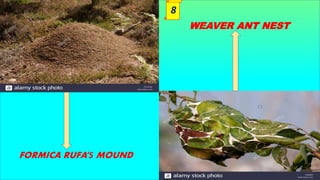
Ant species Formica rufa make mound nest which is 60-160cm in diameter.
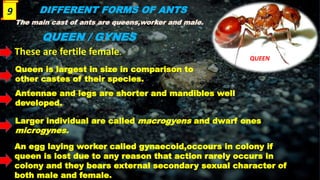
Oecophylla(weaver ant) construct nest that own larval silk mixed with vegetable.
Weaver ant colony consist of single queen and two types of worker.(Small
worker-care for eggs & Large worker-construct nest,care queen).
7
WEAVER ANT NEST
FORMICA RUFA′S MOUND
8
DIFFERENT FORMS OF ANTS
The main cast of ants are queens,worker and male.
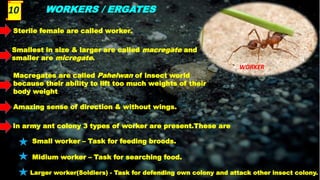
QUEEN / GYNES
These are fertile female.
Queen is largest in size in comparison to
other castes of their species.
Antennae and legs are shorter and mandibles well
developed.
Larger individual are called macrogyens and dwarf ones
microgynes.
An egg laying worker called gynaecoid,occours in colony if
queen is lost due to any reason that action rarely occurs in
colony and they bears external secondary sexual character of
both male and female.
QUEEN
9
WORKERS / ERGATES
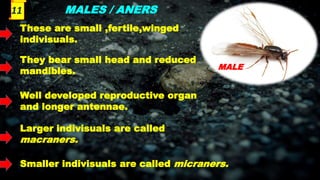
Sterile female are called worker.
Smallest in size & larger are called macregate and
smaller are micregate.
Macregates are called Pahelwan of insect world
because their ability to lift too much weights of their
body weight.
Amazing sense of direction & without wings.
In army ant colony 3 types of worker are present.These are
Small worker – Task for feeding broods.
Midium worker – Task for searching food.
Larger worker(Soldiers) - Task for defending own colony and attack other insect colony.
WORKER
10
MALES / ANERS
These are small ,fertile,winged
indivisuals.
They bear small head and reduced
mandibles.
Well developed reproductive organ
and longer antennae.
Larger indivisuals are called
macraners.
Smaller indivisuals are called micraners.
MALE
11
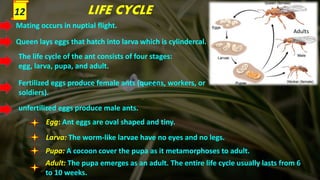
LIFE CYCLE
Mating occurs in nuptial flight.
Adult: The pupa emerges as an adult. The entire life cycle usually lasts from 6
to 10 weeks.
The life cycle of the ant consists of four stages:
egg, larva, pupa, and adult.
Fertilized eggs produce female ants (queens, workers, or
soldiers).
unfertilized eggs produce male ants.
Egg: Ant eggs are oval shaped and tiny.
Larva: The worm-like larvae have no eyes and no legs.
Pupa: A cocoon cover the pupa as it metamorphoses to adult.
Queen lays eggs that hatch into larva which is cylindercal.
Adults
12
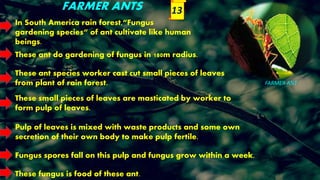
FARMER ANTS
In South America rain forest,“Fungus
gardening species“ of ant cultivate like human
beings.
These ant do gardening of fungus in 180m radius.
These ant species worker cast cut small pieces of leaves
from plant of rain forest.
These small pieces of leaves are masticated by worker to
form pulp of leaves.
Pulp of leaves is mixed with waste products and some own
secretion of their own body to make pulp fertile.
Fungus spores fall on this pulp and fungus grow within a week.
These fungus is food of these ant.
FARMER ANT
13
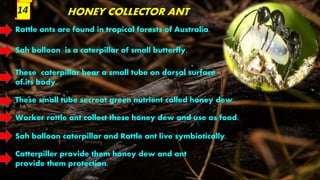
HONEY COLLECTOR ANT
Rattle ants are found in tropical forests of Australia.
Sah balloon is a caterpillar of small butterfly.
These caterpillar bear a small tube on dorsal surface
of its body.
These small tube secreat green nutrient called honey dew.
Worker rattle ant collect these honey dew and use as food.
Sah balloon caterpillar and Rattle ant live symbiotically.
Catterpiller provide them honey dew and ant
provide them protection.
14
SOME INTERSTING FACTS ABOUT ANTS
Ants have ability to carry 10-50 times their own body weight.
Ants do not have lungs and ears.
But breath through spiracles.
But hear using vibration.
Lot of ants in world, around 1 millions ant = 1 human in the world.
Ants have two stomaches.
One stomach – Hoilding food for own.
Another stomach – For sharing food to other ant.
Ants are as old as dinosaurs. ( During cretaceous period 130
millions years ago.)
15
Social Behaviour of Ant

Social Behaviour of Ant

  • 1.
    TOPIC- SOCIAL BEHAVIOUR OF ANTS GOVT.COLLEGE( AUTO.)ANGULGUIDED BY-RUTUPARNA PANDA DEBENDRAKUMARMAJHI ROLL NO- 16ZOO030
  • 2.
    CONTENTS Introduction Type of Indianants Nest Formation Different forms of ants Life cycle Farmer ants Honey collecter ant Some Intresting facts about ants 2
  • 3.
    CLASS-INSECTA ORDER-HYMENOPTERA FAMILY-FORMICIDAE PHYLUM-EUARTHROPODA KINGDOM-ANIMALIA Species in world– More than 12000 species & Species in India – Around 828 species. About 90% Ant species are social . Commonly 6 species of Inian ant carry social behaviour. These are given below. MONOMORIUM CAMPONOTUS SOLENOPSIS DORYLUS AENICTUS OECOPHYLLA 3
  • 4.
    Large and littleblack. Commonly called Pharaoh ant.(Pharaoh=king of Egypt). Length-0.5mm. Life spane- 4 to 12 months. MONOMORIUM CAMPONOTUS Common black ant. Commonly called as Carpenter ant. Length-0.2mm. Life spane-6 to 12 weeks. predators in nature. 4
  • 5.
    SOLENOPSIS DORYLUS Commonly calledfire ant & small red ant. Comparetvely other ant ,fire ant bite and spray formic acid. Length-3 to 6mm. Life spane of Queen and Worker are 7 years and 5 weeks respectively. Nest in soil,river bank,pond shore etc. Commonly called as driver ant. Also calld as winged ant. Length-1mm Life spane-2 to 3 years. 5
  • 6.
    AENICTUS Commonly called asarmy ant. Very hard working and predators in nature. Length-0.5 mm Life spane-3 years. OECOPHYLLA Commonly called as weaver ant. Mostly found in trees and red in colour. Show unique nest building behavior where worker construct nest by weaving and using larval silk. Length-8 to 10mm Life spane-8 to 10 weeks. 6
  • 7.
    NEST FORMATION New colonyis found by a single fertilized queen. Some species do not construct nest and most of species make their own nest. Some species occupy temporaily nests of other ants that relationship called plesiobiosis. Ant make subterranean nests by excavating that form granier used as storing food and galleries chamber for brood. Ant species Formica rufa make mound nest which is 60-160cm in diameter. Oecophylla(weaver ant) construct nest that own larval silk mixed with vegetable. Weaver ant colony consist of single queen and two types of worker.(Small worker-care for eggs & Large worker-construct nest,care queen). 7
  • 8.
    WEAVER ANT NEST FORMICARUFA′S MOUND 8
  • 9.
    DIFFERENT FORMS OFANTS The main cast of ants are queens,worker and male. QUEEN / GYNES These are fertile female. Queen is largest in size in comparison to other castes of their species. Antennae and legs are shorter and mandibles well developed. Larger individual are called macrogyens and dwarf ones microgynes. An egg laying worker called gynaecoid,occours in colony if queen is lost due to any reason that action rarely occurs in colony and they bears external secondary sexual character of both male and female. QUEEN 9
  • 10.
    WORKERS / ERGATES Sterilefemale are called worker. Smallest in size & larger are called macregate and smaller are micregate. Macregates are called Pahelwan of insect world because their ability to lift too much weights of their body weight. Amazing sense of direction & without wings. In army ant colony 3 types of worker are present.These are Small worker – Task for feeding broods. Midium worker – Task for searching food. Larger worker(Soldiers) - Task for defending own colony and attack other insect colony. WORKER 10
  • 11.
    MALES / ANERS Theseare small ,fertile,winged indivisuals. They bear small head and reduced mandibles. Well developed reproductive organ and longer antennae. Larger indivisuals are called macraners. Smaller indivisuals are called micraners. MALE 11
  • 12.
    LIFE CYCLE Mating occursin nuptial flight. Adult: The pupa emerges as an adult. The entire life cycle usually lasts from 6 to 10 weeks. The life cycle of the ant consists of four stages: egg, larva, pupa, and adult. Fertilized eggs produce female ants (queens, workers, or soldiers). unfertilized eggs produce male ants. Egg: Ant eggs are oval shaped and tiny. Larva: The worm-like larvae have no eyes and no legs. Pupa: A cocoon cover the pupa as it metamorphoses to adult. Queen lays eggs that hatch into larva which is cylindercal. Adults 12
  • 13.
    FARMER ANTS In SouthAmerica rain forest,“Fungus gardening species“ of ant cultivate like human beings. These ant do gardening of fungus in 180m radius. These ant species worker cast cut small pieces of leaves from plant of rain forest. These small pieces of leaves are masticated by worker to form pulp of leaves. Pulp of leaves is mixed with waste products and some own secretion of their own body to make pulp fertile. Fungus spores fall on this pulp and fungus grow within a week. These fungus is food of these ant. FARMER ANT 13
  • 14.
    HONEY COLLECTOR ANT Rattleants are found in tropical forests of Australia. Sah balloon is a caterpillar of small butterfly. These caterpillar bear a small tube on dorsal surface of its body. These small tube secreat green nutrient called honey dew. Worker rattle ant collect these honey dew and use as food. Sah balloon caterpillar and Rattle ant live symbiotically. Catterpiller provide them honey dew and ant provide them protection. 14
  • 15.
    SOME INTERSTING FACTSABOUT ANTS Ants have ability to carry 10-50 times their own body weight. Ants do not have lungs and ears. But breath through spiracles. But hear using vibration. Lot of ants in world, around 1 millions ant = 1 human in the world. Ants have two stomaches. One stomach – Hoilding food for own. Another stomach – For sharing food to other ant. Ants are as old as dinosaurs. ( During cretaceous period 130 millions years ago.) 15