Approach &
Classification of OM
Intro
O Osteomyelitis getting more common
O Pattern changing
O Lesser– Haematogenous origin
O More common – 2o to surgery, injury, DM
O Potential outcome
O Acute OM – major systemic illness –
mortality
O Chronic OM – chronic pain and ill health
– unemployment, recurrent
medical treatment
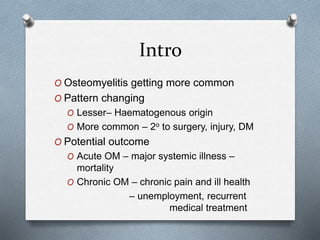
When to suspect?
Oh/o systemic
infection (esp
paeds)
Oh/o surgical
intervention /
trauma
Bony tenderness
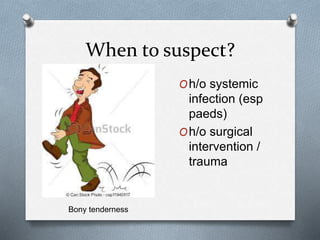
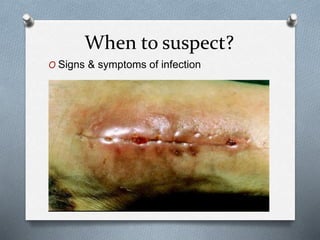
When to suspect?
O Signs & symptoms of infection
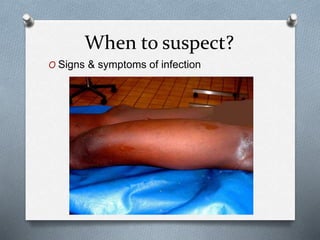
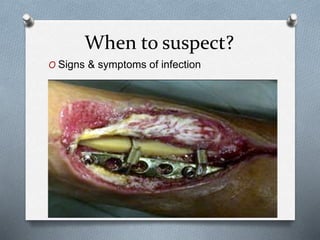
When to suspect?
O Signs & symptoms of infection
When to suspect?
O Signs & symptoms of infection
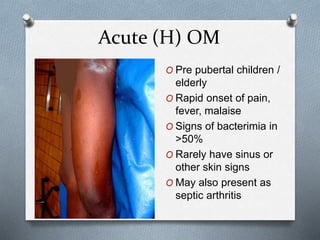
Acute (H) OM
O Pre pubertal children /
elderly
O Rapid onset of pain,
fever, malaise
O Signs of bacterimia in
>50%
O Rarely have sinus or
other skin signs
O May also present as
septic arthritis
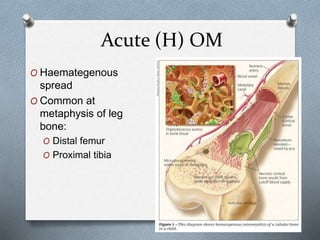
Acute (H) OM
O Haemategenous
spread
O Common at
metaphysis of leg
bone:
O Distal femur
O Proximal tibia
Chronic OM
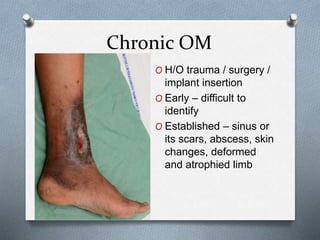
O H/O trauma / surgery /
implant insertion
O Early – difficult to
identify
O Established – sinus or
its scars, abscess, skin
changes, deformed
and atrophied limb
Chronic OM
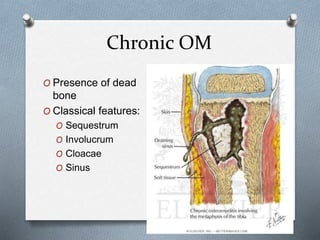
O Presence of dead
bone
O Classical features:
O Sequestrum
O Involucrum
O Cloacae
O Sinus
What to do next?
O When history and PE gives a strong
suggestion of OM as a diagnosis:
O Lab investigations
O Radiographic investigations
Gold standard
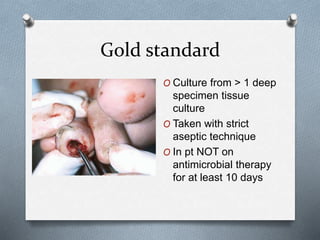
O Culture from > 1 deep
specimen tissue
culture
O Taken with strict
aseptic technique
O In pt NOT on
antimicrobial therapy
for at least 10 days
CLASSIFICATION
General
O Many classifications based on type and
origin
O Doesn’t help in m(x)
O Classification that guides management:
O Cierny-Mader classification
Cierny-Mader
O Physiological grouping of host
O Important to determine pt’s ability to cope
with prolonged treatment
O Highlight pt’s area of dysfunction that could
be optimized for better healing
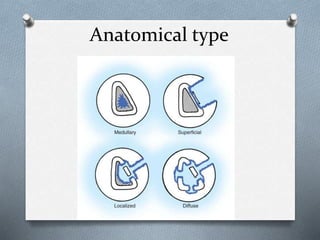
O Anatomical type of the disease
O Based on specific distribution of infected
bone
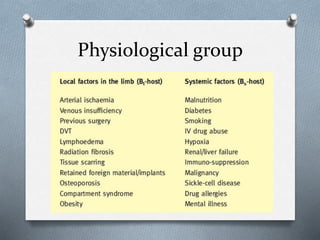
Physiological group
O A – healthy host
O B – host with impairments that directly
affect ability to heal / reduce efficacy of
drugs / prevent surgery
O Bl – local conditions
O Bs – systemic conditions
O Bls – both
O C – moribund pt
O Treatment of infxn does not improve
survival or QOL
Physiological group
Anatomical type
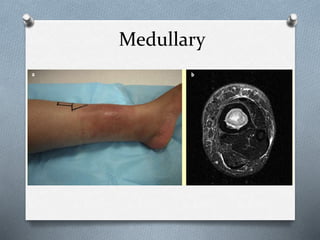
Medullary
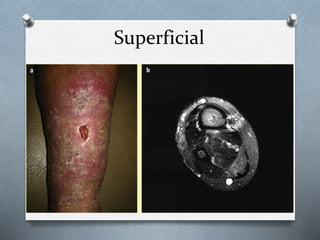
Superficial
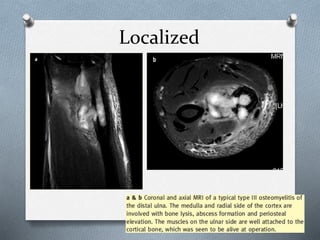
Localized
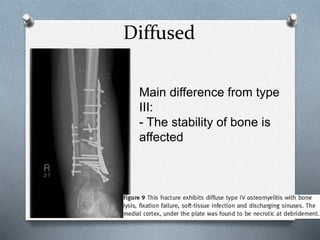
Diffused
Main difference from type
III:
- The stability of bone is
affected
Approach & classification of osteomyelitis

Approach & classification of osteomyelitis

  • 1.
  • 2.
    Intro O Osteomyelitis gettingmore common O Pattern changing O Lesser– Haematogenous origin O More common – 2o to surgery, injury, DM O Potential outcome O Acute OM – major systemic illness – mortality O Chronic OM – chronic pain and ill health – unemployment, recurrent medical treatment
  • 3.
    When to suspect? Oh/osystemic infection (esp paeds) Oh/o surgical intervention / trauma Bony tenderness
  • 4.
    When to suspect? OSigns & symptoms of infection
  • 5.
    When to suspect? OSigns & symptoms of infection
  • 6.
    When to suspect? OSigns & symptoms of infection
  • 7.
    Acute (H) OM OPre pubertal children / elderly O Rapid onset of pain, fever, malaise O Signs of bacterimia in >50% O Rarely have sinus or other skin signs O May also present as septic arthritis
  • 8.
    Acute (H) OM OHaemategenous spread O Common at metaphysis of leg bone: O Distal femur O Proximal tibia
  • 9.
    Chronic OM O H/Otrauma / surgery / implant insertion O Early – difficult to identify O Established – sinus or its scars, abscess, skin changes, deformed and atrophied limb
  • 10.
    Chronic OM O Presenceof dead bone O Classical features: O Sequestrum O Involucrum O Cloacae O Sinus
  • 11.
    What to donext? O When history and PE gives a strong suggestion of OM as a diagnosis: O Lab investigations O Radiographic investigations
  • 12.
    Gold standard O Culturefrom > 1 deep specimen tissue culture O Taken with strict aseptic technique O In pt NOT on antimicrobial therapy for at least 10 days
  • 13.
  • 14.
    General O Many classificationsbased on type and origin O Doesn’t help in m(x) O Classification that guides management: O Cierny-Mader classification
  • 15.
    Cierny-Mader O Physiological groupingof host O Important to determine pt’s ability to cope with prolonged treatment O Highlight pt’s area of dysfunction that could be optimized for better healing O Anatomical type of the disease O Based on specific distribution of infected bone
  • 16.
    Physiological group O A– healthy host O B – host with impairments that directly affect ability to heal / reduce efficacy of drugs / prevent surgery O Bl – local conditions O Bs – systemic conditions O Bls – both O C – moribund pt O Treatment of infxn does not improve survival or QOL
  • 17.
  • 18.
  • 19.
  • 20.
  • 21.
  • 22.
    Diffused Main difference fromtype III: - The stability of bone is affected