Examination, evaluation & Assessment
of Hand and Wrist
Dr. Abid Ullah PT
Lecturer FIMS
Abbottabad
Email:
dr.abidullahpt@yahoo.com
OBJECTIVES
 Review the clinical anatomy and physical exam of the
wrist and hand
 Formulate a pathoanatomic diagnosis in the clinical
setting
 Discuss common clinical conditions that can be
elicited from the physical exam
INTRODUCTION: Hand and Wrist
 Series of complex, delicately balanced joints
 Function is integral to every act of daily living
 Most active portion of the upper extremity
INTRODUCTION
 The least protected joints
 Extremely vulnerable to injury
 Difficult and complex examination
 Diagnosis often vague
 If no fracture = “wrist strain or sprain”
 Bilateral comparison useful
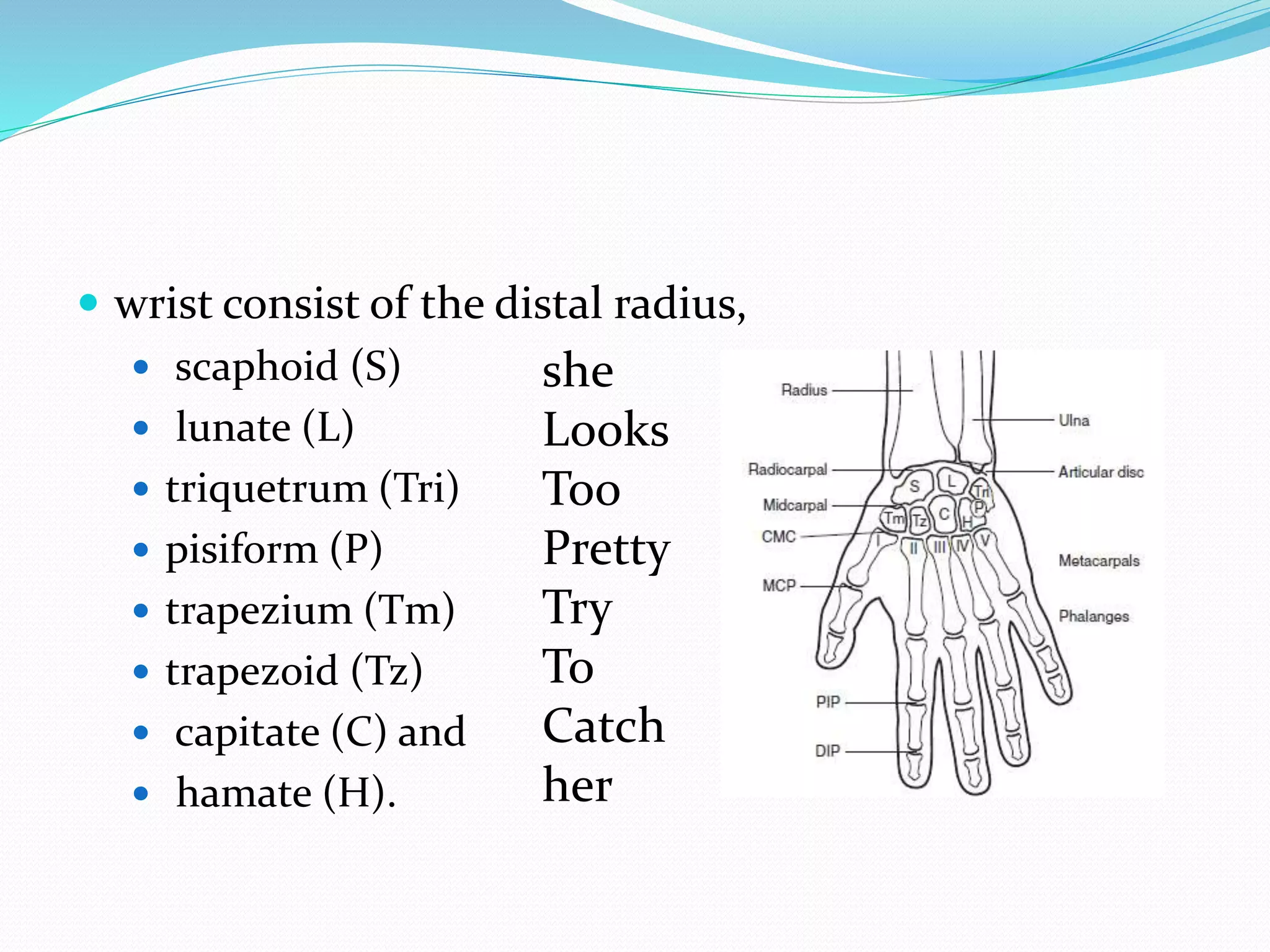
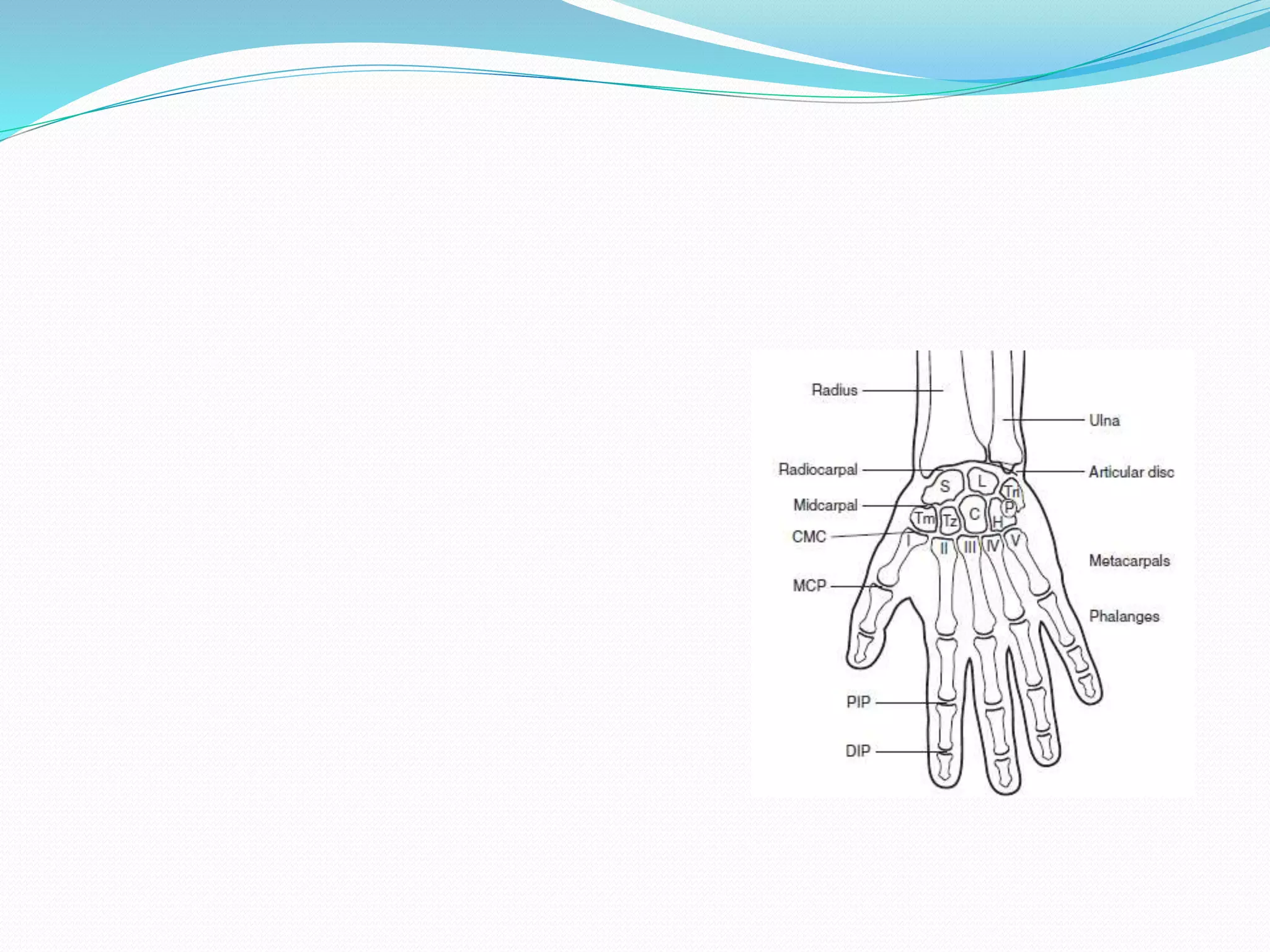
 wrist consist of the distal radius,
 scaphoid (S)
 lunate (L)
 triquetrum (Tri)
 pisiform (P)
 trapezium (Tm)
 trapezoid (Tz)
 capitate (C) and
 hamate (H).
she
Looks
Too
Pretty
Try
To
Catch
her
Bony Anatomy
 Phalanges: 14
 Sesamoids: 2
 Metacarpals: 5
 Carpals
 Proximal row: 4
 Distal row: 4
 Radius and Ulna
Lister’s tubercle
Radiocarpal Joint
 (RC) joint is enclosed in a loose but strong capsule.
 The biconcave articulating surface is the distal end of
the radius and radioulnar disk; it is angled slightly
volarward and ulnarward.
 The biconvex articulating surface is the combined
proximal surface of the scaphoid, lunate, and
triquetrum.
 the convex proximal row of carpals slides in the
direction opposite the physiological motion of the
hand.
Bony Anatomy
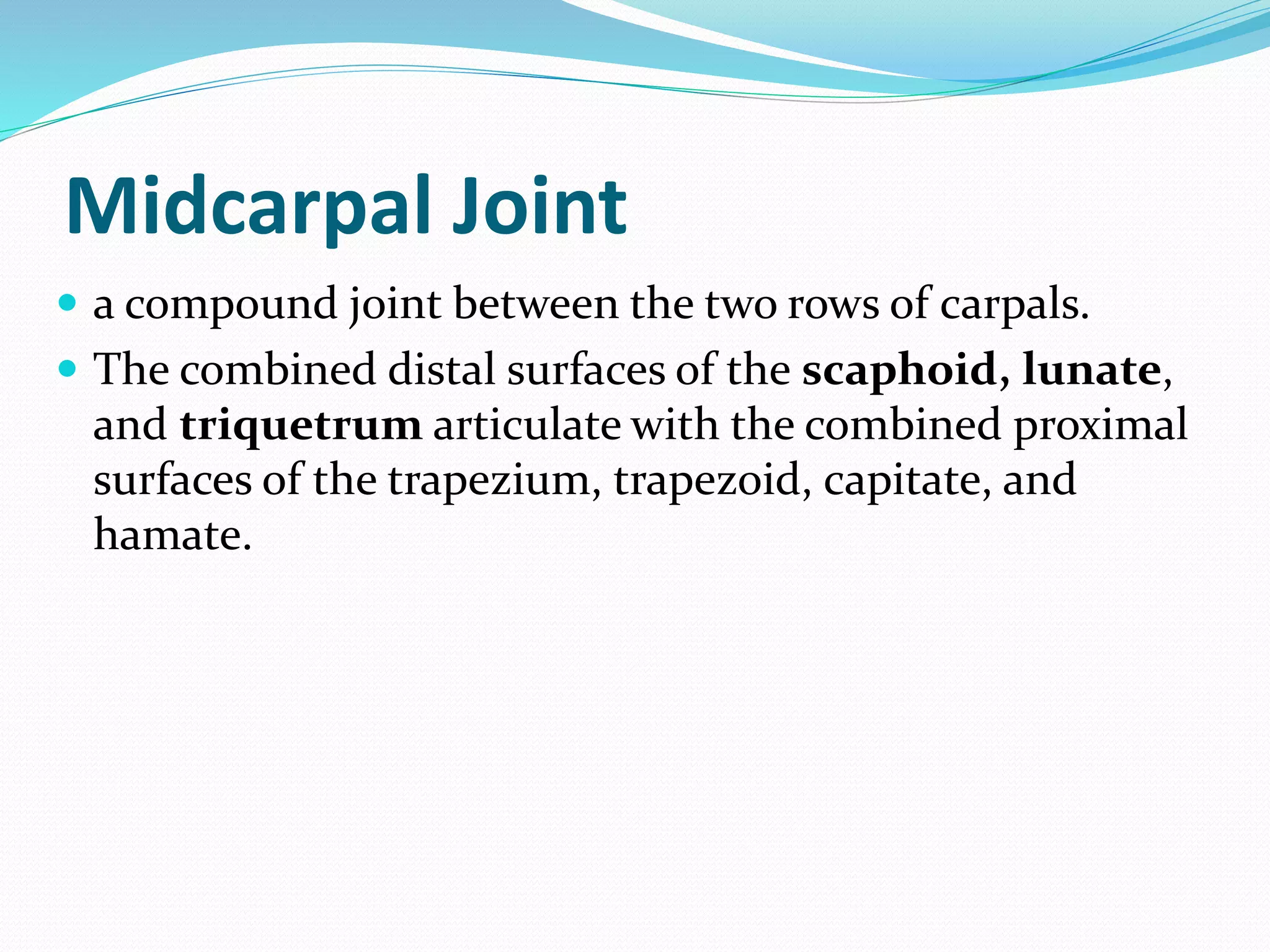
Midcarpal Joint
 a compound joint between the two rows of carpals.
 The combined distal surfaces of the scaphoid, lunate,
and triquetrum articulate with the combined proximal
surfaces of the trapezium, trapezoid, capitate, and
hamate.
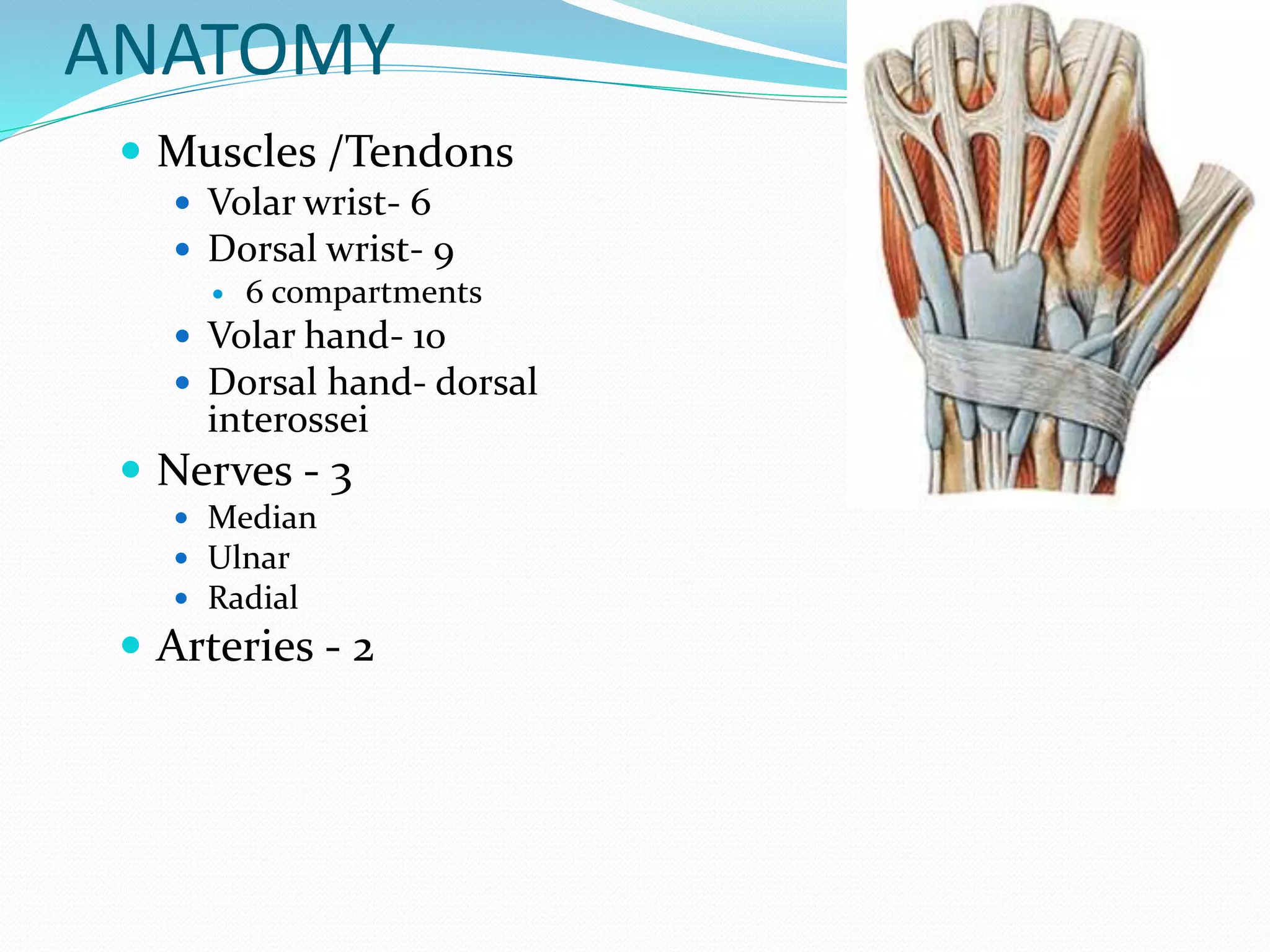
ANATOMY
 Muscles /Tendons
 Volar wrist- 6
 Dorsal wrist- 9
 6 compartments
 Volar hand- 10
 Dorsal hand- dorsal
interossei
 Nerves - 3
 Median
 Ulnar
 Radial
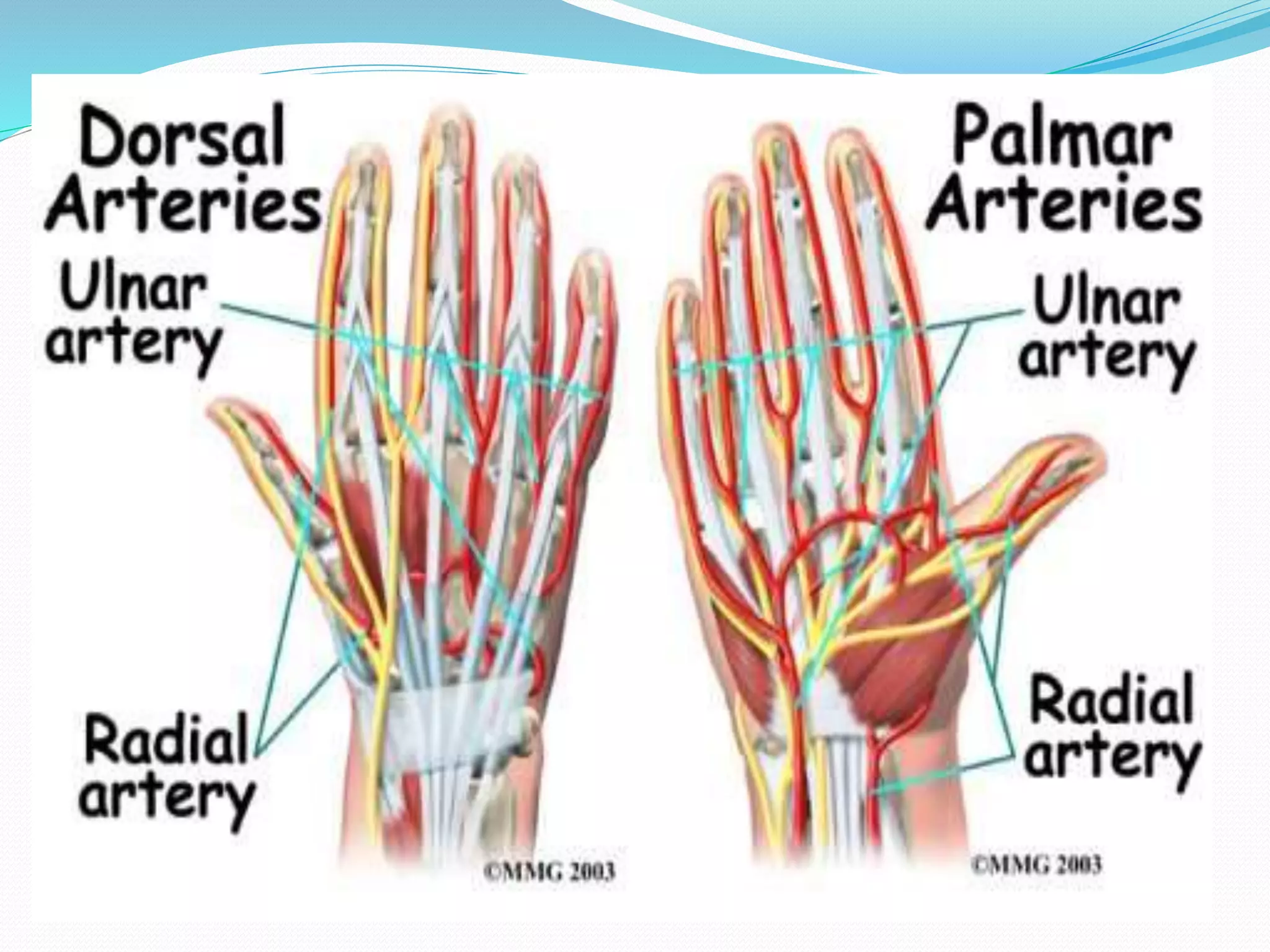
 Arteries - 2
HISTORY
 Age
 Handedness
 Chief complaint
 Occupation
 Previous injury
 Previous surgery
 Sx related to specific
activities
 What exacerbates
 What improves
 Frequency
 Duration
Range of motion
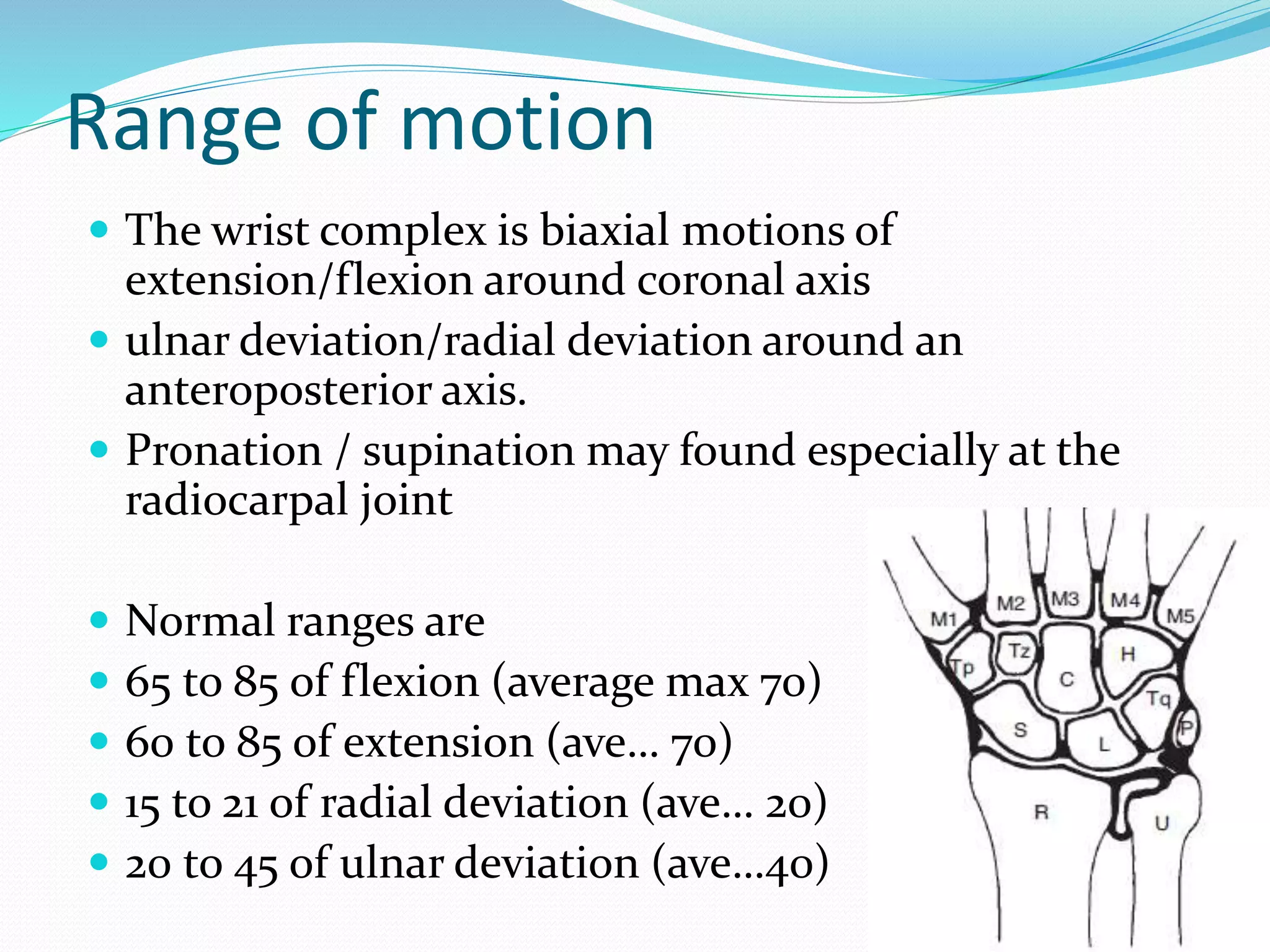
 The wrist complex is biaxial motions of
extension/flexion around coronal axis
 ulnar deviation/radial deviation around an
anteroposterior axis.
 Pronation / supination may found especially at the
radiocarpal joint
 Normal ranges are
 65 to 85 of flexion (average max 70)
 60 to 85 of extension (ave… 70)
 15 to 21 of radial deviation (ave… 20)
 20 to 45 of ulnar deviation (ave…40)
PHYSICAL EXAM
 Inspection
 Palpation
 Range of Motion
 Neurologic Exam
 Special Tests
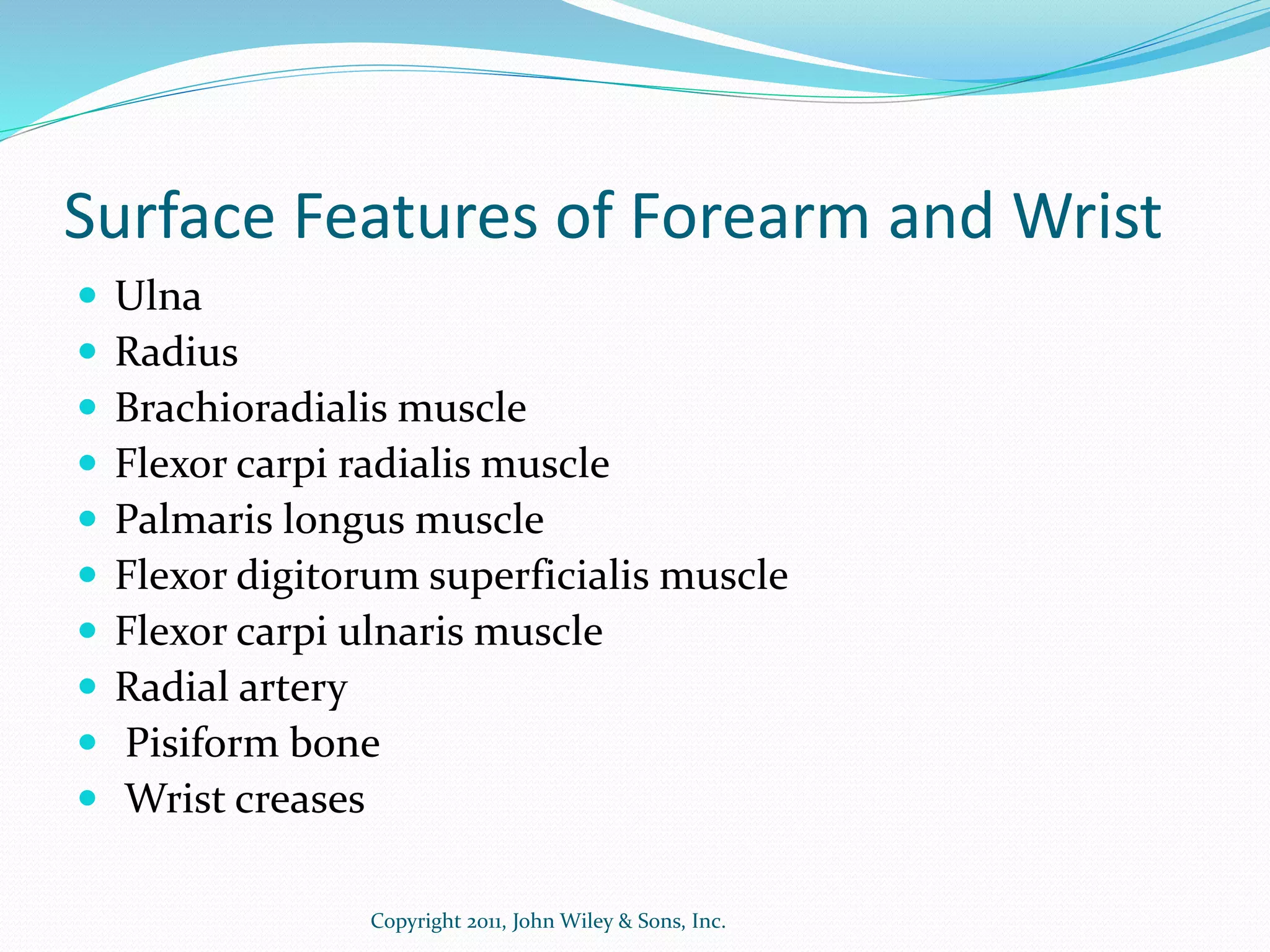
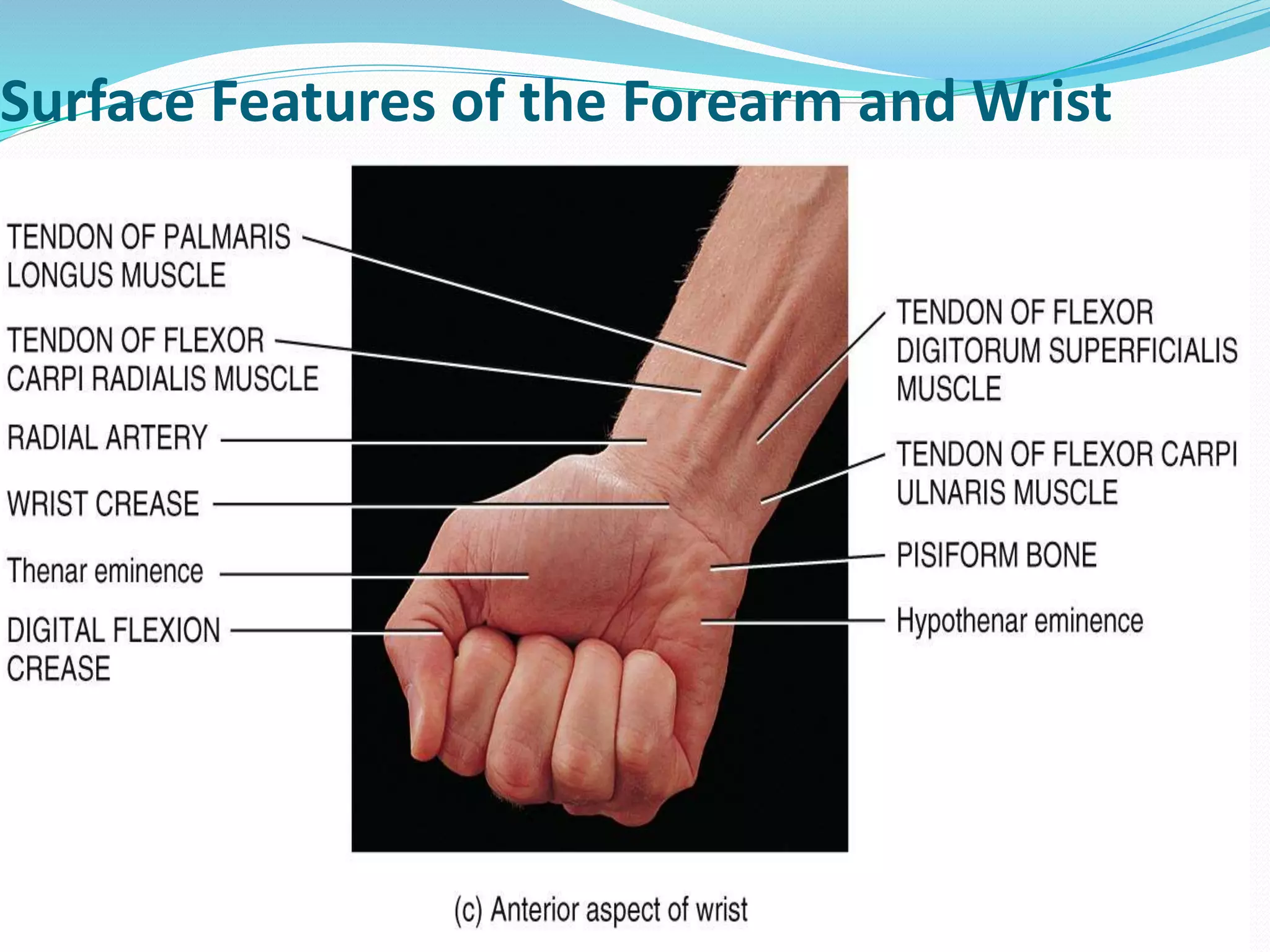
Surface Features of Forearm and Wrist
 Ulna
 Radius
 Brachioradialis muscle
 Flexor carpi radialis muscle
 Palmaris longus muscle
 Flexor digitorum superficialis muscle
 Flexor carpi ulnaris muscle
 Radial artery
 Pisiform bone
 Wrist creases
Copyright 2011, John Wiley & Sons, Inc.
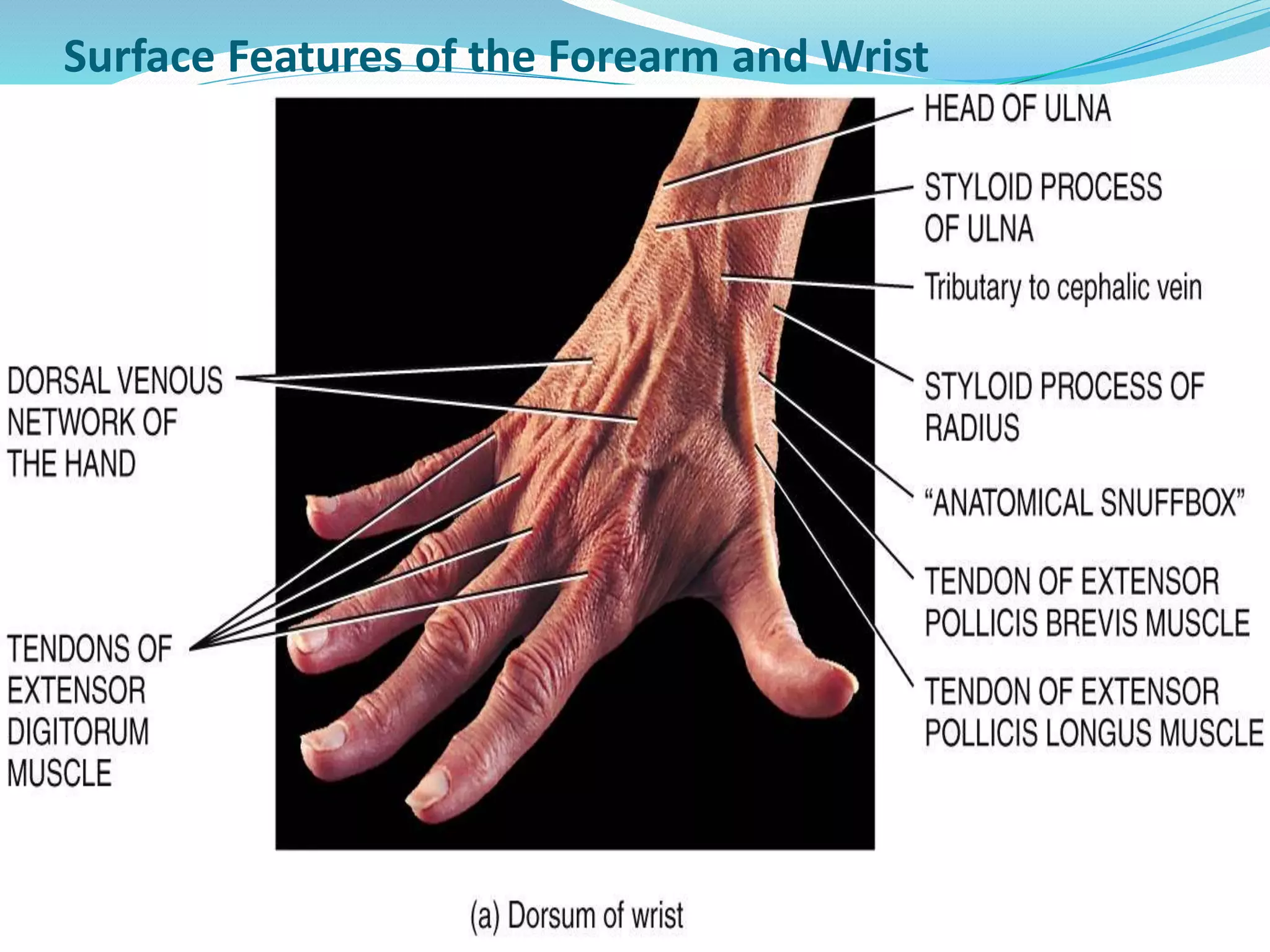
Ulnar styloid/distal ulna.
Medial aspect of the distal ulna
Site of attachment of ulnar collateral ligament of the wrist
Fractures of the ulnar styloid can lead to instability of the
distal radioulnar joint (DRUJ).
Palpation, supination, pronation
Radial styloid.
Lateral aspect of distal radius
Site of attachment for the brachioradialis tendon and
radial collateral ligament of the wrist.
Surface Features of the Forearm and Wrist
Copyright 2011, John Wiley & Sons, Inc.
Surface Features of the Forearm and Wrist
Copyright 2011, John Wiley & Sons, Inc.
Surface Features of the Forearm and Wrist
Surface Features of the Hand
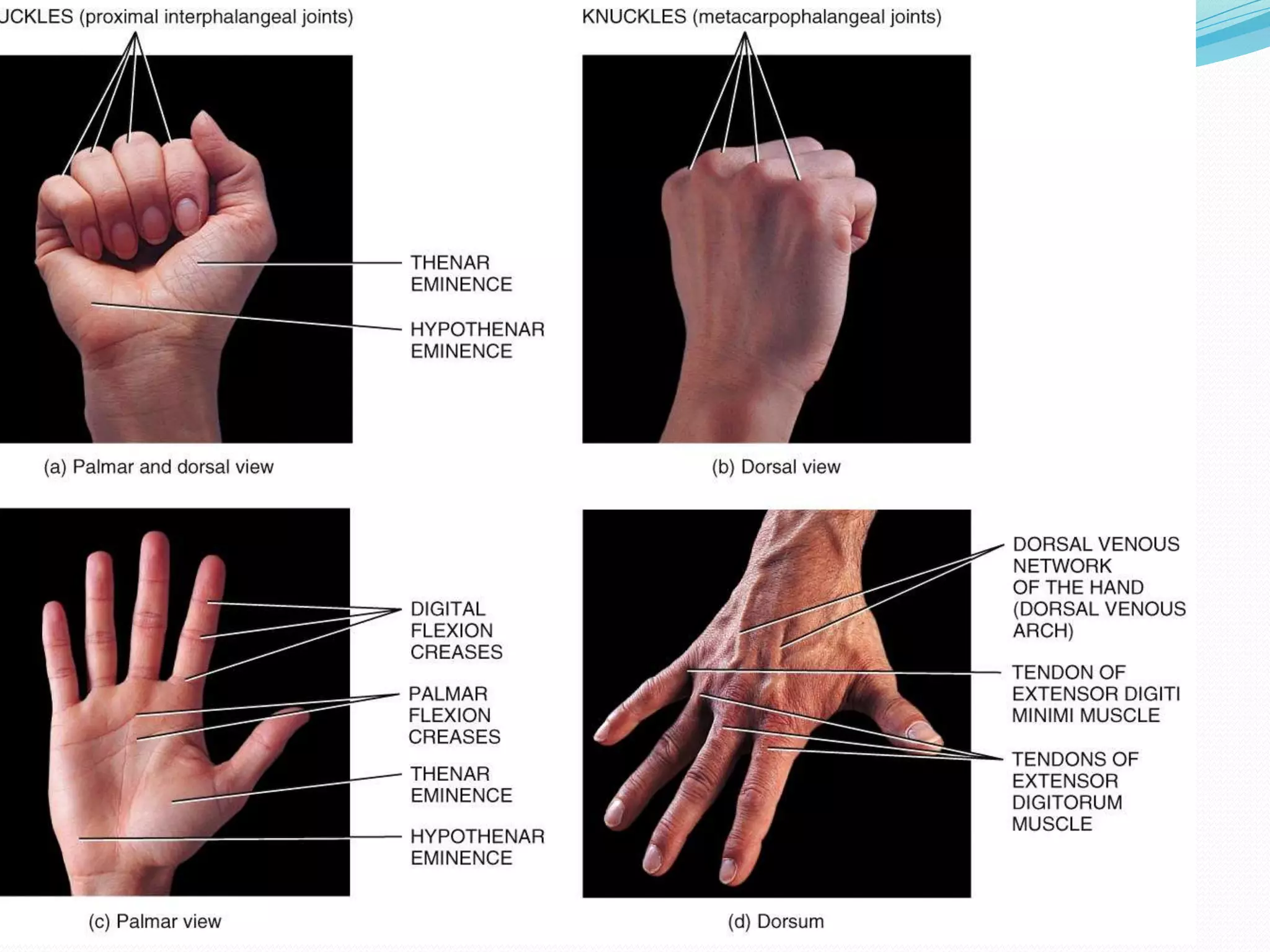
 Knuckles
 Dorsal venous network of the hand (dorsal venous arch).
 Tendon of extensor digiti minimi muscle
 Tendons of extensor digitorum muscle
Copyright 2011, John Wiley & Sons, Inc.
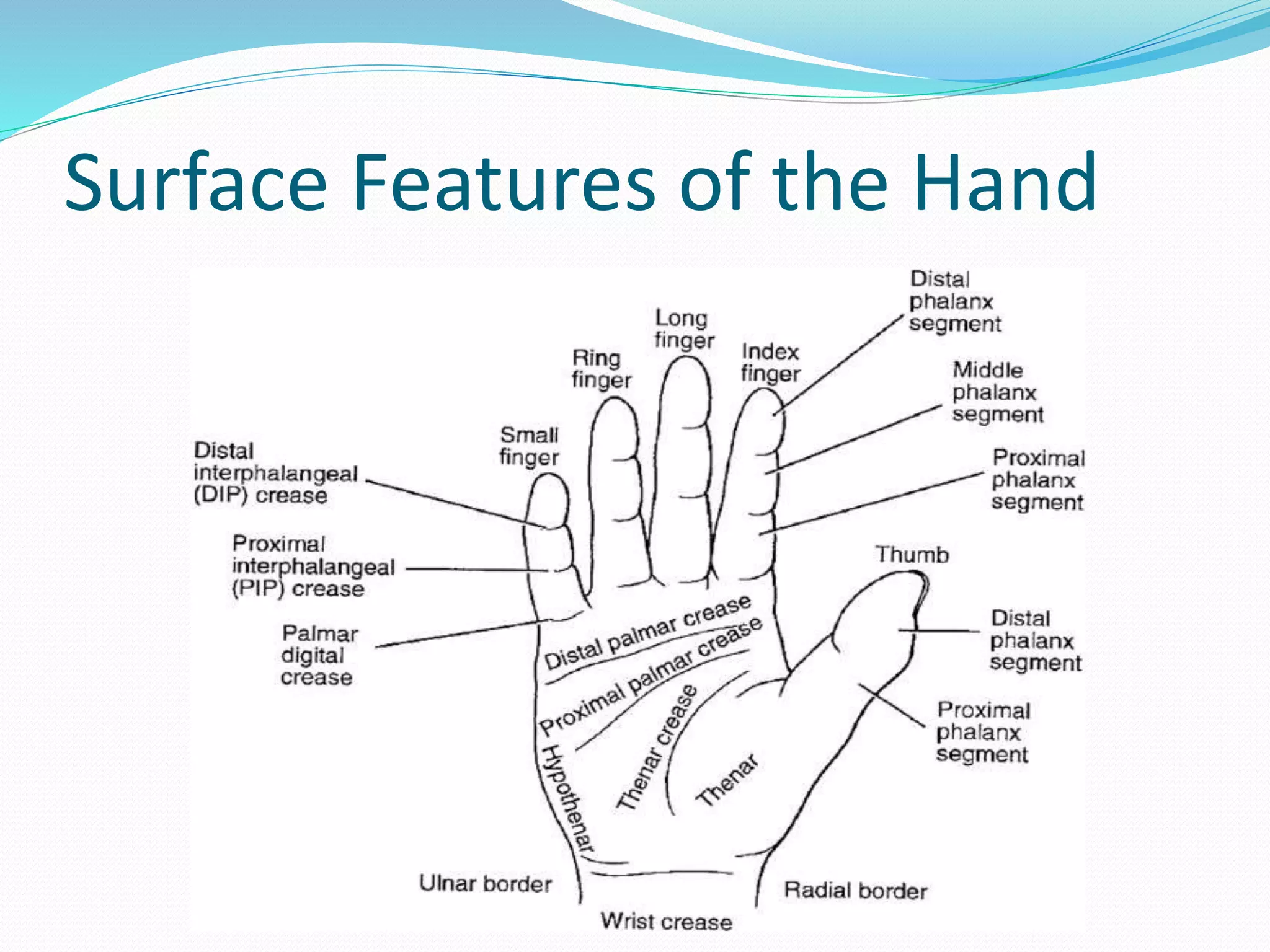
Surface Features of the Hand
INSPECTION
 Observe upper
extremity as patient
enters room
 Examine hand in
function
 Deformities
 Attitude of the hand
INSPECTION
Palmar Surface
 Creases
 Thenar and
Hypothenar Eminence
 Arched Framework
 Hills and Valleys
 Web Spaces
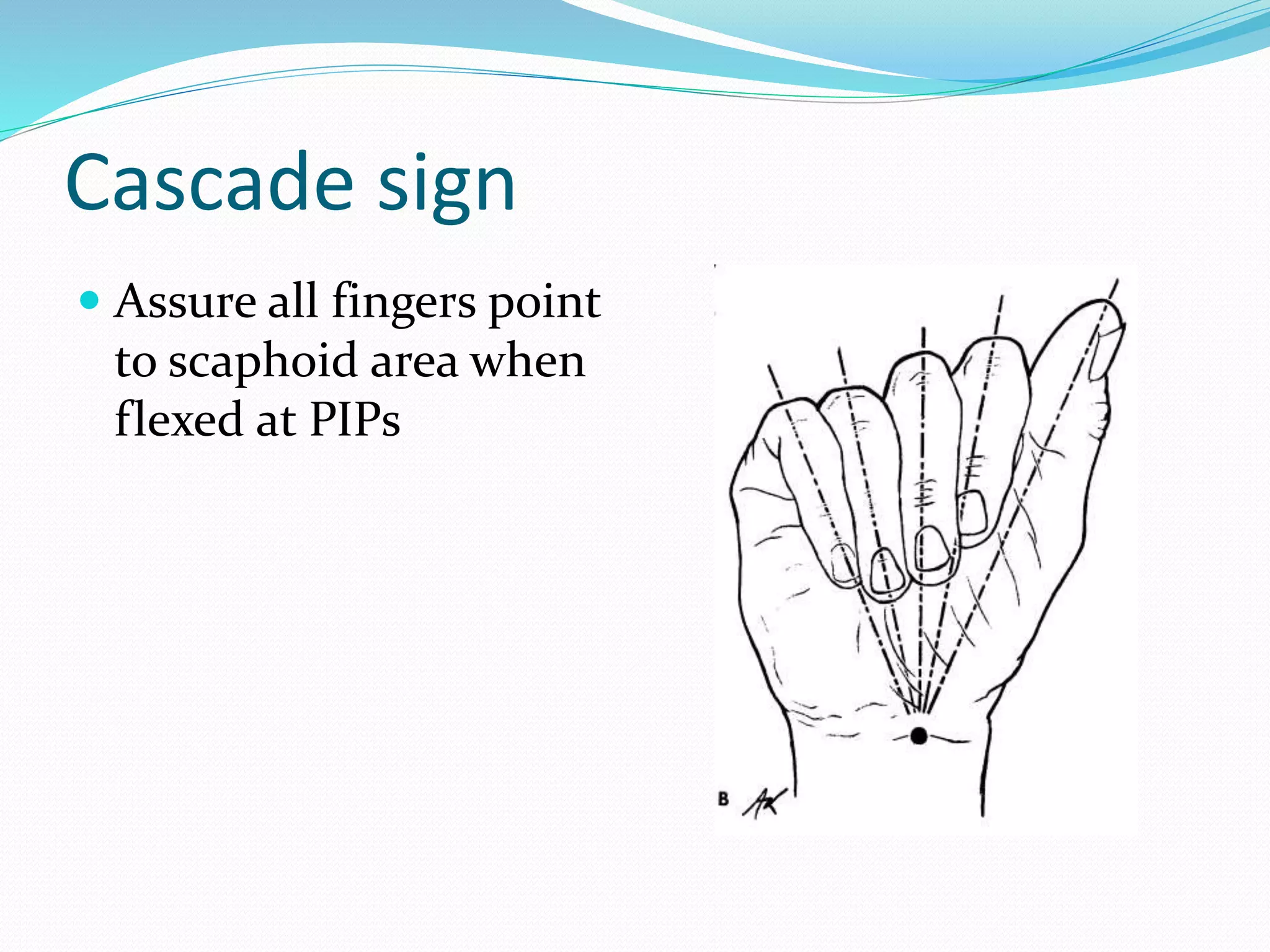
Cascade sign
 Assure all fingers point
to scaphoid area when
flexed at PIPs
Volar Wrist Musculature
 Six muscles have
tendons crossing
the volar aspect of
the wrist and,
therefore, are
capable of creating
a
 wrist flexion
movement
 These are
 Palmaris longus (PL),
 flexor carpi radialis (FCR),
 Flexor carpi ulnaris (FCU),
 the flexor digitorum superficialis (FDS),
 flexor digitorum profundus (FDP),
 the flexor pollicis longus (FPL) muscles.
 first three of these muscles are primary wrist muscles.
 last three are flexors of digits with secondary actions
at wrist
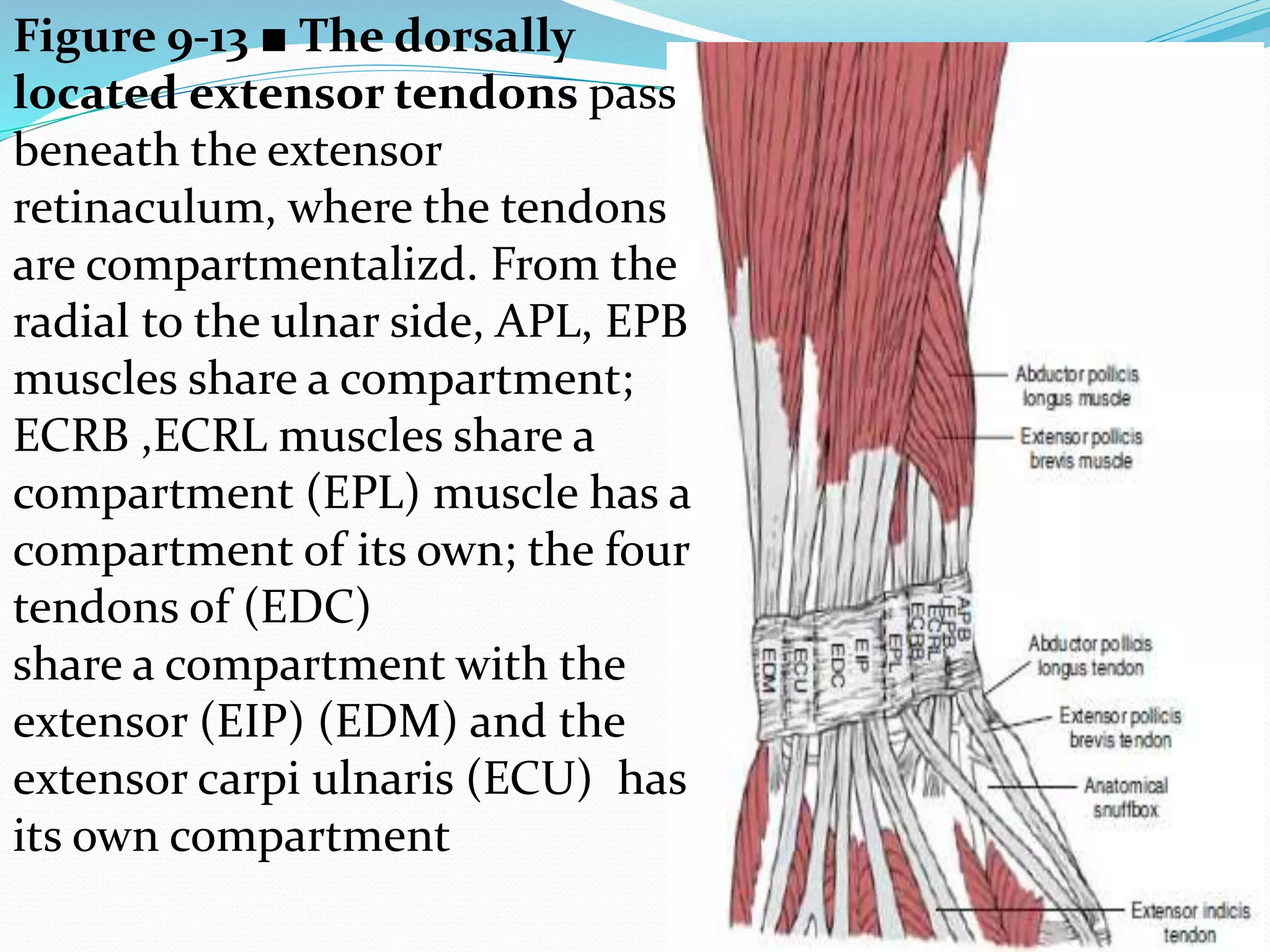
Figure 9-13 ■ The dorsally
located extensor tendons pass
beneath the extensor
retinaculum, where the tendons
are compartmentalizd. From the
radial to the ulnar side, APL, EPB
muscles share a compartment;
ECRB ,ECRL muscles share a
compartment (EPL) muscle has a
compartment of its own; the four
tendons of (EDC)
share a compartment with the
extensor (EIP) (EDM) and the
extensor carpi ulnaris (ECU) has
its own compartment
INSPECTION of Dorsal Hand and
Wrist
 Hills and Valleys
 Height of metacarpal heads
 Finger nails
 Pale or white=anemia or circulatory
 Spoon shaped=fungal infection
 Clubbed=respiratory or congenital heart
 Deformities
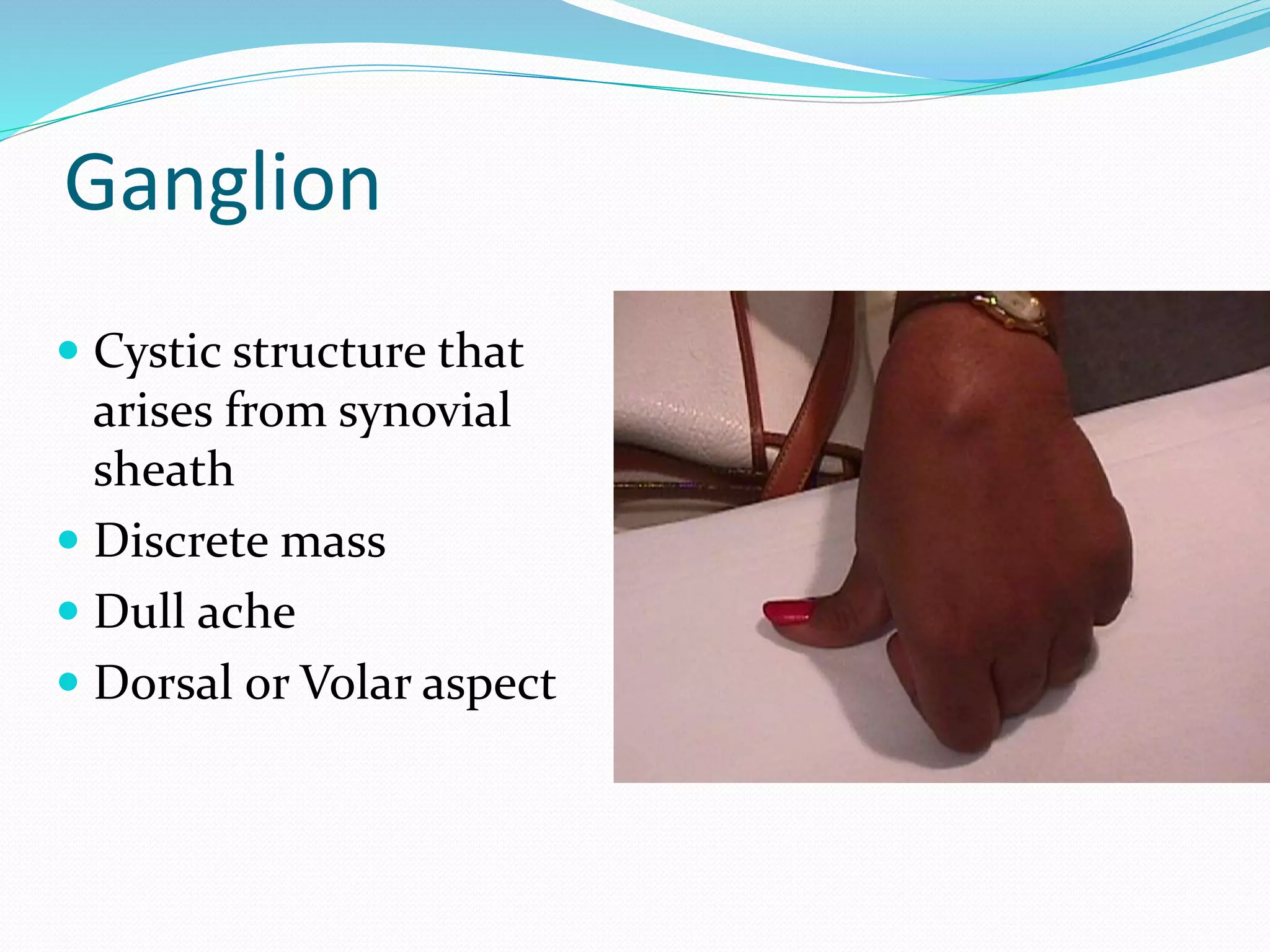
Ganglion
 Cystic structure that
arises from synovial
sheath
 Discrete mass
 Dull ache
 Dorsal or Volar aspect
Boutonniere Deformity
 Tear or stretch of the
central extensor
tendon at PIP
 Note: unopposed
flexion at PIP
 Extension at DIP
 Trauma or
inflammatory
arthritis
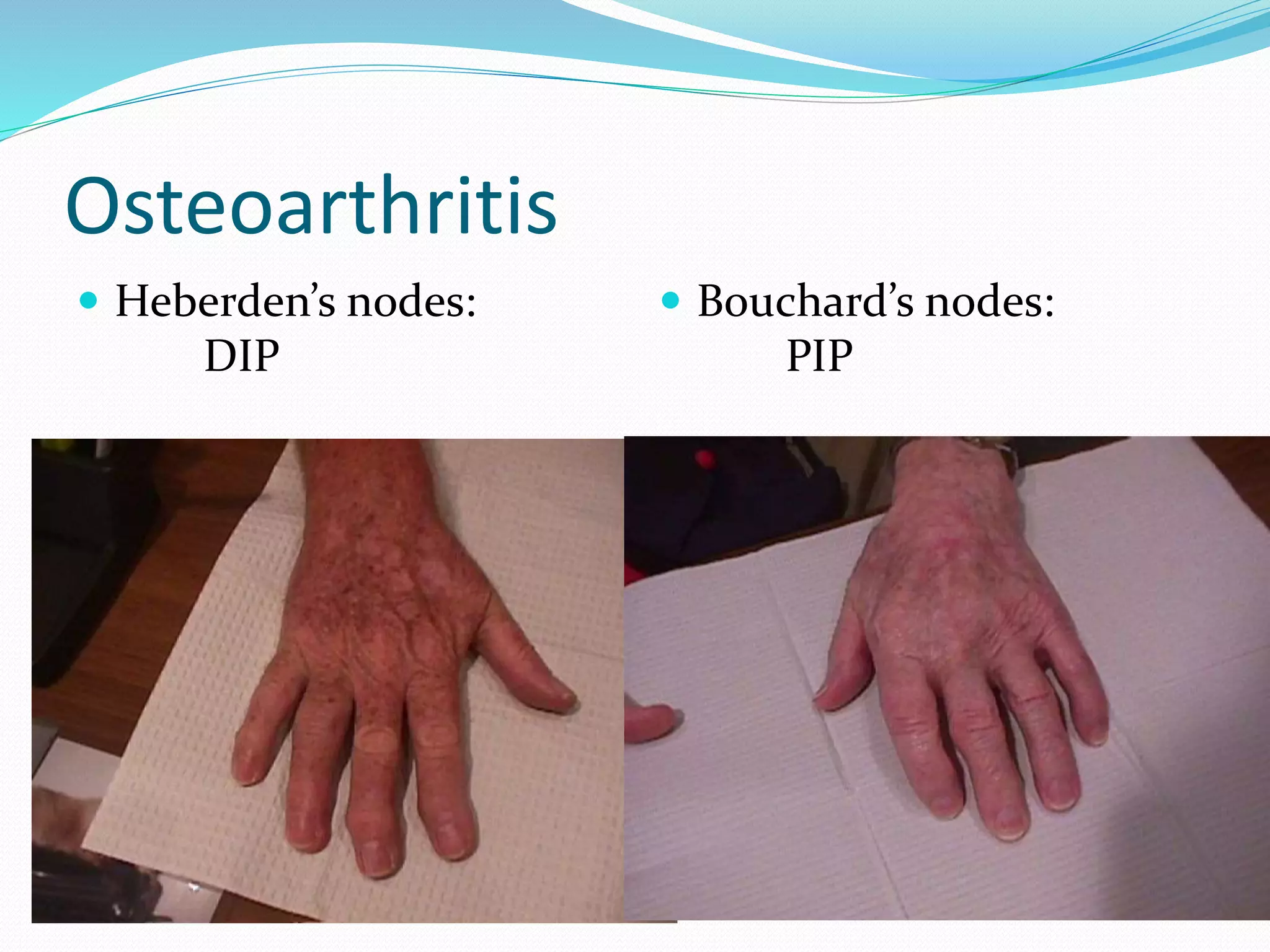
Osteoarthritis
 Heberden’s nodes:
DIP
 Bouchard’s nodes:
PIP
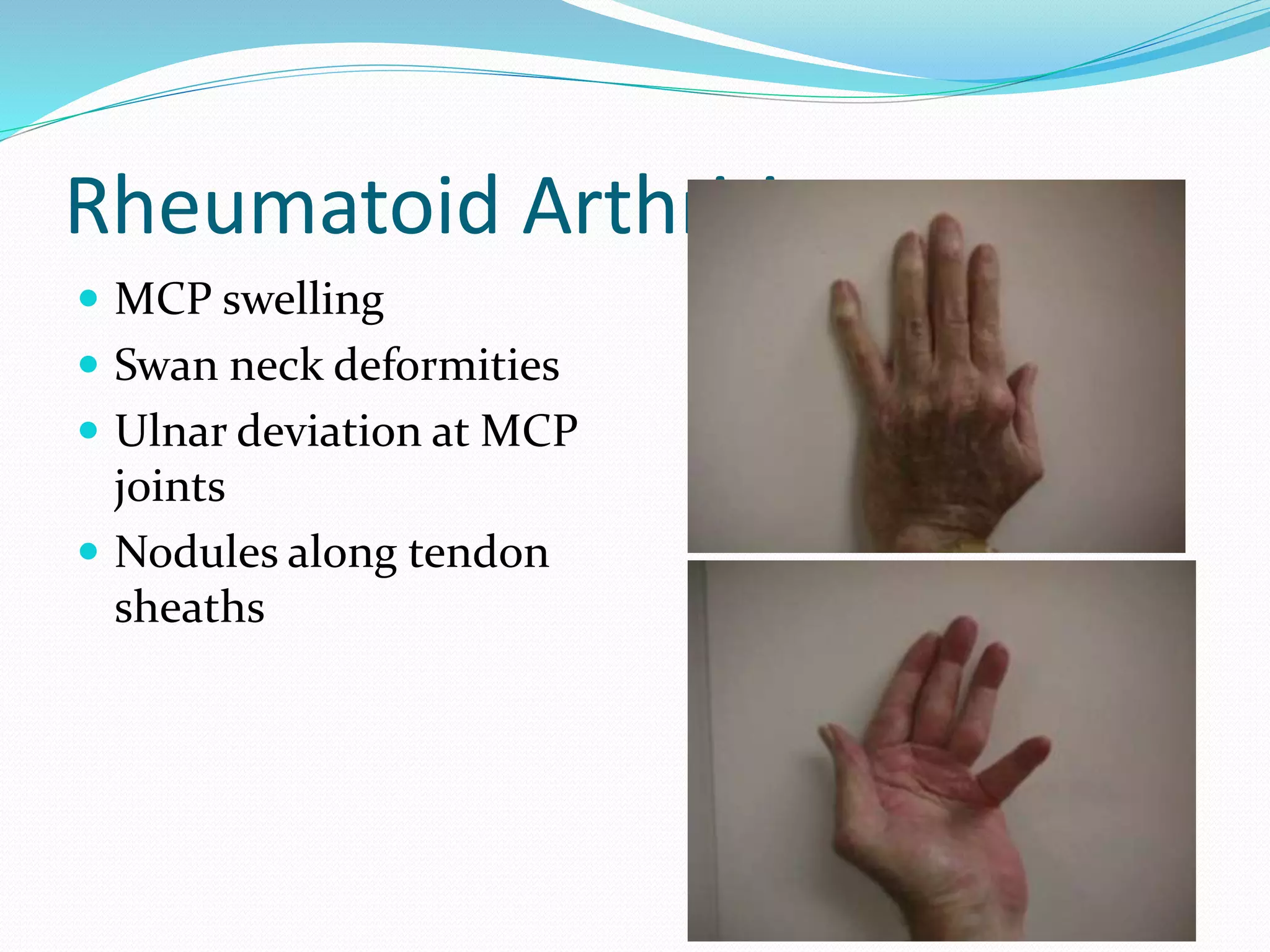
Rheumatoid Arthritis
 MCP swelling
 Swan neck deformities
 Ulnar deviation at MCP
joints
 Nodules along tendon
sheaths
Mallet Finger
 Hyperflexion injury
 Ruptured terminal
extensor mechanism at
DIP
 Incomplete extension
of DIP joint or extensor
lag
 Treatment:
 stack splint
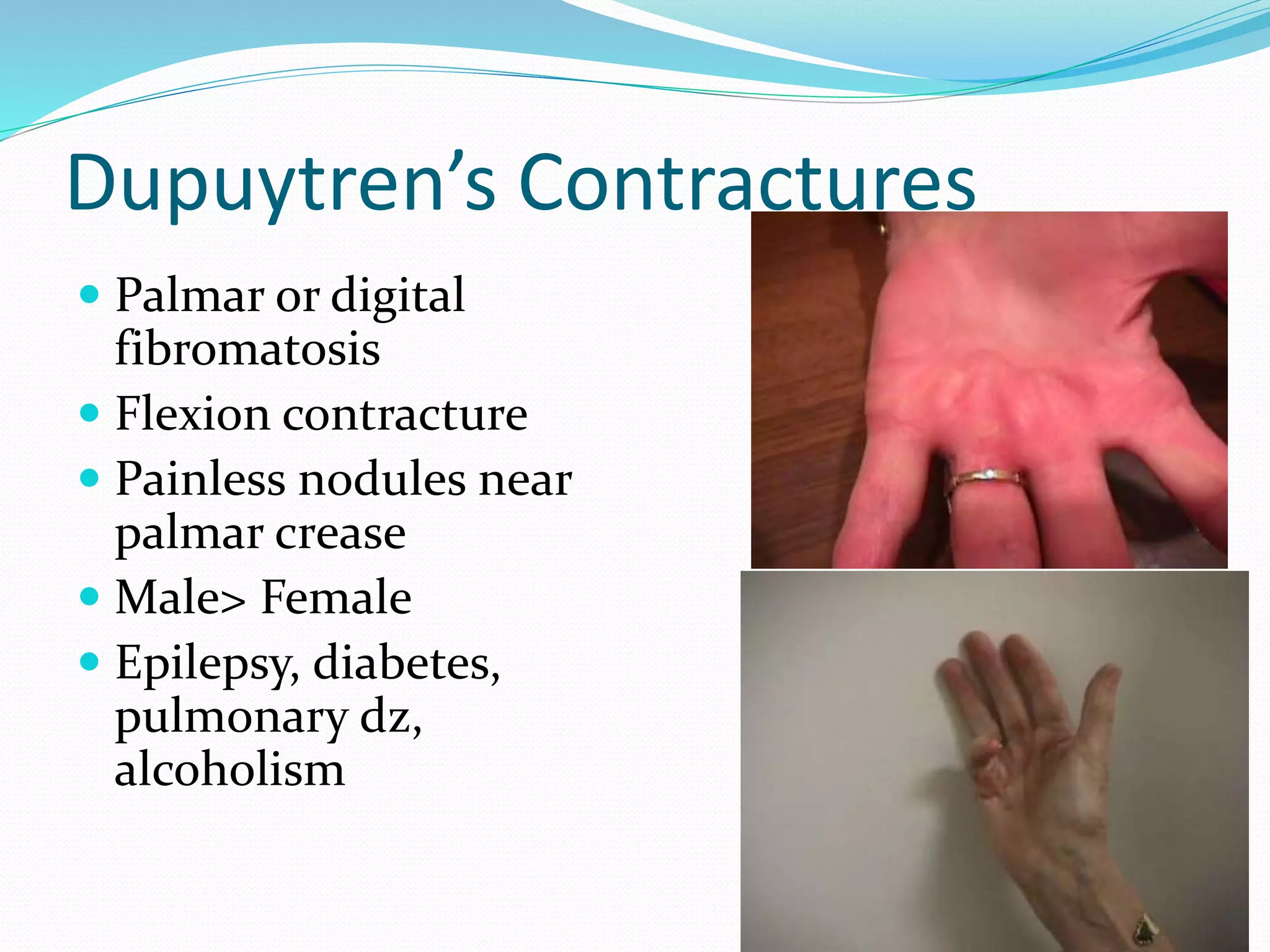
Dupuytren’s Contractures
 Palmar or digital
fibromatosis
 Flexion contracture
 Painless nodules near
palmar crease
 Male> Female
 Epilepsy, diabetes,
pulmonary dz,
alcoholism
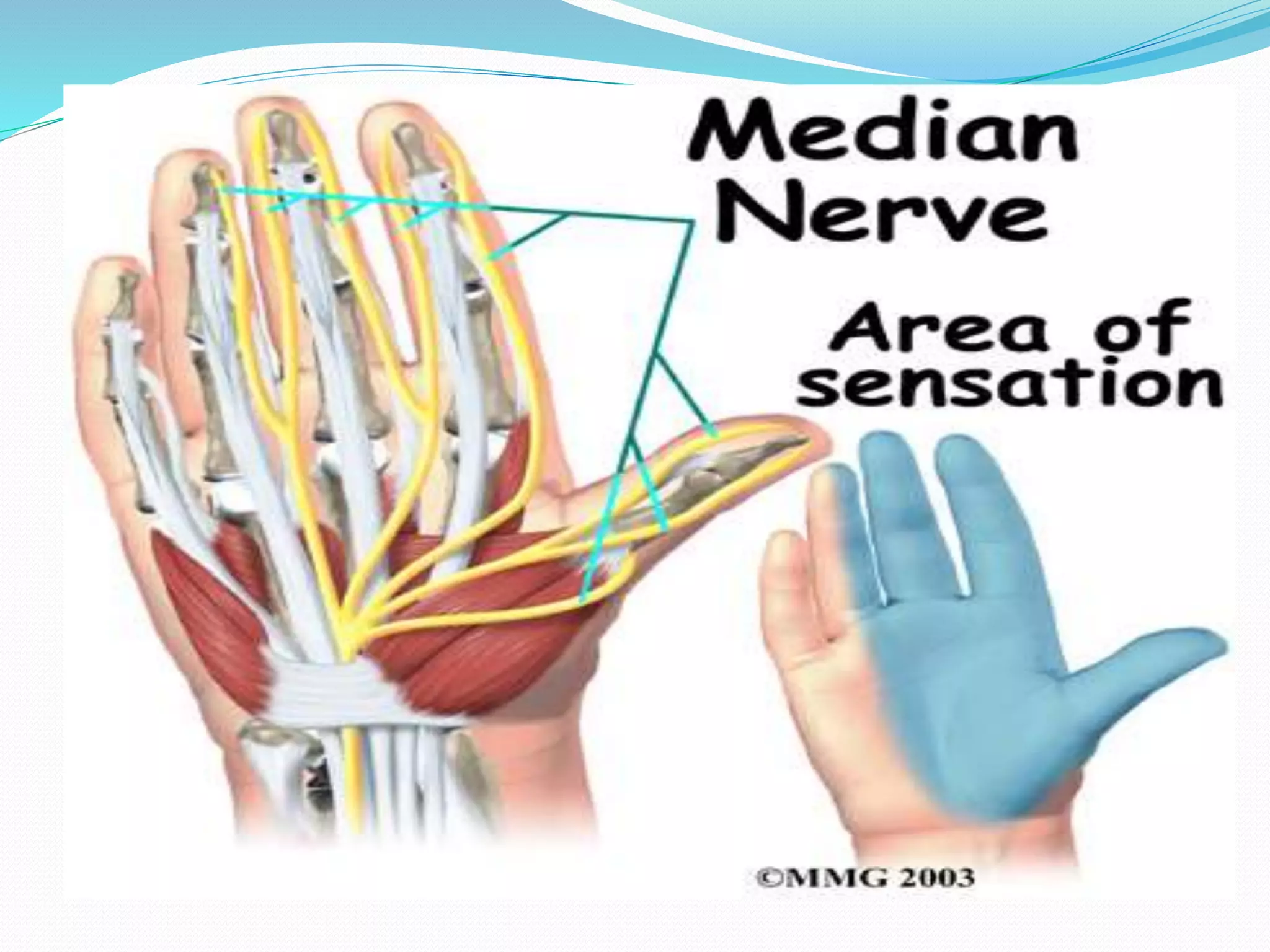
Carpal Tunnel
 The median nerve and the finger flexion tendons lie
within the carpal tunnel.
 This is a common site of compression neuropathy.
Carpal Tunnel
Guyon’s Canal
(Ulnar Tunnel)
 The ulnar nerve and artery lie within Guyon’s tunnel.
 This is also a common site of compression neuropathy.
Guyon’s Canal
(Ulnar Tunnel)
Carpal Tunnel Syndrome
 Carpal tunnel syndrome is a compression neuropathy
of the median nerve.
 Compression occurs under the flexor retinaculum at
the wrist.
Carpal Tunnel Syndrome
 Clinical Signs and Symptoms
 Loss of sensation of the tips of the first three fingers
 Hand and wrist pain
 Weakness of grip
Tinel’s Wrist Sign
 Procedure: Patient’s hand supinated. Stabilize the
wrist with one hand. With your opposite hand, tap the
palmar surface of the wrist with a neurological reflex
hammer.
 Rationale: Tingling along the distribution of the
medial nerve indicates carpal tunnel syndrome. The
cause could be any of the following: inflammation of
the flexor retinaculum, anterior dislocation of the
lunate bone, arthritic changes, or tenosynovitis of the
flexor digitorum tendons.
Tinel’s Wrist Sign
Phalen’s Test
 Procedure: Flex both wrist and approximate them
towards each other. Hold for 60 seconds.
 Rationale: When both wrists are flexed, the flexor
retinaculum provides increased compression of the
medial nerve in the carpal tunnel. Tingling in the
distribution of the median nerve (thumb, index finger,
middle finger, and medial half of ring finger) indicates
carpal tunnel syndrome.
Phalen’s Test
Reverse Phalen’s Test
 Procedure: Instruct the patient to extend the affected
wrist and have him grip your hand. With your
opposite thumb, press on the carpal tunnel.
 Rationale: Extending the hand and providing pressure
over the carpal tunnel further constricts the tunnel.
Tingling may indicate compression of the medial
nerve.
Reverse Phalen’s Test
Ulnar Tunnel Syndrome
 The ulnar nerve travels through the tunnel of Guyon
and innervates the muscles of the little and ring
fingers.
 Ulnar nerve syndrome is a compression neuropathy of
the ulnar nerve.
Guyon’s Canal (Ulnar Tunnel)
Ulnar Tunnel Syndrome
 Clinical Signs and Symptoms
 Pain over the little and ring finger
 Weakness of grip
 Difficulty with finger spreading
 Claw hand
Ulnar Tunnel Triad
 Procedure: Inspect and palpate the patient’s wrist,
looking for tenderness over the ulnar tunnel, clawing
of the ring finger, and hypothenar wasting.
 Rationale: All of these signs are indicative of ulnar
nerve compression possibly in the tunnel of Guyon.
Ulnar Tunnel Triad
Stenosing Tenosynovitis
 Stenosing tenosynovitis in the wrist affects the tendon
and sheath of the abductor pollicis longus and
extensor pollicis brevis.
 It is also termed de Quervain’s or Hoffman’s disease.
 Swelling of the tendons and thickening of the sheaths
that they pass through is due to an overuse condition
of the wrist and thumb.
Stenosing Tenosynovitis
 Clinical Signs and Symptoms
 Painful wrist and thumb during movement
 Swelling over the radial styloid
 Tendons and sheath tender to palpation
Stenosing Tenosynovitis
Finkelstein’s Test
 Procedure: Instruct the patient to make a fist with the
thumb across the palmar surface of the hand and to
stress the wrist medially.
 Rationale: Making a fist and stressing it medially will
stress the abductor pollicis longus and extensor
pollicis brevis tendons. Pain in the distal styloid
process of the radius indicates stenosing tenosynovitis
of the tendons (de Quervain’s disease).
Finkelstein’s Test

Wrist and hand examination

  • 1.
    Examination, evaluation &Assessment of Hand and Wrist Dr. Abid Ullah PT Lecturer FIMS Abbottabad Email: dr.abidullahpt@yahoo.com
  • 2.
    OBJECTIVES  Review theclinical anatomy and physical exam of the wrist and hand  Formulate a pathoanatomic diagnosis in the clinical setting  Discuss common clinical conditions that can be elicited from the physical exam
  • 3.
    INTRODUCTION: Hand andWrist  Series of complex, delicately balanced joints  Function is integral to every act of daily living  Most active portion of the upper extremity
  • 4.
    INTRODUCTION  The leastprotected joints  Extremely vulnerable to injury  Difficult and complex examination  Diagnosis often vague  If no fracture = “wrist strain or sprain”  Bilateral comparison useful
  • 5.
     wrist consistof the distal radius,  scaphoid (S)  lunate (L)  triquetrum (Tri)  pisiform (P)  trapezium (Tm)  trapezoid (Tz)  capitate (C) and  hamate (H). she Looks Too Pretty Try To Catch her
  • 7.
    Bony Anatomy  Phalanges:14  Sesamoids: 2  Metacarpals: 5  Carpals  Proximal row: 4  Distal row: 4  Radius and Ulna Lister’s tubercle
  • 8.
    Radiocarpal Joint  (RC)joint is enclosed in a loose but strong capsule.  The biconcave articulating surface is the distal end of the radius and radioulnar disk; it is angled slightly volarward and ulnarward.  The biconvex articulating surface is the combined proximal surface of the scaphoid, lunate, and triquetrum.  the convex proximal row of carpals slides in the direction opposite the physiological motion of the hand.
  • 9.
  • 10.
    Midcarpal Joint  acompound joint between the two rows of carpals.  The combined distal surfaces of the scaphoid, lunate, and triquetrum articulate with the combined proximal surfaces of the trapezium, trapezoid, capitate, and hamate.
  • 13.
    ANATOMY  Muscles /Tendons Volar wrist- 6  Dorsal wrist- 9  6 compartments  Volar hand- 10  Dorsal hand- dorsal interossei  Nerves - 3  Median  Ulnar  Radial  Arteries - 2
  • 21.
    HISTORY  Age  Handedness Chief complaint  Occupation  Previous injury  Previous surgery  Sx related to specific activities  What exacerbates  What improves  Frequency  Duration
  • 22.
    Range of motion The wrist complex is biaxial motions of extension/flexion around coronal axis  ulnar deviation/radial deviation around an anteroposterior axis.  Pronation / supination may found especially at the radiocarpal joint  Normal ranges are  65 to 85 of flexion (average max 70)  60 to 85 of extension (ave… 70)  15 to 21 of radial deviation (ave… 20)  20 to 45 of ulnar deviation (ave…40)
  • 23.
    PHYSICAL EXAM  Inspection Palpation  Range of Motion  Neurologic Exam  Special Tests
  • 24.
    Surface Features ofForearm and Wrist  Ulna  Radius  Brachioradialis muscle  Flexor carpi radialis muscle  Palmaris longus muscle  Flexor digitorum superficialis muscle  Flexor carpi ulnaris muscle  Radial artery  Pisiform bone  Wrist creases Copyright 2011, John Wiley & Sons, Inc.
  • 25.
    Ulnar styloid/distal ulna. Medialaspect of the distal ulna Site of attachment of ulnar collateral ligament of the wrist Fractures of the ulnar styloid can lead to instability of the distal radioulnar joint (DRUJ). Palpation, supination, pronation Radial styloid. Lateral aspect of distal radius Site of attachment for the brachioradialis tendon and radial collateral ligament of the wrist.
  • 26.
    Surface Features ofthe Forearm and Wrist Copyright 2011, John Wiley & Sons, Inc.
  • 27.
    Copyright 2011, JohnWiley & Sons, Inc. Surface Features of the Forearm and Wrist
  • 28.
    Copyright 2011, JohnWiley & Sons, Inc. Surface Features of the Forearm and Wrist
  • 29.
    Surface Features ofthe Hand  Knuckles  Dorsal venous network of the hand (dorsal venous arch).  Tendon of extensor digiti minimi muscle  Tendons of extensor digitorum muscle
  • 30.
    Copyright 2011, JohnWiley & Sons, Inc.
  • 31.
  • 32.
  • 33.
    INSPECTION  Observe upper extremityas patient enters room  Examine hand in function  Deformities  Attitude of the hand
  • 34.
    INSPECTION Palmar Surface  Creases Thenar and Hypothenar Eminence  Arched Framework  Hills and Valleys  Web Spaces
  • 35.
    Cascade sign  Assureall fingers point to scaphoid area when flexed at PIPs
  • 36.
    Volar Wrist Musculature Six muscles have tendons crossing the volar aspect of the wrist and, therefore, are capable of creating a  wrist flexion movement
  • 37.
     These are Palmaris longus (PL),  flexor carpi radialis (FCR),  Flexor carpi ulnaris (FCU),  the flexor digitorum superficialis (FDS),  flexor digitorum profundus (FDP),  the flexor pollicis longus (FPL) muscles.  first three of these muscles are primary wrist muscles.  last three are flexors of digits with secondary actions at wrist
  • 38.
    Figure 9-13 ■The dorsally located extensor tendons pass beneath the extensor retinaculum, where the tendons are compartmentalizd. From the radial to the ulnar side, APL, EPB muscles share a compartment; ECRB ,ECRL muscles share a compartment (EPL) muscle has a compartment of its own; the four tendons of (EDC) share a compartment with the extensor (EIP) (EDM) and the extensor carpi ulnaris (ECU) has its own compartment
  • 39.
    INSPECTION of DorsalHand and Wrist  Hills and Valleys  Height of metacarpal heads  Finger nails  Pale or white=anemia or circulatory  Spoon shaped=fungal infection  Clubbed=respiratory or congenital heart  Deformities
  • 40.
    Ganglion  Cystic structurethat arises from synovial sheath  Discrete mass  Dull ache  Dorsal or Volar aspect
  • 41.
    Boutonniere Deformity  Tearor stretch of the central extensor tendon at PIP  Note: unopposed flexion at PIP  Extension at DIP  Trauma or inflammatory arthritis
  • 42.
  • 43.
    Rheumatoid Arthritis  MCPswelling  Swan neck deformities  Ulnar deviation at MCP joints  Nodules along tendon sheaths
  • 44.
    Mallet Finger  Hyperflexioninjury  Ruptured terminal extensor mechanism at DIP  Incomplete extension of DIP joint or extensor lag  Treatment:  stack splint
  • 45.
    Dupuytren’s Contractures  Palmaror digital fibromatosis  Flexion contracture  Painless nodules near palmar crease  Male> Female  Epilepsy, diabetes, pulmonary dz, alcoholism
  • 46.
    Carpal Tunnel  Themedian nerve and the finger flexion tendons lie within the carpal tunnel.  This is a common site of compression neuropathy.
  • 47.
  • 48.
    Guyon’s Canal (Ulnar Tunnel) The ulnar nerve and artery lie within Guyon’s tunnel.  This is also a common site of compression neuropathy.
  • 49.
  • 50.
    Carpal Tunnel Syndrome Carpal tunnel syndrome is a compression neuropathy of the median nerve.  Compression occurs under the flexor retinaculum at the wrist.
  • 51.
  • 52.
    Carpal Tunnel Syndrome Clinical Signs and Symptoms  Loss of sensation of the tips of the first three fingers  Hand and wrist pain  Weakness of grip
  • 53.
    Tinel’s Wrist Sign Procedure: Patient’s hand supinated. Stabilize the wrist with one hand. With your opposite hand, tap the palmar surface of the wrist with a neurological reflex hammer.  Rationale: Tingling along the distribution of the medial nerve indicates carpal tunnel syndrome. The cause could be any of the following: inflammation of the flexor retinaculum, anterior dislocation of the lunate bone, arthritic changes, or tenosynovitis of the flexor digitorum tendons.
  • 54.
  • 55.
    Phalen’s Test  Procedure:Flex both wrist and approximate them towards each other. Hold for 60 seconds.  Rationale: When both wrists are flexed, the flexor retinaculum provides increased compression of the medial nerve in the carpal tunnel. Tingling in the distribution of the median nerve (thumb, index finger, middle finger, and medial half of ring finger) indicates carpal tunnel syndrome.
  • 56.
  • 57.
    Reverse Phalen’s Test Procedure: Instruct the patient to extend the affected wrist and have him grip your hand. With your opposite thumb, press on the carpal tunnel.  Rationale: Extending the hand and providing pressure over the carpal tunnel further constricts the tunnel. Tingling may indicate compression of the medial nerve.
  • 58.
  • 59.
    Ulnar Tunnel Syndrome The ulnar nerve travels through the tunnel of Guyon and innervates the muscles of the little and ring fingers.  Ulnar nerve syndrome is a compression neuropathy of the ulnar nerve.
  • 60.
  • 61.
    Ulnar Tunnel Syndrome Clinical Signs and Symptoms  Pain over the little and ring finger  Weakness of grip  Difficulty with finger spreading  Claw hand
  • 62.
    Ulnar Tunnel Triad Procedure: Inspect and palpate the patient’s wrist, looking for tenderness over the ulnar tunnel, clawing of the ring finger, and hypothenar wasting.  Rationale: All of these signs are indicative of ulnar nerve compression possibly in the tunnel of Guyon.
  • 63.
  • 64.
    Stenosing Tenosynovitis  Stenosingtenosynovitis in the wrist affects the tendon and sheath of the abductor pollicis longus and extensor pollicis brevis.  It is also termed de Quervain’s or Hoffman’s disease.  Swelling of the tendons and thickening of the sheaths that they pass through is due to an overuse condition of the wrist and thumb.
  • 65.
    Stenosing Tenosynovitis  ClinicalSigns and Symptoms  Painful wrist and thumb during movement  Swelling over the radial styloid  Tendons and sheath tender to palpation
  • 66.
  • 67.
    Finkelstein’s Test  Procedure:Instruct the patient to make a fist with the thumb across the palmar surface of the hand and to stress the wrist medially.  Rationale: Making a fist and stressing it medially will stress the abductor pollicis longus and extensor pollicis brevis tendons. Pain in the distal styloid process of the radius indicates stenosing tenosynovitis of the tendons (de Quervain’s disease).
  • 68.