Disorders of the Shoulder
Farbod Zahedi Tajrishi
Medical student
Babol University of Medical Sciences
Preview
• Bones
• Joints
• Muscles
• Physical exam
• Tests and signs
• Diagnostic procedures
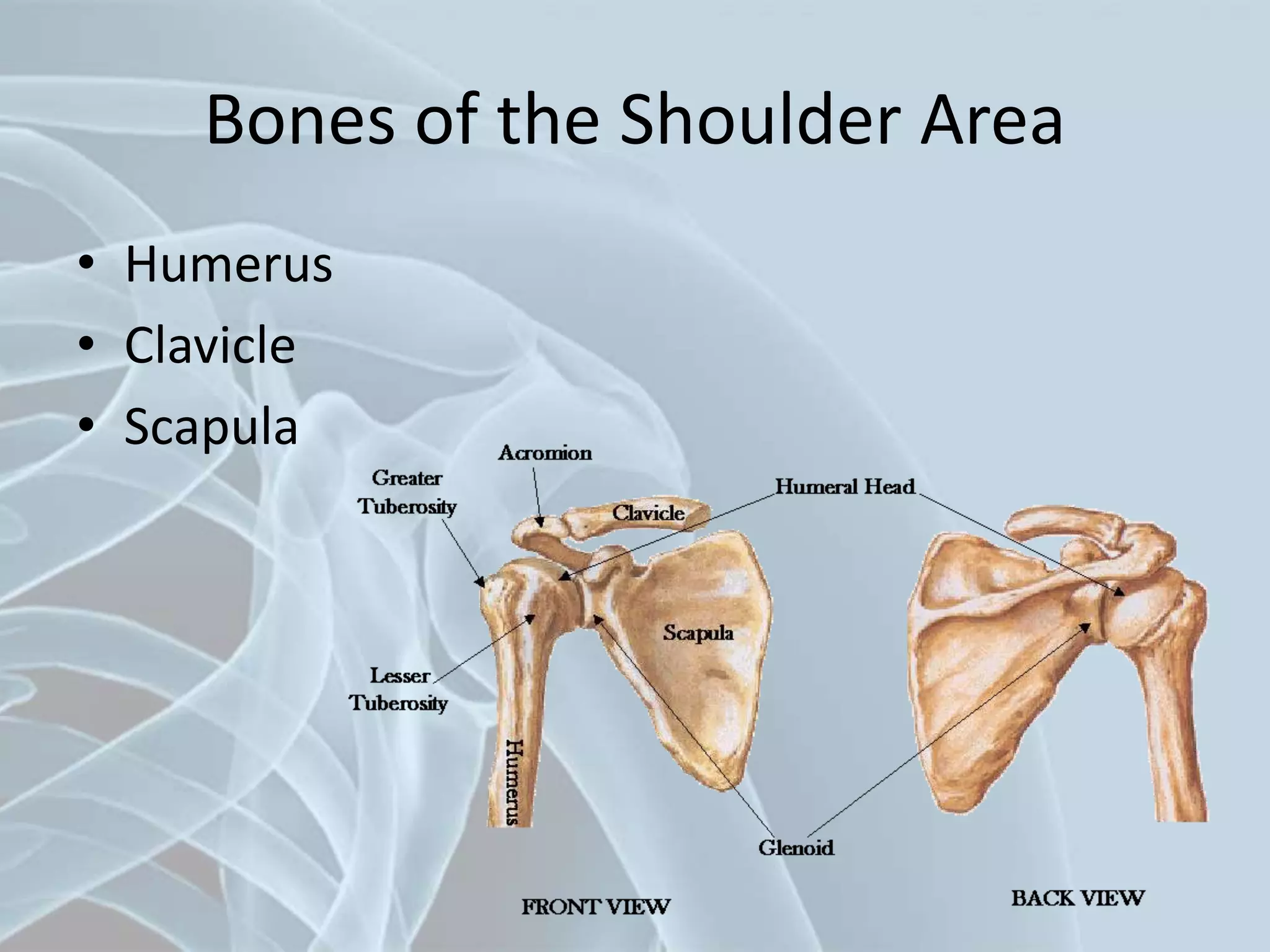
Bones of the Shoulder Area
• Humerus
• Clavicle
• Scapula
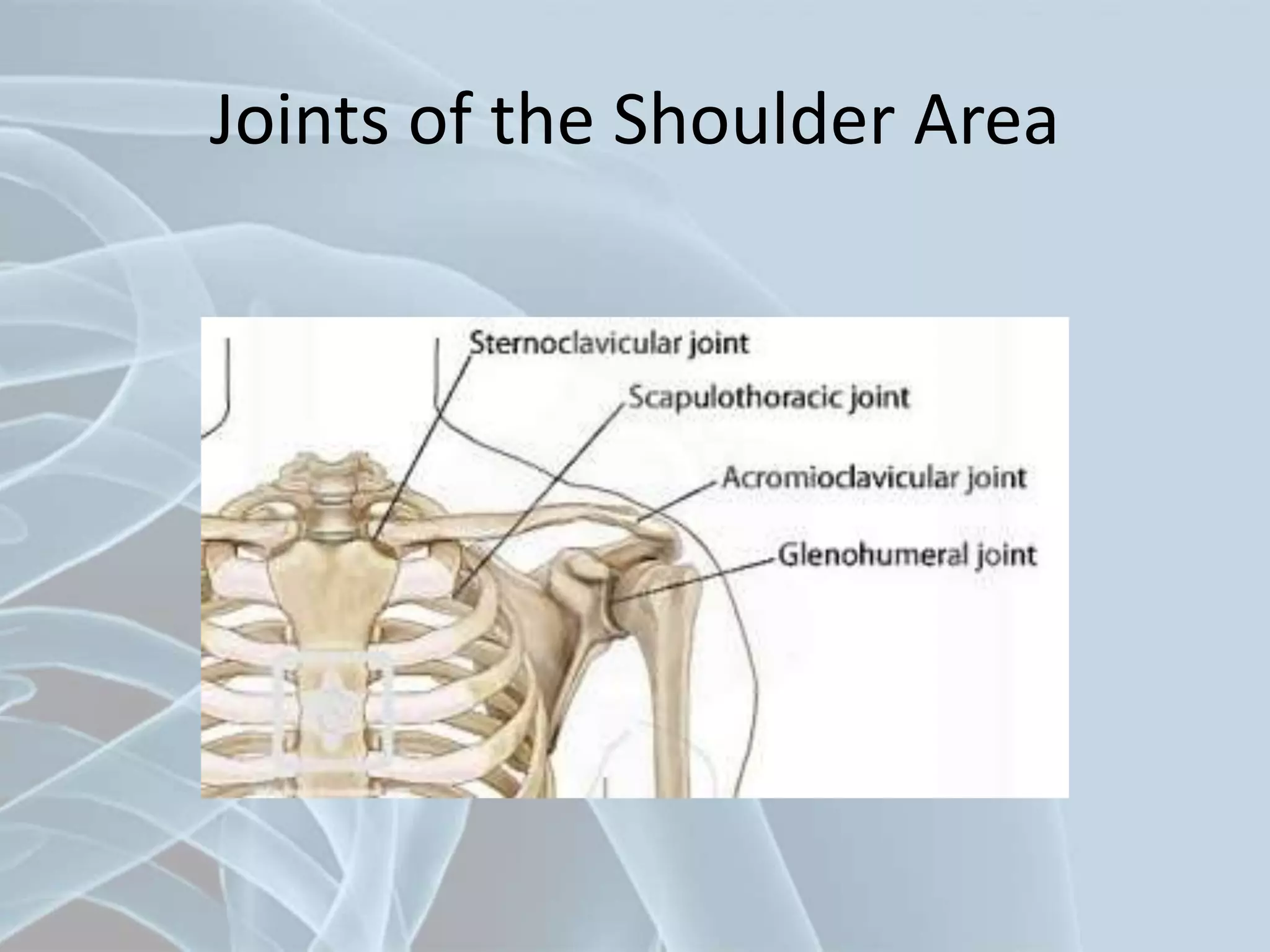
Joints of the Shoulder Area
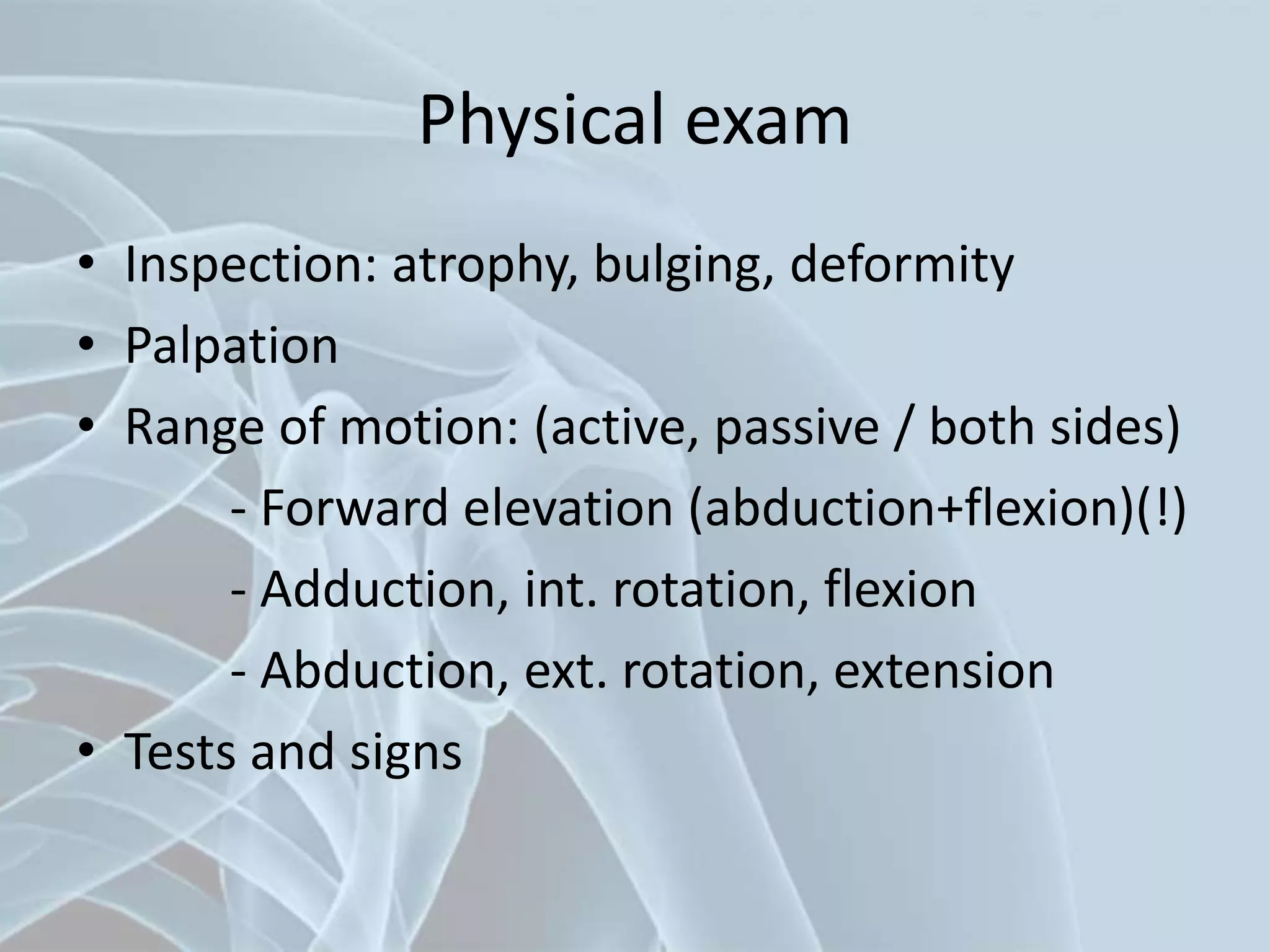
Muscles of the Shoulder Area
A. The Rotator Cuff
 Supraspinatus
 Infraspinatus
 Subscapularis
 Teres minor
B. Big muscles
 Deltoid
 Pectoralis major
 Trapezius
 Latissimus dorsi
 Teres major
 Biceps
Physical exam
• Inspection: atrophy, bulging, deformity
• Palpation
• Range of motion: (active, passive / both sides)
- Forward elevation (abduction+flexion)(!)
- Adduction, int. rotation, flexion
- Abduction, ext. rotation, extension
• Tests and signs
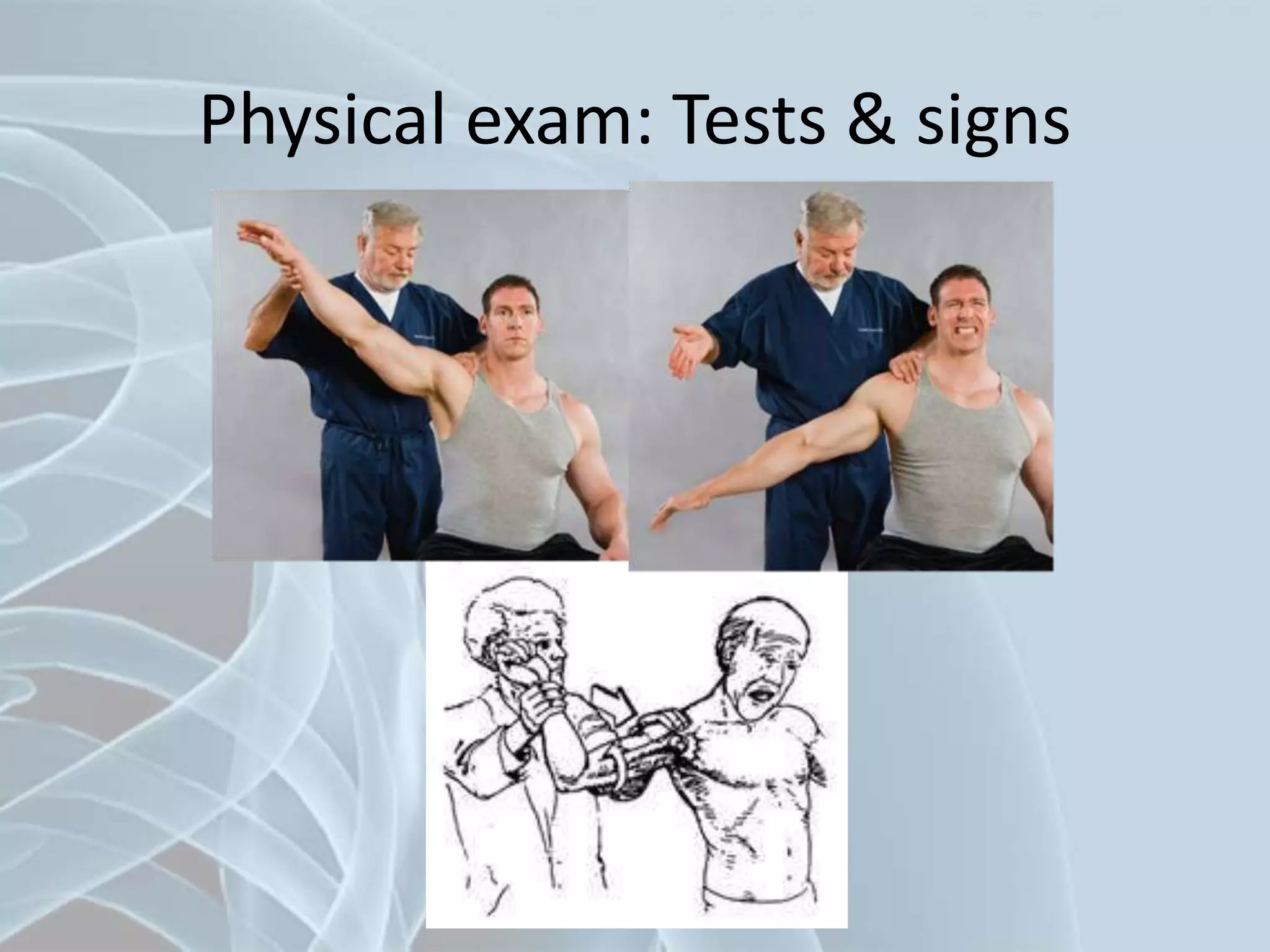
Physical exam: Tests & signs
• Impingement sign  positive in rotator cuff
inflammation/ tearing
• Impingement test  injection of local anesthetic to
subacromial space. Positive if pain goes away.
• Apprehension sign  90 degrees abduction & ext.
rotation + mild pressure from behind. Positive in anterior shoulder
instability.
• Drop Arm sign  90 degrees abduction & mild int. rotation.
Positive if the patient can’t hold his/her arm without help.
Physical exam: Tests & signs
Diagnostic procedures: Radiography
• An AP view x-ray is enough in most cases.
• Lateral / Axillary view in specific cases, e.g.
posterior shoulder dislocation
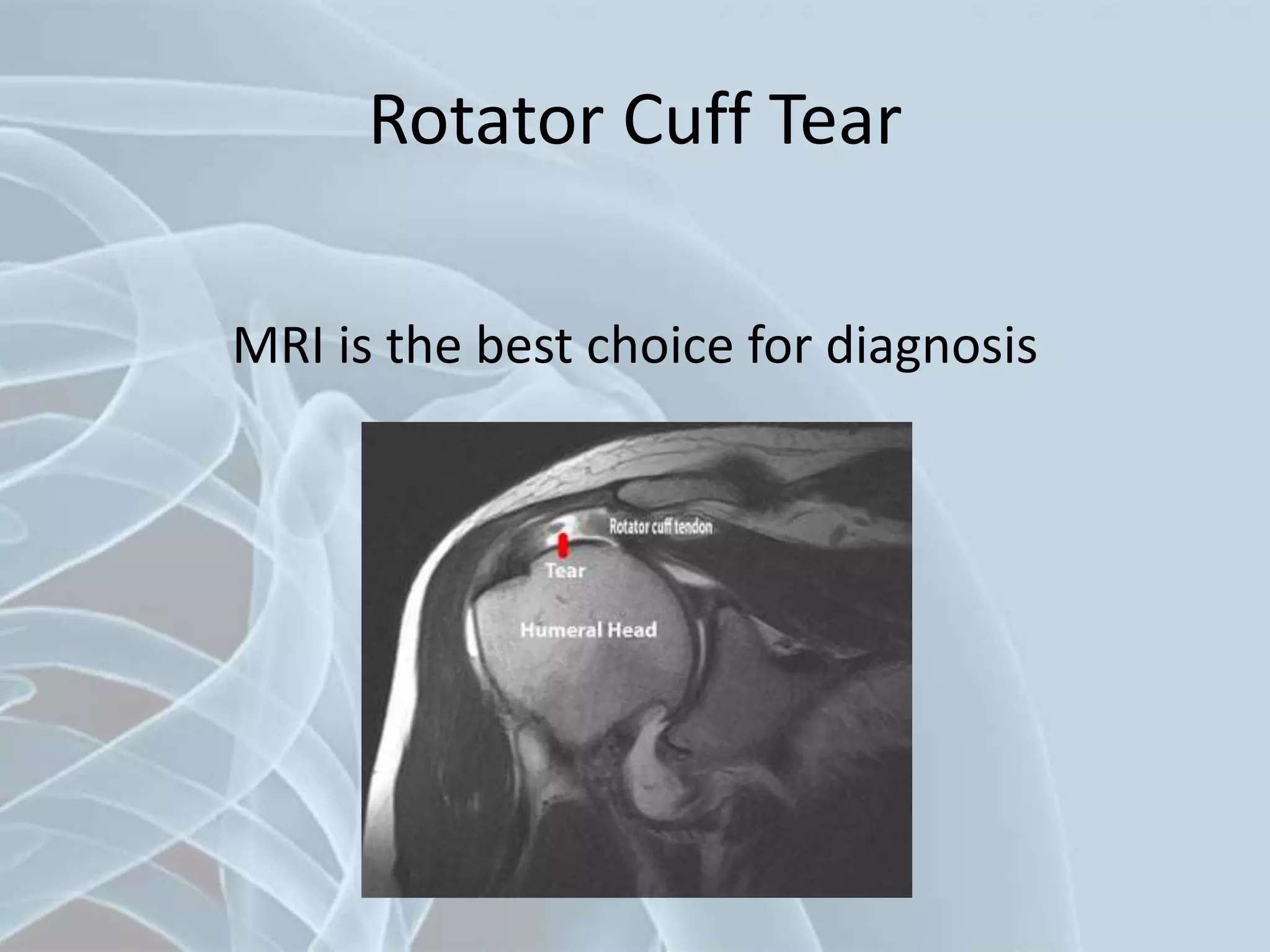
• MRI / Arthrography for soft tissue injuries e.g.
rotator cuff tendon tearing
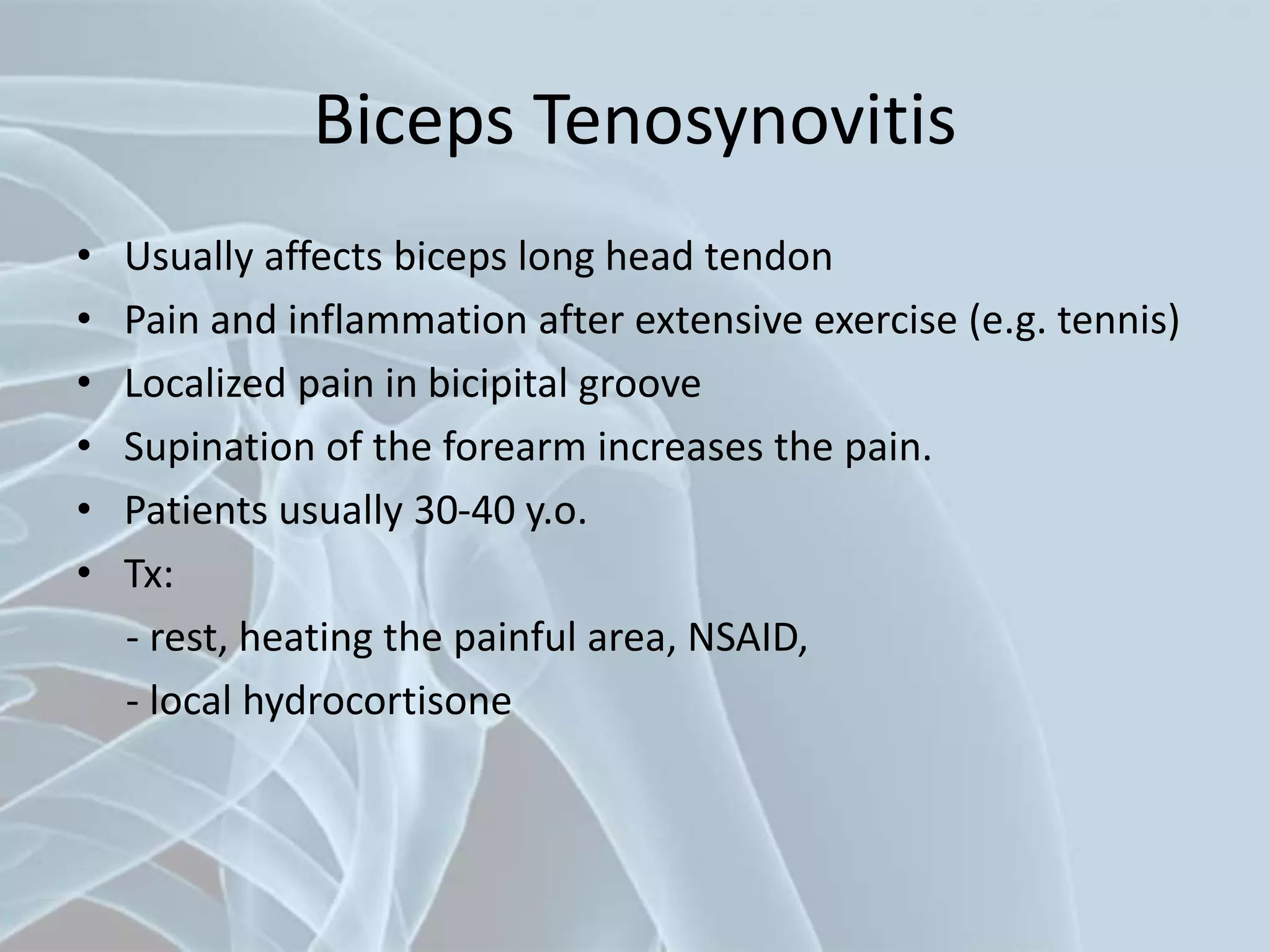
Diagnostic procedures: Arthroscopy
• Is used for dx. and tx. of most shoulder
disorders these days.
Biceps Tenosynovitis
• Usually affects biceps long head tendon
• Pain and inflammation after extensive exercise (e.g. tennis)
• Localized pain in bicipital groove
• Supination of the forearm increases the pain.
• Patients usually 30-40 y.o.
• Tx:
- rest, heating the painful area, NSAID,
- local hydrocortisone
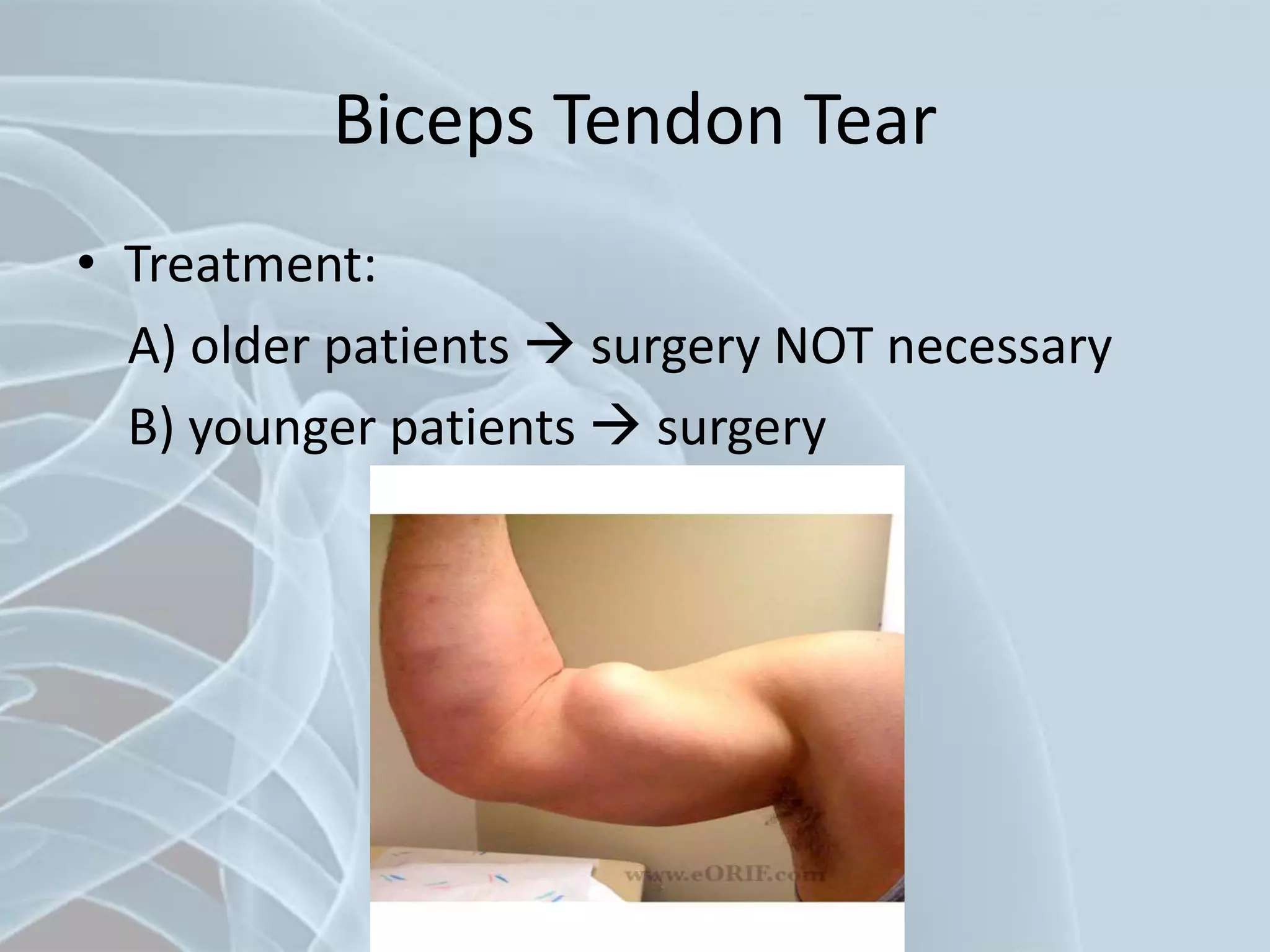
Biceps Tendon Tear
• Etiology: sudden contraction e.g. heavy load
• Clinical presentation:
- 50-60 y.o. / upper or lower portion (usually upper)
- sudden & extreme pain which decreases over a short period
of time is a characteristic sign
- flexion and ext. rotation weakening of the forearm
- arm deformity (oval shape turns to round & its site changes)
- tenderness in tearing site
- ecchymosis in tearing site
- ROM of the shoulder is NORMAL
Biceps Tendon Tear
• Treatment:
A) older patients  surgery NOT necessary
B) younger patients  surgery
Degenerative Arthritis of Shoulder
• Etiology: hx. of past trauma to shoulder & tearing of
the rotator cuff muscles
• Clinical presentation: usually > 50 y.o. / shoulder
restriction of movement / pain with rotational
movements
• Dx: radiography ed articular space, sclerosis,
osteophyte
• Tx:
-medical: NSAID, physiotherapy, Intra-articular steroid
-surgical: joint replacement
Frozen Shoulder
 Definition:
Shoulder restriction of movement to all sides
due to fibrosis in articular capsule
Frozen Shoulder
• Etiology:
1) Primary ( idiopathic )
2) Secondary : trauma to / surgery on shoulder
- Underlying causes such as diseases of the heart,
brain & neck, breast cancer and diabetes 
articular capsule fibrosis due to stimulation of
neurologic reflexes
- Psychological
** decreased articular space in both forms
Frozen Shoulder
• Clinical presentation:
- Mostly female / 5th & 6th decades
- Three clinical phases:
1. Persistent pain (esp. at night) + total limitation of movement
2. ed pain (or no change) + ed limitation of movement
3. Movements gradually return to normal form
- int. rotation is the first affected motion in frozen shoulder
- Limitation of passive movements (esp. rotation) to all sides is the key to dx
- Arthrography confirms the dx  obvious decreased articular volume
Frozen Shoulder
• Treatment:
- Depends on the stage of the disease
- Patient education in all phases
- Corticosteroid / long acting local anesthetic inj.
- Manipulation of shoulder under anesthesia (stage
2,3)  increases range of motion
- Arthroscopy (releases fibrotic capsule)
- Surgery (rarely)
Frozen Shoulder
• Psychotherapy is suggested due to the
psychological underlying causes of the disease
• Long-term prognosis is good.
• 80% of ROM returns in most cases
Rotator Cuff Tear
• Muscles and their functions:
1. Supraspinatus: humerus stabilizer + arm abduction
2. infraspinatus: ext. rotation
3. Teres minor
4. Subscapularis: int. rotation
Rotator Cuff Tear
• Anatomy:
Origin: scapula
Insertion:
subscapularis  lesser tuberosity of humerus
others  greater tuberosity of humerus
Rotator Cuff Tear
• Etiology
1. Rotator cuff tendons chronically get stuck
between acromion process & greater
tuberosity
2. trauma
Rotator Cuff Tear
• Clinical presentation:
- Shoulder pain (the most imp.):
1. anterior with radiation to the arm
2. Mild at first and only when elevating the arm
3. Progression: pain at rest, frozen shoulder
- Decreased ROM (esp. start of shoulder abd.)
- In complete rotator cuff tear & supraspinatus tendon tear, the patient can’t start
shoulder abduction, however, if the shoulder is passively abducted (30 degrees) then
he/she can continue the abduction by using deltoid muscle.
Rotator Cuff Tear
• Physical exam:
1. Jobe test (empty can)
2. Ext. rotation stress test
3. Lift-off test
Rotator Cuff Tear
MRI is the best choice for diagnosis
Rotator Cuff Tear
• Treatment:
1. Non-surgical: (50% useful)
- decreasing over-head activities of the shoulder
- NSAID
- corticosteroid inj.
- physiotherapy
2. Surgical
IMPORTANT: Complete rest leads to frozen shoulder so it is not
indicated in tx. of rotator cuff tear.
Rotator Cuff Tear
• Indications for surgical treatment:
1. No response to non-surgical tx.
2. Massive tearing
3. Acute tear (caused by trauma) esp. in young patients
4. Active patients esp. tear in dominant shoulder
5. Tear + muscular weakness
Impingement Syndrome
• Etiology:
- daily over head over activity & sports such as
tennis and swimming (Swimmer’s Shoulder)
- rotator cuff tendons esp. supraspinatus
tendon get stuck between humerus and
acromion process.
- acromion deformity
Impingement Syndrome
• Clinical presentation:
- Usually >40 y.o / starts gradually but trauma
or exercise can trigger an acute onset
- Low to moderate pain while active
- Empty can sign (pain and limited motion with
forward elevation & internal rotation) (imp.)
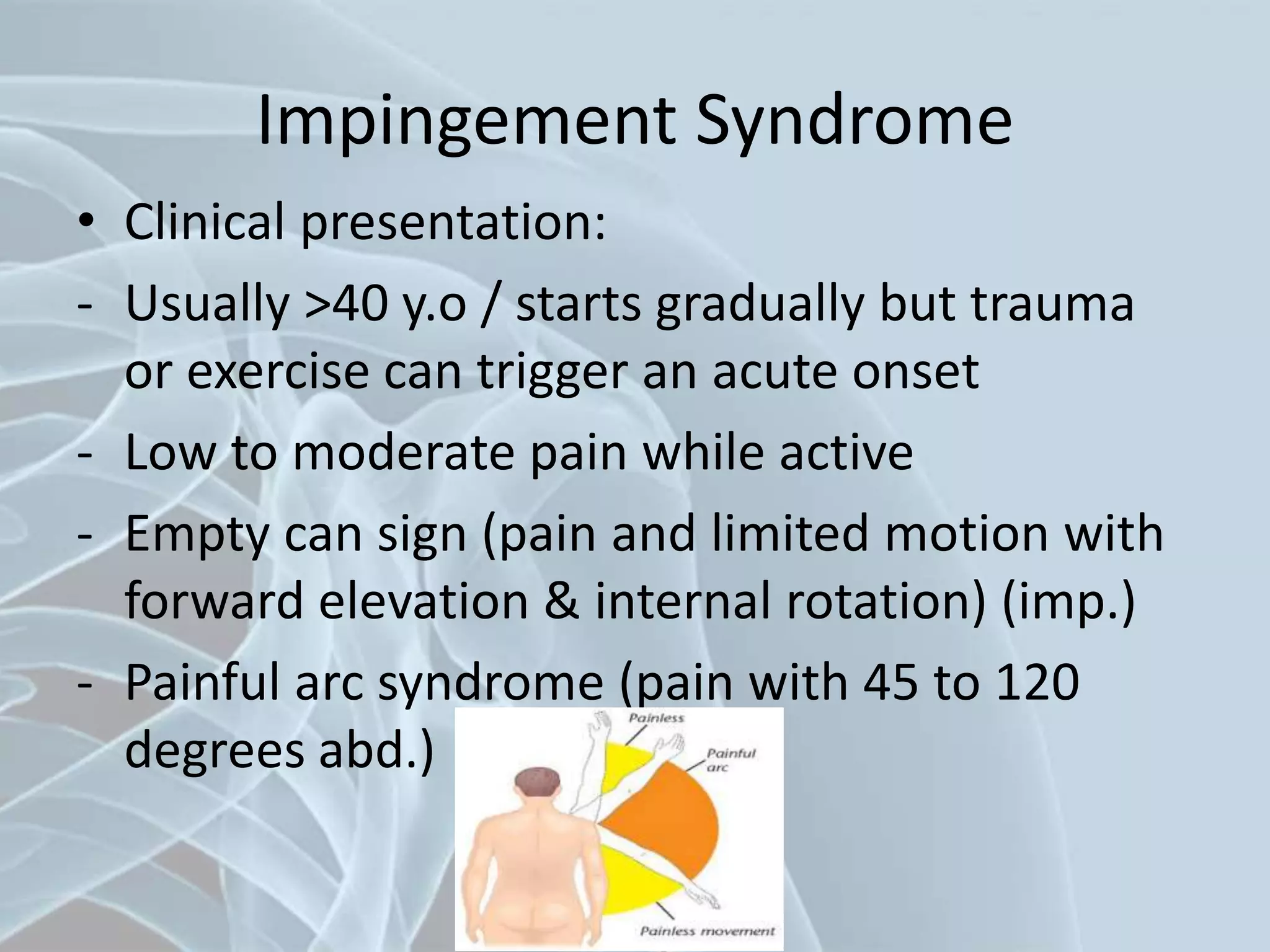
- Painful arc syndrome (pain with 45 to 120
degrees abd.)
Impingement Syndrome
- Sometimes: trauma -> broad tendon tear ->
inability to move shoulder -> drop arm test +
- Hawkins-Kennedy sign +
- Neer (Impingement) Sign +
Impingement Syndrome
• Diagnosis:
- No sign in AP radiograph
- Spur on the anterior border of
acromion/acromial deformity in true lateral x-
ray view of scapula
- Arthrography & MRI to rule out rotator cuff
tendon tear
Impingement Syndrome
• Treatment:
- heavy activities
- Physiotherapy
- NSAID
- Long acting corticosteroid (methyl prednisolone
inj.) in sub-acromial bursa (repeated injections
increases the risk of tendon degeneration & tear)
- Surgery (open or arthroscopy) if no response
after 3-6 months of treatment (esp. in case of
acromion deformity
Rotator Cuff Calcified Tendonitis
• Definition
• Epidemiology :
- 20 to 25 y.o / caucasian / male / western
countries
• Three phases
1. Calcium formation in tendon -> pain
2. Stability -> mild, chronic pain
3. Absorption -> scar & granulation tissue replaces
calcium , inflammation, throbbing pain
Rotator Cuff Calcified Tendonitis
• Radiographic finding: accumulation of calcium
under acromion process
• Treatment:
- Stage 1,2 : NSAID + physiotherapy
- Stage 3 : steroid + Saline inj. To subacromial space
/ ice pack / morphine for severe pain
- Arthroscopic surgery in case of no response
• Prognosis: calcium will be absorbed finally and
the pain goes away
Thank you for your
attention
Farbod Zahedi Tajrishi, Nov. 2015

Shoulder Disorders

  • 1.
    Disorders of theShoulder Farbod Zahedi Tajrishi Medical student Babol University of Medical Sciences
  • 2.
    Preview • Bones • Joints •Muscles • Physical exam • Tests and signs • Diagnostic procedures
  • 3.
    Bones of theShoulder Area • Humerus • Clavicle • Scapula
  • 4.
    Joints of theShoulder Area
  • 5.
    Muscles of theShoulder Area A. The Rotator Cuff  Supraspinatus  Infraspinatus  Subscapularis  Teres minor B. Big muscles  Deltoid  Pectoralis major  Trapezius  Latissimus dorsi  Teres major  Biceps
  • 6.
    Physical exam • Inspection:atrophy, bulging, deformity • Palpation • Range of motion: (active, passive / both sides) - Forward elevation (abduction+flexion)(!) - Adduction, int. rotation, flexion - Abduction, ext. rotation, extension • Tests and signs
  • 7.
    Physical exam: Tests& signs • Impingement sign  positive in rotator cuff inflammation/ tearing • Impingement test  injection of local anesthetic to subacromial space. Positive if pain goes away. • Apprehension sign  90 degrees abduction & ext. rotation + mild pressure from behind. Positive in anterior shoulder instability. • Drop Arm sign  90 degrees abduction & mild int. rotation. Positive if the patient can’t hold his/her arm without help.
  • 8.
  • 9.
    Diagnostic procedures: Radiography •An AP view x-ray is enough in most cases. • Lateral / Axillary view in specific cases, e.g. posterior shoulder dislocation • MRI / Arthrography for soft tissue injuries e.g. rotator cuff tendon tearing
  • 10.
    Diagnostic procedures: Arthroscopy •Is used for dx. and tx. of most shoulder disorders these days.
  • 11.
    Biceps Tenosynovitis • Usuallyaffects biceps long head tendon • Pain and inflammation after extensive exercise (e.g. tennis) • Localized pain in bicipital groove • Supination of the forearm increases the pain. • Patients usually 30-40 y.o. • Tx: - rest, heating the painful area, NSAID, - local hydrocortisone
  • 12.
    Biceps Tendon Tear •Etiology: sudden contraction e.g. heavy load • Clinical presentation: - 50-60 y.o. / upper or lower portion (usually upper) - sudden & extreme pain which decreases over a short period of time is a characteristic sign - flexion and ext. rotation weakening of the forearm - arm deformity (oval shape turns to round & its site changes) - tenderness in tearing site - ecchymosis in tearing site - ROM of the shoulder is NORMAL
  • 13.
    Biceps Tendon Tear •Treatment: A) older patients  surgery NOT necessary B) younger patients  surgery
  • 14.
    Degenerative Arthritis ofShoulder • Etiology: hx. of past trauma to shoulder & tearing of the rotator cuff muscles • Clinical presentation: usually > 50 y.o. / shoulder restriction of movement / pain with rotational movements • Dx: radiography ed articular space, sclerosis, osteophyte • Tx: -medical: NSAID, physiotherapy, Intra-articular steroid -surgical: joint replacement
  • 15.
    Frozen Shoulder  Definition: Shoulderrestriction of movement to all sides due to fibrosis in articular capsule
  • 16.
    Frozen Shoulder • Etiology: 1)Primary ( idiopathic ) 2) Secondary : trauma to / surgery on shoulder - Underlying causes such as diseases of the heart, brain & neck, breast cancer and diabetes  articular capsule fibrosis due to stimulation of neurologic reflexes - Psychological ** decreased articular space in both forms
  • 17.
    Frozen Shoulder • Clinicalpresentation: - Mostly female / 5th & 6th decades - Three clinical phases: 1. Persistent pain (esp. at night) + total limitation of movement 2. ed pain (or no change) + ed limitation of movement 3. Movements gradually return to normal form - int. rotation is the first affected motion in frozen shoulder - Limitation of passive movements (esp. rotation) to all sides is the key to dx - Arthrography confirms the dx  obvious decreased articular volume
  • 18.
    Frozen Shoulder • Treatment: -Depends on the stage of the disease - Patient education in all phases - Corticosteroid / long acting local anesthetic inj. - Manipulation of shoulder under anesthesia (stage 2,3)  increases range of motion - Arthroscopy (releases fibrotic capsule) - Surgery (rarely)
  • 19.
    Frozen Shoulder • Psychotherapyis suggested due to the psychological underlying causes of the disease • Long-term prognosis is good. • 80% of ROM returns in most cases
  • 20.
    Rotator Cuff Tear •Muscles and their functions: 1. Supraspinatus: humerus stabilizer + arm abduction 2. infraspinatus: ext. rotation 3. Teres minor 4. Subscapularis: int. rotation
  • 21.
    Rotator Cuff Tear •Anatomy: Origin: scapula Insertion: subscapularis  lesser tuberosity of humerus others  greater tuberosity of humerus
  • 22.
    Rotator Cuff Tear •Etiology 1. Rotator cuff tendons chronically get stuck between acromion process & greater tuberosity 2. trauma
  • 23.
    Rotator Cuff Tear •Clinical presentation: - Shoulder pain (the most imp.): 1. anterior with radiation to the arm 2. Mild at first and only when elevating the arm 3. Progression: pain at rest, frozen shoulder - Decreased ROM (esp. start of shoulder abd.) - In complete rotator cuff tear & supraspinatus tendon tear, the patient can’t start shoulder abduction, however, if the shoulder is passively abducted (30 degrees) then he/she can continue the abduction by using deltoid muscle.
  • 24.
    Rotator Cuff Tear •Physical exam: 1. Jobe test (empty can) 2. Ext. rotation stress test 3. Lift-off test
  • 25.
    Rotator Cuff Tear MRIis the best choice for diagnosis
  • 26.
    Rotator Cuff Tear •Treatment: 1. Non-surgical: (50% useful) - decreasing over-head activities of the shoulder - NSAID - corticosteroid inj. - physiotherapy 2. Surgical IMPORTANT: Complete rest leads to frozen shoulder so it is not indicated in tx. of rotator cuff tear.
  • 27.
    Rotator Cuff Tear •Indications for surgical treatment: 1. No response to non-surgical tx. 2. Massive tearing 3. Acute tear (caused by trauma) esp. in young patients 4. Active patients esp. tear in dominant shoulder 5. Tear + muscular weakness
  • 28.
    Impingement Syndrome • Etiology: -daily over head over activity & sports such as tennis and swimming (Swimmer’s Shoulder) - rotator cuff tendons esp. supraspinatus tendon get stuck between humerus and acromion process. - acromion deformity
  • 29.
    Impingement Syndrome • Clinicalpresentation: - Usually >40 y.o / starts gradually but trauma or exercise can trigger an acute onset - Low to moderate pain while active - Empty can sign (pain and limited motion with forward elevation & internal rotation) (imp.) - Painful arc syndrome (pain with 45 to 120 degrees abd.)
  • 30.
    Impingement Syndrome - Sometimes:trauma -> broad tendon tear -> inability to move shoulder -> drop arm test + - Hawkins-Kennedy sign + - Neer (Impingement) Sign +
  • 31.
    Impingement Syndrome • Diagnosis: -No sign in AP radiograph - Spur on the anterior border of acromion/acromial deformity in true lateral x- ray view of scapula - Arthrography & MRI to rule out rotator cuff tendon tear
  • 32.
    Impingement Syndrome • Treatment: -heavy activities - Physiotherapy - NSAID - Long acting corticosteroid (methyl prednisolone inj.) in sub-acromial bursa (repeated injections increases the risk of tendon degeneration & tear) - Surgery (open or arthroscopy) if no response after 3-6 months of treatment (esp. in case of acromion deformity
  • 33.
    Rotator Cuff CalcifiedTendonitis • Definition • Epidemiology : - 20 to 25 y.o / caucasian / male / western countries • Three phases 1. Calcium formation in tendon -> pain 2. Stability -> mild, chronic pain 3. Absorption -> scar & granulation tissue replaces calcium , inflammation, throbbing pain
  • 34.
    Rotator Cuff CalcifiedTendonitis • Radiographic finding: accumulation of calcium under acromion process • Treatment: - Stage 1,2 : NSAID + physiotherapy - Stage 3 : steroid + Saline inj. To subacromial space / ice pack / morphine for severe pain - Arthroscopic surgery in case of no response • Prognosis: calcium will be absorbed finally and the pain goes away
  • 35.
    Thank you foryour attention Farbod Zahedi Tajrishi, Nov. 2015