Sreeraj S R
SHORT WAVE DIATHERMY
-
-
-
-
-
+
+
+
+
+
+
Sreeraj S R
Dia means through
Thermo means temperature /heat.
Frequency of 27.12 MHz
Wavelength greater than 11meter
Description
High-frequency electrical currents
› Radio waves
Pass through the tissues
Cause molecular vibration
Results in deep heating
Capable of heating large volumes of tissues
Causes both thermal and non thermal effects
Sreeraj S R
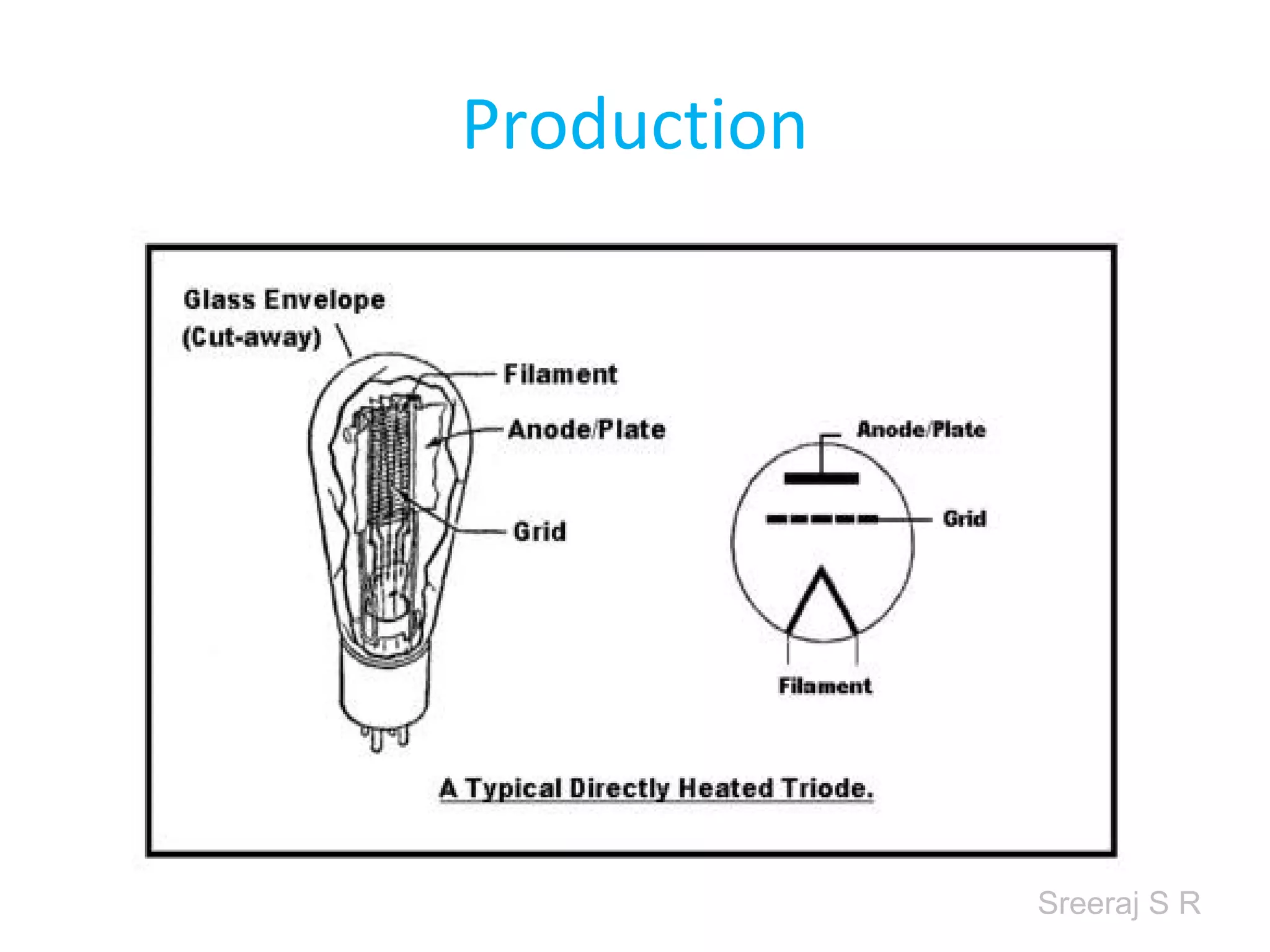
Production
Sreeraj S R
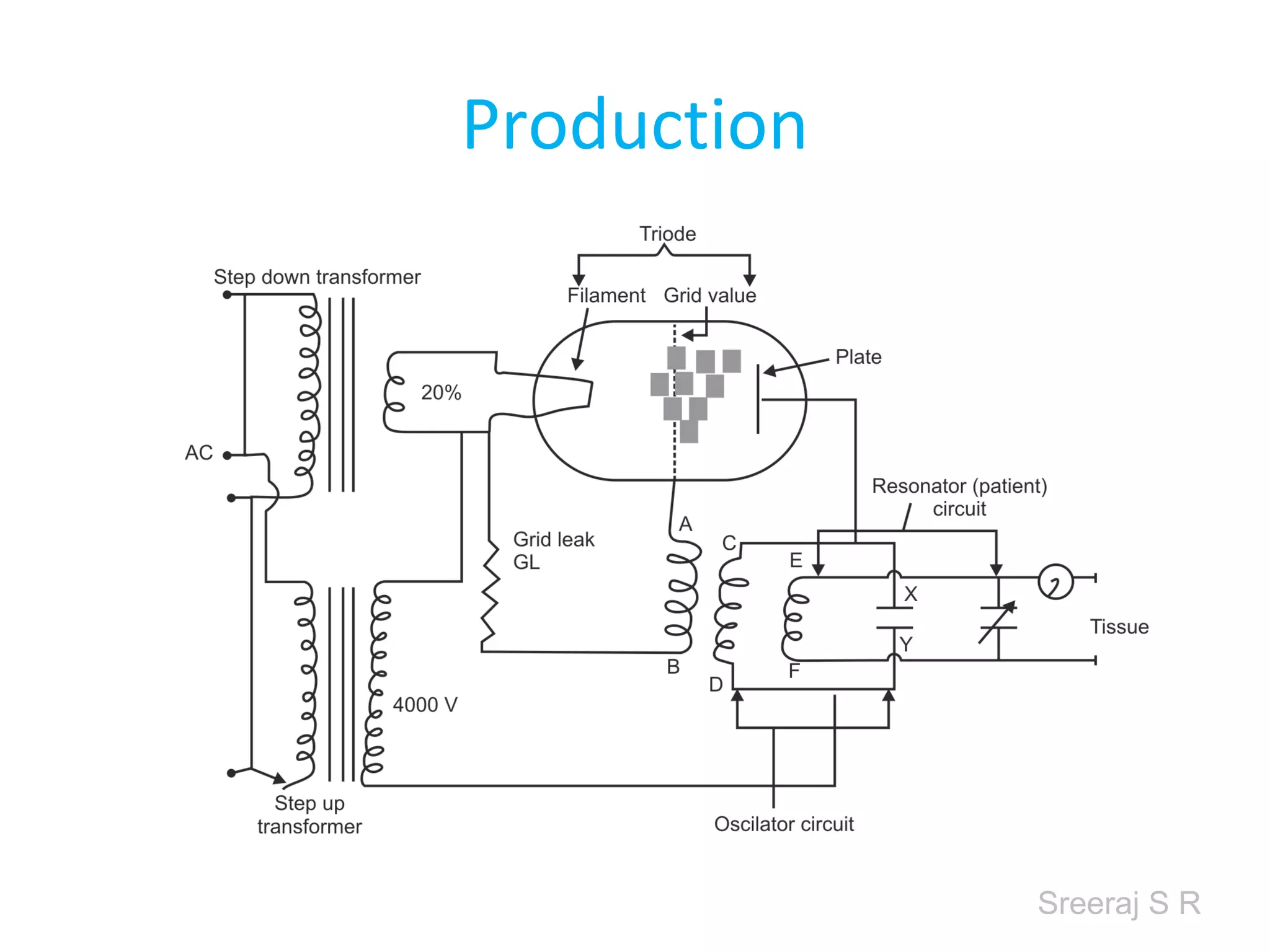
Production
Sreeraj S R
Production
Sreeraj S R
Production
Sreeraj S R
Production
Sreeraj S R
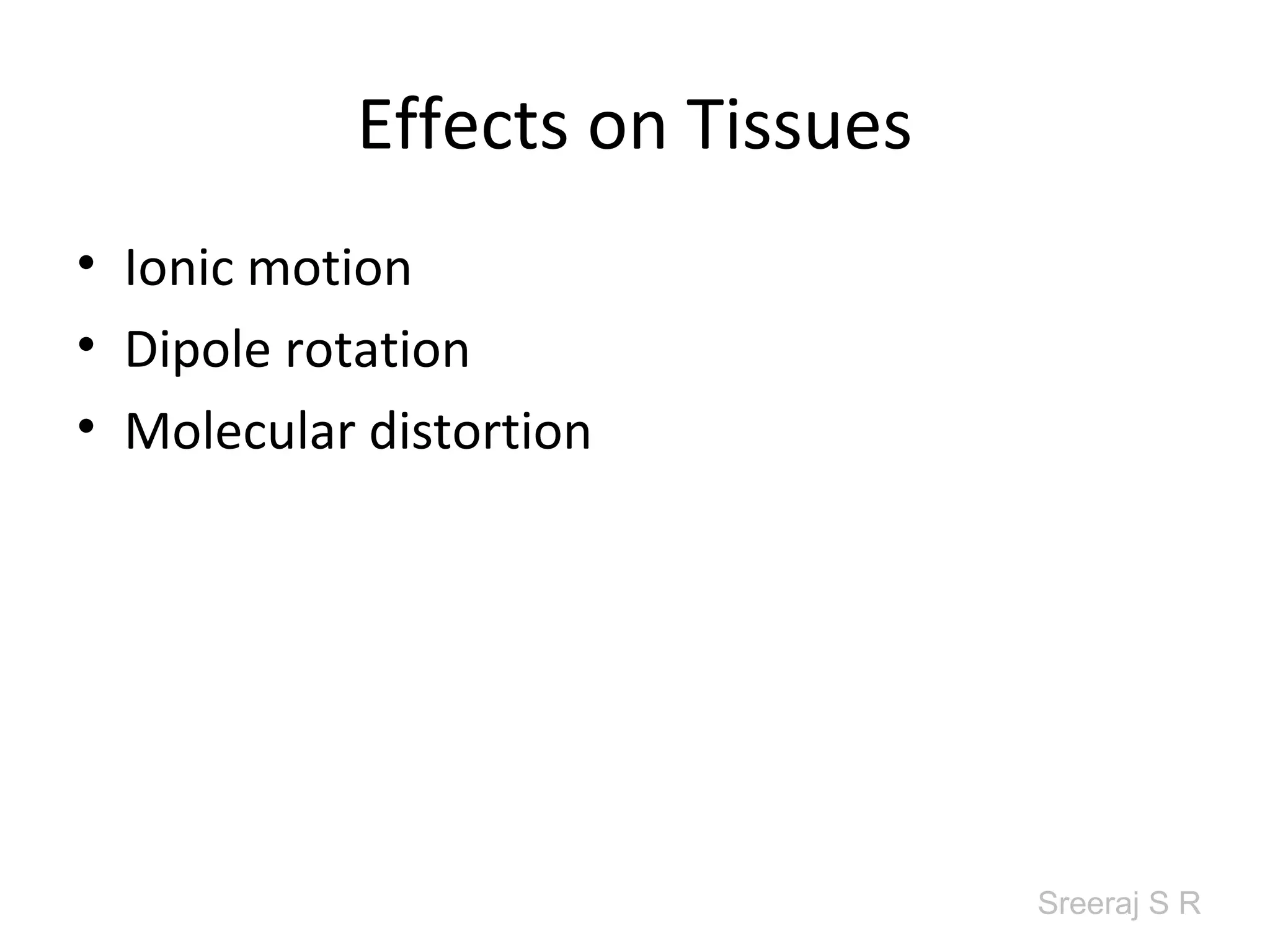
Effects on Tissues
• Ionic motion
• Dipole rotation
• Molecular distortion
Sreeraj S R
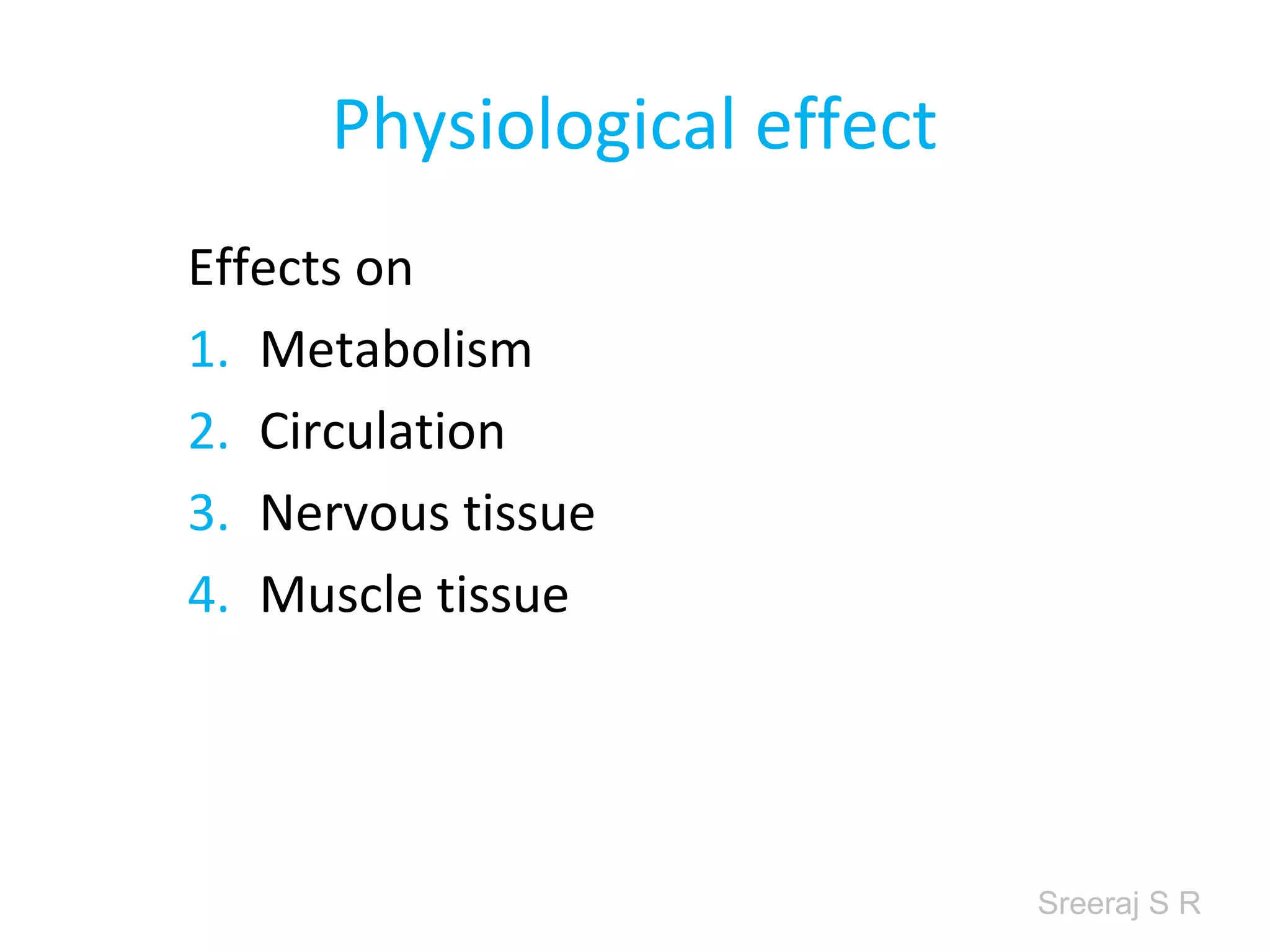
Physiological effect
Effects on
1. Metabolism
2. Circulation
3. Nervous tissue
4. Muscle tissue
Sreeraj S R
Therapeutic Effect
Effects on
1. Inflammation
2. Bacterial Infection
3. Relief of pain
4. Traumatic conditions
5. Reduce healing time
Sreeraj S R
Types of Shortwave Diathermy
Induction Field
Capacitive Field
Sreeraj S R
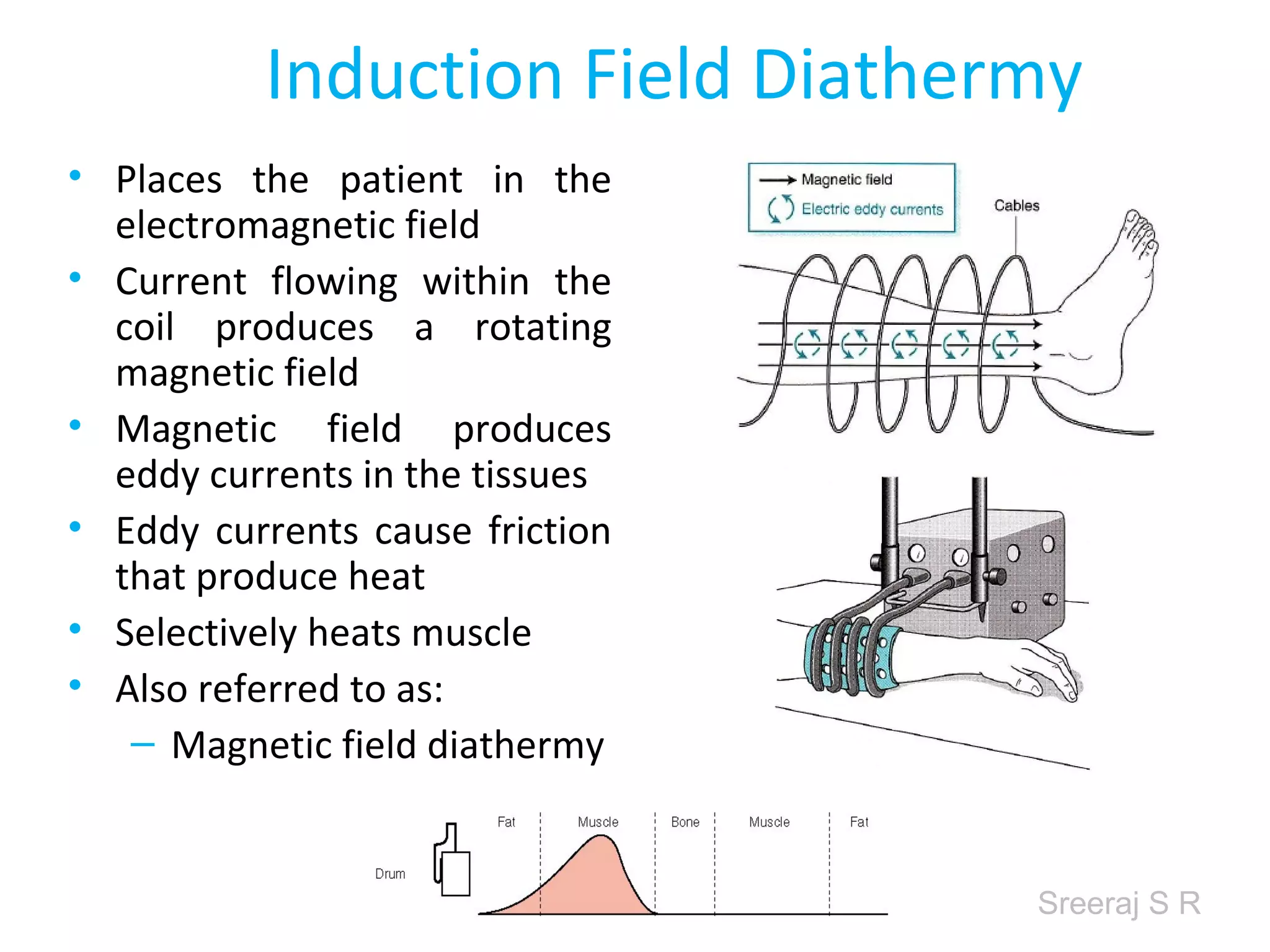
Induction Field Diathermy
• Places the patient in the
electromagnetic field
• Current flowing within the
coil produces a rotating
magnetic field
• Magnetic field produces
eddy currents in the tissues
• Eddy currents cause friction
that produce heat
• Selectively heats muscle
• Also referred to as:
– Magnetic field diathermy
Sreeraj S R
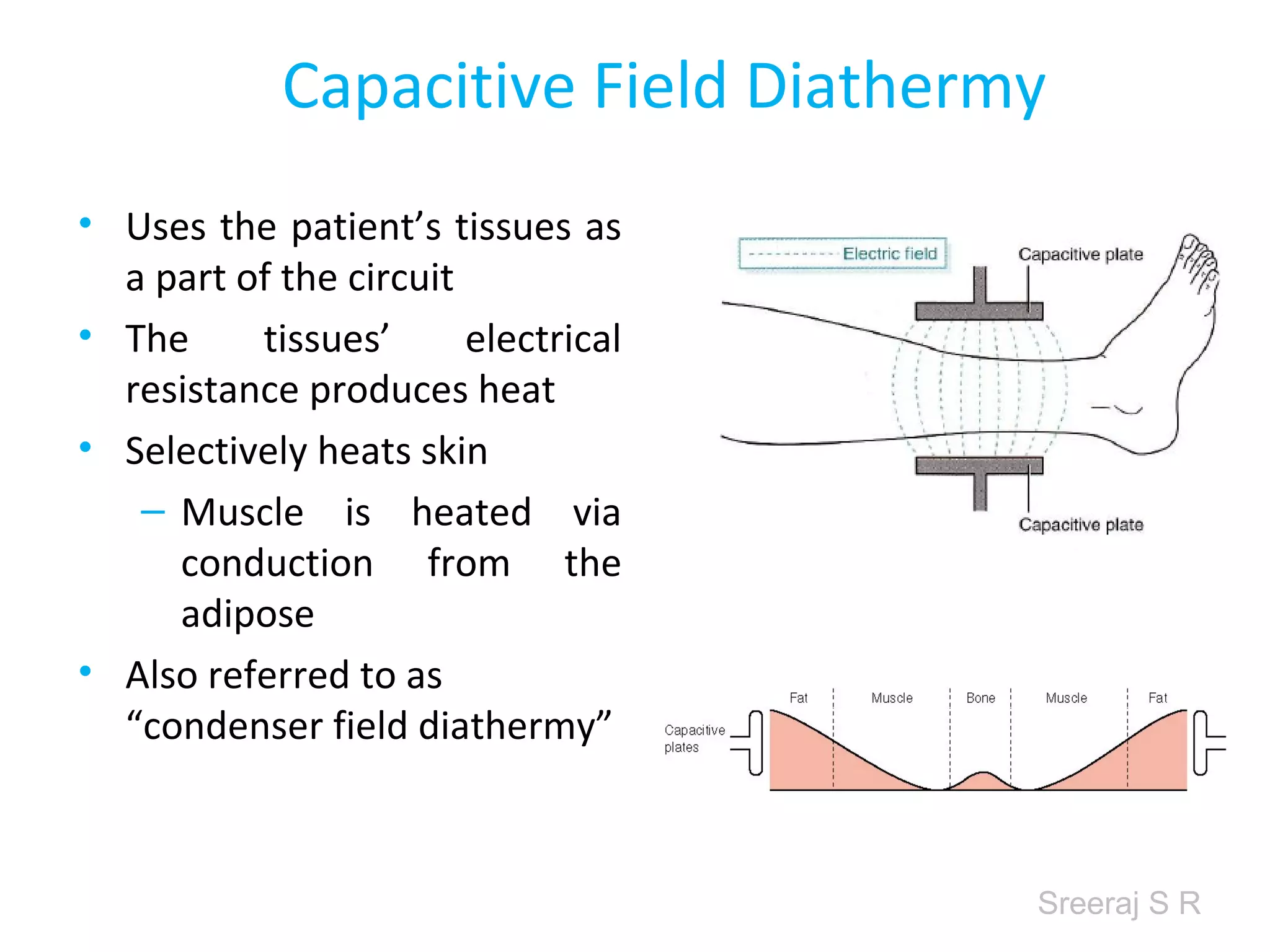
Capacitive Field Diathermy
• Uses the patient’s tissues as
a part of the circuit
• The tissues’ electrical
resistance produces heat
• Selectively heats skin
– Muscle is heated via
conduction from the
adipose
• Also referred to as
“condenser field diathermy”
Sreeraj S R
TYPES OF ELECTRODES
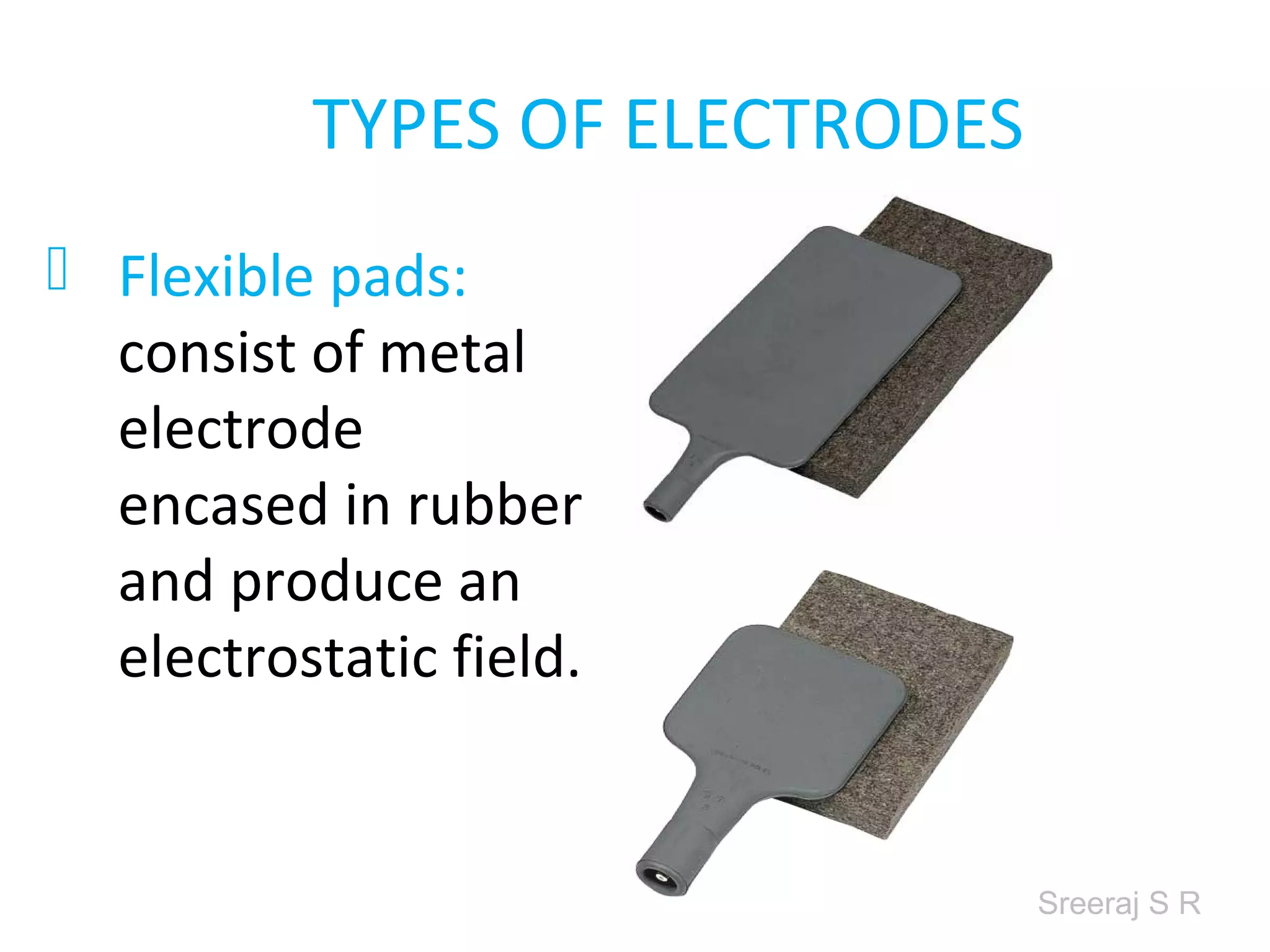
Flexible pads:
consist of metal
electrode
encased in rubber
and produce an
electrostatic field.
Sreeraj S R
TYPES OF ELECTRODES
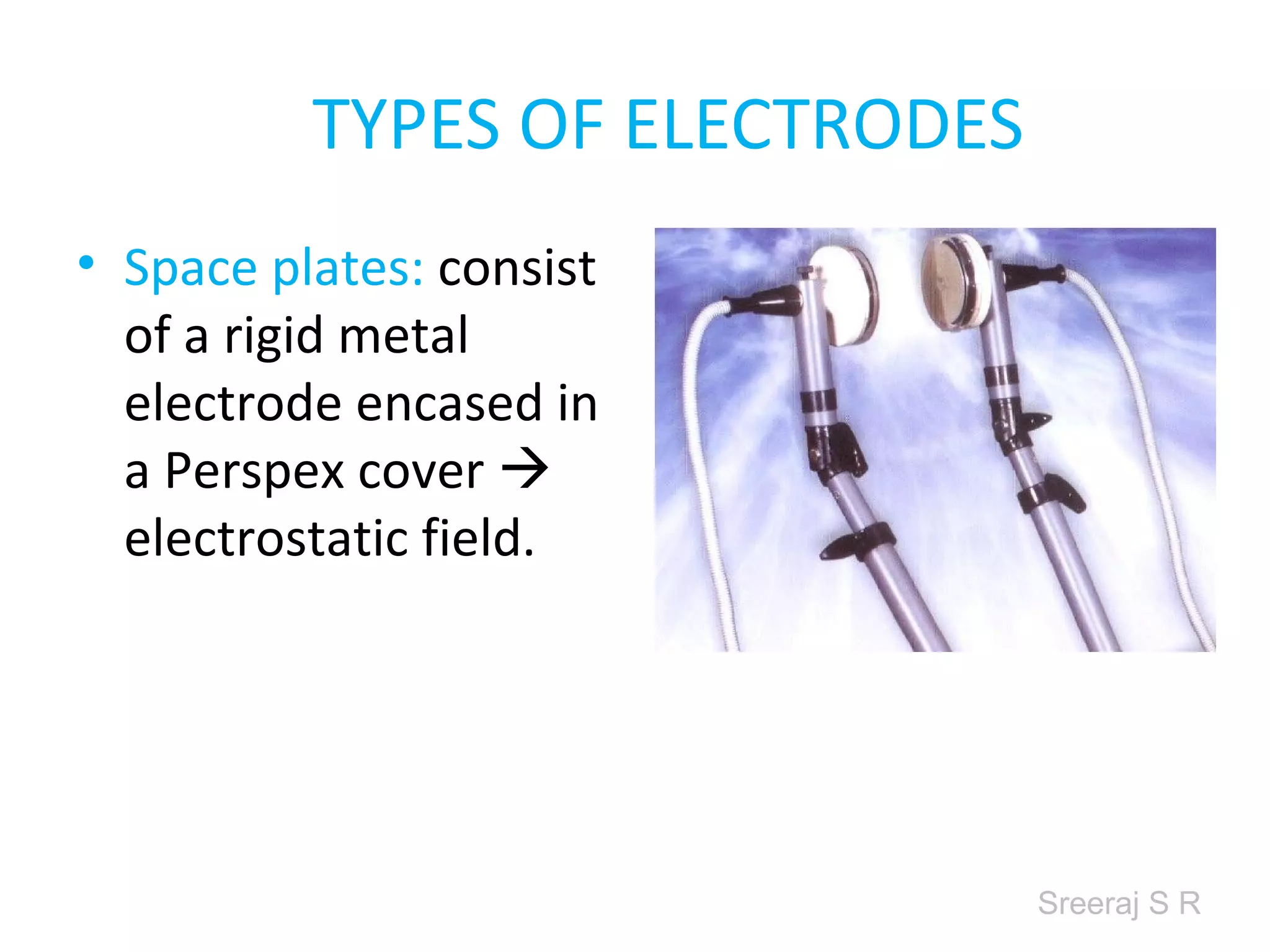
• Space plates: consist
of a rigid metal
electrode encased in
a Perspex cover
electrostatic field.
Sreeraj S R
TYPES OF ELECTRODES
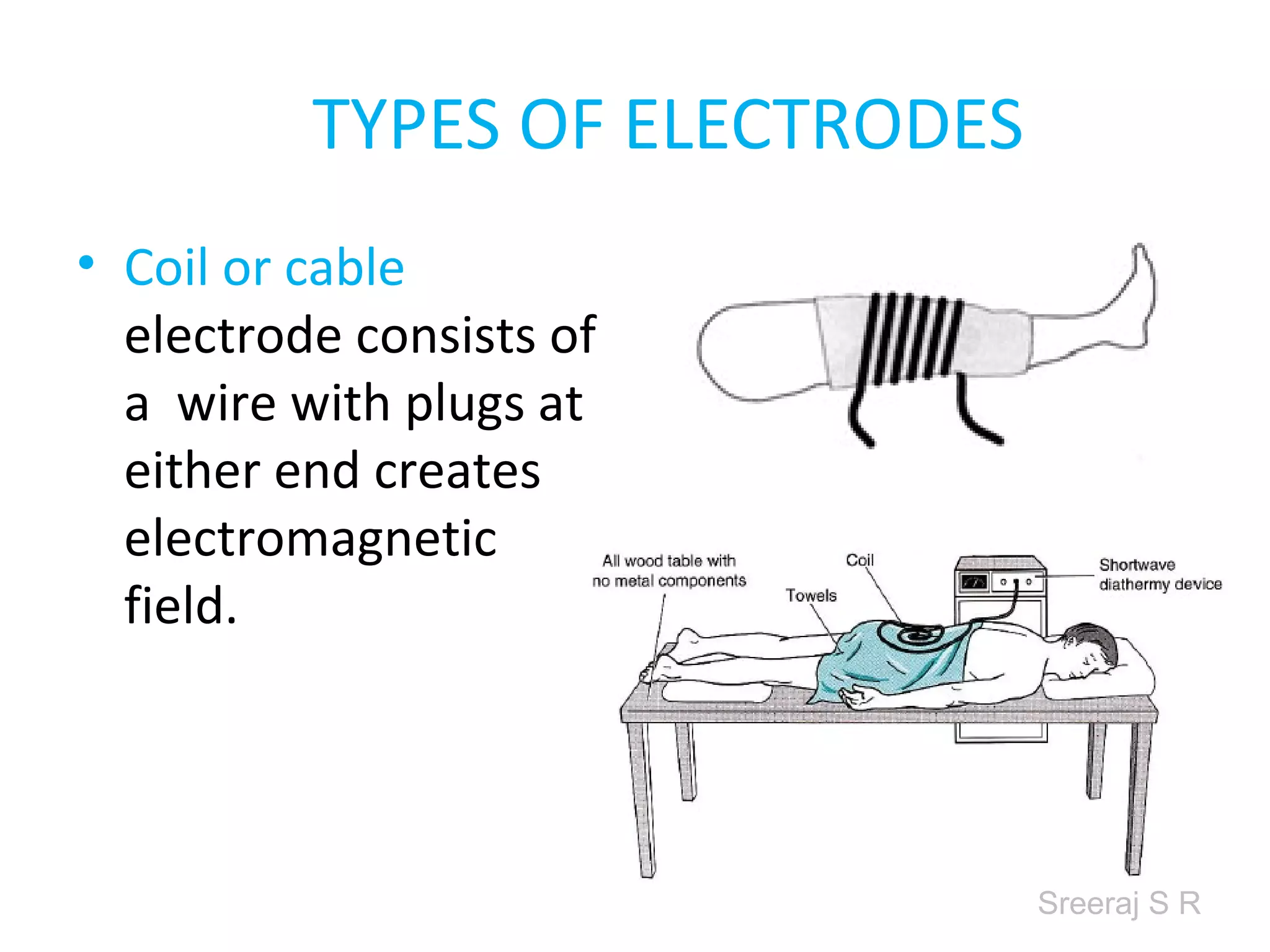
• Coil or cable
electrode consists of
a wire with plugs at
either end creates
electromagnetic
field.
Sreeraj S R
TYPES OF ELECTRODES
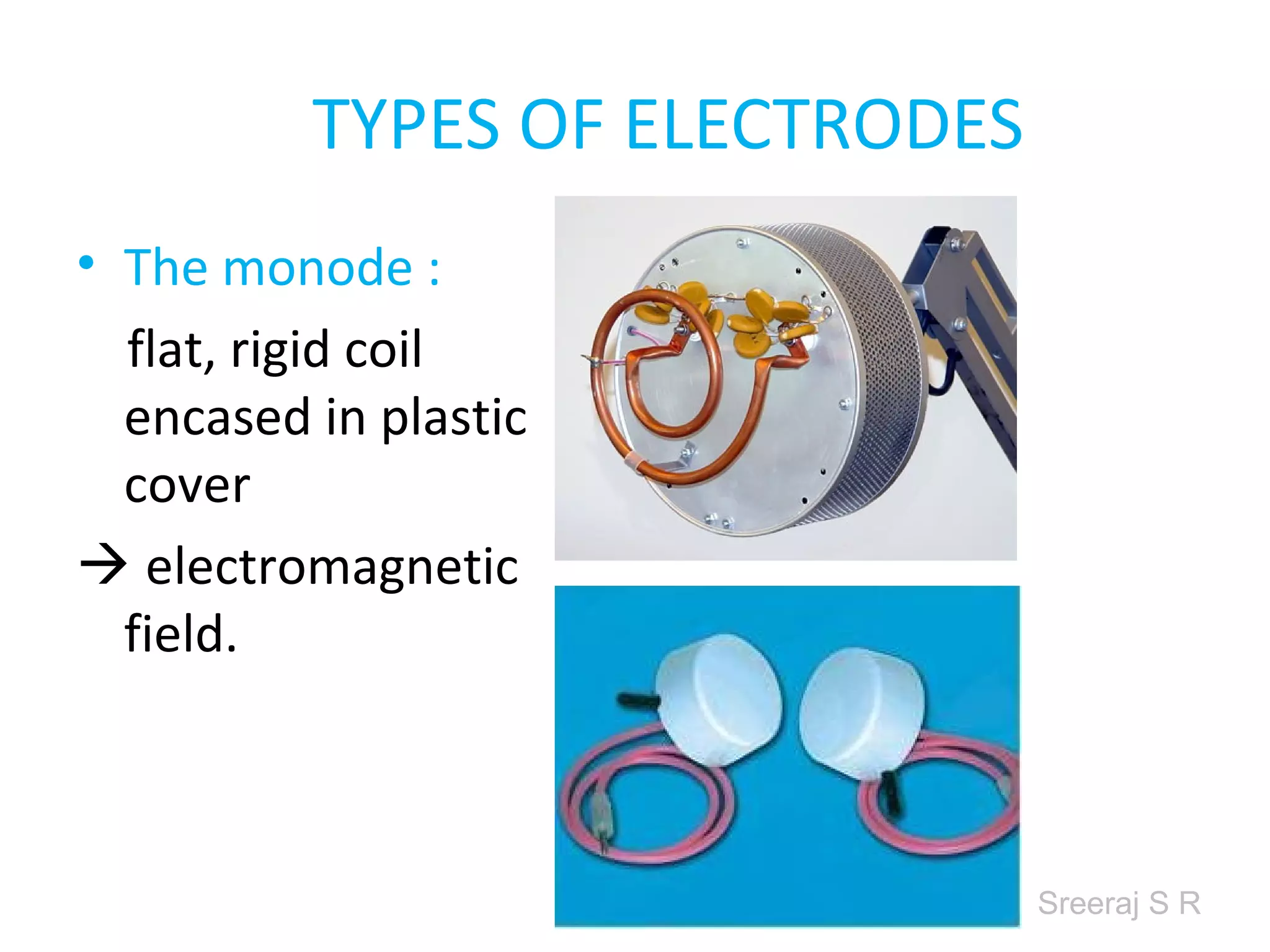
• The monode :
flat, rigid coil
encased in plastic
cover
electromagnetic
field.
Sreeraj S R
TYPES OF ELECTRODES
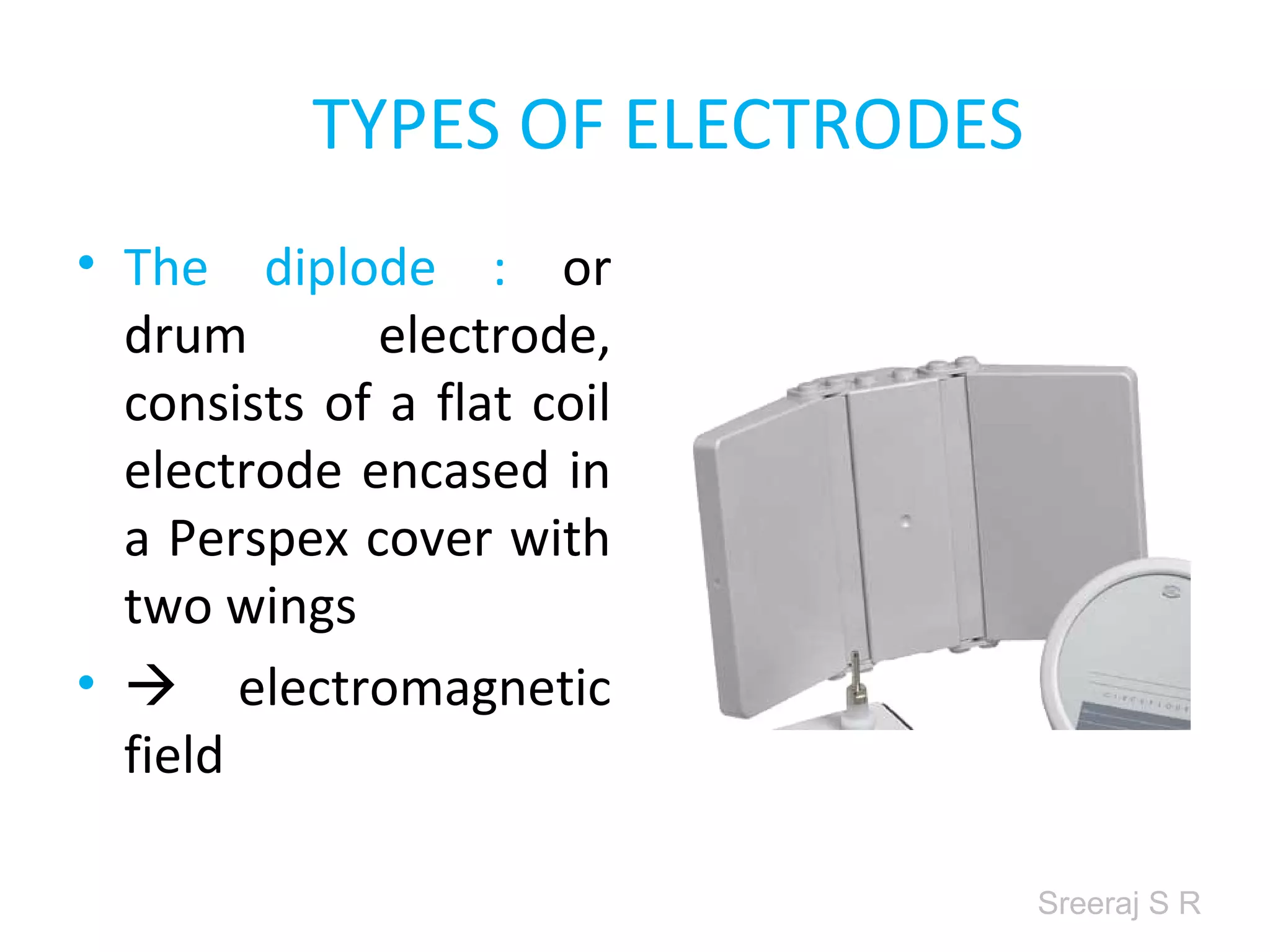
• The diplode : or
drum electrode,
consists of a flat coil
electrode encased in
a Perspex cover with
two wings
• electromagnetic
field
Sreeraj S R
FACTORS INFLUENCE FIELD DISTRIBUTION IN S.W.D
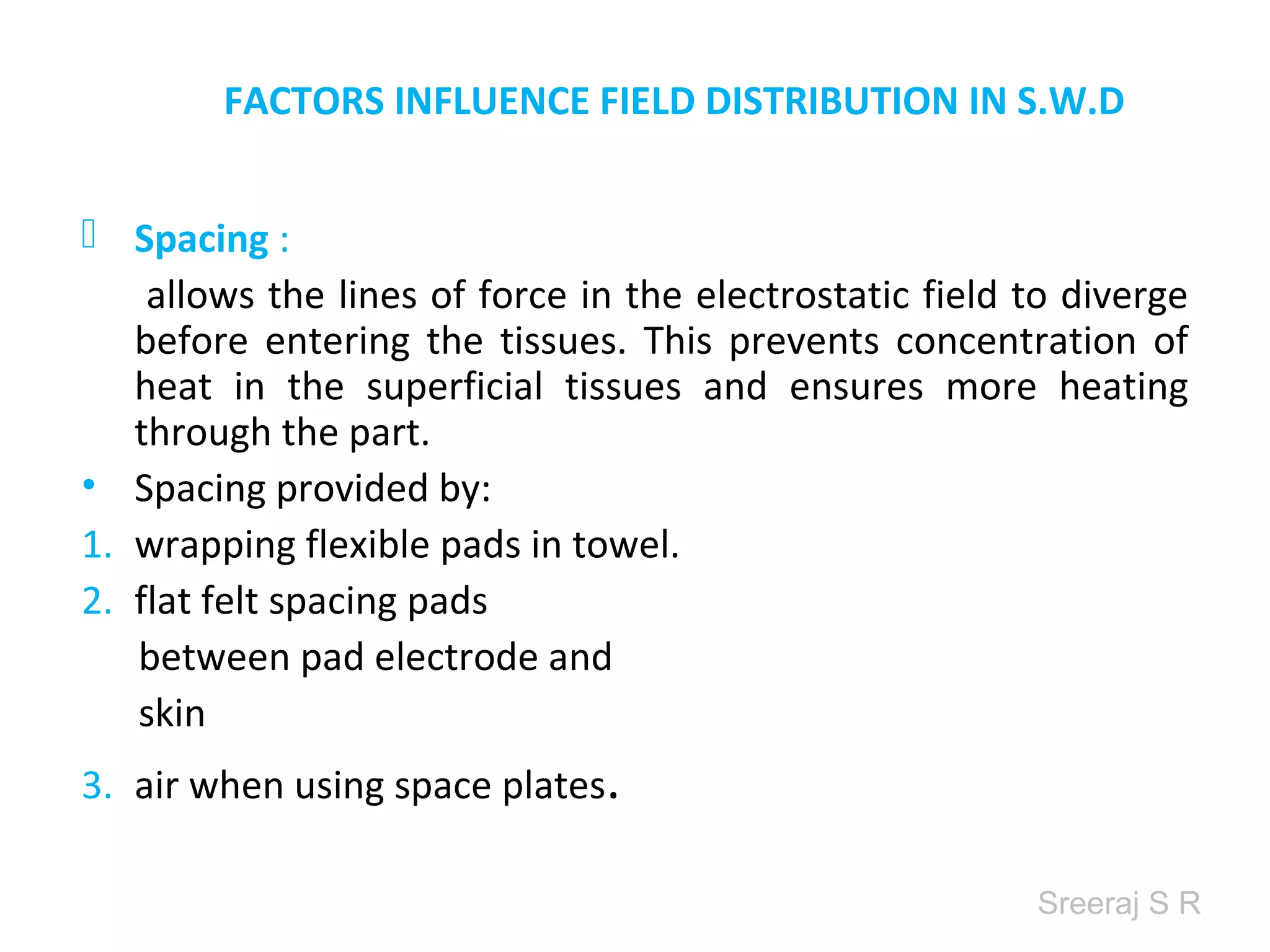
Spacing :
allows the lines of force in the electrostatic field to diverge
before entering the tissues. This prevents concentration of
heat in the superficial tissues and ensures more heating
through the part.
• Spacing provided by:
1. wrapping flexible pads in towel.
2. flat felt spacing pads
between pad electrode and
skin
3. air when using space plates.
Sreeraj S R
FACTORS INFLUENCE FIELD DISTRIBUTION IN S.W.D
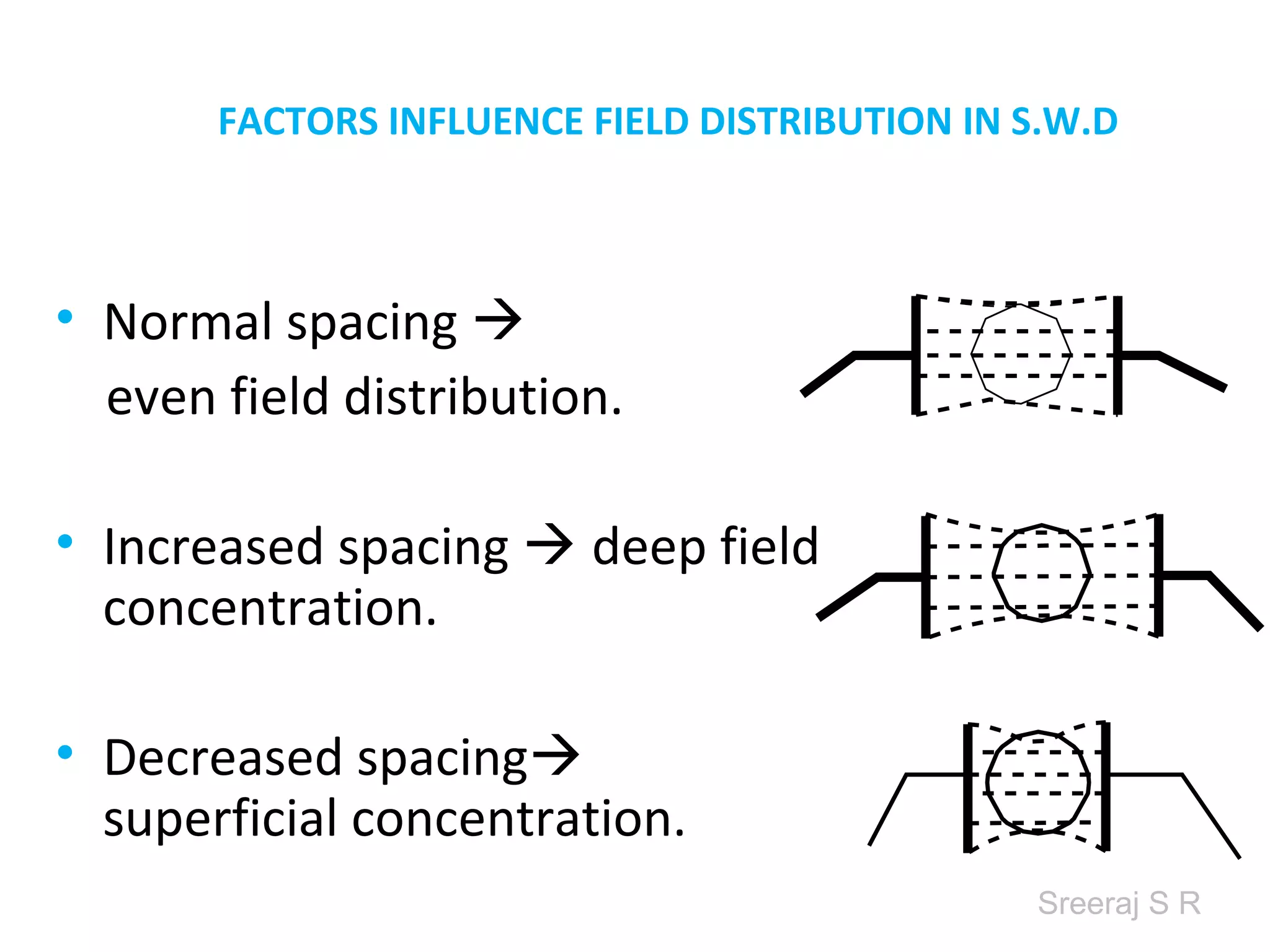
• Normal spacing
even field distribution.
• Increased spacing deep field
concentration.
• Decreased spacing
superficial concentration.
Sreeraj S R
FACTORS INFLUENCE FIELD DISTRIBUTION IN S.W.D
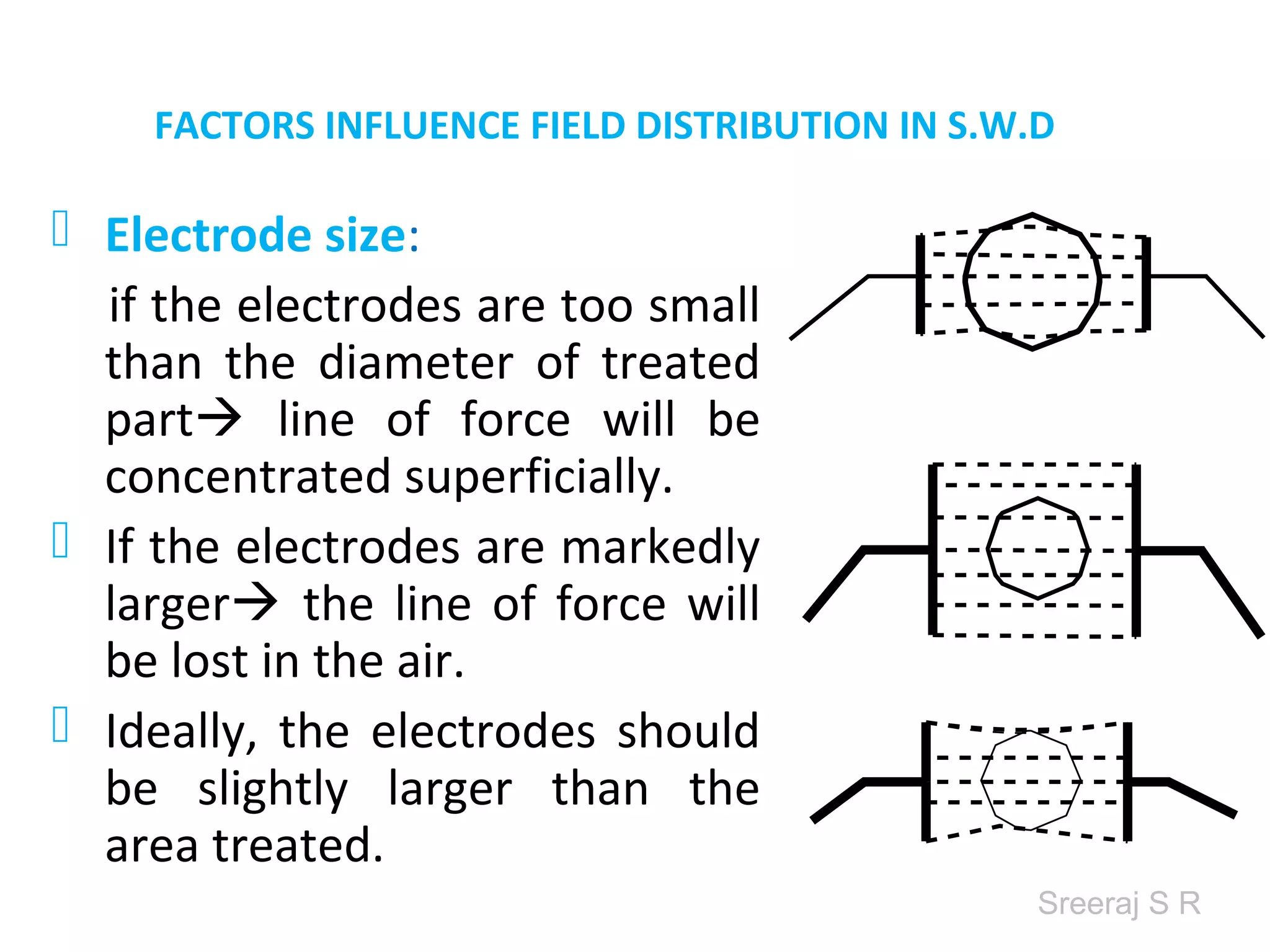
Electrode size:
if the electrodes are too small
than the diameter of treated
part line of force will be
concentrated superficially.
If the electrodes are markedly
larger the line of force will
be lost in the air.
Ideally, the electrodes should
be slightly larger than the area
treated.
Sreeraj S R
FACTORS INFLUENCE FIELD DISTRIBUTION IN S.W.D
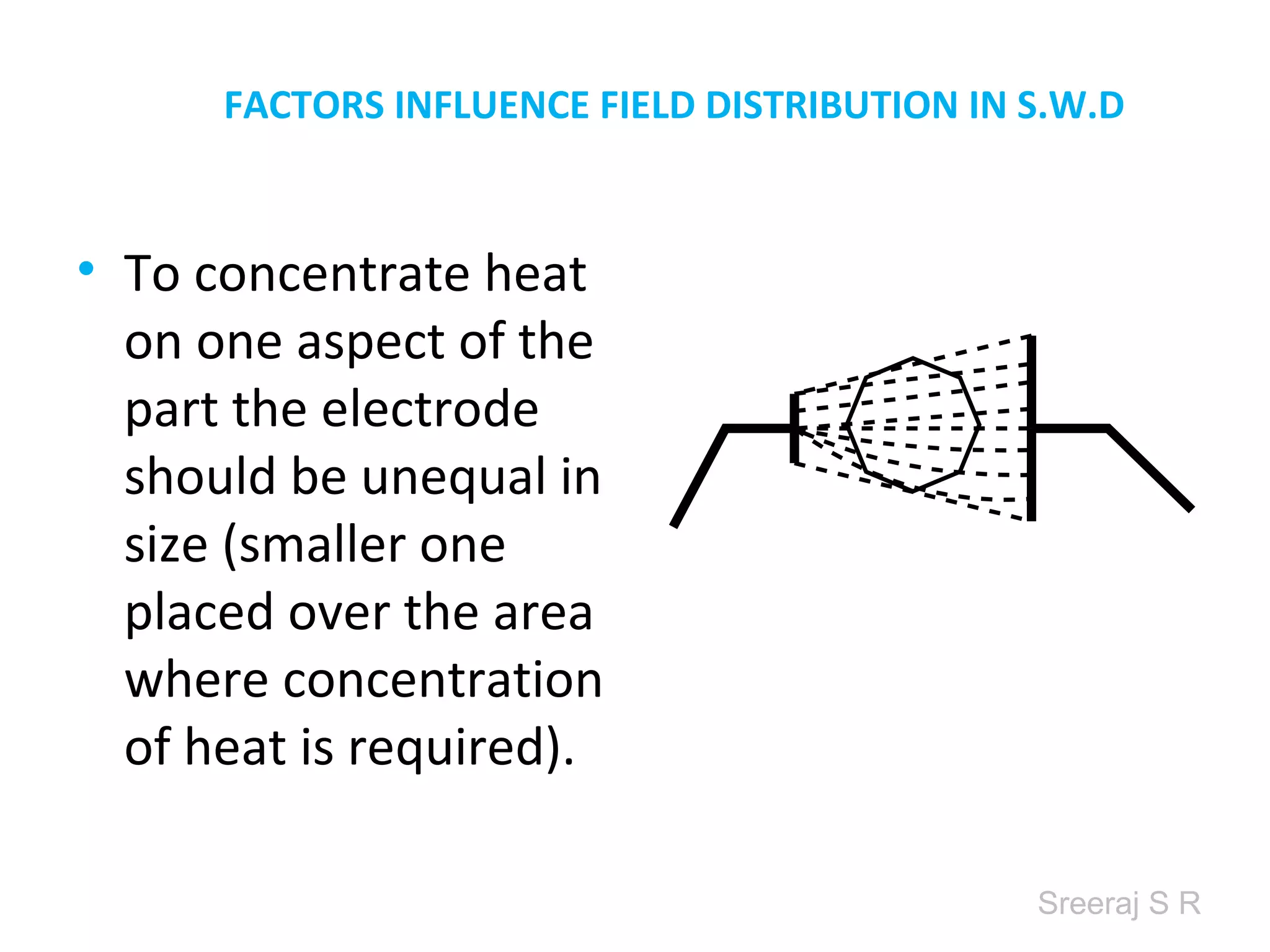
• To concentrate heat
on one aspect of the
part the electrode
should be unequal in
size (smaller one
placed over the area
where concentration
of heat is required).
Sreeraj S R
FACTORS INFLUENCE FIELD DISTRIBUTION IN S.W.D
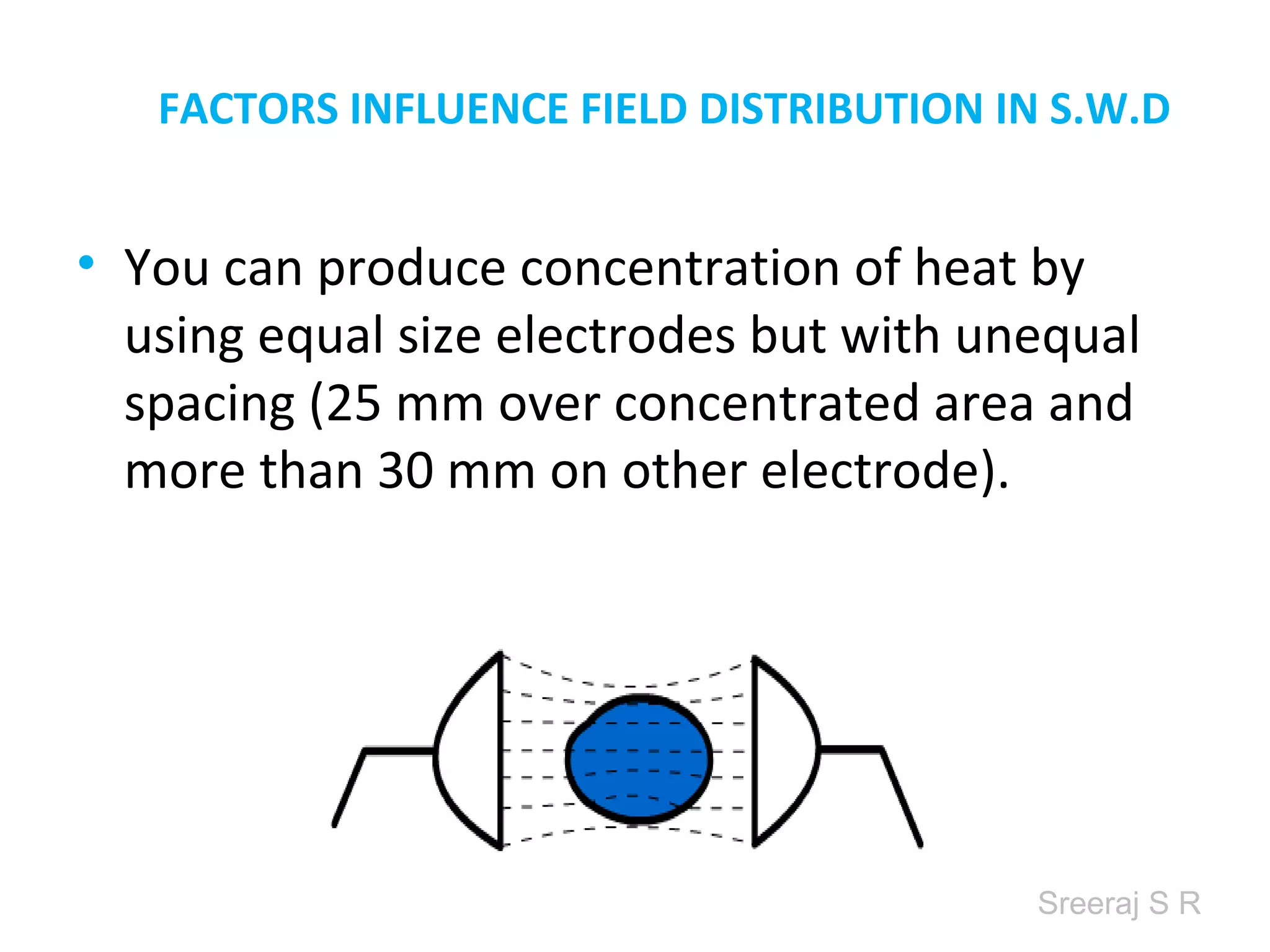
• You can produce concentration of heat by
using equal size electrodes but with unequal
spacing (25 mm over concentrated area and
more than 30 mm on other electrode).
Sreeraj S R
FACTORS INFLUENCE FIELD DISTRIBUTION IN S.W.D
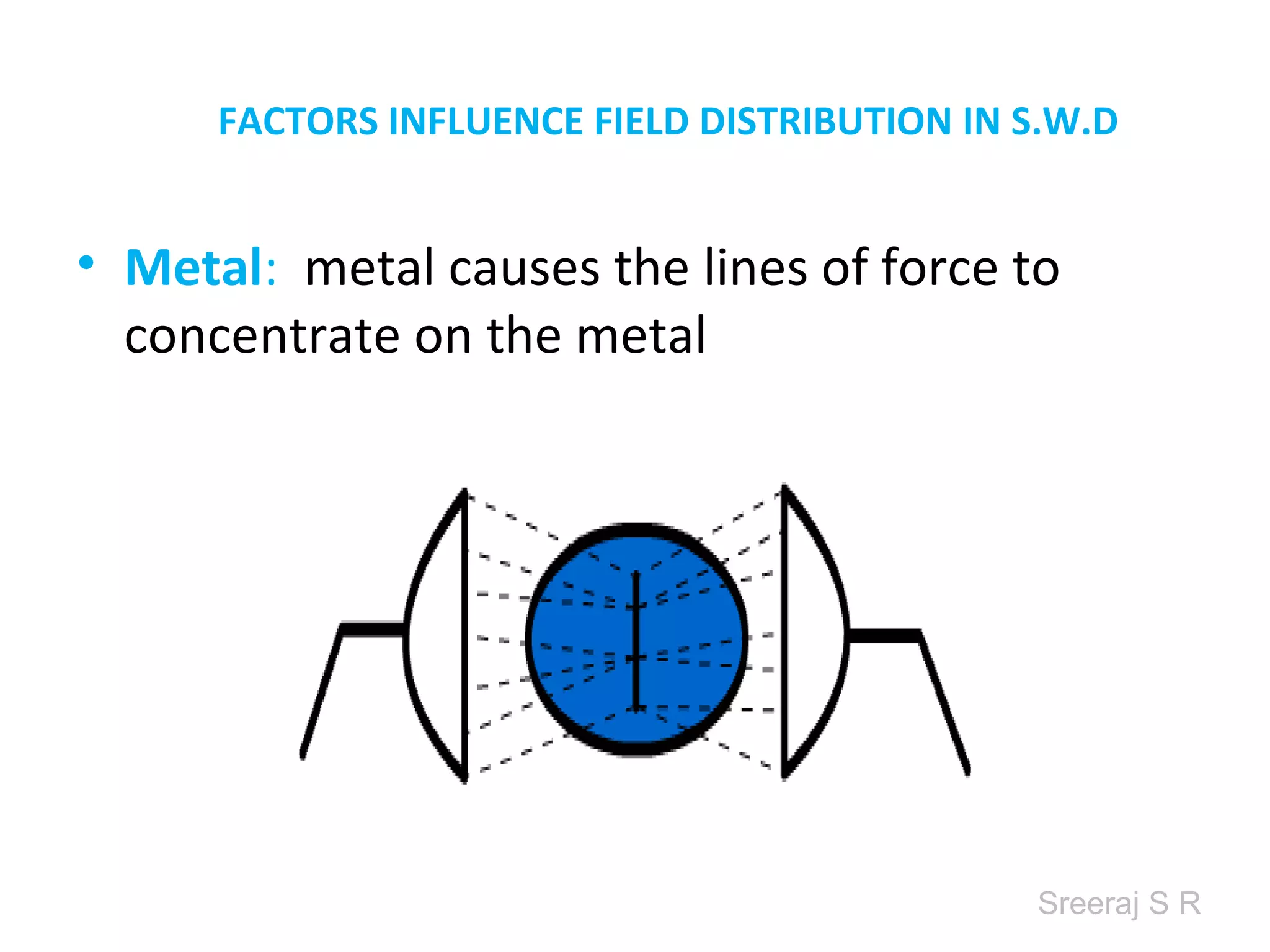
• Metal: metal causes the lines of force to
concentrate on the metal
Sreeraj S R
THERAPEUTIC VARIATION IN THE FIELD DISTRIBUTION
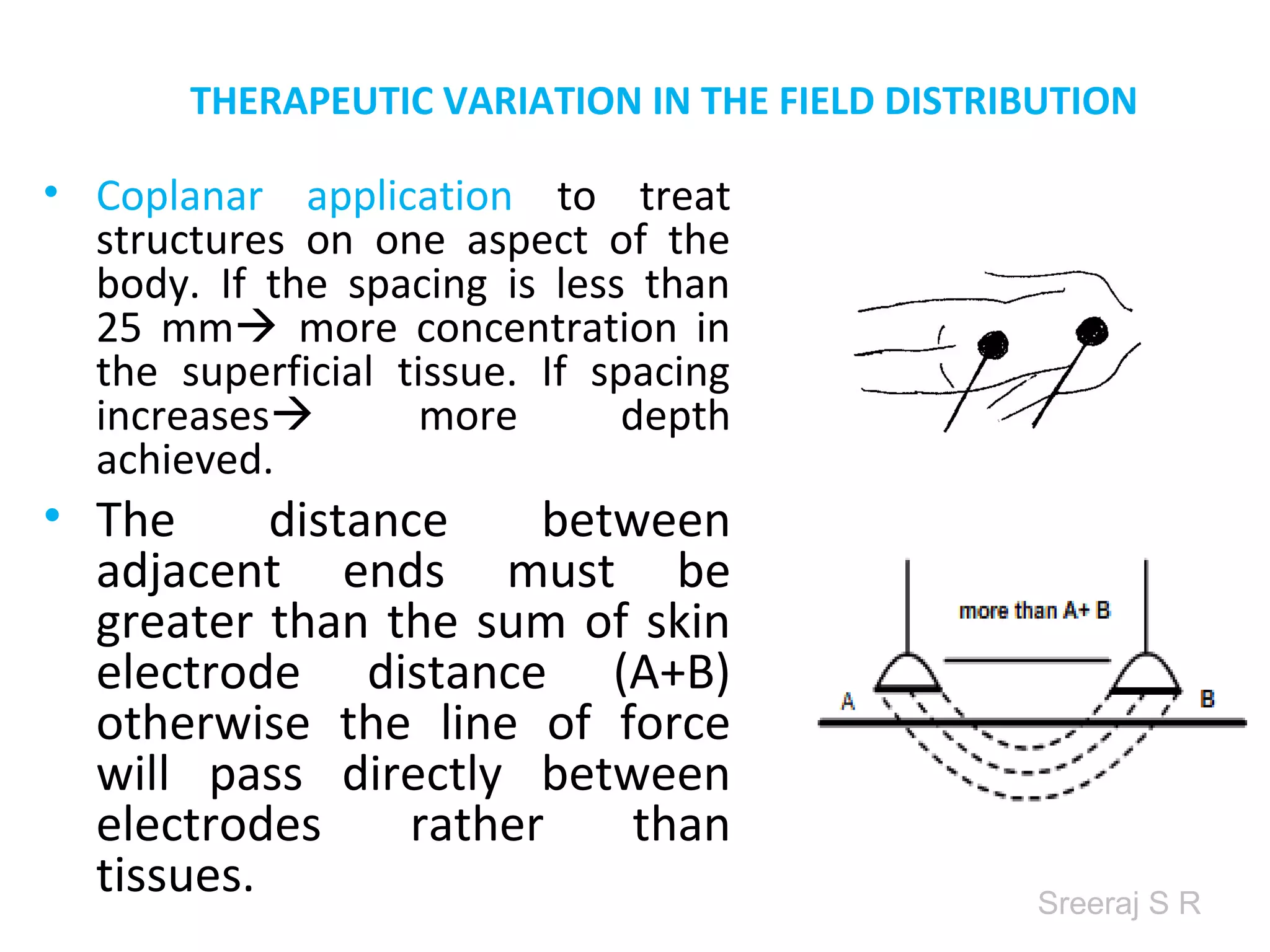
• Coplanar application to treat
structures on one aspect of the
body. If the spacing is less than 25
mm more concentration in the
superficial tissue. If spacing
increases more depth achieved.
• The distance between
adjacent ends must be
greater than the sum of skin
electrode distance (A+B)
otherwise the line of force
will pass directly between
electrodes rather than
tissues.
Sreeraj S R
THERAPEUTIC VARIATION IN THE FIELD DISTRIBUTION
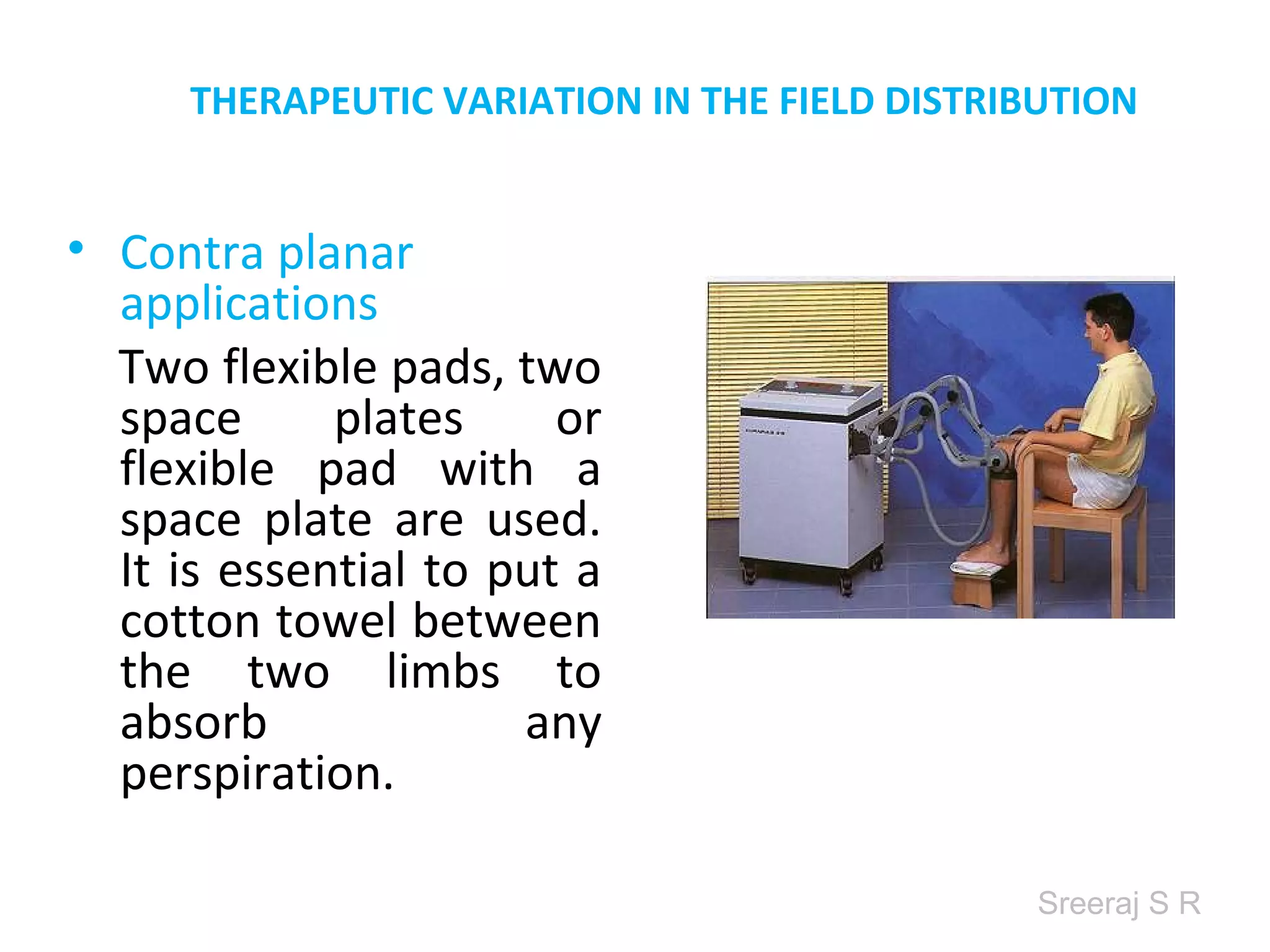
• Contra planar
applications
Two flexible pads, two
space plates or
flexible pad with a
space plate are used.
It is essential to put a
cotton towel between
the two limbs to
absorb any
perspiration.
Sreeraj S R
THERAPEUTIC VARIATION IN THE FIELD DISTRIBUTION
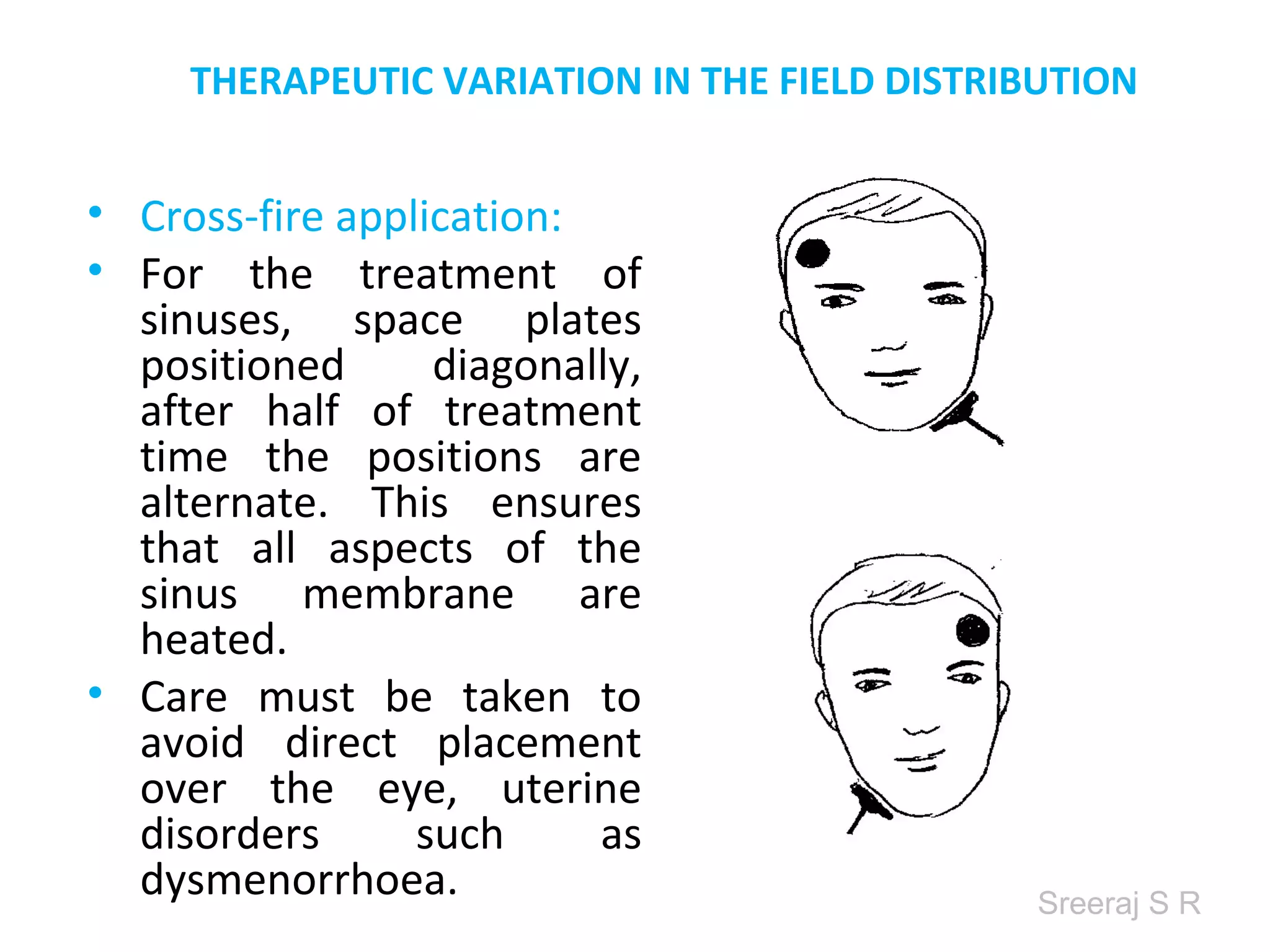
• Cross-fire application:
• For the treatment of
sinuses, space plates
positioned diagonally,
after half of treatment
time the positions are
alternate. This ensures
that all aspects of the
sinus membrane are
heated.
• Care must be taken to
avoid direct placement
over the eye, uterine
disorders such as
dysmenorrhoea.
Sreeraj S R
THERAPEUTIC VARIATION IN THE FIELD DISTRIBUTION
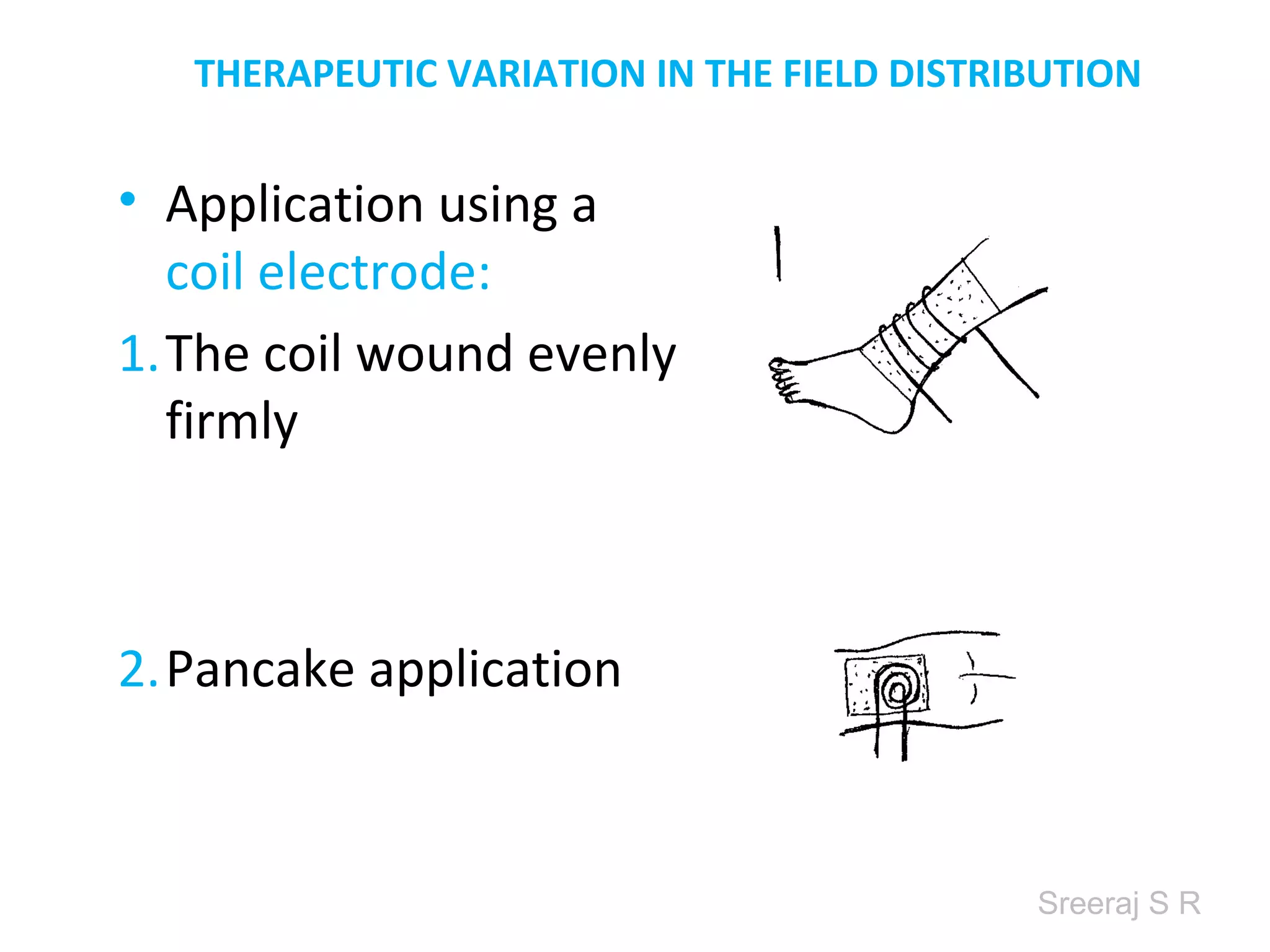
• Application using a
coil electrode:
1. The coil wound
evenly firmly
2. Pancake application
Sreeraj S R
THERAPEUTIC VARIATION IN THE FIELD DISTRIBUTION
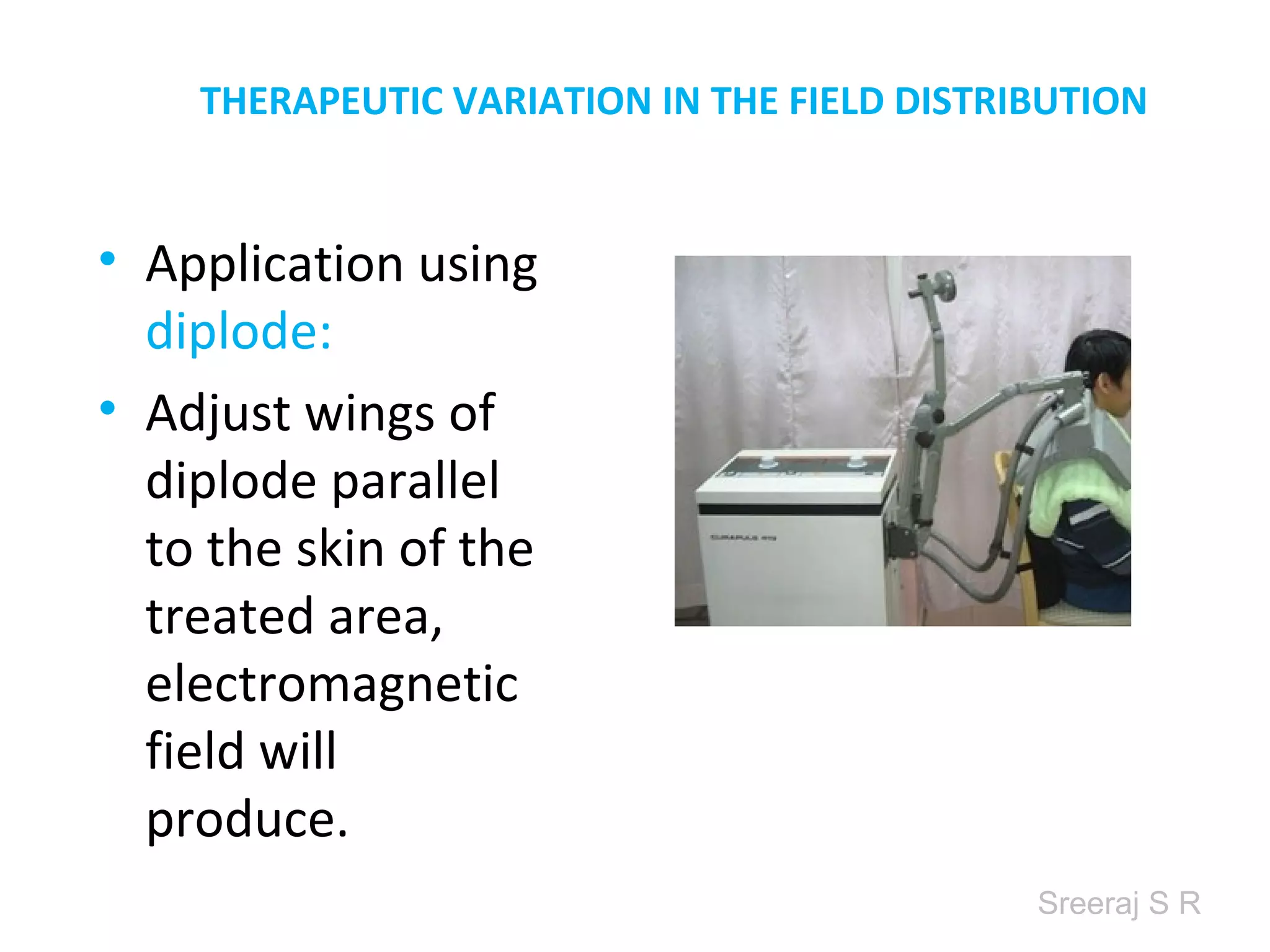
• Application using
diplode:
• Adjust wings of
diplode parallel
to the skin of the
treated area,
electromagnetic
field will
produce.
Sreeraj S R
Dangers
1. Burns
• Concentration of electric field
• Excess current
• Impaired blood flow
• Hypersensitive skin
• Leads touching skin
2. Scalds
3. Electric shock
4. Overdose
5. Precipitation of gangrene
6. Faintness
7. Giddiness
Sreeraj S R
Contraindications
• Metal implants or metal jewelry
(be aware of body piercings)
• Cardiac pacemakers
• Ischemic areas
• Peripheral vascular disease
• Perspiration and moist dressings:
The water collects and
concentrates the heat.
• Tendency to hemorrhage,
including menstruation.
• Pregnancy
• Fever
• Sensory loss
• Cancer
• Deep X ray
• Tumours
• Unreliable patients
• Areas of particular sensitivity:
– Epiphyseal plates in children
– The genitals
– Sites of infection
– The abdomen with an implanted
intrauterine device (IUD)
– The eyes and face
– Application through the skull

Short wave diathermy srs

  • 1.
    Sreeraj S R SHORTWAVE DIATHERMY - - - - - + + + + + +
  • 2.
    Sreeraj S R Diameans through Thermo means temperature /heat. Frequency of 27.12 MHz Wavelength greater than 11meter Description High-frequency electrical currents › Radio waves Pass through the tissues Cause molecular vibration Results in deep heating Capable of heating large volumes of tissues Causes both thermal and non thermal effects
  • 3.
  • 4.
  • 5.
  • 6.
  • 7.
  • 8.
    Sreeraj S R Effectson Tissues • Ionic motion • Dipole rotation • Molecular distortion
  • 9.
    Sreeraj S R Physiologicaleffect Effects on 1. Metabolism 2. Circulation 3. Nervous tissue 4. Muscle tissue
  • 10.
    Sreeraj S R TherapeuticEffect Effects on 1. Inflammation 2. Bacterial Infection 3. Relief of pain 4. Traumatic conditions 5. Reduce healing time
  • 11.
    Sreeraj S R Typesof Shortwave Diathermy Induction Field Capacitive Field
  • 12.
    Sreeraj S R InductionField Diathermy • Places the patient in the electromagnetic field • Current flowing within the coil produces a rotating magnetic field • Magnetic field produces eddy currents in the tissues • Eddy currents cause friction that produce heat • Selectively heats muscle • Also referred to as: – Magnetic field diathermy
  • 13.
    Sreeraj S R CapacitiveField Diathermy • Uses the patient’s tissues as a part of the circuit • The tissues’ electrical resistance produces heat • Selectively heats skin – Muscle is heated via conduction from the adipose • Also referred to as “condenser field diathermy”
  • 14.
    Sreeraj S R TYPESOF ELECTRODES Flexible pads: consist of metal electrode encased in rubber and produce an electrostatic field.
  • 15.
    Sreeraj S R TYPESOF ELECTRODES • Space plates: consist of a rigid metal electrode encased in a Perspex cover electrostatic field.
  • 16.
    Sreeraj S R TYPESOF ELECTRODES • Coil or cable electrode consists of a wire with plugs at either end creates electromagnetic field.
  • 17.
    Sreeraj S R TYPESOF ELECTRODES • The monode : flat, rigid coil encased in plastic cover electromagnetic field.
  • 18.
    Sreeraj S R TYPESOF ELECTRODES • The diplode : or drum electrode, consists of a flat coil electrode encased in a Perspex cover with two wings • electromagnetic field
  • 19.
    Sreeraj S R FACTORSINFLUENCE FIELD DISTRIBUTION IN S.W.D Spacing : allows the lines of force in the electrostatic field to diverge before entering the tissues. This prevents concentration of heat in the superficial tissues and ensures more heating through the part. • Spacing provided by: 1. wrapping flexible pads in towel. 2. flat felt spacing pads between pad electrode and skin 3. air when using space plates.
  • 20.
    Sreeraj S R FACTORSINFLUENCE FIELD DISTRIBUTION IN S.W.D • Normal spacing even field distribution. • Increased spacing deep field concentration. • Decreased spacing superficial concentration.
  • 21.
    Sreeraj S R FACTORSINFLUENCE FIELD DISTRIBUTION IN S.W.D Electrode size: if the electrodes are too small than the diameter of treated part line of force will be concentrated superficially. If the electrodes are markedly larger the line of force will be lost in the air. Ideally, the electrodes should be slightly larger than the area treated.
  • 22.
    Sreeraj S R FACTORSINFLUENCE FIELD DISTRIBUTION IN S.W.D • To concentrate heat on one aspect of the part the electrode should be unequal in size (smaller one placed over the area where concentration of heat is required).
  • 23.
    Sreeraj S R FACTORSINFLUENCE FIELD DISTRIBUTION IN S.W.D • You can produce concentration of heat by using equal size electrodes but with unequal spacing (25 mm over concentrated area and more than 30 mm on other electrode).
  • 24.
    Sreeraj S R FACTORSINFLUENCE FIELD DISTRIBUTION IN S.W.D • Metal: metal causes the lines of force to concentrate on the metal
  • 25.
    Sreeraj S R THERAPEUTICVARIATION IN THE FIELD DISTRIBUTION • Coplanar application to treat structures on one aspect of the body. If the spacing is less than 25 mm more concentration in the superficial tissue. If spacing increases more depth achieved. • The distance between adjacent ends must be greater than the sum of skin electrode distance (A+B) otherwise the line of force will pass directly between electrodes rather than tissues.
  • 26.
    Sreeraj S R THERAPEUTICVARIATION IN THE FIELD DISTRIBUTION • Contra planar applications Two flexible pads, two space plates or flexible pad with a space plate are used. It is essential to put a cotton towel between the two limbs to absorb any perspiration.
  • 27.
    Sreeraj S R THERAPEUTICVARIATION IN THE FIELD DISTRIBUTION • Cross-fire application: • For the treatment of sinuses, space plates positioned diagonally, after half of treatment time the positions are alternate. This ensures that all aspects of the sinus membrane are heated. • Care must be taken to avoid direct placement over the eye, uterine disorders such as dysmenorrhoea.
  • 28.
    Sreeraj S R THERAPEUTICVARIATION IN THE FIELD DISTRIBUTION • Application using a coil electrode: 1. The coil wound evenly firmly 2. Pancake application
  • 29.
    Sreeraj S R THERAPEUTICVARIATION IN THE FIELD DISTRIBUTION • Application using diplode: • Adjust wings of diplode parallel to the skin of the treated area, electromagnetic field will produce.
  • 30.
    Sreeraj S R Dangers 1.Burns • Concentration of electric field • Excess current • Impaired blood flow • Hypersensitive skin • Leads touching skin 2. Scalds 3. Electric shock 4. Overdose 5. Precipitation of gangrene 6. Faintness 7. Giddiness
  • 31.
    Sreeraj S R Contraindications •Metal implants or metal jewelry (be aware of body piercings) • Cardiac pacemakers • Ischemic areas • Peripheral vascular disease • Perspiration and moist dressings: The water collects and concentrates the heat. • Tendency to hemorrhage, including menstruation. • Pregnancy • Fever • Sensory loss • Cancer • Deep X ray • Tumours • Unreliable patients • Areas of particular sensitivity: – Epiphyseal plates in children – The genitals – Sites of infection – The abdomen with an implanted intrauterine device (IUD) – The eyes and face – Application through the skull

Editor's Notes

  • #10 Van’t Hoff’s law: any chemical reaction which is capable of being accelerated can be accelerated by heat. Direct reflex vasodilatation by stimulating cutaneous thermoreceptors , release of bradykinin, and indirectly by spinal reflex Increased Nerve Conduction, decreased conduction latency and firing rate Alter soft tissue extensibility