INFRAREDDepartment of CE/IT
IntroductionInfrared radiation (IR radiation) is electromagnetic radiation with a wavelength between 0.7 and 300 micrometres, which equates to a frequency range between approximately 1 and 430Its wavelength is longer (and the frequency lower) than that of visible light, but the wavelength is shorter (and the frequency higher) than that of terahertz radiation microwaves. Bright sunlight provides an irradiance of just over 1 kilowatt per square meter at sea level. Of this energy, 527 watts is infrared radiation, 445 watts is visible light, and 32 watts is ultraviolet radiation.Department of CE/IT
Department of CE/IT
Origins of the termThe name means below red, the Latin infra meaning "below". Red is the color of the longest wavelengths of visible light. Infrared light has a longer wavelength (and so a lower frequency) than that of red light visible to humans, hence the literal meaning of below red.INFRARED=INFRA+REDDepartment of CE/IT
HISTROYThe discovery of infrared radiation is ascribed to William Herschel, the astronomer, in the early 19th century. Herschel published his results in 1800 before the Royal Society of London. Herschel used a prism to refract light from the sun and detected the infrared, beyond the red part of the spectrum, through an increase in the temperature recorded on a thermometer. He was surprised at the result and called them "Calorific Rays". The term 'Infrared' did not appear until late in the 19th century.Department of CE/IT
Different regions in the infraredCIE division schemeAstronomy division schemeSensor response division schemeTelecommunication bands in the infraredHeatDepartment of CE/IT
CIE division schemeThe International Commission on Illumination (CIE) recommended the division of optical radiation into the following three bands:IR-A: 700 nm–1400 nm (0,7 µm – 1.4 µm)IR-B: 1400 nm–3000 nm (1.4 µm – 3 µm)IR-C: 3000 nm–1 mm (3 µm – 1000 µm)Department of CE/IT
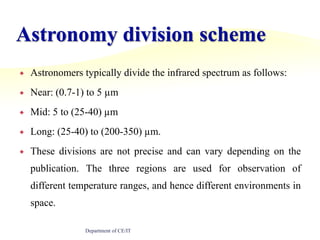
Astronomy division schemeAstronomers typically divide the infrared spectrum as follows:Near: (0.7-1) to 5 µmMid: 5 to (25-40) µmLong: (25-40) to (200-350) µm.These divisions are not precise and can vary depending on the publication. The three regions are used for observation of different temperature ranges, and hence different environments in space.Department of CE/IT
Sensor response division schemeA third scheme divides up the band based on the response of various detectors:Near infrared: from 0.7 to 1.0 micrometers (from the approximate end of the response of the human eye to that of silicon).Short-wave infrared: 1.0 to 3 micrometers (from the cut off of silicon to that of the MWIR atmospheric window. InGaAs covers to about 1.8 micrometers; the less sensitive lead salts cover this region.Mid-wave infrared: 3 to 5 micrometers (defined by the atmospheric window and covered by Indium antimonide [InSb] and HgCdTe and partially by lead selenide [PbSe]).Long-wave infrared: 8 to 12, or 7 to 14 micrometers: the atmospheric window (Covered by HgCdTe and microbolometers).Very-long wave infrared (VLWIR): 12 to about 30 micrometers, covered by doped silicon.Department of CE/IT
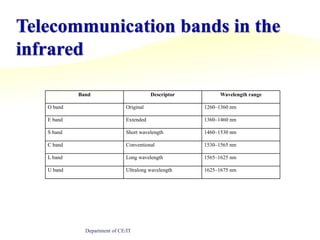
Telecommunication bands in the infraredDepartment of CE/IT
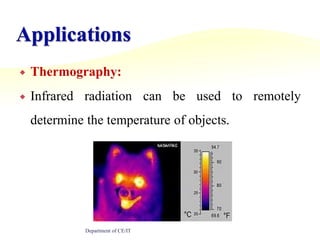
ApplicationsThermography:Infrared radiation can be used to remotely determine the temperature of objects.Department of CE/IT
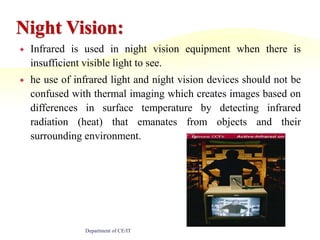
Night Vision:Infrared is used in night vision equipment when there is insufficient visible light to see.he use of infrared light and night vision devices should not be confused with thermal imaging which creates images based on differences in surface temperature by detecting infrared radiation (heat) that emanates from objects and their surrounding environment.Department of CE/IT
Other imagingIn infrared photography, infrared filters are used to capture the near-infrared spectrum. Digital cameras often use infrared blockers. Cheaper digital cameras and camera phones have less effective filters and can "see" intense near-infrared, appearing as a bright purple-white color. This is especially pronounced when taking pictures of subjects near IR-bright areas (such as near a lamp), where the resulting infrared interference can wash out the image. There is also a technique called 'T-ray' imaging, which is imaging using far infrared or terahertz radiation. Lack of bright sources makes terahertz photography technically more challenging than most other infrared imaging techniques. Recently T-ray imaging has been of considerable interest due to a number of new developments such as terahertz time-domain spectroscopy.Department of CE/IT
TrackingInfrared tracking, also known as infrared homing, refers to a passive missile guidance system which uses the emission from a target of electromagnetic radiation in the infrared part of the spectrum to track it. Missiles which use infrared seeking are often referred to as "heat-seekers", since infrared (IR) is just below the visible spectrum of light in frequency and is radiated strongly by hot bodies. Many objects such as people, vehicle engines, and aircraft generate and retain heat, and as such, are especially visible in the infrared wavelengths of light compared to objects in the backgroundDepartment of CE/IT
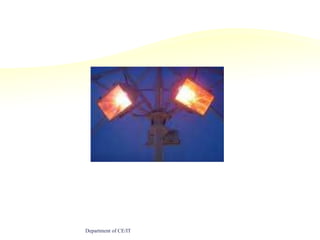
HeatingInfrared radiation can be used as a deliberate heating source.Infrared heating is also becoming more popular in industrial manufacturing processes, e.g. curing of coatings, forming of plastics, annealing, plastic welding, print drying. In these applications, infrared heaters replace convection ovens and contact heating. Efficiency is achieved by matching the wavelength of the infrared heater to the absorption characteristics of the material.Department of CE/IT
Other ApplicationsHeatingCommunicationsSpectroscoptyMeteorologyAstronomyArt historyBiological systemsHealth hazardDepartment of CE/IT
Uses of infraredMoisture detectionMold detection Water leak detectionLoss preventionRoof leak detectionEnergy efficiencyBuilding maintenanceWater damage restorationDepartment of CE/IT
Referenceswww. wikipedia.orgDepartment of CE/IT
The End… Thank u…Department of CE/IT

Infrared

  • 1.
  • 2.
    IntroductionInfrared radiation (IRradiation) is electromagnetic radiation with a wavelength between 0.7 and 300 micrometres, which equates to a frequency range between approximately 1 and 430Its wavelength is longer (and the frequency lower) than that of visible light, but the wavelength is shorter (and the frequency higher) than that of terahertz radiation microwaves. Bright sunlight provides an irradiance of just over 1 kilowatt per square meter at sea level. Of this energy, 527 watts is infrared radiation, 445 watts is visible light, and 32 watts is ultraviolet radiation.Department of CE/IT
  • 3.
  • 4.
    Origins of thetermThe name means below red, the Latin infra meaning "below". Red is the color of the longest wavelengths of visible light. Infrared light has a longer wavelength (and so a lower frequency) than that of red light visible to humans, hence the literal meaning of below red.INFRARED=INFRA+REDDepartment of CE/IT
  • 5.
    HISTROYThe discovery ofinfrared radiation is ascribed to William Herschel, the astronomer, in the early 19th century. Herschel published his results in 1800 before the Royal Society of London. Herschel used a prism to refract light from the sun and detected the infrared, beyond the red part of the spectrum, through an increase in the temperature recorded on a thermometer. He was surprised at the result and called them "Calorific Rays". The term 'Infrared' did not appear until late in the 19th century.Department of CE/IT
  • 6.
    Different regions inthe infraredCIE division schemeAstronomy division schemeSensor response division schemeTelecommunication bands in the infraredHeatDepartment of CE/IT
  • 7.
    CIE division schemeTheInternational Commission on Illumination (CIE) recommended the division of optical radiation into the following three bands:IR-A: 700 nm–1400 nm (0,7 µm – 1.4 µm)IR-B: 1400 nm–3000 nm (1.4 µm – 3 µm)IR-C: 3000 nm–1 mm (3 µm – 1000 µm)Department of CE/IT
  • 8.
    Astronomy division schemeAstronomerstypically divide the infrared spectrum as follows:Near: (0.7-1) to 5 µmMid: 5 to (25-40) µmLong: (25-40) to (200-350) µm.These divisions are not precise and can vary depending on the publication. The three regions are used for observation of different temperature ranges, and hence different environments in space.Department of CE/IT
  • 9.
    Sensor response divisionschemeA third scheme divides up the band based on the response of various detectors:Near infrared: from 0.7 to 1.0 micrometers (from the approximate end of the response of the human eye to that of silicon).Short-wave infrared: 1.0 to 3 micrometers (from the cut off of silicon to that of the MWIR atmospheric window. InGaAs covers to about 1.8 micrometers; the less sensitive lead salts cover this region.Mid-wave infrared: 3 to 5 micrometers (defined by the atmospheric window and covered by Indium antimonide [InSb] and HgCdTe and partially by lead selenide [PbSe]).Long-wave infrared: 8 to 12, or 7 to 14 micrometers: the atmospheric window (Covered by HgCdTe and microbolometers).Very-long wave infrared (VLWIR): 12 to about 30 micrometers, covered by doped silicon.Department of CE/IT
  • 10.
    Telecommunication bands inthe infraredDepartment of CE/IT
  • 11.
    ApplicationsThermography:Infrared radiation canbe used to remotely determine the temperature of objects.Department of CE/IT
  • 12.
    Night Vision:Infrared isused in night vision equipment when there is insufficient visible light to see.he use of infrared light and night vision devices should not be confused with thermal imaging which creates images based on differences in surface temperature by detecting infrared radiation (heat) that emanates from objects and their surrounding environment.Department of CE/IT
  • 13.
    Other imagingIn infraredphotography, infrared filters are used to capture the near-infrared spectrum. Digital cameras often use infrared blockers. Cheaper digital cameras and camera phones have less effective filters and can "see" intense near-infrared, appearing as a bright purple-white color. This is especially pronounced when taking pictures of subjects near IR-bright areas (such as near a lamp), where the resulting infrared interference can wash out the image. There is also a technique called 'T-ray' imaging, which is imaging using far infrared or terahertz radiation. Lack of bright sources makes terahertz photography technically more challenging than most other infrared imaging techniques. Recently T-ray imaging has been of considerable interest due to a number of new developments such as terahertz time-domain spectroscopy.Department of CE/IT
  • 14.
    TrackingInfrared tracking, alsoknown as infrared homing, refers to a passive missile guidance system which uses the emission from a target of electromagnetic radiation in the infrared part of the spectrum to track it. Missiles which use infrared seeking are often referred to as "heat-seekers", since infrared (IR) is just below the visible spectrum of light in frequency and is radiated strongly by hot bodies. Many objects such as people, vehicle engines, and aircraft generate and retain heat, and as such, are especially visible in the infrared wavelengths of light compared to objects in the backgroundDepartment of CE/IT
  • 15.
    HeatingInfrared radiation canbe used as a deliberate heating source.Infrared heating is also becoming more popular in industrial manufacturing processes, e.g. curing of coatings, forming of plastics, annealing, plastic welding, print drying. In these applications, infrared heaters replace convection ovens and contact heating. Efficiency is achieved by matching the wavelength of the infrared heater to the absorption characteristics of the material.Department of CE/IT
  • 16.
  • 17.
    Uses of infraredMoisturedetectionMold detection Water leak detectionLoss preventionRoof leak detectionEnergy efficiencyBuilding maintenanceWater damage restorationDepartment of CE/IT
  • 18.
  • 19.
    The End… Thanku…Department of CE/IT