DIATHERMY...... 
PRESENTED BY: 
A THERAPEUTIC APPROACH 
NIVETA SINGH 
Centre for Biomedical Engg. 
SHOBHIT UNIVERSITY
INTRODUCTION 
 Diathermy is a therapeutic treatment commonly prescribed 
for muscular and joint associated pains. 
 The term ‘diathermy’ means ‘through heating’ or producing 
deep heating directly in the tissues of the body. 
‘ Dia’ through (also means two) 
‘thermy’ heat or temperature 
 It simulates the circulation, relieve pain, enhances rate of 
recovery of healing the tissue.
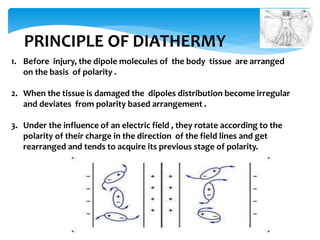
PRINCIPLE OF DIATHERMY 
1. Before injury, the dipole molecules of the body tissue are arranged 
on the basis of polarity . 
2. When the tissue is damaged the dipoles distribution become irregular 
and deviates from polarity based arrangement . 
3. Under the influence of an electric field , they rotate according to the 
polarity of their charge in the direction of the field lines and get 
rearranged and tends to acquire its previous stage of polarity.
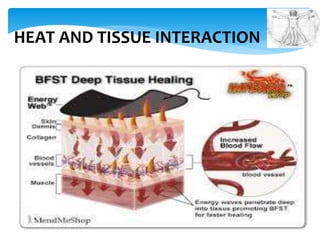
HEAT AND TISSUE INTERACTION
CHALLENGES OF DIATHERMY 
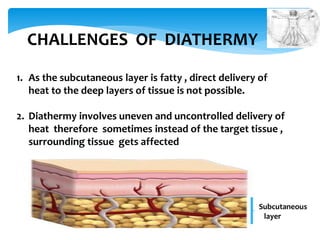
1. As the subcutaneous layer is fatty , direct delivery of 
heat to the deep layers of tissue is not possible. 
2. Diathermy involves uneven and uncontrolled delivery of 
heat therefore sometimes instead of the target tissue , 
surrounding tissue gets affected 
Subcutaneous 
layer
DIATHERMY 
• Diathermy uses an electric current to produce heat deep 
inside a targeted tissue. 
It can reach areas as deep as two inches from the skin’s 
surface. 
• The diathermy machine does not apply heat directly to 
the body. Instead, the current from the machine allows 
the body to generate heat from within the targeted 
tissue. 
• As the heat increases, it promotes blood flow. 
It can also help improve flexibility in stiff joints and 
connective tissue.
BENEFITS OF DIATHERMY 
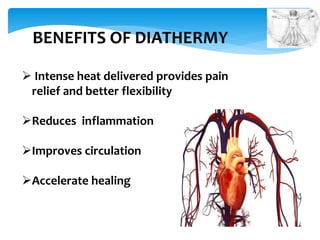
 Intense heat delivered provides pain 
relief and better flexibility 
Reduces inflammation 
Improves circulation 
Accelerate healing
TYPES OF DIATHERMY 
1. SHORT WAVE DIATHERMY 
2. LONGWAVE DIATHERMY 
3. MICROWAVE DIATHERMY 
4. ULTRASOUND DIATHERMY 
5. LASER DIATHERMY
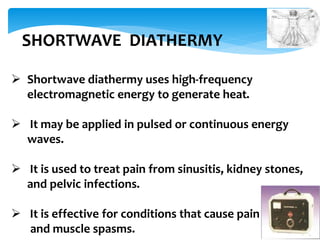
SHORTWAVE DIATHERMY 
 Shortwave diathermy uses high-frequency 
electromagnetic energy to generate heat. 
 It may be applied in pulsed or continuous energy 
waves. 
 It is used to treat pain from sinusitis, kidney stones, 
and pelvic infections. 
 It is effective for conditions that cause pain 
and muscle spasms.
Shortwave Has Three Main 
Frequencies: 
 27.12 MHz, wavelength 11 M (most common used 
one). 
 13.56 MHz wavelength 22 M. 
 40.68 MHz 7.5 M.
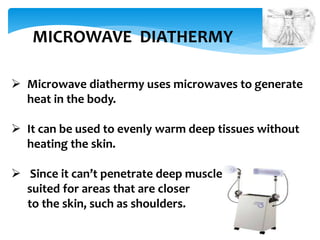
MICROWAVE DIATHERMY 
 Microwave diathermy uses microwaves to generate 
heat in the body. 
 It can be used to evenly warm deep tissues without 
heating the skin. 
 Since it can’t penetrate deep muscles, it is best 
suited for areas that are closer 
to the skin, such as shoulders.
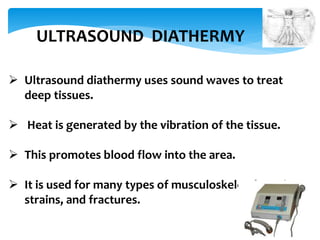
ULTRASOUND DIATHERMY 
 Ultrasound diathermy uses sound waves to treat 
deep tissues. 
 Heat is generated by the vibration of the tissue. 
 This promotes blood flow into the area. 
 It is used for many types of musculoskeletal sprains, 
strains, and fractures.
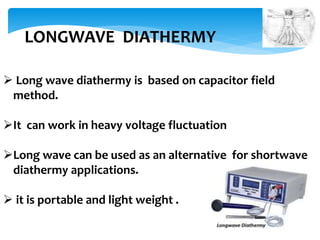
LONGWAVE DIATHERMY 
 Long wave diathermy is based on capacitor field 
method. 
It can work in heavy voltage fluctuation 
Long wave can be used as an alternative for shortwave 
diathermy applications. 
 it is portable and light weight .
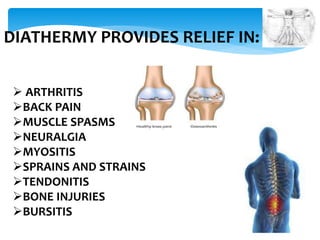
DIATHERMY PROVIDES RELIEF IN: 
 ARTHRITIS 
BACK PAIN 
MUSCLE SPASMS 
NEURALGIA 
MYOSITIS 
SPRAINS AND STRAINS 
TENDONITIS 
BONE INJURIES 
BURSITIS
UNWANTED EFFECTS 
OF DIATHERMY 
 The electromagnetic energy used in diathermy can cause 
extreme heat in metal devices such as bone pins, dental 
fillings, and metal sutures causing burns 
 During diathermy treatment, the patient becomes a part 
of the electrical field. Touching a bare metal object, such 
as a cabinet, during diathermy can cause a shock or burn.
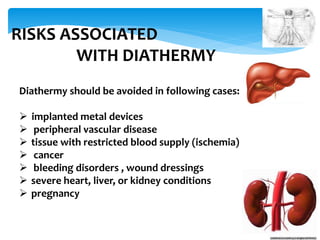
RISKS ASSOCIATED 
WITH DIATHERMY 
Diathermy should be avoided in following cases: 
 implanted metal devices 
 peripheral vascular disease 
 tissue with restricted blood supply (ischemia) 
 cancer 
 bleeding disorders , wound dressings 
 severe heart, liver, or kidney conditions 
 pregnancy
Diathermy

Diathermy

  • 1.
    DIATHERMY...... PRESENTED BY: A THERAPEUTIC APPROACH NIVETA SINGH Centre for Biomedical Engg. SHOBHIT UNIVERSITY
  • 2.
    INTRODUCTION  Diathermyis a therapeutic treatment commonly prescribed for muscular and joint associated pains.  The term ‘diathermy’ means ‘through heating’ or producing deep heating directly in the tissues of the body. ‘ Dia’ through (also means two) ‘thermy’ heat or temperature  It simulates the circulation, relieve pain, enhances rate of recovery of healing the tissue.
  • 3.
    PRINCIPLE OF DIATHERMY 1. Before injury, the dipole molecules of the body tissue are arranged on the basis of polarity . 2. When the tissue is damaged the dipoles distribution become irregular and deviates from polarity based arrangement . 3. Under the influence of an electric field , they rotate according to the polarity of their charge in the direction of the field lines and get rearranged and tends to acquire its previous stage of polarity.
  • 4.
    HEAT AND TISSUEINTERACTION
  • 5.
    CHALLENGES OF DIATHERMY 1. As the subcutaneous layer is fatty , direct delivery of heat to the deep layers of tissue is not possible. 2. Diathermy involves uneven and uncontrolled delivery of heat therefore sometimes instead of the target tissue , surrounding tissue gets affected Subcutaneous layer
  • 6.
    DIATHERMY • Diathermyuses an electric current to produce heat deep inside a targeted tissue. It can reach areas as deep as two inches from the skin’s surface. • The diathermy machine does not apply heat directly to the body. Instead, the current from the machine allows the body to generate heat from within the targeted tissue. • As the heat increases, it promotes blood flow. It can also help improve flexibility in stiff joints and connective tissue.
  • 7.
    BENEFITS OF DIATHERMY  Intense heat delivered provides pain relief and better flexibility Reduces inflammation Improves circulation Accelerate healing
  • 8.
    TYPES OF DIATHERMY 1. SHORT WAVE DIATHERMY 2. LONGWAVE DIATHERMY 3. MICROWAVE DIATHERMY 4. ULTRASOUND DIATHERMY 5. LASER DIATHERMY
  • 9.
    SHORTWAVE DIATHERMY Shortwave diathermy uses high-frequency electromagnetic energy to generate heat.  It may be applied in pulsed or continuous energy waves.  It is used to treat pain from sinusitis, kidney stones, and pelvic infections.  It is effective for conditions that cause pain and muscle spasms.
  • 10.
    Shortwave Has ThreeMain Frequencies:  27.12 MHz, wavelength 11 M (most common used one).  13.56 MHz wavelength 22 M.  40.68 MHz 7.5 M.
  • 11.
    MICROWAVE DIATHERMY Microwave diathermy uses microwaves to generate heat in the body.  It can be used to evenly warm deep tissues without heating the skin.  Since it can’t penetrate deep muscles, it is best suited for areas that are closer to the skin, such as shoulders.
  • 12.
    ULTRASOUND DIATHERMY Ultrasound diathermy uses sound waves to treat deep tissues.  Heat is generated by the vibration of the tissue.  This promotes blood flow into the area.  It is used for many types of musculoskeletal sprains, strains, and fractures.
  • 13.
    LONGWAVE DIATHERMY Long wave diathermy is based on capacitor field method. It can work in heavy voltage fluctuation Long wave can be used as an alternative for shortwave diathermy applications.  it is portable and light weight .
  • 14.
    DIATHERMY PROVIDES RELIEFIN:  ARTHRITIS BACK PAIN MUSCLE SPASMS NEURALGIA MYOSITIS SPRAINS AND STRAINS TENDONITIS BONE INJURIES BURSITIS
  • 15.
    UNWANTED EFFECTS OFDIATHERMY  The electromagnetic energy used in diathermy can cause extreme heat in metal devices such as bone pins, dental fillings, and metal sutures causing burns  During diathermy treatment, the patient becomes a part of the electrical field. Touching a bare metal object, such as a cabinet, during diathermy can cause a shock or burn.
  • 16.
    RISKS ASSOCIATED WITHDIATHERMY Diathermy should be avoided in following cases:  implanted metal devices  peripheral vascular disease  tissue with restricted blood supply (ischemia)  cancer  bleeding disorders , wound dressings  severe heart, liver, or kidney conditions  pregnancy