
SHORTWAVE DIATHERMY
Dr Ranjan Mishra(PT)
AIIMS ,Patna
Diathermy
• Diathermy is the application of Shortwave or
microwave electromagnetic energy to produce heat
and other physiological changes within the tissue
• The term ‘diathermy’ means ‘through heating’ or
producing deep heating directly in the tissues of the
body.
‘ Dia’ through
‘thermy’ heat or temperature
PRINCIPLE OF DIATHERMY
• Before injury, the dipole molecules of the body
tissue are arranged on the basis of polarity .
• When the tissue is damaged the dipoles
distribution become irregular and deviates from
polarity based arrangement .
• Under the influence of an electric field , they
rotate according to the polarity of their charge in
the direction of the field lines and get rearranged
and tends to acquire its previous stage of polarity
CHALLENGES OF DIATHERMY
• As the subcutaneous layer is fatty , direct
delivery of heat to the deep layers of tissue is
not possible.
• Diathermy involves uneven and uncontrolled
delivery of heat therefore sometimes instead
of the target tissue , surrounding tissue gets
affected.
• Diathermy uses high frequency electric
current to produce heat deep inside a targeted
tissue.
• It can reach areas as deep as two inches from
the skin’s surface.
• The diathermy machine does not apply heat
directly to the body.
• Instead, the current from the machine allows
the body to generate heat from within the
targeted tissue.
• As the heat increases, it promotes blood flow.
• It can also help improve flexibility in stiff
joints and connective tissue.
Effects of high frequency currents on
the tissue.
• Vibrations of ion
• Dipole rotation
• Molecular distortation
PHYSIOLOGICAL EFFECTS
• Increased metabolism:
• Increased blood supply:
• General rise of temperature:
• Fall in blood pressure:
• Increased activity of sweat glands:
Therapeutic effect
1.Increase blood flow.
2. Help resolution of inflammation.
3. accelerate wound healing.
4. ↗ extensibility of deep collagen tissues.
5. ↘ joint stiffness.
6. Relief deep mus. Pain & spasm. ( via muscle
spindle & Golgi tendon organ stimulation)
BENEFITS OF DIATHERMY
• Intense heat delivered provides pain
relief and better flexibility
• Reduces inflammation
• Improves circulation
• Accelerate healing
TYPES OF DIATHERMY
• SHORT WAVE DIATHERMY
• LONGWAVE DIATHERMY
• MICROWAVE DIATHERMY
• ULTRASOUND DIATHERMY
• LASER DIATHERMY
SHORT WAVE DIATHERMY
• Def.: SWD is a modality that produces deep
heating via conversion of electromagnetic energy
to thermal energy.
• The pattern of heat produced depend on:
Freq. used.
type of SWD unit.
water content of the tissues.
• Shortwave diathermy current freq. 10 – 100
MHz
(The shortest radiofrequency wave is used in
therapeutic diathermy.)
• the commonly used in medical work having freq.
of 27.12 MHz with wavelength of 11 meters
Modalities:
Continuous and Pulsed (PSWD).
• PSWD: application of series of short pulses of
SWD so that short periods of SWD interrupted by
gaps where there is no SWD.
• The patient receives lower dose of SWD energy
compared with continuous SWD applied of the
same time and the tissues will receive lower
thermal load.
• Acute condition should be treated with low dose PSWD
and chronic conditions should be treated with high dose
SWD.
• PSWD is usually applied for 30 to 60 minutes once or
twice a day,5 to 7 times in a week.
• SWD: produce both deep and superficial tissue heating,
under certain controlled conditions.
• Thermal level diathermy is generally applied for 20 minutes.
Methods Of Applying SWD
• Inductive method
• Capacitive method
Inductive method
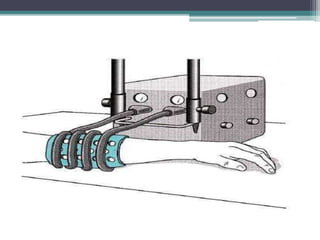
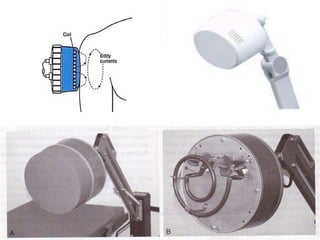
• Uses a long flexible, metal conductor, a thick wire covered in a
thick rubber insulator.
• Also uses monode, diplode, or drum depending on size,
shapes and numbers of coil and manufacturer.
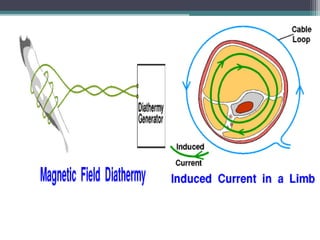
• In both the cases a coil is used to produce high frequency
alternating magnetic field.
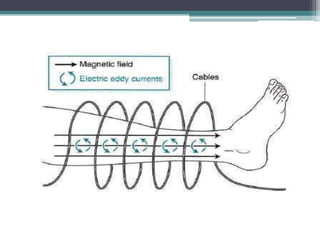
• AC Current flowing within the coil produces a magnetic field
perpendicular to coil.
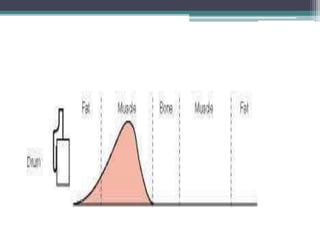
• Magnetic field produces eddy currents in the tissues. This
induced eddy current cause charged particles in the tissue to
oscillate and that produce heat in the tissue.
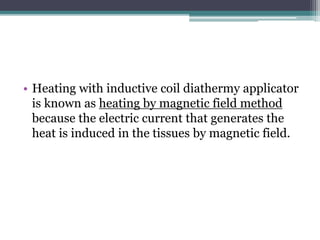
• Heating with inductive coil diathermy applicator
is known as heating by magnetic field method
because the electric current that generates the
heat is induced in the tissues by magnetic field.
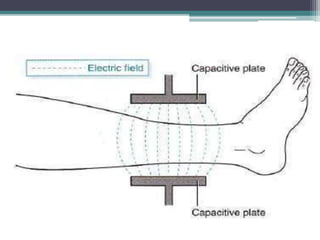
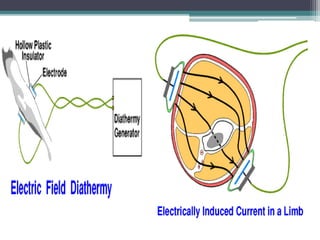
Capacitive Field Diathermy
• Uses capacitive plate diathermy applicators,which is
made of metal encased in plastic housing or transmissive
carbon rubber electrodes that are placed between felt
pads.
• A high frequency AC current flow from one plate to other
through the patient, producing an electric field and a
flow of current in body tissue that is between the plates.
• Also referred to as “condenser field diathermy”
TYPES OF ELECTRODES
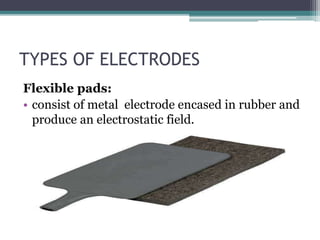
Flexible pads:
• consist of metal electrode encased in rubber and
produce an electrostatic field.
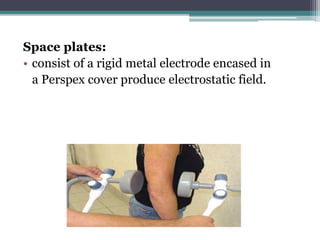
Space plates:
• consist of a rigid metal electrode encased in
a Perspex cover produce electrostatic field.
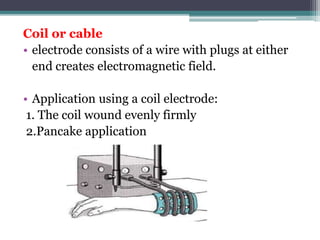
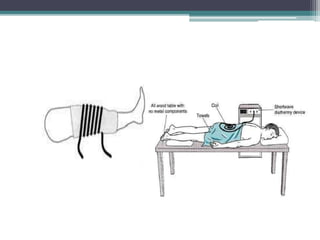
Coil or cable
• electrode consists of a wire with plugs at either
end creates electromagnetic field.
• Application using a coil electrode:
1. The coil wound evenly firmly
2.Pancake application
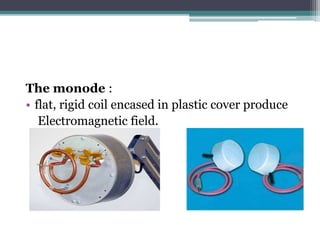
The monode :
• flat, rigid coil encased in plastic cover produce
Electromagnetic field.
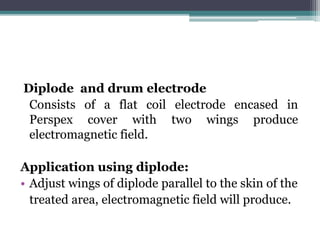
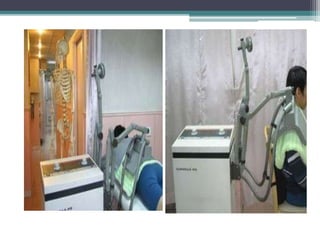
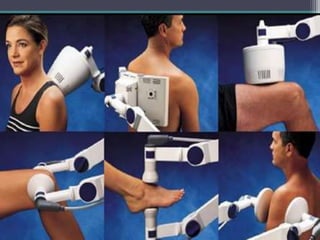
Diplode and drum electrode
Consists of a flat coil electrode encased in
Perspex cover with two wings produce
electromagnetic field.
Application using diplode:
• Adjust wings of diplode parallel to the skin of the
treated area, electromagnetic field will produce.
FACTORS INFLUENCE FIELD DISTRIBUTION IN
S.W.D( capacitor field method)
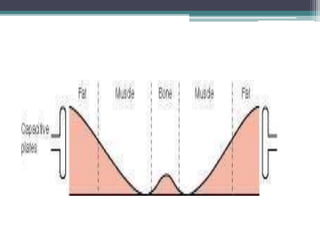
• Spacing :
allows the lines of force in the electrostatic field to
diverge before entering the tissues. This prevents
concentration of heat in the superficial tissues and
ensures more heating through the part.
• Spacing provided by:
1. wrapping flexible pads in towel.
2. flat felt spacing pads between pad
electrode and skin
3. air when using space plates.
• Normal spacing even field distribution.
• Increased spacing deep field concentration.
• Decreased spacing superficial concentration
• If the spacing is less than 25 mm more concentration
in the treat superficial tissue.
• If spacing Increases more depth achieved.
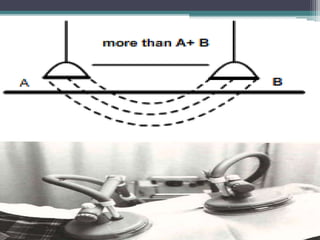
• The distance between adjacent ends must be greater
than the sum of skin electrode distance (A+B)
otherwise the line of force will pass directly between
Electrodes rather than tissues.
Electrode size:
• Guid lines for electrode selection &
placement:
1. Electrode should be of equal size
2. Electrode should be slightly larger than the
body part
3. Electrode should be equidistant & at right
angles to the skin surface.
• if the electrodes are too small than the diameter
of treated part line of force will be concentrated
superficially.
• If the electrodes are markedly larger the line of
force will be lost in the air.
• Ideally, the electrodes should be slightly larger
than the area treated.
• To concentrate heat on one aspect of the part the
electrode should be unequal in size. (smaller one placed
over the area where concentration of heat is required).
Or you can produce concentration of heat by using equal
size electrodes but with unequal spacing (25 mm over
concentrated area and more than 30 mm on other
electrode).
Distance from short wave machine-
• To restrict exposure it is recommended that
operator should remain 1 m from continuous
wave diathermy equipment,0.5 m from pulsed
treatment with capacitive electrode and 0.2 m
from pulsed inductive applicators.
Electrodes arrangements
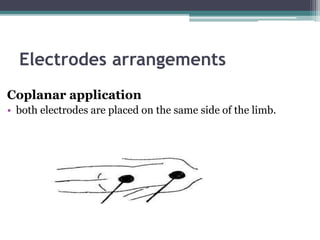
Coplanar application
• both electrodes are placed on the same side of the limb.
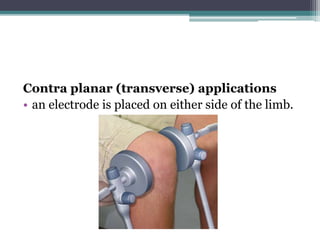
Contra planar (transverse) applications
• an electrode is placed on either side of the limb.
• Longitudinal application:
one electrode is placed at each end of the limb.
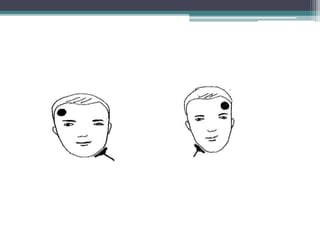
Cross-fire application:
• For the treatment of sinuses, space plates
positioned after half diagonally,of treatment
time the positions are alternate.
• this ensures that the all the sinses membranes
are heated.
• Care must be taken to avoid direct placement
over the eye ,uterine disorders such as
dysmenrrohea.
USES
• Musculoskeletal Disorders
• Degenerative Joint Disorders
Ex. OA and RA
• Sprain
• Strain
• Hematoma
• Muscle & tendon Tears
• Capsule Lesions
DANGERS
• Burns
• Concentration of electric field
• • Impaired blood flow
• Excess current
• Hypersensitive skin
• Leads touching skin
• Scalds
• Electric shock
• Overdose
• Precipitation of gangrene
• Faintness
• Giddiness
Contraindications
• Metal implants or metal jewelry (be aware of body
piercings)
• Cardiac pacemakers
• Ischemic areas
• Peripheral vascular disease
• Perspiration and moist dressings: The water collects
and concentrates the heat.
• • Tendency to hemorrhage, including menstruation.
• • Pregnancy
• • Fever
• Sensory loss
• Cancer
• Deep X ray
• Tumours
• Unreliable patients
• Areas of particular sensitivity:
• Epiphyseal plates in children
– The genitals
– Sites of infection
– The abdomen with an implanted intrauterine device
(IUD)
– The eyes and face
– Application through the skull
Treatment with Shot Wave Diathermy
on chronic low back pain
Protocol
• SWD was applied by Condenser technique. Condenser
pads were applied to the back with spacing between skin
and electrodes provided by 1 to 2 inch layers of terry
cloth. It was applied for 15 minutes three times in a week
for six weeks.
conclusions
• concluded that treatment with SWD may be benefited if
SWD is used as an adjunct to NSAID.
The interventions done included HVLAT and SWD on 15 subjects in
each group the subject received max of 9 treatment sessions, 3 times
per week for 3weeks for both the groups.
The outcome measures were VAS, ODI and ROM (flexion, extension).
The objective of the study was to see the effect of HVLAT and SWD on
outcome measures and compare them and Ergonomic advice being
common to both groups.
Concluded that high velocity low amplitude thrust manipulation
can be used in rehabilitation of chronic mechanical low back pain
patients.
• Comparison of Efficacy of SWD and
High Velocity Low Amplitude Thrust Manipulation (HVLATM
for management of chronic mechanical low back
pain
Effects Of 10 Minutes Short Wave
Diathermy (SWD) On Osteoarthritis (OA)
Knee; Compared To 20 Minutes Short Wave
Diathermy (SWD)
• General Objective:
To compare the effects of 10 minutes (experimental) over
20 minutes (control) SWD in treatment of OA knee by
using WOMAC.
• From analysis and examination the significant
improvement was found in the group of patients who
received 20 minutes SWD plus NSAIDs.So , it is almost
clear that , 20 minutes SWD is more effective then 10
minutes of SWD.
Thank you…………..

SHORT WAVE DIATHERMY (SWD)

  • 1.
    SHORTWAVE DIATHERMY Dr RanjanMishra(PT) AIIMS ,Patna
  • 2.
    Diathermy • Diathermy isthe application of Shortwave or microwave electromagnetic energy to produce heat and other physiological changes within the tissue • The term ‘diathermy’ means ‘through heating’ or producing deep heating directly in the tissues of the body. ‘ Dia’ through ‘thermy’ heat or temperature
  • 3.
    PRINCIPLE OF DIATHERMY •Before injury, the dipole molecules of the body tissue are arranged on the basis of polarity . • When the tissue is damaged the dipoles distribution become irregular and deviates from polarity based arrangement . • Under the influence of an electric field , they rotate according to the polarity of their charge in the direction of the field lines and get rearranged and tends to acquire its previous stage of polarity
  • 4.
    CHALLENGES OF DIATHERMY •As the subcutaneous layer is fatty , direct delivery of heat to the deep layers of tissue is not possible. • Diathermy involves uneven and uncontrolled delivery of heat therefore sometimes instead of the target tissue , surrounding tissue gets affected.
  • 5.
    • Diathermy useshigh frequency electric current to produce heat deep inside a targeted tissue. • It can reach areas as deep as two inches from the skin’s surface. • The diathermy machine does not apply heat directly to the body. • Instead, the current from the machine allows the body to generate heat from within the targeted tissue. • As the heat increases, it promotes blood flow. • It can also help improve flexibility in stiff joints and connective tissue.
  • 6.
    Effects of highfrequency currents on the tissue. • Vibrations of ion • Dipole rotation • Molecular distortation
  • 7.
    PHYSIOLOGICAL EFFECTS • Increasedmetabolism: • Increased blood supply: • General rise of temperature: • Fall in blood pressure: • Increased activity of sweat glands:
  • 8.
    Therapeutic effect 1.Increase bloodflow. 2. Help resolution of inflammation. 3. accelerate wound healing. 4. ↗ extensibility of deep collagen tissues. 5. ↘ joint stiffness. 6. Relief deep mus. Pain & spasm. ( via muscle spindle & Golgi tendon organ stimulation)
  • 9.
    BENEFITS OF DIATHERMY •Intense heat delivered provides pain relief and better flexibility • Reduces inflammation • Improves circulation • Accelerate healing
  • 10.
    TYPES OF DIATHERMY •SHORT WAVE DIATHERMY • LONGWAVE DIATHERMY • MICROWAVE DIATHERMY • ULTRASOUND DIATHERMY • LASER DIATHERMY
  • 11.
    SHORT WAVE DIATHERMY •Def.: SWD is a modality that produces deep heating via conversion of electromagnetic energy to thermal energy. • The pattern of heat produced depend on: Freq. used. type of SWD unit. water content of the tissues.
  • 12.
    • Shortwave diathermycurrent freq. 10 – 100 MHz (The shortest radiofrequency wave is used in therapeutic diathermy.) • the commonly used in medical work having freq. of 27.12 MHz with wavelength of 11 meters
  • 13.
    Modalities: Continuous and Pulsed(PSWD). • PSWD: application of series of short pulses of SWD so that short periods of SWD interrupted by gaps where there is no SWD. • The patient receives lower dose of SWD energy compared with continuous SWD applied of the same time and the tissues will receive lower thermal load.
  • 14.
    • Acute conditionshould be treated with low dose PSWD and chronic conditions should be treated with high dose SWD. • PSWD is usually applied for 30 to 60 minutes once or twice a day,5 to 7 times in a week. • SWD: produce both deep and superficial tissue heating, under certain controlled conditions. • Thermal level diathermy is generally applied for 20 minutes.
  • 15.
    Methods Of ApplyingSWD • Inductive method • Capacitive method
  • 16.
    Inductive method • Usesa long flexible, metal conductor, a thick wire covered in a thick rubber insulator. • Also uses monode, diplode, or drum depending on size, shapes and numbers of coil and manufacturer. • In both the cases a coil is used to produce high frequency alternating magnetic field. • AC Current flowing within the coil produces a magnetic field perpendicular to coil. • Magnetic field produces eddy currents in the tissues. This induced eddy current cause charged particles in the tissue to oscillate and that produce heat in the tissue.
  • 17.
    • Heating withinductive coil diathermy applicator is known as heating by magnetic field method because the electric current that generates the heat is induced in the tissues by magnetic field.
  • 23.
    Capacitive Field Diathermy •Uses capacitive plate diathermy applicators,which is made of metal encased in plastic housing or transmissive carbon rubber electrodes that are placed between felt pads. • A high frequency AC current flow from one plate to other through the patient, producing an electric field and a flow of current in body tissue that is between the plates. • Also referred to as “condenser field diathermy”
  • 27.
    TYPES OF ELECTRODES Flexiblepads: • consist of metal electrode encased in rubber and produce an electrostatic field.
  • 28.
    Space plates: • consistof a rigid metal electrode encased in a Perspex cover produce electrostatic field.
  • 29.
    Coil or cable •electrode consists of a wire with plugs at either end creates electromagnetic field. • Application using a coil electrode: 1. The coil wound evenly firmly 2.Pancake application
  • 31.
    The monode : •flat, rigid coil encased in plastic cover produce Electromagnetic field.
  • 32.
    Diplode and drumelectrode Consists of a flat coil electrode encased in Perspex cover with two wings produce electromagnetic field. Application using diplode: • Adjust wings of diplode parallel to the skin of the treated area, electromagnetic field will produce.
  • 35.
    FACTORS INFLUENCE FIELDDISTRIBUTION IN S.W.D( capacitor field method) • Spacing : allows the lines of force in the electrostatic field to diverge before entering the tissues. This prevents concentration of heat in the superficial tissues and ensures more heating through the part. • Spacing provided by: 1. wrapping flexible pads in towel. 2. flat felt spacing pads between pad electrode and skin 3. air when using space plates.
  • 36.
    • Normal spacingeven field distribution. • Increased spacing deep field concentration. • Decreased spacing superficial concentration • If the spacing is less than 25 mm more concentration in the treat superficial tissue. • If spacing Increases more depth achieved. • The distance between adjacent ends must be greater than the sum of skin electrode distance (A+B) otherwise the line of force will pass directly between Electrodes rather than tissues.
  • 38.
    Electrode size: • Guidlines for electrode selection & placement: 1. Electrode should be of equal size 2. Electrode should be slightly larger than the body part 3. Electrode should be equidistant & at right angles to the skin surface.
  • 39.
    • if theelectrodes are too small than the diameter of treated part line of force will be concentrated superficially. • If the electrodes are markedly larger the line of force will be lost in the air. • Ideally, the electrodes should be slightly larger than the area treated.
  • 40.
    • To concentrateheat on one aspect of the part the electrode should be unequal in size. (smaller one placed over the area where concentration of heat is required). Or you can produce concentration of heat by using equal size electrodes but with unequal spacing (25 mm over concentrated area and more than 30 mm on other electrode).
  • 41.
    Distance from shortwave machine- • To restrict exposure it is recommended that operator should remain 1 m from continuous wave diathermy equipment,0.5 m from pulsed treatment with capacitive electrode and 0.2 m from pulsed inductive applicators.
  • 42.
    Electrodes arrangements Coplanar application •both electrodes are placed on the same side of the limb.
  • 43.
    Contra planar (transverse)applications • an electrode is placed on either side of the limb.
  • 44.
    • Longitudinal application: oneelectrode is placed at each end of the limb.
  • 45.
    Cross-fire application: • Forthe treatment of sinuses, space plates positioned after half diagonally,of treatment time the positions are alternate. • this ensures that the all the sinses membranes are heated. • Care must be taken to avoid direct placement over the eye ,uterine disorders such as dysmenrrohea.
  • 47.
    USES • Musculoskeletal Disorders •Degenerative Joint Disorders Ex. OA and RA • Sprain • Strain • Hematoma • Muscle & tendon Tears • Capsule Lesions
  • 48.
    DANGERS • Burns • Concentrationof electric field • • Impaired blood flow • Excess current • Hypersensitive skin • Leads touching skin • Scalds • Electric shock • Overdose • Precipitation of gangrene • Faintness • Giddiness
  • 49.
    Contraindications • Metal implantsor metal jewelry (be aware of body piercings) • Cardiac pacemakers • Ischemic areas • Peripheral vascular disease • Perspiration and moist dressings: The water collects and concentrates the heat. • • Tendency to hemorrhage, including menstruation. • • Pregnancy • • Fever
  • 50.
    • Sensory loss •Cancer • Deep X ray • Tumours • Unreliable patients • Areas of particular sensitivity: • Epiphyseal plates in children – The genitals – Sites of infection – The abdomen with an implanted intrauterine device (IUD) – The eyes and face – Application through the skull
  • 51.
    Treatment with ShotWave Diathermy on chronic low back pain Protocol • SWD was applied by Condenser technique. Condenser pads were applied to the back with spacing between skin and electrodes provided by 1 to 2 inch layers of terry cloth. It was applied for 15 minutes three times in a week for six weeks. conclusions • concluded that treatment with SWD may be benefited if SWD is used as an adjunct to NSAID.
  • 52.
    The interventions doneincluded HVLAT and SWD on 15 subjects in each group the subject received max of 9 treatment sessions, 3 times per week for 3weeks for both the groups. The outcome measures were VAS, ODI and ROM (flexion, extension). The objective of the study was to see the effect of HVLAT and SWD on outcome measures and compare them and Ergonomic advice being common to both groups. Concluded that high velocity low amplitude thrust manipulation can be used in rehabilitation of chronic mechanical low back pain patients. • Comparison of Efficacy of SWD and High Velocity Low Amplitude Thrust Manipulation (HVLATM for management of chronic mechanical low back pain
  • 53.
    Effects Of 10Minutes Short Wave Diathermy (SWD) On Osteoarthritis (OA) Knee; Compared To 20 Minutes Short Wave Diathermy (SWD) • General Objective: To compare the effects of 10 minutes (experimental) over 20 minutes (control) SWD in treatment of OA knee by using WOMAC. • From analysis and examination the significant improvement was found in the group of patients who received 20 minutes SWD plus NSAIDs.So , it is almost clear that , 20 minutes SWD is more effective then 10 minutes of SWD.
  • 54.