Therapeutic Modalities.
Teona Shavshishvili
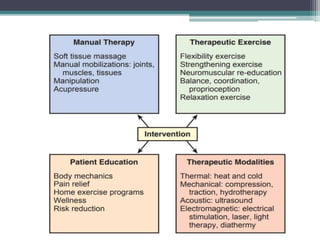
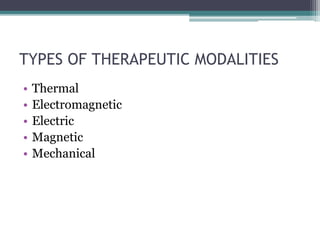
TYPES OF THERAPEUTIC MODALITIES
• Thermal
• Electromagnetic
• Electric
• Magnetic
• Mechanical
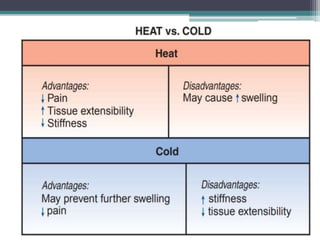
Thermal Modalities: Cold and Heat
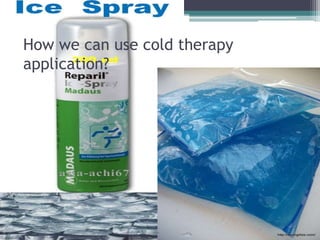
How we can use cold therapy
application?
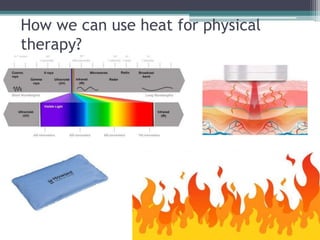
How we can use heat for physical
therapy?
Normal Stages, Phases, and Events of
Inflammation and Repair
• I Inflammatory
• II Proliferative
• III Maturation
Hemodynamic Effects
Peripheral Nerve Effects
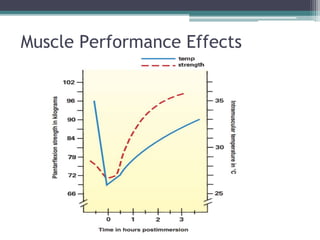
Muscle Performance Effects
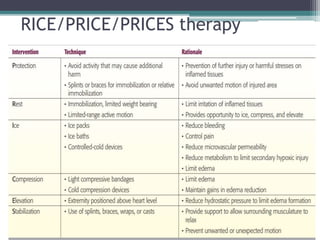
RICE/PRICE/PRICES therapy
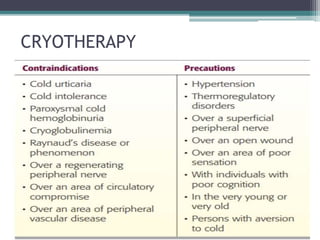
CRYOTHERAPY
BIOPHYSICAL EFFECTS OF
TEMPERATURE ELEVATION
• 1. Extent of the temperature increase
• 2. Rate at which energy is being added to the
tissue
• 3. Volume of tissue exposed
• 4. Composition of the absorbing tissue
• 5. Capacity of the tissue to dissipate heat (largely
a factor of blood supply)
CLINICAL APPLICATION: PRINCIPLES
AND INDICATIONS
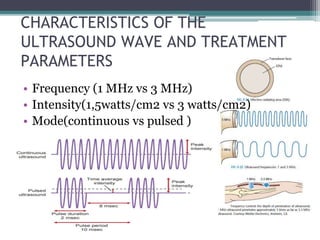
CHARACTERISTICS OF THE
ULTRASOUND WAVE AND TREATMENT
PARAMETERS
• Frequency (1 MHz vs 3 MHz)
• Intensity(1,5watts/cm2 vs 3 watts/cm2)
• Mode(continuous vs pulsed )
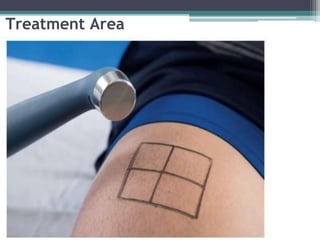
Treatment Area
Common Uses of Therapeutic
Ultrasound
• Soft tissue inflammation
• Tissue extensibility
• Scar tissue remodeling
• Tissue healing
• Pain
• Soft tissue swelling
• Meeting patient expectations
• Placebo effect
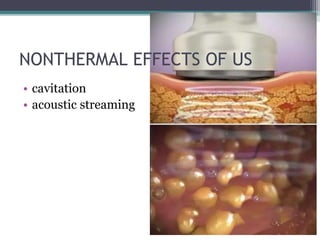
NONTHERMAL EFFECTS OF US
• cavitation
• acoustic streaming
Phonophoresis
• The effects of US to enhance the entry through skin of
a topical agent has been attributed to both physical
“pushing” of the agent through the skin and to an in-
crease in the permeability of the dermal layer
CONTRAINDICATIONS AND
PRECAUTIONS
• Pregnancy
• Active bone growth at the epiphysis
• Cancer
• Tuberculosis infection
• Hemorrhagic conditions
• Impaired circulation
• Myositis ossificans
• Deep vein thrombosis or thrombophlebitis
• Acute injury
• Recently irradiated tissue
• Impaired sensation
• Impaired cognition or communication
• Skin disease
• Reproductive organs
• Eyes
• Anterior neck—particularly over the carotid arteries, carotid sinus, and vagus and phrenic
nerves
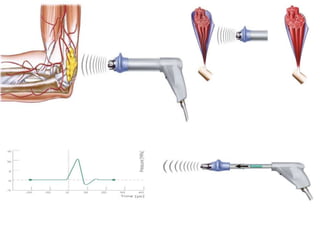
EXTRACORPOREAL
SHOCK WAVE THERAPY
• Chronic plantar fasciitis
• Calcific tendonitis of the rotator cuff in the shoulDer although
disintegration of calcium deposits may not correlate with
improvements in pain and function
• Lateral epicondylitis (“tennis elbow”)
• Achilles tendinopathy
• Chronic foot ulcers, either diabetic or nondiabetic
• Osteoarthritis of the knees
contraindications
• Bleeding conditions
• Pacemakers
• Medications that prolong blood clotting
• Children
• Pregnancy
• Acute injuries
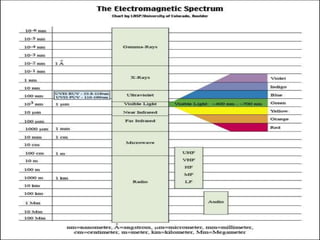
ELECTROMAGNETIC WAVES
• quantum energy
• Frequency
• wavelength
Waves of energy can be:
• reflected,
• Deflected and
• absorbed by the media through which they
travel.
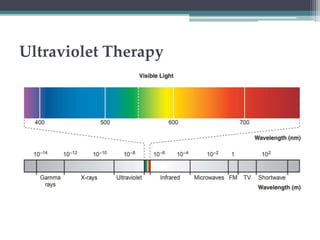
LIGHT THERAPY
• ultraviolet (UV) light
• light-emitting diode (LED)
• supraluminous light-emitting diode (SLED)
• laser
Ultraviolet Therapy
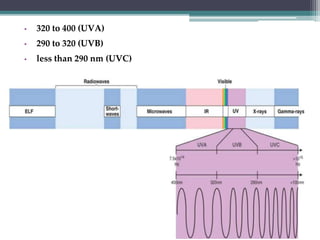
• 320 to 400 (UVA)
• 290 to 320 (UVB)
• less than 290 nm (UVC)
Effects of Ultraviolet
Radiation
• Erythema Production UVB and
UVA
• Tanning
• Epidermal Hyperplasia
• Vitamin D Synthesis
• Bactericidal Effects UVC
• Wound Healing UVC
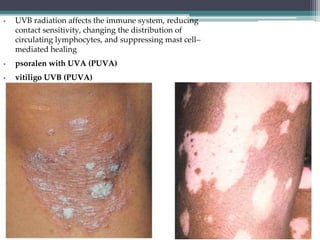
• UVB radiation affects the immune system, reducing
contact sensitivity, changing the distribution of
circulating lymphocytes, and suppressing mast cell–
mediated healing
• psoralen with UVA (PUVA)
• vitiligo UVB (PUVA)
Contraindications for Ultraviolet
Radiation
• • Irradiation of the eyes
• • Skin cancer
• • Pulmonary tuberculosis
• • Cardiac, kidney, or liver disease
• • Systemic lupus erythematosus
• • Fever
ALSO:
• Irradiation of the Eyes
• Certain Systemic Conditions
• Photosensitizing Medications and Dietary
• Supplements
• Photosensitivity
• Recent X-Ray Therapy
• Erythema From Prior Ultraviolet Dose
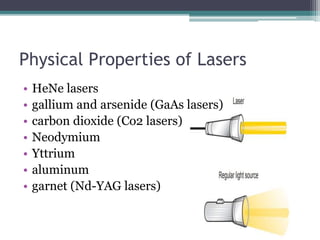
Physical Properties of Lasers
• HeNe lasers
• gallium and arsenide (GaAs lasers)
• carbon dioxide (Co2 lasers)
• Neodymium
• Yttrium
• aluminum
• garnet (Nd-YAG lasers)
Physiological Effects of Lasers
• Tissue Repair
• Control of inflammation
• Pain management
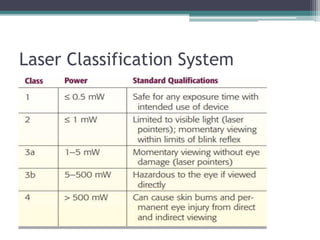
Laser Classification System
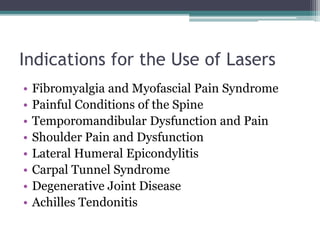
Indications for the Use of Lasers
• Fibromyalgia and Myofascial Pain Syndrome
• Painful Conditions of the Spine
• Temporomandibular Dysfunction and Pain
• Shoulder Pain and Dysfunction
• Lateral Humeral Epicondylitis
• Carpal Tunnel Syndrome
• Degenerative Joint Disease
• Achilles Tendonitis
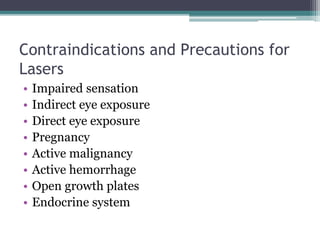
Contraindications and Precautions for
Lasers
• Impaired sensation
• Indirect eye exposure
• Direct eye exposure
• Pregnancy
• Active malignancy
• Active hemorrhage
• Open growth plates
• Endocrine system
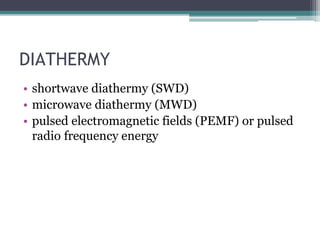
DIATHERMY
• shortwave diathermy (SWD)
• microwave diathermy (MWD)
• pulsed electromagnetic fields (PEMF) or pulsed
radio frequency energy
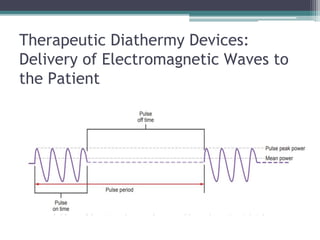
Therapeutic Diathermy Devices:
Delivery of Electromagnetic Waves to
the Patient
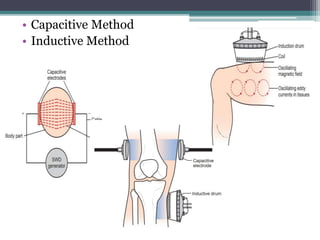
• Capacitive Method
• Inductive Method
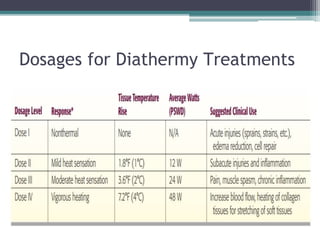
Dosages for Diathermy Treatments
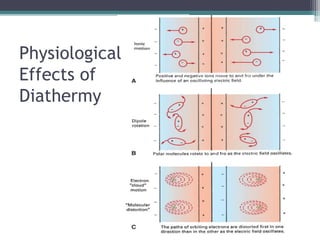
Physiological
Effects of
Diathermy
Precautions for Diathermy
• Small pieces of metal or metal fixation devices
(screws, plates, rods)
• imbedded in the body Intrauterine contraceptive
devices with copper Decreased sensation
• Impaired circulation
• Over growing epiphyses in children
• Obese patients
• Use of diathermy near other medical electrical
devices, especially near patients who have electrodes
attached to their skin Over the low back or pelvis in
women who are menstruating
• Atrophic, infected, or damaged skin
Contraindications for Diathermy
• Any metallic object on the patient or within the
electromagnetic field
• Any metals imbedded in the body
• Metal loops imbedded in the body
• Cancerous tissues
• Hemorrhage or increased tendency of hemorrhage
• Cardiac pacemakers, implanted stimulators, including any
device with lead wires attached or unattached
• Acute injury or inflammation
• Pregnancy
• Joints or organs containing high levels of fluid, including the
eyes or testes
• Synthetic materials such as clothing, pillows, and bed
coverings
Contraindications for Diathermy
• Head, face, or TMJ for patients wearing contact
lenses
• Unconscious patients or patients who are
mentally confused
• Over moist clothes, dressings, or accumulations
of perspiration on the skin
• Loss of sensation in area of body to be treated
Patients with severe circulatory impairment
(peripheral vascular disease, etc.)
PRINCIPLES OF ELECTRICITY
• Charge
• Polarity and Creation of Electric Force
Fields(cathode and anode)
• Conductors and Insulators
• Current
• Ohm’s Law: Resistance, Capacitance, and
Impedance
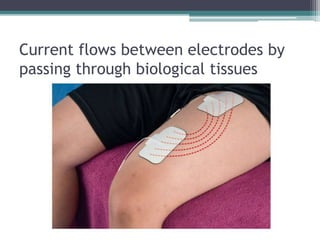
Current flows between electrodes by
passing through biological tissues
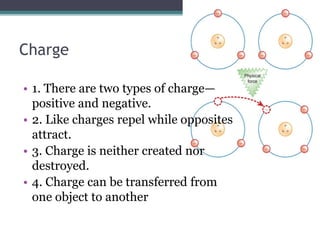
Charge
• 1. There are two types of charge—
positive and negative.
• 2. Like charges repel while opposites
attract.
• 3. Charge is neither created nor
destroyed.
• 4. Charge can be transferred from
one object to another
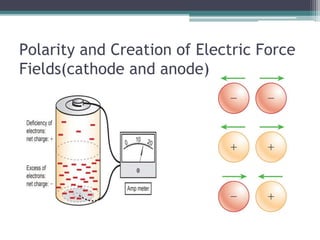
Polarity and Creation of Electric Force
Fields(cathode and anode)
Current ( I )
• The international unit for current is the ampere
(amp or A/mA)
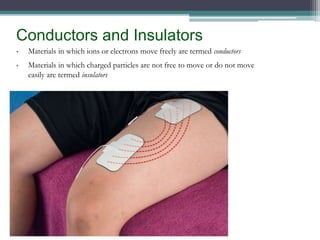
Conductors and Insulators
• Materials in which ions or electrons move freely are termed conductors
• Materials in which charged particles are not free to move or do not move
easily are termed insulators
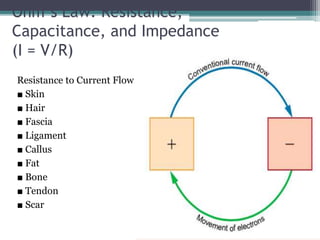
Ohm’s Law: Resistance,
Capacitance, and Impedance
(I = V/R)
Resistance to Current Flow
■ Skin
■ Hair
■ Fascia
■ Ligament
■ Callus
■ Fat
■ Bone
■ Tendon
■ Scar
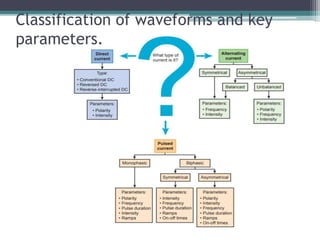
CURRENTS AND WAVEFORMS
• direct current (DC)
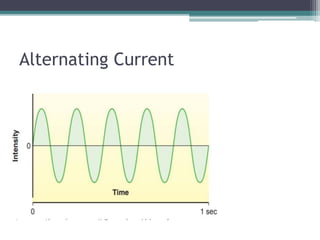
• alternating current (AC)
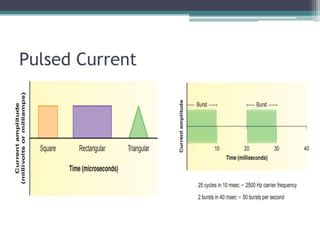
• pulsed current, or pulsatile current
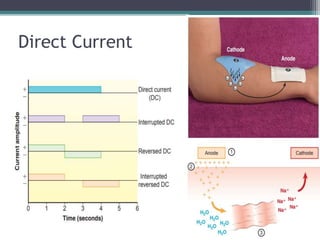
Direct Current
Alternating Current
Pulsed Current
Classification of waveforms and key
parameters.
PHYSIOLOGICAL RESPONSE TO
ELECTRICAL CURRENT
• Electrochemical Effects (anode attracts acid and
cathode attracts base)
• Electrothermal Effects
• Electrophysical Effects
Levels of Response to Electrical
Stimulation
• sensory
• Motor
• noxious
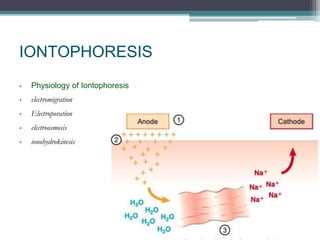
IONTOPHORESIS
• Physiology of Iontophoresis
• electromigration
• Electroporation
• electroosmosis
• ionohydrokinesis
Electrotherapy for Activation of
Skeletal Muscle
• Strengthening: Neuromuscular and muscular
Electrical Stimulation
• Reeducation and Retraining: Functional
Electrical Stimulation
Electrotherapy for pain modulation
Physical medicine and rehabilitation board review
Sara J. Cuccurullo Third edition.
PG. 621-639

Therapeutic Modalities copy 2.pptx.......

  • 1.
  • 3.
    TYPES OF THERAPEUTICMODALITIES • Thermal • Electromagnetic • Electric • Magnetic • Mechanical
  • 4.
  • 5.
    How we canuse cold therapy application?
  • 6.
    How we canuse heat for physical therapy?
  • 7.
    Normal Stages, Phases,and Events of Inflammation and Repair • I Inflammatory • II Proliferative • III Maturation
  • 8.
  • 9.
  • 10.
  • 11.
  • 12.
  • 13.
    BIOPHYSICAL EFFECTS OF TEMPERATUREELEVATION • 1. Extent of the temperature increase • 2. Rate at which energy is being added to the tissue • 3. Volume of tissue exposed • 4. Composition of the absorbing tissue • 5. Capacity of the tissue to dissipate heat (largely a factor of blood supply)
  • 14.
  • 17.
    CHARACTERISTICS OF THE ULTRASOUNDWAVE AND TREATMENT PARAMETERS • Frequency (1 MHz vs 3 MHz) • Intensity(1,5watts/cm2 vs 3 watts/cm2) • Mode(continuous vs pulsed )
  • 18.
  • 19.
    Common Uses ofTherapeutic Ultrasound • Soft tissue inflammation • Tissue extensibility • Scar tissue remodeling • Tissue healing • Pain • Soft tissue swelling • Meeting patient expectations • Placebo effect
  • 20.
    NONTHERMAL EFFECTS OFUS • cavitation • acoustic streaming
  • 21.
    Phonophoresis • The effectsof US to enhance the entry through skin of a topical agent has been attributed to both physical “pushing” of the agent through the skin and to an in- crease in the permeability of the dermal layer
  • 22.
    CONTRAINDICATIONS AND PRECAUTIONS • Pregnancy •Active bone growth at the epiphysis • Cancer • Tuberculosis infection • Hemorrhagic conditions • Impaired circulation • Myositis ossificans • Deep vein thrombosis or thrombophlebitis • Acute injury • Recently irradiated tissue • Impaired sensation • Impaired cognition or communication • Skin disease • Reproductive organs • Eyes • Anterior neck—particularly over the carotid arteries, carotid sinus, and vagus and phrenic nerves
  • 24.
    EXTRACORPOREAL SHOCK WAVE THERAPY •Chronic plantar fasciitis • Calcific tendonitis of the rotator cuff in the shoulDer although disintegration of calcium deposits may not correlate with improvements in pain and function • Lateral epicondylitis (“tennis elbow”) • Achilles tendinopathy • Chronic foot ulcers, either diabetic or nondiabetic • Osteoarthritis of the knees
  • 25.
    contraindications • Bleeding conditions •Pacemakers • Medications that prolong blood clotting • Children • Pregnancy • Acute injuries
  • 27.
    ELECTROMAGNETIC WAVES • quantumenergy • Frequency • wavelength
  • 28.
    Waves of energycan be: • reflected, • Deflected and • absorbed by the media through which they travel.
  • 29.
    LIGHT THERAPY • ultraviolet(UV) light • light-emitting diode (LED) • supraluminous light-emitting diode (SLED) • laser
  • 30.
  • 31.
    • 320 to400 (UVA) • 290 to 320 (UVB) • less than 290 nm (UVC)
  • 32.
    Effects of Ultraviolet Radiation •Erythema Production UVB and UVA • Tanning • Epidermal Hyperplasia • Vitamin D Synthesis • Bactericidal Effects UVC • Wound Healing UVC
  • 33.
    • UVB radiationaffects the immune system, reducing contact sensitivity, changing the distribution of circulating lymphocytes, and suppressing mast cell– mediated healing • psoralen with UVA (PUVA) • vitiligo UVB (PUVA)
  • 34.
    Contraindications for Ultraviolet Radiation •• Irradiation of the eyes • • Skin cancer • • Pulmonary tuberculosis • • Cardiac, kidney, or liver disease • • Systemic lupus erythematosus • • Fever
  • 35.
    ALSO: • Irradiation ofthe Eyes • Certain Systemic Conditions • Photosensitizing Medications and Dietary • Supplements • Photosensitivity • Recent X-Ray Therapy • Erythema From Prior Ultraviolet Dose
  • 36.
    Physical Properties ofLasers • HeNe lasers • gallium and arsenide (GaAs lasers) • carbon dioxide (Co2 lasers) • Neodymium • Yttrium • aluminum • garnet (Nd-YAG lasers)
  • 38.
    Physiological Effects ofLasers • Tissue Repair • Control of inflammation • Pain management
  • 39.
  • 40.
    Indications for theUse of Lasers • Fibromyalgia and Myofascial Pain Syndrome • Painful Conditions of the Spine • Temporomandibular Dysfunction and Pain • Shoulder Pain and Dysfunction • Lateral Humeral Epicondylitis • Carpal Tunnel Syndrome • Degenerative Joint Disease • Achilles Tendonitis
  • 41.
    Contraindications and Precautionsfor Lasers • Impaired sensation • Indirect eye exposure • Direct eye exposure • Pregnancy • Active malignancy • Active hemorrhage • Open growth plates • Endocrine system
  • 42.
    DIATHERMY • shortwave diathermy(SWD) • microwave diathermy (MWD) • pulsed electromagnetic fields (PEMF) or pulsed radio frequency energy
  • 43.
    Therapeutic Diathermy Devices: Deliveryof Electromagnetic Waves to the Patient
  • 44.
    • Capacitive Method •Inductive Method
  • 45.
  • 46.
  • 47.
    Precautions for Diathermy •Small pieces of metal or metal fixation devices (screws, plates, rods) • imbedded in the body Intrauterine contraceptive devices with copper Decreased sensation • Impaired circulation • Over growing epiphyses in children • Obese patients • Use of diathermy near other medical electrical devices, especially near patients who have electrodes attached to their skin Over the low back or pelvis in women who are menstruating • Atrophic, infected, or damaged skin
  • 48.
    Contraindications for Diathermy •Any metallic object on the patient or within the electromagnetic field • Any metals imbedded in the body • Metal loops imbedded in the body • Cancerous tissues • Hemorrhage or increased tendency of hemorrhage • Cardiac pacemakers, implanted stimulators, including any device with lead wires attached or unattached • Acute injury or inflammation • Pregnancy • Joints or organs containing high levels of fluid, including the eyes or testes • Synthetic materials such as clothing, pillows, and bed coverings
  • 49.
    Contraindications for Diathermy •Head, face, or TMJ for patients wearing contact lenses • Unconscious patients or patients who are mentally confused • Over moist clothes, dressings, or accumulations of perspiration on the skin • Loss of sensation in area of body to be treated Patients with severe circulatory impairment (peripheral vascular disease, etc.)
  • 50.
    PRINCIPLES OF ELECTRICITY •Charge • Polarity and Creation of Electric Force Fields(cathode and anode) • Conductors and Insulators • Current • Ohm’s Law: Resistance, Capacitance, and Impedance
  • 51.
    Current flows betweenelectrodes by passing through biological tissues
  • 52.
    Charge • 1. Thereare two types of charge— positive and negative. • 2. Like charges repel while opposites attract. • 3. Charge is neither created nor destroyed. • 4. Charge can be transferred from one object to another
  • 53.
    Polarity and Creationof Electric Force Fields(cathode and anode)
  • 54.
    Current ( I) • The international unit for current is the ampere (amp or A/mA)
  • 55.
    Conductors and Insulators •Materials in which ions or electrons move freely are termed conductors • Materials in which charged particles are not free to move or do not move easily are termed insulators
  • 56.
    Ohm’s Law: Resistance, Capacitance,and Impedance (I = V/R) Resistance to Current Flow ■ Skin ■ Hair ■ Fascia ■ Ligament ■ Callus ■ Fat ■ Bone ■ Tendon ■ Scar
  • 57.
    CURRENTS AND WAVEFORMS •direct current (DC) • alternating current (AC) • pulsed current, or pulsatile current
  • 58.
  • 59.
  • 60.
  • 61.
    Classification of waveformsand key parameters.
  • 62.
    PHYSIOLOGICAL RESPONSE TO ELECTRICALCURRENT • Electrochemical Effects (anode attracts acid and cathode attracts base) • Electrothermal Effects • Electrophysical Effects
  • 63.
    Levels of Responseto Electrical Stimulation • sensory • Motor • noxious
  • 64.
    IONTOPHORESIS • Physiology ofIontophoresis • electromigration • Electroporation • electroosmosis • ionohydrokinesis
  • 65.
    Electrotherapy for Activationof Skeletal Muscle • Strengthening: Neuromuscular and muscular Electrical Stimulation • Reeducation and Retraining: Functional Electrical Stimulation
  • 66.
  • 67.
    Physical medicine andrehabilitation board review Sara J. Cuccurullo Third edition. PG. 621-639