Presented by
Rasika.Walunj
Modern College Of Pharmacy (For Ladies),
Moshi, Pune. 412105.
Introduction of Ions Into The Body Using Direct
Electrical Current
Transports Ions Across A Membrane Or Into a
Tissue
Facilitated movement of ions across a skin
(membrane) under the influence of an externally
applied small electrical potential difference
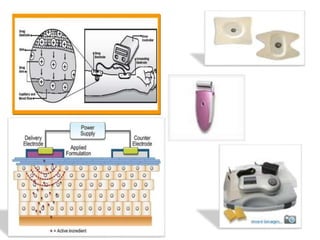
 The basic principle of Iontophoretic drug delivery is that
“like charges” repel “like charges” so the drug ions are
repelled or pushed into the underlying tissue.
 When direct (DC) current is applied to an ionized drug
solution, the ions that have the same charge as the
electrode are repelled by the electrode and are delivered
through the skin.
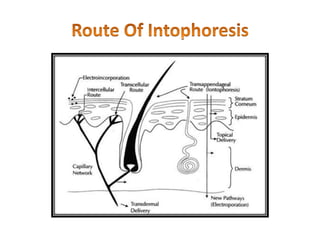
 Sweat ducts are primary paths by which ions move
through the skin
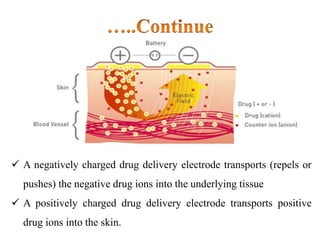
 A negatively charged drug delivery electrode transports (repels or
pushes) the negative drug ions into the underlying tissue
 A positively charged drug delivery electrode transports positive
drug ions into the skin.
 Transport of drugs across the skin involves either diffusion,
migration or electro osmosis.
 Electro osmosis is the bulk flow of fluid occurring in the
same direction as the flow of counter ions when a voltage
difference is applied across a charged, porous membrane.
 This flow involves motion of fluid without concentration
gradient and is a significant factor affecting iontophoresis
 Operational Factors : Biological Factors
 I. Composition of formulation:
 Concentration of drug solution
 pH of donor solution: determines the ionization of
peptides
 Ionic strength: increase in ionic strength will decrease
drug delivery, as extraneous ions compete with the drug
ions.
 Presence of co-ions: generally more mobile and smaller in size
than the drug ions itself and can dominate the penetration
 into the skin thereby causing a decrease in transdermal flux
 of the drug e.g. buffer
 II. Physicochemical properties of the permeant:
 Molecular size and weight: smaller ions are transported at a
faster rate than larger ions
 Polarity: the compounds which are hydrophilic are considered
ideal candidates for optimum flux
 Charge: the sign of the charge determines the mechanism by which
iontophoresis will proceed e.g., electro-repulsion or electro-
repulsion and electro-osmosis .
 The transport of cations has been shown to be better than anions for
amino acids and peptides ,an increase in charge will require pH to
be decreased, which in turn shall directly decrease the
electroosmosis and electrotransport process. An increased positive
charge on peptide, cause it to bind tightly to the membrane creating
a reservoir which in turn can decrease the rate at which the steady
state flux will be achieved
 Experimental conditions:
I. Current density
II. Current profile
III. Duration of treatment
IV. Electrode material
V. Polarity of electrodes
 Biological Factors
I. Intra and inter subject variability
II. Regional blood flow
III. Skin pH
IV. Condition of skin
1. Indicated to introduce ions into the body using direct current
follows faradays law of currant.
2. Advantages are it’s painless,
3. Sterile /noninvasive
4. For administration of charged drug
5. Better compliance
6. Small quantity of drug
7. Sports therapist /physiotherapist choice
1. Skin irritation
2. Some time problem of failure of battery
3. Electrode may fails due to corrosion
4. Selection of appropriate ion form drug
5. Not easy to use/Special direction and skilled person
6. Some problem of antigenisity/allergy.
7. Sensitivity to chemical environment
8. Itching
9. Skin pigmentation
10. Skin resistance is always less than
11. The initial value when current of 0.16ma Is applied for 10
sec.
1. Analgesia
2. Scar modification
3. Wound healing
4. Edema
5. Burns
6. Inflammatory MS conditions
7. CA++ deposits
8. Hyperhidrosis
9. M spasm
10. Fungi open skin lesions
11. Herpes
12. Gout
IONTOPHORESIS

IONTOPHORESIS

  • 1.
    Presented by Rasika.Walunj Modern CollegeOf Pharmacy (For Ladies), Moshi, Pune. 412105.
  • 2.
    Introduction of IonsInto The Body Using Direct Electrical Current Transports Ions Across A Membrane Or Into a Tissue Facilitated movement of ions across a skin (membrane) under the influence of an externally applied small electrical potential difference
  • 4.
     The basicprinciple of Iontophoretic drug delivery is that “like charges” repel “like charges” so the drug ions are repelled or pushed into the underlying tissue.  When direct (DC) current is applied to an ionized drug solution, the ions that have the same charge as the electrode are repelled by the electrode and are delivered through the skin.  Sweat ducts are primary paths by which ions move through the skin
  • 5.
     A negativelycharged drug delivery electrode transports (repels or pushes) the negative drug ions into the underlying tissue  A positively charged drug delivery electrode transports positive drug ions into the skin.
  • 6.
     Transport ofdrugs across the skin involves either diffusion, migration or electro osmosis.  Electro osmosis is the bulk flow of fluid occurring in the same direction as the flow of counter ions when a voltage difference is applied across a charged, porous membrane.  This flow involves motion of fluid without concentration gradient and is a significant factor affecting iontophoresis
  • 8.
     Operational Factors: Biological Factors  I. Composition of formulation:  Concentration of drug solution  pH of donor solution: determines the ionization of peptides  Ionic strength: increase in ionic strength will decrease drug delivery, as extraneous ions compete with the drug ions.
  • 9.
     Presence ofco-ions: generally more mobile and smaller in size than the drug ions itself and can dominate the penetration  into the skin thereby causing a decrease in transdermal flux  of the drug e.g. buffer  II. Physicochemical properties of the permeant:  Molecular size and weight: smaller ions are transported at a faster rate than larger ions  Polarity: the compounds which are hydrophilic are considered ideal candidates for optimum flux
  • 10.
     Charge: thesign of the charge determines the mechanism by which iontophoresis will proceed e.g., electro-repulsion or electro- repulsion and electro-osmosis .  The transport of cations has been shown to be better than anions for amino acids and peptides ,an increase in charge will require pH to be decreased, which in turn shall directly decrease the electroosmosis and electrotransport process. An increased positive charge on peptide, cause it to bind tightly to the membrane creating a reservoir which in turn can decrease the rate at which the steady state flux will be achieved
  • 11.
     Experimental conditions: I.Current density II. Current profile III. Duration of treatment IV. Electrode material V. Polarity of electrodes  Biological Factors I. Intra and inter subject variability II. Regional blood flow III. Skin pH IV. Condition of skin
  • 12.
    1. Indicated tointroduce ions into the body using direct current follows faradays law of currant. 2. Advantages are it’s painless, 3. Sterile /noninvasive 4. For administration of charged drug 5. Better compliance 6. Small quantity of drug 7. Sports therapist /physiotherapist choice
  • 13.
    1. Skin irritation 2.Some time problem of failure of battery 3. Electrode may fails due to corrosion 4. Selection of appropriate ion form drug 5. Not easy to use/Special direction and skilled person 6. Some problem of antigenisity/allergy. 7. Sensitivity to chemical environment 8. Itching 9. Skin pigmentation 10. Skin resistance is always less than 11. The initial value when current of 0.16ma Is applied for 10 sec.
  • 14.
    1. Analgesia 2. Scarmodification 3. Wound healing 4. Edema 5. Burns 6. Inflammatory MS conditions 7. CA++ deposits 8. Hyperhidrosis 9. M spasm 10. Fungi open skin lesions 11. Herpes 12. Gout