Refrigerants
Introduction
• The thermodynamic efficiency of a refrigeration system
depends mainly on its operating temperatures. However,
important practical issues such as the system design, size,
initial and operating costs, safety, reliability, and
serviceability etc. depend very much on the type of
refrigerant selected for a given application.
• Due to several environmental issues such as ozone layer
depletion and global warming and their relation to the various
refrigerants used, the selection of suitable refrigerant has
become one of the most important issues in recent times.
Primary and Secondary Refrigerants
• Primary refrigerants are those fluids, which are used directly as
working fluids, for example in vapour compression and vapour
absorption refrigeration systems. When used in compression or
absorption systems, these fluids provide refrigeration by
undergoing a phase change process in the evaporator.
• Classification of Primary Refrigerants
- Halocarbon compounds
- Azeotropes
- Hydrocarbons
- Inorganic compounds
- Unsaturated organic compounds
Continued
• Secondary refrigerants are those liquids, which are used for
transporting thermal energy from one location to other.
The commonly used secondary refrigerants are the solutions of
water and ethylene glycol, propylene glycol or calcium chloride.
These solutions are known under the general name of brines or
antifreezes (which reduces the freezing temp).
Refrigerant Selection Criteria
• Selection of refrigerant for a particular application is based on
the following requirements:
• Thermodynamic and physical properties
• Chemical properties
• Environmental and safety criteria
• Economic criteria
Thermodynamic & Physical Properties
• Suction pressure: At a given evaporator temperature, the
saturation pressure should be above atmospheric for
prevention of air or moisture entrance into the system and
ease of leak detection. Higher suction pressure is better as it
leads to smaller compressor displacement.
• Discharge pressure: At a given condenser temperature, the
discharge pressure should be as small as possible to allow
light-weight construction of compressor, condenser etc.
• Pressure ratio: Should be as small as possible for high
volumetric efficiency and low power consumption.
• Latent heat of vaporization: Should be as large as possible so
that the required mass flow rate per unit cooling capacity will
be smaller.
• Isentropic index of compression: Should be as small as possible so that
the temperature rise during compression will be small.
• Liquid specific heat: Should be small so that degree of subcooling will be
large.
• Vapour specific heat: Should be large so that the degree of superheating
will be small.
• Thermal conductivity: Thermal conductivity in both liquid as well as
vapour phase should be high for higher heat transfer coefficients.
• Freezing point: The freezing point of the refrigerant should be lower
than the lowest operating temperature of the cycle to prevent blockage
of refrigerant pipelines.
• Viscosity: Viscosity should be small in both liquid and vapour phases for
smaller frictional pressure drops.
• Dilelectric strength: This is an important property for systems using
hermetic compressors. For these systems the refrigerants should have as
high a dielectric strength as possible. High-dielectric strength prevents
current from traveling through the working fluid.
Chemical Properties
• Chemical stability: The refrigerants should be chemically stable as
long as they are inside the refrigeration system.
• Inert
• Compatibility with common materials of construction (both metals
and non-metals).
• Flammability : Should not have danger of explosion
Economic Criteria
• Cost of refrigerant : Should be cheap
• Availability and Supply : Should be available in abundance and also
it can be easily supplied
• Storage : Should be able to store in small pressure vessel as
possible.
• Handling facility : Should be conveniently handled during
transportation and charging .
Environmental and Safety Properties
At present the environment friendliness of the refrigerant is a major
factor in deciding the usefulness of a particular refrigerant.
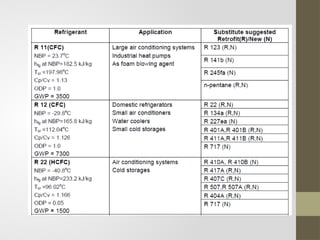
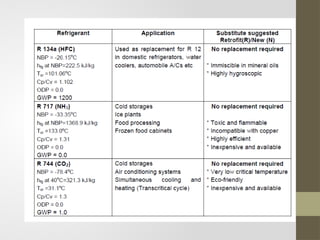
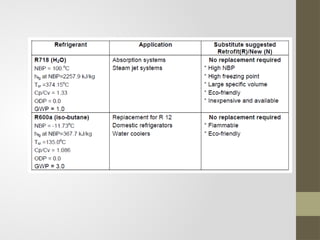
• Ozone Depletion Potential (ODP): According to the Montreal
protocol, the ODP of refrigerants should be zero, i.e., they should
be non-ozone depleting substances. Refrigerants having non-
zero ODP have either already been phased-out (e.g. R 11, R 12)
or will be phased-out in near-future(e.g. R22). Since ODP
depends mainly on the presence of chlorine or bromine in the
molecules, refrigerants having either chlorine (i.e., CFCs and
HCFCs) or bromine cannot be used under the new regulations
• Global Warming Potential (GWP): Refrigerants should have as
low a GWP value as possible to minimize the problem of global
warming. Refrigerants with zero ODP but a high value of GWP
(e.g. R134a) are likely to be regulated in future.
Ozone Depletion and Global warming
• An issue of growing concern for the present day environment is the
impact of the various refrigerants on the ozone depletion and global
warming of the environment. The main culprits in these cases are the
chlorine containing halogenated hydrocarbons, commonly known as
chlorofluorocarbons or CFC which are being used as refrigerants.
• The Earth’s atmosphere is made up of various layers. The layer just above
the Earth’s surface is known as the troposphere. The troposphere extends
up to 10 km from the surface. The ozone layer is just above the
troposphere and located in the stratosphere. The stratospheric ozone is
Earth’s natural protection to harmful ultraviolet (UV) radiation from the
sun. UV radiation is harmful to human, plant and animal life. The ozone
layer gets depleted by the action of these refrigerants.
• CFCs, when they are released from the surface of the Earth, rise slowly
into the stratosphere. Here they interacts with the incoming UV light from
the Sun, which releases the chlorine atoms from the parent compound. It
is this chlorine atom which reacts with the ozone molecules.
Safety Properties
• Smell : A refrigerant having smelling properties is better since its
leakage can be noticed/detected
• Ease of leak detection: In the event of leakage of refrigerant from
the system, it should be easy to detect the leaks.
• Non toxic
• Non- flammability
• Should not contribute global warming and deplete ozone layer
Designation of Refrigerants
• Since a large number of refrigerants have been developed
over the years for a wide variety of applications, a numbering
system has been adopted to designate various refrigerants.
From the number, one can get some useful information about
the type of refrigerant, its chemical composition, molecular
weight etc. All the refrigerants are designated by R followed by
a unique number.
Fully Saturated, Halogenated
Compounds
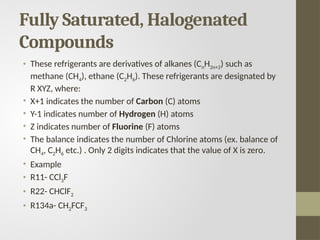
• These refrigerants are derivatives of alkanes (CnH2n+2) such as
methane (CH4), ethane (C2H6). These refrigerants are designated by
R XYZ, where:
• X+1 indicates the number of Carbon (C) atoms
• Y-1 indicates number of Hydrogen (H) atoms
• Z indicates number of Fluorine (F) atoms
• The balance indicates the number of Chlorine atoms (ex. balance of
CH4, C2H6 etc.) . Only 2 digits indicates that the value of X is zero.
• Example
• R11- CCl3F
• R22- CHClF2
• R134a- CH2FCF3
Inorganic Refrigerants
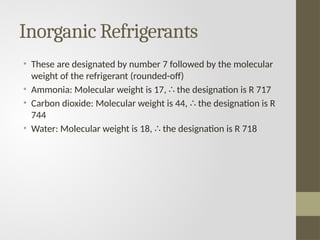
• These are designated by number 7 followed by the molecular
weight of the refrigerant (rounded-off)
• Ammonia: Molecular weight is 17, the designation is R 717
∴
• Carbon dioxide: Molecular weight is 44, the designation is R
∴
744
• Water: Molecular weight is 18, the designation is R 718
∴
Mixtures
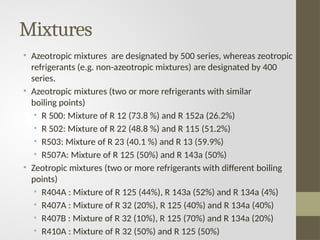
• Azeotropic mixtures are designated by 500 series, whereas zeotropic
refrigerants (e.g. non-azeotropic mixtures) are designated by 400
series.
• Azeotropic mixtures (two or more refrigerants with similar
boiling points)
• R 500: Mixture of R 12 (73.8 %) and R 152a (26.2%)
• R 502: Mixture of R 22 (48.8 %) and R 115 (51.2%)
• R503: Mixture of R 23 (40.1 %) and R 13 (59.9%)
• R507A: Mixture of R 125 (50%) and R 143a (50%)
• Zeotropic mixtures (two or more refrigerants with different boiling
points)
• R404A : Mixture of R 125 (44%), R 143a (52%) and R 134a (4%)
• R407A : Mixture of R 32 (20%), R 125 (40%) and R 134a (40%)
• R407B : Mixture of R 32 (10%), R 125 (70%) and R 134a (20%)
• R410A : Mixture of R 32 (50%) and R 125 (50%)
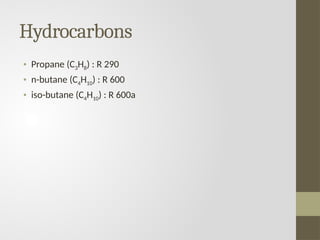
Hydrocarbons
• Propane (C3H8) : R 290
• n-butane (C4H10) : R 600
• iso-butane (C4H10) : R 600a
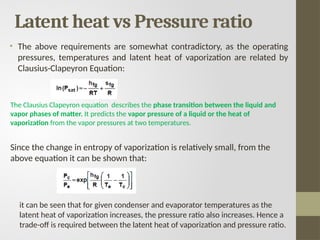
• The above requirements are somewhat contradictory, as the operating
pressures, temperatures and latent heat of vaporization are related by
Clausius-Clapeyron Equation:
The Clausius Clapeyron equation describes the phase transition between the liquid and
vapor phases of matter. It predicts the vapor pressure of a liquid or the heat of
vaporization from the vapor pressures at two temperatures.
Since the change in entropy of vaporization is relatively small, from the
above equation it can be shown that:
it can be seen that for given condenser and evaporator temperatures as the
latent heat of vaporization increases, the pressure ratio also increases. Hence a
trade-off is required between the latent heat of vaporization and pressure ratio.
Latent heat vs Pressure ratio
Thanks

Refrigerants_new.pptx refergeration and airconditioning

  • 1.
  • 2.
    Introduction • The thermodynamicefficiency of a refrigeration system depends mainly on its operating temperatures. However, important practical issues such as the system design, size, initial and operating costs, safety, reliability, and serviceability etc. depend very much on the type of refrigerant selected for a given application. • Due to several environmental issues such as ozone layer depletion and global warming and their relation to the various refrigerants used, the selection of suitable refrigerant has become one of the most important issues in recent times.
  • 3.
    Primary and SecondaryRefrigerants • Primary refrigerants are those fluids, which are used directly as working fluids, for example in vapour compression and vapour absorption refrigeration systems. When used in compression or absorption systems, these fluids provide refrigeration by undergoing a phase change process in the evaporator. • Classification of Primary Refrigerants - Halocarbon compounds - Azeotropes - Hydrocarbons - Inorganic compounds - Unsaturated organic compounds
  • 4.
    Continued • Secondary refrigerantsare those liquids, which are used for transporting thermal energy from one location to other. The commonly used secondary refrigerants are the solutions of water and ethylene glycol, propylene glycol or calcium chloride. These solutions are known under the general name of brines or antifreezes (which reduces the freezing temp).
  • 5.
    Refrigerant Selection Criteria •Selection of refrigerant for a particular application is based on the following requirements: • Thermodynamic and physical properties • Chemical properties • Environmental and safety criteria • Economic criteria
  • 6.
    Thermodynamic & PhysicalProperties • Suction pressure: At a given evaporator temperature, the saturation pressure should be above atmospheric for prevention of air or moisture entrance into the system and ease of leak detection. Higher suction pressure is better as it leads to smaller compressor displacement. • Discharge pressure: At a given condenser temperature, the discharge pressure should be as small as possible to allow light-weight construction of compressor, condenser etc. • Pressure ratio: Should be as small as possible for high volumetric efficiency and low power consumption. • Latent heat of vaporization: Should be as large as possible so that the required mass flow rate per unit cooling capacity will be smaller.
  • 7.
    • Isentropic indexof compression: Should be as small as possible so that the temperature rise during compression will be small. • Liquid specific heat: Should be small so that degree of subcooling will be large. • Vapour specific heat: Should be large so that the degree of superheating will be small. • Thermal conductivity: Thermal conductivity in both liquid as well as vapour phase should be high for higher heat transfer coefficients. • Freezing point: The freezing point of the refrigerant should be lower than the lowest operating temperature of the cycle to prevent blockage of refrigerant pipelines. • Viscosity: Viscosity should be small in both liquid and vapour phases for smaller frictional pressure drops. • Dilelectric strength: This is an important property for systems using hermetic compressors. For these systems the refrigerants should have as high a dielectric strength as possible. High-dielectric strength prevents current from traveling through the working fluid.
  • 8.
    Chemical Properties • Chemicalstability: The refrigerants should be chemically stable as long as they are inside the refrigeration system. • Inert • Compatibility with common materials of construction (both metals and non-metals). • Flammability : Should not have danger of explosion
  • 9.
    Economic Criteria • Costof refrigerant : Should be cheap • Availability and Supply : Should be available in abundance and also it can be easily supplied • Storage : Should be able to store in small pressure vessel as possible. • Handling facility : Should be conveniently handled during transportation and charging .
  • 10.
    Environmental and SafetyProperties At present the environment friendliness of the refrigerant is a major factor in deciding the usefulness of a particular refrigerant. • Ozone Depletion Potential (ODP): According to the Montreal protocol, the ODP of refrigerants should be zero, i.e., they should be non-ozone depleting substances. Refrigerants having non- zero ODP have either already been phased-out (e.g. R 11, R 12) or will be phased-out in near-future(e.g. R22). Since ODP depends mainly on the presence of chlorine or bromine in the molecules, refrigerants having either chlorine (i.e., CFCs and HCFCs) or bromine cannot be used under the new regulations • Global Warming Potential (GWP): Refrigerants should have as low a GWP value as possible to minimize the problem of global warming. Refrigerants with zero ODP but a high value of GWP (e.g. R134a) are likely to be regulated in future.
  • 11.
    Ozone Depletion andGlobal warming • An issue of growing concern for the present day environment is the impact of the various refrigerants on the ozone depletion and global warming of the environment. The main culprits in these cases are the chlorine containing halogenated hydrocarbons, commonly known as chlorofluorocarbons or CFC which are being used as refrigerants. • The Earth’s atmosphere is made up of various layers. The layer just above the Earth’s surface is known as the troposphere. The troposphere extends up to 10 km from the surface. The ozone layer is just above the troposphere and located in the stratosphere. The stratospheric ozone is Earth’s natural protection to harmful ultraviolet (UV) radiation from the sun. UV radiation is harmful to human, plant and animal life. The ozone layer gets depleted by the action of these refrigerants. • CFCs, when they are released from the surface of the Earth, rise slowly into the stratosphere. Here they interacts with the incoming UV light from the Sun, which releases the chlorine atoms from the parent compound. It is this chlorine atom which reacts with the ozone molecules.
  • 13.
    Safety Properties • Smell: A refrigerant having smelling properties is better since its leakage can be noticed/detected • Ease of leak detection: In the event of leakage of refrigerant from the system, it should be easy to detect the leaks. • Non toxic • Non- flammability • Should not contribute global warming and deplete ozone layer
  • 14.
    Designation of Refrigerants •Since a large number of refrigerants have been developed over the years for a wide variety of applications, a numbering system has been adopted to designate various refrigerants. From the number, one can get some useful information about the type of refrigerant, its chemical composition, molecular weight etc. All the refrigerants are designated by R followed by a unique number.
  • 15.
    Fully Saturated, Halogenated Compounds •These refrigerants are derivatives of alkanes (CnH2n+2) such as methane (CH4), ethane (C2H6). These refrigerants are designated by R XYZ, where: • X+1 indicates the number of Carbon (C) atoms • Y-1 indicates number of Hydrogen (H) atoms • Z indicates number of Fluorine (F) atoms • The balance indicates the number of Chlorine atoms (ex. balance of CH4, C2H6 etc.) . Only 2 digits indicates that the value of X is zero. • Example • R11- CCl3F • R22- CHClF2 • R134a- CH2FCF3
  • 16.
    Inorganic Refrigerants • Theseare designated by number 7 followed by the molecular weight of the refrigerant (rounded-off) • Ammonia: Molecular weight is 17, the designation is R 717 ∴ • Carbon dioxide: Molecular weight is 44, the designation is R ∴ 744 • Water: Molecular weight is 18, the designation is R 718 ∴
  • 17.
    Mixtures • Azeotropic mixturesare designated by 500 series, whereas zeotropic refrigerants (e.g. non-azeotropic mixtures) are designated by 400 series. • Azeotropic mixtures (two or more refrigerants with similar boiling points) • R 500: Mixture of R 12 (73.8 %) and R 152a (26.2%) • R 502: Mixture of R 22 (48.8 %) and R 115 (51.2%) • R503: Mixture of R 23 (40.1 %) and R 13 (59.9%) • R507A: Mixture of R 125 (50%) and R 143a (50%) • Zeotropic mixtures (two or more refrigerants with different boiling points) • R404A : Mixture of R 125 (44%), R 143a (52%) and R 134a (4%) • R407A : Mixture of R 32 (20%), R 125 (40%) and R 134a (40%) • R407B : Mixture of R 32 (10%), R 125 (70%) and R 134a (20%) • R410A : Mixture of R 32 (50%) and R 125 (50%)
  • 18.
    Hydrocarbons • Propane (C3H8): R 290 • n-butane (C4H10) : R 600 • iso-butane (C4H10) : R 600a
  • 22.
    • The aboverequirements are somewhat contradictory, as the operating pressures, temperatures and latent heat of vaporization are related by Clausius-Clapeyron Equation: The Clausius Clapeyron equation describes the phase transition between the liquid and vapor phases of matter. It predicts the vapor pressure of a liquid or the heat of vaporization from the vapor pressures at two temperatures. Since the change in entropy of vaporization is relatively small, from the above equation it can be shown that: it can be seen that for given condenser and evaporator temperatures as the latent heat of vaporization increases, the pressure ratio also increases. Hence a trade-off is required between the latent heat of vaporization and pressure ratio. Latent heat vs Pressure ratio
  • 23.

Editor's Notes

  • #22 Clausius-Clapeyron equation describes the phase transition between two phases of matter that have the same composition. This equation is used to estimate vapor pressure as a function of temperature or to find the heat of the phase transition from the vapor pressures at two temperatures. When graphed, the relationship between temperature and pressure of a liquid is a curve rather than a straight line. In the case of water, for example, vapor pressure increases much faster than temperature. The Clausius-Clapeyron equation gives the slope of the tangents to the curve.