MAULANA AZAD NATIONAL INSTITUTE OF TECHNOLOGY,
BHOPAL
AN INSTITUTE OF NATIONAL IMPORTANCE
PEDAL POWERED REFRIGERATION SYSTEM BASED ON
ZEOLITE ADSORPTION PHENOMENA
Team Number – T17
Team Members
(B.Tech. VIth Sem, Mechanical - 1)
1. Nishant Prakash (141116083)
2. Shubham Shukla (141116101)
3. Abhishek Raj (141116089)
4. Pramod Kumar (141116063)
Team Guide :-
Dr. Manoj Arya
Assistant Professor, Department of Mechanical Engineering,
MANIT, Bhopal, (M.P.)
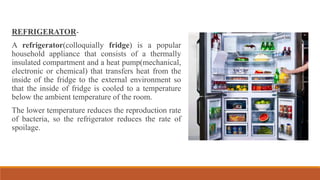
REFRIGERATOR-
A refrigerator(colloquially fridge) is a popular
household appliance that consists of a thermally
insulated compartment and a heat pump(mechanical,
electronic or chemical) that transfers heat from the
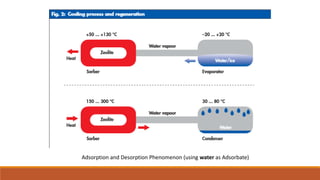
inside of the fridge to the external environment so
that the inside of fridge is cooled to a temperature
below the ambient temperature of the room.
The lower temperature reduces the reproduction rate
of bacteria, so the refrigerator reduces the rate of
spoilage.
Terms Used
Zeolite : These are microporous, aluminosilicate minerals commonly used as commercial adsorbents and catalysts.
These occur naturally but are also produced industrially on a large scale. Eg., Na2Al2Si3O10.2H2O , The formula for
Natrolite.
Adsorption : Adsorption is the adhesion of atoms, ions, or dissolved solid to a surface. This process creates a film
of the Adsorbate on the surface of adsorbent. It is a surface based process. It is driven by cohesive forces such as
Van-der-wall forces, hydrogen bonding, electrostatic forces, etc. There are two types of Adsorption processes-
1. Physical Adsorption - It is a process in which the electronic structure of the atom or molecule is barely
perturbed upon adsorption. In physical adsorption, the individuality of the adsorbate and the adsorbent are
preserved.
2. Chemical Adsorption - Chemisorption is a kind of adsorption which involves a chemical reaction between the
surface and the adsorbate. New chemical bonds are generated at the adsorbant surface.
Adsorption is nearly always an exothermic process.
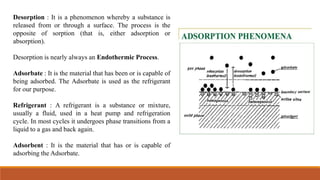
Desorption : It is a phenomenon whereby a substance is
released from or through a surface. The process is the
opposite of sorption (that is, either adsorption or
absorption).
Desorption is nearly always an Endothermic Process.
Adsorbate : It is the material that has been or is capable of
being adsorbed. The Adsorbate is used as the refrigerant
for our purpose.
Refrigerant : A refrigerant is a substance or mixture,
usually a fluid, used in a heat pump and refrigeration
cycle. In most cycles it undergoes phase transitions from a
liquid to a gas and back again.
Adsorbent : It is the material that has or is capable of
adsorbing the Adsorbate.
Drawbacks of the conventional Refrigeration Systems :
This system is popular and advantageous due to its high coefficient of performance, small
size and low weight but the system comes with certain disadvantages :-
1. High Energy consumption as the compressor compresses the vapour in the cycle.
2. Dependency on the power grid.
3. The refrigerant used in such systems have chlorofluorocarbon (CFC), Hydro
chlorofluorocarbon (HCFC) which in turn lead to global warming and Ozone Layer
Depletion.
FACT : According to the latest NASA investigation, the holes in the ozonosphere
over the two poles currently occupy approximately 28,300,000 km2, up from
approximately 24,000,000 km2 in 1994.
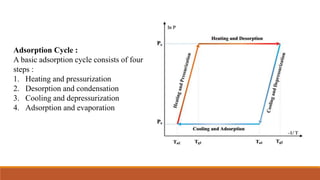
Adsorption Cycle :
A basic adsorption cycle consists of four
steps :
1. Heating and pressurization
2. Desorption and condensation
3. Cooling and depressurization
4. Adsorption and evaporation
Refrigerants and Adsorbents :
There are several combinations of Refrigerants and Adsorbents available and each
possess certain merits and demerits thus resulting in varying performances. The proper
selection depends on -
• The desired characteristics of refrigeration system.
• Properties of the adsorbent/adsorbate pair
• Temperature of heat source
• Cost
• Availability and environmental impact.
Choice of adsorbent :
While selecting adsorbent, the most important features that must be taken care of
are :
1. High adsorption and desorption capacity thus improving cooling characteristics.
2. Low specific heat
3. Good thermal conductivity, to shorten cycle time
4. Nontoxic and non-corrosive
5. Chemically and physically compatible with chosen refrigerant
6. Must be cost effective and should be available in plenty.
The most commonly used adsorbents are activated carbon, zeolite and silica gel.
Among these, silica gel satisfies most of the criteria listed above but it is expensive
and is not easily available.
Choice of Refrigerant:
The refrigerants must satisfy the following requisites for an effective performance :
1. For better adsorption, molecular size should be small.
2. High latent heat per unit volume.
3. High thermal conductivity.
4. Good thermal stability.
5. Low viscosity.
6. Low toxicity and must not be flammable and corrosive.
7. Must be environment friendly.
Among several available refrigerants the most promising one are ammonia,
methanol, water which have relatively high latent heat values and also presents good
performances. Among these ammonia is a bit capricious due to its flammable and
corrosive nature.
The most commonly used pairs are zeolite- water, zeolite-methanol, silica gel-
water, carbon – methanol and activated carbon – ammonia.
Zeolite-methanol/water is good for cooling and overcoming environmental
problems related to vapor compression refrigeration systems because they have
zero ozone layer depletion potential and no global warming potential. Also
zeolite crystals are eternal i.e. they can undergo infinite adsorption-desorption
cycles.
REFRIGERATION APPARATUS :
The refrigeration apparatus consists of two chambers, a pressure gauge, a refrigerating
chamber, a vacuum pump (which is run by pedaling), valves and connecting pipes.
 One of the chambers consists of Adsorbent bed. This is also known as the Adsorber. It
adsorbs the vapor coming from the evaporator chamber.
 The other chamber contains the Adsorbate. It consists of the evaporator chamber
(during the adsorption stage) and the condenser (during the desorption stage).
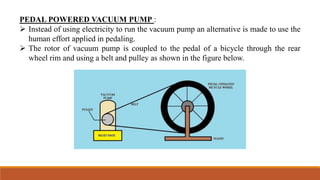
PEDAL POWERED VACUUM PUMP :
 Instead of using electricity to run the vacuum pump an alternative is made to use the
human effort applied in pedaling.
 The rotor of vacuum pump is coupled to the pedal of a bicycle through the rear
wheel rim and using a belt and pulley as shown in the figure below.
Refrigerator Body :
The Refrigerator body is a thermally insulated compartment. The Adsorbate
cylinder/chamber is placed inside the refrigerator body. The evaporator is located at the
top inside the cooling chamber. Warmer air around the evaporator stays in this upper
region. The air only cools down in the cooling phase, when it falls to the bottom of the
cooling chamber.
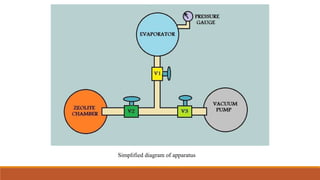
Simplified diagram of apparatus
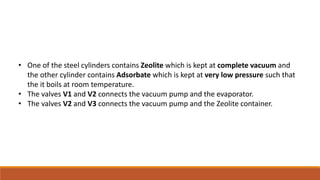
• One of the steel cylinders contains Zeolite which is kept at complete vacuum and
the other cylinder contains Adsorbate which is kept at very low pressure such that
the it boils at room temperature.
• The valves V1 and V2 connects the vacuum pump and the evaporator.
• The valves V2 and V3 connects the vacuum pump and the Zeolite container.
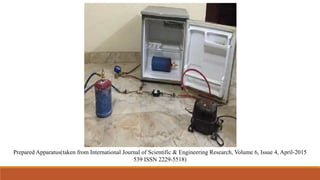
Prepared Apparatus(taken from International Journal of Scientific & Engineering Research, Volume 6, Issue 4, April-2015
539 ISSN 2229-5518)
Working of the Refrigeration Apparatus :
The system operates in two stages-
1. The Adsorption Stage : In the adsorption process, the valves V2 and V3 are opened,
and the vacuum pump is used to extract all the air from the Zeolite cylinder and create
complete vacuum inside it. The valve V2 is then closed and the evaporator is then
connected to the vacuum pump by opening valves V1 and V3. The pressure inside the
evaporator is lowered such that Adsorbate starts boiling at room temperature. The
valve V3 is then closed and the Zeolite chamber and evaporator are connected by
opening the valves V1 and V2.
• As soon as the pressure reaches a certain value, the Adsorbate present in the
Evaporator starts to get converted into vapor.
• This latent heat of vaporization is obtained from the refrigerating chamber.
• The surface molecules take up this heat and leave the bulk as vapour. As a result
of heat loss from the refrigerating chamber, its temperature starts to fall.
• Thus, a refrigeration effect is observed.
• After some time, the Zeolite becomes saturated.
• The adsorbent (Zeolite) starts adsorbing the vapor from the evaporator.
• Heat is released due to adsorption, hence the temperature of the Zeolite starts
increasing while the temperature of the refrigerating chamber goes on decreasing
thus a cooling effect is produced.
• In general, one can achieve constant temperatures of 0-6 Celsius for 1 day with
only 10min of pedaling.
2. The Desorption Stage : As soon as the Zeolite becomes saturated and is
incapable of adsorbing more adsorbate, the Zeolite container is heated such
that the Zeolite loses adsorbate and it gets collected in the condenser. The heat
may be provided by using Solar energy making it completely eco-friendly and
very less dependent on electricity.
Regeneration of zeolite occurs by heating the zeolite container opening the valves
V1 and V2 such that the water lost by the zeolite reaches back to the condenser.
Adsorption and Desorption Phenomenon (using water as Adsorbate)
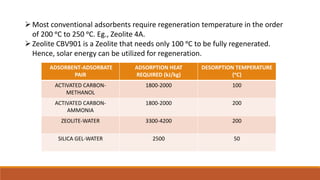
Most conventional adsorbents require regeneration temperature in the order
of 200 ᵒC to 250 ᵒC. Eg., Zeolite 4A.
Zeolite CBV901 is a Zeolite that needs only 100 ᵒC to be fully regenerated.
Hence, solar energy can be utilized for regeneration.
ADSORBENT-ADSORBATE
PAIR
ADSORPTION HEAT
REQUIRED (kJ/kg)
DESORPTION TEMPERATURE
(ᵒC)
ACTIVATED CARBON-
METHANOL
1800-2000 100
ACTIVATED CARBON-
AMMONIA
1800-2000 200
ZEOLITE-WATER 3300-4200 200
SILICA GEL-WATER 2500 50
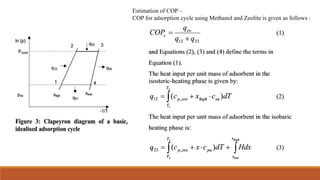
Estimation of COP –
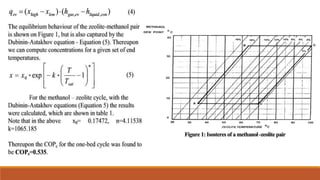
COP for adsorption cycle using Methanol and Zeolite is given as follows :
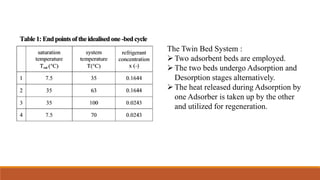
The Twin Bed System :
Two adsorbent beds are employed.
The two beds undergo Adsorption and
Desorption stages alternatively.
The heat released during Adsorption by
one Adsorber is taken up by the other
and utilized for regeneration.

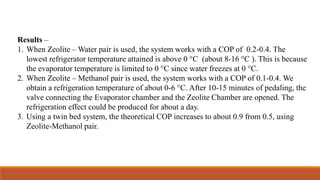
Results –
1. When Zeolite – Water pair is used, the system works with a COP of 0.2-0.4. The
lowest refrigerator temperature attained is above 0 °C (about 8-16 °C ). This is because
the evaporator temperature is limited to 0 °C since water freezes at 0 °C.
2. When Zeolite – Methanol pair is used, the system works with a COP of 0.1-0.4. We
obtain a refrigeration temperature of about 0-6 °C. After 10-15 minutes of pedaling, the
valve connecting the Evaporator chamber and the Zeolite Chamber are opened. The
refrigeration effect could be produced for about a day.
3. Using a twin bed system, the theoretical COP increases to about 0.9 from 0.5, using
Zeolite-Methanol pair.
Advantages of Zeolite Adsorption Refrigeration Systems :
1. The risk of global warming and ozone depletion is completely eliminated. Unlike
conventional Refrigerators, these do not use CFCs and HCFCs as refrigerants
which contribute to global warming and ozone depletion.
2. This offers increased mobility and independency from power grid(using solar
energy for regeneration).
3. Reduced Cost – Low initial cost as well as zero running cost.
4. Inexpensive and easy to manufacture, since simple equipments and components
are used.
Applications of Zeolite Adsorption Refrigeration systems :
1. Can be used in rural areas where Electricity Supply is scarce or not available.
2. Can be used in the medical field for storage of vaccines and medicines.
3. Can be used by mobile ice-cream sellers instead of conventional ice-boxes they
use.
4. This technology suits for the transport of food and other perishables.
5. Can be coupled with crankshaft of cars and the required heat for regeneration can
be obtained from the exhaust gases of the IC engine.
References :
1. International Journal for Research in Applied Science and Engineering, “Pedal
Powered Refrigerator”, Volume 4 Issue VI, June 2016 IC Value: 13.98, ISSN: 2321-
9653.
2. International Journal of Scientific & Engineering Research, “Zeolite-Water
Adsorption Refrigeration System, Volume 6, Issue 4, April-2015 537 ISSN 2229-
5518.
3. Pelagia Research Library, Advances in Applied Science Research, 2012, 3 (6):3737-
3745, “Performance of a zeolite – water adsorption refrigerator”, *N. O. Omisanya,
C. O. Folayan, S. Y. Aku and S. S. Adefila..
4. Renewable and Sustainable Energy Reviews, “Adsorption refrigeration technology
– An overview of theory and its solar energy applications”(September, 2015),
Parash Goyal, Prashant Baredar, Arvind Mittal, Ameenur. R. Siddiqui, Energy
Department, Maulana Azad National Institute of Technology, Bhopal, India.
References(continued) :
5. www.wikipedia.org/wiki/Refrigerator
6. www.bine.info/Publications/Projektinfo
7. http://www.learnengineering.org/2014/04/working-of-Refrigerator.html
8. Belgenin KisaAdresi, “A review Adsorption working pair for refrigeration
Elsevier”, 2010
9. http://web.mit.edu/2.972/www/reports/compression_refrigeration_system/compres
sion_refrigeration_system.html
10. Understanding Pedal Power on www.autonopedia.org 09 oct. 2014
Pedal powered refrigerator

Pedal powered refrigerator

  • 1.
    MAULANA AZAD NATIONALINSTITUTE OF TECHNOLOGY, BHOPAL AN INSTITUTE OF NATIONAL IMPORTANCE
  • 2.
    PEDAL POWERED REFRIGERATIONSYSTEM BASED ON ZEOLITE ADSORPTION PHENOMENA Team Number – T17 Team Members (B.Tech. VIth Sem, Mechanical - 1) 1. Nishant Prakash (141116083) 2. Shubham Shukla (141116101) 3. Abhishek Raj (141116089) 4. Pramod Kumar (141116063) Team Guide :- Dr. Manoj Arya Assistant Professor, Department of Mechanical Engineering, MANIT, Bhopal, (M.P.)
  • 3.
    REFRIGERATOR- A refrigerator(colloquially fridge)is a popular household appliance that consists of a thermally insulated compartment and a heat pump(mechanical, electronic or chemical) that transfers heat from the inside of the fridge to the external environment so that the inside of fridge is cooled to a temperature below the ambient temperature of the room. The lower temperature reduces the reproduction rate of bacteria, so the refrigerator reduces the rate of spoilage.
  • 4.
    Terms Used Zeolite :These are microporous, aluminosilicate minerals commonly used as commercial adsorbents and catalysts. These occur naturally but are also produced industrially on a large scale. Eg., Na2Al2Si3O10.2H2O , The formula for Natrolite. Adsorption : Adsorption is the adhesion of atoms, ions, or dissolved solid to a surface. This process creates a film of the Adsorbate on the surface of adsorbent. It is a surface based process. It is driven by cohesive forces such as Van-der-wall forces, hydrogen bonding, electrostatic forces, etc. There are two types of Adsorption processes- 1. Physical Adsorption - It is a process in which the electronic structure of the atom or molecule is barely perturbed upon adsorption. In physical adsorption, the individuality of the adsorbate and the adsorbent are preserved. 2. Chemical Adsorption - Chemisorption is a kind of adsorption which involves a chemical reaction between the surface and the adsorbate. New chemical bonds are generated at the adsorbant surface. Adsorption is nearly always an exothermic process.
  • 5.
    Desorption : Itis a phenomenon whereby a substance is released from or through a surface. The process is the opposite of sorption (that is, either adsorption or absorption). Desorption is nearly always an Endothermic Process. Adsorbate : It is the material that has been or is capable of being adsorbed. The Adsorbate is used as the refrigerant for our purpose. Refrigerant : A refrigerant is a substance or mixture, usually a fluid, used in a heat pump and refrigeration cycle. In most cycles it undergoes phase transitions from a liquid to a gas and back again. Adsorbent : It is the material that has or is capable of adsorbing the Adsorbate.
  • 6.
    Drawbacks of theconventional Refrigeration Systems : This system is popular and advantageous due to its high coefficient of performance, small size and low weight but the system comes with certain disadvantages :- 1. High Energy consumption as the compressor compresses the vapour in the cycle. 2. Dependency on the power grid. 3. The refrigerant used in such systems have chlorofluorocarbon (CFC), Hydro chlorofluorocarbon (HCFC) which in turn lead to global warming and Ozone Layer Depletion. FACT : According to the latest NASA investigation, the holes in the ozonosphere over the two poles currently occupy approximately 28,300,000 km2, up from approximately 24,000,000 km2 in 1994.
  • 7.
    Adsorption Cycle : Abasic adsorption cycle consists of four steps : 1. Heating and pressurization 2. Desorption and condensation 3. Cooling and depressurization 4. Adsorption and evaporation
  • 8.
    Refrigerants and Adsorbents: There are several combinations of Refrigerants and Adsorbents available and each possess certain merits and demerits thus resulting in varying performances. The proper selection depends on - • The desired characteristics of refrigeration system. • Properties of the adsorbent/adsorbate pair • Temperature of heat source • Cost • Availability and environmental impact.
  • 9.
    Choice of adsorbent: While selecting adsorbent, the most important features that must be taken care of are : 1. High adsorption and desorption capacity thus improving cooling characteristics. 2. Low specific heat 3. Good thermal conductivity, to shorten cycle time 4. Nontoxic and non-corrosive 5. Chemically and physically compatible with chosen refrigerant 6. Must be cost effective and should be available in plenty. The most commonly used adsorbents are activated carbon, zeolite and silica gel. Among these, silica gel satisfies most of the criteria listed above but it is expensive and is not easily available.
  • 10.
    Choice of Refrigerant: Therefrigerants must satisfy the following requisites for an effective performance : 1. For better adsorption, molecular size should be small. 2. High latent heat per unit volume. 3. High thermal conductivity. 4. Good thermal stability. 5. Low viscosity. 6. Low toxicity and must not be flammable and corrosive. 7. Must be environment friendly. Among several available refrigerants the most promising one are ammonia, methanol, water which have relatively high latent heat values and also presents good performances. Among these ammonia is a bit capricious due to its flammable and corrosive nature.
  • 11.
    The most commonlyused pairs are zeolite- water, zeolite-methanol, silica gel- water, carbon – methanol and activated carbon – ammonia. Zeolite-methanol/water is good for cooling and overcoming environmental problems related to vapor compression refrigeration systems because they have zero ozone layer depletion potential and no global warming potential. Also zeolite crystals are eternal i.e. they can undergo infinite adsorption-desorption cycles.
  • 12.
    REFRIGERATION APPARATUS : Therefrigeration apparatus consists of two chambers, a pressure gauge, a refrigerating chamber, a vacuum pump (which is run by pedaling), valves and connecting pipes.  One of the chambers consists of Adsorbent bed. This is also known as the Adsorber. It adsorbs the vapor coming from the evaporator chamber.  The other chamber contains the Adsorbate. It consists of the evaporator chamber (during the adsorption stage) and the condenser (during the desorption stage).
  • 13.
    PEDAL POWERED VACUUMPUMP :  Instead of using electricity to run the vacuum pump an alternative is made to use the human effort applied in pedaling.  The rotor of vacuum pump is coupled to the pedal of a bicycle through the rear wheel rim and using a belt and pulley as shown in the figure below.
  • 14.
    Refrigerator Body : TheRefrigerator body is a thermally insulated compartment. The Adsorbate cylinder/chamber is placed inside the refrigerator body. The evaporator is located at the top inside the cooling chamber. Warmer air around the evaporator stays in this upper region. The air only cools down in the cooling phase, when it falls to the bottom of the cooling chamber.
  • 15.
  • 16.
    • One ofthe steel cylinders contains Zeolite which is kept at complete vacuum and the other cylinder contains Adsorbate which is kept at very low pressure such that the it boils at room temperature. • The valves V1 and V2 connects the vacuum pump and the evaporator. • The valves V2 and V3 connects the vacuum pump and the Zeolite container.
  • 17.
    Prepared Apparatus(taken fromInternational Journal of Scientific & Engineering Research, Volume 6, Issue 4, April-2015 539 ISSN 2229-5518)
  • 18.
    Working of theRefrigeration Apparatus : The system operates in two stages- 1. The Adsorption Stage : In the adsorption process, the valves V2 and V3 are opened, and the vacuum pump is used to extract all the air from the Zeolite cylinder and create complete vacuum inside it. The valve V2 is then closed and the evaporator is then connected to the vacuum pump by opening valves V1 and V3. The pressure inside the evaporator is lowered such that Adsorbate starts boiling at room temperature. The valve V3 is then closed and the Zeolite chamber and evaporator are connected by opening the valves V1 and V2.
  • 19.
    • As soonas the pressure reaches a certain value, the Adsorbate present in the Evaporator starts to get converted into vapor. • This latent heat of vaporization is obtained from the refrigerating chamber. • The surface molecules take up this heat and leave the bulk as vapour. As a result of heat loss from the refrigerating chamber, its temperature starts to fall. • Thus, a refrigeration effect is observed. • After some time, the Zeolite becomes saturated.
  • 20.
    • The adsorbent(Zeolite) starts adsorbing the vapor from the evaporator. • Heat is released due to adsorption, hence the temperature of the Zeolite starts increasing while the temperature of the refrigerating chamber goes on decreasing thus a cooling effect is produced. • In general, one can achieve constant temperatures of 0-6 Celsius for 1 day with only 10min of pedaling.
  • 21.
    2. The DesorptionStage : As soon as the Zeolite becomes saturated and is incapable of adsorbing more adsorbate, the Zeolite container is heated such that the Zeolite loses adsorbate and it gets collected in the condenser. The heat may be provided by using Solar energy making it completely eco-friendly and very less dependent on electricity. Regeneration of zeolite occurs by heating the zeolite container opening the valves V1 and V2 such that the water lost by the zeolite reaches back to the condenser.
  • 22.
    Adsorption and DesorptionPhenomenon (using water as Adsorbate)
  • 23.
    Most conventional adsorbentsrequire regeneration temperature in the order of 200 ᵒC to 250 ᵒC. Eg., Zeolite 4A. Zeolite CBV901 is a Zeolite that needs only 100 ᵒC to be fully regenerated. Hence, solar energy can be utilized for regeneration. ADSORBENT-ADSORBATE PAIR ADSORPTION HEAT REQUIRED (kJ/kg) DESORPTION TEMPERATURE (ᵒC) ACTIVATED CARBON- METHANOL 1800-2000 100 ACTIVATED CARBON- AMMONIA 1800-2000 200 ZEOLITE-WATER 3300-4200 200 SILICA GEL-WATER 2500 50
  • 24.
    Estimation of COP– COP for adsorption cycle using Methanol and Zeolite is given as follows :
  • 26.
    The Twin BedSystem : Two adsorbent beds are employed. The two beds undergo Adsorption and Desorption stages alternatively. The heat released during Adsorption by one Adsorber is taken up by the other and utilized for regeneration.
  • 27.
    Results – 1. WhenZeolite – Water pair is used, the system works with a COP of 0.2-0.4. The lowest refrigerator temperature attained is above 0 °C (about 8-16 °C ). This is because the evaporator temperature is limited to 0 °C since water freezes at 0 °C. 2. When Zeolite – Methanol pair is used, the system works with a COP of 0.1-0.4. We obtain a refrigeration temperature of about 0-6 °C. After 10-15 minutes of pedaling, the valve connecting the Evaporator chamber and the Zeolite Chamber are opened. The refrigeration effect could be produced for about a day. 3. Using a twin bed system, the theoretical COP increases to about 0.9 from 0.5, using Zeolite-Methanol pair.
  • 28.
    Advantages of ZeoliteAdsorption Refrigeration Systems : 1. The risk of global warming and ozone depletion is completely eliminated. Unlike conventional Refrigerators, these do not use CFCs and HCFCs as refrigerants which contribute to global warming and ozone depletion. 2. This offers increased mobility and independency from power grid(using solar energy for regeneration). 3. Reduced Cost – Low initial cost as well as zero running cost. 4. Inexpensive and easy to manufacture, since simple equipments and components are used.
  • 29.
    Applications of ZeoliteAdsorption Refrigeration systems : 1. Can be used in rural areas where Electricity Supply is scarce or not available. 2. Can be used in the medical field for storage of vaccines and medicines. 3. Can be used by mobile ice-cream sellers instead of conventional ice-boxes they use. 4. This technology suits for the transport of food and other perishables. 5. Can be coupled with crankshaft of cars and the required heat for regeneration can be obtained from the exhaust gases of the IC engine.
  • 30.
    References : 1. InternationalJournal for Research in Applied Science and Engineering, “Pedal Powered Refrigerator”, Volume 4 Issue VI, June 2016 IC Value: 13.98, ISSN: 2321- 9653. 2. International Journal of Scientific & Engineering Research, “Zeolite-Water Adsorption Refrigeration System, Volume 6, Issue 4, April-2015 537 ISSN 2229- 5518. 3. Pelagia Research Library, Advances in Applied Science Research, 2012, 3 (6):3737- 3745, “Performance of a zeolite – water adsorption refrigerator”, *N. O. Omisanya, C. O. Folayan, S. Y. Aku and S. S. Adefila.. 4. Renewable and Sustainable Energy Reviews, “Adsorption refrigeration technology – An overview of theory and its solar energy applications”(September, 2015), Parash Goyal, Prashant Baredar, Arvind Mittal, Ameenur. R. Siddiqui, Energy Department, Maulana Azad National Institute of Technology, Bhopal, India.
  • 31.
    References(continued) : 5. www.wikipedia.org/wiki/Refrigerator 6.www.bine.info/Publications/Projektinfo 7. http://www.learnengineering.org/2014/04/working-of-Refrigerator.html 8. Belgenin KisaAdresi, “A review Adsorption working pair for refrigeration Elsevier”, 2010 9. http://web.mit.edu/2.972/www/reports/compression_refrigeration_system/compres sion_refrigeration_system.html 10. Understanding Pedal Power on www.autonopedia.org 09 oct. 2014