REFRIGERANTS 
By :- 
ENGINEER IN TRAINEE’s 
1. ALOK K N 
2. MANISH KUMAR 
3. ARPITA BANERJEE 
4. ABHISHEK BRAHMPURYA 
5. MANOJ KUMAR 
6. SURYA PRATAP BHANJA 
7. TANWI FARHEEN
CONTENTS :- 
• Definition 
• History 
• Classification 
• Colour coding 
• Properties 
• Conclusion
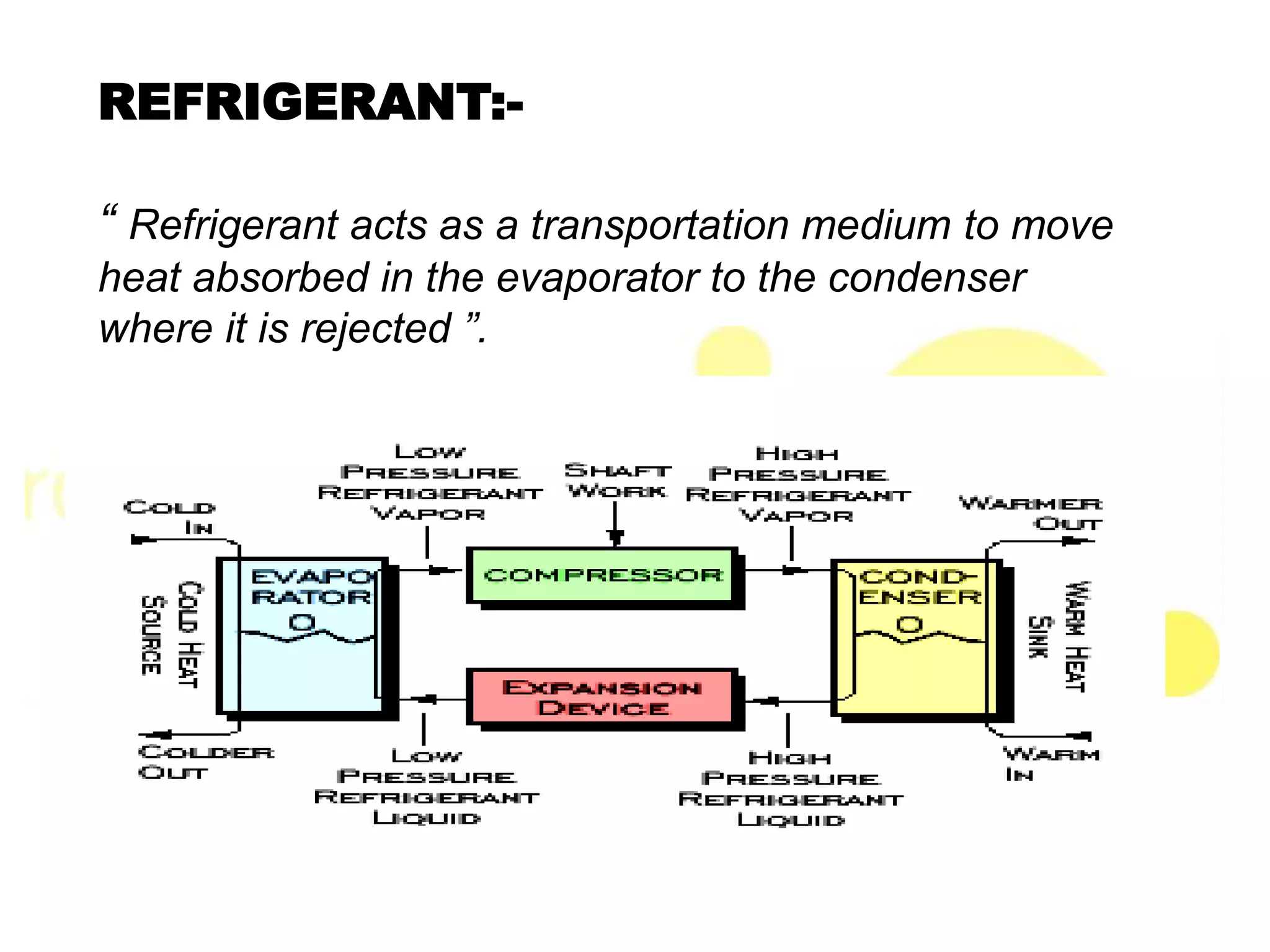
REFRIGERANT:- 
“ Refrigerant acts as a transportation medium to move 
heat absorbed in the evaporator to the condenser 
where it is rejected ”.
HISTORY OF REFRIGERANTS :- 
Natural refrigerants:- 
1) Ice blocks 
2) Using nocturnal cooling 
3) Use of evaporation 
Artificial refrigerants :- 
1) In 1835, Jakob Perkins use ethyl ether as the refrigerant ( b.p= 30’c). 
(if air mixed forms an explosive gas). 
2) In 1874, Raowl Piolet designs the first sulphur dioxide based system. 
(forms H2SO4 when gets moisture). 
3) In 1885, Fraunz Windhausen builds the first to use co2 in Germany. 
(high operating pressure ). 
4)In 1920, iso-butane based domestic refrigerator ( highly flammable), 
General Electric first introduce “Kelvinator “ refrigerator. 
5) In 1930, Introduction of CFCs .
CLASSIFICATION OF REFRIGERANTS
Based on Working Principle :- 
REFRIGERANTS 
PRIMARY REFRIGERANTS 
SECONDARY REFRIGERANTS 
1) Used directly as 
working fluids. 
2) Undergo phase 
change. 
Eg, R134a, R404a 
1) Liquids that are used 
to transport energy. 
2) Not undergo any 
phase change. 
Eg. Water , brines.
REFRIGERANT SELECTION CRITERIA:- 
i. Thermodynamic and Thermo-physical properties 
ii. Environmental and safety properties, and 
iii. Economics
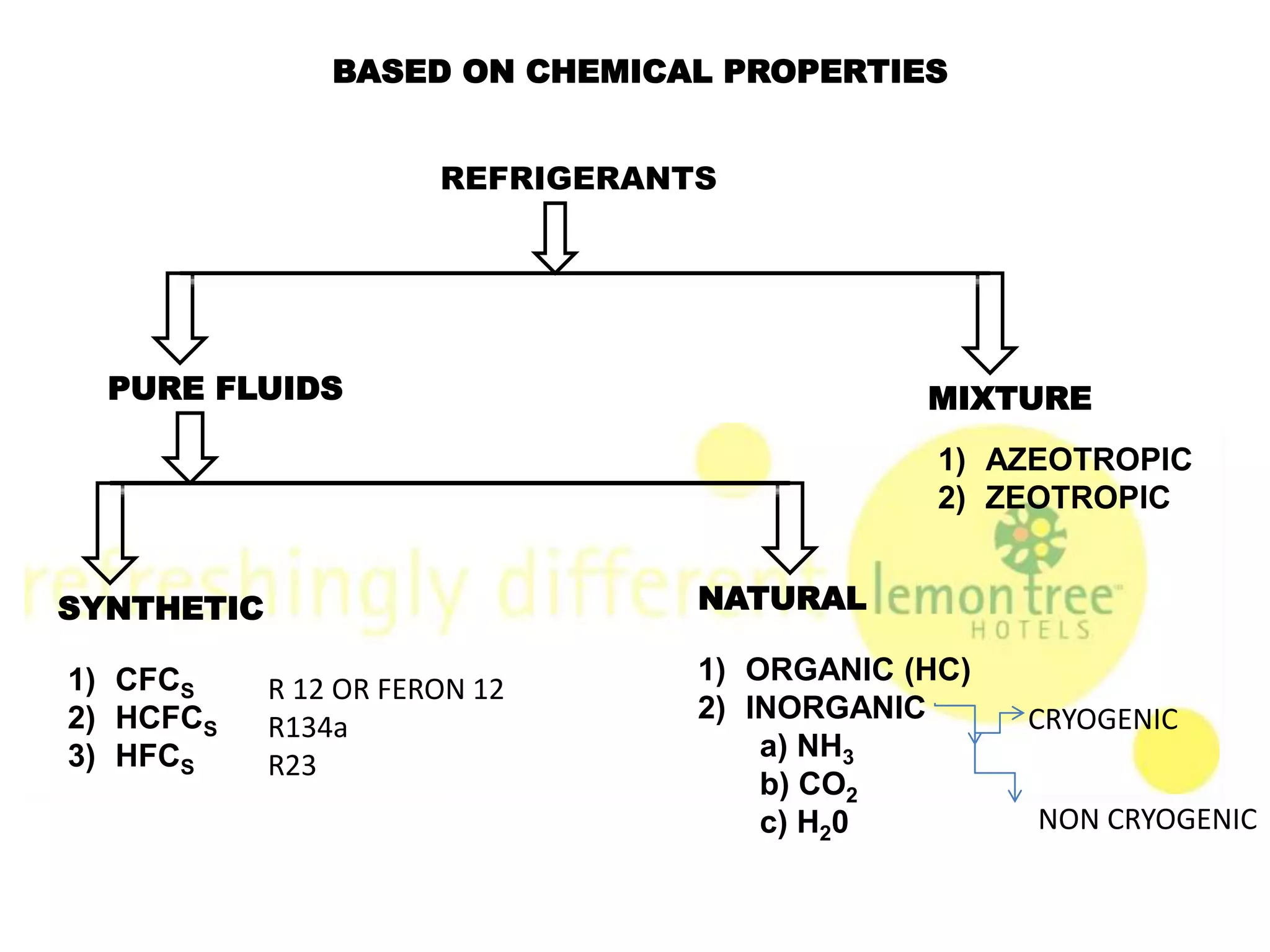
REFRIGERANTS 
PURE FLUIDS 
MIXTURE 
1) AZEOTROPIC 
2) ZEOTROPIC 
SYNTHETIC 
NATURAL 
1) CFCS 
2) HCFCS 
3) HFCS 
1) ORGANIC (HC) 
2) INORGANIC 
a) NH3 
b) CO2 
c) H20 
R 12 OR FERON 12 
R134a 
R23 
CRYOGENIC 
NON CRYOGENIC 
BASED ON CHEMICAL PROPERTIES
BASED ON SAFETY :- 
Toxicity 
Class A 
• No Toxicity indication <= 400 ppm 
EG. CO2 , R 22 
Class B 
• Toxicity < 400 ppm 
EG. NH3 
Flammability 
(at 21°C and 101 kPa ) 
Class 1 
Do not show flame 
propagation . 
Class 2 
Lower flammability limit 
more than 0.10 kg/m3 and 
a heat of combustion of less 
than 19 kJ/kg 
Class 3 
Lower flammability limit of less 
than or equal to 0.10 kg/m3 
and a heat of combustion 
greater than or equal to 19 kJ/kg.
NOMENCLATURE 
(synthetic) (DU PONT CORP.) 
All refrigerants are designated by R followed by a number 
R xyz 
Where, 
X+1 = Number of carbon atoms 
Y -1 = Number of hydrogen atoms 
Z = Number of fluorine atoms 
The balance indicates number of Cl atoms 
Ex: R 22 
X = 0 ⇒ No. of Carbon atoms = 0+1 = 1 
Y = 2 ⇒ No. of Hydrogen atoms = 2-1 = 1 
Z = 2 ⇒ No. of Fluorine atoms = 2 
The balance = 4 – no. of (H+F) atoms = 4-1-2 = 1 ⇒ No. of Chlorine atoms = 1 
∴The chemical formula of R 22 = CHClF2
R 152a burns at 23 cm/s and R 32 burns at 6.27 cm/s
INORGANIC REFRIGERANTS: 
Designated by number 7 followed by their molecular weight. 
NH3= 17, R 717 
Ex :- CO2, H2O, NH3. 
•CO2 
1. Zero ODP & GWP is 1. 
2. Non Flammable, Non toxic. 
3. Drawback - Operating pressure (high side) : 80 bars. 
4. Low efficiency 
•Ammonia 
1. Toxic. 
2. Flammable ( 16 – 28% concentration ). 
3. Not compatible with copper (cuperic oxide) 
•Water 
1. Used in absorption system . 
2. Cannot be used under higher working pressure.
MIXTURES 
1) Azeotropic mixture : 500 series, 
• A stable mixture of two or several refrigerant . 
• vapor and liquid phases retain identical compositions over a wide range of 
temperatures. 
Examples : R-500 : 73.8% R12 and 26.2% R152 
R-502 : 8.8% R22 and 51.2% R115 
2) Zeotropic mixture : 400 series, 
•Composition in liquid phase differs to that in vapor phase. 
•Do not boil at constant temperatures unlike azeotropic refrigerants because of dff. 
Boiling points. 
Examples :R404a : R125/143a/134a (44%,52%,4%) 
R407c : R32/125/134a (23%, 25%, 52%)
NATURAL REFRIGERANTS :- 
Hydrocarbon 
 Their efficiency is good 
 With no ODP and very small GWP values 
 Compatible with lubricating oils 
 Extraordinary reliability. 
 Highly flammable 
Examples: R170, Ethane, C2H6 
R290 , Propane C3H3 
R600, Butane, C4H10 
R600a, Isobutane, C4H10 
Blends of the above Gases
SYNTHETIC REFRIGERANTS
CFCs: 
• Combination of CARBON+CHLORINE+FLUORINE. 
• Also commonly know as FREONS. 
• High ODP=1 and high GWP. 
• CHLORINE has an excellent anti-wear characteristic. 
• As ODP & GWP is high so it got banned. 
• Few examples are: 
 R-11 
 R-12 
 R-13 and many more.
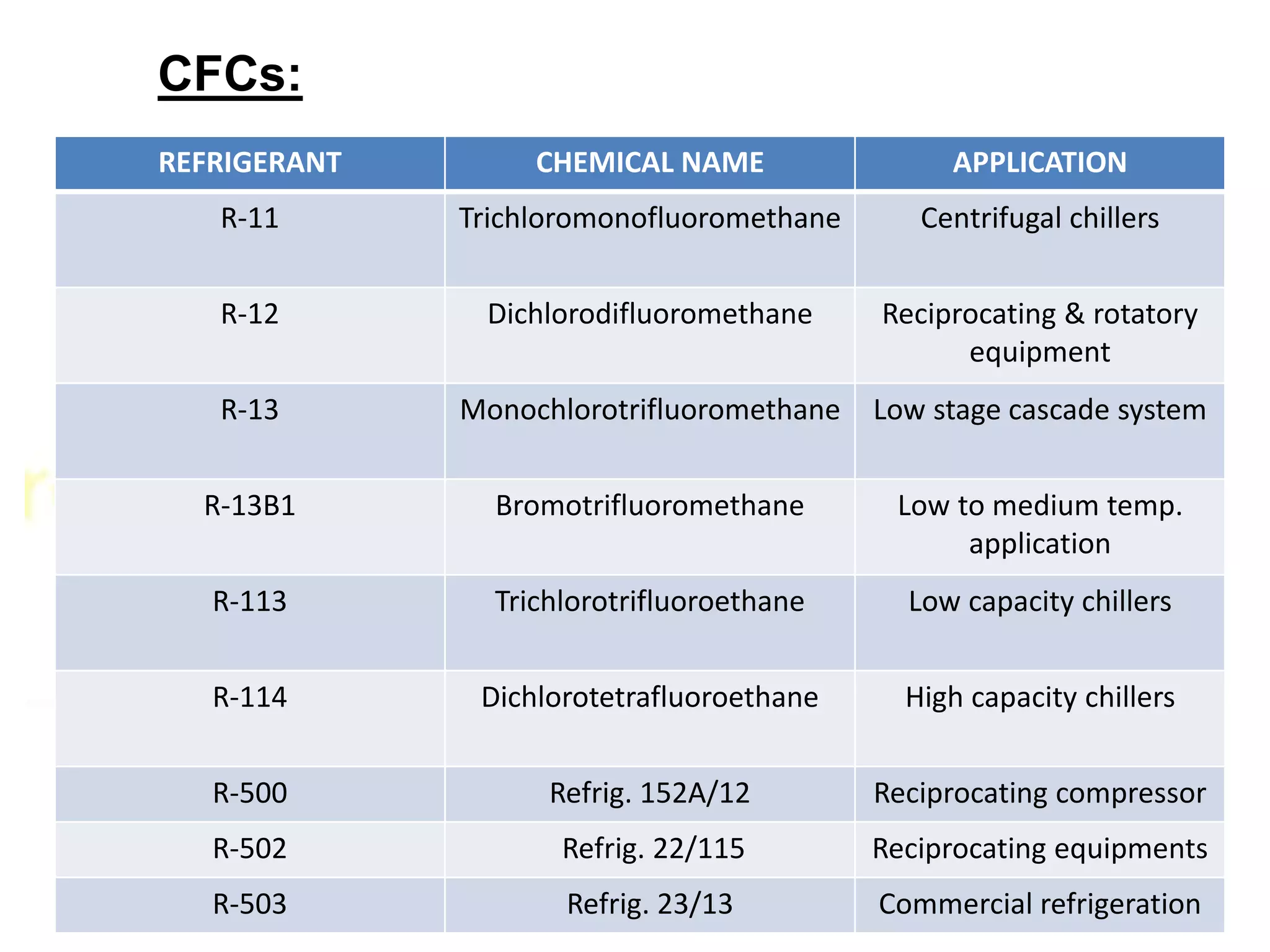
CFCs: 
REFRIGERANT CHEMICAL NAME APPLICATION 
R-11 Trichloromonofluoromethane Centrifugal chillers 
R-12 Dichlorodifluoromethane Reciprocating & rotatory 
equipment 
R-13 Monochlorotrifluoromethane Low stage cascade system 
R-13B1 Bromotrifluoromethane Low to medium temp. 
application 
R-113 Trichlorotrifluoroethane Low capacity chillers 
R-114 Dichlorotetrafluoroethane High capacity chillers 
R-500 Refrig. 152A/12 Reciprocating compressor 
R-502 Refrig. 22/115 Reciprocating equipments 
R-503 Refrig. 23/13 Commercial refrigeration
HCFCs: 
• Combination of HYDROGEN+CHLORINE+FLUORINE+CARBON. 
• Low CHLORINE content than CFCs. 
• It has ODP=0.05 & LESS but not zero. 
• Low GWP value than CFCs. 
• NON-FLAMMABLE & environment acceptable. 
• Few examples are: 
 R-123 ODP=0.02 
BP= -28’C 
Critical Temperature=183.68’C 
 R-22 ODP=0.05 
BP= -40.81’C 
Critical Temperature=96.15’C
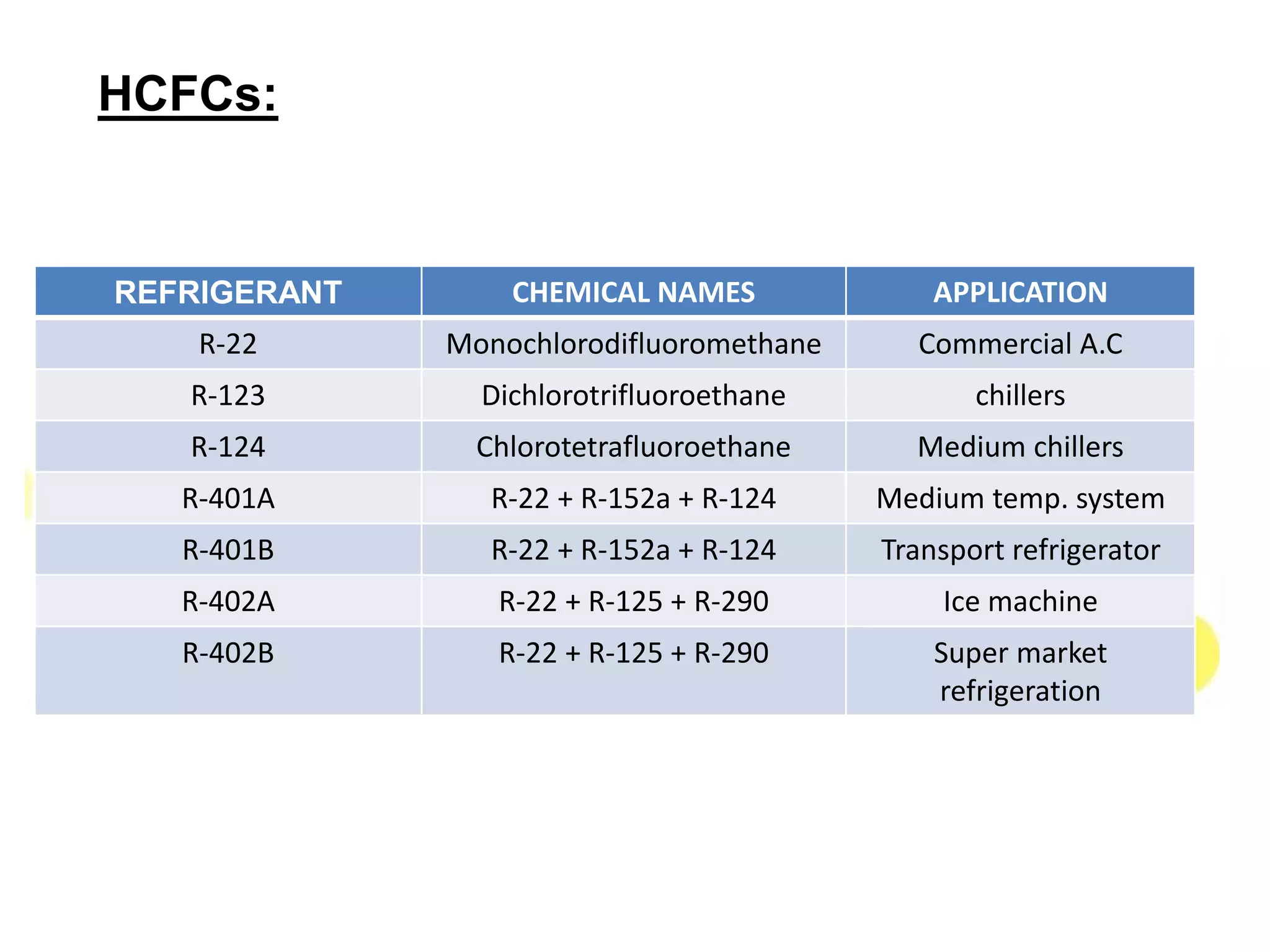
REFRIGERANT CHEMICAL NAMES APPLICATION 
R-22 Monochlorodifluoromethane Commercial A.C 
R-123 Dichlorotrifluoroethane chillers 
R-124 Chlorotetrafluoroethane Medium chillers 
R-401A R-22 + R-152a + R-124 Medium temp. system 
R-401B R-22 + R-152a + R-124 Transport refrigerator 
R-402A R-22 + R-125 + R-290 Ice machine 
R-402B R-22 + R-125 + R-290 Super market 
refrigeration 
HCFCs:
HFCs: 
• Combination of HYDROGEN+FLUORINE+CARBON. 
• NON-FLAMMABLE, RECYCLABLE, LOW TOXICITY. 
• Minimum EMISSION and maximize ENERGY-EFFICIENT. 
• Its ODP=0 and LOW GWP. 
• Require POE oil for the lubrication purpose. 
• Few examples are: 
 R-410A ODP=0 
BP= -48.5’C 
Critical Temperature=72.8’C 
 R-134A ODP=0 
BP= -26.06’C 
Critical Temperature=101.08’C
HFCs: 
REFRIGERANT CHEMICAL NAMES APPLICATION 
R-23 Trifluoromethane Low temp. 
refrigeration 
R-134A Tetrafluoroethane Automative system 
& commercial ref. 
R-404A R-125 + R-143a + R-134a Medium & low 
temp. 
R-407C R-32 + R-125 + R-134a R 22 replacement 
R-410A R-32 + R-125 Residential A.C 
R-507 Refrig. 125/143a Commercial ref.
POE’s 
o Synthetic refrigeration lubricant is used with 
all HFC refrigerants such as R407A and 
R407C. 
o Used in Centrifugal, Screw, Scroll, 
reciprocating types Compressors. 
o They provide maximum protection and 
lubrication at higher compressor 
temperatures.
Refrigerant Acids:- 
o HFC’s & POE’s are used widely. 
o It causes formation of oil sludge's due to low stability. 
o It leads to seize the compressors & further burn out. 
o Do preventive maintenance to check inorganic acids.
COLOR CODES OF REFRIGERANTS 
• Easy recognize gas cylinder 
• Different refrigerant has different color coding 
• Few examples are given below: 
R-22 – LIGHT GREEN 
R-134A – LIGHT SKY BLUE 
R-404A – ORANGE 
• The name label of the gases are given on the cylinder.
PROPERTIES OF REFRIGERANTS
Thermodynamic properties 
•Boiling point :- It should have low boiling point. 
•Freezing point :- It should have low freezing point. 
•Evaporative pressure :- It should be above atmospheric 
pressure. 
•Condensing pressure :- It should have low condensing 
pressure. 
•Latent heat of vaporization :- It should have high latent 
heat of vaporization. 
•Critical pressure and temperature :- It should be above 
the condensing pressure and temperature. 
•Thermal conductivity :- It should have high thermal 
conductivity. 
•Co-efficient of performance :- COP has direct effect on 
running cost of refrigeration cycle so higher the COP 
lower will be the running cost.
Thermodynamic Properties 
Refrigerants R 12 R 22 R 134a R 404a R 407a NH3 H2O CO2 
B.P (⁰C) -28.8 -40.81 -26.2 -46.4 -45 -33 100 -57 
B.P (⁰C) -28.8 -40.81 -26.2 -46.4 -45 -33 100 -78.3 
F.P (⁰C) 
F.P (⁰C) -157.7 -160 -96.66 ------ ------- -77.7 0 -56.6 
Latent heat of 
vaporization 
(KJ/kg) 
166.95 233.75 215.9 143.68 235.57 1371.2 2.257 571.3 
Critical temp. 
(⁰C) 
112 96.15 100.95 72.07 82.2 132.4 374 30.98 
Critical 
pressure (bar) 
41.15 49.9 40.6 37.32 45.15 8.88 217.7 77.77 
Specific heat 
at const. 
pressure 
(KJ/mol.K) 
.074 .057 1.03 1.520 .0374 
Latent heat of 
vaporization 
(KJ/kg) 
166.95 233.75 215.9 143.68 235.57 1371.2 2.25 
7 
571.3 
Critical temp. 
(⁰C) 
112 96.15 100.95 72.07 82.2 132.4 374 30.98 
Critical 
pressure (bar) 
41.15 49.9 40.6 37.32 45.15 8.88 217. 
7 
77.77 
Specific heat 
(KJ/mol.K) 
.074 .057 .08754 1.03 1.520 6.91 4.18 .0374 
COP(@ 35’C) 3.677 3.701 3.586 3.603
Chemical properties 
•Toxicity :- It should be non toxic. It should not 
be harmful for humans. 
•Corrosiveness :- It should not be corrosive and 
should not have any effect on materials used in 
equipments. 
•Flammability :- It should be inert and should 
not catch fire when subjected to high 
temperature. 
•Miscibility with oil :- It should not react with 
lubrication oil. 
•Chemical stability & inertness :- It should be 
chemically stable for operating ranges of 
temperature.
Physical properties 
•Specific volume :- It should be low in vapour 
state. 
•Viscosity :- It should have low viscosity. 
•Leakage Detection :- It should have less 
tendency to leak & if it leaking it should have a 
pungent smell so that the leakage can be 
detected easily. 
Refrigerants R 12 R 22 R 134a R 404a R 407a NH3 H2O CO2 
Viscosity(c p) .1076 .1256 .012 .001 .1 .276 1 .137
Other properties 
•Handling & Maintenance :- It should be 
easy & safe to handle. 
•Cost & Availability :- It should be 
readily available at LOW cost. 
•Performance of the System:- It should 
have high COP & LOW power 
requirement.
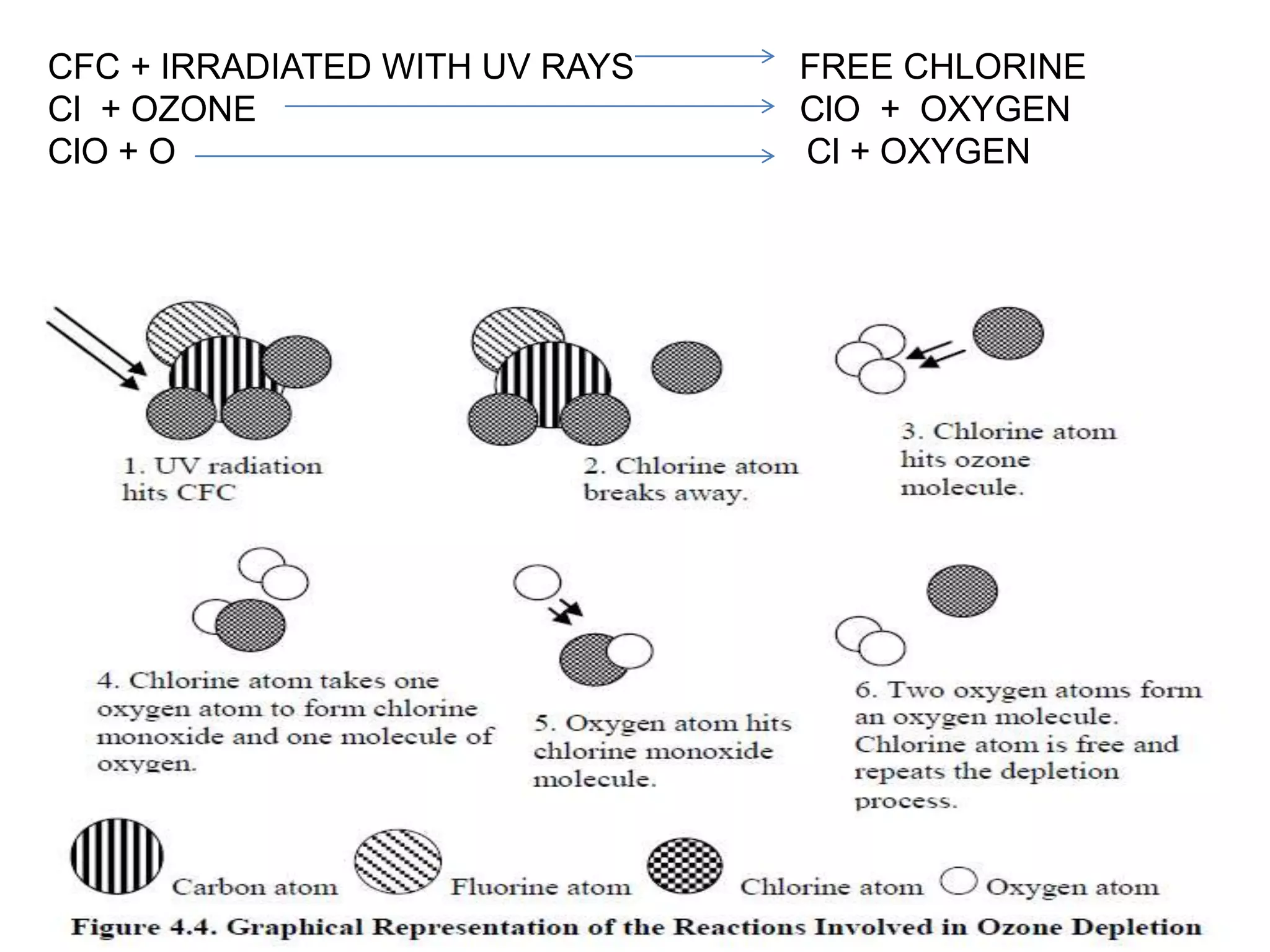
OZONE DEPLETION: 
• Ozone layer gets depleted by the action of CFCs. 
• The greatest concentration of ozone are found from 
12 km to 50 km above the earth forming a layer in 
the stratosphere which is called the ozone layer. 
• Few examples are given in details: 
 R-12 ODP is “1” 
 R-22 ODP is “0.05” 
 R-134a ODP is “0”
CFC + IRRADIATED WITH UV RAYS FREE CHLORINE 
Cl + OZONE ClO + OXYGEN 
ClO + O Cl + OXYGEN
GLOBAL WARMING POTENTIAL 
• Measurement of global warming 
• Done in relation with CO2,where co2 has GWP 1 
• Lower the value of GWP better the refrigerant 
• Few examples are given below: 
 R-11 - High chlorine content 
GWP is 4000 
 R-22 - Low chlorine content 
GWP is 1700 
 R-134A- No chlorine content 
GWP is 1300
MONTREAL PROTOCOL :- 
=> SIGNED IN 1987 UNDER THE ‘UNEP’, AFTER MUCH DISCUSSIONS 
=> MORE THAN 170 COUNTRIES HAVE RATIFIED 
=> INDIA RATIFIED ON SEPT 17,1992 
=> ONE OF MOST SUCCESSFUL EXAMPLE OF INTERNATIONAL 
COOPERATION IN UN HISTORY 
ozone depleting 
substance 
developed countries developing countries 
CFCs phased out end of 
1995 
total phase out by 
2010 
halons phased out end of 
1993 
total phase out by 
2010 
HCFCs total phase out by 
2020 
total phase out by 
2040
TEWI 
• Total Equivalent Warming Impact 
• TEWI = direct emission (c)+ indirect (e). 
• The refrigerants have been rated according to 
their LCCP(Life cycle climate performance). 
• LCCP= TEWI + GWP(ID)+ GWP(D).
CONCLUSION 
• Don’t treat the today’s refrigerants with 
yesterday’s techniques. 
• CFC’s replaced by refrigerants blends. 
• R & D of the refrigerants is in the field of 
environmental acceptability. 
• TEWI, the factor used to decide the overall 
capability of a refrigerant.
Refrigerant
Refrigerant
Refrigerant

Refrigerant

  • 1.
    REFRIGERANTS By :- ENGINEER IN TRAINEE’s 1. ALOK K N 2. MANISH KUMAR 3. ARPITA BANERJEE 4. ABHISHEK BRAHMPURYA 5. MANOJ KUMAR 6. SURYA PRATAP BHANJA 7. TANWI FARHEEN
  • 2.
    CONTENTS :- •Definition • History • Classification • Colour coding • Properties • Conclusion
  • 3.
    REFRIGERANT:- “ Refrigerantacts as a transportation medium to move heat absorbed in the evaporator to the condenser where it is rejected ”.
  • 4.
    HISTORY OF REFRIGERANTS:- Natural refrigerants:- 1) Ice blocks 2) Using nocturnal cooling 3) Use of evaporation Artificial refrigerants :- 1) In 1835, Jakob Perkins use ethyl ether as the refrigerant ( b.p= 30’c). (if air mixed forms an explosive gas). 2) In 1874, Raowl Piolet designs the first sulphur dioxide based system. (forms H2SO4 when gets moisture). 3) In 1885, Fraunz Windhausen builds the first to use co2 in Germany. (high operating pressure ). 4)In 1920, iso-butane based domestic refrigerator ( highly flammable), General Electric first introduce “Kelvinator “ refrigerator. 5) In 1930, Introduction of CFCs .
  • 5.
  • 6.
    Based on WorkingPrinciple :- REFRIGERANTS PRIMARY REFRIGERANTS SECONDARY REFRIGERANTS 1) Used directly as working fluids. 2) Undergo phase change. Eg, R134a, R404a 1) Liquids that are used to transport energy. 2) Not undergo any phase change. Eg. Water , brines.
  • 7.
    REFRIGERANT SELECTION CRITERIA:- i. Thermodynamic and Thermo-physical properties ii. Environmental and safety properties, and iii. Economics
  • 8.
    REFRIGERANTS PURE FLUIDS MIXTURE 1) AZEOTROPIC 2) ZEOTROPIC SYNTHETIC NATURAL 1) CFCS 2) HCFCS 3) HFCS 1) ORGANIC (HC) 2) INORGANIC a) NH3 b) CO2 c) H20 R 12 OR FERON 12 R134a R23 CRYOGENIC NON CRYOGENIC BASED ON CHEMICAL PROPERTIES
  • 9.
    BASED ON SAFETY:- Toxicity Class A • No Toxicity indication <= 400 ppm EG. CO2 , R 22 Class B • Toxicity < 400 ppm EG. NH3 Flammability (at 21°C and 101 kPa ) Class 1 Do not show flame propagation . Class 2 Lower flammability limit more than 0.10 kg/m3 and a heat of combustion of less than 19 kJ/kg Class 3 Lower flammability limit of less than or equal to 0.10 kg/m3 and a heat of combustion greater than or equal to 19 kJ/kg.
  • 10.
    NOMENCLATURE (synthetic) (DUPONT CORP.) All refrigerants are designated by R followed by a number R xyz Where, X+1 = Number of carbon atoms Y -1 = Number of hydrogen atoms Z = Number of fluorine atoms The balance indicates number of Cl atoms Ex: R 22 X = 0 ⇒ No. of Carbon atoms = 0+1 = 1 Y = 2 ⇒ No. of Hydrogen atoms = 2-1 = 1 Z = 2 ⇒ No. of Fluorine atoms = 2 The balance = 4 – no. of (H+F) atoms = 4-1-2 = 1 ⇒ No. of Chlorine atoms = 1 ∴The chemical formula of R 22 = CHClF2
  • 11.
    R 152a burnsat 23 cm/s and R 32 burns at 6.27 cm/s
  • 13.
    INORGANIC REFRIGERANTS: Designatedby number 7 followed by their molecular weight. NH3= 17, R 717 Ex :- CO2, H2O, NH3. •CO2 1. Zero ODP & GWP is 1. 2. Non Flammable, Non toxic. 3. Drawback - Operating pressure (high side) : 80 bars. 4. Low efficiency •Ammonia 1. Toxic. 2. Flammable ( 16 – 28% concentration ). 3. Not compatible with copper (cuperic oxide) •Water 1. Used in absorption system . 2. Cannot be used under higher working pressure.
  • 14.
    MIXTURES 1) Azeotropicmixture : 500 series, • A stable mixture of two or several refrigerant . • vapor and liquid phases retain identical compositions over a wide range of temperatures. Examples : R-500 : 73.8% R12 and 26.2% R152 R-502 : 8.8% R22 and 51.2% R115 2) Zeotropic mixture : 400 series, •Composition in liquid phase differs to that in vapor phase. •Do not boil at constant temperatures unlike azeotropic refrigerants because of dff. Boiling points. Examples :R404a : R125/143a/134a (44%,52%,4%) R407c : R32/125/134a (23%, 25%, 52%)
  • 15.
    NATURAL REFRIGERANTS :- Hydrocarbon  Their efficiency is good  With no ODP and very small GWP values  Compatible with lubricating oils  Extraordinary reliability.  Highly flammable Examples: R170, Ethane, C2H6 R290 , Propane C3H3 R600, Butane, C4H10 R600a, Isobutane, C4H10 Blends of the above Gases
  • 16.
  • 17.
    CFCs: • Combinationof CARBON+CHLORINE+FLUORINE. • Also commonly know as FREONS. • High ODP=1 and high GWP. • CHLORINE has an excellent anti-wear characteristic. • As ODP & GWP is high so it got banned. • Few examples are:  R-11  R-12  R-13 and many more.
  • 18.
    CFCs: REFRIGERANT CHEMICALNAME APPLICATION R-11 Trichloromonofluoromethane Centrifugal chillers R-12 Dichlorodifluoromethane Reciprocating & rotatory equipment R-13 Monochlorotrifluoromethane Low stage cascade system R-13B1 Bromotrifluoromethane Low to medium temp. application R-113 Trichlorotrifluoroethane Low capacity chillers R-114 Dichlorotetrafluoroethane High capacity chillers R-500 Refrig. 152A/12 Reciprocating compressor R-502 Refrig. 22/115 Reciprocating equipments R-503 Refrig. 23/13 Commercial refrigeration
  • 19.
    HCFCs: • Combinationof HYDROGEN+CHLORINE+FLUORINE+CARBON. • Low CHLORINE content than CFCs. • It has ODP=0.05 & LESS but not zero. • Low GWP value than CFCs. • NON-FLAMMABLE & environment acceptable. • Few examples are:  R-123 ODP=0.02 BP= -28’C Critical Temperature=183.68’C  R-22 ODP=0.05 BP= -40.81’C Critical Temperature=96.15’C
  • 20.
    REFRIGERANT CHEMICAL NAMESAPPLICATION R-22 Monochlorodifluoromethane Commercial A.C R-123 Dichlorotrifluoroethane chillers R-124 Chlorotetrafluoroethane Medium chillers R-401A R-22 + R-152a + R-124 Medium temp. system R-401B R-22 + R-152a + R-124 Transport refrigerator R-402A R-22 + R-125 + R-290 Ice machine R-402B R-22 + R-125 + R-290 Super market refrigeration HCFCs:
  • 21.
    HFCs: • Combinationof HYDROGEN+FLUORINE+CARBON. • NON-FLAMMABLE, RECYCLABLE, LOW TOXICITY. • Minimum EMISSION and maximize ENERGY-EFFICIENT. • Its ODP=0 and LOW GWP. • Require POE oil for the lubrication purpose. • Few examples are:  R-410A ODP=0 BP= -48.5’C Critical Temperature=72.8’C  R-134A ODP=0 BP= -26.06’C Critical Temperature=101.08’C
  • 22.
    HFCs: REFRIGERANT CHEMICALNAMES APPLICATION R-23 Trifluoromethane Low temp. refrigeration R-134A Tetrafluoroethane Automative system & commercial ref. R-404A R-125 + R-143a + R-134a Medium & low temp. R-407C R-32 + R-125 + R-134a R 22 replacement R-410A R-32 + R-125 Residential A.C R-507 Refrig. 125/143a Commercial ref.
  • 23.
    POE’s o Syntheticrefrigeration lubricant is used with all HFC refrigerants such as R407A and R407C. o Used in Centrifugal, Screw, Scroll, reciprocating types Compressors. o They provide maximum protection and lubrication at higher compressor temperatures.
  • 24.
    Refrigerant Acids:- oHFC’s & POE’s are used widely. o It causes formation of oil sludge's due to low stability. o It leads to seize the compressors & further burn out. o Do preventive maintenance to check inorganic acids.
  • 25.
    COLOR CODES OFREFRIGERANTS • Easy recognize gas cylinder • Different refrigerant has different color coding • Few examples are given below: R-22 – LIGHT GREEN R-134A – LIGHT SKY BLUE R-404A – ORANGE • The name label of the gases are given on the cylinder.
  • 26.
  • 27.
    Thermodynamic properties •Boilingpoint :- It should have low boiling point. •Freezing point :- It should have low freezing point. •Evaporative pressure :- It should be above atmospheric pressure. •Condensing pressure :- It should have low condensing pressure. •Latent heat of vaporization :- It should have high latent heat of vaporization. •Critical pressure and temperature :- It should be above the condensing pressure and temperature. •Thermal conductivity :- It should have high thermal conductivity. •Co-efficient of performance :- COP has direct effect on running cost of refrigeration cycle so higher the COP lower will be the running cost.
  • 28.
    Thermodynamic Properties RefrigerantsR 12 R 22 R 134a R 404a R 407a NH3 H2O CO2 Refrigerants R 12 R 22 R 134a R 404a R 407a NH3 H2O CO2 B.P (⁰C) -28.8 -40.81 -26.2 -46.4 -45 -33 100 -57 B.P (⁰C) -28.8 -40.81 -26.2 -46.4 -45 -33 100 -78.3 F.P (⁰C) F.P (⁰C) -157.7 -160 -96.66 ------ ------- -77.7 0 -56.6 Latent heat of vaporization (KJ/kg) 166.95 233.75 215.9 143.68 235.57 1371.2 2.257 571.3 Critical temp. (⁰C) 112 96.15 100.95 72.07 82.2 132.4 374 30.98 Critical pressure (bar) 41.15 49.9 40.6 37.32 45.15 8.88 217.7 77.77 Specific heat at const. pressure (KJ/mol.K) .074 .057 1.03 1.520 .0374 Latent heat of vaporization (KJ/kg) 166.95 233.75 215.9 143.68 235.57 1371.2 2.25 7 571.3 Critical temp. (⁰C) 112 96.15 100.95 72.07 82.2 132.4 374 30.98 Critical pressure (bar) 41.15 49.9 40.6 37.32 45.15 8.88 217. 7 77.77 Specific heat (KJ/mol.K) .074 .057 .08754 1.03 1.520 6.91 4.18 .0374 COP(@ 35’C) 3.677 3.701 3.586 3.603
  • 29.
    Chemical properties •Toxicity:- It should be non toxic. It should not be harmful for humans. •Corrosiveness :- It should not be corrosive and should not have any effect on materials used in equipments. •Flammability :- It should be inert and should not catch fire when subjected to high temperature. •Miscibility with oil :- It should not react with lubrication oil. •Chemical stability & inertness :- It should be chemically stable for operating ranges of temperature.
  • 30.
    Physical properties •Specificvolume :- It should be low in vapour state. •Viscosity :- It should have low viscosity. •Leakage Detection :- It should have less tendency to leak & if it leaking it should have a pungent smell so that the leakage can be detected easily. Refrigerants R 12 R 22 R 134a R 404a R 407a NH3 H2O CO2 Viscosity(c p) .1076 .1256 .012 .001 .1 .276 1 .137
  • 31.
    Other properties •Handling& Maintenance :- It should be easy & safe to handle. •Cost & Availability :- It should be readily available at LOW cost. •Performance of the System:- It should have high COP & LOW power requirement.
  • 32.
    OZONE DEPLETION: •Ozone layer gets depleted by the action of CFCs. • The greatest concentration of ozone are found from 12 km to 50 km above the earth forming a layer in the stratosphere which is called the ozone layer. • Few examples are given in details:  R-12 ODP is “1”  R-22 ODP is “0.05”  R-134a ODP is “0”
  • 33.
    CFC + IRRADIATEDWITH UV RAYS FREE CHLORINE Cl + OZONE ClO + OXYGEN ClO + O Cl + OXYGEN
  • 34.
    GLOBAL WARMING POTENTIAL • Measurement of global warming • Done in relation with CO2,where co2 has GWP 1 • Lower the value of GWP better the refrigerant • Few examples are given below:  R-11 - High chlorine content GWP is 4000  R-22 - Low chlorine content GWP is 1700  R-134A- No chlorine content GWP is 1300
  • 35.
    MONTREAL PROTOCOL :- => SIGNED IN 1987 UNDER THE ‘UNEP’, AFTER MUCH DISCUSSIONS => MORE THAN 170 COUNTRIES HAVE RATIFIED => INDIA RATIFIED ON SEPT 17,1992 => ONE OF MOST SUCCESSFUL EXAMPLE OF INTERNATIONAL COOPERATION IN UN HISTORY ozone depleting substance developed countries developing countries CFCs phased out end of 1995 total phase out by 2010 halons phased out end of 1993 total phase out by 2010 HCFCs total phase out by 2020 total phase out by 2040
  • 36.
    TEWI • TotalEquivalent Warming Impact • TEWI = direct emission (c)+ indirect (e). • The refrigerants have been rated according to their LCCP(Life cycle climate performance). • LCCP= TEWI + GWP(ID)+ GWP(D).
  • 37.
    CONCLUSION • Don’ttreat the today’s refrigerants with yesterday’s techniques. • CFC’s replaced by refrigerants blends. • R & D of the refrigerants is in the field of environmental acceptability. • TEWI, the factor used to decide the overall capability of a refrigerant.