Topic: Shell Fishery
Subject: Economic Zoology
PresenteRs: ABDUL QAHAR
Anwar Zada
Alia Syed
Asad Ali
Presented TO: Respected Sir ,Waqas Ahmad Shams
Buner Campus
Shellfish:
An aquatic animal, such as a mollusk or crustacean, that has a
shell or shell-like exoskeleton.
Shell Fishery:
The Study Of Shell fish is called shell fishery.
OR
A commercially exploited {make full use of and derive benefit from (a resource)}
population of shellfish.
OR
The industry or occupation of catching, processing, or selling shellfish.
They Have shells instead of backbones
OR
TWO CLASSIFICATIONS OF
WATER ANIMALS
• Finfish (Often called
“FISH)
– Fins and backbones.
• Shellfish
– Shells instead of
backbones.
SHELLFISH
Are distinguished from fin fish by their hard outer shells and
their lack of backbones or internal skeletons.
SHELLFISH
CLASSIFICATION of
7
 Mollusks are soft sea animals.
OR
Soft bodies that are partially or fully covered
by hard shells
 There are three types that are commonly
eaten:
 Bivalves have a pair of shells (like clams)
 Univalves have a single shell (like conch)
 Cephalopods have a single thin internal shell
called a cuttlebone (like octopus)
Shellfish
Those with one shell are known as Gastropods.
Conch clamsoctopus
Cephalopod
Crustaceans are animals with segmented shells and
jointed legs (like lobster)
Crustaceans:
Animals Covered by crust like shells and have segmented
bodies
Crustaceans:
OR
Shellfish
Lobster
Types of mollusks:
Oysters
Clams
Scallops
Types of Crustaceans:
Shrimp
Lobster
Crabs
Shellfish
Mollusks
Oysters
Clams Scallops
11
Shellfish
Crustaceans
Lobster
Crab
Shrimp
CLASSIFICATION
• Mollusks- are soft sea
animals.
Categories:
Bivalves: which have pair of
hinged shells
Ex: clams, oysters, mussels,
scallops
Univalves: which have a single
shell Ex: abalone, conch
Cephalopods: squids, octopus,
cuttlefish.
• Crustaceans – are
animals with segmented shells
and jointed legs.
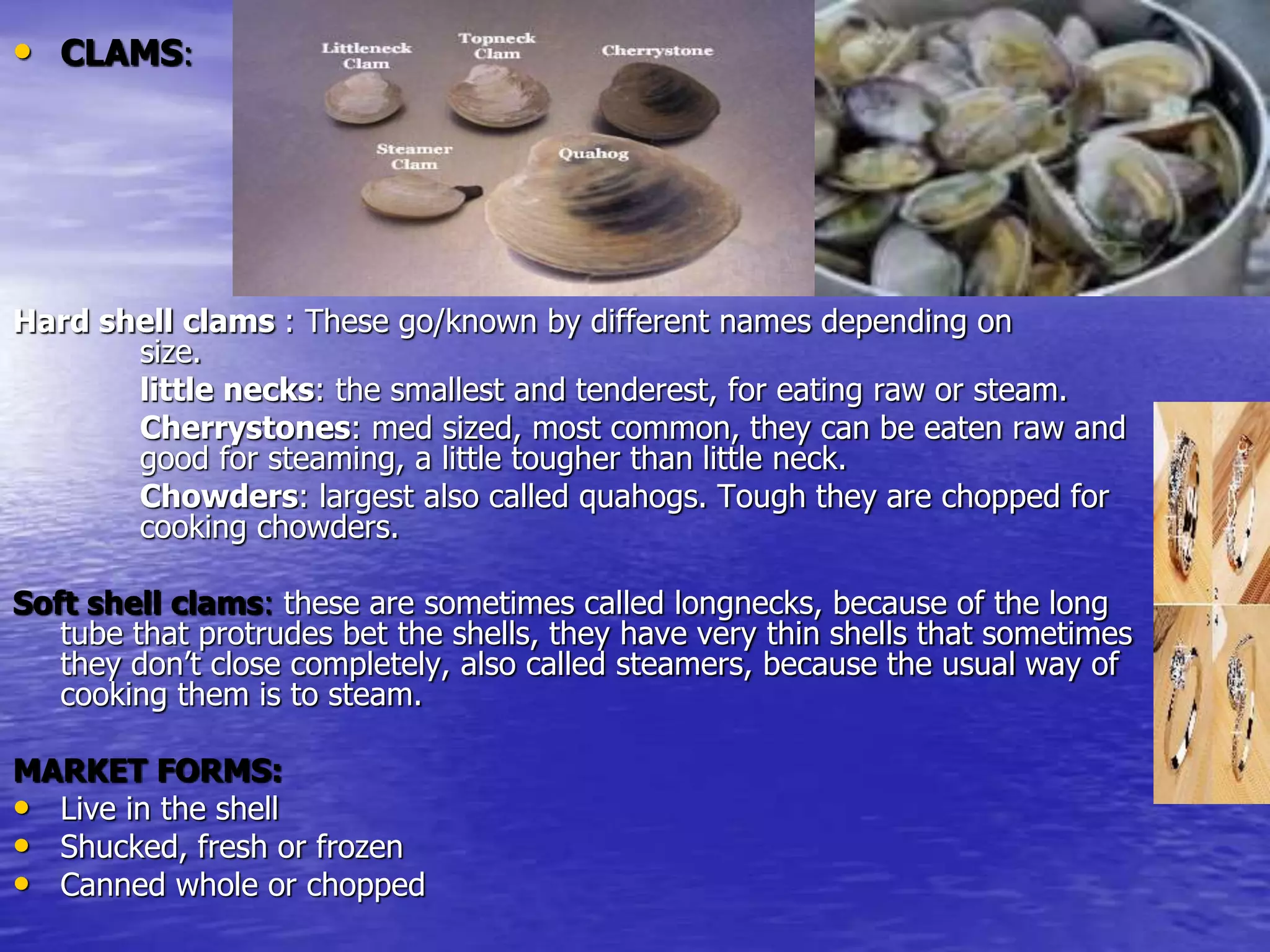
• CLAMS:
Hard shell clams : These go/known by different names depending on
size.
little necks: the smallest and tenderest, for eating raw or steam.
Cherrystones: med sized, most common, they can be eaten raw and
good for steaming, a little tougher than little neck.
Chowders: largest also called quahogs. Tough they are chopped for
cooking chowders.
Soft shell clams: these are sometimes called longnecks, because of the long
tube that protrudes bet the shells, they have very thin shells that sometimes
they don’t close completely, also called steamers, because the usual way of
cooking them is to steam.
MARKET FORMS:
• Live in the shell
• Shucked, fresh or frozen
• Canned whole or chopped
Shellfish
MOLLUSKS
Shellfish
• Oysters
– Can be
purchased
• live in the shell
• Fresh or frozen
shucked
(covered)
• Canned
(Preserved and
sealed in a can
or jar.)
– Packaged
according to
size
– Live Oysters
• Tightly closed
shells
• Shells that
close quickly
when touched
– Shucked
Oysters
• Plump (having a
full rounded
shape)
• Creamy in
color
• Odorless
Shellfish
• Clams
– Available
• Live in the shell
• Fresh or frozen shucked
• Canned-packaged according to size
– Shucked clams should be…
• Plump
• Odorless
• Creamy colored
– The shells of live clams should be
tightly closed or should close
when touched
Shellfish
• Scallops
– Two varieties available
• Tiny bay scallops
– Creamy white or pink in color
• Larger deep sea scallops
– White in color
– Cannot buy scallops in the shell
– Available fresh or frozen
– Whole body is edible…commonly in the U.S. only the
large muscle used to close the shell is eaten!
Shellfish
CRUSTACEANS
Shellfish
• Shrimp
– Many varieties
– Most sold without the
head and thorax
– You may need to peel
away the outer shell
– Before cooking, remove
intestinal tract called
deveining
– Marketed according to
the number needed to
weigh 1 pound
– Marketed by size
• large, medium, small
– Frozen shrimp may be
purchased uncooked or
cooked and either
peeled or unpeeled
– When purchasing…look
for shrimp that’s
odorless with
firmly attached
shells
Shellfish
• Lobster
– Dark, blue-green when
removed from water
– Become red when
cooked
– Can be purchased
• Live
• Frozen whole or tail
• Cooked
• Canned
– When buying
live lobster,
look for…
• Those with
tails that
snap back
quickly after
being
flattened
Shellfish
• Crabs
– Common species are the blue and
Dungeness crab
– Can be purchased
• Live
• Cooked fresh or frozen
• Canned
Shellfish Harvesting
• Harvesting methods
– Diving
– Dredging
– Trapping and pots
– Tongs and rakes
Trapping fish in pots
Tongs
Rakes
Dredging
Tongs
Shellfish: Signs of Freshness
1. Shell of shrimp should be firmly attached with
no noticeable odor
2. Sea scallops should be white; bay scallops are
pink or creamy white
3. Live oyster and clam shells should be tightly
closed
4. Shucked oysters and clams should be plump,
creamy white and odorless
Guidelines for cooking shellfish
• Cook for a
short period of
time at
moderate
temp.
• Overcooking
causes tough
body.
• Cooking methods:
– Simmering ( to
cook in a liquid at or just below the
boiling point.)
– Baking
{To cook (food) with dry heat, especially in an oven.
}
– Broiling
(To cook by direct radiant heat, as over a gri
ll or under an electric element.)
– Pan-frying
(To fry in a frying pan or skillet with a small
amount of fat.)
– Deep-fry {to cook (food) in a deep layer
of oil or fat}
– Microwave (to cook or heat in a
microwave oven)
Pan-frying
Deep-fry
Microwave Oven
Baking
Simmering
Broiling
General Hints
• To reduce fat content when
purchasing Shellfish…look for
Shellfish stored in water rather
than oil
• When serving shrimp
cocktail…purchase large, fancy
shrimp rather than the small
shrimp
fancy shrimp
shrimp
Aquaculture
• Aquaculture, also known as aquafarming, is the farming of aquatic
organisms such as fish, crustaceans, molluscs and aquatic plants.
• Aquaculture involves cultivating freshwater and saltwater populations
under controlled conditions.
• Particular kinds of aquaculture include fish farming, shrimp
farming, oyster farming and the cultivation of ornamental fish.
Aquaculture installations in Southern Chile
• Shellfish are grown in artificial containers such as earthen ponds,
cages and concrete or fiberglass tanks. The cultured organism is
reproduced and offspring raised in captivity. The young organisms
are stocked at a known density and fed a nutritionally complete diet
to maximize growth rate. Water quality is monitored to maintain a
healthy environment. Animals are harvested with nets when they
reach market size.
History
• Aquaculture was operating in China since 2500 BC.
Crustaceans:
Commercial shrimp farming began in the 1970s, and
production increases after that.
About 75% of farmed shrimp is produced in Asia, in particular
in China and Thailand. The other 25% is produced mainly in America,
where Brazil is the largest producer. Thailand is the largest exporter.
Molluscs:
• Aquacultured shellfish include various oyster, mussel and clam
species.
• Abalone farming began in the late 1950s and early 1960s in
Japan and China.
Abalone farming
Guidelines for storing Shellfish
• Highly perishable
1. Refrigerator: Store in a tightly
closed container in the coldest part
of the refrigerator and use within a
day or two.
2. Freezer: wrap in moisture-proof
and vapor-proof material
3. Canned: store in a cool, dry space.
Refrigerate unused portions
4. Temperature must be keep 29° to 32°F
(–2° to 0°C).
Global aquaculture production by country 2010
Some interesting facts about shellfishery
• Alaska is the largest producer of shellfish in the United
States.
• Shrimp and oysters are the most important shellfish in the United States in
terms of the amount eaten!
• Some molluscs, such as squids and cuttlefish, have their shells
inside their bodies.
• Despite the name, shellfish are not a kind of fish, but are simply
water-dwelling animals
• The Jewish laws of Kashrut forbid the eating of shellfish.
• Shellfish are low in calories (heat), fat, and sodium and high
in vitamins A, B, and D and protein.
• Most molluscs with shells can produce pearls.
www.slideshare.net/abdulqahar045
This is my Blog from here u can download this
Presentation.
Abdul QahaR
Be peaceful, be courteous, obey the law, respect everyone; but if someone
puts his/her hand on you, send him/her to the cemetery.
A Q

Shell fishery edited , prepared and shared by abdul qahar

  • 2.
    Topic: Shell Fishery Subject:Economic Zoology PresenteRs: ABDUL QAHAR Anwar Zada Alia Syed Asad Ali Presented TO: Respected Sir ,Waqas Ahmad Shams Buner Campus
  • 3.
    Shellfish: An aquatic animal,such as a mollusk or crustacean, that has a shell or shell-like exoskeleton. Shell Fishery: The Study Of Shell fish is called shell fishery. OR A commercially exploited {make full use of and derive benefit from (a resource)} population of shellfish. OR The industry or occupation of catching, processing, or selling shellfish. They Have shells instead of backbones OR
  • 4.
    TWO CLASSIFICATIONS OF WATERANIMALS • Finfish (Often called “FISH) – Fins and backbones. • Shellfish – Shells instead of backbones.
  • 5.
    SHELLFISH Are distinguished fromfin fish by their hard outer shells and their lack of backbones or internal skeletons.
  • 6.
  • 7.
    7  Mollusks aresoft sea animals. OR Soft bodies that are partially or fully covered by hard shells  There are three types that are commonly eaten:  Bivalves have a pair of shells (like clams)  Univalves have a single shell (like conch)  Cephalopods have a single thin internal shell called a cuttlebone (like octopus) Shellfish Those with one shell are known as Gastropods. Conch clamsoctopus Cephalopod
  • 8.
    Crustaceans are animalswith segmented shells and jointed legs (like lobster) Crustaceans: Animals Covered by crust like shells and have segmented bodies Crustaceans: OR Shellfish Lobster
  • 9.
    Types of mollusks: Oysters Clams Scallops Typesof Crustaceans: Shrimp Lobster Crabs
  • 10.
  • 11.
  • 12.
    CLASSIFICATION • Mollusks- aresoft sea animals. Categories: Bivalves: which have pair of hinged shells Ex: clams, oysters, mussels, scallops Univalves: which have a single shell Ex: abalone, conch Cephalopods: squids, octopus, cuttlefish. • Crustaceans – are animals with segmented shells and jointed legs.
  • 13.
    • CLAMS: Hard shellclams : These go/known by different names depending on size. little necks: the smallest and tenderest, for eating raw or steam. Cherrystones: med sized, most common, they can be eaten raw and good for steaming, a little tougher than little neck. Chowders: largest also called quahogs. Tough they are chopped for cooking chowders. Soft shell clams: these are sometimes called longnecks, because of the long tube that protrudes bet the shells, they have very thin shells that sometimes they don’t close completely, also called steamers, because the usual way of cooking them is to steam. MARKET FORMS: • Live in the shell • Shucked, fresh or frozen • Canned whole or chopped
  • 14.
  • 15.
    Shellfish • Oysters – Canbe purchased • live in the shell • Fresh or frozen shucked (covered) • Canned (Preserved and sealed in a can or jar.) – Packaged according to size – Live Oysters • Tightly closed shells • Shells that close quickly when touched – Shucked Oysters • Plump (having a full rounded shape) • Creamy in color • Odorless
  • 16.
    Shellfish • Clams – Available •Live in the shell • Fresh or frozen shucked • Canned-packaged according to size – Shucked clams should be… • Plump • Odorless • Creamy colored – The shells of live clams should be tightly closed or should close when touched
  • 17.
    Shellfish • Scallops – Twovarieties available • Tiny bay scallops – Creamy white or pink in color • Larger deep sea scallops – White in color – Cannot buy scallops in the shell – Available fresh or frozen – Whole body is edible…commonly in the U.S. only the large muscle used to close the shell is eaten!
  • 18.
  • 19.
    Shellfish • Shrimp – Manyvarieties – Most sold without the head and thorax – You may need to peel away the outer shell – Before cooking, remove intestinal tract called deveining – Marketed according to the number needed to weigh 1 pound – Marketed by size • large, medium, small – Frozen shrimp may be purchased uncooked or cooked and either peeled or unpeeled – When purchasing…look for shrimp that’s odorless with firmly attached shells
  • 20.
    Shellfish • Lobster – Dark,blue-green when removed from water – Become red when cooked – Can be purchased • Live • Frozen whole or tail • Cooked • Canned – When buying live lobster, look for… • Those with tails that snap back quickly after being flattened
  • 21.
    Shellfish • Crabs – Commonspecies are the blue and Dungeness crab – Can be purchased • Live • Cooked fresh or frozen • Canned
  • 22.
    Shellfish Harvesting • Harvestingmethods – Diving – Dredging – Trapping and pots – Tongs and rakes Trapping fish in pots Tongs Rakes Dredging Tongs
  • 23.
    Shellfish: Signs ofFreshness 1. Shell of shrimp should be firmly attached with no noticeable odor 2. Sea scallops should be white; bay scallops are pink or creamy white 3. Live oyster and clam shells should be tightly closed 4. Shucked oysters and clams should be plump, creamy white and odorless
  • 24.
    Guidelines for cookingshellfish • Cook for a short period of time at moderate temp. • Overcooking causes tough body. • Cooking methods: – Simmering ( to cook in a liquid at or just below the boiling point.) – Baking {To cook (food) with dry heat, especially in an oven. } – Broiling (To cook by direct radiant heat, as over a gri ll or under an electric element.) – Pan-frying (To fry in a frying pan or skillet with a small amount of fat.) – Deep-fry {to cook (food) in a deep layer of oil or fat} – Microwave (to cook or heat in a microwave oven) Pan-frying Deep-fry Microwave Oven Baking Simmering Broiling
  • 25.
    General Hints • Toreduce fat content when purchasing Shellfish…look for Shellfish stored in water rather than oil • When serving shrimp cocktail…purchase large, fancy shrimp rather than the small shrimp fancy shrimp shrimp
  • 26.
    Aquaculture • Aquaculture, alsoknown as aquafarming, is the farming of aquatic organisms such as fish, crustaceans, molluscs and aquatic plants. • Aquaculture involves cultivating freshwater and saltwater populations under controlled conditions. • Particular kinds of aquaculture include fish farming, shrimp farming, oyster farming and the cultivation of ornamental fish. Aquaculture installations in Southern Chile
  • 27.
    • Shellfish aregrown in artificial containers such as earthen ponds, cages and concrete or fiberglass tanks. The cultured organism is reproduced and offspring raised in captivity. The young organisms are stocked at a known density and fed a nutritionally complete diet to maximize growth rate. Water quality is monitored to maintain a healthy environment. Animals are harvested with nets when they reach market size.
  • 28.
    History • Aquaculture wasoperating in China since 2500 BC. Crustaceans: Commercial shrimp farming began in the 1970s, and production increases after that. About 75% of farmed shrimp is produced in Asia, in particular in China and Thailand. The other 25% is produced mainly in America, where Brazil is the largest producer. Thailand is the largest exporter.
  • 29.
    Molluscs: • Aquacultured shellfishinclude various oyster, mussel and clam species. • Abalone farming began in the late 1950s and early 1960s in Japan and China. Abalone farming
  • 30.
    Guidelines for storingShellfish • Highly perishable 1. Refrigerator: Store in a tightly closed container in the coldest part of the refrigerator and use within a day or two. 2. Freezer: wrap in moisture-proof and vapor-proof material 3. Canned: store in a cool, dry space. Refrigerate unused portions 4. Temperature must be keep 29° to 32°F (–2° to 0°C).
  • 31.
  • 32.
    Some interesting factsabout shellfishery • Alaska is the largest producer of shellfish in the United States. • Shrimp and oysters are the most important shellfish in the United States in terms of the amount eaten! • Some molluscs, such as squids and cuttlefish, have their shells inside their bodies. • Despite the name, shellfish are not a kind of fish, but are simply water-dwelling animals • The Jewish laws of Kashrut forbid the eating of shellfish. • Shellfish are low in calories (heat), fat, and sodium and high in vitamins A, B, and D and protein. • Most molluscs with shells can produce pearls.
  • 33.
    www.slideshare.net/abdulqahar045 This is myBlog from here u can download this Presentation. Abdul QahaR
  • 34.
    Be peaceful, becourteous, obey the law, respect everyone; but if someone puts his/her hand on you, send him/her to the cemetery. A Q