GEOGRAPHY PROJECT ON:
ENDANGERED SPECIES
Made by:
ajit prasad
WHAT IS AN ENDANGERED SPECIES??
SAHYADRIA DENISONII
SAHYADRIA DENISONII
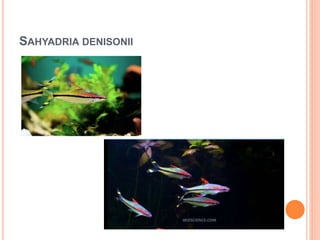
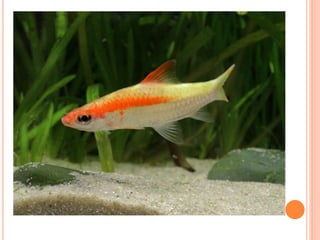
•Sahyadria denisonii (Denison barb, red-line torpedo barb, or roseline
shark) is a species of cyprinid fish endemic to the fast-flowing hill streams
and rivers of the Western Ghats in India.
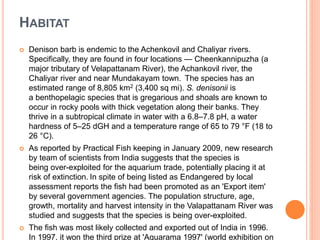
•The fish is characterized by a torpedo-shaped body with silver scales, a red
line running from their snout, through the eye, back towards the middle of the
body; and below the red line, a black line that runs the length of the fish to the
tail. As they mature, a distinctive green/blue marking on top of the head
develops. This species reputedly reaches a length of 15 centimeters
(5.9 in) TL, but typically will only reach 9–11 centimeters (3.5–4.3 in). They
are active schooling fishes.
HABITAT
 Denison barb is endemic to the Achenkovil and Chaliyar rivers.
Specifically, they are found in four locations — Cheenkannipuzha (a
major tributary of Velapattanam River), the Achankovil river, the
Chaliyar river and near Mundakayam town. The species has an
estimated range of 8,805 km2 (3,400 sq mi). S. denisonii is
a benthopelagic species that is gregarious and shoals are known to
occur in rocky pools with thick vegetation along their banks. They
thrive in a subtropical climate in water with a 6.8–7.8 pH, a water
hardness of 5–25 dGH and a temperature range of 65 to 79 °F (18 to
26 °C).
 As reported by Practical Fish keeping in January 2009, new research
by team of scientists from India suggests that the species is
being over-exploited for the aquarium trade, potentially placing it at
risk of extinction. In spite of being listed as Endangered by local
assessment reports the fish had been promoted as an 'Export item'
by several government agencies. The population structure, age,
growth, mortality and harvest intensity in the Valapattanam River was
studied and suggests that the species is being over-exploited.
 The fish was most likely collected and exported out of India in 1996.
In 1997, it won the third prize at 'Aquarama 1997' (world exhibition on
BEHAVIOR
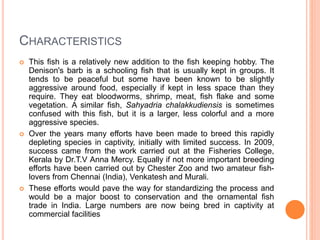
 This fish is a relatively new addition to the fish keeping hobby. The
Denison's barb is a schooling fish that is usually kept in groups. It
tends to be peaceful but some have been known to be slightly
aggressive around food, especially if kept in less space than they
require. They eat bloodworms, shrimp, meat, fish flake and some
vegetation. A similar fish, Sahyadria chalakkudiensis is sometimes
confused with this fish, but it is a larger, less colorful and a more
aggressive species.
CHARACTERISTICS
 This fish is a relatively new addition to the fish keeping hobby. The
Denison's barb is a schooling fish that is usually kept in groups. It
tends to be peaceful but some have been known to be slightly
aggressive around food, especially if kept in less space than they
require. They eat bloodworms, shrimp, meat, fish flake and some
vegetation. A similar fish, Sahyadria chalakkudiensis is sometimes
confused with this fish, but it is a larger, less colorful and a more
aggressive species.
 Over the years many efforts have been made to breed this rapidly
depleting species in captivity, initially with limited success. In 2009,
success came from the work carried out at the Fisheries College,
Kerala by Dr.T.V Anna Mercy. Equally if not more important breeding
efforts have been carried out by Chester Zoo and two amateur fish-
lovers from Chennai (India), Venkatesh and Murali.
 These efforts would pave the way for standardizing the process and
would be a major boost to conservation and the ornamental fish
trade in India. Large numbers are now being bred in captivity at
commercial facilities
SNOW LEOPARD
SNOW LEOPARD
 The Snow leopard or ounce (Panthera uncia syn. Uncia uncia) is a
large cat native to the mountain ranges of Central and South Asia. It
is listed as endangered on the IUCN Red List of Threatened
Species because, as of 2003, the size of the global population was
estimated at 4,080–6,590 adults, of which fewer than 2,500
individuals may reproduce in the wild.
 Drawing from the latest available data, the Global Snow Leopard and
Eco-System Protection Program (GSLEP)uses an estimate of
between 3,920 and 6,390 individuals in the wild.
 Snow leopards inhabit alpine and subalpine zones at elevations from
3,000 to 4,500 m (9,800 to 14,800 ft). In the northern range
countries, they also occur at lower elevations.
 The snow leopard is the National Heritage
Animal of Afghanistan and Pakistan.
DESCRIPTION
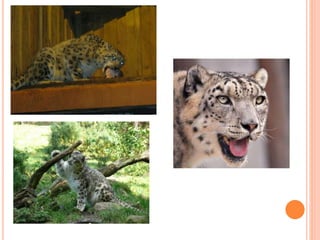
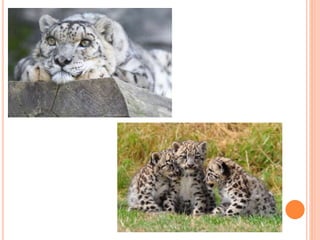
 Snow leopards have long, thick fur, and their base color varies from
smoky gray to yellowish tan, with whitish under parts. They have dark
grey to black open rosettes on their bodies, with small spots of the
same color on their heads and larger spots on their legs and tails.
Unusually among cats, their eyes are pale green or grey in color.
 Snow leopards are slightly smaller than the other big cats However,
their tail is quite long - 80 to 100 cm (31 to 39 inches).
 Snow leopards show several adaptations for living in a cold,
mountainous environment. Their bodies are stocky, their fur is thick,
and their ears are small and rounded, all of which help to minimize
heat loss. Their paws are wide, which distributes their weight better
for walking on snow, and have fur on their undersides to increase
their grip on steep and unstable surfaces; it also helps to minimize
heat loss. Snow leopards' tails are long and flexible, helping them to
maintain their balance, which is very important in the rocky terrain
they inhabit. Their tails are also very thick due to storage of fat and
are very thickly covered with fur which allows them to be used like a
blanket to protect their faces when asleep
 Snow leopards show several adaptations for living in a cold,
mountainous environment. Their bodies are stocky, their fur is thick,
and their ears are small and rounded, all of which help to minimize
heat loss. Their paws are wide, which distributes their weight better
for walking on snow, and have fur on their undersides to increase
their grip on steep and unstable surfaces; it also helps to minimize
heat loss. Snow leopards' tails are long and flexible, helping them to
maintain their balance, which is very important in the rocky terrain
they inhabit. Their tails are also very thick due to storage of fat and
are very thickly covered with fur which allows them to be used like a
blanket to protect their faces when asleep
 The snow leopard has a short muzzle and domed forehead,
containing unusually large nasal cavities that help the animal breathe
the thin, cold air of their mountainous environment.
 The snow leopard cannot roar. Snow leopard vocalizations include
hisses, chuffing, mews, growls, and wailing.
 Snow leopards are carnivores and actively hunt their prey. Like many
cats, they are also opportunistic feeders, eating whatever meat they
can find, including carrion and domestic livestock. They can kill
animals two to four times their own weight, such as
the bharal, Himalayan tahr, markhor, argali, horse, and camel, but
will readily take much smaller prey, such as hares and birds.
Unusually among cats, snow leopards also eat a significant amount
of vegetation, including grass and twigs.
 Snow leopards prefer to ambush prey from above, using broken
terrain to conceal their approach. They will actively pursue prey down
steep mountainsides, using the momentum of their initial leap to
chase animals for up to 300 m (980 ft). They kill with a bite to the
neck, and may drag the prey to a safe location before feeding. They
consume all edible parts of the carcass, and can survive on a single
bharal for two weeks before hunting again. Annual prey needs
appears to be 20–30 adult blue sheep.
POPULATION AND DISTRIBUTION
 Potential snow leopard habitat in the Indian Himalayas is estimated
at less than 90,000 km2 (35,000 sq mi) in the states of Jammu and
Kashmir, Uttarakhand, Himachal Pradesh, Sikkim, and Arunachal
Pradesh, of which about 34,000 km2(13,000 sq mi) is considered
good habitat, and 14.4% is protected. In the beginning of the 1990s,
the Indian snow leopard population was estimated at roughly 200–
600 individuals living across about 25 protected areas.
 Global warming has caused the tree line to be increased in altitude,
resulting in the decrease of wild prey that depend on the plants for
food.
 The total wild population of the snow leopard was estimated at 4,510
to 7,350 individuals (India–approx.500). There are also
approximately 600 snow leopards in zoos around the world.

endangered animals

  • 1.
    GEOGRAPHY PROJECT ON: ENDANGEREDSPECIES Made by: ajit prasad
  • 2.
    WHAT IS ANENDANGERED SPECIES??
  • 3.
  • 4.
    SAHYADRIA DENISONII •Sahyadria denisonii(Denison barb, red-line torpedo barb, or roseline shark) is a species of cyprinid fish endemic to the fast-flowing hill streams and rivers of the Western Ghats in India. •The fish is characterized by a torpedo-shaped body with silver scales, a red line running from their snout, through the eye, back towards the middle of the body; and below the red line, a black line that runs the length of the fish to the tail. As they mature, a distinctive green/blue marking on top of the head develops. This species reputedly reaches a length of 15 centimeters (5.9 in) TL, but typically will only reach 9–11 centimeters (3.5–4.3 in). They are active schooling fishes.
  • 6.
    HABITAT  Denison barbis endemic to the Achenkovil and Chaliyar rivers. Specifically, they are found in four locations — Cheenkannipuzha (a major tributary of Velapattanam River), the Achankovil river, the Chaliyar river and near Mundakayam town. The species has an estimated range of 8,805 km2 (3,400 sq mi). S. denisonii is a benthopelagic species that is gregarious and shoals are known to occur in rocky pools with thick vegetation along their banks. They thrive in a subtropical climate in water with a 6.8–7.8 pH, a water hardness of 5–25 dGH and a temperature range of 65 to 79 °F (18 to 26 °C).  As reported by Practical Fish keeping in January 2009, new research by team of scientists from India suggests that the species is being over-exploited for the aquarium trade, potentially placing it at risk of extinction. In spite of being listed as Endangered by local assessment reports the fish had been promoted as an 'Export item' by several government agencies. The population structure, age, growth, mortality and harvest intensity in the Valapattanam River was studied and suggests that the species is being over-exploited.  The fish was most likely collected and exported out of India in 1996. In 1997, it won the third prize at 'Aquarama 1997' (world exhibition on
  • 7.
    BEHAVIOR  This fishis a relatively new addition to the fish keeping hobby. The Denison's barb is a schooling fish that is usually kept in groups. It tends to be peaceful but some have been known to be slightly aggressive around food, especially if kept in less space than they require. They eat bloodworms, shrimp, meat, fish flake and some vegetation. A similar fish, Sahyadria chalakkudiensis is sometimes confused with this fish, but it is a larger, less colorful and a more aggressive species.
  • 8.
    CHARACTERISTICS  This fishis a relatively new addition to the fish keeping hobby. The Denison's barb is a schooling fish that is usually kept in groups. It tends to be peaceful but some have been known to be slightly aggressive around food, especially if kept in less space than they require. They eat bloodworms, shrimp, meat, fish flake and some vegetation. A similar fish, Sahyadria chalakkudiensis is sometimes confused with this fish, but it is a larger, less colorful and a more aggressive species.  Over the years many efforts have been made to breed this rapidly depleting species in captivity, initially with limited success. In 2009, success came from the work carried out at the Fisheries College, Kerala by Dr.T.V Anna Mercy. Equally if not more important breeding efforts have been carried out by Chester Zoo and two amateur fish- lovers from Chennai (India), Venkatesh and Murali.  These efforts would pave the way for standardizing the process and would be a major boost to conservation and the ornamental fish trade in India. Large numbers are now being bred in captivity at commercial facilities
  • 9.
  • 10.
    SNOW LEOPARD  TheSnow leopard or ounce (Panthera uncia syn. Uncia uncia) is a large cat native to the mountain ranges of Central and South Asia. It is listed as endangered on the IUCN Red List of Threatened Species because, as of 2003, the size of the global population was estimated at 4,080–6,590 adults, of which fewer than 2,500 individuals may reproduce in the wild.  Drawing from the latest available data, the Global Snow Leopard and Eco-System Protection Program (GSLEP)uses an estimate of between 3,920 and 6,390 individuals in the wild.  Snow leopards inhabit alpine and subalpine zones at elevations from 3,000 to 4,500 m (9,800 to 14,800 ft). In the northern range countries, they also occur at lower elevations.  The snow leopard is the National Heritage Animal of Afghanistan and Pakistan.
  • 11.
    DESCRIPTION  Snow leopardshave long, thick fur, and their base color varies from smoky gray to yellowish tan, with whitish under parts. They have dark grey to black open rosettes on their bodies, with small spots of the same color on their heads and larger spots on their legs and tails. Unusually among cats, their eyes are pale green or grey in color.  Snow leopards are slightly smaller than the other big cats However, their tail is quite long - 80 to 100 cm (31 to 39 inches).  Snow leopards show several adaptations for living in a cold, mountainous environment. Their bodies are stocky, their fur is thick, and their ears are small and rounded, all of which help to minimize heat loss. Their paws are wide, which distributes their weight better for walking on snow, and have fur on their undersides to increase their grip on steep and unstable surfaces; it also helps to minimize heat loss. Snow leopards' tails are long and flexible, helping them to maintain their balance, which is very important in the rocky terrain they inhabit. Their tails are also very thick due to storage of fat and are very thickly covered with fur which allows them to be used like a blanket to protect their faces when asleep
  • 12.
     Snow leopardsshow several adaptations for living in a cold, mountainous environment. Their bodies are stocky, their fur is thick, and their ears are small and rounded, all of which help to minimize heat loss. Their paws are wide, which distributes their weight better for walking on snow, and have fur on their undersides to increase their grip on steep and unstable surfaces; it also helps to minimize heat loss. Snow leopards' tails are long and flexible, helping them to maintain their balance, which is very important in the rocky terrain they inhabit. Their tails are also very thick due to storage of fat and are very thickly covered with fur which allows them to be used like a blanket to protect their faces when asleep  The snow leopard has a short muzzle and domed forehead, containing unusually large nasal cavities that help the animal breathe the thin, cold air of their mountainous environment.  The snow leopard cannot roar. Snow leopard vocalizations include hisses, chuffing, mews, growls, and wailing.
  • 14.
     Snow leopardsare carnivores and actively hunt their prey. Like many cats, they are also opportunistic feeders, eating whatever meat they can find, including carrion and domestic livestock. They can kill animals two to four times their own weight, such as the bharal, Himalayan tahr, markhor, argali, horse, and camel, but will readily take much smaller prey, such as hares and birds. Unusually among cats, snow leopards also eat a significant amount of vegetation, including grass and twigs.  Snow leopards prefer to ambush prey from above, using broken terrain to conceal their approach. They will actively pursue prey down steep mountainsides, using the momentum of their initial leap to chase animals for up to 300 m (980 ft). They kill with a bite to the neck, and may drag the prey to a safe location before feeding. They consume all edible parts of the carcass, and can survive on a single bharal for two weeks before hunting again. Annual prey needs appears to be 20–30 adult blue sheep.
  • 16.
    POPULATION AND DISTRIBUTION Potential snow leopard habitat in the Indian Himalayas is estimated at less than 90,000 km2 (35,000 sq mi) in the states of Jammu and Kashmir, Uttarakhand, Himachal Pradesh, Sikkim, and Arunachal Pradesh, of which about 34,000 km2(13,000 sq mi) is considered good habitat, and 14.4% is protected. In the beginning of the 1990s, the Indian snow leopard population was estimated at roughly 200– 600 individuals living across about 25 protected areas.  Global warming has caused the tree line to be increased in altitude, resulting in the decrease of wild prey that depend on the plants for food.  The total wild population of the snow leopard was estimated at 4,510 to 7,350 individuals (India–approx.500). There are also approximately 600 snow leopards in zoos around the world.