Game animals
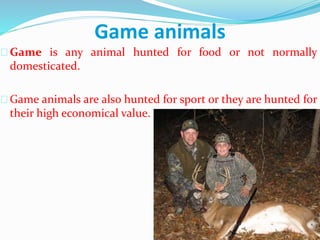
Game is any animal hunted for food or not normally
domesticated.
Game animals are also hunted for sport or they are hunted for
their high economical value.
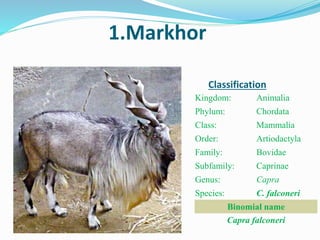
1.Markhor
Kingdom: Animalia
Phylum: Chordata
Class: Mammalia
Order: Artiodactyla
Family: Bovidae
Subfamily: Caprinae
Genus: Capra
Species: C. falconeri
Binomial name
Capra falconeri
Classification
Cause of name
The colloquial name is thought by some to be derived
from the Persian word mar, meaning snake, and khor,
meaning "eater", which is sometimes interpreted ……
To either represent the species' ability to kill snakes
OR
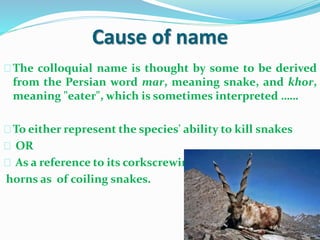
As a reference to its corkscrewing
horns as of coiling snakes.
According to folklore , the markhor has the ability to kill a
snake and eat it.
Thereafter, while chewing the cud, a foam-like substance comes
out of its mouth which drops on the ground and dries.
This foam-like substance is sought after by the local people,
who believe it is useful in extracting snake poison from snake
bitten wounds.
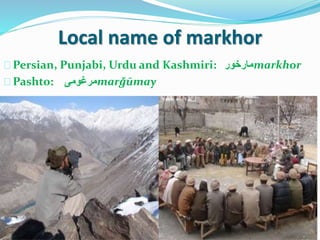
Local name of markhor
Persian, Punjabi, Urdu and Kashmiri: ‫مارخور‬markhor
Pashto: ‫مرغومی‬marǧūmay
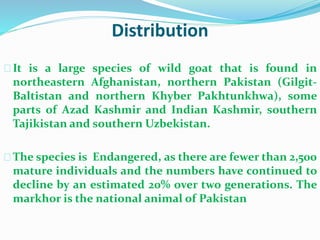
Distribution
It is a large species of wild goat that is found in
northeastern Afghanistan, northern Pakistan (Gilgit-
Baltistan and northern Khyber Pakhtunkhwa), some
parts of Azad Kashmir and Indian Kashmir, southern
Tajikistan and southern Uzbekistan.
The species is Endangered, as there are fewer than 2,500
mature individuals and the numbers have continued to
decline by an estimated 20% over two generations. The
markhor is the national animal of Pakistan
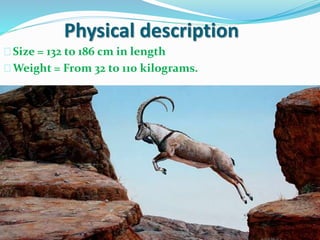
Physical description
Size = 132 to 186 cm in length
Weight = From 32 to 110 kilograms.
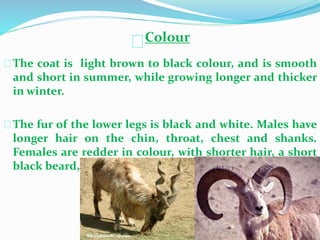
Colour
The coat is light brown to black colour, and is smooth
and short in summer, while growing longer and thicker
in winter.
The fur of the lower legs is black and white. Males have
longer hair on the chin, throat, chest and shanks.
Females are redder in colour, with shorter hair, a short
black beard, and are maleness.
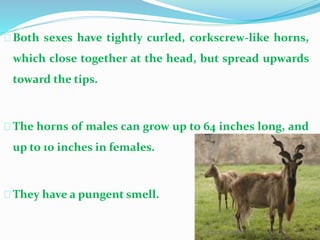
Both sexes have tightly curled, corkscrew-like horns,
which close together at the head, but spread upwards
toward the tips.
The horns of males can grow up to 64 inches long, and
up to 10 inches in females.
They have a pungent smell.
Behaviour
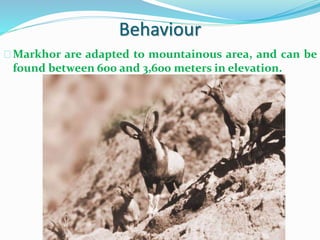
Markhor are adapted to mountainous area, and can be
found between 600 and 3,600 meters in elevation.
Hunting
In British India, markhor were considered to be
among the most challenging game species, due to the
danger involved in stalking and pursuing them in
high, mountainous terrain.
In Pakistan it is endangered and its hunting is illegal
In India, markhor are still hunted for food near the
Pakistani border.
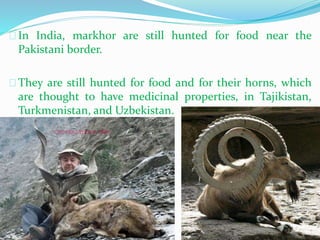
They are still hunted for food and for their horns, which
are thought to have medicinal properties, in Tajikistan,
Turkmenistan, and Uzbekistan.
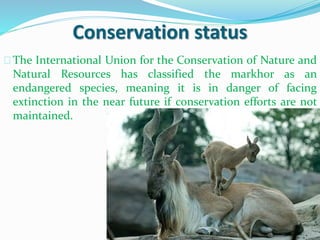
Conservation status
The International Union for the Conservation of Nature and
Natural Resources has classified the markhor as an
endangered species, meaning it is in danger of facing
extinction in the near future if conservation efforts are not
maintained.
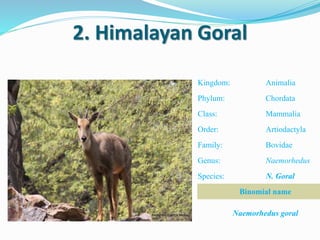
2. Himalayan Goral
Kingdom: Animalia
Phylum: Chordata
Class: Mammalia
Order: Artiodactyla
Family: Bovidae
Genus: Naemorhedus
Species: N. Goral
Binomial name
Naemorhedus goral
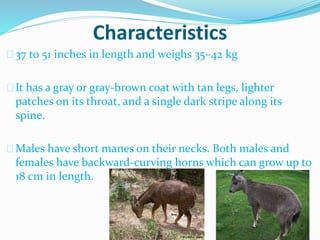
Characteristics
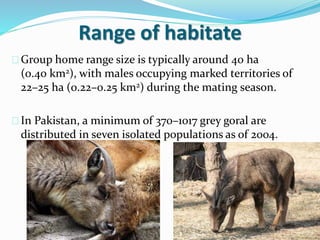
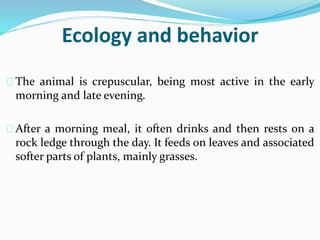
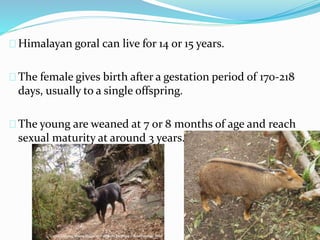
37 to 51 inches in length and weighs 35–42 kg
It has a gray or gray-brown coat with tan legs, lighter
patches on its throat, and a single dark stripe along its
spine.
Males have short manes on their necks. Both males and
females have backward-curving horns which can grow up to
18 cm in length.
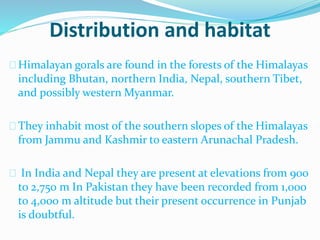
Distribution and habitat
Himalayan gorals are found in the forests of the Himalayas
including Bhutan, northern India, Nepal, southern Tibet,
and possibly western Myanmar.
They inhabit most of the southern slopes of the Himalayas
from Jammu and Kashmir to eastern Arunachal Pradesh.
In India and Nepal they are present at elevations from 900
to 2,750 m In Pakistan they have been recorded from 1,000
to 4,000 m altitude but their present occurrence in Punjab
is doubtful.
Range of habitate
Group home range size is typically around 40 ha
(0.40 km2), with males occupying marked territories of
22–25 ha (0.22–0.25 km2) during the mating season.
In Pakistan, a minimum of 370–1017 grey goral are
distributed in seven isolated populations as of 2004.
Ecology and behavior
The animal is crepuscular, being most active in the early
morning and late evening.
After a morning meal, it often drinks and then rests on a
rock ledge through the day. It feeds on leaves and associated
softer parts of plants, mainly grasses.
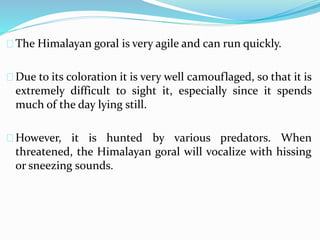
The Himalayan goral is very agile and can run quickly.
Due to its coloration it is very well camouflaged, so that it is
extremely difficult to sight it, especially since it spends
much of the day lying still.
However, it is hunted by various predators. When
threatened, the Himalayan goral will vocalize with hissing
or sneezing sounds.
Himalayan goral can live for 14 or 15 years.
The female gives birth after a gestation period of 170-218
days, usually to a single offspring.
The young are weaned at 7 or 8 months of age and reach
sexual maturity at around 3 years.
Conservation
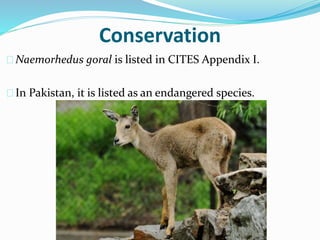
Naemorhedus goral is listed in CITES Appendix I.
In Pakistan, it is listed as an endangered species.
Game animals Shared By Abdul Qahar

Game animals Shared By Abdul Qahar

  • 1.
    Game animals Game isany animal hunted for food or not normally domesticated. Game animals are also hunted for sport or they are hunted for their high economical value.
  • 2.
    1.Markhor Kingdom: Animalia Phylum: Chordata Class:Mammalia Order: Artiodactyla Family: Bovidae Subfamily: Caprinae Genus: Capra Species: C. falconeri Binomial name Capra falconeri Classification
  • 3.
    Cause of name Thecolloquial name is thought by some to be derived from the Persian word mar, meaning snake, and khor, meaning "eater", which is sometimes interpreted …… To either represent the species' ability to kill snakes OR As a reference to its corkscrewing horns as of coiling snakes.
  • 4.
    According to folklore, the markhor has the ability to kill a snake and eat it. Thereafter, while chewing the cud, a foam-like substance comes out of its mouth which drops on the ground and dries. This foam-like substance is sought after by the local people, who believe it is useful in extracting snake poison from snake bitten wounds.
  • 5.
    Local name ofmarkhor Persian, Punjabi, Urdu and Kashmiri: ‫مارخور‬markhor Pashto: ‫مرغومی‬marǧūmay
  • 6.
    Distribution It is alarge species of wild goat that is found in northeastern Afghanistan, northern Pakistan (Gilgit- Baltistan and northern Khyber Pakhtunkhwa), some parts of Azad Kashmir and Indian Kashmir, southern Tajikistan and southern Uzbekistan. The species is Endangered, as there are fewer than 2,500 mature individuals and the numbers have continued to decline by an estimated 20% over two generations. The markhor is the national animal of Pakistan
  • 7.
    Physical description Size =132 to 186 cm in length Weight = From 32 to 110 kilograms.
  • 8.
    Colour The coat islight brown to black colour, and is smooth and short in summer, while growing longer and thicker in winter. The fur of the lower legs is black and white. Males have longer hair on the chin, throat, chest and shanks. Females are redder in colour, with shorter hair, a short black beard, and are maleness.
  • 9.
    Both sexes havetightly curled, corkscrew-like horns, which close together at the head, but spread upwards toward the tips. The horns of males can grow up to 64 inches long, and up to 10 inches in females. They have a pungent smell.
  • 10.
    Behaviour Markhor are adaptedto mountainous area, and can be found between 600 and 3,600 meters in elevation.
  • 11.
    Hunting In British India,markhor were considered to be among the most challenging game species, due to the danger involved in stalking and pursuing them in high, mountainous terrain. In Pakistan it is endangered and its hunting is illegal
  • 12.
    In India, markhorare still hunted for food near the Pakistani border. They are still hunted for food and for their horns, which are thought to have medicinal properties, in Tajikistan, Turkmenistan, and Uzbekistan.
  • 13.
    Conservation status The InternationalUnion for the Conservation of Nature and Natural Resources has classified the markhor as an endangered species, meaning it is in danger of facing extinction in the near future if conservation efforts are not maintained.
  • 14.
    2. Himalayan Goral Kingdom:Animalia Phylum: Chordata Class: Mammalia Order: Artiodactyla Family: Bovidae Genus: Naemorhedus Species: N. Goral Binomial name Naemorhedus goral
  • 15.
    Characteristics 37 to 51inches in length and weighs 35–42 kg It has a gray or gray-brown coat with tan legs, lighter patches on its throat, and a single dark stripe along its spine. Males have short manes on their necks. Both males and females have backward-curving horns which can grow up to 18 cm in length.
  • 16.
    Distribution and habitat Himalayangorals are found in the forests of the Himalayas including Bhutan, northern India, Nepal, southern Tibet, and possibly western Myanmar. They inhabit most of the southern slopes of the Himalayas from Jammu and Kashmir to eastern Arunachal Pradesh. In India and Nepal they are present at elevations from 900 to 2,750 m In Pakistan they have been recorded from 1,000 to 4,000 m altitude but their present occurrence in Punjab is doubtful.
  • 17.
    Range of habitate Grouphome range size is typically around 40 ha (0.40 km2), with males occupying marked territories of 22–25 ha (0.22–0.25 km2) during the mating season. In Pakistan, a minimum of 370–1017 grey goral are distributed in seven isolated populations as of 2004.
  • 18.
    Ecology and behavior Theanimal is crepuscular, being most active in the early morning and late evening. After a morning meal, it often drinks and then rests on a rock ledge through the day. It feeds on leaves and associated softer parts of plants, mainly grasses.
  • 19.
    The Himalayan goralis very agile and can run quickly. Due to its coloration it is very well camouflaged, so that it is extremely difficult to sight it, especially since it spends much of the day lying still. However, it is hunted by various predators. When threatened, the Himalayan goral will vocalize with hissing or sneezing sounds.
  • 20.
    Himalayan goral canlive for 14 or 15 years. The female gives birth after a gestation period of 170-218 days, usually to a single offspring. The young are weaned at 7 or 8 months of age and reach sexual maturity at around 3 years.
  • 21.
    Conservation Naemorhedus goral islisted in CITES Appendix I. In Pakistan, it is listed as an endangered species.