Rosdy Amparado
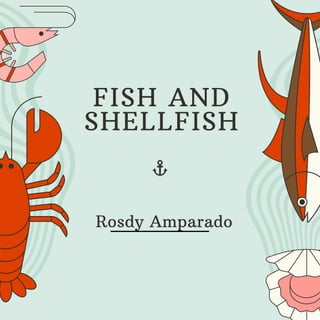
FISH AND
SHELLFISH
A chef must be familiar with a wide variety of fish and
shellfish be able to select their best quality and
understand the best cooking techniques to use in their
preperation.
STRUCTURE AND MUSCLE
CMPOSITION
The flesh of fish and shellfish consists primarily of
water, protein, fat and minerals. The fish and
shellfish use in cooking can be divided into three
categories: FISH, MOLLUSKS, and CRUSTACEANS.
FISH
These are aquatic vertebrates with fins for
swimming, an internal skeleton of bone,
cartilage, and gills for breathing. They are live
in the seas and ocean and some are in fresh
water. Base on shape and skeletal structure,
fish can be divided into two groups: ROUND
FISH and FLAT FISH.
1.ROUND FISH
Round fish swim in vertical
position and have eyes in both
sides of their head. Their body
may be truly round, oval or
compressed. Example of this fish
are ; Tilapia, salmon, and yellow
fin tuna.
2. FLAT FISH
Flat fish has a asymmetrical and
compressed bodies. They swim in
horizontal position and have both eyes in
top of their heads. They are found in deep
ocean waters. The skin on top of their
bodies is dark to comouflage them from
predators and can change colors
according to their surroundings.
SHELLFISH
Shellfish are aquatic invertebrates with shells
and carapaces, the hard shell on the back of
animals such as turtles or crabs. They are
found both in fresh and salt water.
1. MOLLUKS
These are shellfish characterized by ssoft,
unsegmented bodies with no internal
skeleton. Moat mollusks are hard outer shells.
Molluks are divided into three groups.
Univalves, Bivalves, Cephalopods.
a. UNIVALVES
These are mollusks with a single shell in
which the soft bodied anima resides. They
are actually marine snails with a single foot
used to attached the creatures to fixed
objects such as rocks.
b. BIVALVES
These are mollusks with two
bilateral shells attached by a
central hinge.
c. CEPHALOPODS
These are marine mollusks with distinct heads,
well developed eyes, a number of arms that are
attached to the head near the mouth and
saclike-fin bearing mantle. They do not have an
outer shell instead there is a thin internal shell
called a pen or cuttlebone .
2. CRUSTACEANS
These are the third group of the fish and shellfish
category. These are shellfish that have outer
skeleton or shell and jointed limb and they breath
through gills, They are both found in sea waters
and fresh wateers.
NUTRITIONAL BENEFITS
Fish and shellfish are low calories, fat, and
sodium. They are high protein content and
vitamins A, B and D. Fish and shellfish are also
high in minerals especially in calcium,
potassium, phosphorus and iron.
DETERMINING FRESHNES
Fish and shellfish are highly perishable. A few hours at
the wrong temperature or couple of days in the
refrigerator can spoil them. It is important to determine
the freshness of the fish and shellfish that you
purchased and cook. Freshness can determine by this
criteria:
SMELL - it should have a slight smell
or no odor at all. Any off odor are sign
of aged and improperly handled
seafoods.
EYES - both should be clear and full.
Sunken eyes means that the fish is
drying out and is probably not fresh.
GILLS - It should be intact and bright
red. Brown gills are sign of age.
TEXTURE - The flesh of the fish should
be firm. Mushy flesh or flesh that
does not spring back when pressed
with a finger is a sign of poor quality
or aged.
FINS and SCALES - It should be moist
and full without excessive drying on
the outer edges. Dry fins or scales are
sign of aged, damaged fins or scale
may be a sign of mishandlin.
APPERANCE - Fish cuts should be
moist and glistening, without bruises
or dark spot. Edge should not be
brown or dry.
MOVEMENT - Shellfish should be
purchased liv and should show
movement. Lobster and crustaceans
should be active, clams, mussels and
oyster that are partially opened
should snap shut when tapped with a
finger.
SA 4 chapter 20 fish and shellfish, other

  • 1.
  • 2.
    A chef mustbe familiar with a wide variety of fish and shellfish be able to select their best quality and understand the best cooking techniques to use in their preperation. STRUCTURE AND MUSCLE CMPOSITION The flesh of fish and shellfish consists primarily of water, protein, fat and minerals. The fish and shellfish use in cooking can be divided into three categories: FISH, MOLLUSKS, and CRUSTACEANS.
  • 3.
    FISH These are aquaticvertebrates with fins for swimming, an internal skeleton of bone, cartilage, and gills for breathing. They are live in the seas and ocean and some are in fresh water. Base on shape and skeletal structure, fish can be divided into two groups: ROUND FISH and FLAT FISH.
  • 4.
    1.ROUND FISH Round fishswim in vertical position and have eyes in both sides of their head. Their body may be truly round, oval or compressed. Example of this fish are ; Tilapia, salmon, and yellow fin tuna.
  • 5.
    2. FLAT FISH Flatfish has a asymmetrical and compressed bodies. They swim in horizontal position and have both eyes in top of their heads. They are found in deep ocean waters. The skin on top of their bodies is dark to comouflage them from predators and can change colors according to their surroundings.
  • 6.
    SHELLFISH Shellfish are aquaticinvertebrates with shells and carapaces, the hard shell on the back of animals such as turtles or crabs. They are found both in fresh and salt water.
  • 7.
    1. MOLLUKS These areshellfish characterized by ssoft, unsegmented bodies with no internal skeleton. Moat mollusks are hard outer shells. Molluks are divided into three groups. Univalves, Bivalves, Cephalopods.
  • 8.
    a. UNIVALVES These aremollusks with a single shell in which the soft bodied anima resides. They are actually marine snails with a single foot used to attached the creatures to fixed objects such as rocks.
  • 9.
    b. BIVALVES These aremollusks with two bilateral shells attached by a central hinge.
  • 10.
    c. CEPHALOPODS These aremarine mollusks with distinct heads, well developed eyes, a number of arms that are attached to the head near the mouth and saclike-fin bearing mantle. They do not have an outer shell instead there is a thin internal shell called a pen or cuttlebone .
  • 11.
    2. CRUSTACEANS These arethe third group of the fish and shellfish category. These are shellfish that have outer skeleton or shell and jointed limb and they breath through gills, They are both found in sea waters and fresh wateers.
  • 12.
    NUTRITIONAL BENEFITS Fish andshellfish are low calories, fat, and sodium. They are high protein content and vitamins A, B and D. Fish and shellfish are also high in minerals especially in calcium, potassium, phosphorus and iron.
  • 13.
    DETERMINING FRESHNES Fish andshellfish are highly perishable. A few hours at the wrong temperature or couple of days in the refrigerator can spoil them. It is important to determine the freshness of the fish and shellfish that you purchased and cook. Freshness can determine by this criteria:
  • 14.
    SMELL - itshould have a slight smell or no odor at all. Any off odor are sign of aged and improperly handled seafoods. EYES - both should be clear and full. Sunken eyes means that the fish is drying out and is probably not fresh. GILLS - It should be intact and bright red. Brown gills are sign of age.
  • 15.
    TEXTURE - Theflesh of the fish should be firm. Mushy flesh or flesh that does not spring back when pressed with a finger is a sign of poor quality or aged. FINS and SCALES - It should be moist and full without excessive drying on the outer edges. Dry fins or scales are sign of aged, damaged fins or scale may be a sign of mishandlin.
  • 16.
    APPERANCE - Fishcuts should be moist and glistening, without bruises or dark spot. Edge should not be brown or dry. MOVEMENT - Shellfish should be purchased liv and should show movement. Lobster and crustaceans should be active, clams, mussels and oyster that are partially opened should snap shut when tapped with a finger.