Characteristics and Market forms
of Shellfish
Characteristics
Mollusks
• Oysters have rough, irregular shells.
• Flesh of oyster is extremely soft and delicate
and contains a high percentage of water.
• Hard-shell clams – can be eaten raw
Characteristics and Market forms
of Shellfish
• Soft-shell clams are called steamers. The usual way to cook is
to steam.
• The shells of mussels are not as heavy as clamshells, yellow to
orange in color and firm but tender when cooked.
• Scallops are creamy white in color and have a sweet flavor.
• Squid is somewhat chewy and is cut up or fried quickly.
Characteristics and Market forms
of Shellfish
Crustaceans
• The lobster shell is dark green or bluish
green but turns red when cooked.
• Live lobster must be alive when cooked.
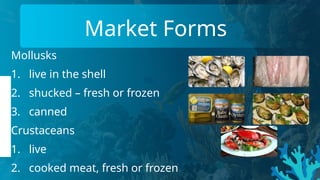
Market Forms
Mollusks
1. live in the shell
2. shucked – fresh or frozen
3. canned
Crustaceans
1. live
2. cooked meat, fresh or frozen
HANDLE
SEAFOOD
DISHES
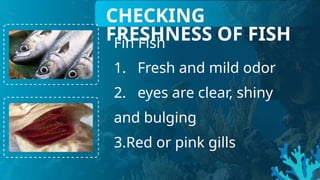
CHECKING
FRESHNESS OF FISH
Fin Fish
1. Fresh and mild odor
2. eyes are clear, shiny
and bulging
3.Red or pink gills
CHECKING
FRESHNESS OF FISH
Fin Fish
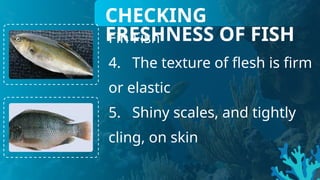
4. The texture of flesh is firm
or elastic
5. Shiny scales, and tightly
cling, on skin
Shellfish
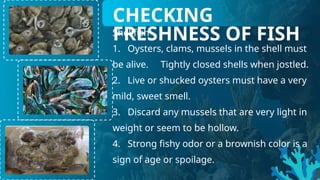
1. Oysters, clams, mussels in the shell must
be alive. Tightly closed shells when jostled.
2. Live or shucked oysters must have a very
mild, sweet smell.
3. Discard any mussels that are very light in
weight or seem to be hollow.
4. Strong fishy odor or a brownish color is a
sign of age or spoilage.
CHECKING
FRESHNESS OF FISH
Shellfish
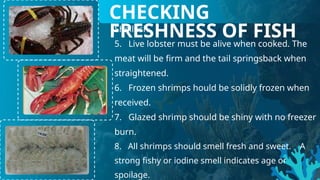
5. Live lobster must be alive when cooked. The
meat will be firm and the tail springsback when
straightened.
6. Frozen shrimps hould be solidly frozen when
received.
7. Glazed shrimp should be shiny with no freezer
burn.
8. All shrimps should smell fresh and sweet. A
strong fishy or iodine smell indicates age or
spoilage.
CHECKING
FRESHNESS OF FISH
Shellfish
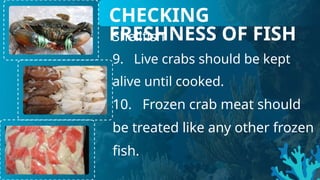
9. Live crabs should be kept
alive until cooked.
10. Frozen crab meat should
be treated like any other frozen
fish.
CHECKING
FRESHNESS OF FISH
HANDLING
AND
STORAGE OF
FRESH
FISH
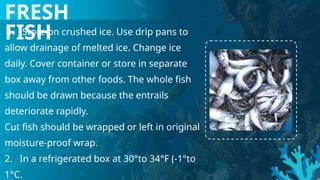
1. Store on crushed ice. Use drip pans to
allow drainage of melted ice. Change ice
daily. Cover container or store in separate
box away from other foods. The whole fish
should be drawn because the entrails
deteriorate rapidly.
Cut fish should be wrapped or left in original
moisture-proof wrap.
2. In a refrigerated box at 30°to 34°F (-1°to
1°C.
FRESH
FISH
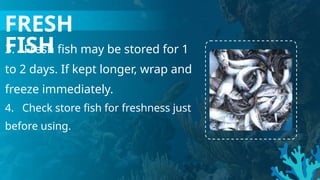
3. Fresh fish may be stored for 1
to 2 days. If kept longer, wrap and
freeze immediately.
4. Check store fish for freshness just
before using.
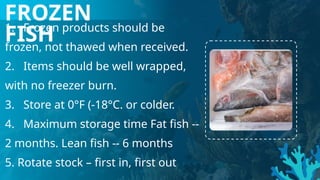
1. Frozen products should be
frozen, not thawed when received.
2. Items should be well wrapped,
with no freezer burn.
3. Store at 0°F (-18°C. or colder.
4. Maximum storage time Fat fish --
2 months. Lean fish -- 6 months
5. Rotate stock – first in, first out
FROZEN
FISH
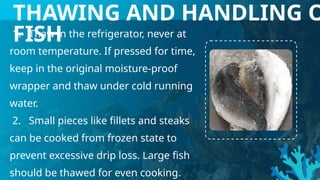
1. Thaw in the refrigerator, never at
room temperature. If pressed for time,
keep in the original moisture-proof
wrapper and thaw under cold running
water.
2. Small pieces like fillets and steaks
can be cooked from frozen state to
prevent excessive drip loss. Large fish
should be thawed for even cooking.
THAWING AND HANDLING O
FISH
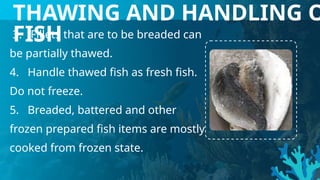
3. Fillets that are to be breaded can
be partially thawed.
4. Handle thawed fish as fresh fish.
Do not freeze.
5. Breaded, battered and other
frozen prepared fish items are mostly
cooked from frozen state.
THAWING AND HANDLING O
FISH
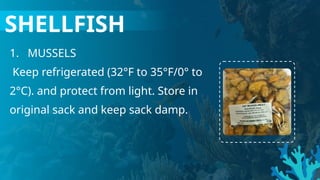
1. MUSSELS
Keep refrigerated (32°F to 35°F/0° to
2°C). and protect from light. Store in
original sack and keep sack damp.
SHELLFISH
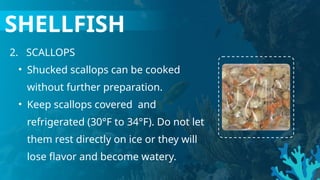
2. SCALLOPS
• Shucked scallops can be cooked
without further preparation.
• Keep scallops covered and
refrigerated (30°F to 34°F). Do not let
them rest directly on ice or they will
lose flavor and become watery.
SHELLFISH
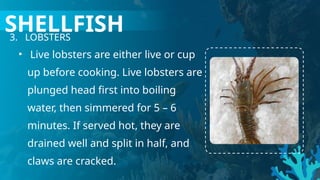
3. LOBSTERS
• Live lobsters are either live or cup
up before cooking. Live lobsters are
plunged head first into boiling
water, then simmered for 5 – 6
minutes. If served hot, they are
drained well and split in half, and
claws are cracked.
SHELLFISH
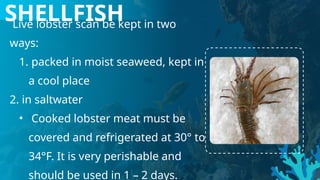
Live lobster scan be kept in two
ways:
1. packed in moist seaweed, kept in
a cool place
2. in saltwater
• Cooked lobster meat must be
covered and refrigerated at 30° to
34°F. It is very perishable and
should be used in 1 – 2 days.
SHELLFISH
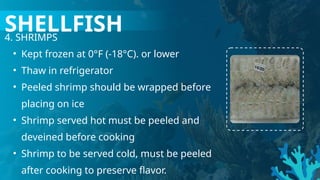
4. SHRIMPS
• Kept frozen at 0°F (-18°C). or lower
• Thaw in refrigerator
• Peeled shrimp should be wrapped before
placing on ice
• Shrimp served hot must be peeled and
deveined before cooking
• Shrimp to be served cold, must be peeled
after cooking to preserve flavor.
SHELLFISH
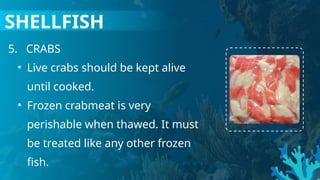
5. CRABS
• Live crabs should be kept alive
until cooked.
• Frozen crabmeat is very
perishable when thawed. It must
be treated like any other frozen
fish.
SHELLFISH

characteristic and market.pptx_2nd quarter

  • 1.
    Characteristics and Marketforms of Shellfish Characteristics Mollusks • Oysters have rough, irregular shells. • Flesh of oyster is extremely soft and delicate and contains a high percentage of water. • Hard-shell clams – can be eaten raw
  • 2.
    Characteristics and Marketforms of Shellfish • Soft-shell clams are called steamers. The usual way to cook is to steam. • The shells of mussels are not as heavy as clamshells, yellow to orange in color and firm but tender when cooked. • Scallops are creamy white in color and have a sweet flavor. • Squid is somewhat chewy and is cut up or fried quickly.
  • 3.
    Characteristics and Marketforms of Shellfish Crustaceans • The lobster shell is dark green or bluish green but turns red when cooked. • Live lobster must be alive when cooked.
  • 4.
    Market Forms Mollusks 1. livein the shell 2. shucked – fresh or frozen 3. canned Crustaceans 1. live 2. cooked meat, fresh or frozen
  • 5.
  • 6.
    CHECKING FRESHNESS OF FISH FinFish 1. Fresh and mild odor 2. eyes are clear, shiny and bulging 3.Red or pink gills
  • 7.
    CHECKING FRESHNESS OF FISH FinFish 4. The texture of flesh is firm or elastic 5. Shiny scales, and tightly cling, on skin
  • 8.
    Shellfish 1. Oysters, clams,mussels in the shell must be alive. Tightly closed shells when jostled. 2. Live or shucked oysters must have a very mild, sweet smell. 3. Discard any mussels that are very light in weight or seem to be hollow. 4. Strong fishy odor or a brownish color is a sign of age or spoilage. CHECKING FRESHNESS OF FISH
  • 9.
    Shellfish 5. Live lobstermust be alive when cooked. The meat will be firm and the tail springsback when straightened. 6. Frozen shrimps hould be solidly frozen when received. 7. Glazed shrimp should be shiny with no freezer burn. 8. All shrimps should smell fresh and sweet. A strong fishy or iodine smell indicates age or spoilage. CHECKING FRESHNESS OF FISH
  • 10.
    Shellfish 9. Live crabsshould be kept alive until cooked. 10. Frozen crab meat should be treated like any other frozen fish. CHECKING FRESHNESS OF FISH
  • 12.
  • 13.
    FRESH FISH 1. Store oncrushed ice. Use drip pans to allow drainage of melted ice. Change ice daily. Cover container or store in separate box away from other foods. The whole fish should be drawn because the entrails deteriorate rapidly. Cut fish should be wrapped or left in original moisture-proof wrap. 2. In a refrigerated box at 30°to 34°F (-1°to 1°C.
  • 14.
    FRESH FISH 3. Fresh fishmay be stored for 1 to 2 days. If kept longer, wrap and freeze immediately. 4. Check store fish for freshness just before using.
  • 15.
    1. Frozen productsshould be frozen, not thawed when received. 2. Items should be well wrapped, with no freezer burn. 3. Store at 0°F (-18°C. or colder. 4. Maximum storage time Fat fish -- 2 months. Lean fish -- 6 months 5. Rotate stock – first in, first out FROZEN FISH
  • 16.
    1. Thaw inthe refrigerator, never at room temperature. If pressed for time, keep in the original moisture-proof wrapper and thaw under cold running water. 2. Small pieces like fillets and steaks can be cooked from frozen state to prevent excessive drip loss. Large fish should be thawed for even cooking. THAWING AND HANDLING O FISH
  • 17.
    3. Fillets thatare to be breaded can be partially thawed. 4. Handle thawed fish as fresh fish. Do not freeze. 5. Breaded, battered and other frozen prepared fish items are mostly cooked from frozen state. THAWING AND HANDLING O FISH
  • 18.
    1. MUSSELS Keep refrigerated(32°F to 35°F/0° to 2°C). and protect from light. Store in original sack and keep sack damp. SHELLFISH
  • 19.
    2. SCALLOPS • Shuckedscallops can be cooked without further preparation. • Keep scallops covered and refrigerated (30°F to 34°F). Do not let them rest directly on ice or they will lose flavor and become watery. SHELLFISH
  • 20.
    3. LOBSTERS • Livelobsters are either live or cup up before cooking. Live lobsters are plunged head first into boiling water, then simmered for 5 – 6 minutes. If served hot, they are drained well and split in half, and claws are cracked. SHELLFISH
  • 21.
    Live lobster scanbe kept in two ways: 1. packed in moist seaweed, kept in a cool place 2. in saltwater • Cooked lobster meat must be covered and refrigerated at 30° to 34°F. It is very perishable and should be used in 1 – 2 days. SHELLFISH
  • 22.
    4. SHRIMPS • Keptfrozen at 0°F (-18°C). or lower • Thaw in refrigerator • Peeled shrimp should be wrapped before placing on ice • Shrimp served hot must be peeled and deveined before cooking • Shrimp to be served cold, must be peeled after cooking to preserve flavor. SHELLFISH
  • 23.
    5. CRABS • Livecrabs should be kept alive until cooked. • Frozen crabmeat is very perishable when thawed. It must be treated like any other frozen fish. SHELLFISH