WELCOME
HEALTH DEVICES AND ITS COMMUNICATION
State-of-the-art health monitoring devices and services has recently become more and more publicized and in some cases accessible in the form of test-applications. currently available telemonitoring devices use as many as different wireless standards  * Bluetooth, Zigbee, Ant, 900 MHz , WiFi * GPS * Ultra-wideband * 3G Long Term Evolution * 4G Mobile Systems
A variety of sensors are available to measure physiological state associated with health and fitness.  These are devices for measuring body weight, blood pressure, glucose levels, oxygenation, respiration and even heart activity by using low-cost ECG sensors. Increasingly, a second class of devices emerges which are  worn on the body  for 24 hours and collect data on multiple sensory channels as long as up to 7 days.
COMMUNICATION
Technologies Involved Short and medium range wireless networks Miniaturized sensors Battery technology Combination of these technologies are creating a variety of opportunities for remotely monitoring patient’s physiological functions and for providing information to and support for patients in managing their own health
DEVICES


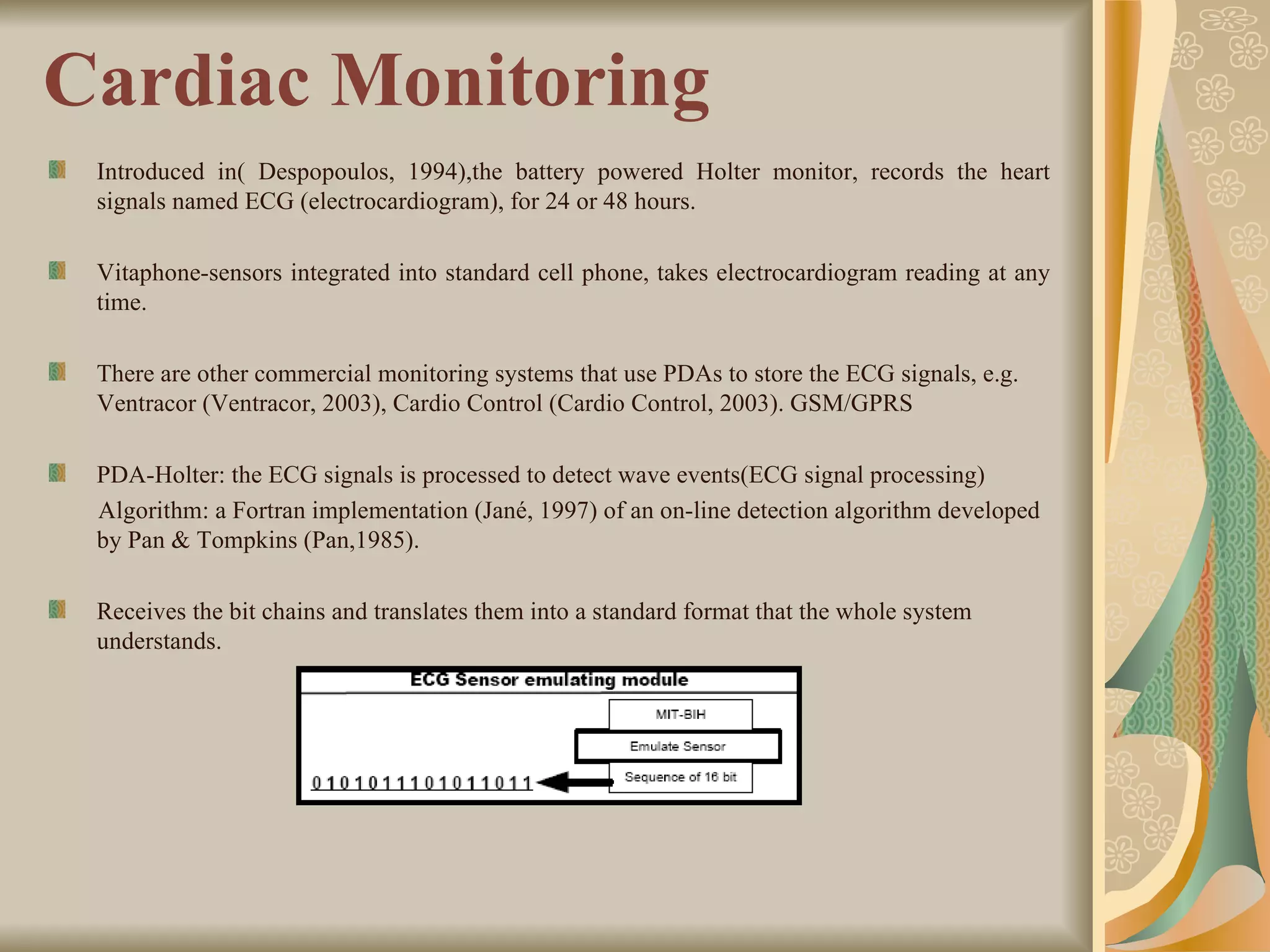
Cardiac Monitoring Introduced in( Despopoulos, 1994),the battery powered Holter monitor, records the heart signals named ECG (electrocardiogram), for 24 or 48 hours. Vitaphone-sensors integrated into standard cell phone, takes electrocardiogram reading at any time. There are other commercial monitoring systems that use PDAs to store the ECG signals, e.g. Ventracor (Ventracor, 2003), Cardio Control (Cardio Control, 2003). GSM/GPRS  PDA-Holter: the ECG signals is processed to detect wave events(ECG signal processing) Algorithm: a Fortran implementation (Jané, 1997) of an on-line detection algorithm developed by Pan & Tompkins (Pan,1985). Receives the bit chains and translates them into a standard format that the whole system understands.
CONTINUED.. The rhythm detection delays obtained is because the detection algorithm used needs the previous beat types and the next three ones, in order to detect the rhythm for the current beat. For packages of one second the PC achieves an average of 4.43 seconds in obtaining the rhythm,meanwhile the PDA needs 10.3 seconds, but, as the processing cannot be performed in real time, the rhythm detection delay would grow if the experiment duration were longer. The time needed for system to notify an alarm is T notify = t rhythm detection + t alarm compression + t communication latency
Micro Power Oximeter Fast, reliable SpO2 and Pulse Rate measurements on any patient. Data is transmitted from the oximeter board to the host at a rate of 60 packages per second. Data is formatted in 4 byte packets. The Micro Power Oximeter Board communicates with the host computer through a single, high-speed asynchronous serial channel at 3.3V CMOS levels. Data provided to the host includes %SpO2 (8 pulse beat average as well as instantaneous)
Onyx II 9560 Fingertip pulse oximeter Bluetooth wireless technology Oxygen Saturation Display Range- 0-100%spO2 Pulse Rate Display Range- 18 to 321 beats/min Measurement Wavelengths and Output Power * Red: 660 nanometers @ 0.8 mw    maximum average * Infrared: 910 nanometers @ 1.2 mw    maximum average
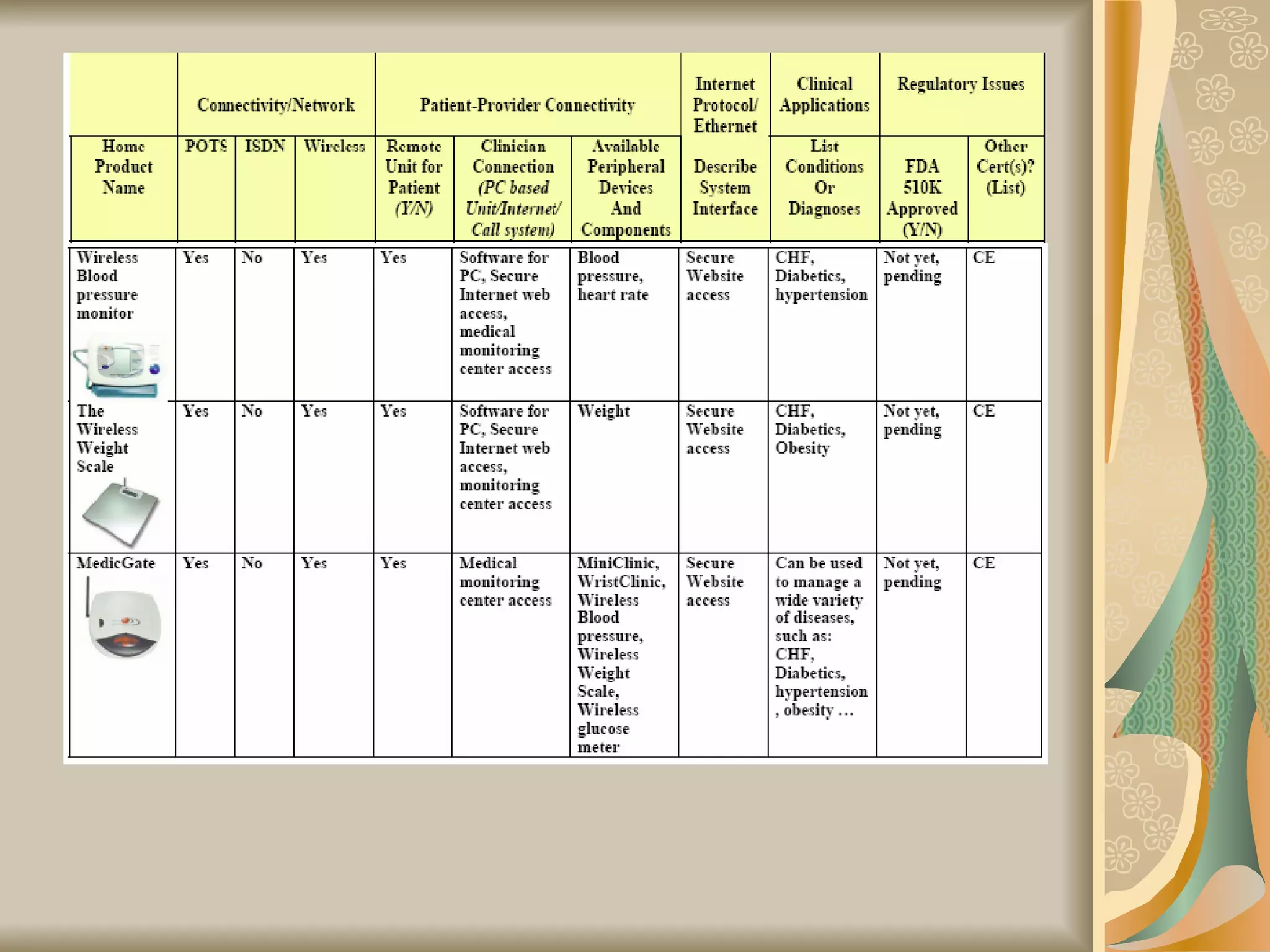
GlucoTel blood sugar monitoring   Measures the blood sugar level and then sends the test results using Bluetooth technology to the patient's cell phone.  The transmission from the cell phone to the internet database is done either by cell phone internet connection or normal text messaging. Both ways are automatic and do not require user interaction.  Other products are Pressure Tel and Weight Tel
 
REFERENCES
http://www.bodytel.com/en/patient/products/the_system.html http://www.nonin.com/productsList.asp?PageID=2000&sec=1&sub=0 www. draeger -   medical .com/MT/internet/EN/us/about/press/2005/doc/press_05_56e_masimo.pdf   ursafe.tesa.prd.fr/ursafe/new/CM/articles/paper014.pdf
THANK YOU

Sharmila Devices

  • 1.
  • 2.
    HEALTH DEVICES ANDITS COMMUNICATION
  • 3.
    State-of-the-art health monitoringdevices and services has recently become more and more publicized and in some cases accessible in the form of test-applications. currently available telemonitoring devices use as many as different wireless standards * Bluetooth, Zigbee, Ant, 900 MHz , WiFi * GPS * Ultra-wideband * 3G Long Term Evolution * 4G Mobile Systems
  • 4.
    A variety ofsensors are available to measure physiological state associated with health and fitness. These are devices for measuring body weight, blood pressure, glucose levels, oxygenation, respiration and even heart activity by using low-cost ECG sensors. Increasingly, a second class of devices emerges which are worn on the body for 24 hours and collect data on multiple sensory channels as long as up to 7 days.
  • 5.
  • 6.
    Technologies Involved Shortand medium range wireless networks Miniaturized sensors Battery technology Combination of these technologies are creating a variety of opportunities for remotely monitoring patient’s physiological functions and for providing information to and support for patients in managing their own health
  • 7.
  • 8.
  • 9.
  • 10.
  • 11.
    Cardiac Monitoring Introducedin( Despopoulos, 1994),the battery powered Holter monitor, records the heart signals named ECG (electrocardiogram), for 24 or 48 hours. Vitaphone-sensors integrated into standard cell phone, takes electrocardiogram reading at any time. There are other commercial monitoring systems that use PDAs to store the ECG signals, e.g. Ventracor (Ventracor, 2003), Cardio Control (Cardio Control, 2003). GSM/GPRS PDA-Holter: the ECG signals is processed to detect wave events(ECG signal processing) Algorithm: a Fortran implementation (Jané, 1997) of an on-line detection algorithm developed by Pan & Tompkins (Pan,1985). Receives the bit chains and translates them into a standard format that the whole system understands.
  • 12.
    CONTINUED.. The rhythmdetection delays obtained is because the detection algorithm used needs the previous beat types and the next three ones, in order to detect the rhythm for the current beat. For packages of one second the PC achieves an average of 4.43 seconds in obtaining the rhythm,meanwhile the PDA needs 10.3 seconds, but, as the processing cannot be performed in real time, the rhythm detection delay would grow if the experiment duration were longer. The time needed for system to notify an alarm is T notify = t rhythm detection + t alarm compression + t communication latency
  • 13.
    Micro Power OximeterFast, reliable SpO2 and Pulse Rate measurements on any patient. Data is transmitted from the oximeter board to the host at a rate of 60 packages per second. Data is formatted in 4 byte packets. The Micro Power Oximeter Board communicates with the host computer through a single, high-speed asynchronous serial channel at 3.3V CMOS levels. Data provided to the host includes %SpO2 (8 pulse beat average as well as instantaneous)
  • 14.
    Onyx II 9560Fingertip pulse oximeter Bluetooth wireless technology Oxygen Saturation Display Range- 0-100%spO2 Pulse Rate Display Range- 18 to 321 beats/min Measurement Wavelengths and Output Power * Red: 660 nanometers @ 0.8 mw maximum average * Infrared: 910 nanometers @ 1.2 mw maximum average
  • 15.
    GlucoTel blood sugarmonitoring Measures the blood sugar level and then sends the test results using Bluetooth technology to the patient's cell phone. The transmission from the cell phone to the internet database is done either by cell phone internet connection or normal text messaging. Both ways are automatic and do not require user interaction. Other products are Pressure Tel and Weight Tel
  • 16.
  • 17.
  • 18.
    http://www.bodytel.com/en/patient/products/the_system.html http://www.nonin.com/productsList.asp?PageID=2000&sec=1&sub=0 www.draeger - medical .com/MT/internet/EN/us/about/press/2005/doc/press_05_56e_masimo.pdf ursafe.tesa.prd.fr/ursafe/new/CM/articles/paper014.pdf
  • 19.