Ambulatory Devices Measuring
Cardiorespiratory Activity with Motion
Marcel Młyńczak, MSc, Marek Żyliński, MSc,

Wiktor Niewiadomski, PhD, Gerard Cybulski, PhD

Warsaw University of Technology, Faculty of Mechatronics,
Institute of Metrology and Biomedical Engineering
Porto, February 21, 2017
Introduction
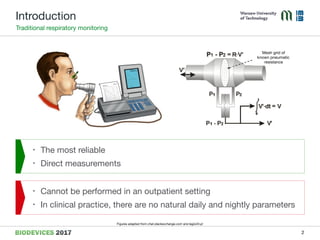
Traditional respiratory monitoring
Mesh grid of 

known pneumatic
resistance
• The most reliable

• Direct measurements
• Cannot be performed in an outpatient setting

• In clinical practice, there are no natural daily and nightly parameters
Figures adapted from chat.stackexchange.com and legio24.pl
2
Introduction
Ambulatory respiratory monitoring
Continuous
measurements
Traditional examination captures a single point in time. 

The registrations carried out under more natural conditions and taking into
account activity, circadian rhythms could expand early diagnosis.
Sleep
Indirect methods
PSG could mark snoring and central or obstructive sleep apnea episodes.
The breathing patterns are usually measured indirectly by 

a belt and a cannula, which make sleep less natural and comfortable.
Acoustical approaches, respiratory plethysmography or 

impedance pneumography.
3
Introduction
Impedance pneumography
Basic idea
Based on the measurement of the changes of transthoracic
bioimpedance, which could be linearily connected with changes 

of the amount of air in the lungs.
Taking
measurements
Processing
remarks
Usually carried out using current tetrapolar method.

Voltage electrodes are usually positioned on the 

midaxillary line at about 5th-rib level.
The signal is volume-related. 

In order to obtain flows impedance pneumography signals 

should be differentiated.
4
Introduction
Motion and heart activity
• Based on the present guidelines, each
sleep study device should be equipped
with pulse oximetry and heart activity
registration unit.

• Simultaneous analysis of heart activity
along with respiratory one could allow
assessment of the autonomic nervous
system operation. Such experiments 

are rarely carried out under natural
conditions.
• The calibration coefficients converting
impedance to volume are dependent
mainly upon subjects and body
positions.

• It seems also very important with
regards to sleep studies, e.g., for
hypnogram estimation.

• The motion-associated artifacts could 

be adaptively removed, smoothed, 

or marked using a synchronized 

motion signal.
Motion tracking Cardiorespiratory coupling
5
Objective
Development and pilot testing of portable devices which would register:

• respiratory activity (using impedance pneumography)

• ECG

• motion

• pulse oximetry (saturation, pulse wave)
1. 3.2.
Sleep studies
Sport 

applications
Physiological
applications
6
The devices
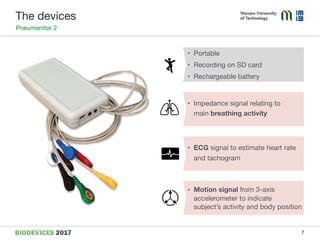
Pneumonitor 2
• ECG signal to estimate heart rate
and tachogram
• Impedance signal relating to 

main breathing activity
• Portable

• Recording on SD card

• Rechargeable battery
• Motion signal from 3-axis
accelerometer to indicate 

subject’s activity and body position
7
The devices
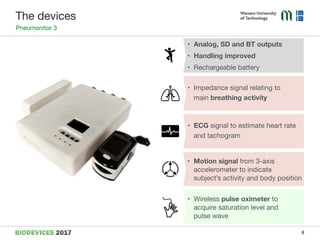
Pneumonitor 3
• ECG signal to estimate heart rate
and tachogram
• Impedance signal relating to 

main breathing activity
• Analog, SD and BT outputs
• Handling improved
• Rechargeable battery
• Wireless pulse oximeter to
acquire saturation level and 

pulse wave
• Motion signal from 3-axis
accelerometer to indicate 

subject’s activity and body position
8
Electrode configurations
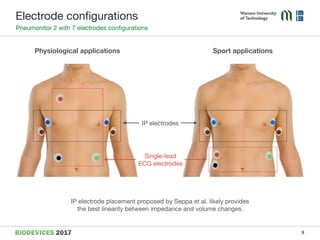
Pneumonitor 2 with 7 electrodes configurations
IP electrodes
Single-lead

ECG electrodes
IP electrode placement proposed by Seppa et al. likely provides 

the best linearity between impedance and volume changes.
9
Physiological applications Sport applications
Electrode configurations
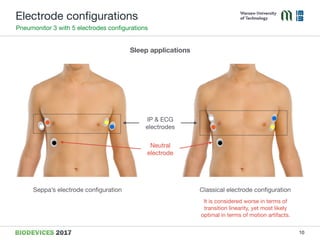
Pneumonitor 3 with 5 electrodes configurations
IP & ECG 

electrodes
Neutral 

electrode
Seppa’s electrode configuration Classical electrode configuration
It is considered worse in terms of 

transition linearity, yet most likely 

optimal in terms of motion artifacts.
10
Sleep applications
Methodology
• Calibration procedure - free 30-second-lasting breathing in supine, sitting and
standing body positions.

• Test procedure consisting of 6 normal breaths and then 6 deep breaths (with the
subjective difference), for three breathing rates (6, 10 and 15 BPM) and for the same
three body positions as during calibration.

• Reference: Flow Measurement System with a Spirometer Unit and a Fleisch-type 

Heatable Flow Transducer 5530, with a Conical Mouthpiece (Medikro Oy, Finland).

• Qualitative assessment of acquired signals and the usability from subjects’
perspective were tested during walking, climbing stairs, exercising on a cycle
ergometer for 90 seconds with the increasing load (from 50W to 200W).

• The activity and changing of body positions on a bed were tested during sleep.

• MATLAB 2016b software was used to review and analyze the results.
11
Methodology
Subjects - generally healthy students, 10 males
12
Minimum Mean Maximum
Weight [kg] 65.0 77.4 100.0
Height [cm] 171.0 179.3 187.0
BMI 20.75 24.14 33.41
Age 19 23 27
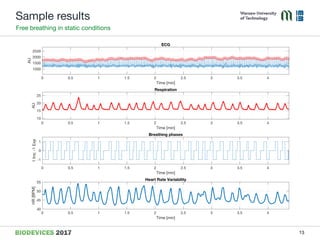
Sample results
Free breathing in static conditions
13
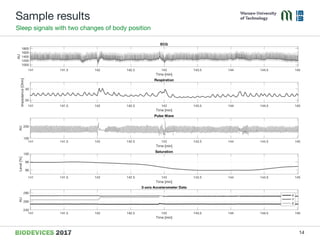
Sample results
Sleep signals with two changes of body position
14
Results
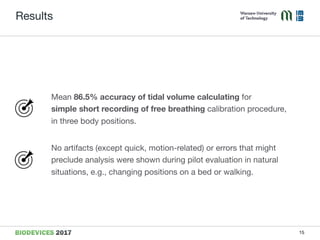
Mean 86.5% accuracy of tidal volume calculating for 

simple short recording of free breathing calibration procedure, 

in three body positions.

No artifacts (except quick, motion-related) or errors that might
preclude analysis were shown during pilot evaluation in natural
situations, e.g., changing positions on a bed or walking.
15
Final discussion
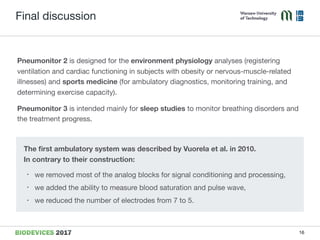
Pneumonitor 2 is designed for the environment physiology analyses (registering
ventilation and cardiac functioning in subjects with obesity or nervous-muscle-related
illnesses) and sports medicine (for ambulatory diagnostics, monitoring training, and
determining exercise capacity). 

Pneumonitor 3 is intended mainly for sleep studies to monitor breathing disorders and
the treatment progress.
The first ambulatory system was described by Vuorela et al. in 2010. 

In contrary to their construction: 

• we removed most of the analog blocks for signal conditioning and processing, 

• we added the ability to measure blood saturation and pulse wave, 

• we reduced the number of electrodes from 7 to 5.
16
Porto, February 21, 2017
Ambulatory Devices Measuring
Cardiorespiratory Activity with Motion
Marcel Młyńczak, MSc

mlynczak@mchtr.pw.edu.pl

Ambulatory Devices Measuring Cardiorespiratory Activity with Motion

  • 1.
    Ambulatory Devices Measuring CardiorespiratoryActivity with Motion Marcel Młyńczak, MSc, Marek Żyliński, MSc, Wiktor Niewiadomski, PhD, Gerard Cybulski, PhD Warsaw University of Technology, Faculty of Mechatronics, Institute of Metrology and Biomedical Engineering Porto, February 21, 2017
  • 2.
    Introduction Traditional respiratory monitoring Meshgrid of 
 known pneumatic resistance • The most reliable • Direct measurements • Cannot be performed in an outpatient setting • In clinical practice, there are no natural daily and nightly parameters Figures adapted from chat.stackexchange.com and legio24.pl 2
  • 3.
    Introduction Ambulatory respiratory monitoring Continuous measurements Traditionalexamination captures a single point in time. 
 The registrations carried out under more natural conditions and taking into account activity, circadian rhythms could expand early diagnosis. Sleep Indirect methods PSG could mark snoring and central or obstructive sleep apnea episodes. The breathing patterns are usually measured indirectly by 
 a belt and a cannula, which make sleep less natural and comfortable. Acoustical approaches, respiratory plethysmography or 
 impedance pneumography. 3
  • 4.
    Introduction Impedance pneumography Basic idea Basedon the measurement of the changes of transthoracic bioimpedance, which could be linearily connected with changes 
 of the amount of air in the lungs. Taking measurements Processing remarks Usually carried out using current tetrapolar method. Voltage electrodes are usually positioned on the 
 midaxillary line at about 5th-rib level. The signal is volume-related. 
 In order to obtain flows impedance pneumography signals 
 should be differentiated. 4
  • 5.
    Introduction Motion and heartactivity • Based on the present guidelines, each sleep study device should be equipped with pulse oximetry and heart activity registration unit. • Simultaneous analysis of heart activity along with respiratory one could allow assessment of the autonomic nervous system operation. Such experiments 
 are rarely carried out under natural conditions. • The calibration coefficients converting impedance to volume are dependent mainly upon subjects and body positions. • It seems also very important with regards to sleep studies, e.g., for hypnogram estimation. • The motion-associated artifacts could 
 be adaptively removed, smoothed, 
 or marked using a synchronized 
 motion signal. Motion tracking Cardiorespiratory coupling 5
  • 6.
    Objective Development and pilottesting of portable devices which would register: • respiratory activity (using impedance pneumography) • ECG • motion • pulse oximetry (saturation, pulse wave) 1. 3.2. Sleep studies Sport 
 applications Physiological applications 6
  • 7.
    The devices Pneumonitor 2 •ECG signal to estimate heart rate and tachogram • Impedance signal relating to 
 main breathing activity • Portable • Recording on SD card • Rechargeable battery • Motion signal from 3-axis accelerometer to indicate 
 subject’s activity and body position 7
  • 8.
    The devices Pneumonitor 3 •ECG signal to estimate heart rate and tachogram • Impedance signal relating to 
 main breathing activity • Analog, SD and BT outputs • Handling improved • Rechargeable battery • Wireless pulse oximeter to acquire saturation level and 
 pulse wave • Motion signal from 3-axis accelerometer to indicate 
 subject’s activity and body position 8
  • 9.
    Electrode configurations Pneumonitor 2with 7 electrodes configurations IP electrodes Single-lead ECG electrodes IP electrode placement proposed by Seppa et al. likely provides 
 the best linearity between impedance and volume changes. 9 Physiological applications Sport applications
  • 10.
    Electrode configurations Pneumonitor 3with 5 electrodes configurations IP & ECG electrodes Neutral electrode Seppa’s electrode configuration Classical electrode configuration It is considered worse in terms of 
 transition linearity, yet most likely 
 optimal in terms of motion artifacts. 10 Sleep applications
  • 11.
    Methodology • Calibration procedure- free 30-second-lasting breathing in supine, sitting and standing body positions. • Test procedure consisting of 6 normal breaths and then 6 deep breaths (with the subjective difference), for three breathing rates (6, 10 and 15 BPM) and for the same three body positions as during calibration. • Reference: Flow Measurement System with a Spirometer Unit and a Fleisch-type 
 Heatable Flow Transducer 5530, with a Conical Mouthpiece (Medikro Oy, Finland). • Qualitative assessment of acquired signals and the usability from subjects’ perspective were tested during walking, climbing stairs, exercising on a cycle ergometer for 90 seconds with the increasing load (from 50W to 200W). • The activity and changing of body positions on a bed were tested during sleep. • MATLAB 2016b software was used to review and analyze the results. 11
  • 12.
    Methodology Subjects - generallyhealthy students, 10 males 12 Minimum Mean Maximum Weight [kg] 65.0 77.4 100.0 Height [cm] 171.0 179.3 187.0 BMI 20.75 24.14 33.41 Age 19 23 27
  • 13.
    Sample results Free breathingin static conditions 13
  • 14.
    Sample results Sleep signalswith two changes of body position 14
  • 15.
    Results Mean 86.5% accuracyof tidal volume calculating for 
 simple short recording of free breathing calibration procedure, 
 in three body positions. No artifacts (except quick, motion-related) or errors that might preclude analysis were shown during pilot evaluation in natural situations, e.g., changing positions on a bed or walking. 15
  • 16.
    Final discussion Pneumonitor 2is designed for the environment physiology analyses (registering ventilation and cardiac functioning in subjects with obesity or nervous-muscle-related illnesses) and sports medicine (for ambulatory diagnostics, monitoring training, and determining exercise capacity). Pneumonitor 3 is intended mainly for sleep studies to monitor breathing disorders and the treatment progress. The first ambulatory system was described by Vuorela et al. in 2010. 
 In contrary to their construction: • we removed most of the analog blocks for signal conditioning and processing, • we added the ability to measure blood saturation and pulse wave, • we reduced the number of electrodes from 7 to 5. 16
  • 17.
    Porto, February 21,2017 Ambulatory Devices Measuring Cardiorespiratory Activity with Motion Marcel Młyńczak, MSc mlynczak@mchtr.pw.edu.pl