Promoting and Protecting your health!
   What is Wireless Medical Telemetry ?
     Wireless medical telemetry is generally used to monitor patient
    physiological parameters (e.g., cardiac signals) over a distance via radio-
    frequency (RF) communications between a transmitter worn by the
    patient and a central monitoring station.


   Advantage
    Allows patient movement without tethering the patient to a bedside
    monitor with a hard-wired connection.
Electromagnetic spectrum.
   Composed of alternating electric and magnetic fields travelling through
    space.
   What differentiates different types of electromagnetic energy is the
    wavelength of the fields.
   Wavelengths can vary dramatically, as can their effects. Eg-
    X-ray and gamma ray energy have wavelengths (10-10 – 10-14m) s

   Radio waves- longer wavelengths (1 -104m)
    Most commonly used for communication purposes.
    Wireless medical telemetry device - a device that transmits
    physiological signals via radio frequency (RF) from a transmitter worn by
    the patient to a remote receiver.
Steps Involved-

1) Amplify the bio-signal.
2) Once amplified, the signal can modulate the RF carrier generated by an
   oscillator.
3) The modulated RF signal can then be directly applied to the radiating
   antenna. The transmitter is usually powered by a small battery pack
   operating at a low voltage by minimizing the electrical hazards and risks to
   the patient.

Problems Involved-

Signal interference from other wireless devices.
For example, in many hospitals, there is often a sign not to use cell phones.
   Solution- (WMTS)
    It is a set of RF bands used solely for wireless medical telemetry
    applications.
     These frequencies are 608-614 MHz, 1395-1400 MHz, and 1427-1432
    MHz.
    Hence protected from interference caused by other RF sources such as
    wireless phones and wireless local area networks (WLAN).

   This, in turn, allows for faster and more reliable two–way
    communication.
   However, the WMTS bands are very narrow, making videos and voice
    transmission virtually impossible.
The BioRadio 150 operates within a set of RF bands known as the ISM
    bands.
   The ISM bands are 902-928 MHz, 2400-2500 MHz, and 5725-5875 MHz.
    The BioRadio 150 operates in the 902-928 MHz band.


    Advantage of ISM
    Increased bandwidth, making voice and video transmissions possible.

    However, this increased bandwidth is more susceptible to interference
    from devices such as wireless telephones and microwave ovens
    because they are not exclusive to medical telemetry equipment.
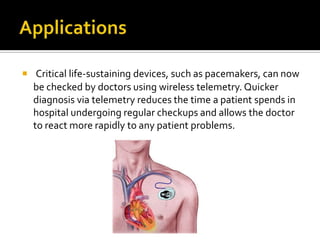
 Critical life-sustaining devices, such as pacemakers, can now
  be checked by doctors using wireless telemetry. Quicker
  diagnosis via telemetry reduces the time a patient spends in
  hospital undergoing regular checkups and allows the doctor
  to react more rapidly to any patient problems.
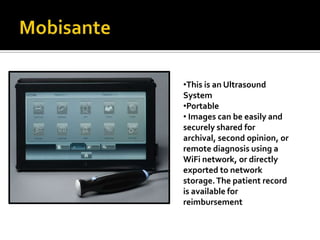
•This is an Ultrasound
System
•Portable
• Images can be easily and
securely shared for
archival, second opinion, or
remote diagnosis using a
WiFi network, or directly
exported to network
storage. The patient record
is available for
reimbursement
  Most recent wireless protocol in the medical space.
 Enables increased patient mobility and gives healthcare
  professionals easier access to patient data.
 Designed to allow small groups of up to eight devices
  communicate with each other over a Personal Area Network
  (PAN).
  These ad hoc networks, called piconets, have the potential
  to make the seamless integration of all key medical
  equipment in hospital rooms and at home possible.
 Patient privacy can easily be designed into products, since
  Bluetooth supports many security features, including
  password protection and encryption.
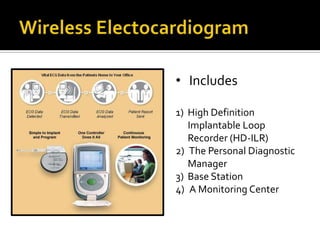
• Includes

1) High Definition
   Implantable Loop
   Recorder (HD-ILR)
2) The Personal Diagnostic
   Manager
3) Base Station
4) A Monitoring Center
Sleuth™ Wireless Electrocardiogram
                                     Monitoring System


•It is small and thin device ( size nearly to that of the smallest
pacemakers).
•The HD-ILR is implanted under the skin.


Working
The Personal Diagnostic Manager is a hand-held, multipurpose
device that automatically retrieves and stores relevant ECG data
from the HD-ILR, securely relays the information to the monitoring
center
   Data are collected in two ways:
    – Patients who feel faint can press a symptom button which tells
    the system to store the patient’s ECG strip during the time of the
    fainting spell.
    –The system automatically captures and stores the ECG strip
    when the patient’s heart rate is above or below physician
    programmed limits.

   At the third party Monitoring Center, certified cardiac technicians
    review the patient’s ECG data and provide information to the
    physician to aid in the diagnosis. Physicians can access this
    information via a secure Web portal, and have the reports
    faxed, mailed or e-mailed to them as they prefer.
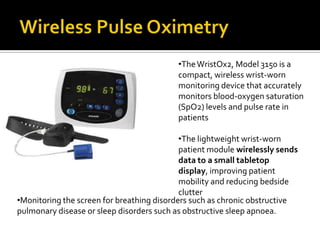
•The WristOx2, Model 3150 is a
                                           compact, wireless wrist-worn
                                           monitoring device that accurately
                                           monitors blood-oxygen saturation
                                           (SpO2) levels and pulse rate in
                                           patients

                                            •The lightweight wrist-worn
                                            patient module wirelessly sends
                                            data to a small tabletop
                                            display, improving patient
                                            mobility and reducing bedside
                                            clutter
•Monitoring the screen for breathing disorders such as chronic obstructive
pulmonary disease or sleep disorders such as obstructive sleep apnoea.
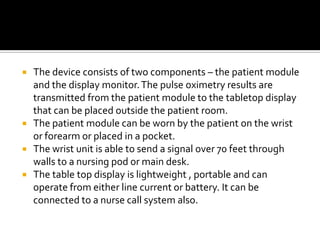
   The device consists of two components – the patient module
    and the display monitor. The pulse oximetry results are
    transmitted from the patient module to the tabletop display
    that can be placed outside the patient room.
   The patient module can be worn by the patient on the wrist
    or forearm or placed in a pocket.
   The wrist unit is able to send a signal over 70 feet through
    walls to a nursing pod or main desk.
   The table top display is lightweight , portable and can
    operate from either line current or battery. It can be
    connected to a nurse call system also.
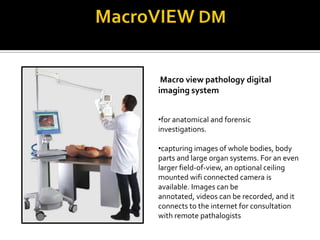
Macro view pathology digital
imaging system


•for anatomical and forensic
investigations.

•capturing images of whole bodies, body
parts and large organ systems. For an even
larger field-of-view, an optional ceiling
mounted wifi connected camera is
available. Images can be
annotated, videos can be recorded, and it
connects to the internet for consultation
with remote pathalogists
   Post- Operative Patients
   Maternity Unit
   Post-operative Cesarean Section
   New born Nursery
    Use of wireless techniques in medical science will bring
    out a sea-change with improvements in patient care
    treatment. Since the technology uses the existing
    communication infrastructure, it is easy to realize and
    implement wireless medical systems without much
    effort and cost.
   It will enable patients to move and perform their daily
    chores without any worry. Patients who need continuous
    monitoring can wear a telemetry device, which
    automatically sends vital signals to the hospital.
   There is a need to create an interest in this field and
    initiate research activities.
THANK YOU

Wireless telemetry systems

  • 1.
  • 2.
    What is Wireless Medical Telemetry ? Wireless medical telemetry is generally used to monitor patient physiological parameters (e.g., cardiac signals) over a distance via radio- frequency (RF) communications between a transmitter worn by the patient and a central monitoring station.  Advantage Allows patient movement without tethering the patient to a bedside monitor with a hard-wired connection.
  • 3.
    Electromagnetic spectrum.  Composed of alternating electric and magnetic fields travelling through space.  What differentiates different types of electromagnetic energy is the wavelength of the fields.  Wavelengths can vary dramatically, as can their effects. Eg- X-ray and gamma ray energy have wavelengths (10-10 – 10-14m) s  Radio waves- longer wavelengths (1 -104m) Most commonly used for communication purposes.  Wireless medical telemetry device - a device that transmits physiological signals via radio frequency (RF) from a transmitter worn by the patient to a remote receiver.
  • 4.
    Steps Involved- 1) Amplifythe bio-signal. 2) Once amplified, the signal can modulate the RF carrier generated by an oscillator. 3) The modulated RF signal can then be directly applied to the radiating antenna. The transmitter is usually powered by a small battery pack operating at a low voltage by minimizing the electrical hazards and risks to the patient. Problems Involved- Signal interference from other wireless devices. For example, in many hospitals, there is often a sign not to use cell phones.
  • 5.
    Solution- (WMTS) It is a set of RF bands used solely for wireless medical telemetry applications. These frequencies are 608-614 MHz, 1395-1400 MHz, and 1427-1432 MHz. Hence protected from interference caused by other RF sources such as wireless phones and wireless local area networks (WLAN).  This, in turn, allows for faster and more reliable two–way communication.  However, the WMTS bands are very narrow, making videos and voice transmission virtually impossible.
  • 6.
    The BioRadio 150operates within a set of RF bands known as the ISM bands.  The ISM bands are 902-928 MHz, 2400-2500 MHz, and 5725-5875 MHz. The BioRadio 150 operates in the 902-928 MHz band.  Advantage of ISM Increased bandwidth, making voice and video transmissions possible.  However, this increased bandwidth is more susceptible to interference from devices such as wireless telephones and microwave ovens because they are not exclusive to medical telemetry equipment.
  • 7.
     Critical life-sustainingdevices, such as pacemakers, can now be checked by doctors using wireless telemetry. Quicker diagnosis via telemetry reduces the time a patient spends in hospital undergoing regular checkups and allows the doctor to react more rapidly to any patient problems.
  • 8.
    •This is anUltrasound System •Portable • Images can be easily and securely shared for archival, second opinion, or remote diagnosis using a WiFi network, or directly exported to network storage. The patient record is available for reimbursement
  • 9.
     Mostrecent wireless protocol in the medical space.  Enables increased patient mobility and gives healthcare professionals easier access to patient data.  Designed to allow small groups of up to eight devices communicate with each other over a Personal Area Network (PAN). These ad hoc networks, called piconets, have the potential to make the seamless integration of all key medical equipment in hospital rooms and at home possible.  Patient privacy can easily be designed into products, since Bluetooth supports many security features, including password protection and encryption.
  • 10.
    • Includes 1) HighDefinition Implantable Loop Recorder (HD-ILR) 2) The Personal Diagnostic Manager 3) Base Station 4) A Monitoring Center
  • 11.
    Sleuth™ Wireless Electrocardiogram Monitoring System •It is small and thin device ( size nearly to that of the smallest pacemakers). •The HD-ILR is implanted under the skin. Working The Personal Diagnostic Manager is a hand-held, multipurpose device that automatically retrieves and stores relevant ECG data from the HD-ILR, securely relays the information to the monitoring center
  • 12.
    Data are collected in two ways: – Patients who feel faint can press a symptom button which tells the system to store the patient’s ECG strip during the time of the fainting spell. –The system automatically captures and stores the ECG strip when the patient’s heart rate is above or below physician programmed limits.  At the third party Monitoring Center, certified cardiac technicians review the patient’s ECG data and provide information to the physician to aid in the diagnosis. Physicians can access this information via a secure Web portal, and have the reports faxed, mailed or e-mailed to them as they prefer.
  • 13.
    •The WristOx2, Model3150 is a compact, wireless wrist-worn monitoring device that accurately monitors blood-oxygen saturation (SpO2) levels and pulse rate in patients •The lightweight wrist-worn patient module wirelessly sends data to a small tabletop display, improving patient mobility and reducing bedside clutter •Monitoring the screen for breathing disorders such as chronic obstructive pulmonary disease or sleep disorders such as obstructive sleep apnoea.
  • 14.
    The device consists of two components – the patient module and the display monitor. The pulse oximetry results are transmitted from the patient module to the tabletop display that can be placed outside the patient room.  The patient module can be worn by the patient on the wrist or forearm or placed in a pocket.  The wrist unit is able to send a signal over 70 feet through walls to a nursing pod or main desk.  The table top display is lightweight , portable and can operate from either line current or battery. It can be connected to a nurse call system also.
  • 15.
    Macro view pathologydigital imaging system •for anatomical and forensic investigations. •capturing images of whole bodies, body parts and large organ systems. For an even larger field-of-view, an optional ceiling mounted wifi connected camera is available. Images can be annotated, videos can be recorded, and it connects to the internet for consultation with remote pathalogists
  • 16.
    Post- Operative Patients  Maternity Unit  Post-operative Cesarean Section  New born Nursery
  • 17.
    Use of wireless techniques in medical science will bring out a sea-change with improvements in patient care treatment. Since the technology uses the existing communication infrastructure, it is easy to realize and implement wireless medical systems without much effort and cost.  It will enable patients to move and perform their daily chores without any worry. Patients who need continuous monitoring can wear a telemetry device, which automatically sends vital signals to the hospital.  There is a need to create an interest in this field and initiate research activities.
  • 18.