Chapter 7: Control Techniques

        October 23, 2012
Roadmap
• Discuss Reflection Assignment #2
  – Due Nov. 1 via BlackBoard
• Coming Up: Exam #3 next Tuesday, Oct. 30
• Quick review
• Chapter 7
Factorial Designs
• When to use
• Main and interaction effects
• Effect patterns in data displays
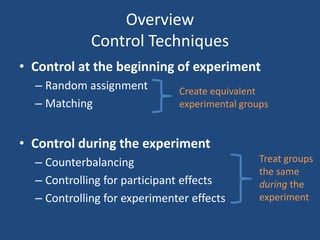
Overview
             Control Techniques
• Control at the beginning of experiment
  – Random assignment         Create equivalent
  – Matching                  experimental groups


• Control during the experiment
  – Counterbalancing                           Treat groups
                                               the same
  – Controlling for participant effects        during the
  – Controlling for experimenter effects       experiment
Methods for Matching Participants
• Holding variables constant
• Building the extraneous variable into the
  design
• Yoked control
• Equating participants
Matching by Holding Variables
               Constant
• Hold extraneous variable constant for all
  groups in the experiment

• All participants in each treatment group will
  have same degree or type of extraneous
  variable

• Requires selection criteria for participant
  sample
Build Extraneous Variable into the
            Research Design
• Especially useful if you are interested in:
  – Differences produced by the levels of the
    extraneous variable
  – Interaction between levels of IV and levels of
    extraneous variable


• Sound familiar?
  – What kind of research design would this be?
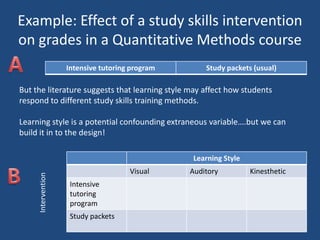
Example: Effect of a study skills intervention
on grades in a Quantitative Methods course
                    Intensive tutoring program       Study packets (usual)

But the literature suggests that learning style may affect how students
respond to different study skills training methods.

Learning style is a potential confounding extraneous variable….but we can
build it in to the design!

                                                 Learning Style
                                      Visual     Auditory         Kinesthetic
     Intervention


                     Intensive
                     tutoring
                     program
                     Study packets
Matching by Equating Participants
Precision control
• Match each participant in experimental group
  with a participant in control group on
  variable(s) of concern

• Example: Scholtz (1973) compared defense
  styles in suicide attempt vs. no attempt
Matching by Yoked Control
• Match participants on the basis of the
  sequence of administering an event
• Each control participant is “yoked” to an
  experimental participant
• Controls for the possible influence of
  participant-controlled events
• Example: Sklar & Anisan (1979)
  – stress and immune response
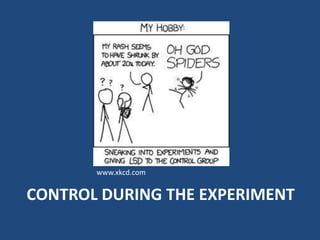
www.xkcd.com


CONTROL DURING THE EXPERIMENT
Control During the Experiment
• Must treat the different groups in the same
  way during the experiment, except for
  administration of the IV

• Why is this important?
• Control during the experiment
  – Counterbalancing            within-participants designs
  – Controlling for participant effects
  – Controlling for experimenter effects
Counterbalancing
• Used to control for sequencing effects in a
  repeated measures (aka within-subjects) design

• Sequencing effects occur when participants
  participate in more than one condition

• Two types of sequencing effects
  – Order effect
  – Carryover effect
Counterbalancing
• Order effect
  – “Arises from the order in which treatment
    conditions are administered to participants”
  – Treatment/experiment exposure can influence
    performance on subsequent tasks and measures
  – Most common:
     • Practice effect
     • fatigue
Counterbalancing
• Carryover effect
  – Performance in one condition is affected by the
    condition that precedes it
  – Example: Participant receives active drug before
    the placebo, and the residual effects are still
    present during placebo condition


• One strategy: “wash-out” period
Counterbalancing Techniques
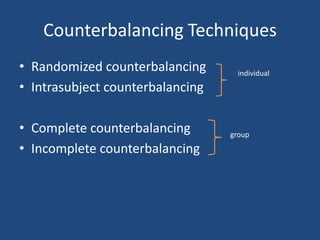
• Randomized counterbalancing       individual
• Intrasubject counterbalancing

• Complete counterbalancing       group
• Incomplete counterbalancing
Types of Counterbalancing
• Randomized counterbalancing
  – Sequence order is randomly determined for each
    individual
  – Just like random assignment to conditions
  – You do not decide the sequence, must use a random process to decide
    order
Types of Counterbalancing
• Intrasubject Counterbalancing
  – When each participant receives all levels of the IV
    more than one time
  – Have participants take conditions first in one
    order, then again in the reverse order

  – Disadvantage: Participant burden is increased
     • Must complete each condition more than once
Types of Counterbalancing
• Complete and Incomplete counterbalancing
  – Group counterbalancing
  – Determine possible sequences
  – Randomly assign to sequence such that sequences
    are distributed across groups rather than
    individuals
Participant Effects
• Demand characteristics
  – Cues in the experiment that might influence
    participant behavior


• Positive self-presentation
  – Motivation for participants to present themselves
    in a positive light
Control of Participant Effects
• Deception
  – Giving participants a bogus rationale for the
    experiment


• Can range from minor deceit to more
  elaborate schemes
        Classic example: Milgram studies
Control of Participant Interpretation
• Previously discussed methods provide good
  control for demand characteristics of study

• But how do we know what participants’
  perceptions of our study are?
  – Ask them!
Control of Participant Interpretation
• Retrospective Verbal Reports: after experiment
  – Disadvantage: Participants might forget
    perceptions by the end of the study


• Concurrent Verbal Reports: during experiment
  – Solomon’s Sacrifice Groups
  – Concurrent probing
  – Think-aloud technique
Control of Experimenter Effects
• Experimenter effects
  – The biasing influence that can be exerted by the
    experimenter


• Data Recording errors--control
  –   Be careful
  –   Multiple observers and data recorders
  –   Keep experimenter blind to participants’ conditions
  –   Electronic or mechanical data recording*
Control of Experimenter Effects
• Experimenter Attribute Errors
  – Some experimenters, because of their attributes,
    produce more of an effect than other
    experimenters


• Control technique:
  – Experimenters should run all conditions
  – Experimenters same on characteristics that might
    affect DV
Control of Experimenter Effects
• Experimenter Expectancy Errors
  – Experimenter’s expectations about the study
    influence participant responses


Control techniques:
• Blind technique
• Partial blind technique
• Automation
Ideal:
 Control Participant AND Experimenter Effects
• Double-Blind Placebo Method
  – Participant and experimenter blind to condition
  – “Devise manipulations that appear essentially
    identical to research participants in all conditions”
  – Example: Compare drug to identical sugar pill
    (placebo)

Chapter 7 class version(1)

  • 1.
    Chapter 7: ControlTechniques October 23, 2012
  • 2.
    Roadmap • Discuss ReflectionAssignment #2 – Due Nov. 1 via BlackBoard • Coming Up: Exam #3 next Tuesday, Oct. 30 • Quick review • Chapter 7
  • 3.
    Factorial Designs • Whento use • Main and interaction effects • Effect patterns in data displays
  • 4.
    Overview Control Techniques • Control at the beginning of experiment – Random assignment Create equivalent – Matching experimental groups • Control during the experiment – Counterbalancing Treat groups the same – Controlling for participant effects during the – Controlling for experimenter effects experiment
  • 5.
    Methods for MatchingParticipants • Holding variables constant • Building the extraneous variable into the design • Yoked control • Equating participants
  • 6.
    Matching by HoldingVariables Constant • Hold extraneous variable constant for all groups in the experiment • All participants in each treatment group will have same degree or type of extraneous variable • Requires selection criteria for participant sample
  • 7.
    Build Extraneous Variableinto the Research Design • Especially useful if you are interested in: – Differences produced by the levels of the extraneous variable – Interaction between levels of IV and levels of extraneous variable • Sound familiar? – What kind of research design would this be?
  • 8.
    Example: Effect ofa study skills intervention on grades in a Quantitative Methods course Intensive tutoring program Study packets (usual) But the literature suggests that learning style may affect how students respond to different study skills training methods. Learning style is a potential confounding extraneous variable….but we can build it in to the design! Learning Style Visual Auditory Kinesthetic Intervention Intensive tutoring program Study packets
  • 9.
    Matching by EquatingParticipants Precision control • Match each participant in experimental group with a participant in control group on variable(s) of concern • Example: Scholtz (1973) compared defense styles in suicide attempt vs. no attempt
  • 10.
    Matching by YokedControl • Match participants on the basis of the sequence of administering an event • Each control participant is “yoked” to an experimental participant • Controls for the possible influence of participant-controlled events • Example: Sklar & Anisan (1979) – stress and immune response
  • 11.
  • 12.
    Control During theExperiment • Must treat the different groups in the same way during the experiment, except for administration of the IV • Why is this important?
  • 13.
    • Control duringthe experiment – Counterbalancing within-participants designs – Controlling for participant effects – Controlling for experimenter effects
  • 14.
    Counterbalancing • Used tocontrol for sequencing effects in a repeated measures (aka within-subjects) design • Sequencing effects occur when participants participate in more than one condition • Two types of sequencing effects – Order effect – Carryover effect
  • 15.
    Counterbalancing • Order effect – “Arises from the order in which treatment conditions are administered to participants” – Treatment/experiment exposure can influence performance on subsequent tasks and measures – Most common: • Practice effect • fatigue
  • 16.
    Counterbalancing • Carryover effect – Performance in one condition is affected by the condition that precedes it – Example: Participant receives active drug before the placebo, and the residual effects are still present during placebo condition • One strategy: “wash-out” period
  • 17.
    Counterbalancing Techniques • Randomizedcounterbalancing individual • Intrasubject counterbalancing • Complete counterbalancing group • Incomplete counterbalancing
  • 18.
    Types of Counterbalancing •Randomized counterbalancing – Sequence order is randomly determined for each individual – Just like random assignment to conditions – You do not decide the sequence, must use a random process to decide order
  • 19.
    Types of Counterbalancing •Intrasubject Counterbalancing – When each participant receives all levels of the IV more than one time – Have participants take conditions first in one order, then again in the reverse order – Disadvantage: Participant burden is increased • Must complete each condition more than once
  • 20.
    Types of Counterbalancing •Complete and Incomplete counterbalancing – Group counterbalancing – Determine possible sequences – Randomly assign to sequence such that sequences are distributed across groups rather than individuals
  • 21.
    Participant Effects • Demandcharacteristics – Cues in the experiment that might influence participant behavior • Positive self-presentation – Motivation for participants to present themselves in a positive light
  • 22.
    Control of ParticipantEffects • Deception – Giving participants a bogus rationale for the experiment • Can range from minor deceit to more elaborate schemes Classic example: Milgram studies
  • 23.
    Control of ParticipantInterpretation • Previously discussed methods provide good control for demand characteristics of study • But how do we know what participants’ perceptions of our study are? – Ask them!
  • 24.
    Control of ParticipantInterpretation • Retrospective Verbal Reports: after experiment – Disadvantage: Participants might forget perceptions by the end of the study • Concurrent Verbal Reports: during experiment – Solomon’s Sacrifice Groups – Concurrent probing – Think-aloud technique
  • 25.
    Control of ExperimenterEffects • Experimenter effects – The biasing influence that can be exerted by the experimenter • Data Recording errors--control – Be careful – Multiple observers and data recorders – Keep experimenter blind to participants’ conditions – Electronic or mechanical data recording*
  • 26.
    Control of ExperimenterEffects • Experimenter Attribute Errors – Some experimenters, because of their attributes, produce more of an effect than other experimenters • Control technique: – Experimenters should run all conditions – Experimenters same on characteristics that might affect DV
  • 27.
    Control of ExperimenterEffects • Experimenter Expectancy Errors – Experimenter’s expectations about the study influence participant responses Control techniques: • Blind technique • Partial blind technique • Automation
  • 28.
    Ideal: Control ParticipantAND Experimenter Effects • Double-Blind Placebo Method – Participant and experimenter blind to condition – “Devise manipulations that appear essentially identical to research participants in all conditions” – Example: Compare drug to identical sugar pill (placebo)