CLASSROOM
RESEARCH METHOD
Silvia Nanda Putri Erito
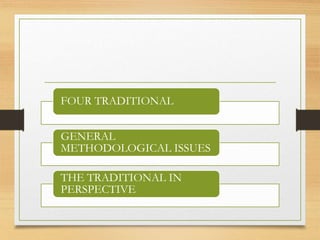
FOUR TRADITIONAL
GENERAL
METHODOLOGICAL ISSUES
THE TRADITIONAL IN
PERSPECTIVE
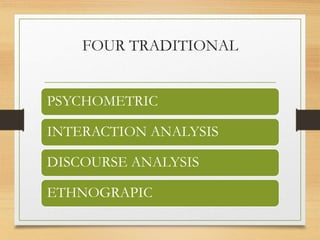
FOUR TRADITIONAL
PSYCHOMETRIC
INTERACTION ANALYSIS
DISCOURSE ANALYSIS
ETHNOGRAPIC
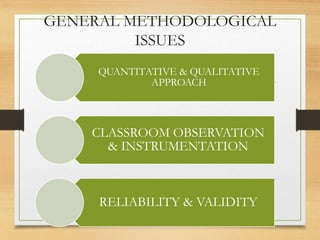
GENERAL METHODOLOGICAL
ISSUES
QUANTITATIVE & QUALITATIVE
APPROACH
CLASSROOM OBSERVATION
& INSTRUMENTATION
RELIABILITY & VALIDITY
QUANTITATIVE
The Purpose is to generalize, to predict, and to posit
causal relationship.
There is statistical analysis.
QUALITATIVE
The purpose is to contextualize and to interpret.
There is a interpretive analysis of the data and
categorization of the data.
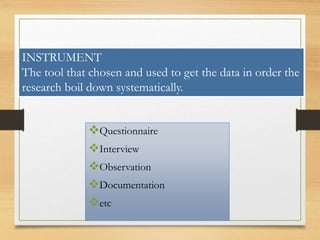
Questionnaire
Interview
Observation
Documentation
etc
INSTRUMENT
The tool that chosen and used to get the data in order the
research boil down systematically.
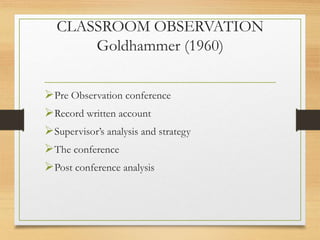
CLASSROOM OBSERVATION
Goldhammer (1960)
Pre Observation conference
Record written account
Supervisor’s analysis and strategy
The conference
Post conference analysis
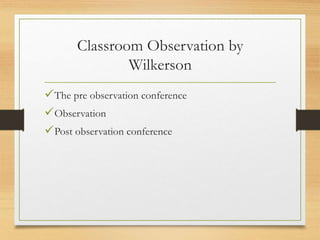
Classroom Observation by
Wilkerson
The pre observation conference
Observation
Post observation conference
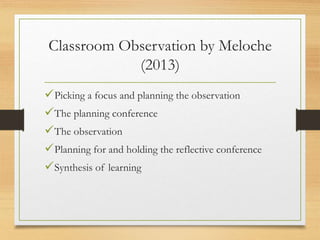
Classroom Observation by Meloche
(2013)
Picking a focus and planning the observation
The planning conference
The observation
Planning for and holding the reflective conference
Synthesis of learning
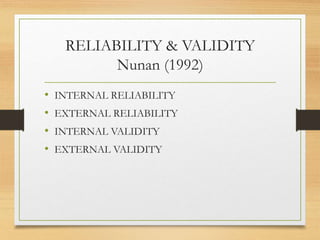
RELIABILITY & VALIDITY
Nunan (1992)
• INTERNAL RELIABILITY
• EXTERNAL RELIABILITY
• INTERNAL VALIDITY
• EXTERNAL VALIDITY
Traditions in Perspective
• Psychometric approach
• Interaction analysis approach
• Discourse analysis approach
• Ethnographic approach
Psychometric Approach
• Concerns with quantitative results
• Employs experiments, statistical test, and control
groups
• Often uses to measure the improvement of students’
test scores after being exposed to a different teaching
method
Interaction Analysis
Approach
• Used to study spontaneous teaching behaviour and used
in projects which attempt to help teachers modify their
behaviour.
• In recent years, a much greater role has been attributed
to interactive features of classroom behaviors, such as
turn-taking, questioning and answering, negotiation of
meaning, and feedback
Purposes of Interaction
Analysis Approach
• Developing skill in observation of teaching
• Providing a tool for the analysis of teaching
• Providing a tool for feedback
• Setting framework for practicing and learning
Discourse Analysis
Approach
• Educational researchers using discourse analysis as a
method/tool of inquiry to wrestle with questions of
context, definitions of “text,” and notions of
discourse
• It has contributed to a growth in awareness of the
internal formal structure and functional purpose of
the verbal classroom interaction
• It explores key contributions in the study of discourse,
including how underlying social systems shape
interaction, how identities are constructed in and
through talk, the relationship between interaction and
learning in both formal and informal educational
contexts, and how embodiment, multimodality, and
virtual spaces offer new sites of analysis
Analytical Units Employed in L2
Discourse Analysis
• Structural units
i.e. utterance, turn, etc
• Functional units
i.e. repetition, expansion, etc
Ethnographic Approach
• Concerns with qualitative results
• Uses surveys, systematic observation, and
journals
• Ethnographic research is often applied in research on
the classroom “culture” or some other aspect of
students’ learning experience
• Classroom ethnography emphasizes the sociocultural
nature of teaching and learning processes, and
behaviour.

Classroom research method