
Research Design:
Case Study
Lecturer: Yee Bee Choo
IPGKTHO
Topic 1f
What is Case Study
• Yin (1994:23) defines the case study research
method “as an empirical inquiry that investigates
a contemporary phenomenon within its real-life
context; when the boundaries between
phenomenon and context are not clearly
evident; and in which multiple sources of
evidence are used.”
• A method to deeply observe the characteristics
of individual unit such as a person, a group or a
community, in order to analyse various
phenomena in relation to that unit of study.
What is Case Study
• A case study is an in-depth exploration of a
bounded system (e.g., activity, event, process, or
individuals) based on extensive data collection
(Creswell, 2007).
• Bounded means that the case is separated out
for research in terms of time, place, or some
physical boundaries (Creswell, 2012).
• Stenhouse (1999) states that the task of case
study is to produce reports of experience and to
offer evidence, not to deal with generalisation.
What is Case Study
• The “case” may be a single individual, several
individuals separately or in a group, a programme,
events, or activities (e.g., a teacher, several teachers,
or the implementation of a new Maths programme).
• The “case” may represent a process consisting of a
series of steps (e.g., a college curriculum process)
that form a sequence of activities.
• A case study differs from ethnography as it focuses
on a programme, event, or activity involving
individuals rather than a group.
• Also, a researcher in a case study is more interested
in describing the activities of the group instead of
identifying shared patterns of behaviour exhibited
by the group.
When do Use Case Study
1. The types of questions to be answered (to answer how
and why questions)
2. The extent of control over behavioural events (when
the relevant behaviour cannot be manipulated)
3. The degree of focus on contemporary as opposed to
historical events (Typically case study research uses a
variety of evidence from different sources, such as
documents, artefacts, interviews and observation, and
this goes beyond the range of sources of evidence that
might be available in historical study.)
It is useful when “A how or why question is being asked
about a contemporary set of events over which the
investigator has little or no control” (Yin, 1994, p.9).
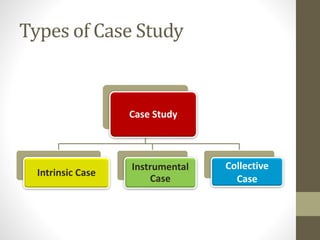
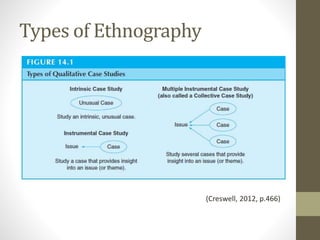
Types of Case Study
Case Study
Intrinsic Case
Instrumental
Case
Collective
Case
Types of Case Study
Intrinsic Case
• It is undertaken because of researcher intrinsic
interests, and aims to get deep understanding of
a certain case (Stake, 2005).
• The study of a bilingual school illustrates this
form of a case study (Stake, 2000).
Types of Case Study
Instrumental Case
• It provides a base to understand other issues.
Usually this case is a secondary interest of the
researcher and used to support other interest
(Stake, 2005).
• For example, the issue of language learning
might be studied in a case study of a bilingual
school.
Types of Case Study
Multiple or Collective Case Study
• It investigates whether there are similarities or
differences among the cases’ characteristics to
get better understanding of particular interests
(Stake, 2005).
• A case study researcher might examine several
schools to illustrate alternative approaches to
school choice for students.
Types of Ethnography
(Creswell, 2012, p.466)
Characteristics of Case Study
1. Social actions and social structures: The study object is
always in some way related to people, more
specifically, interpretations of the social actors’
perception of a given phenomena or the meaning
actors attribute to a phenomena. Moreover,
individuals are studied in their natural environment.
2. Contemporary: The researcher is interested in a
contemporary phenomenon, historical studies are thus
excluded.
3. Holistic: One’s perspective is holistic when trying to
understand and explain what happens and why it
happens. It thus becomes important to understand
and identify contextual factors that surround the unit
of analysis.
(Grunbaum, 2007)
Characteristics of Case Study
4. Multi research purpose: Case studies are primarily
qualitative and the objective can be descriptive,
exploratory and/or explanatory, that is, they can
be theory generating or contribute to
modifications of theory.
5. Controllability: The researcher has no control of
crucial events evolving in the studied context.
6. Triangulation: The researcher applies numerous
data sources in the search of understanding.
7. “Thick” description: “Rich” and contextual
accounts are produced based on the case study
(Grunbaum, 2007)
Advantages of Case Study
• A lot of rich and in-depth data can be collected.
• Case study provides a holistic interpretation and
always refers to a social context.
• It can be conducted on rare cases where large
samples of similar participants are not available.
E.g. cases of brain damage.
• Within the case study, scientific experiments can
be conducted to produce hypotheses which can
be used for later testing.
Disadvantages of Case Study
• The data collected cannot necessarily be generalised
to the wider population.
• Some case studies are not scientific. The researchers
may not be able to cover all issues and offer a
scientific generalisation because they tend to have
limited evidence, not as many as quantitative
research .
• Case studies are generally on one person or a few
people, but there also tends to only be one
researcher collecting the data. This can lead to bias
in data collection.
• It is also very difficult to draw a definite cause/effect
from case studies.
Steps in Conducting Case Study
1. Conceptualisations of the topic
2. Select and emphasise a particular phenomenon,
and deciding the research questions
3. Collect all the raw data from interviews,
observations or documents such as programme
files or reports, articles, and proposals.
4. Organise, classify and edit the raw data into an
accessible file
5. Formulate triangulation of observations and
develop interpretation.
6. Select an alternative interpretation followed by
writing a report in holistic and systematic forms.
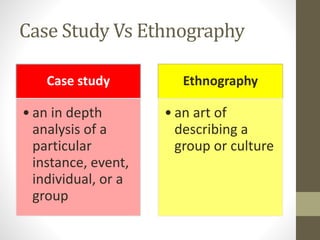
Case Study Vs Ethnography
Case study
• an in depth
analysis of a
particular
instance, event,
individual, or a
group
Ethnography
• an art of
describing a
group or culture
Case Study Vs Ethnography
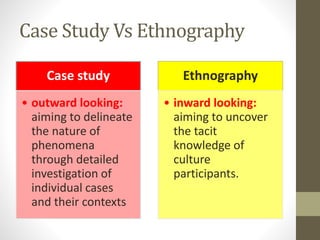
Case study
• outward looking:
aiming to delineate
the nature of
phenomena
through detailed
investigation of
individual cases
and their contexts
Ethnography
• inward looking:
aiming to uncover
the tacit
knowledge of
culture
participants.
Case Study Vs Ethnography
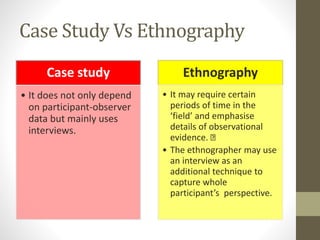
Case study
• It does not only depend
on participant-observer
data but mainly uses
interviews.
Ethnography
• It may require certain
periods of time in the
‘field’ and emphasise
details of observational
evidence.
• The ethnographer may use
an interview as an
additional technique to
capture whole
participant’s perspective.
Case Study Vs Ethnography
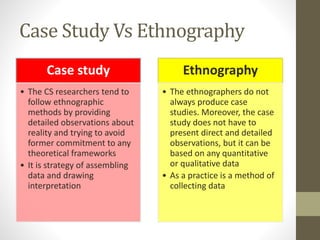
Case study
• The CS researchers tend to
follow ethnographic
methods by providing
detailed observations about
reality and trying to avoid
former commitment to any
theoretical frameworks
• It is strategy of assembling
data and drawing
interpretation
Ethnography
• The ethnographers do not
always produce case
studies. Moreover, the case
study does not have to
present direct and detailed
observations, but it can be
based on any quantitative
or qualitative data
• As a practice is a method of
collecting data
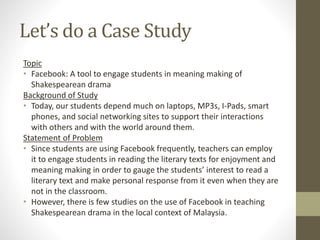
Let’s do a Case Study
Topic
• Facebook: A tool to engage students in meaning making of
Shakespearean drama
Background of Study
• Today, our students depend much on laptops, MP3s, I-Pads, smart
phones, and social networking sites to support their interactions
with others and with the world around them.
Statement of Problem
• Since students are using Facebook frequently, teachers can employ
it to engage students in reading the literary texts for enjoyment and
meaning making in order to gauge the students’ interest to read a
literary text and make personal response from it even when they are
not in the classroom.
• However, there is few studies on the use of Facebook in teaching
Shakespearean drama in the local context of Malaysia.
Let’s do a Case Study
Purpose of Study
• To explore how Shakespearean drama can be taught and learnt
through online social network in particular Facebook
Research Objective
• To investigate the use of Facebook to help the students in meaning
making of Shakespearean drama
Research Question
• How does Facebook facilitates students’ learning in meaning making
of Shakespearean drama
Scope of Study
• A group of twenty students who took the course “Drama in English”
(TSL1064) in the second semester in the foundation course at an
Institute of Teacher Education Campus in Johor, Malaysia
Let’s do a Case Study
Limitations of Study
• This study involved only twenty students and the results
cannot be generalised to the wider population.
Significance of Study
• Teachers can integrate online social network in the
teaching and learning processes to facilitate students’
learning experiences as well as encourage participation
in class.
• Students can utilise online social network to help them
understand difficult literary texts by Shakespeare.
Let’s do a Case Study
Operational Definitions
1. Facebook
• Facebook is a social networking site that makes it easy
for people to connect and share with their family and
friends online. It was originally designed for college
students, created in 2004 by Mark Zuckerberg while he
was enrolled at Harvard University.
• In this study, Facebook is used as a teaching and learning
tool by the researcher to engage her participants in
sharing their views and opinions about Shakesperean
Drama.
Let’s do a Case Study
Operational Definitions
2. Shakespearean Drama
• Shakespearean drama are plays that were written by
William Shakespeare which use complex sentence
structures and obsolete words that lead many students
to think they are reading Old or Middle English
(Mabillard, 2000). Drama is characterised by lines of
dialogue and stage directions.
• Shakespearean drama refers to the literary drama texts
written by William Shakespearean and the text used in
this study was “Hamlet”. It is studied and used for stage
performance. Source:
Yee, B.C., Mohd Nawi, A., & Abdullah, T. (2016).
Facebook: A tool to engage students in meaning making of
Shakespearean drama. Man in India, 96(6), 1891-1902.
Tutorial 1f (Pair Work)
• Read the article from
https://www.researchgate.net/publication/307599215_Motivation_and
_Innovation_in_English_Language_Teaching_by_Pre-service_Teachers
• Based on the article, identify the following:
• Title
• Author
• Problem/Issue
• Suggestion(s) to overcome the problem/issue
• Research objectives/questions
• Research hypotheses
• Sample
• Research methodology
• Research instruments
• Findings/ Discussion
• You can type or handwrite your answer.
• Write your answers in not more than two sentences.
Main Reference
• Creswell, J.W. (2012). Educational research:
planning, conducting and evaluating quantitative
and qualitative research. (4th Ed.). Boston, MA:
Pearson Education Inc.
• Grünbaum, N. N. (2007). Identification of
ambiguity in the case study research typology:
What is a unit of analysis? Qualitative Market
Research, 10(1), 78-97. DOI:
10.1108/13522750710720413
• Yin, R.K. (1994). Case Study Research – Design
and Method (2nd ed.). Thousand Oaks, CA: Sage.

TSLB3143 Topic 1f Case Study

  • 1.
    Research Design: Case Study Lecturer:Yee Bee Choo IPGKTHO Topic 1f
  • 2.
    What is CaseStudy • Yin (1994:23) defines the case study research method “as an empirical inquiry that investigates a contemporary phenomenon within its real-life context; when the boundaries between phenomenon and context are not clearly evident; and in which multiple sources of evidence are used.” • A method to deeply observe the characteristics of individual unit such as a person, a group or a community, in order to analyse various phenomena in relation to that unit of study.
  • 3.
    What is CaseStudy • A case study is an in-depth exploration of a bounded system (e.g., activity, event, process, or individuals) based on extensive data collection (Creswell, 2007). • Bounded means that the case is separated out for research in terms of time, place, or some physical boundaries (Creswell, 2012). • Stenhouse (1999) states that the task of case study is to produce reports of experience and to offer evidence, not to deal with generalisation.
  • 4.
    What is CaseStudy • The “case” may be a single individual, several individuals separately or in a group, a programme, events, or activities (e.g., a teacher, several teachers, or the implementation of a new Maths programme). • The “case” may represent a process consisting of a series of steps (e.g., a college curriculum process) that form a sequence of activities. • A case study differs from ethnography as it focuses on a programme, event, or activity involving individuals rather than a group. • Also, a researcher in a case study is more interested in describing the activities of the group instead of identifying shared patterns of behaviour exhibited by the group.
  • 5.
    When do UseCase Study 1. The types of questions to be answered (to answer how and why questions) 2. The extent of control over behavioural events (when the relevant behaviour cannot be manipulated) 3. The degree of focus on contemporary as opposed to historical events (Typically case study research uses a variety of evidence from different sources, such as documents, artefacts, interviews and observation, and this goes beyond the range of sources of evidence that might be available in historical study.) It is useful when “A how or why question is being asked about a contemporary set of events over which the investigator has little or no control” (Yin, 1994, p.9).
  • 6.
    Types of CaseStudy Case Study Intrinsic Case Instrumental Case Collective Case
  • 7.
    Types of CaseStudy Intrinsic Case • It is undertaken because of researcher intrinsic interests, and aims to get deep understanding of a certain case (Stake, 2005). • The study of a bilingual school illustrates this form of a case study (Stake, 2000).
  • 8.
    Types of CaseStudy Instrumental Case • It provides a base to understand other issues. Usually this case is a secondary interest of the researcher and used to support other interest (Stake, 2005). • For example, the issue of language learning might be studied in a case study of a bilingual school.
  • 9.
    Types of CaseStudy Multiple or Collective Case Study • It investigates whether there are similarities or differences among the cases’ characteristics to get better understanding of particular interests (Stake, 2005). • A case study researcher might examine several schools to illustrate alternative approaches to school choice for students.
  • 10.
  • 11.
    Characteristics of CaseStudy 1. Social actions and social structures: The study object is always in some way related to people, more specifically, interpretations of the social actors’ perception of a given phenomena or the meaning actors attribute to a phenomena. Moreover, individuals are studied in their natural environment. 2. Contemporary: The researcher is interested in a contemporary phenomenon, historical studies are thus excluded. 3. Holistic: One’s perspective is holistic when trying to understand and explain what happens and why it happens. It thus becomes important to understand and identify contextual factors that surround the unit of analysis. (Grunbaum, 2007)
  • 12.
    Characteristics of CaseStudy 4. Multi research purpose: Case studies are primarily qualitative and the objective can be descriptive, exploratory and/or explanatory, that is, they can be theory generating or contribute to modifications of theory. 5. Controllability: The researcher has no control of crucial events evolving in the studied context. 6. Triangulation: The researcher applies numerous data sources in the search of understanding. 7. “Thick” description: “Rich” and contextual accounts are produced based on the case study (Grunbaum, 2007)
  • 13.
    Advantages of CaseStudy • A lot of rich and in-depth data can be collected. • Case study provides a holistic interpretation and always refers to a social context. • It can be conducted on rare cases where large samples of similar participants are not available. E.g. cases of brain damage. • Within the case study, scientific experiments can be conducted to produce hypotheses which can be used for later testing.
  • 14.
    Disadvantages of CaseStudy • The data collected cannot necessarily be generalised to the wider population. • Some case studies are not scientific. The researchers may not be able to cover all issues and offer a scientific generalisation because they tend to have limited evidence, not as many as quantitative research . • Case studies are generally on one person or a few people, but there also tends to only be one researcher collecting the data. This can lead to bias in data collection. • It is also very difficult to draw a definite cause/effect from case studies.
  • 15.
    Steps in ConductingCase Study 1. Conceptualisations of the topic 2. Select and emphasise a particular phenomenon, and deciding the research questions 3. Collect all the raw data from interviews, observations or documents such as programme files or reports, articles, and proposals. 4. Organise, classify and edit the raw data into an accessible file 5. Formulate triangulation of observations and develop interpretation. 6. Select an alternative interpretation followed by writing a report in holistic and systematic forms.
  • 16.
    Case Study VsEthnography Case study • an in depth analysis of a particular instance, event, individual, or a group Ethnography • an art of describing a group or culture
  • 17.
    Case Study VsEthnography Case study • outward looking: aiming to delineate the nature of phenomena through detailed investigation of individual cases and their contexts Ethnography • inward looking: aiming to uncover the tacit knowledge of culture participants.
  • 18.
    Case Study VsEthnography Case study • It does not only depend on participant-observer data but mainly uses interviews. Ethnography • It may require certain periods of time in the ‘field’ and emphasise details of observational evidence. • The ethnographer may use an interview as an additional technique to capture whole participant’s perspective.
  • 19.
    Case Study VsEthnography Case study • The CS researchers tend to follow ethnographic methods by providing detailed observations about reality and trying to avoid former commitment to any theoretical frameworks • It is strategy of assembling data and drawing interpretation Ethnography • The ethnographers do not always produce case studies. Moreover, the case study does not have to present direct and detailed observations, but it can be based on any quantitative or qualitative data • As a practice is a method of collecting data
  • 20.
    Let’s do aCase Study Topic • Facebook: A tool to engage students in meaning making of Shakespearean drama Background of Study • Today, our students depend much on laptops, MP3s, I-Pads, smart phones, and social networking sites to support their interactions with others and with the world around them. Statement of Problem • Since students are using Facebook frequently, teachers can employ it to engage students in reading the literary texts for enjoyment and meaning making in order to gauge the students’ interest to read a literary text and make personal response from it even when they are not in the classroom. • However, there is few studies on the use of Facebook in teaching Shakespearean drama in the local context of Malaysia.
  • 21.
    Let’s do aCase Study Purpose of Study • To explore how Shakespearean drama can be taught and learnt through online social network in particular Facebook Research Objective • To investigate the use of Facebook to help the students in meaning making of Shakespearean drama Research Question • How does Facebook facilitates students’ learning in meaning making of Shakespearean drama Scope of Study • A group of twenty students who took the course “Drama in English” (TSL1064) in the second semester in the foundation course at an Institute of Teacher Education Campus in Johor, Malaysia
  • 22.
    Let’s do aCase Study Limitations of Study • This study involved only twenty students and the results cannot be generalised to the wider population. Significance of Study • Teachers can integrate online social network in the teaching and learning processes to facilitate students’ learning experiences as well as encourage participation in class. • Students can utilise online social network to help them understand difficult literary texts by Shakespeare.
  • 23.
    Let’s do aCase Study Operational Definitions 1. Facebook • Facebook is a social networking site that makes it easy for people to connect and share with their family and friends online. It was originally designed for college students, created in 2004 by Mark Zuckerberg while he was enrolled at Harvard University. • In this study, Facebook is used as a teaching and learning tool by the researcher to engage her participants in sharing their views and opinions about Shakesperean Drama.
  • 24.
    Let’s do aCase Study Operational Definitions 2. Shakespearean Drama • Shakespearean drama are plays that were written by William Shakespeare which use complex sentence structures and obsolete words that lead many students to think they are reading Old or Middle English (Mabillard, 2000). Drama is characterised by lines of dialogue and stage directions. • Shakespearean drama refers to the literary drama texts written by William Shakespearean and the text used in this study was “Hamlet”. It is studied and used for stage performance. Source: Yee, B.C., Mohd Nawi, A., & Abdullah, T. (2016). Facebook: A tool to engage students in meaning making of Shakespearean drama. Man in India, 96(6), 1891-1902.
  • 25.
    Tutorial 1f (PairWork) • Read the article from https://www.researchgate.net/publication/307599215_Motivation_and _Innovation_in_English_Language_Teaching_by_Pre-service_Teachers • Based on the article, identify the following: • Title • Author • Problem/Issue • Suggestion(s) to overcome the problem/issue • Research objectives/questions • Research hypotheses • Sample • Research methodology • Research instruments • Findings/ Discussion • You can type or handwrite your answer. • Write your answers in not more than two sentences.
  • 26.
    Main Reference • Creswell,J.W. (2012). Educational research: planning, conducting and evaluating quantitative and qualitative research. (4th Ed.). Boston, MA: Pearson Education Inc. • Grünbaum, N. N. (2007). Identification of ambiguity in the case study research typology: What is a unit of analysis? Qualitative Market Research, 10(1), 78-97. DOI: 10.1108/13522750710720413 • Yin, R.K. (1994). Case Study Research – Design and Method (2nd ed.). Thousand Oaks, CA: Sage.