






Faculty of Engineering and Technology
Department of Architectural Engineering
ARC 323 : Human Studies in
Architecture
Fall 2018
Dr. Yasser Mahgoub
Mid Term Revision
“There is no doubt whatever about the
influence of architecture and structure
upon human character and action.
We make our buildings and afterwards
they make us.
They regulate the course of our lives.”
Winston Churchill,
addressing the English Architectural Association, 1924
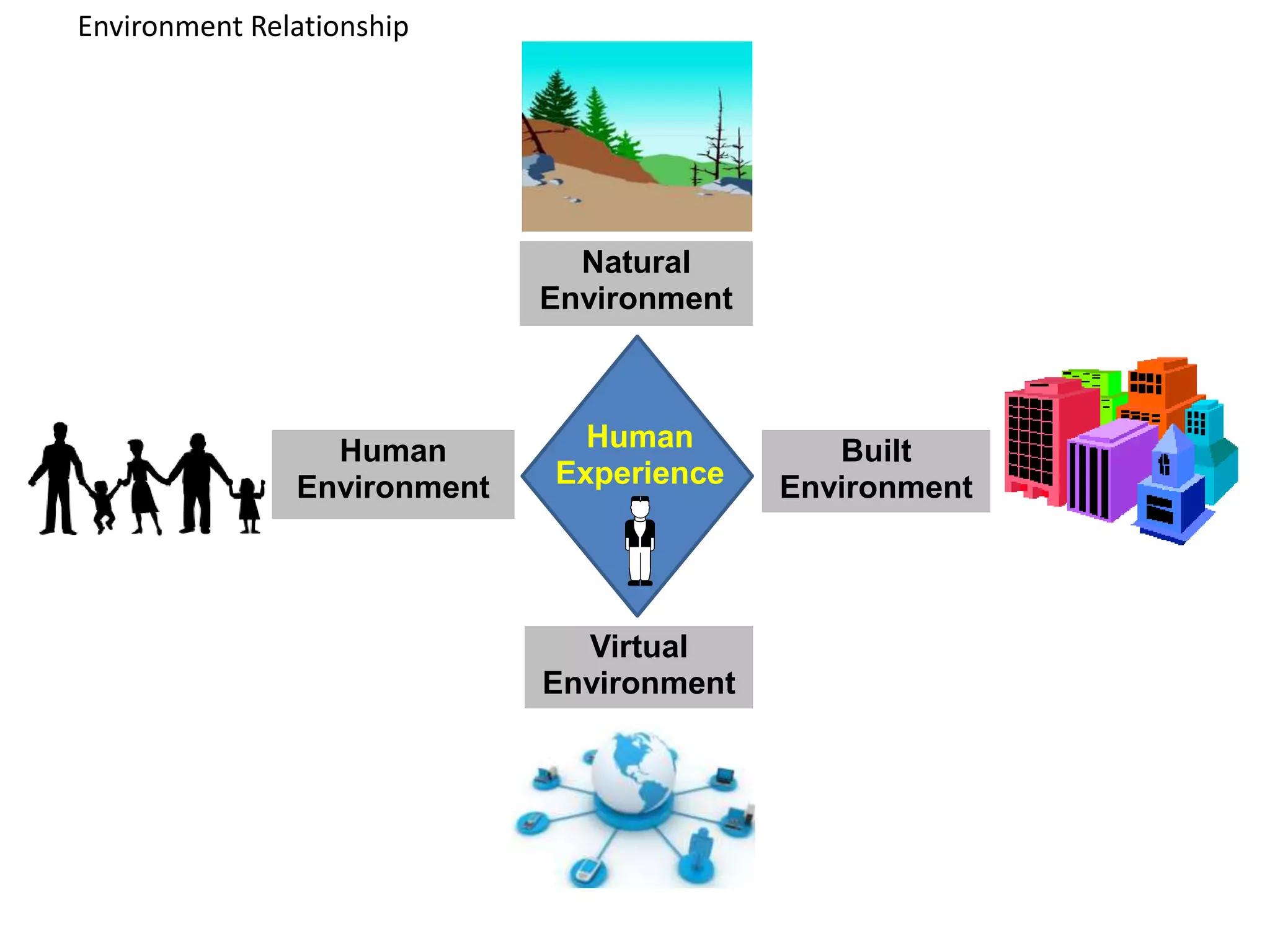
Human
Experience
Human
Environment
Built
Environment
Natural
Environment
Virtual
Environment
Environment Relationship
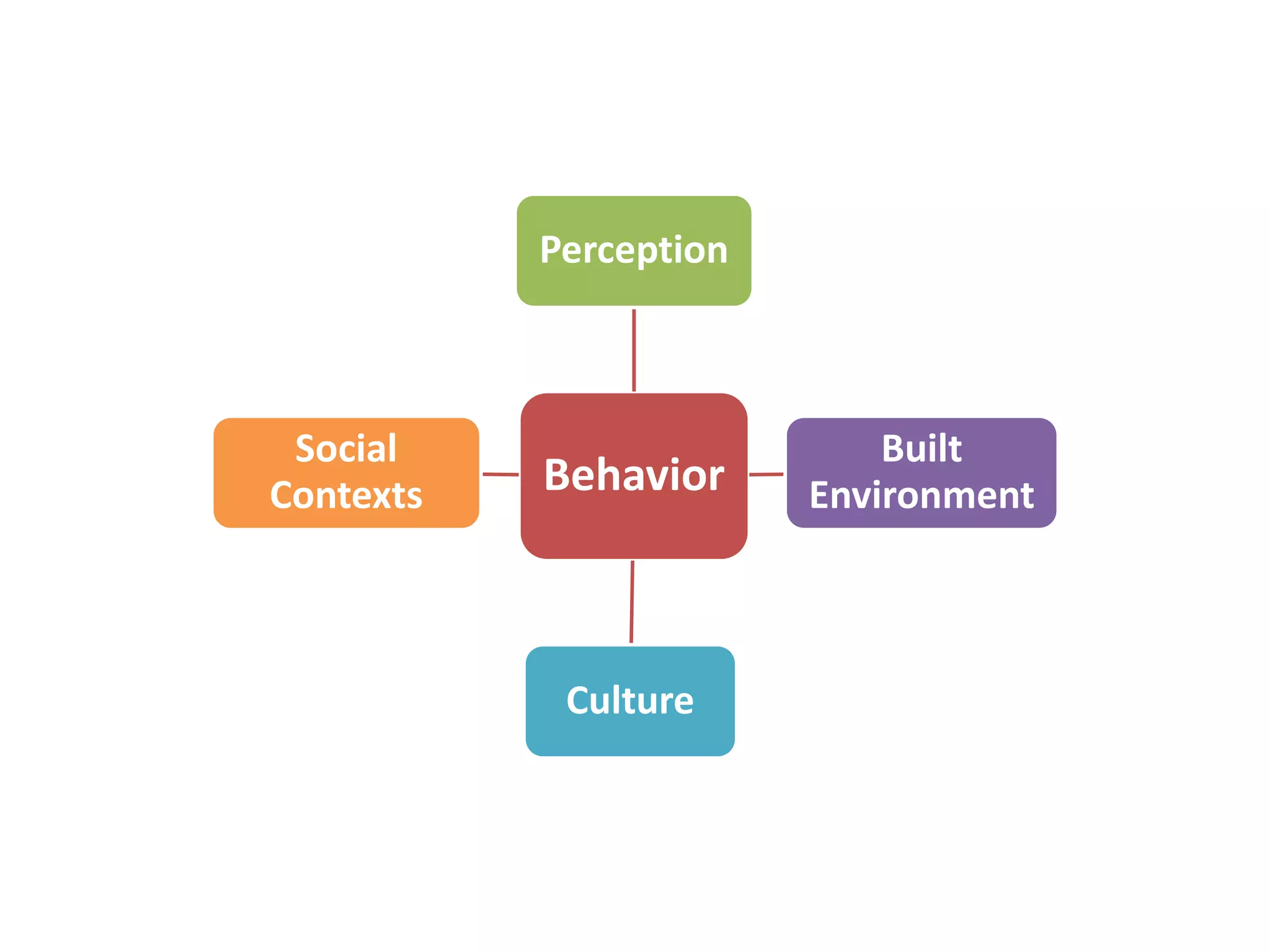
Behavior
Perception
Built
Environment
Culture
Social
Contexts
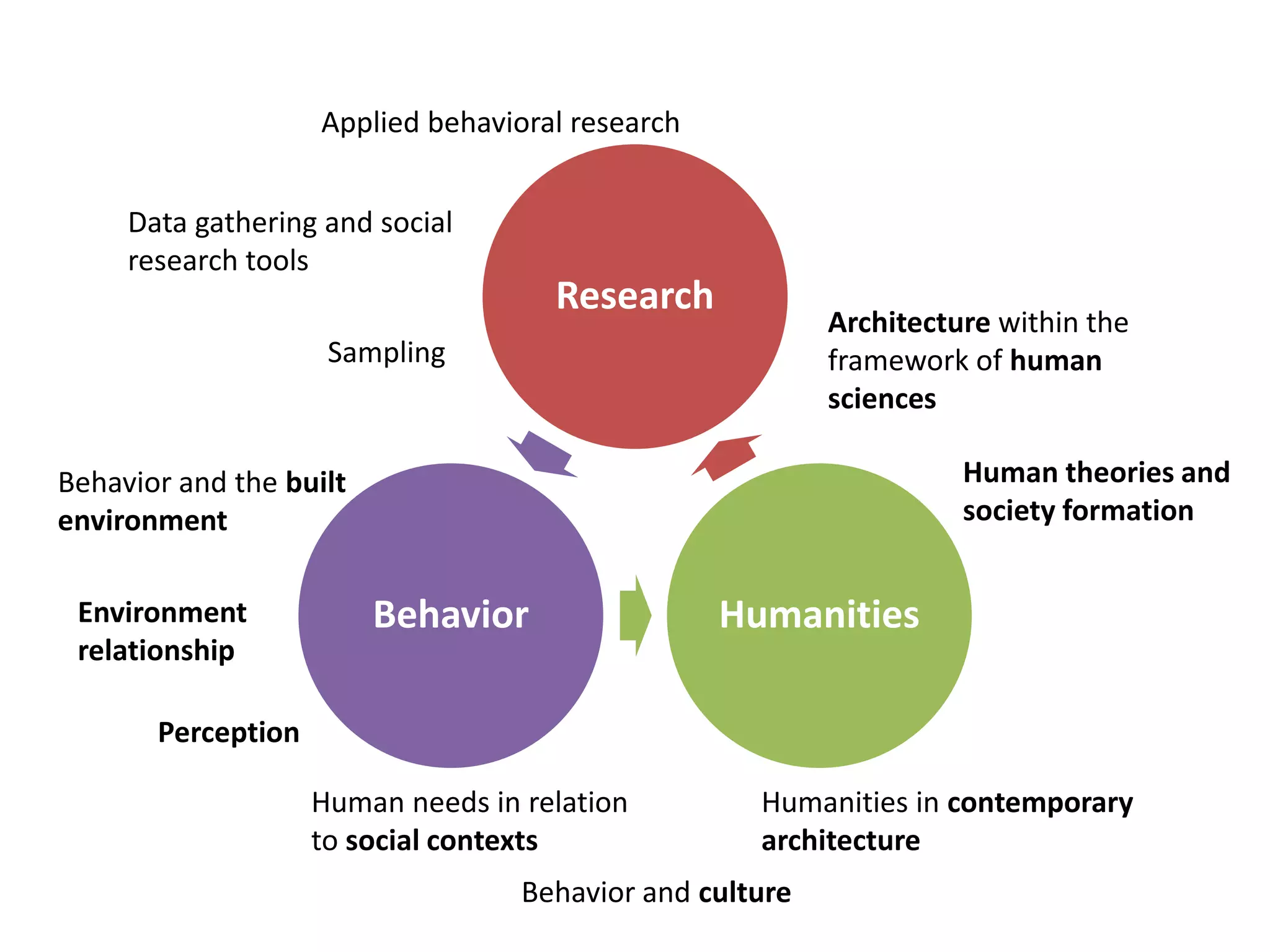
Research
HumanitiesBehavior
Applied behavioral research
Data gathering and social
research tools
Sampling
Human needs in relation
to social contexts
Behavior and the built
environment
Behavior and culture
Perception
Architecture within the
framework of human
sciences
Human theories and
society formation
Environment
relationship
Humanities in contemporary
architecture
Humanities
• Humanities are academic disciplines that study aspects of human
society and culture.
– Anthropology
– Sociology
– Psychology
– Archaeology
– History
– Linguistics and languages
– Law and politics
– Literature
– Philosophy
– Religion
– Performing arts
– Visual arts
– …
Definition of Research
• A systematic inquiry or investigation
into a subject in order to discover or
revise facts, theories or applications.
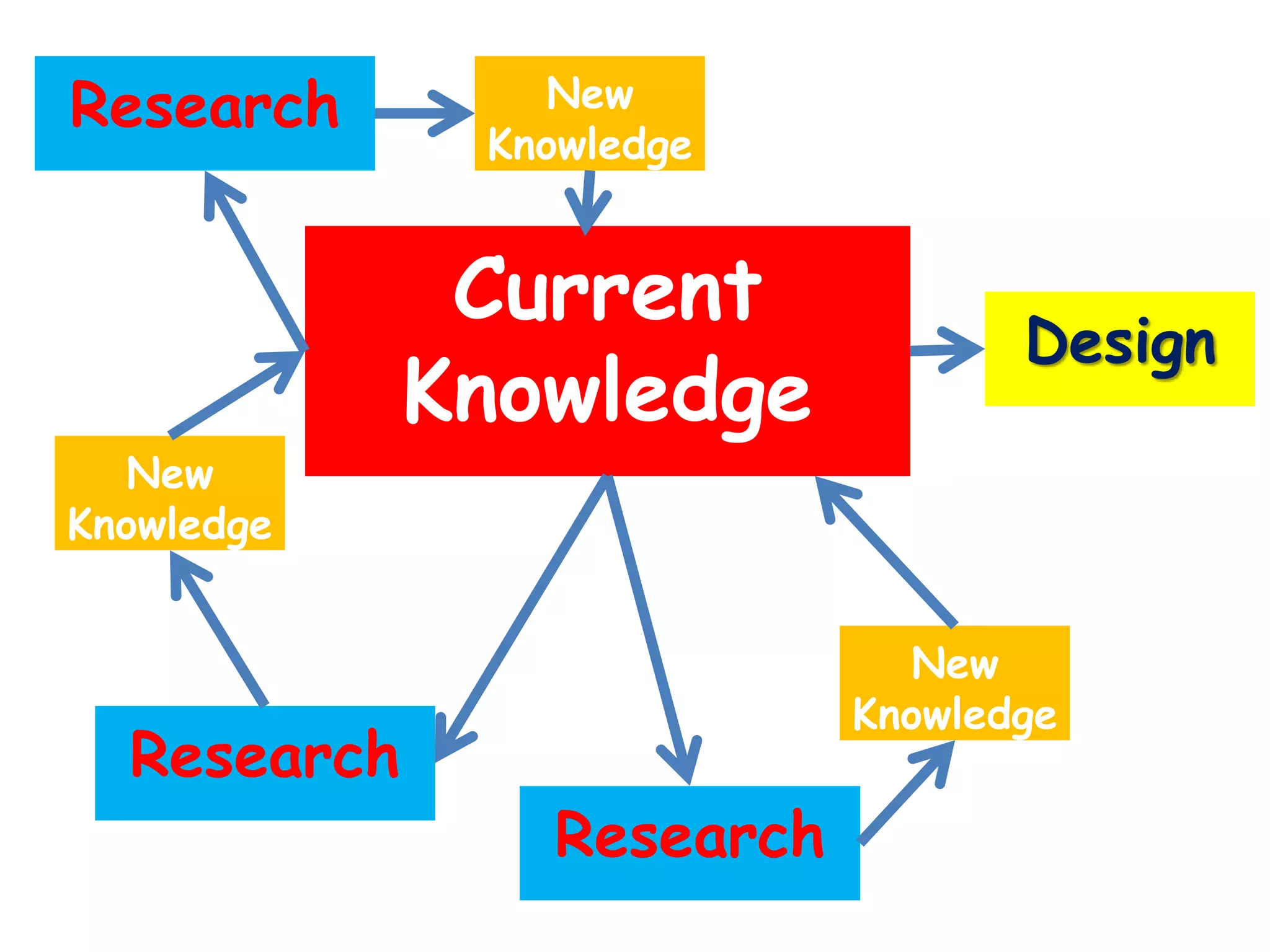
Current
Knowledge
Research
New
Knowledge
Research
New
Knowledge
Design
Research New
Knowledge
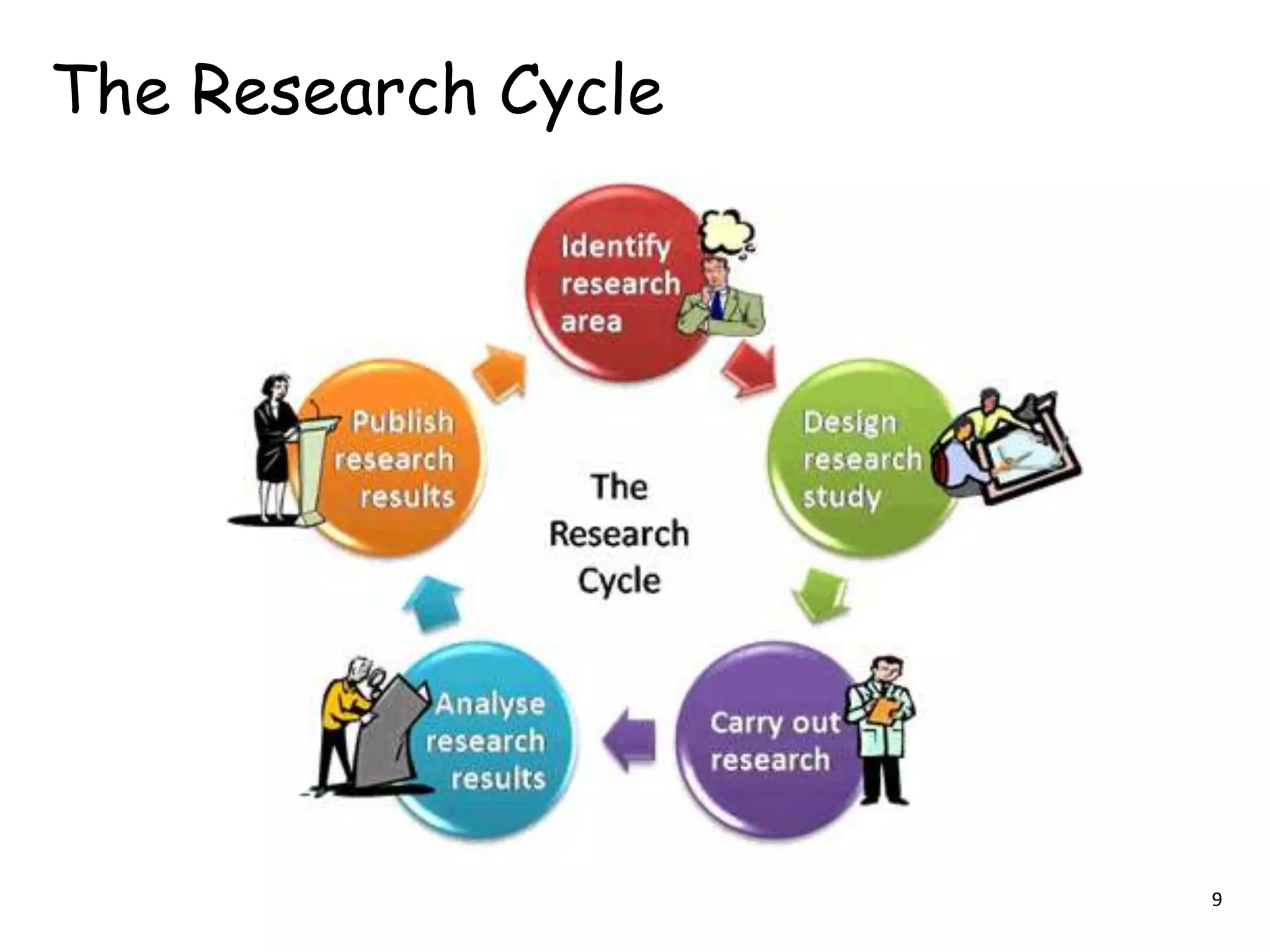
The Research Cycle
9
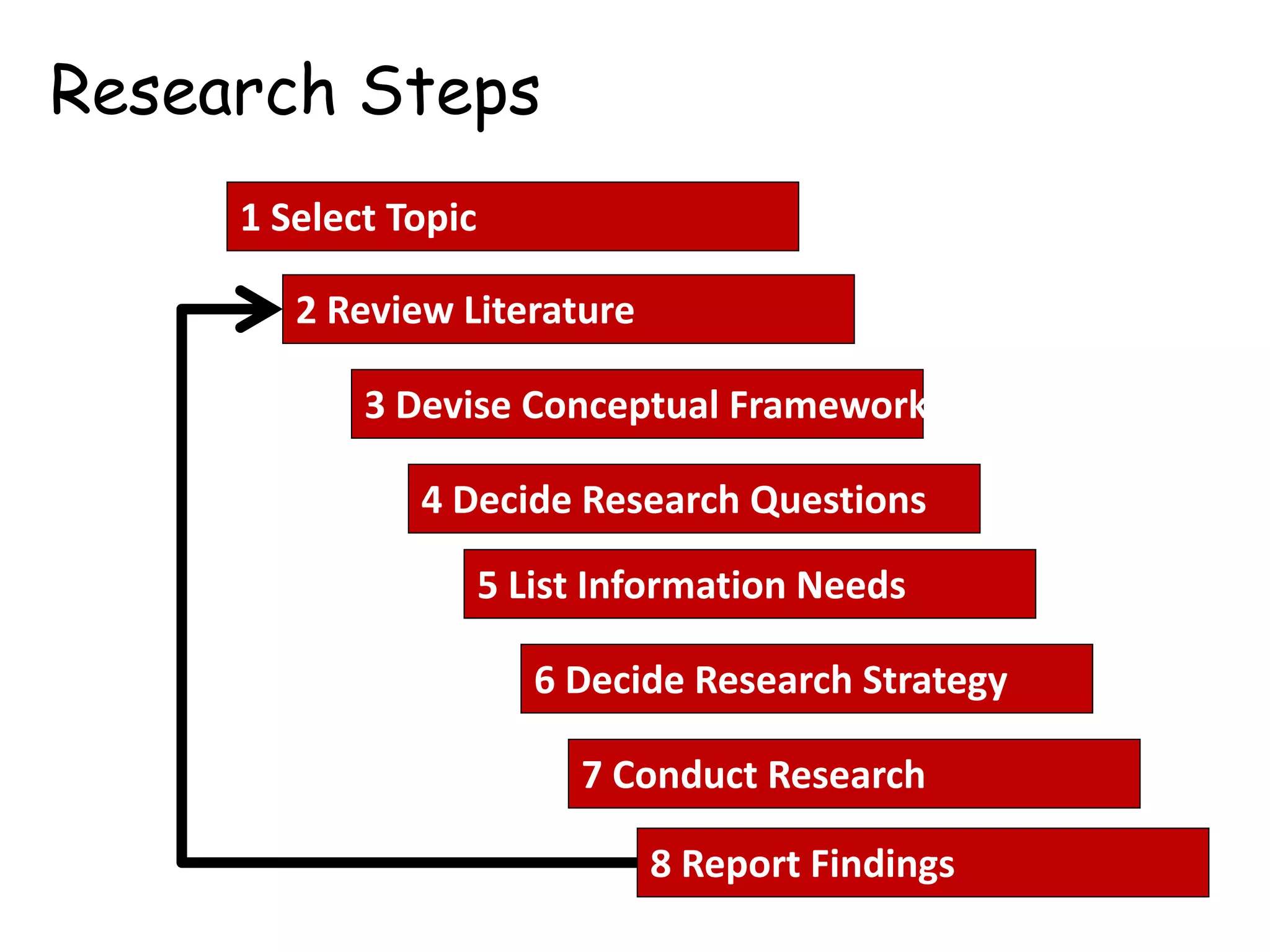
1 Select Topic
2 Review Literature
3 Devise Conceptual Framework
4 Decide Research Questions
5 List Information Needs
6 Decide Research Strategy
7 Conduct Research
8 Report Findings
Research Steps
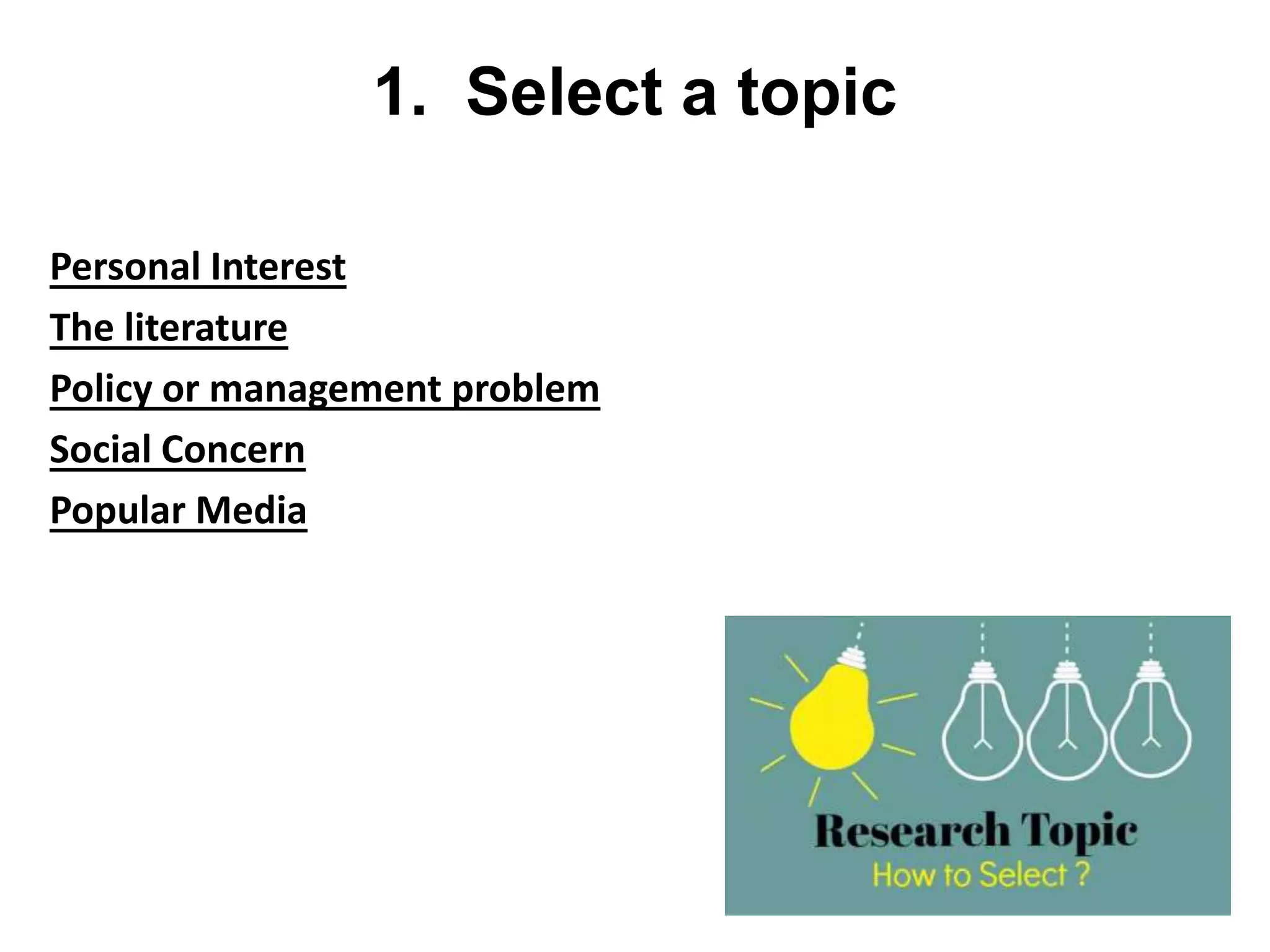
1. Select a topic
Personal Interest
The literature
Policy or management problem
Social Concern
Popular Media
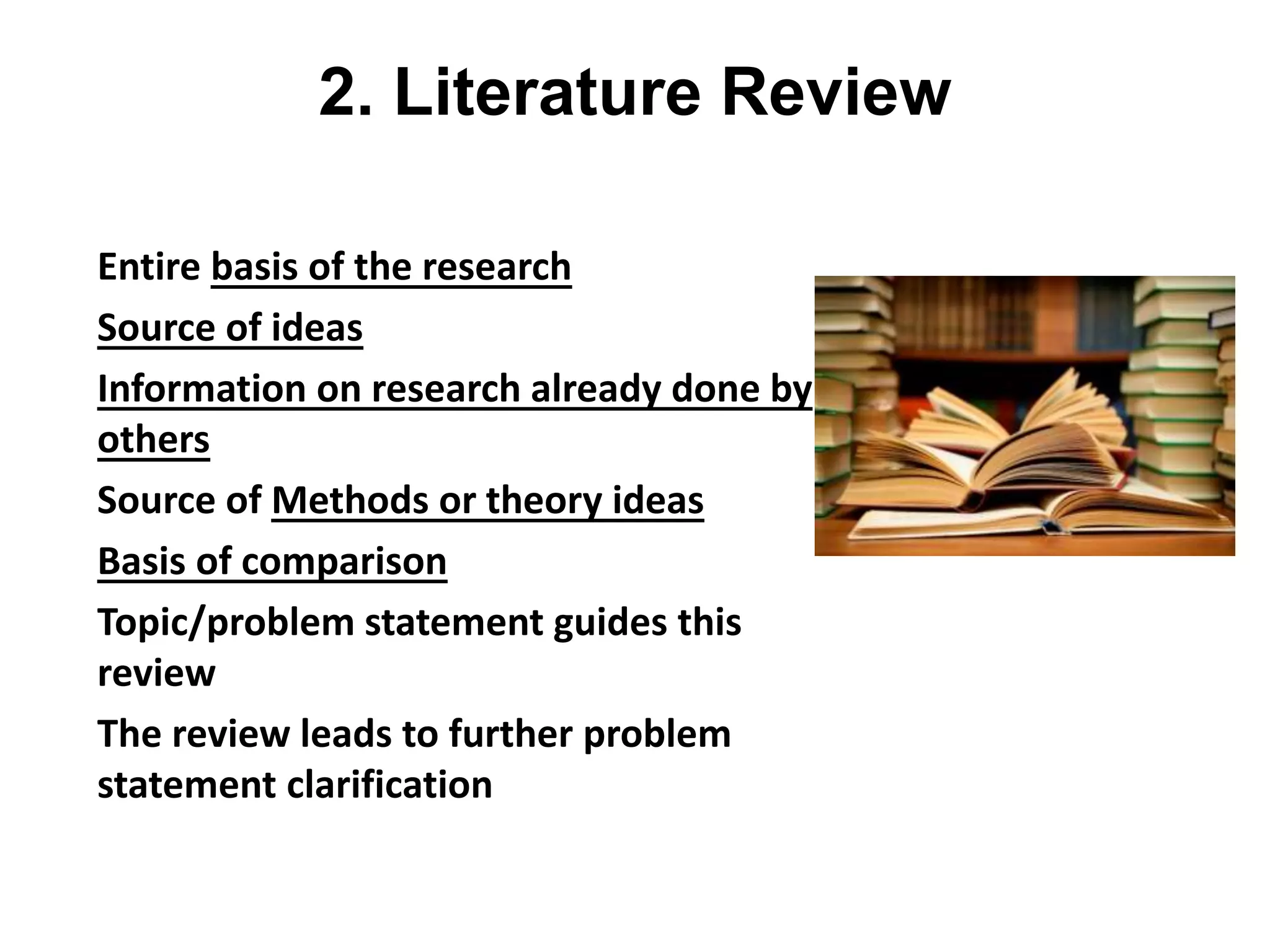
2. Literature Review
• Entire basis of the research
• Source of ideas
• Information on research already done by
others
• Source of Methods or theory ideas
• Basis of comparison
• Topic/problem statement guides this
review
• The review leads to further problem
statement clarification
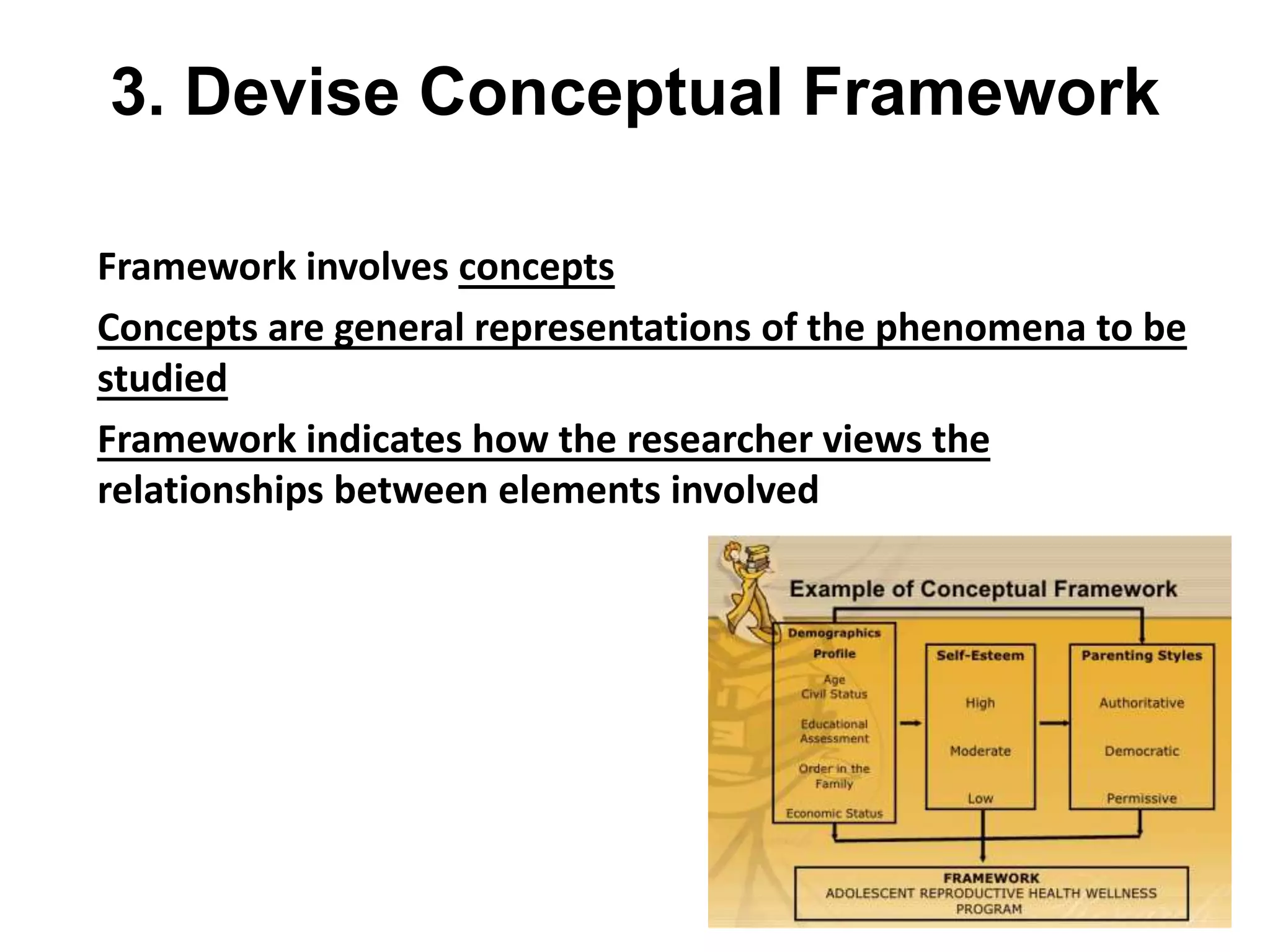
3. Devise Conceptual Framework
Framework involves concepts
Concepts are general representations of the phenomena to be
studied
Framework indicates how the researcher views the
relationships between elements involved
4. Decide on Research Questions
• 1. Find out what is already known about
the subject through doing a literature
review.
• 2. After you know what is already
known, your question might need to be
reformulated so that you have a question
in need of an answer, rather than a
question that has already been
answered.
5. List of Information Needs
• Guided by the Problem Statement and secondary
questions and conceptual framework.
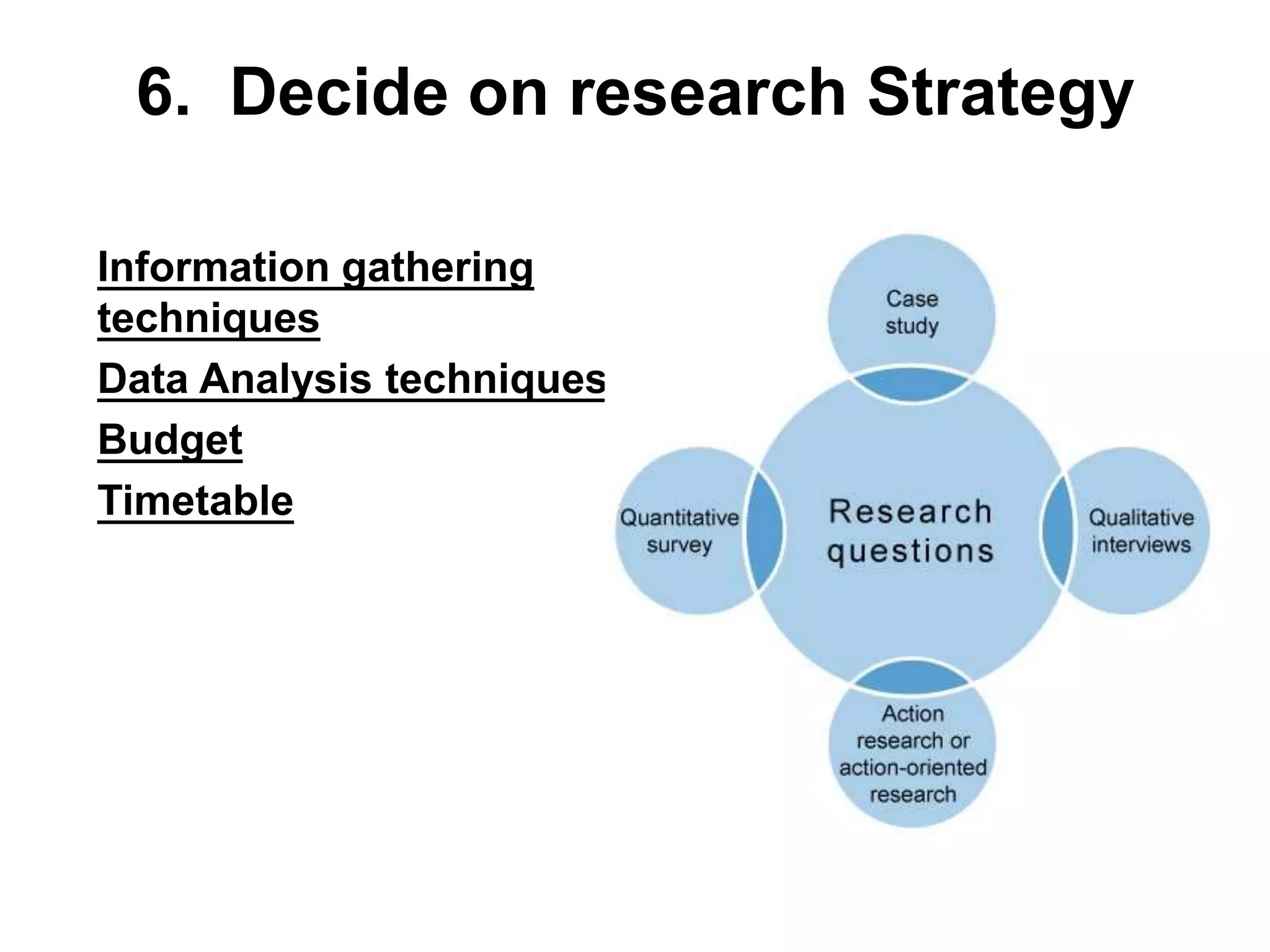
6. Decide on research Strategy
• Information gathering
techniques
• Data Analysis techniques
• Budget
• Timetable
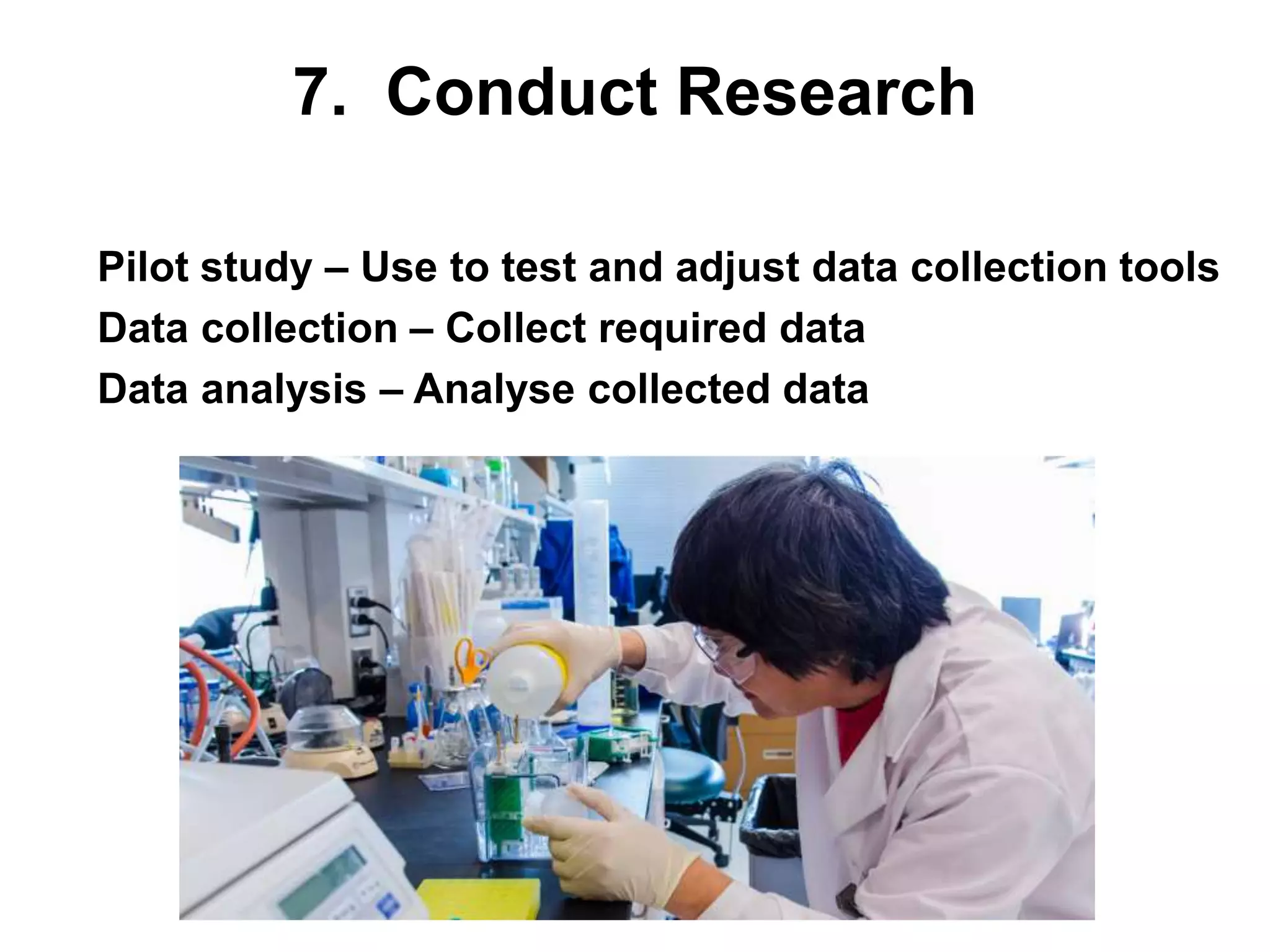
7. Conduct Research
• Pilot study – Use to test and adjust data collection tools
• Data collection – Collect required data
• Data analysis – Analyse collected data
8. Report Findings
• Through - tables, figures, GIS, graphics, and text
discussion/oral presentations
Literature Review (LR)
Knowledge we already possess  New information
– A survey of various sources to produce
knowledge that is more lasting and has more
widespread usefulness.
– A very important part of the research process
– Not only at the beginning of the process but
throughout it.
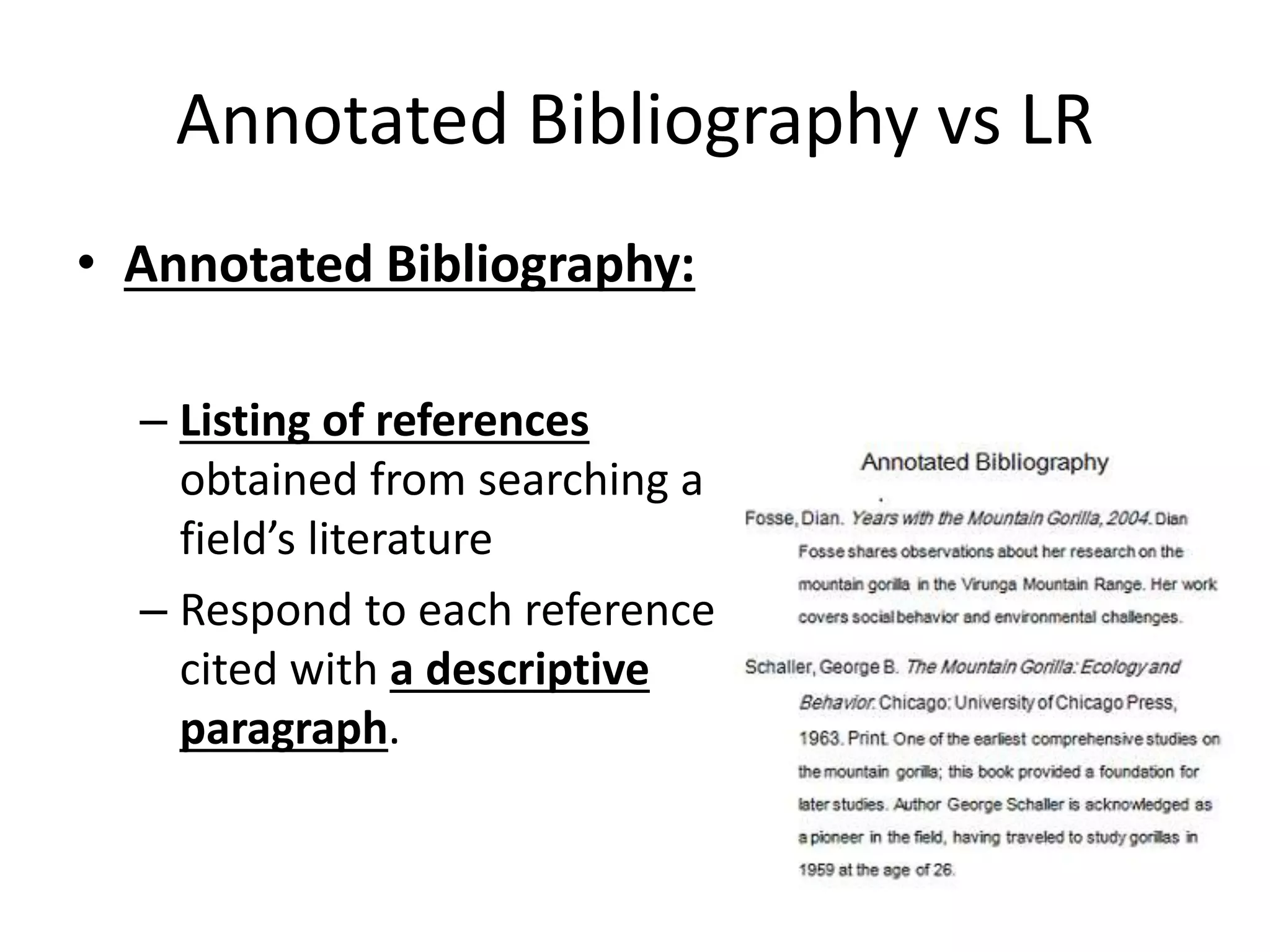
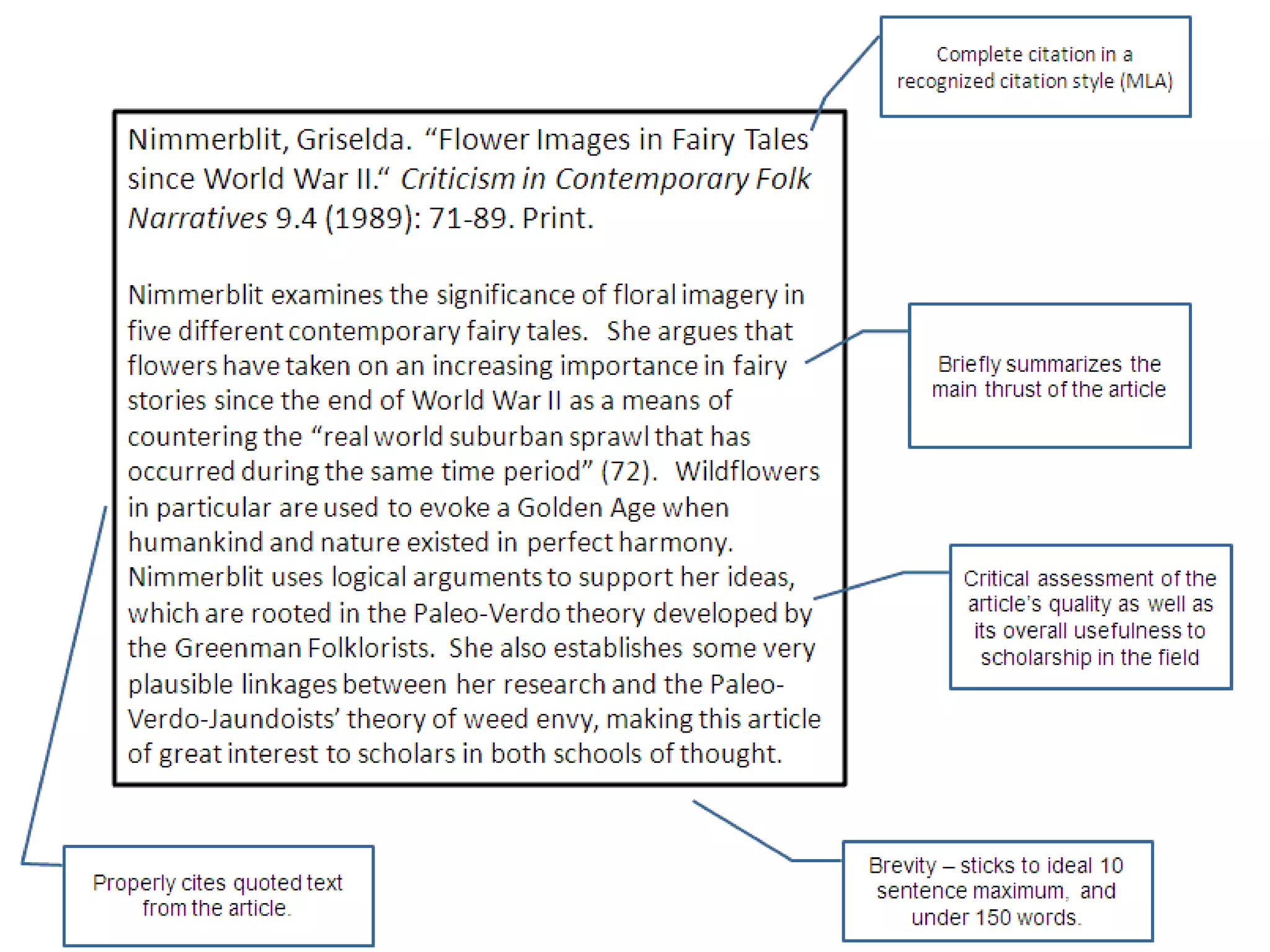
Annotated Bibliography vs LR
• Annotated Bibliography:
– Listing of references
obtained from searching a
field’s literature
– Respond to each reference
cited with a descriptive
paragraph.
3.1.2. Annotated Bibliography vs LR
• Annotated Bibliography:
– Listing of references obtained from searching a
field’s literature
– Respond to each reference cited with a descriptive
paragraph: Goals, Theoretical stance, Relevance
for the investigation.
Annotated Bibliography vs LR
• Literature Review:
– Introductory statement
– Summary of the lines of existing research
(grouped)
– Observations on the state of literature: Expand –
Covered – Arguments - …
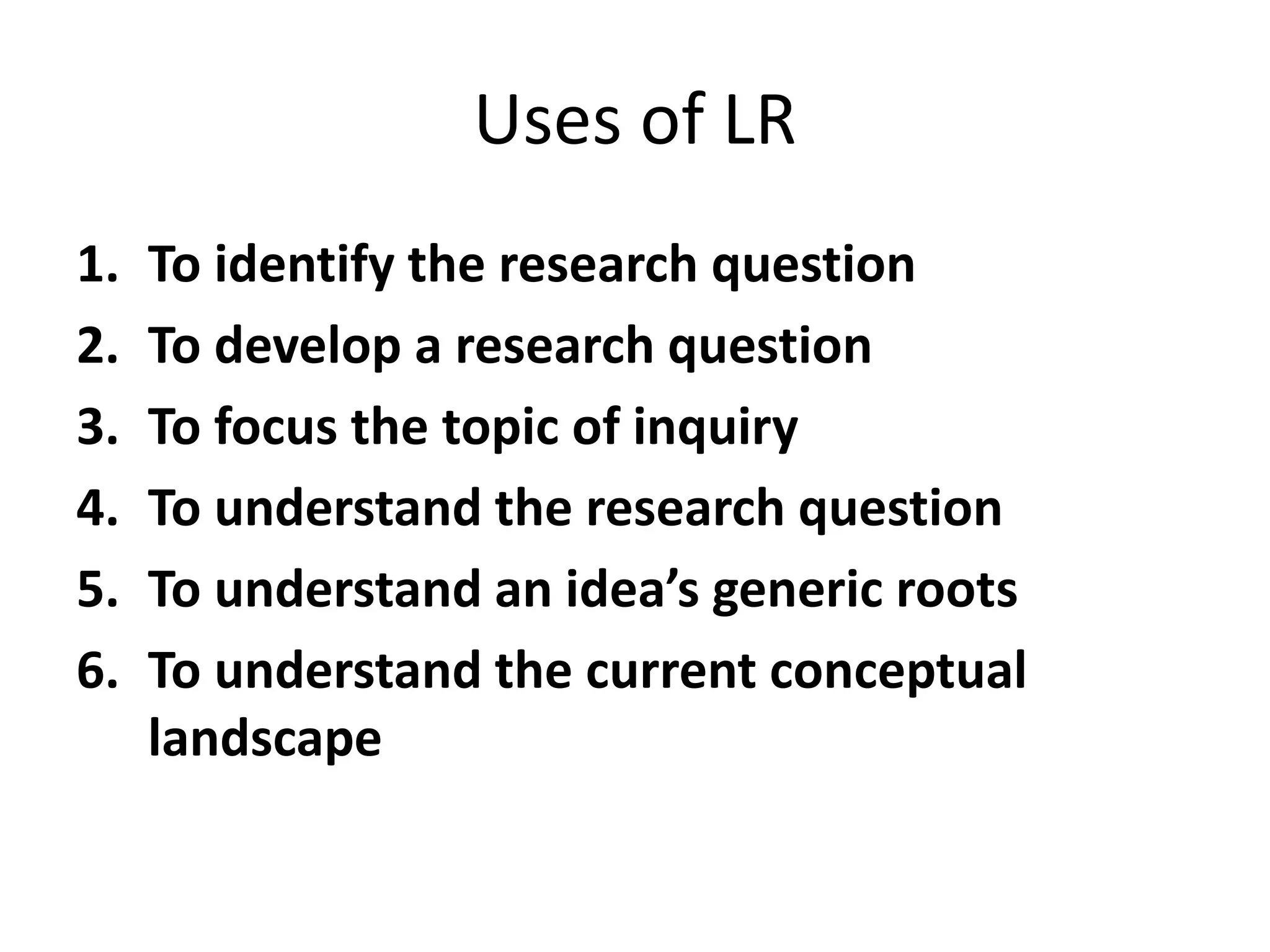
Uses of LR
1. To identify the research question
2. To develop a research question
3. To focus the topic of inquiry
4. To understand the research question
5. To understand an idea’s generic roots
6. To understand the current conceptual
landscape
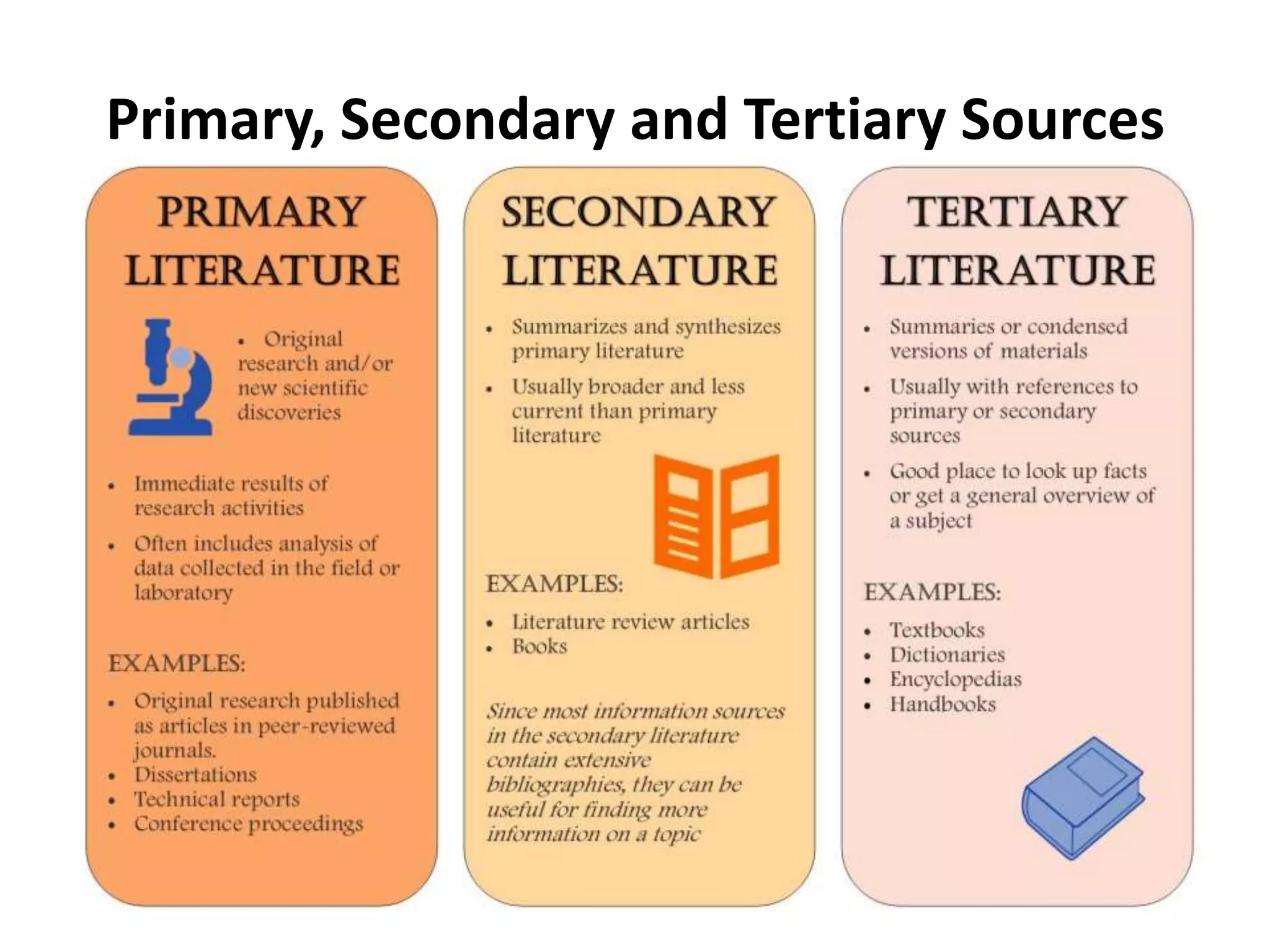
Primary, Secondary and Tertiary Sources
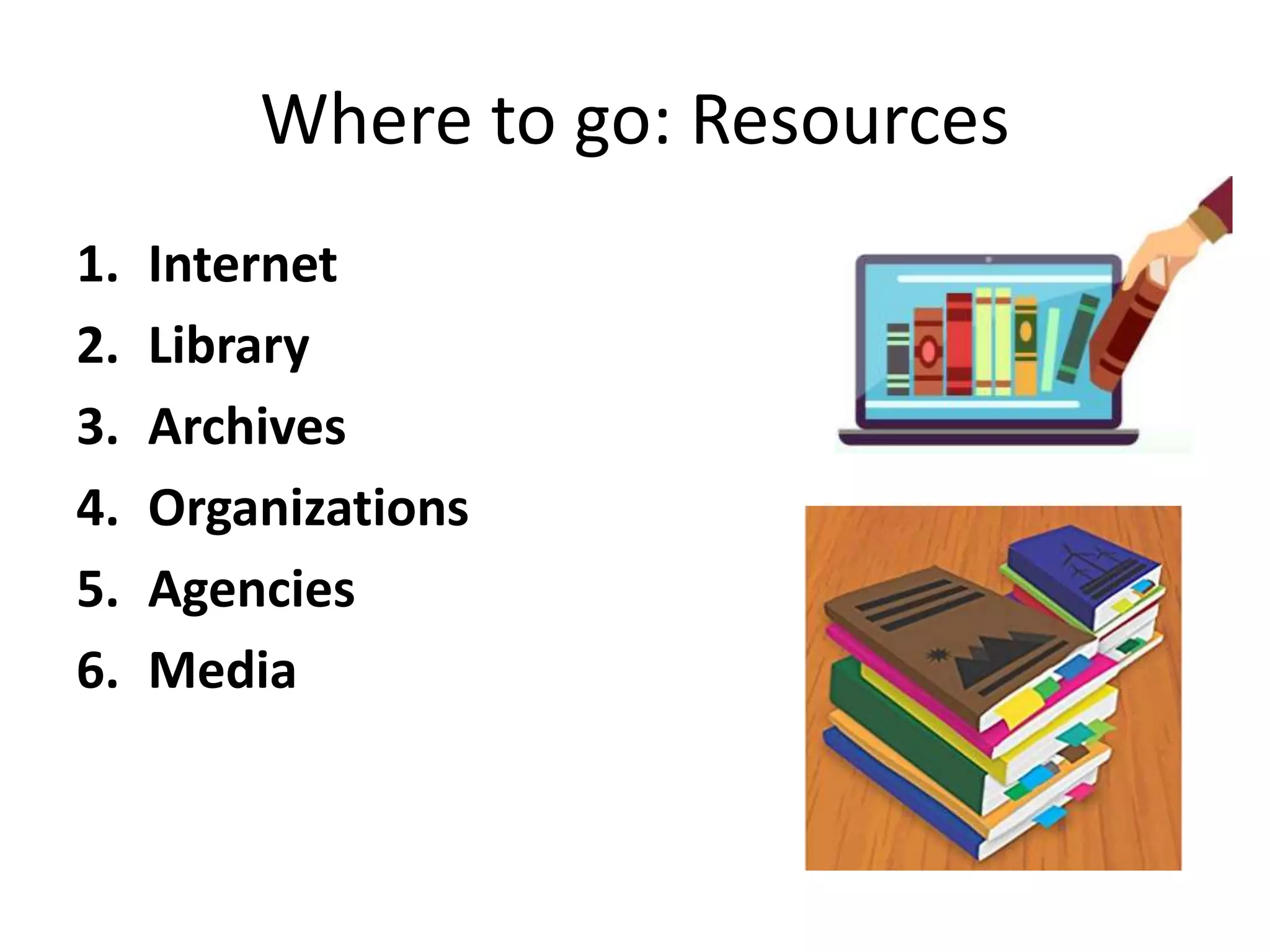
Where to go: Resources
1. Internet
2. Library
3. Archives
4. Organizations
5. Agencies
6. Media
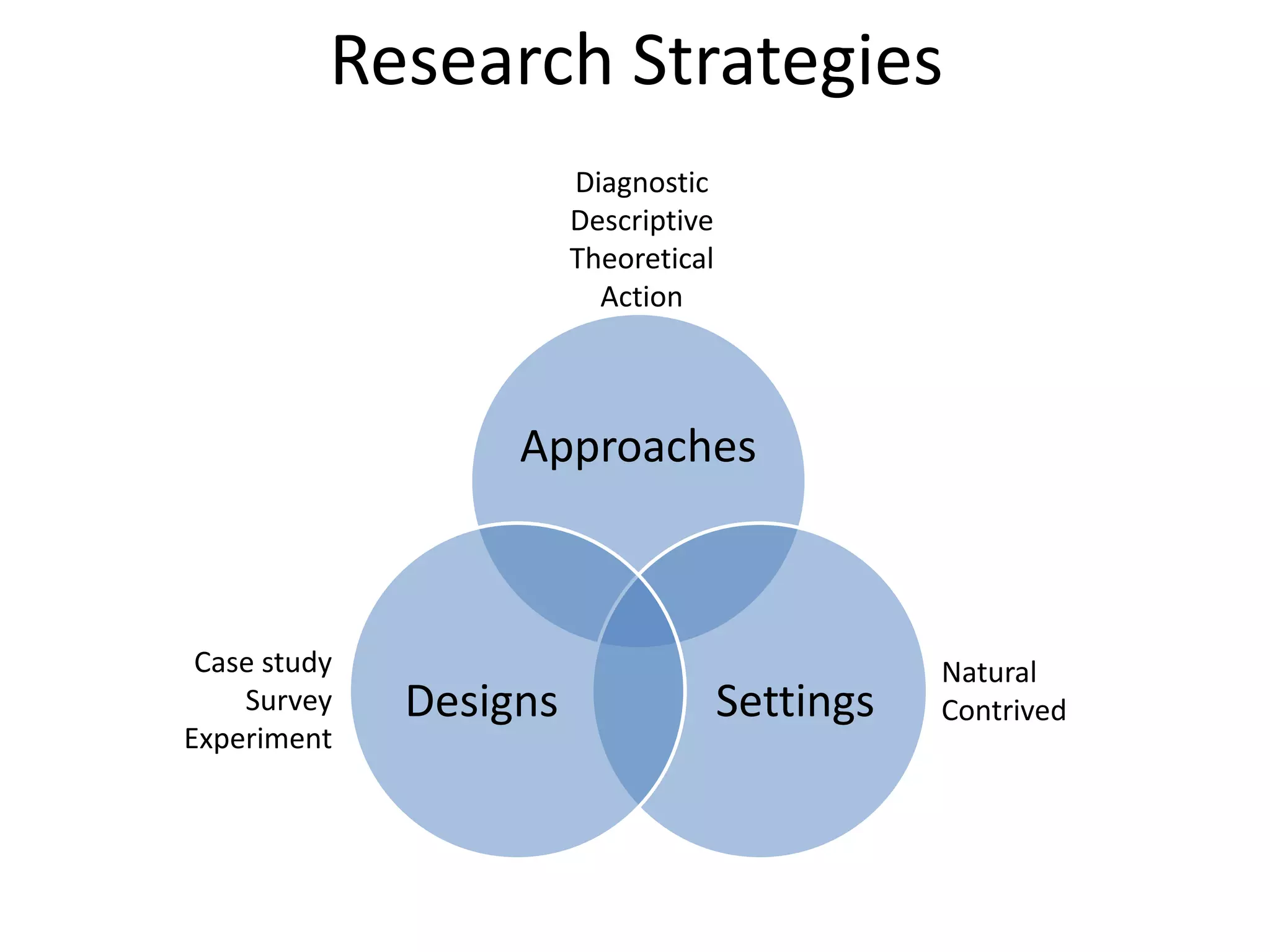
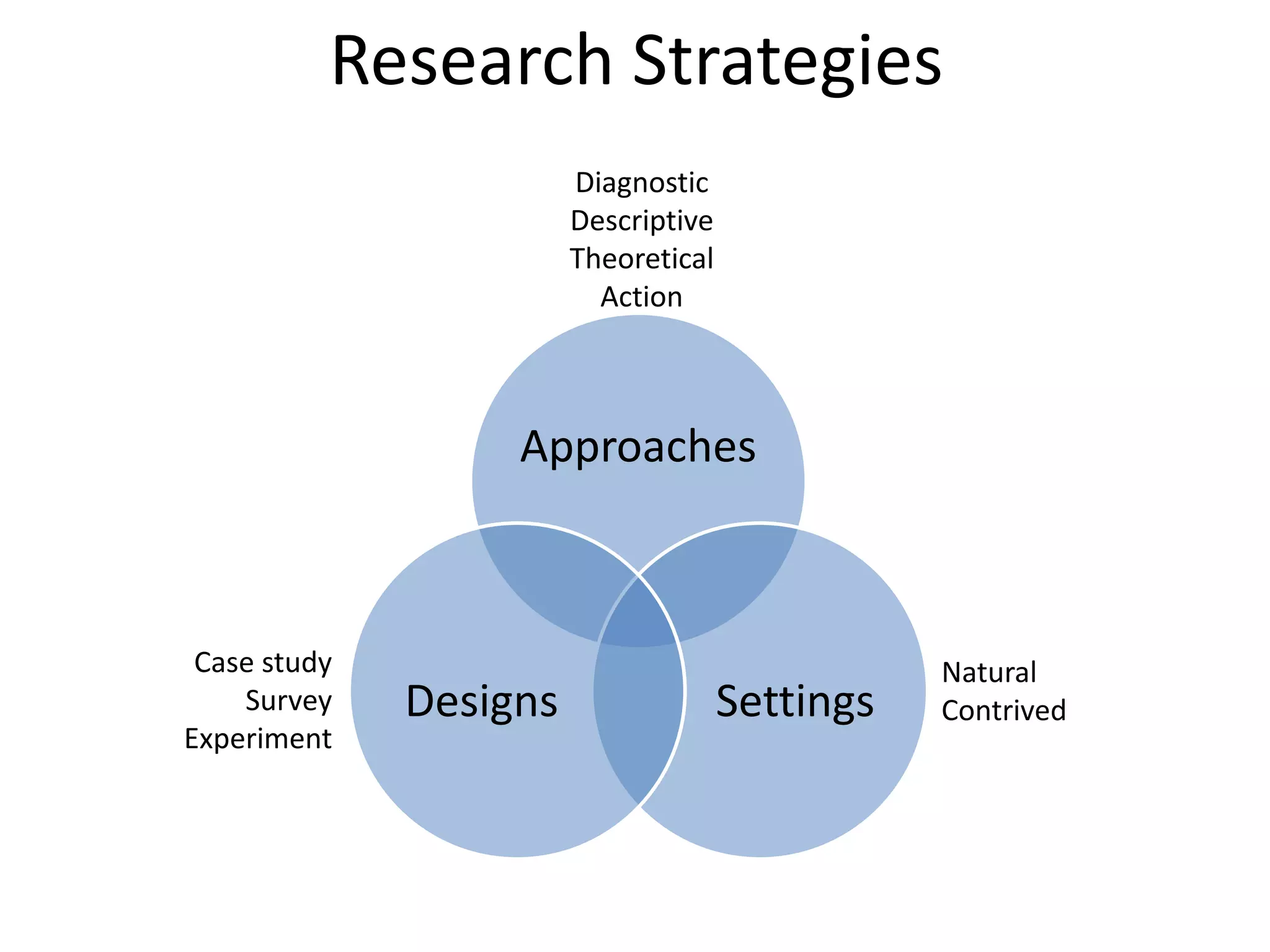
Research Strategies
• Research Approaches
– Diagnostic
– Descriptive
– Theoretical
– Action
• Research Designs
– Case study
– Survey
– Experiment
• Research Settings
– Natural
– Contrived
Research Strategies
Approaches
SettingsDesigns
Diagnostic
Descriptive
Theoretical
Action
Case study
Survey
Experiment
Natural
Contrived
Research Approaches
Diagnostic Studies
• help you deepen your understanding of
a setting.
• offer insight into the structure and
dynamics of a whole situation.
Research Approaches
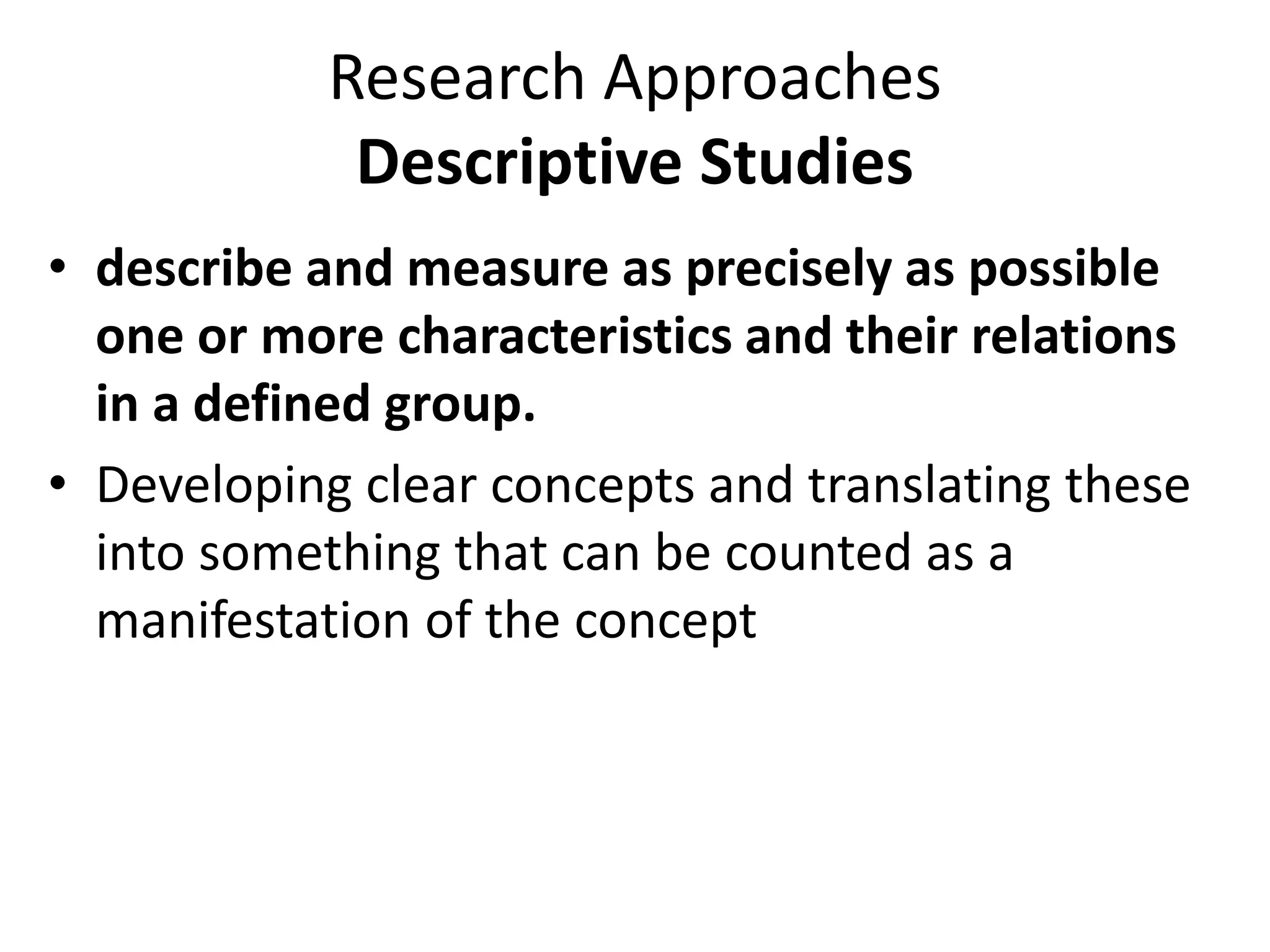
Descriptive Studies
• describe and measure as precisely as possible
one or more characteristics and their relations
in a defined group.
• Developing clear concepts and translating these
into something that can be counted as a
manifestation of the concept
Research Approaches
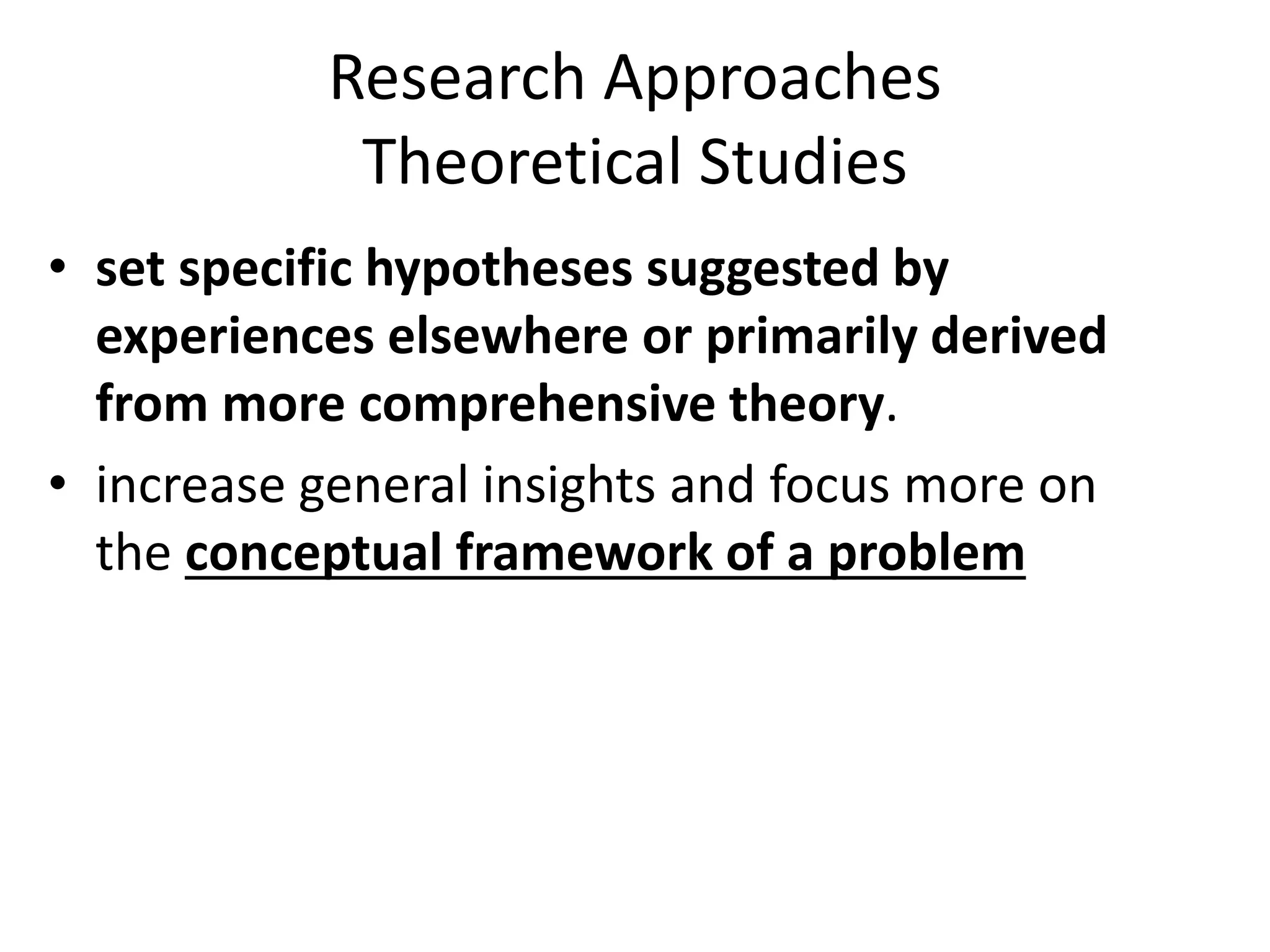
Theoretical Studies
• set specific hypotheses suggested by
experiences elsewhere or primarily derived
from more comprehensive theory.
• increase general insights and focus more on
the conceptual framework of a problem
Research Approaches
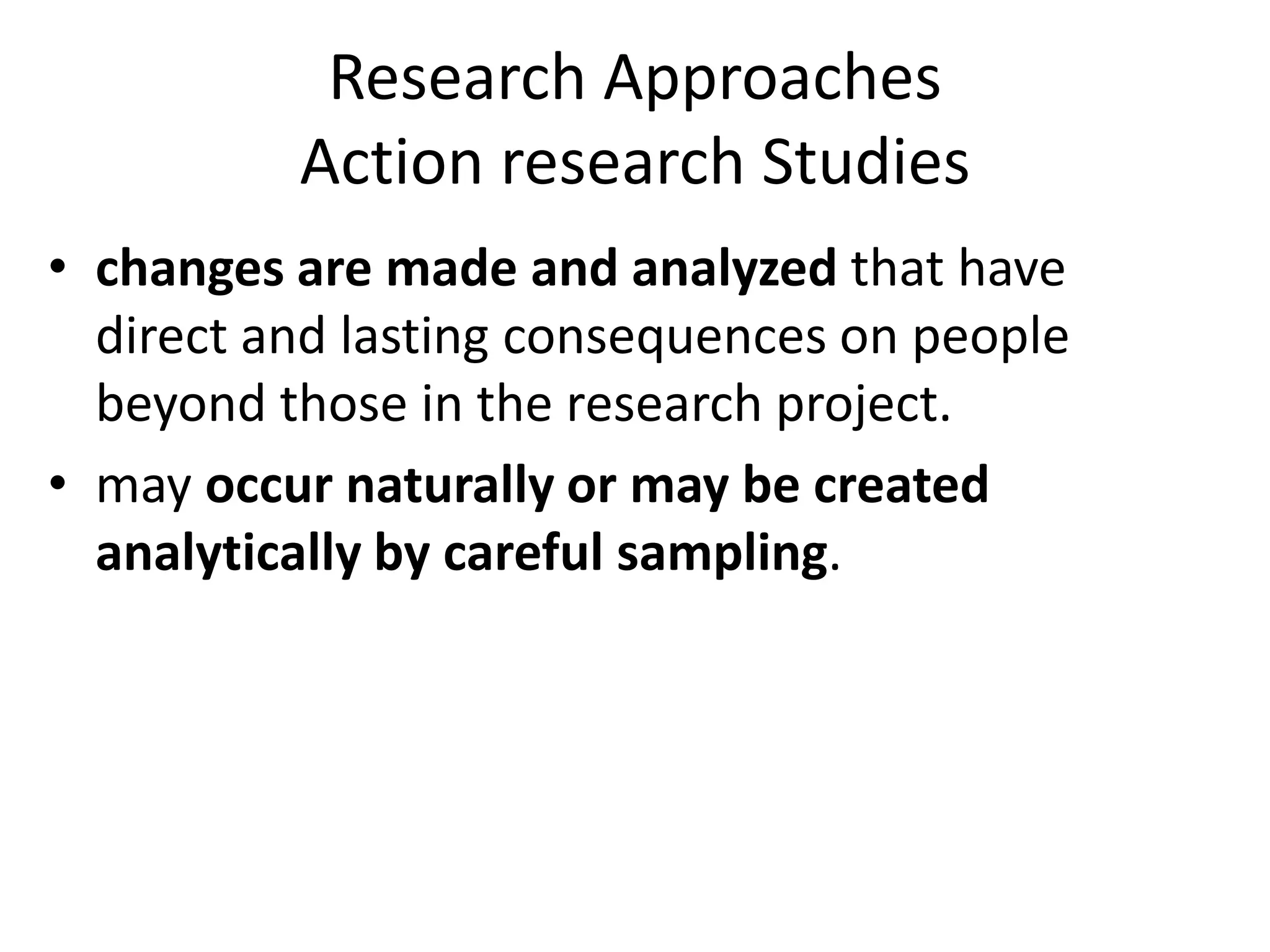
Action research Studies
• changes are made and analyzed that have
direct and lasting consequences on people
beyond those in the research project.
• may occur naturally or may be created
analytically by careful sampling.
Research Strategies
Approaches
SettingsDesigns
Diagnostic
Descriptive
Theoretical
Action
Case study
Survey
Experiment
Natural
Contrived
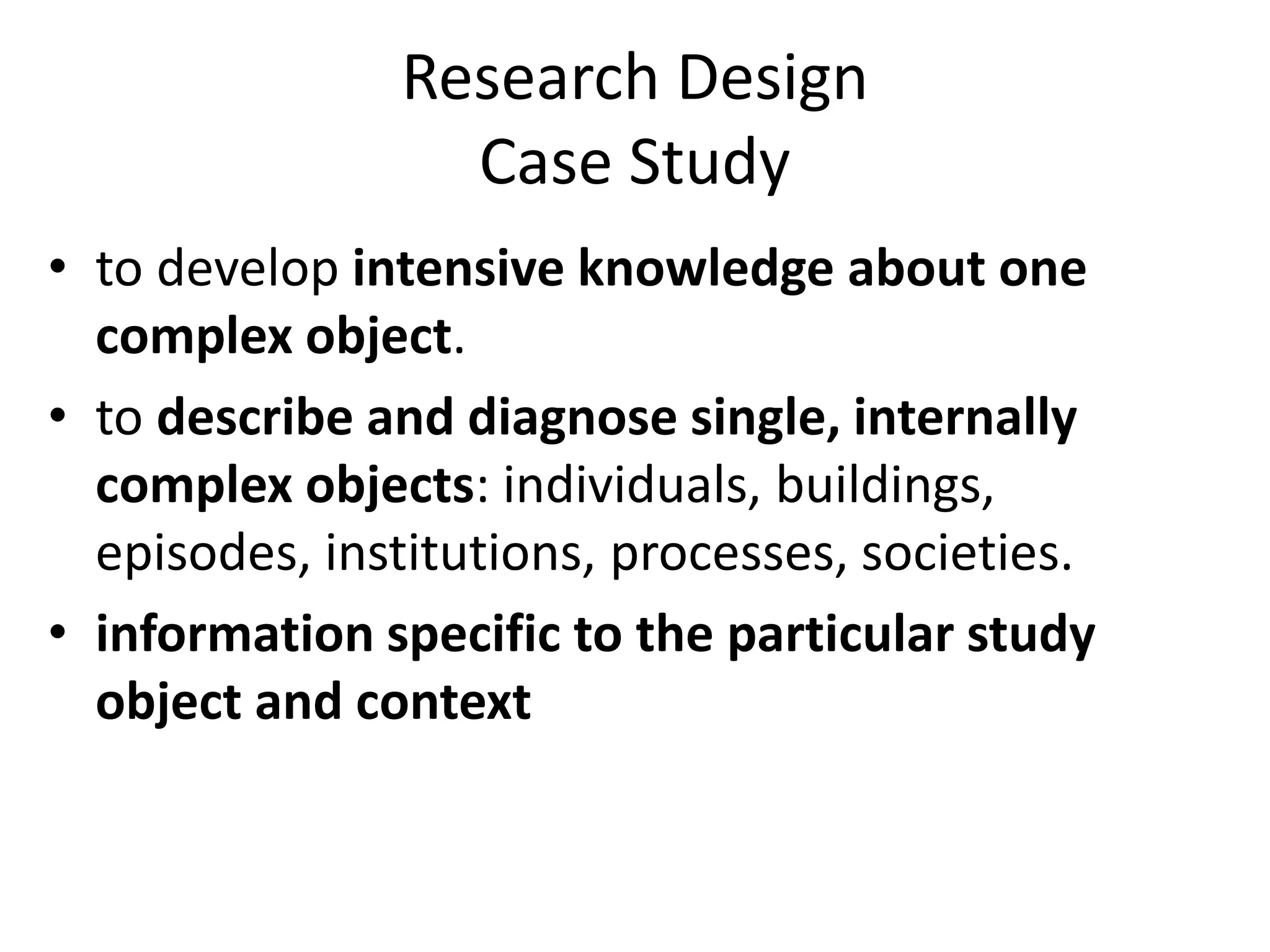
Research Design
Case Study
• to develop intensive knowledge about one
complex object.
• to describe and diagnose single, internally
complex objects: individuals, buildings,
episodes, institutions, processes, societies.
• information specific to the particular study
object and context
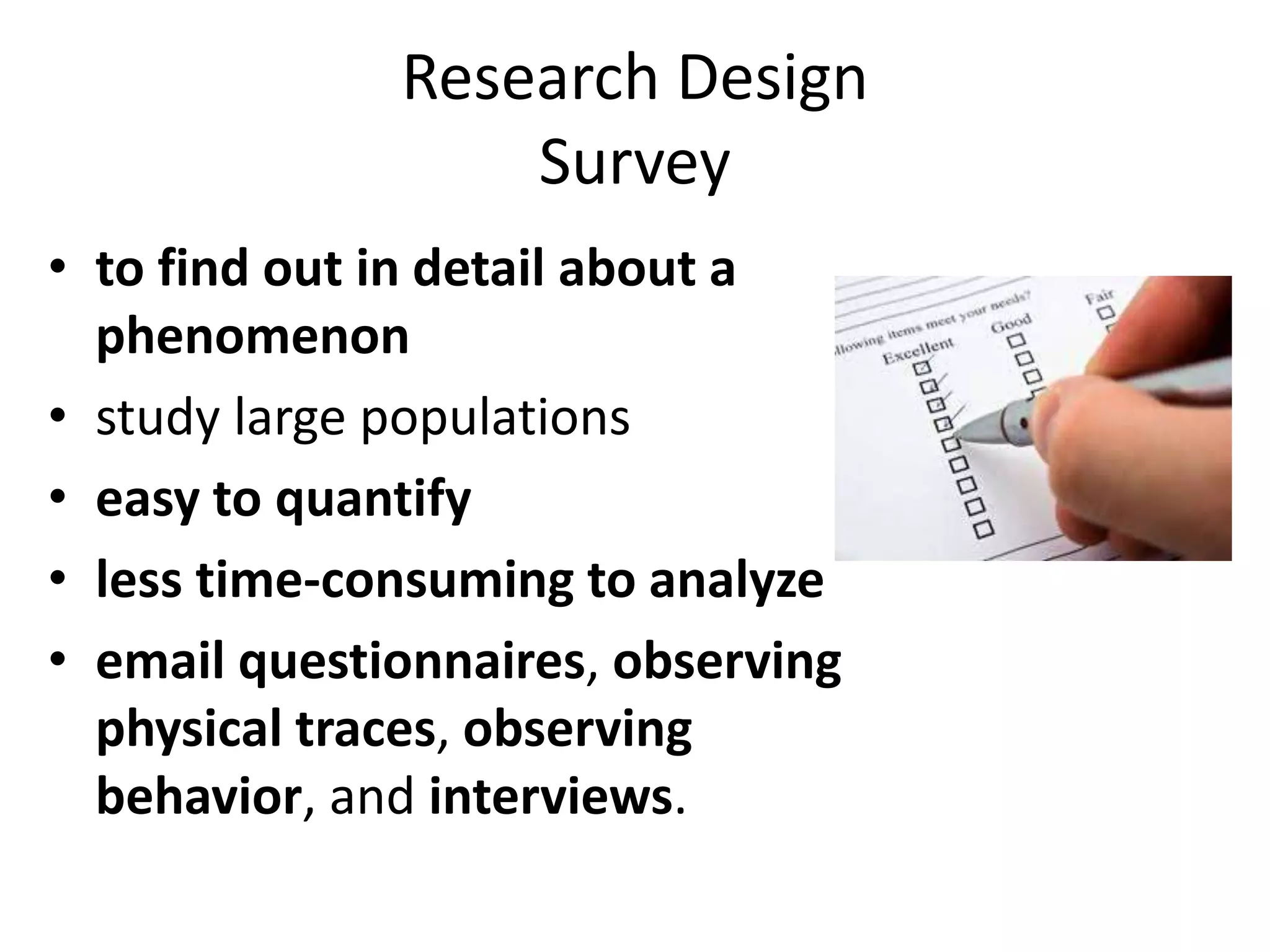
Research Design
Survey
• to find out in detail about a
phenomenon
• study large populations
• easy to quantify
• less time-consuming to analyze
• email questionnaires, observing
physical traces, observing
behavior, and interviews.
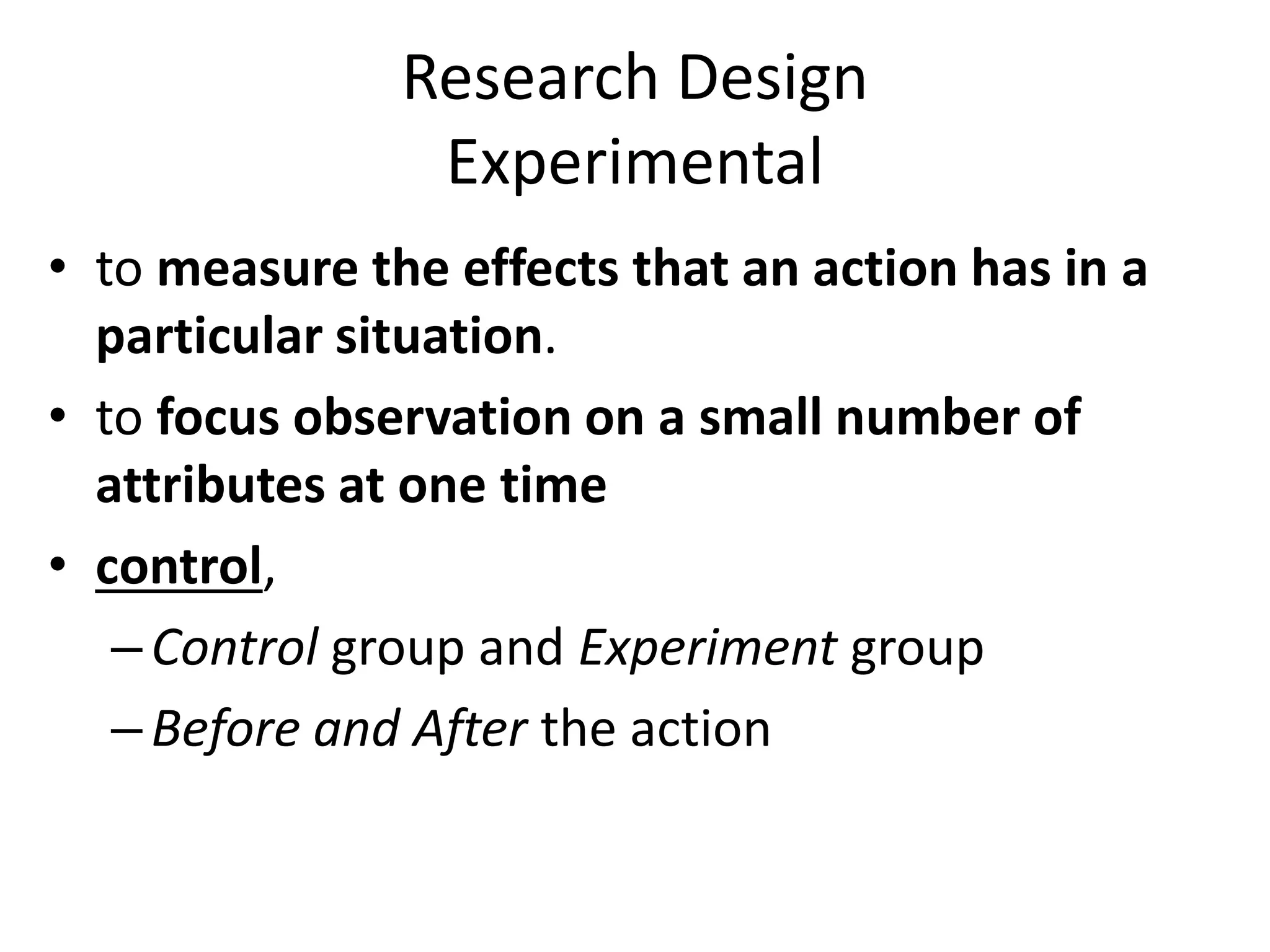
Research Design
Experimental
• to measure the effects that an action has in a
particular situation.
• to focus observation on a small number of
attributes at one time
• control,
–Control group and Experiment group
–Before and After the action
Research Design
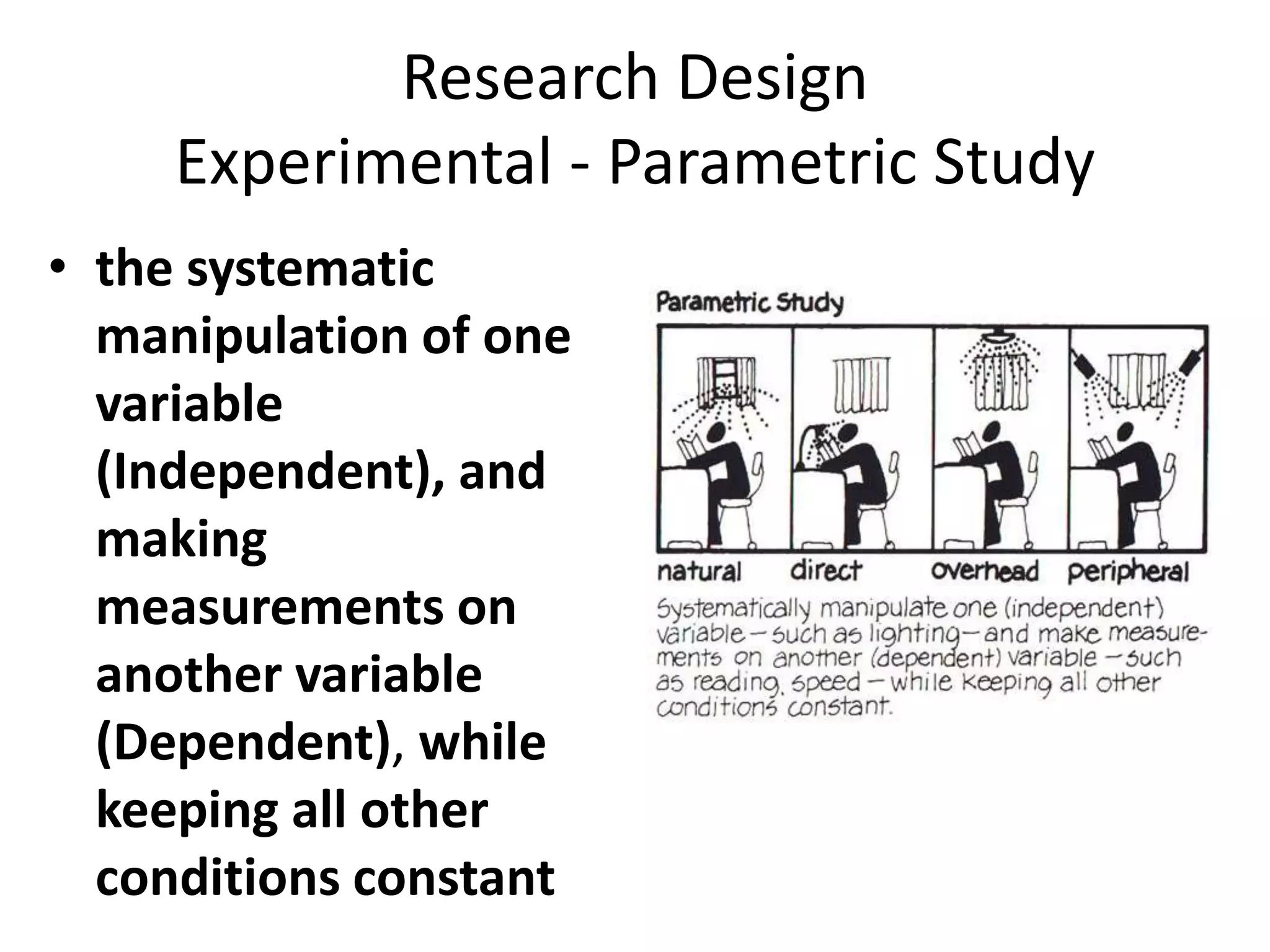
Experimental - Parametric Study
• the systematic
manipulation of one
variable
(Independent), and
making
measurements on
another variable
(Dependent), while
keeping all other
conditions constant
Research Design
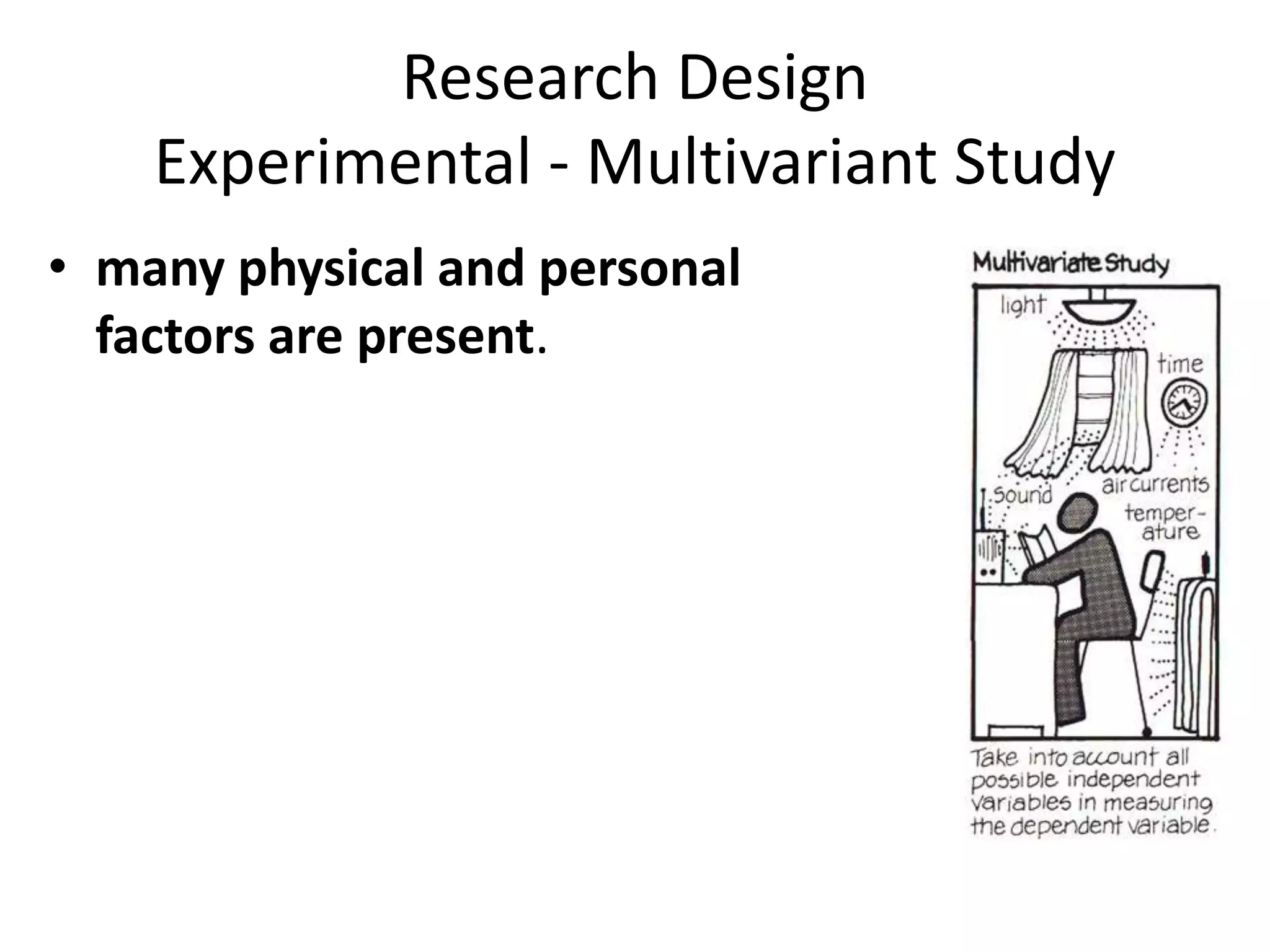
Experimental - Multivariant Study
• many physical and personal
factors are present.
Research Settings
Natural Settings
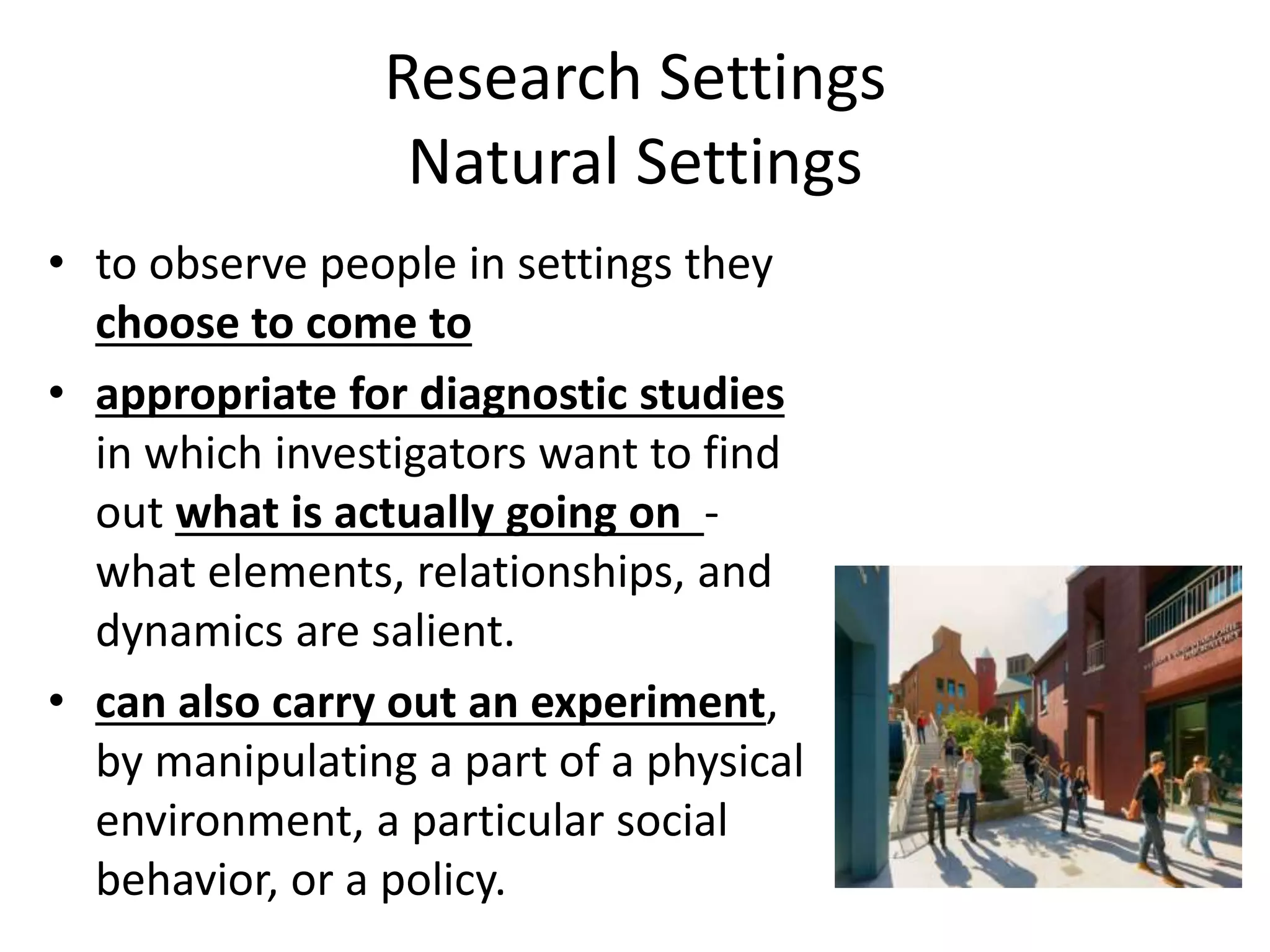
• to observe people in settings they
choose to come to
• appropriate for diagnostic studies
in which investigators want to find
out what is actually going on -
what elements, relationships, and
dynamics are salient.
• can also carry out an experiment,
by manipulating a part of a physical
environment, a particular social
behavior, or a policy.
Research Settings
Contrived Settings
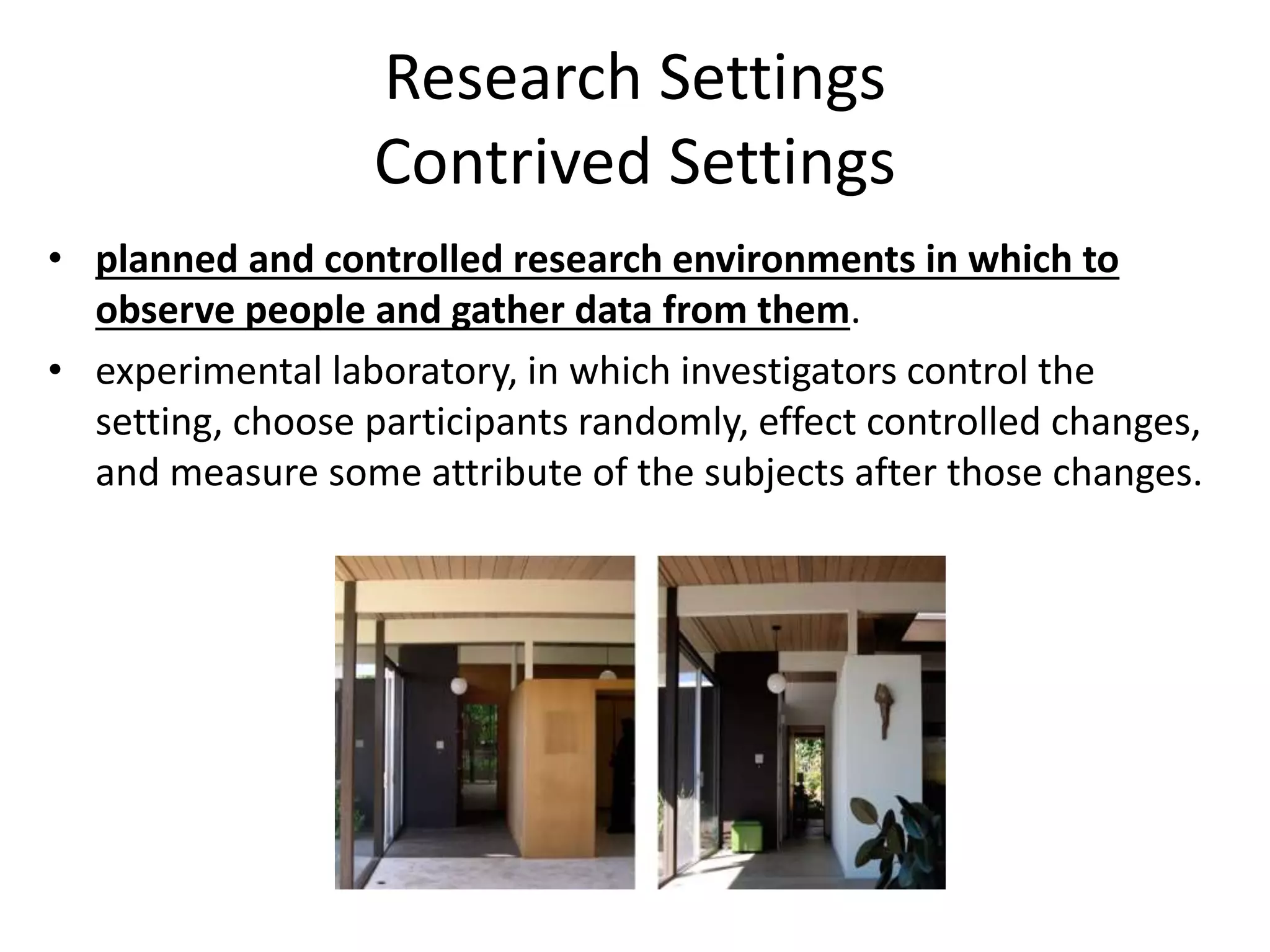
• planned and controlled research environments in which to
observe people and gather data from them.
• experimental laboratory, in which investigators control the
setting, choose participants randomly, effect controlled changes,
and measure some attribute of the subjects after those changes.
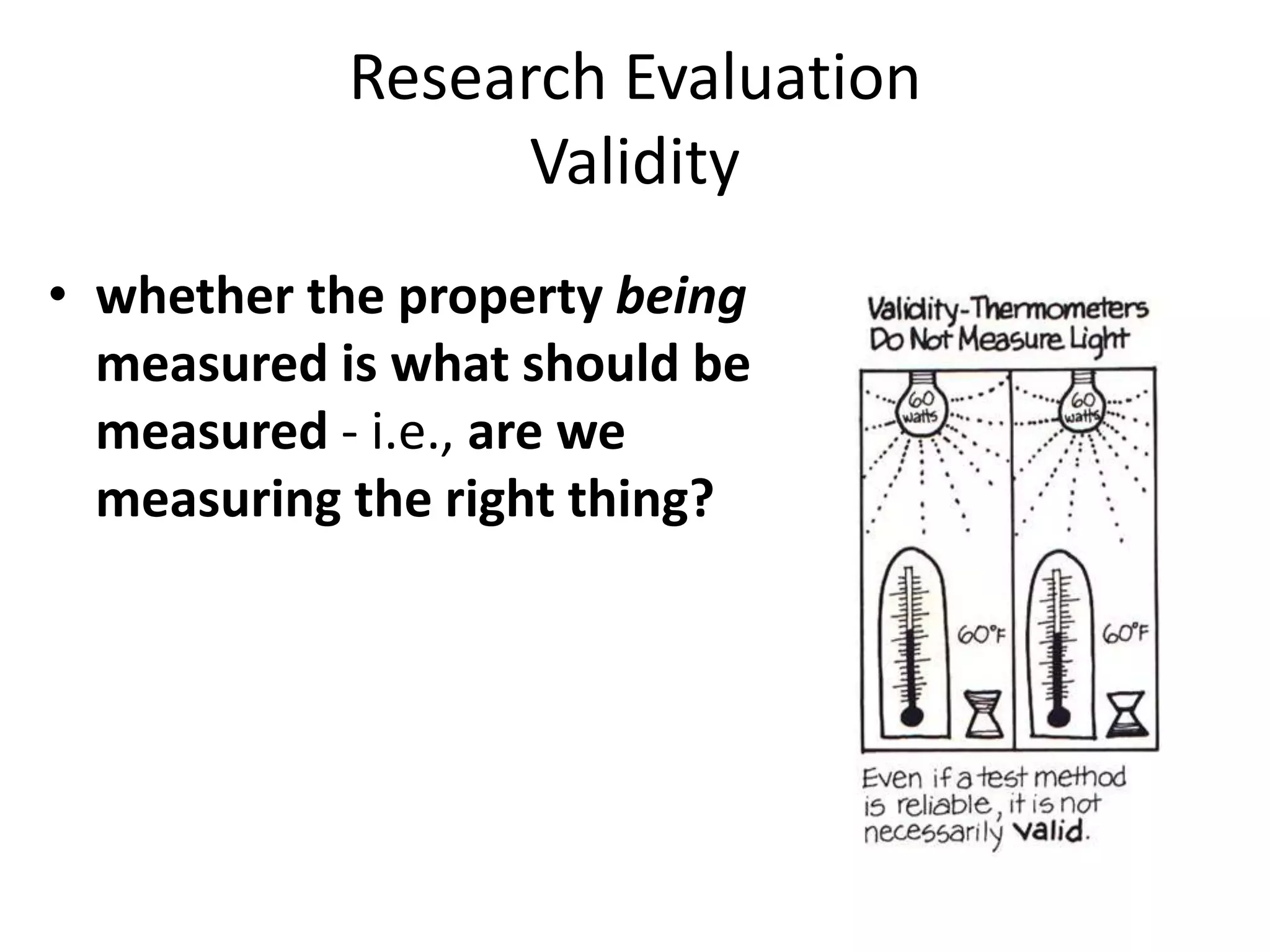
Research Evaluation
Validity
• whether the property being
measured is what should be
measured - i.e., are we
measuring the right thing?
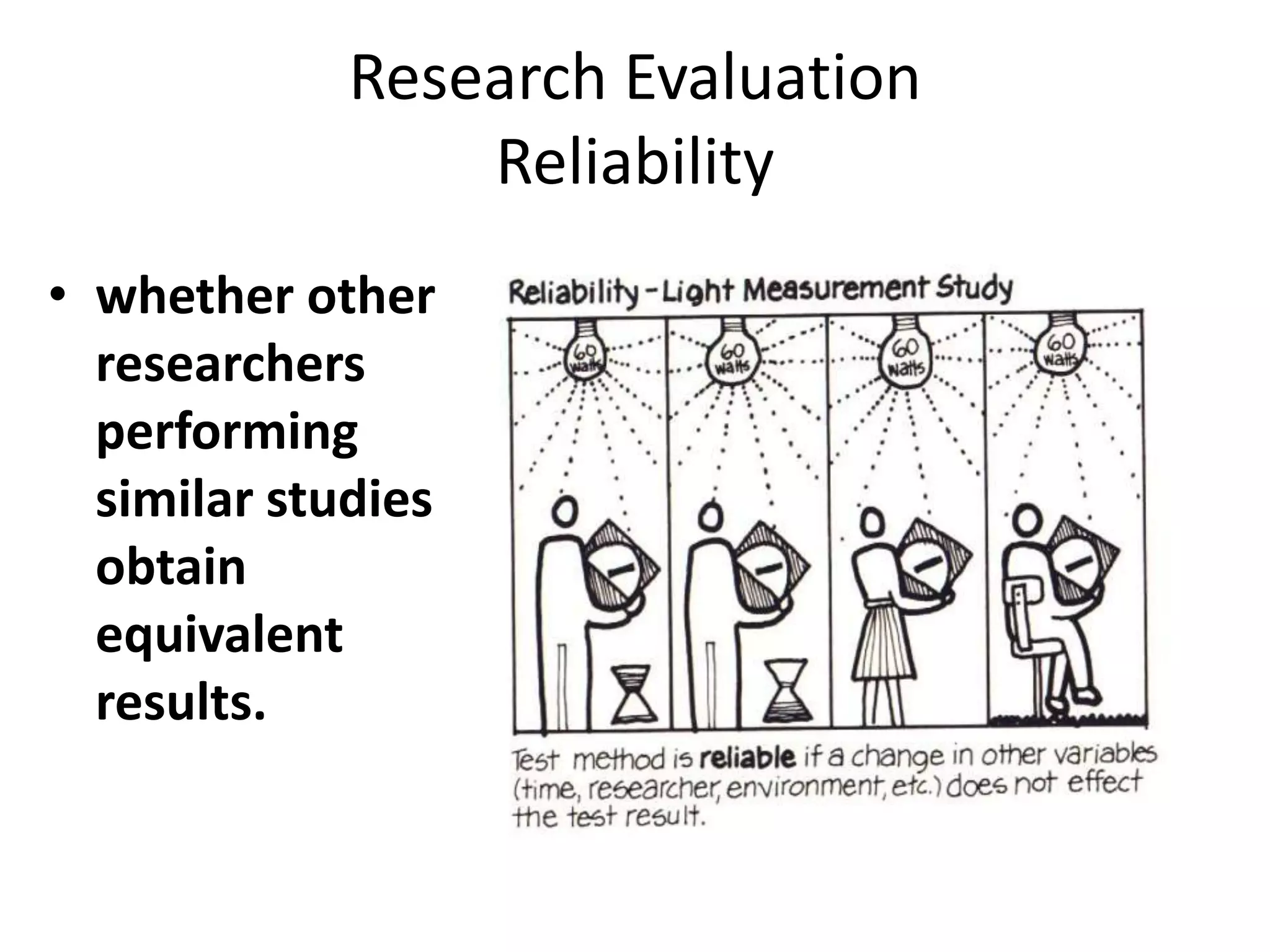
Research Evaluation
Reliability
• whether other
researchers
performing
similar studies
obtain
equivalent
results.
Research Methods
1. Observing Physical Traces
2. Observing Environmental Behavior
3. Focused Interviews
4. Standardized Questionnaires
5. Games
Research Methods:
Observing Physical Traces
• Systematically looking at physical surroundings to find
reflections of previous activity not produced in order to be
measured by researchers.
– unconsciously left behind
– conscious changes
1. How an environment got to be the way it is?
2. What decisions its designers and builders made about the
place?
3. How people actually use it?
4. How they feel toward their surroundings?
5. How that particular environment meets the needs of its
users?
• Qualities of the Method
1. Unobtrusive
2. Durable
3. Easy
Research Methods:
Observing Physical Traces
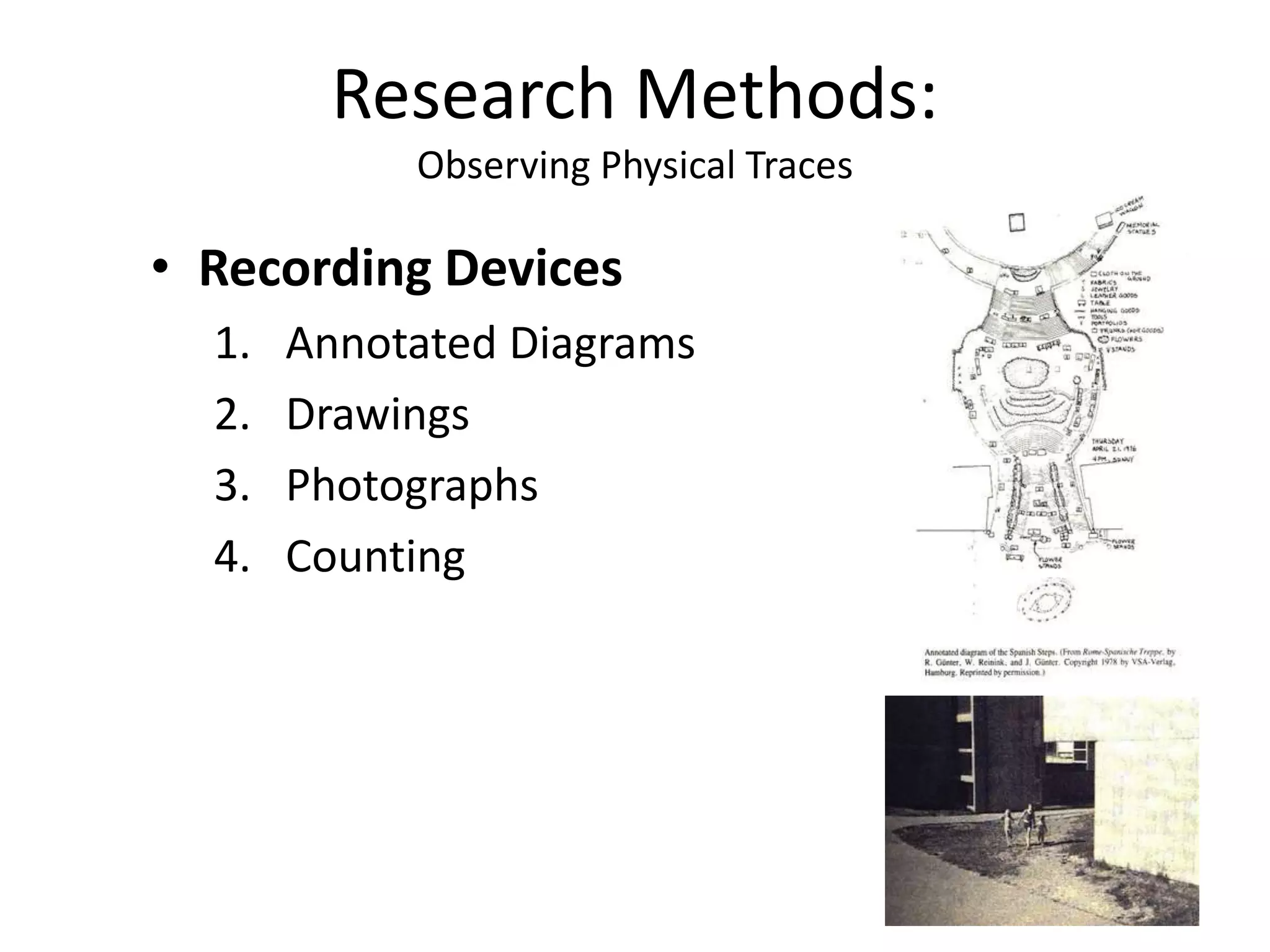
• Recording Devices
1. Annotated Diagrams
2. Drawings
3. Photographs
4. Counting
Research Methods:
Observing Physical Traces
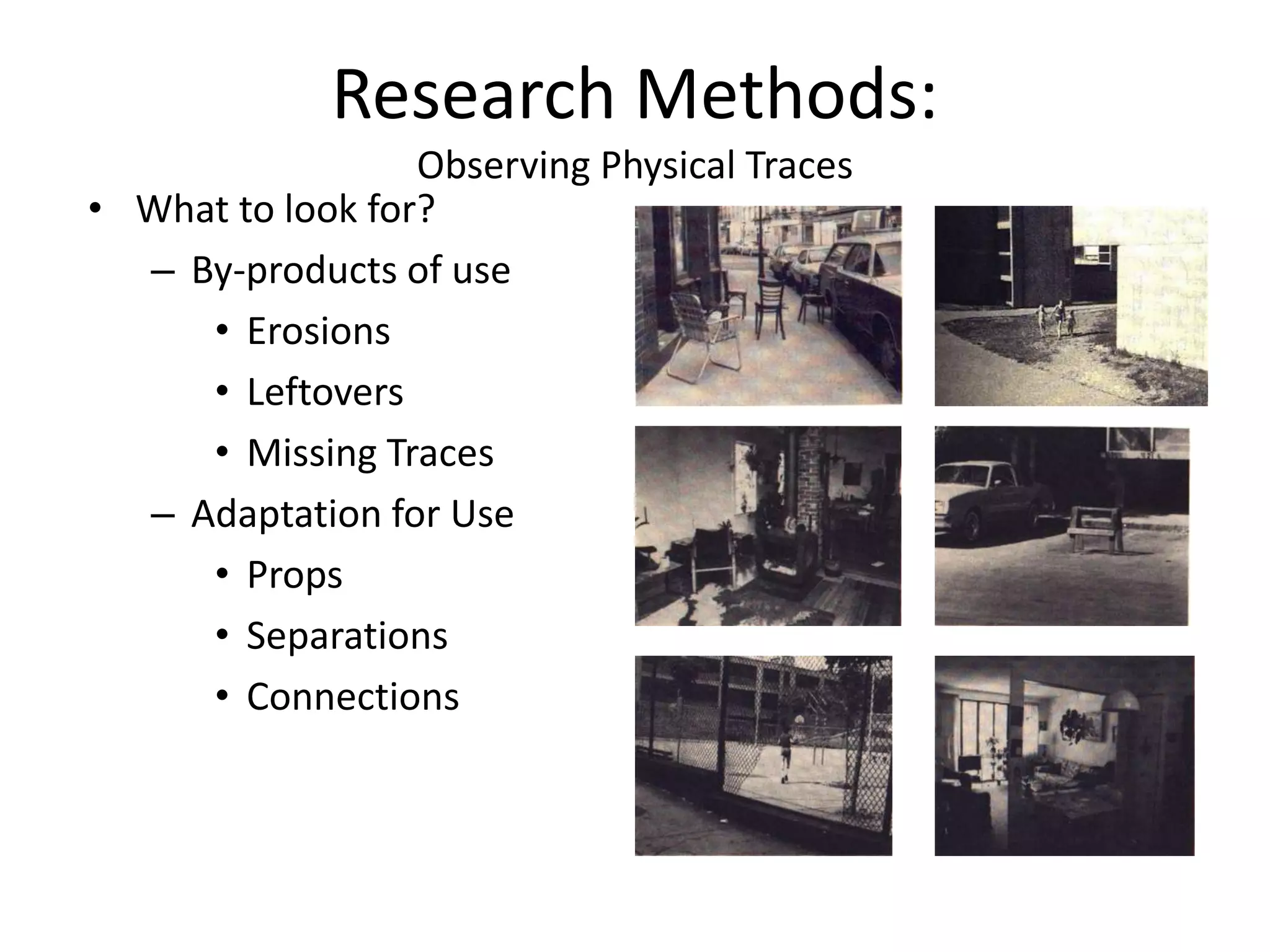
• What to look for?
– By-products of use
• Erosions
• Leftovers
• Missing Traces
– Adaptation for Use
• Props
• Separations
• Connections
Research Methods:
Observing Physical Traces
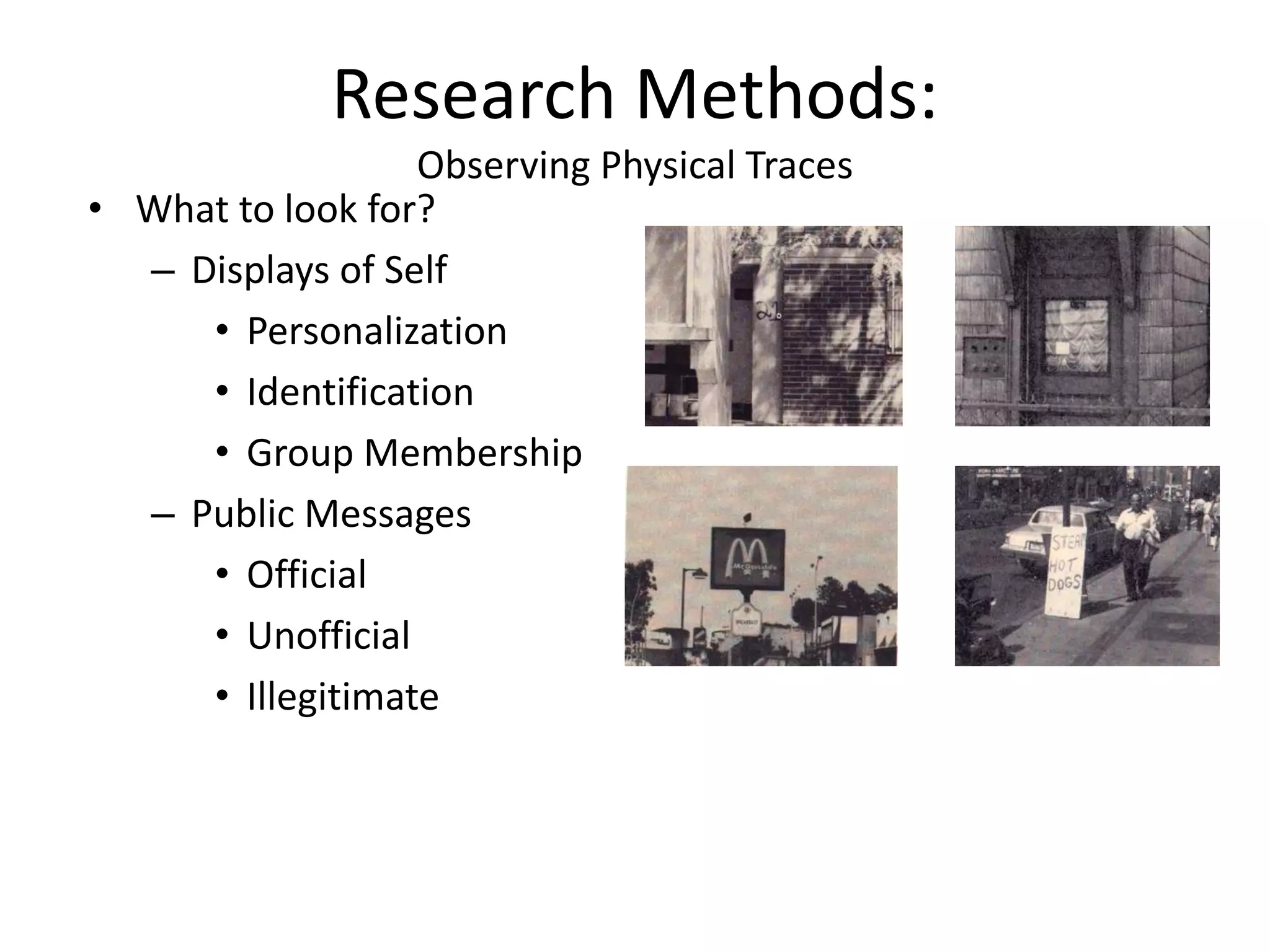
• What to look for?
– Displays of Self
• Personalization
• Identification
• Group Membership
– Public Messages
• Official
• Unofficial
• Illegitimate
Research Methods:
Observing Physical Traces
• Systematically watching people use their environments:
individuals, pairs of people, small groups, and large groups.
– What do they do?
– How do activities relate to one another spatially?
– How do spatial relations affect participants?
– How does a physical environment support or interfere
with behaviors taking place within it?
– What side effects does the setting have on relationships
between individuals or groups?
Research Methods:
Observing Environmental Behavior
• Generates data about:
– people's activities and the relationships needed to sustain
them; about
– regularities of behavior; about
– expected uses, new uses, and misuses of a place; and about
– behavioral opportunities and constraints that environments
provide.
Research Methods:
Observing Environmental Behavior
• Qualities of the Method
• Empathetic
• Direct
• Dynamic
• Reflective
• Variable Intrusive
• Observers’ Vantage Points
 Secret Outsider
 Recognized Outsider
 Marginal Participant
 Full Participant
Research Methods:
Observing Environmental Behavior
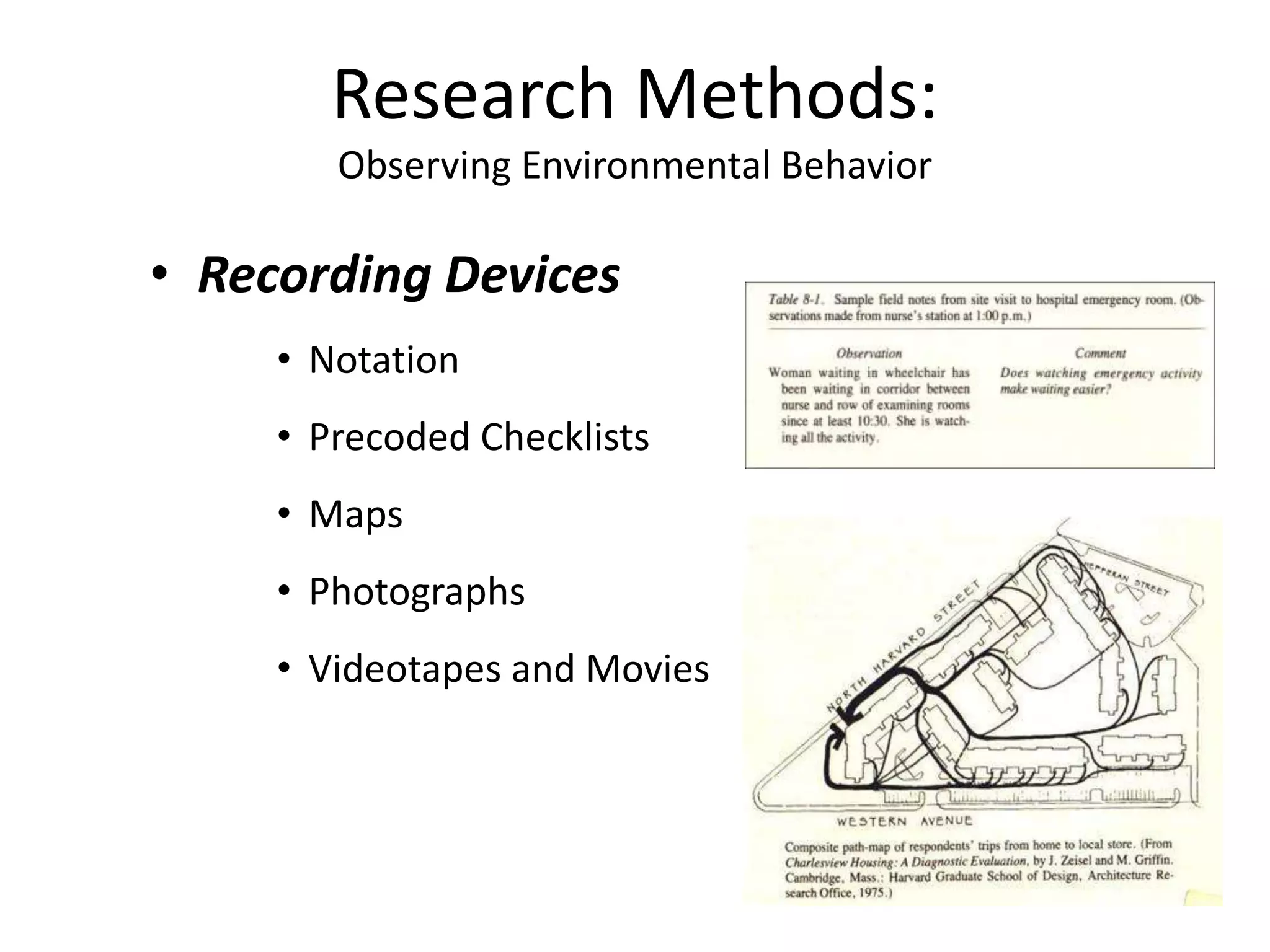
• Recording Devices
• Notation
• Precoded Checklists
• Maps
• Photographs
• Videotapes and Movies
Research Methods:
Observing Environmental Behavior
• What to Observe?
– Elements of Observation
• Who is Actor
• Doing what Act
• With whom? Significant Other
• In what relationship, Relationships (aural, visual, tactile, olfactory,
symbolic)
• In what context, Sociocultural Context (situation, culture)
• Where? Physical Setting (props, spatial relations)
Research Methods:
Observing Environmental Behavior
• Posing questions systematically to find
out what people think, feel, do, know,
believe, and expect.
Research Methods:
Focused Interviews
• Focused Interviews can be used with
individuals or groups to find out in depth:
1. How people define a concrete situation?
2. What they consider important about it?
3. What effects they intended their actions to have in the
situation?
4. How they feel about it?
Research Methods:
Focused Interviews
• The Interview Guide
• A loose set of topics, questions, elements,
patterns, and relationships that the
interviewer tentatively intends to cover.
Research Methods:
Focused Interviews
• Objectives of Focused Interviews:
–Definition of the Situation
–Strength of Respondents’ Feelings
–Intentions
Research Methods:
Focused Interviews
Research Methods:
Focused Interviews
Focused Interviews Probes
Probes are primarily questions that
interviewers interpose to get a respondent
to clarify a point, to explain further what he
meant, to continue talking, or to shift the
topic.
• The Leader Effect
– Appeal for equal time
– Attention to body language
– Asking for a vote
Research Methods:
Focused Interviews Probes
• To discover regularities among groups of
people by comparing answers to the same
set of questions asked of a large number
of people.
• Analysis of questionnaire responses can
provide precise numbers to measure
variables, e.g. degrees, percentages, .etc.
Research Methods:
Standardized Questionnaire
• Qualities of the Method
– Findings in a short time.
– Convincing using Quantitative data
– Control of the investigation
– Intrusiveness
Research Methods:
Standardized Questionnaire
• Precoding Responses
–Open ended questions (free-responses) are time consuming
and costly to analyze.
–Precoding is to partition possible response alternatives into a
set of categories for respondents to choose from.
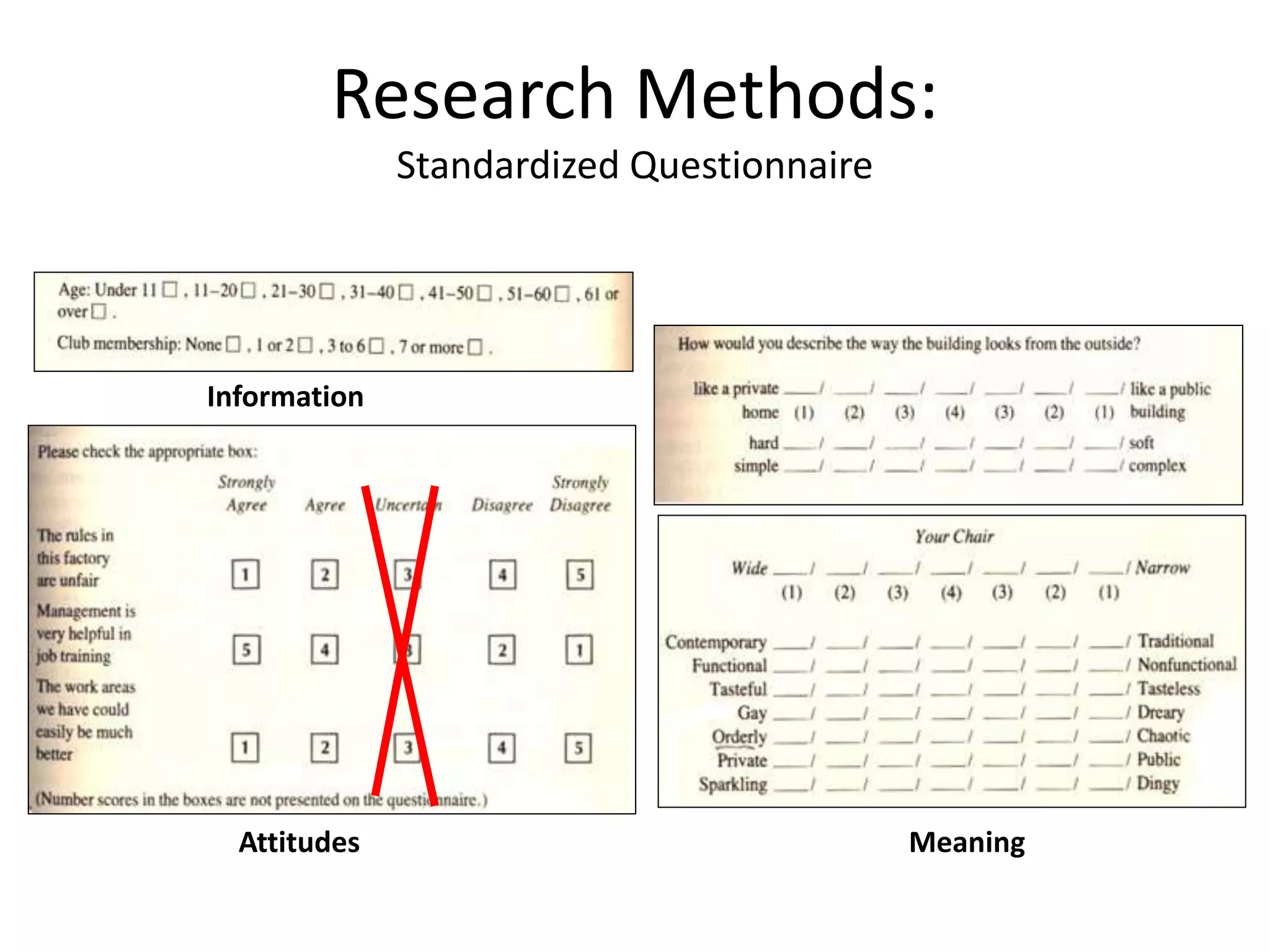
• Nominal (Yes and No , Gender , Religion)
• Ordinal (Information (age), Attitudes
(opinion), Meaning)
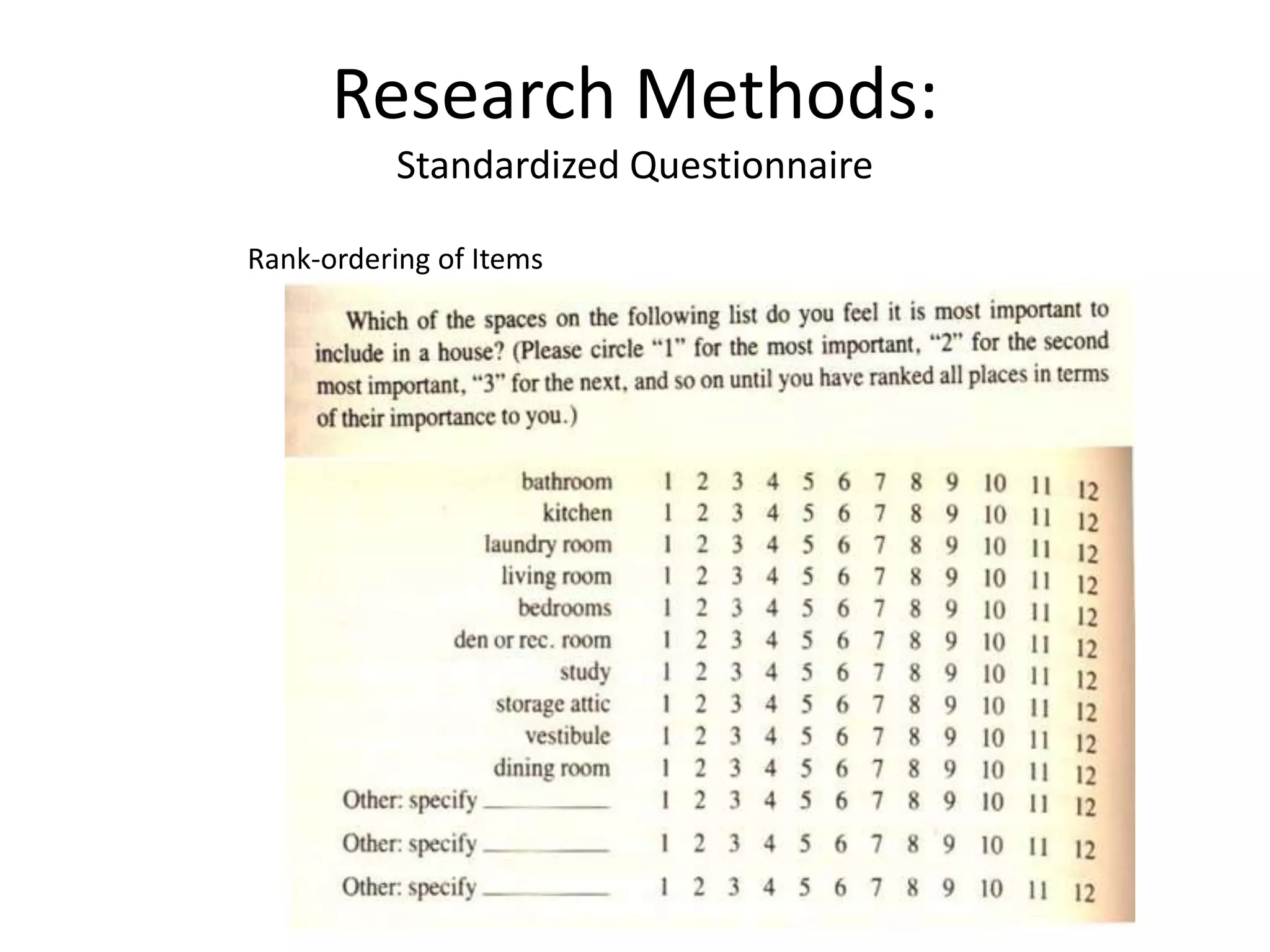
• Rank-ordering of Items
Research Methods:
Standardized Questionnaire
Research Methods:
Standardized Questionnaire
Information
Attitudes Meaning
Research Methods:
Standardized Questionnaire
Rank-ordering of Items
• Visual Responses
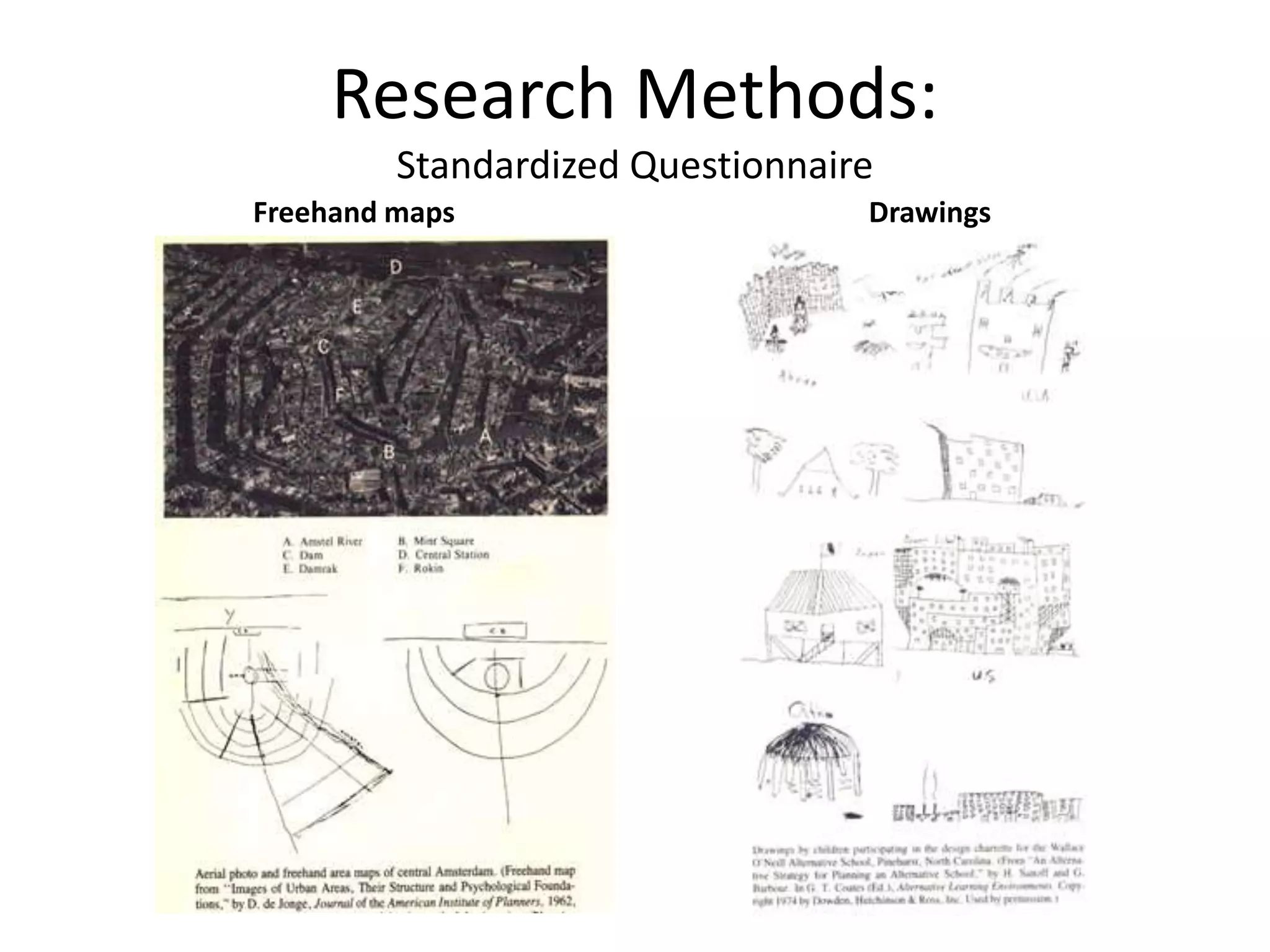
 Freehand Maps (Kevin Lynch)
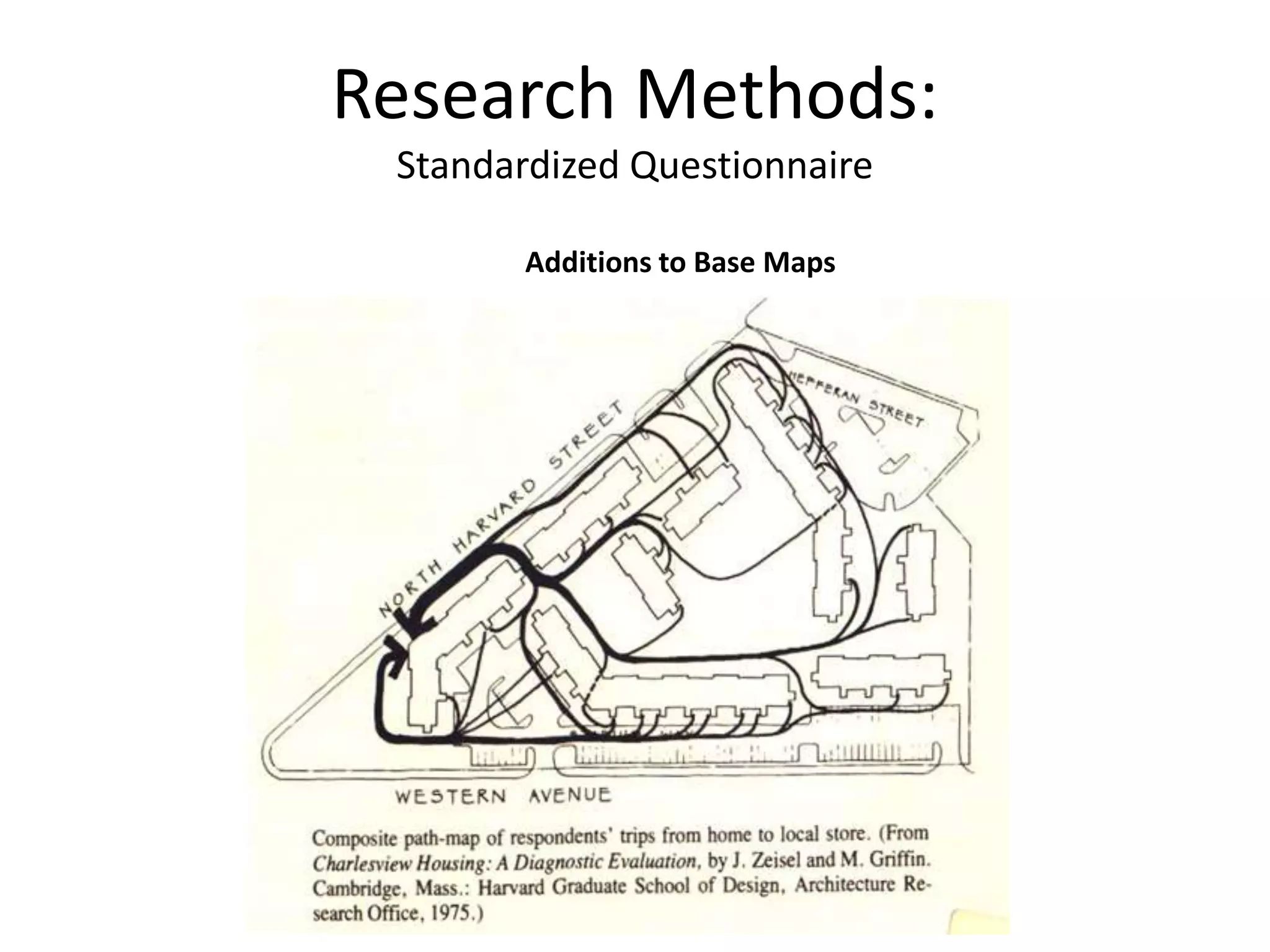
 Additions to Base Maps (Zeisel and Griffin)
 Drawings (Sanoff and Barbour)
 Photographs
Research Methods:
Standardized Questionnaire
Research Methods:
Standardized Questionnaire
Freehand maps Drawings
Research Methods:
Standardized Questionnaire
Additions to Base Maps
• Through which respondents express
themselves by making a series of linked
choice.
–Wilson’s “Neighborhood Game”.
Research Methods:
Games
End
Questions
Question
Question
• Draw a sketch of the research
cycle illustrating its five Main
steps.
Question
• What is the difference
between Annotated
Bibliography and Literature
Review?
Question
• What is the aim of descriptive
studies?
Question
• Define Validity and Reliability.
Question
• Mention 4 types of research
methods?
Question
• “All research methods should
be conducted systematically”.
What do we mean by the
“Systematically”?
Question
• Draw an example of annotated
diagram.
Question
• What to observe when
conducting “Observing
Environmental Behaviour”
research method?
Question
• Draw a question example
asking about “education
level”?
Question
• How can games be used as a
research method for data
gathering?

Arc 323 human studies in architecture fall 2018 lecture 6-mid term revision

  • 1.
    Faculty of Engineeringand Technology Department of Architectural Engineering ARC 323 : Human Studies in Architecture Fall 2018 Dr. Yasser Mahgoub Mid Term Revision
  • 2.
    “There is nodoubt whatever about the influence of architecture and structure upon human character and action. We make our buildings and afterwards they make us. They regulate the course of our lives.” Winston Churchill, addressing the English Architectural Association, 1924
  • 3.
  • 4.
  • 5.
    Research HumanitiesBehavior Applied behavioral research Datagathering and social research tools Sampling Human needs in relation to social contexts Behavior and the built environment Behavior and culture Perception Architecture within the framework of human sciences Human theories and society formation Environment relationship Humanities in contemporary architecture
  • 6.
    Humanities • Humanities areacademic disciplines that study aspects of human society and culture. – Anthropology – Sociology – Psychology – Archaeology – History – Linguistics and languages – Law and politics – Literature – Philosophy – Religion – Performing arts – Visual arts – …
  • 7.
    Definition of Research •A systematic inquiry or investigation into a subject in order to discover or revise facts, theories or applications.
  • 8.
  • 9.
  • 10.
    1 Select Topic 2Review Literature 3 Devise Conceptual Framework 4 Decide Research Questions 5 List Information Needs 6 Decide Research Strategy 7 Conduct Research 8 Report Findings Research Steps
  • 11.
    1. Select atopic Personal Interest The literature Policy or management problem Social Concern Popular Media
  • 12.
    2. Literature Review •Entire basis of the research • Source of ideas • Information on research already done by others • Source of Methods or theory ideas • Basis of comparison • Topic/problem statement guides this review • The review leads to further problem statement clarification
  • 13.
    3. Devise ConceptualFramework Framework involves concepts Concepts are general representations of the phenomena to be studied Framework indicates how the researcher views the relationships between elements involved
  • 14.
    4. Decide onResearch Questions • 1. Find out what is already known about the subject through doing a literature review. • 2. After you know what is already known, your question might need to be reformulated so that you have a question in need of an answer, rather than a question that has already been answered.
  • 15.
    5. List ofInformation Needs • Guided by the Problem Statement and secondary questions and conceptual framework.
  • 16.
    6. Decide onresearch Strategy • Information gathering techniques • Data Analysis techniques • Budget • Timetable
  • 17.
    7. Conduct Research •Pilot study – Use to test and adjust data collection tools • Data collection – Collect required data • Data analysis – Analyse collected data
  • 18.
    8. Report Findings •Through - tables, figures, GIS, graphics, and text discussion/oral presentations
  • 19.
    Literature Review (LR) Knowledgewe already possess  New information – A survey of various sources to produce knowledge that is more lasting and has more widespread usefulness. – A very important part of the research process – Not only at the beginning of the process but throughout it.
  • 20.
    Annotated Bibliography vsLR • Annotated Bibliography: – Listing of references obtained from searching a field’s literature – Respond to each reference cited with a descriptive paragraph.
  • 21.
    3.1.2. Annotated Bibliographyvs LR • Annotated Bibliography: – Listing of references obtained from searching a field’s literature – Respond to each reference cited with a descriptive paragraph: Goals, Theoretical stance, Relevance for the investigation.
  • 22.
    Annotated Bibliography vsLR • Literature Review: – Introductory statement – Summary of the lines of existing research (grouped) – Observations on the state of literature: Expand – Covered – Arguments - …
  • 23.
    Uses of LR 1.To identify the research question 2. To develop a research question 3. To focus the topic of inquiry 4. To understand the research question 5. To understand an idea’s generic roots 6. To understand the current conceptual landscape
  • 24.
    Primary, Secondary andTertiary Sources
  • 25.
    Where to go:Resources 1. Internet 2. Library 3. Archives 4. Organizations 5. Agencies 6. Media
  • 26.
    Research Strategies • ResearchApproaches – Diagnostic – Descriptive – Theoretical – Action • Research Designs – Case study – Survey – Experiment • Research Settings – Natural – Contrived
  • 27.
  • 28.
    Research Approaches Diagnostic Studies •help you deepen your understanding of a setting. • offer insight into the structure and dynamics of a whole situation.
  • 29.
    Research Approaches Descriptive Studies •describe and measure as precisely as possible one or more characteristics and their relations in a defined group. • Developing clear concepts and translating these into something that can be counted as a manifestation of the concept
  • 30.
    Research Approaches Theoretical Studies •set specific hypotheses suggested by experiences elsewhere or primarily derived from more comprehensive theory. • increase general insights and focus more on the conceptual framework of a problem
  • 31.
    Research Approaches Action researchStudies • changes are made and analyzed that have direct and lasting consequences on people beyond those in the research project. • may occur naturally or may be created analytically by careful sampling.
  • 32.
  • 33.
    Research Design Case Study •to develop intensive knowledge about one complex object. • to describe and diagnose single, internally complex objects: individuals, buildings, episodes, institutions, processes, societies. • information specific to the particular study object and context
  • 34.
    Research Design Survey • tofind out in detail about a phenomenon • study large populations • easy to quantify • less time-consuming to analyze • email questionnaires, observing physical traces, observing behavior, and interviews.
  • 35.
    Research Design Experimental • tomeasure the effects that an action has in a particular situation. • to focus observation on a small number of attributes at one time • control, –Control group and Experiment group –Before and After the action
  • 36.
    Research Design Experimental -Parametric Study • the systematic manipulation of one variable (Independent), and making measurements on another variable (Dependent), while keeping all other conditions constant
  • 37.
    Research Design Experimental -Multivariant Study • many physical and personal factors are present.
  • 38.
    Research Settings Natural Settings •to observe people in settings they choose to come to • appropriate for diagnostic studies in which investigators want to find out what is actually going on - what elements, relationships, and dynamics are salient. • can also carry out an experiment, by manipulating a part of a physical environment, a particular social behavior, or a policy.
  • 39.
    Research Settings Contrived Settings •planned and controlled research environments in which to observe people and gather data from them. • experimental laboratory, in which investigators control the setting, choose participants randomly, effect controlled changes, and measure some attribute of the subjects after those changes.
  • 40.
    Research Evaluation Validity • whetherthe property being measured is what should be measured - i.e., are we measuring the right thing?
  • 41.
    Research Evaluation Reliability • whetherother researchers performing similar studies obtain equivalent results.
  • 42.
    Research Methods 1. ObservingPhysical Traces 2. Observing Environmental Behavior 3. Focused Interviews 4. Standardized Questionnaires 5. Games
  • 43.
    Research Methods: Observing PhysicalTraces • Systematically looking at physical surroundings to find reflections of previous activity not produced in order to be measured by researchers. – unconsciously left behind – conscious changes 1. How an environment got to be the way it is? 2. What decisions its designers and builders made about the place? 3. How people actually use it? 4. How they feel toward their surroundings? 5. How that particular environment meets the needs of its users?
  • 44.
    • Qualities ofthe Method 1. Unobtrusive 2. Durable 3. Easy Research Methods: Observing Physical Traces
  • 45.
    • Recording Devices 1.Annotated Diagrams 2. Drawings 3. Photographs 4. Counting Research Methods: Observing Physical Traces
  • 46.
    • What tolook for? – By-products of use • Erosions • Leftovers • Missing Traces – Adaptation for Use • Props • Separations • Connections Research Methods: Observing Physical Traces
  • 47.
    • What tolook for? – Displays of Self • Personalization • Identification • Group Membership – Public Messages • Official • Unofficial • Illegitimate Research Methods: Observing Physical Traces
  • 48.
    • Systematically watchingpeople use their environments: individuals, pairs of people, small groups, and large groups. – What do they do? – How do activities relate to one another spatially? – How do spatial relations affect participants? – How does a physical environment support or interfere with behaviors taking place within it? – What side effects does the setting have on relationships between individuals or groups? Research Methods: Observing Environmental Behavior
  • 49.
    • Generates dataabout: – people's activities and the relationships needed to sustain them; about – regularities of behavior; about – expected uses, new uses, and misuses of a place; and about – behavioral opportunities and constraints that environments provide. Research Methods: Observing Environmental Behavior
  • 50.
    • Qualities ofthe Method • Empathetic • Direct • Dynamic • Reflective • Variable Intrusive • Observers’ Vantage Points  Secret Outsider  Recognized Outsider  Marginal Participant  Full Participant Research Methods: Observing Environmental Behavior
  • 51.
    • Recording Devices •Notation • Precoded Checklists • Maps • Photographs • Videotapes and Movies Research Methods: Observing Environmental Behavior
  • 52.
    • What toObserve? – Elements of Observation • Who is Actor • Doing what Act • With whom? Significant Other • In what relationship, Relationships (aural, visual, tactile, olfactory, symbolic) • In what context, Sociocultural Context (situation, culture) • Where? Physical Setting (props, spatial relations) Research Methods: Observing Environmental Behavior
  • 53.
    • Posing questionssystematically to find out what people think, feel, do, know, believe, and expect. Research Methods: Focused Interviews
  • 54.
    • Focused Interviewscan be used with individuals or groups to find out in depth: 1. How people define a concrete situation? 2. What they consider important about it? 3. What effects they intended their actions to have in the situation? 4. How they feel about it? Research Methods: Focused Interviews
  • 55.
    • The InterviewGuide • A loose set of topics, questions, elements, patterns, and relationships that the interviewer tentatively intends to cover. Research Methods: Focused Interviews
  • 56.
    • Objectives ofFocused Interviews: –Definition of the Situation –Strength of Respondents’ Feelings –Intentions Research Methods: Focused Interviews
  • 57.
    Research Methods: Focused Interviews FocusedInterviews Probes Probes are primarily questions that interviewers interpose to get a respondent to clarify a point, to explain further what he meant, to continue talking, or to shift the topic.
  • 58.
    • The LeaderEffect – Appeal for equal time – Attention to body language – Asking for a vote Research Methods: Focused Interviews Probes
  • 59.
    • To discoverregularities among groups of people by comparing answers to the same set of questions asked of a large number of people. • Analysis of questionnaire responses can provide precise numbers to measure variables, e.g. degrees, percentages, .etc. Research Methods: Standardized Questionnaire
  • 60.
    • Qualities ofthe Method – Findings in a short time. – Convincing using Quantitative data – Control of the investigation – Intrusiveness Research Methods: Standardized Questionnaire
  • 61.
    • Precoding Responses –Openended questions (free-responses) are time consuming and costly to analyze. –Precoding is to partition possible response alternatives into a set of categories for respondents to choose from. • Nominal (Yes and No , Gender , Religion) • Ordinal (Information (age), Attitudes (opinion), Meaning) • Rank-ordering of Items Research Methods: Standardized Questionnaire
  • 62.
  • 63.
  • 64.
    • Visual Responses Freehand Maps (Kevin Lynch)  Additions to Base Maps (Zeisel and Griffin)  Drawings (Sanoff and Barbour)  Photographs Research Methods: Standardized Questionnaire
  • 65.
  • 66.
  • 67.
    • Through whichrespondents express themselves by making a series of linked choice. –Wilson’s “Neighborhood Game”. Research Methods: Games
  • 68.
  • 69.
  • 70.
  • 71.
    Question • Draw asketch of the research cycle illustrating its five Main steps.
  • 72.
    Question • What isthe difference between Annotated Bibliography and Literature Review?
  • 73.
    Question • What isthe aim of descriptive studies?
  • 74.
  • 75.
    Question • Mention 4types of research methods?
  • 76.
    Question • “All researchmethods should be conducted systematically”. What do we mean by the “Systematically”?
  • 77.
    Question • Draw anexample of annotated diagram.
  • 78.
    Question • What toobserve when conducting “Observing Environmental Behaviour” research method?
  • 79.
    Question • Draw aquestion example asking about “education level”?
  • 80.
    Question • How cangames be used as a research method for data gathering?

Editor's Notes

  • #29 تساعدك الدراسات التشخيصية على تعميق فهمك للإعدادات: فهي تقدم أدلة موحية على نطاق واسع. أنها توفر نظرة ثاقبة في هيكل وديناميات الوضع برمته. من أجل موثوقية النتائج ، تعتمد الدراسات التشخيصية على الاتساق والوضوح وترابط الأفكار التي تطورها في الحالة التي تجري دراستها. الباحثون الذين يرغبون في الحصول على قياسات أكثر دقة لسمات معينة لمجموعة أو حالة ، يمكنهم إجراء دراسة وصفية تستند إلى أطر مفاهيمية تم تطويرها في مجموعات تشخيصية. مثال: القرويون الحضريون
  • #30 تصف الدراسات الوصفية وتقيس بأكبر قدر ممكن من الدقة خصائص أو أكثر وعلاقاتها في مجموعة محددة. إن تطوير المفاهيم الواضحة وترجمتها إلى شيء يمكن اعتباره مظهراً من مظاهر المفهوم هي مشاكل حاسمة بشكل خاص في البحث الوصفي. مثال: دراسة الخوف بين سكان مشروع إسكان برويت إيغو في سانت لويس
  • #31 حددت الدراسات النظرية فرضيات محددة مقترحة من التجارب في مكان آخر أو مستمدة أساسًا من نظرية أكثر شمولية. تميل مثل هذه الدراسات إلى زيادة البصائر العامة والتركيز أكثر على الإطار المفاهيمي لمشكلة ما على الطبيعة الدقيقة للمجموعة التي يراقبونها. مثال: الضغوط الاجتماعية في مجموعات غير رسمية
  • #32 في الدراسات البحثية العملية يتم إجراء التغييرات وتحليلها التي لها عواقب مباشرة ودائمة على الأشخاص بخلاف أولئك في مشروع البحث. قد تحدث إعدادات بحث العمل المقارن بشكل طبيعي أو يمكن إنشاؤها بطريقة تحليلية عن طريق أخذ عينات متأنية.
  • #34 يستخدم الباحثون تصميم دراسة حالة عندما يرغبون في تطوير معرفة مكثفة عن أحد الأشياء المعقدة. يتم استخدامها لوصف وتشخيص كائنات مفردة ومعقدة داخليًا: الأفراد والمباني والحلقات والمؤسسات والعمليات والمجتمعات. تعتبر دراسة الحالة مناسبة عندما يكون الباحثون مهتمين بشكل أساسي بمعلومات خاصة بجسم الدراسة المعين والسياق ، بدلاً من المعلومات التي يمكن تعميمها بسهولة على عدد كبير من السكان.
  • #35 يُعد تصميم الاستبيان مفيدًا عندما يريد المحققون معرفة تفاصيل ظاهرة معينة ، مثل رضا السكن ، أو حول فئة من العناصر. غالبًا ما يختار الباحثون في الدراسة الذين يدرسون عددًا كبيرًا من السكان جمع البيانات التي يسهل قياسها ، وبالتالي ، أقل استهلاكا للوقت للتحليل من البيانات النوعية. ولهذا السبب ، فإن طرق البحث المتواترة المستخدمة في الاستبيانات هي استبيانات بالبريد الإلكتروني ، ومراقبة الآثار المادية ، ومراقبة السلوك ، والمقابلات.
  • #36 يكون التصميم التجريبي مناسبًا عندما يريد المحققون قياس التأثيرات التي يحدثها الإجراء في حالة معينة. في التجربة التي تريد أن تكون قادراً على تركيز الملاحظة على عدد صغير من السمات في وقت واحد. للقيام بذلك ، تحتاج إلى التحكم ، حتى تكون متأكدًا قدر المستطاع من أن التأثيرات التي تلاحظها ناتجة عن التغييرات التجريبية. مجموعة التحكم ومجموعة التجربة قبل وبعد العمل
  • #37 يتكون البحث البارامتري من التلاعب المنهجي لمتغير واحد (مستقل) ، وإجراء قياسات على متغير آخر (تابع) على الرغم من أنه يتأثر مباشرة بالمتغير المستقل ، مع الحفاظ على جميع الشروط الأخرى ثابتة عن طريق متغير التحكم
  • #38 في العديد من المواقف ، يصعب تحديد مجموعة واحدة أو حتى مجموعة محدودة من المتغيرات - خاصة في حالة الدراسات السلوكية لبيئات البناء حيث توجد العديد من العوامل المادية والشخصية.
  • #39 توفر الإعدادات الطبيعية للباحثين فرصة فريدة لمراقبة الأشخاص في الأماكن التي يختارون المجيء إليها ، والمشاركة في الأنشطة التي لا يمكن لأي إعداد مفتعل إعادة إنشائها. تعتبر الإعدادات الطبيعية مناسبة بشكل خاص للدراسات التشخيصية التي يرغب المحققون في معرفة ما يحدث فيها بالفعل - ما هي العناصر والعلاقات والديناميكيات البارزة. في الإعدادات الطبيعية ، يمكنك أيضًا إجراء تجربة ، عن طريق التلاعب بجزء من بيئة مادية ، أو سلوك اجتماعي معين ، أو سياسة.
  • #40 يتم إعداد الإعدادات المفتعلة في بيئات بحثية يتم التحكم فيها لمراقبة الأشخاص وجمع البيانات منهم. أحد هذه الإعدادات هو المختبر التجريبي ، حيث يتحكم المحققون في الإعداد ، ويختارون المشاركين عشوائياً ، ويؤثروا في التغييرات ، ويقيسون بعض سمات الموضوعات بعد هذه التغييرات.
  • #41 وتتعلق صلاحية القياس بما إذا كانت الخاصية التي يجري قياسها هي ما ينبغي قياسه - أي ، هل نقيس الشيء الصحيح؟
  • #42 تشير الموثوقية إلى ما إذا كان باحثون آخرون يقومون بأبحاث مماثلة يحصلون على نتائج متكافئة.