Classroom-based Research Lynn Wright FTLA, January 27, 2010 Adapted from a presentation by Darla M. Cooper and Michelle Barton of the RP Group
Action Research is a participatory  process that seeks to bring together action and reflection, theory and practice, in the pursuit of practical solutions to issues of pressing concern. (Reason and Bradbury,  The SAGE Handbook of Action Research , p. 4)
Classroom-based research can be used to discover Students’ knowledge, skills, and/or attitudes The impact of interventions made in the classroom
Benefits of Classroom-based Research Enables you to plan and teach effectively Enhances your research and teaching skills, knowledge and understanding Encourages collaborative work that may help you reflect more effectively on the impact you are having on students’ learning Provides evidence that can be used to support effective classroom interventions Linking research to your own practice in the classroom helps address students’ needs
Classroom-based Research: Step 1 Group Activity Develop questions based on your curiosity about your students’ learning and your teaching Decide on a topic/specific questions or issues to research
Classroom-based Research: Steps 2 & 3 Investigate your questions with your students, documenting what happens Collect and analyze data from your classes, including your own observations and reflections
How to Be a Researcher in Your Classroom Become familiar with research designs and the associated data analyses Pre/post test Group comparison Trend analysis Surveys
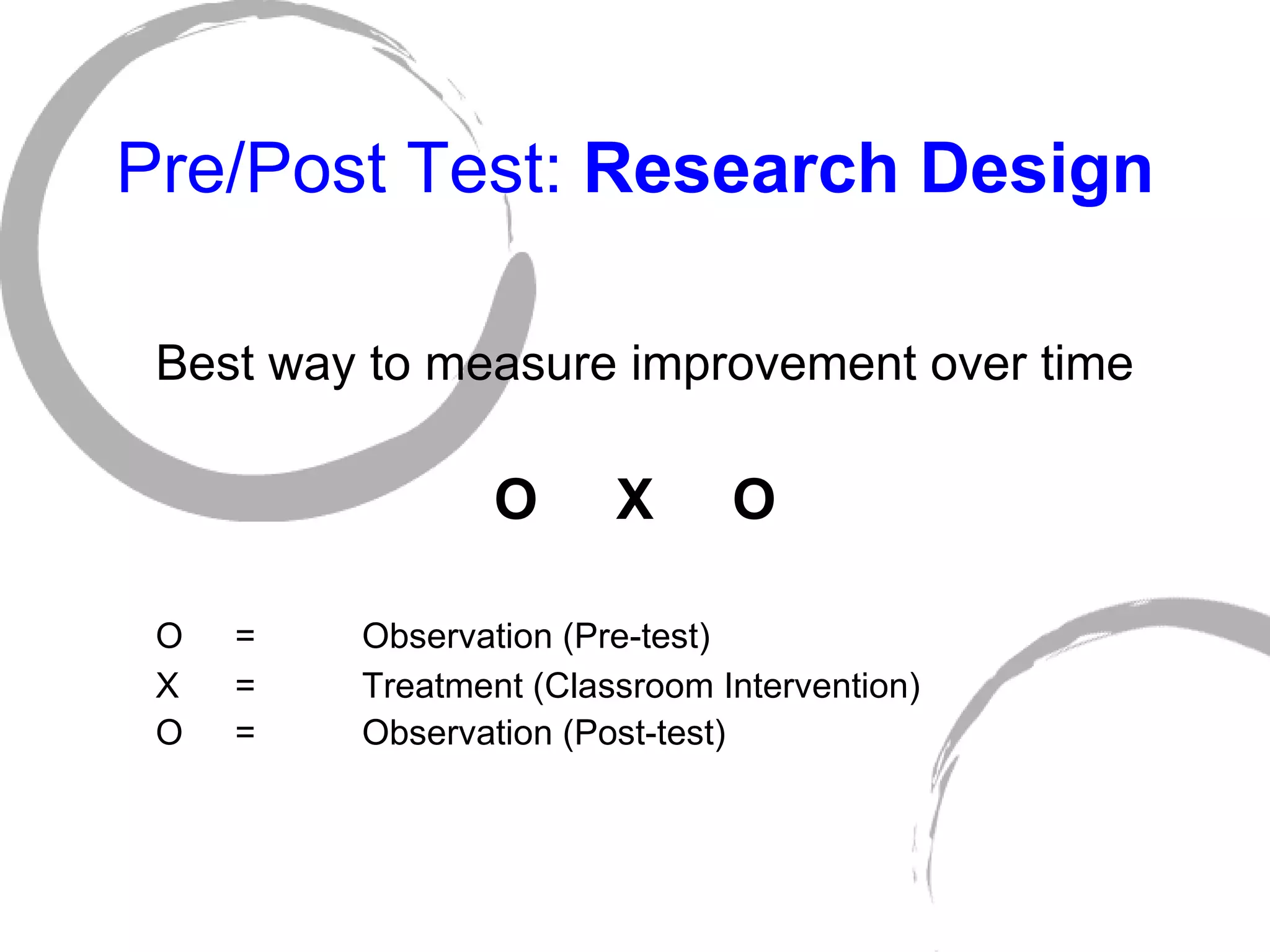
Pre/Post Test:  Research Design Best way to measure improvement over time O  X  O O = Observation (Pre-test) X = Treatment (Classroom Intervention) O = Observation (Post-test)
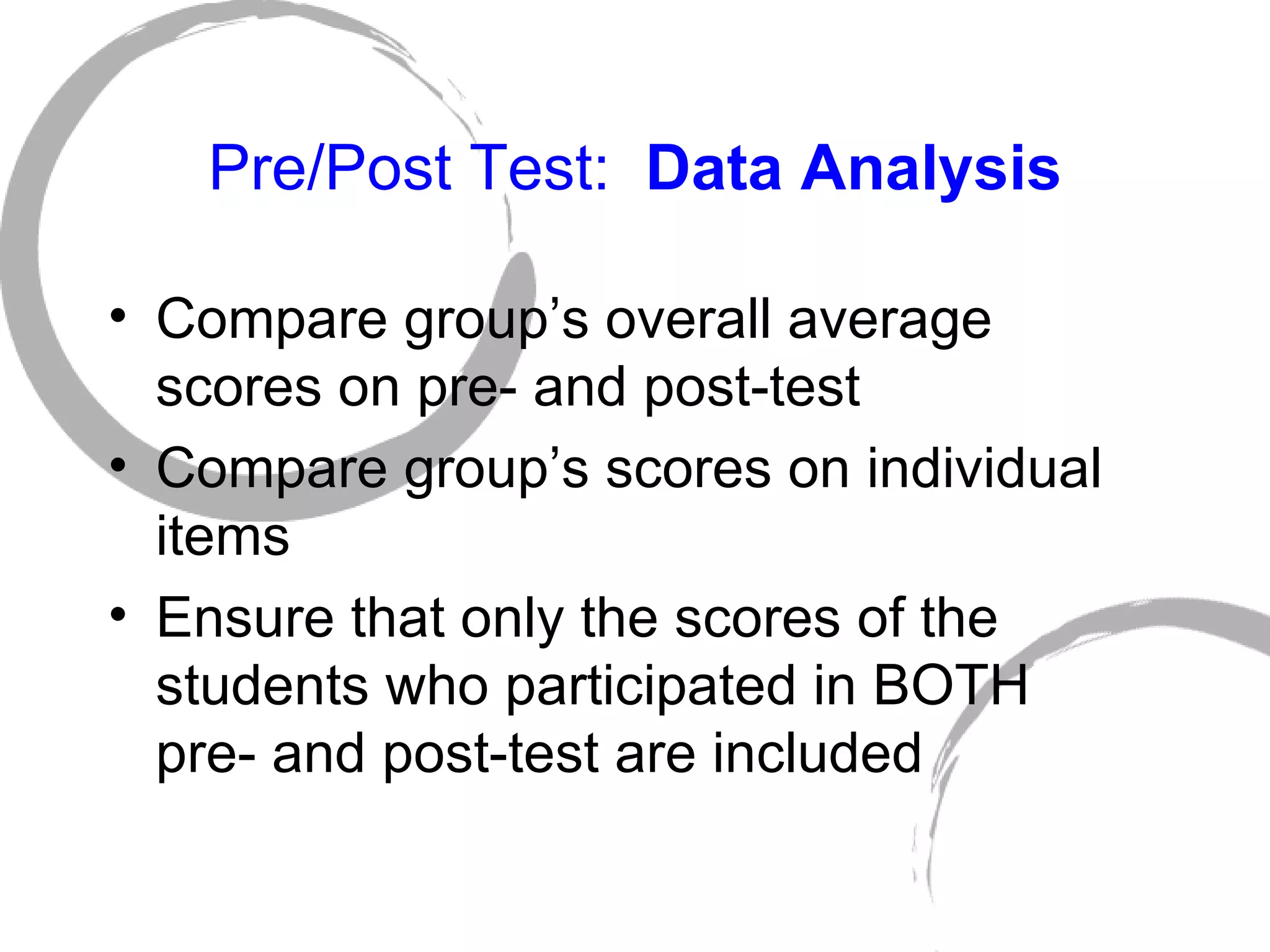
Pre/Post Test:  Data Analysis Compare group’s overall average scores on pre- and post-test Compare group’s scores on individual items Ensure that only the scores of the students who participated in BOTH  pre- and post-test are included
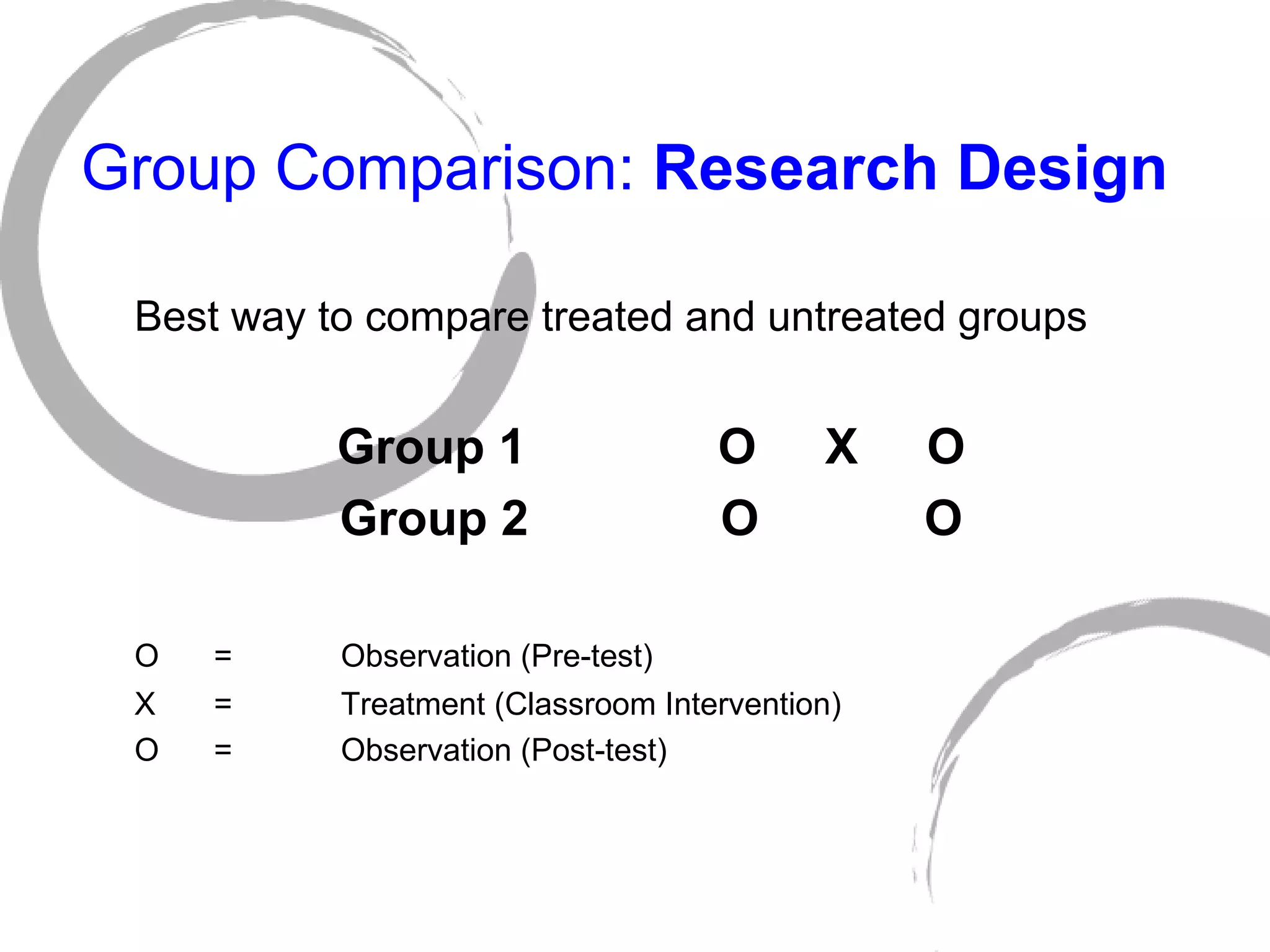
Group Comparison:  Research Design Best way to compare treated and untreated groups Group 1 O  X  O Group 2 O  O O = Observation (Pre-test) X =  Treatment (Classroom Intervention) O = Observation (Post-test)
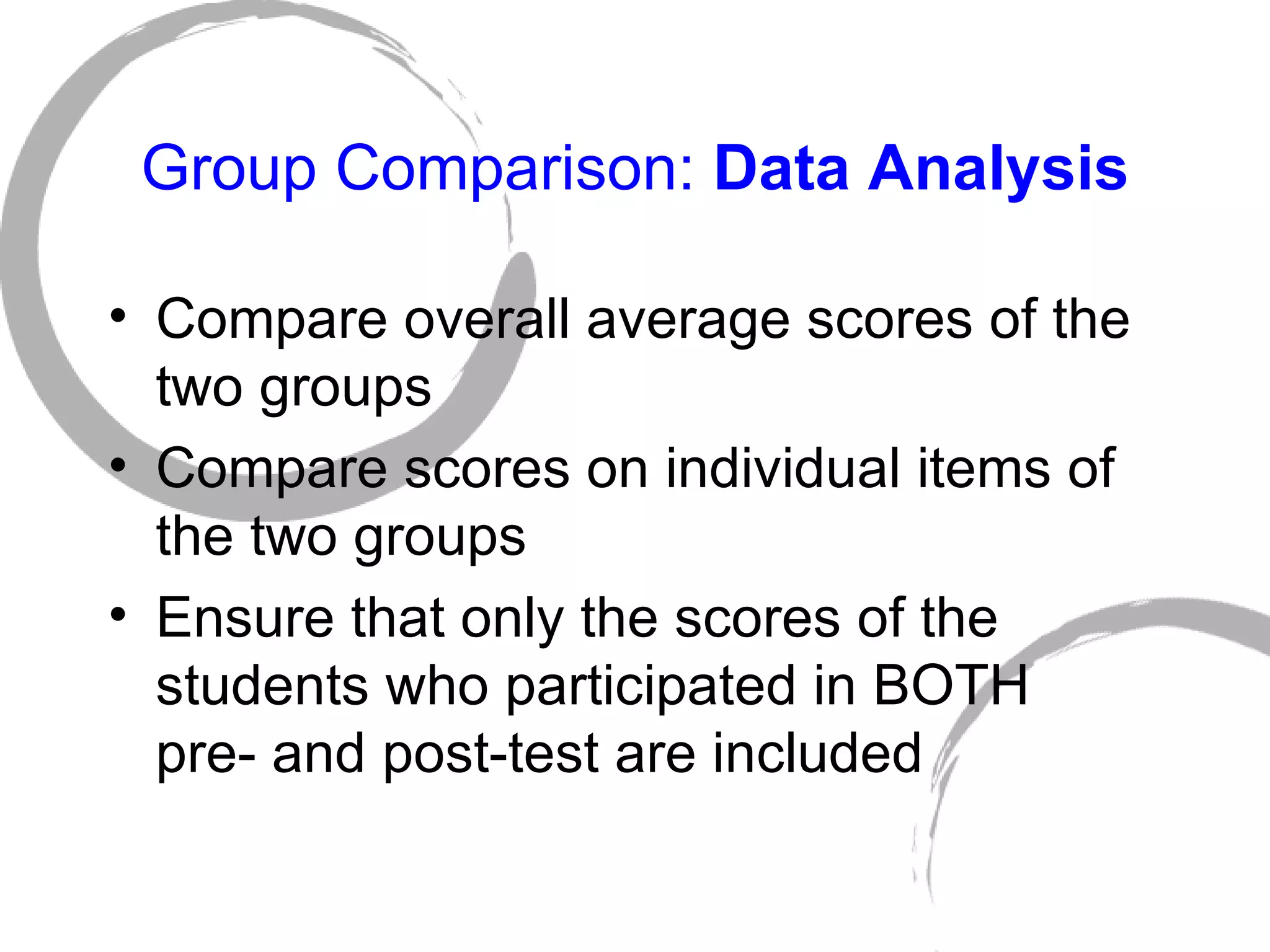
Group Comparison:  Data Analysis Compare overall average scores of the two groups Compare scores on individual items of the two groups Ensure that only the scores of the students who participated in BOTH  pre- and post-test are included
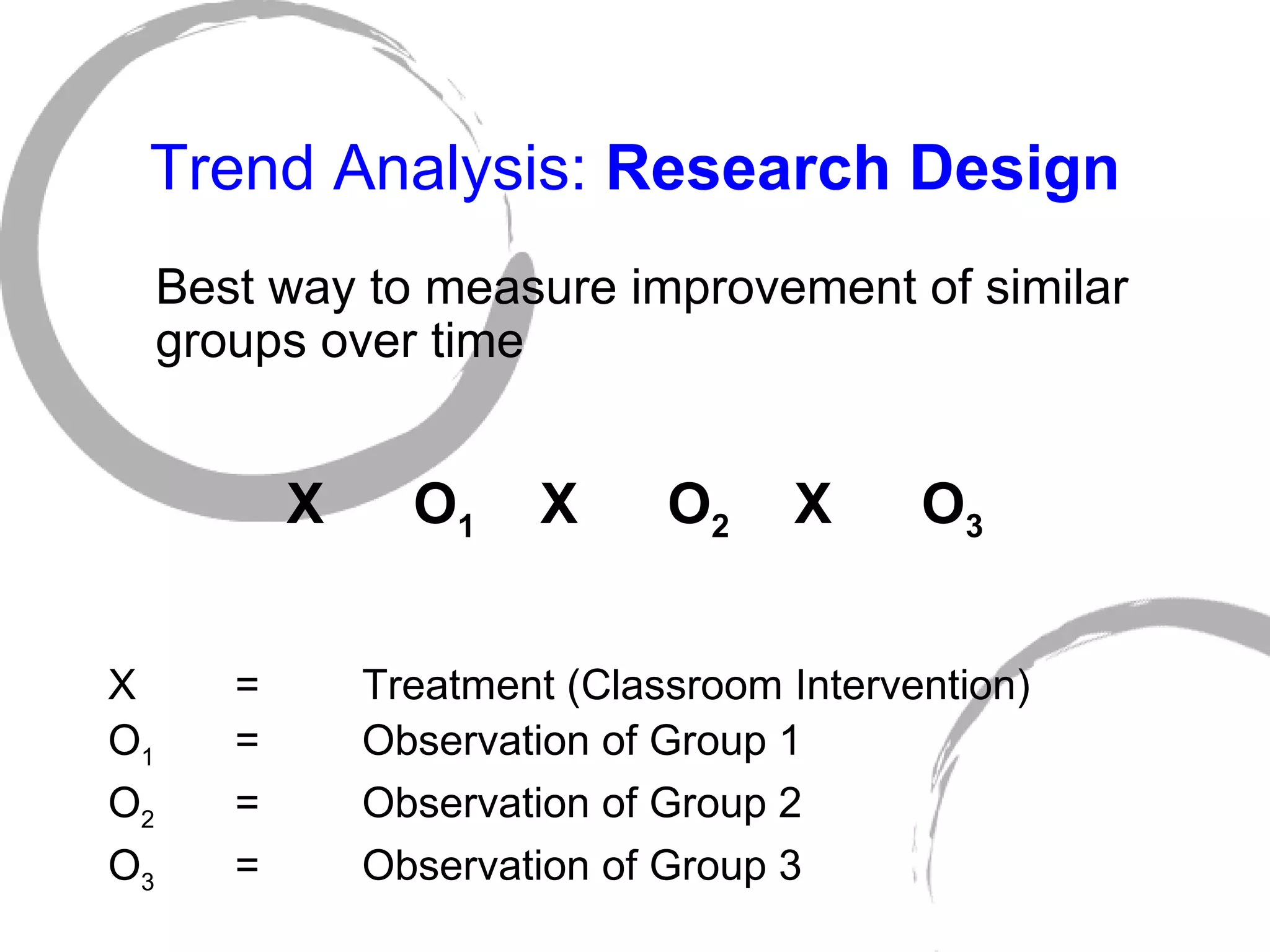
Trend Analysis:  Research Design Best way to measure improvement of similar groups over time X O 1 X O 2 X O 3 X =  Treatment (Classroom Intervention) O 1  =  Observation of Group 1  O 2  =  Observation of Group 2 O 3  =  Observation of Group 3
Trend Analysis:  Research Design Compare overall average score of each group at each observation time Compare scores on individual items of each group at each observation time Be aware that with this design you are not comparing the same group over time; so not measuring the improvement of one group of students, but of students in same class over time (e.g., course success rates)
Surveys:  Research Design   Best way to measure students’ attitudes, beliefs, and/or perceptions Can be used to enhance quantitative data (helps get at the HOW to resolve a problem) Can be pre/post-test or post-test only Can be group comparisons
Surveys:   Data Analysis Look at percentages of students giving each response Analyze open-ended questions to identify themes If given pre/post, compare group’s responses on individual items on pre- and post-tests If given to two or more groups, compare responses of the groups
Qualitative Methods Often asks the question of “how” instead of “what” Looks at the quality of relationships, activities, situations, or materials Types of Methods Observations Interviews Case Studies
Classroom-based Research: Steps 4, 5, & 6 Examine your own assumptions and  beliefs Discuss your research to determine your findings and conclusions Articulate your findings and conclusions, continuing your discussions with a broader range of colleagues
Classroom-based Research Plan Group Activity: Mapping out your project How will you research your topic? Which research designs will you use and who will design them?  (surveys, pre/post-tests, etc.) What kinds of data analyses will you do? When will it be done?  (Create a timeline) What will you do with your findings?  (Dissemination and other next steps)

Classroom Research

  • 1.
    Classroom-based Research LynnWright FTLA, January 27, 2010 Adapted from a presentation by Darla M. Cooper and Michelle Barton of the RP Group
  • 2.
    Action Research isa participatory process that seeks to bring together action and reflection, theory and practice, in the pursuit of practical solutions to issues of pressing concern. (Reason and Bradbury, The SAGE Handbook of Action Research , p. 4)
  • 3.
    Classroom-based research canbe used to discover Students’ knowledge, skills, and/or attitudes The impact of interventions made in the classroom
  • 4.
    Benefits of Classroom-basedResearch Enables you to plan and teach effectively Enhances your research and teaching skills, knowledge and understanding Encourages collaborative work that may help you reflect more effectively on the impact you are having on students’ learning Provides evidence that can be used to support effective classroom interventions Linking research to your own practice in the classroom helps address students’ needs
  • 5.
    Classroom-based Research: Step1 Group Activity Develop questions based on your curiosity about your students’ learning and your teaching Decide on a topic/specific questions or issues to research
  • 6.
    Classroom-based Research: Steps2 & 3 Investigate your questions with your students, documenting what happens Collect and analyze data from your classes, including your own observations and reflections
  • 7.
    How to Bea Researcher in Your Classroom Become familiar with research designs and the associated data analyses Pre/post test Group comparison Trend analysis Surveys
  • 8.
    Pre/Post Test: Research Design Best way to measure improvement over time O X O O = Observation (Pre-test) X = Treatment (Classroom Intervention) O = Observation (Post-test)
  • 9.
    Pre/Post Test: Data Analysis Compare group’s overall average scores on pre- and post-test Compare group’s scores on individual items Ensure that only the scores of the students who participated in BOTH pre- and post-test are included
  • 10.
    Group Comparison: Research Design Best way to compare treated and untreated groups Group 1 O X O Group 2 O O O = Observation (Pre-test) X = Treatment (Classroom Intervention) O = Observation (Post-test)
  • 11.
    Group Comparison: Data Analysis Compare overall average scores of the two groups Compare scores on individual items of the two groups Ensure that only the scores of the students who participated in BOTH pre- and post-test are included
  • 12.
    Trend Analysis: Research Design Best way to measure improvement of similar groups over time X O 1 X O 2 X O 3 X = Treatment (Classroom Intervention) O 1 = Observation of Group 1 O 2 = Observation of Group 2 O 3 = Observation of Group 3
  • 13.
    Trend Analysis: Research Design Compare overall average score of each group at each observation time Compare scores on individual items of each group at each observation time Be aware that with this design you are not comparing the same group over time; so not measuring the improvement of one group of students, but of students in same class over time (e.g., course success rates)
  • 14.
    Surveys: ResearchDesign Best way to measure students’ attitudes, beliefs, and/or perceptions Can be used to enhance quantitative data (helps get at the HOW to resolve a problem) Can be pre/post-test or post-test only Can be group comparisons
  • 15.
    Surveys: Data Analysis Look at percentages of students giving each response Analyze open-ended questions to identify themes If given pre/post, compare group’s responses on individual items on pre- and post-tests If given to two or more groups, compare responses of the groups
  • 16.
    Qualitative Methods Oftenasks the question of “how” instead of “what” Looks at the quality of relationships, activities, situations, or materials Types of Methods Observations Interviews Case Studies
  • 17.
    Classroom-based Research: Steps4, 5, & 6 Examine your own assumptions and beliefs Discuss your research to determine your findings and conclusions Articulate your findings and conclusions, continuing your discussions with a broader range of colleagues
  • 18.
    Classroom-based Research PlanGroup Activity: Mapping out your project How will you research your topic? Which research designs will you use and who will design them? (surveys, pre/post-tests, etc.) What kinds of data analyses will you do? When will it be done? (Create a timeline) What will you do with your findings? (Dissemination and other next steps)