Action Research in ELT
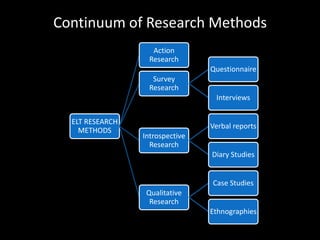
Continuum of Research Methods
                    Action
                   Research
                                 Questionnaire
                    Survey
                   Research
                                  Interviews


  ELT RESEARCH
                                 Verbal reports
    METHODS
                 Introspective
                   Research
                                 Diary Studies


                                 Case Studies
                  Qualitative
                   Research
                                 Ethnographies
ACTION RESEARCH
• Action Research can be defined as a combination of the terms ―action‖
  and ―research.‖ Action research puts ideas into practice for the
  purpose of self-improvement and increasing knowledge about
  curriculum, teaching, and learning. The ultimate result is improvement
  in what happens in the classroom and school (Kemmis & McTaggert,
  1982).
• Action research is a systematic procedure done by teachers (or other
  individuals in an educational setting) to gather information about, and
  subsequently improve, the ways their particular educational setting
  operates, their teaching, and their student learning (Mills, 2011 ).
• Action research is a systematic approach to investigation that enables
  people to find effective solutions to problems they confront in their
  everyday lives. It does not look for generalization but focuses on
  specific situations and localized solutions
Reasons Why Action Research is a Research


     An AR addresses questions of
      interest to other practitioners;
     An AR generates data;
     An AR contains analysis and
      interpretation.
What Differentiated Action
Research from other Researches
–   it is carried out by the practitioner (classroom
    teachers);
–   it can be collaborative or individual;
–   it is situational (identification and solution of
    problems in a specific context);
–   it can be aimed at changing things (improving the
    current state of affairs).
    (Nunan, “Research Methods in Language Learning”
    (1992:17))
ACTION RESEARCH FEATURES
• AR involves action in that it seeks to bring about
  change, specifically in local educational
  contexts.
• AR is a research because it entails the
  collection and analysis of data.
• AR is participatory and collaborative as it
  provides for collaborative investigation by teams
  of colleagues, practitioners and researchers.
• AR is contextual, small-scale and localized—it
  identifies and investigates problems within a
  specific situation.
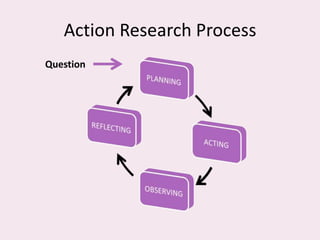
Action Research Process
Question
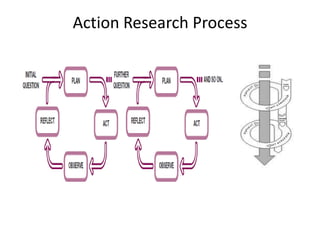
Action Research Process
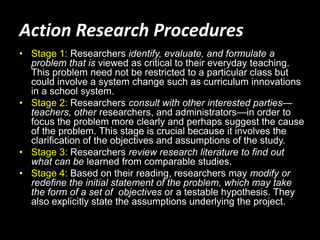
Action Research Procedures
• Stage 1: Researchers identify, evaluate, and formulate a
  problem that is viewed as critical to their everyday teaching.
  This problem need not be restricted to a particular class but
  could involve a system change such as curriculum innovations
  in a school system.
• Stage 2: Researchers consult with other interested parties—
  teachers, other researchers, and administrators—in order to
  focus the problem more clearly and perhaps suggest the cause
  of the problem. This stage is crucial because it involves the
  clarification of the objectives and assumptions of the study.
• Stage 3: Researchers review research literature to find out
  what can be learned from comparable studies.
• Stage 4: Based on their reading, researchers may modify or
  redefine the initial statement of the problem, which may take
  the form of a set of objectives or a testable hypothesis. They
  also explicitly state the assumptions underlying the project.
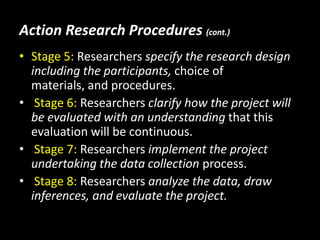
Action Research Procedures (cont.)
• Stage 5: Researchers specify the research design
  including the participants, choice of
  materials, and procedures.
• Stage 6: Researchers clarify how the project will
  be evaluated with an understanding that this
  evaluation will be continuous.
• Stage 7: Researchers implement the project
  undertaking the data collection process.
• Stage 8: Researchers analyze the data, draw
  inferences, and evaluate the project.
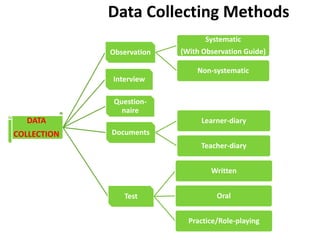
Data Collecting Methods
                                 Systematic
             Observation   (With Observation Guide)

                               Non-systematic
             Interview

              Question-
                naire
  DATA                          Learner-diary
COLLECTION   Documents
                                Teacher-diary


                                   Written


                Test                 Oral


                             Practice/Role-playing
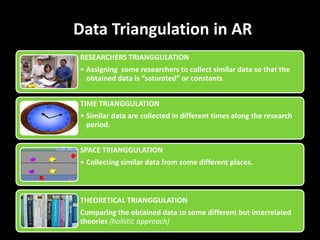
Data Triangulation in AR
RESEARCHERS TRIANGGULATION
• Assigning some researchers to collect similar data so that the
  obtained data is “saturated” or constants


TIME TRIANGGULATION
• Similar data are collected in different times along the research
  period.


SPACE TRIANGGULATION
• Collecting similar data from some different places.


THEORETICAL TRIANGGULATION
Comparing the obtained data to some different but interrelated
theories (holistic approach)
As a process research which is naturalistic and
transformative (aims to make changes) the situation
of an AR continuously changes. To keep its
reliability, the researcher needs to:
1) Attach original data (e.g. interview transcript
    and field notes
2) menggunakan lebih dari satu sumber data untuk
    mendapatkan data yang sama
3) berkolaborasi dengan sejawat atau orang lain
    yang terkait.
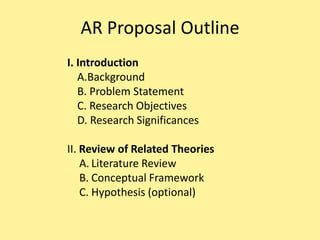
AR Proposal Outline
I. Introduction
   A.Background
   B. Problem Statement
   C. Research Objectives
   D. Research Significances

II. Review of Related Theories
    A. Literature Review
    B. Conceptual Framework
    C. Hypothesis (optional)
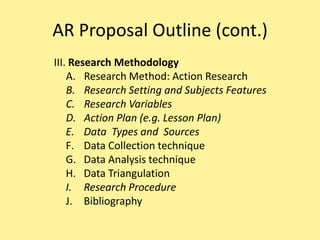
AR Proposal Outline (cont.)
III. Research Methodology
    A. Research Method: Action Research
    B. Research Setting and Subjects Features
    C. Research Variables
    D. Action Plan (e.g. Lesson Plan)
    E. Data Types and Sources
    F. Data Collection technique
    G. Data Analysis technique
    H. Data Triangulation
    I. Research Procedure
    J. Bibliography
References

McKay, S. L. (2006). Researching second language classrooms. New
    Jersey: Lawrence Erlbaum Associates, Inc., Publishers
Burns. A. (2010). Doing action research in english language teaching: A
    guide for practitioners. New York: Routledge:
Creswell, J. W. 2008. Educational research: Planning, conducting, and
    evaluating quantitative and qualitative research. New Jersey:
    Pearson
Denscombe, M. (2010). The good research guide for small-scale social
    research projects. New York: McGraw-Hill
Ross, Kenneth N. (ed.). (2005). Educational research: Some basic
    concepts and terminology. Paris: International Institute for
    Educational Planning/ UNESCO.

Action research

  • 1.
  • 2.
    Continuum of ResearchMethods Action Research Questionnaire Survey Research Interviews ELT RESEARCH Verbal reports METHODS Introspective Research Diary Studies Case Studies Qualitative Research Ethnographies
  • 3.
    ACTION RESEARCH • ActionResearch can be defined as a combination of the terms ―action‖ and ―research.‖ Action research puts ideas into practice for the purpose of self-improvement and increasing knowledge about curriculum, teaching, and learning. The ultimate result is improvement in what happens in the classroom and school (Kemmis & McTaggert, 1982). • Action research is a systematic procedure done by teachers (or other individuals in an educational setting) to gather information about, and subsequently improve, the ways their particular educational setting operates, their teaching, and their student learning (Mills, 2011 ). • Action research is a systematic approach to investigation that enables people to find effective solutions to problems they confront in their everyday lives. It does not look for generalization but focuses on specific situations and localized solutions
  • 4.
    Reasons Why ActionResearch is a Research  An AR addresses questions of interest to other practitioners;  An AR generates data;  An AR contains analysis and interpretation.
  • 5.
    What Differentiated Action Researchfrom other Researches – it is carried out by the practitioner (classroom teachers); – it can be collaborative or individual; – it is situational (identification and solution of problems in a specific context); – it can be aimed at changing things (improving the current state of affairs). (Nunan, “Research Methods in Language Learning” (1992:17))
  • 6.
    ACTION RESEARCH FEATURES •AR involves action in that it seeks to bring about change, specifically in local educational contexts. • AR is a research because it entails the collection and analysis of data. • AR is participatory and collaborative as it provides for collaborative investigation by teams of colleagues, practitioners and researchers. • AR is contextual, small-scale and localized—it identifies and investigates problems within a specific situation.
  • 7.
  • 8.
  • 9.
    Action Research Procedures •Stage 1: Researchers identify, evaluate, and formulate a problem that is viewed as critical to their everyday teaching. This problem need not be restricted to a particular class but could involve a system change such as curriculum innovations in a school system. • Stage 2: Researchers consult with other interested parties— teachers, other researchers, and administrators—in order to focus the problem more clearly and perhaps suggest the cause of the problem. This stage is crucial because it involves the clarification of the objectives and assumptions of the study. • Stage 3: Researchers review research literature to find out what can be learned from comparable studies. • Stage 4: Based on their reading, researchers may modify or redefine the initial statement of the problem, which may take the form of a set of objectives or a testable hypothesis. They also explicitly state the assumptions underlying the project.
  • 10.
    Action Research Procedures(cont.) • Stage 5: Researchers specify the research design including the participants, choice of materials, and procedures. • Stage 6: Researchers clarify how the project will be evaluated with an understanding that this evaluation will be continuous. • Stage 7: Researchers implement the project undertaking the data collection process. • Stage 8: Researchers analyze the data, draw inferences, and evaluate the project.
  • 11.
    Data Collecting Methods Systematic Observation (With Observation Guide) Non-systematic Interview Question- naire DATA Learner-diary COLLECTION Documents Teacher-diary Written Test Oral Practice/Role-playing
  • 12.
    Data Triangulation inAR RESEARCHERS TRIANGGULATION • Assigning some researchers to collect similar data so that the obtained data is “saturated” or constants TIME TRIANGGULATION • Similar data are collected in different times along the research period. SPACE TRIANGGULATION • Collecting similar data from some different places. THEORETICAL TRIANGGULATION Comparing the obtained data to some different but interrelated theories (holistic approach)
  • 13.
    As a processresearch which is naturalistic and transformative (aims to make changes) the situation of an AR continuously changes. To keep its reliability, the researcher needs to: 1) Attach original data (e.g. interview transcript and field notes 2) menggunakan lebih dari satu sumber data untuk mendapatkan data yang sama 3) berkolaborasi dengan sejawat atau orang lain yang terkait.
  • 14.
    AR Proposal Outline I.Introduction A.Background B. Problem Statement C. Research Objectives D. Research Significances II. Review of Related Theories A. Literature Review B. Conceptual Framework C. Hypothesis (optional)
  • 15.
    AR Proposal Outline(cont.) III. Research Methodology A. Research Method: Action Research B. Research Setting and Subjects Features C. Research Variables D. Action Plan (e.g. Lesson Plan) E. Data Types and Sources F. Data Collection technique G. Data Analysis technique H. Data Triangulation I. Research Procedure J. Bibliography
  • 16.
    References McKay, S. L.(2006). Researching second language classrooms. New Jersey: Lawrence Erlbaum Associates, Inc., Publishers Burns. A. (2010). Doing action research in english language teaching: A guide for practitioners. New York: Routledge: Creswell, J. W. 2008. Educational research: Planning, conducting, and evaluating quantitative and qualitative research. New Jersey: Pearson Denscombe, M. (2010). The good research guide for small-scale social research projects. New York: McGraw-Hill Ross, Kenneth N. (ed.). (2005). Educational research: Some basic concepts and terminology. Paris: International Institute for Educational Planning/ UNESCO.

Editor's Notes

  • #13 Validty= results’ consistency and accuracy over time and place
  • #14 Reliability is the consistency of your measurement, or the degree to which an instrument measures the same way each time it is used under the same condition with the same subjects