OBSERVATION
- A TECHNIQUE OF RESEARCH
SURBHI SHARMA
Department of Education,
Lucknow University.
DATA –COLLECTION TOOLS AND TECHNIQUES:
PSYCHOLOGICAL TESTS
INQUIRY FORM
OBSERVATION
INTERVIEW
SOCIOMETRIC TECHNIQUES
Definition of Observation:
A process in which one or more persons
observe what is occurring in some real-life
situation and clarify and record pertinent
happenings according to some planned
scheme.
Nature of Observation:
It is –
 Systematic
 Directed by a specific purpose
 Carefully Focused
 Thoroughly recorded
 Subjected to usual checks for -
a) accuracy
b) validity
c) reliability
Types of Observation:
• Structured vz Unstructured
• Participant vz Non- Participant
• Controlled vz Uncontrolled
STRUCTURED
• Too formal & Observer
arranges the main parts of
situation in such a way that
there is no possibility of
unexpected inferences.
• Everything is
predetermined.
• Used in vast group
situations.
• e.g. : Katz, Goldston and
Benjamin(1958) in their
study on the interaction of
Negros and Whites.
UNSTRUCTURED
• Mainly associated with
participant observation.
• Nothing can be said
before hand about the
situation as with change
in point of view of
observer the material of
observation also
changes.
• Used in exploratory
researches.
• Situation is in natural
settings so it can be
called Naturalistic
observation.
PARTICIPANT
• Observer is part of the
group and hence
extremely active.
• Challenging for the
observer as to be
accepted by the group.
Hence he may live or
work in that area.
• Used in Descriptive
researches.
NON-PARTICIPANT
• Observer is aloof of the
group and observes
without disturbing
them.
• This type of
observation can take
place were the
presence of unknown
person is natural, e.g.
club, parties, functions
etc.
• Used to study children
behavior by
psychologists.
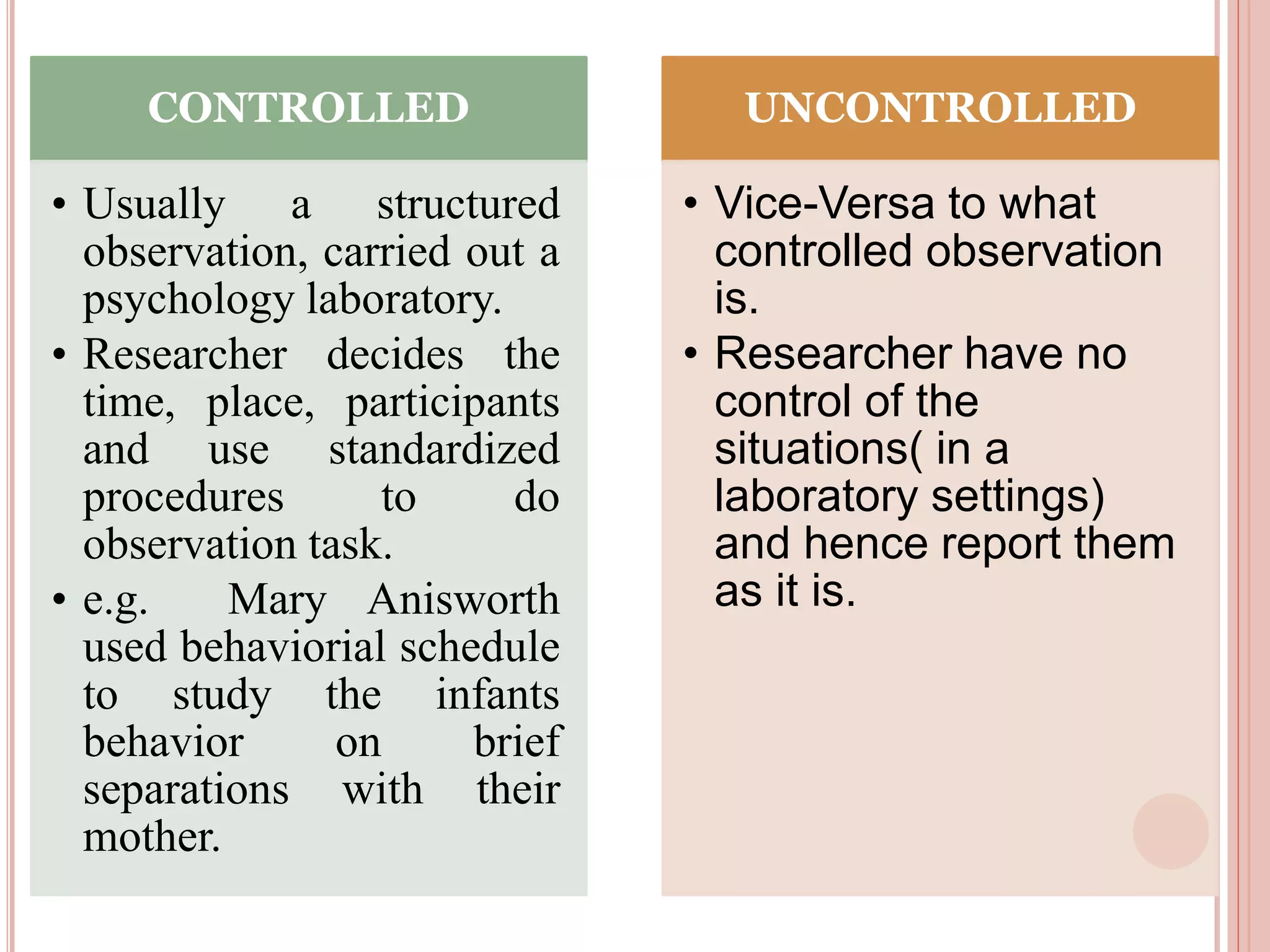
CONTROLLED
• Usually a structured
observation, carried out a
psychology laboratory.
• Researcher decides the
time, place, participants
and use standardized
procedures to do
observation task.
• e.g. Mary Anisworth
used behaviorial schedule
to study the infants
behavior on brief
separations with their
mother.
UNCONTROLLED
• Vice-Versa to what
controlled observation
is.
• Researcher have no
control of the
situations( in a
laboratory settings)
and hence report them
as it is.
Difference in Qualitative and Quantitative
research - Observation Technique:
Qualitative
• Naturalistic/Unstructured
• Direct
• Uncontrolled
• Participant
• Useful for Researches –
Descriptive, exploratory,
ethnographic, grounded
theory .
Quantitative
• Structured
• Controlled
• Non-participant
• Planned, systematic &
in Laboratory
conditions
• Useful for single-
subject experimental
research.
5 Dimensions of variation for an
Observation Technique:
Patton(1990) :
1. The observer’s role may vary from –
 complete participant
 complete observer
 participant as observer
 observer as participant
2. The observer may conduct the observation
covertly, with the full knowledge of those being
observed or with only some of those being
observed aware of the observation.
Contd…
5 Dimensions of variation for an
Observation Technique:
3. Those being observed given full, partial ,
no or false explanation.
4. Duration of Observation.
5. The breadth of focus. (Koul, 2009)
An Observation Technique
requires -
Planning Execution
Recording &
Interpretation
Recording of Observation Technique
employs -
 Rating Scales
 Checklists
 Anecdotes
 Time- sampling method
 Incident sampling method
 Controlled diary method
Reliability of Observation -
 Amount of inter- observer agreement
in records.
 The inconsistencies of a single
observer from one time to another.
 The estimate of the variability of the
trait itself. (Koul, 2009)
Brandt(1972) mentions three kinds of
reliability :-
Validity of Observation -
An observation is valid only to the extent
that the recorded differences in score
represents actual differences in behavior
rather than differences in the
impressions made on different
observers. (Koul, 2009)
Thus inferences drawn are based on the resulting
correlation coefficients often referred to as ‘Stability
Coefficients’
1. Direct procedure to study the situation or
behavior as it is.
2. Special behavior can only be studied by
observation.
3. Helpful to study children & animal behavior.
4. Extremely useful when respondents don’t
cooperate.
5. Useful to overcome language or verbal barriers.
6. Enables the observer to code and record the
event simultaneously to time of occurrence.
Advantages of Observation Technique -
Disadvantages of Observation
Technique -
1. Scope of subjectivity is high with respect
to personal biasness of the observer.
2. Time consuming and sometimes too
expensive.
3. Great expertise required .
4. The group or subject observed can pretend
at times.
References-
1) Asthana, B. (2014/15). Measurement and Evaluation in
Psychology and Education. Agra: Agrawal Publications.
2) Ary, D., Jacobs C.L. & Sorensen,C. (2010).Introduction to
Research in Education. Canada: Wadsworth Cengage
Learning.
3) Best, J.W. & Kahn, J.V.(2006). Research in Education.
USA: Pearson Education Inc.
4) Koul, L.(2009).Methodology of Educational Research.
Shimla: Vikas Publishing House Pvt. Ltd.
5) McLeod, S. A. (2015). Observation methods. Retrieved
from
https://www.simplypsychology.org/observation.html
Observation

Observation

  • 1.
    OBSERVATION - A TECHNIQUEOF RESEARCH SURBHI SHARMA Department of Education, Lucknow University.
  • 2.
    DATA –COLLECTION TOOLSAND TECHNIQUES: PSYCHOLOGICAL TESTS INQUIRY FORM OBSERVATION INTERVIEW SOCIOMETRIC TECHNIQUES
  • 3.
    Definition of Observation: Aprocess in which one or more persons observe what is occurring in some real-life situation and clarify and record pertinent happenings according to some planned scheme.
  • 4.
    Nature of Observation: Itis –  Systematic  Directed by a specific purpose  Carefully Focused  Thoroughly recorded  Subjected to usual checks for - a) accuracy b) validity c) reliability
  • 5.
    Types of Observation: •Structured vz Unstructured • Participant vz Non- Participant • Controlled vz Uncontrolled
  • 6.
    STRUCTURED • Too formal& Observer arranges the main parts of situation in such a way that there is no possibility of unexpected inferences. • Everything is predetermined. • Used in vast group situations. • e.g. : Katz, Goldston and Benjamin(1958) in their study on the interaction of Negros and Whites. UNSTRUCTURED • Mainly associated with participant observation. • Nothing can be said before hand about the situation as with change in point of view of observer the material of observation also changes. • Used in exploratory researches. • Situation is in natural settings so it can be called Naturalistic observation.
  • 7.
    PARTICIPANT • Observer ispart of the group and hence extremely active. • Challenging for the observer as to be accepted by the group. Hence he may live or work in that area. • Used in Descriptive researches. NON-PARTICIPANT • Observer is aloof of the group and observes without disturbing them. • This type of observation can take place were the presence of unknown person is natural, e.g. club, parties, functions etc. • Used to study children behavior by psychologists.
  • 8.
    CONTROLLED • Usually astructured observation, carried out a psychology laboratory. • Researcher decides the time, place, participants and use standardized procedures to do observation task. • e.g. Mary Anisworth used behaviorial schedule to study the infants behavior on brief separations with their mother. UNCONTROLLED • Vice-Versa to what controlled observation is. • Researcher have no control of the situations( in a laboratory settings) and hence report them as it is.
  • 9.
    Difference in Qualitativeand Quantitative research - Observation Technique: Qualitative • Naturalistic/Unstructured • Direct • Uncontrolled • Participant • Useful for Researches – Descriptive, exploratory, ethnographic, grounded theory . Quantitative • Structured • Controlled • Non-participant • Planned, systematic & in Laboratory conditions • Useful for single- subject experimental research.
  • 10.
    5 Dimensions ofvariation for an Observation Technique: Patton(1990) : 1. The observer’s role may vary from –  complete participant  complete observer  participant as observer  observer as participant 2. The observer may conduct the observation covertly, with the full knowledge of those being observed or with only some of those being observed aware of the observation. Contd…
  • 11.
    5 Dimensions ofvariation for an Observation Technique: 3. Those being observed given full, partial , no or false explanation. 4. Duration of Observation. 5. The breadth of focus. (Koul, 2009)
  • 12.
    An Observation Technique requires- Planning Execution Recording & Interpretation
  • 13.
    Recording of ObservationTechnique employs -  Rating Scales  Checklists  Anecdotes  Time- sampling method  Incident sampling method  Controlled diary method
  • 14.
    Reliability of Observation-  Amount of inter- observer agreement in records.  The inconsistencies of a single observer from one time to another.  The estimate of the variability of the trait itself. (Koul, 2009) Brandt(1972) mentions three kinds of reliability :-
  • 15.
    Validity of Observation- An observation is valid only to the extent that the recorded differences in score represents actual differences in behavior rather than differences in the impressions made on different observers. (Koul, 2009) Thus inferences drawn are based on the resulting correlation coefficients often referred to as ‘Stability Coefficients’
  • 16.
    1. Direct procedureto study the situation or behavior as it is. 2. Special behavior can only be studied by observation. 3. Helpful to study children & animal behavior. 4. Extremely useful when respondents don’t cooperate. 5. Useful to overcome language or verbal barriers. 6. Enables the observer to code and record the event simultaneously to time of occurrence. Advantages of Observation Technique -
  • 17.
    Disadvantages of Observation Technique- 1. Scope of subjectivity is high with respect to personal biasness of the observer. 2. Time consuming and sometimes too expensive. 3. Great expertise required . 4. The group or subject observed can pretend at times.
  • 18.
    References- 1) Asthana, B.(2014/15). Measurement and Evaluation in Psychology and Education. Agra: Agrawal Publications. 2) Ary, D., Jacobs C.L. & Sorensen,C. (2010).Introduction to Research in Education. Canada: Wadsworth Cengage Learning. 3) Best, J.W. & Kahn, J.V.(2006). Research in Education. USA: Pearson Education Inc. 4) Koul, L.(2009).Methodology of Educational Research. Shimla: Vikas Publishing House Pvt. Ltd. 5) McLeod, S. A. (2015). Observation methods. Retrieved from https://www.simplypsychology.org/observation.html