

Shared-Use Mobility Summit Highlights

Workshop 137, 93rd Transportation Research Board Annual Meeting
Susan A. Shaheen, Ph.D.
Adjunct Professor & Co-Director,
Transportation Sustainability Research Center
University of California, Berkeley
January 12, 2014
Overview

•
•
•
•

Definitions
Summit highlights
Key takeaways
Next steps
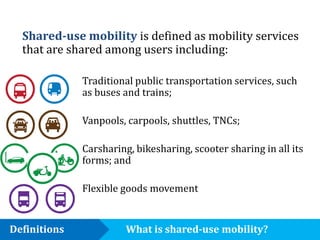
Shared-use mobility is defined as mobility services
that are shared among users including:
Traditional public transportation services, such
as buses and trains;
Vanpools, carpools, shuttles, TNCs;

Carsharing, bikesharing, scooter sharing in all its
forms; and
Flexible goods movement

Definitions

What is shared-use mobility?
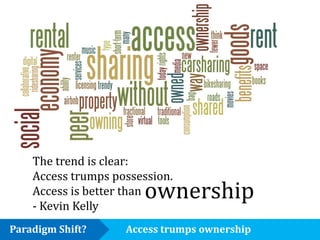
ownership

The trend is clear:
Access trumps possession.
Access is better than
- Kevin Kelly

Paradigm Shift?

Access trumps ownership
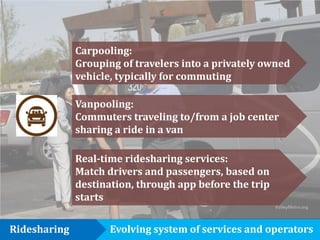
Carpooling:
Grouping of travelers into a privately owned
vehicle, typically for commuting
Vanpooling:
Commuters traveling to/from a job center
sharing a ride in a van
Real-time ridesharing services:
Match drivers and passengers, based on
destination, through app before the trip
starts
Ridesharing

Evolving system of services and operators
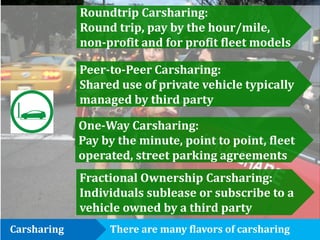
Roundtrip Carsharing:
Round trip, pay by the hour/mile,
non-profit and for profit fleet models
Peer-to-Peer Carsharing:
Shared use of private vehicle typically
managed by third party
One-Way Carsharing:
Pay by the minute, point to point, fleet
operated, street parking agreements
Fractional Ownership Carsharing:
Individuals sublease or subscribe to a
vehicle owned by a third party
Carsharing

There are many flavors of carsharing
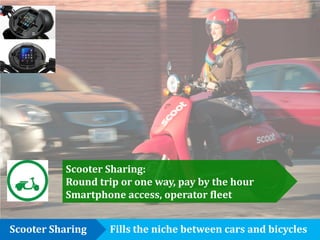
Scooter Sharing:
Round trip or one way, pay by the hour
Smartphone access, operator fleet
Scooter Sharing

Fills the niche between cars and bicycles
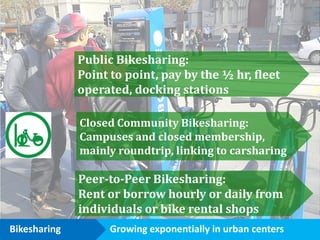
Public Bikesharing:
Point to point, pay by the ½ hr, fleet
operated, docking stations
Closed Community Bikesharing:
Campuses and closed membership,
mainly roundtrip, linking to carsharing

Peer-to-Peer Bikesharing:
Rent or borrow hourly or daily from
individuals or bike rental shops
Bikesharing

Growing exponentially in urban centers
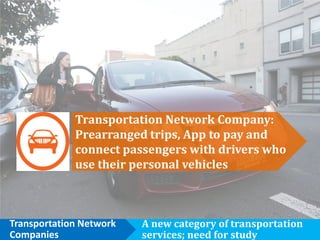
Transportation Network Company:
Prearranged trips, App to pay and
connect passengers with drivers who
use their personal vehicles

Transportation Network
Companies

A new category of transportation
services; need for study
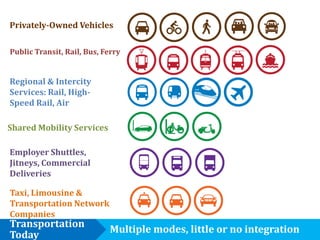
Privately-Owned Vehicles
Public Transit, Rail, Bus, Ferry

Regional & Intercity
Services: Rail, HighSpeed Rail, Air
Shared Mobility Services
Employer Shuttles,
Jitneys, Commercial
Deliveries
Taxi, Limousine &
Transportation Network
Companies

Transportation
Today

Multiple modes, little or no integration
“The Whole Is Greater Than The
Sum of Its Parts.”
-Aristotle
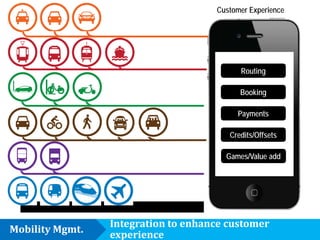
Customer Experience

Routing
Booking
Payments
Credits/Offsets
Games/Value add

Mobility Mgmt.

Integration to enhance customer
experience
Rapid Network Boarding Island

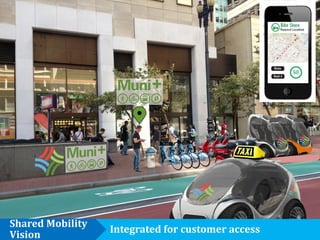
Shared Mobility
Vision

Integrated for customer access

13
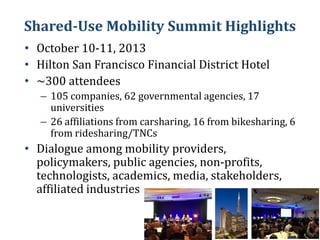
• October 10-11, 2013
• Hilton San Francisco Financial District Hotel
• ~300 attendees

Shared-Use Mobility Summit Highlights
– 105 companies, 62 governmental agencies, 17
universities
– 26 affiliations from carsharing, 16 from bikesharing, 6
from ridesharing/TNCs

• Dialogue among mobility providers,
policymakers, public agencies, non-profits,
technologists, academics, media, stakeholders,
affiliated industries
Key Sessions from the Summit

• Setting the Stage: Trends, Definitions, and Policies
• Shared-Use Mobility Success Stories
• The Sharing Economy: Scaling the Shared-Use Mobility
Marketplace
• Bikesharing Mobile Workshop
• Governance 2.0 (“Micro” Level): Shared-Use Policy Approaches
for City and County Governance
• The Impacts of Shared-Use Mobility Services
• The Future of Mobility and Transportation Policy and Planning
• Fostering Multi-Modal Integration and Public Transit
Connections
• Parallel Industry Breakout Sessions
• Industry Policy Considerations
• The Future of Shared-Use Mobility
Key Takeaways

• Government needs to act as a facilitator
• Social equity demands the “push” of some of these
innovations to lower income areas and populations
• Greater public subsidy needed
• Integration with public transit should be a goal
• Parking and insurance remain obstacles
• Industry-wide standards are needed
• Privacy efforts are important (individual,
company level)
Special Thanks: This Took A Village!

TSRC/ITS Berkeley/UCB: Madonna Camel, Helen Bassham, Adam Cohen,
Josh Steiner, Chris Cosgrove, Phyllis Orrick, Sarah Yang, Laura Melendy

Summit Planning, Support & Advice: Dave Brook, Robert Cervero,
Matthew Christensen, Adam Cohen, Melanie Crotty, Benjamin De La Pena,
Rod Diridon, Sharon Feigon, Neal Gorenflo, Allen Greenberg, Guy Fraker,
Karen Frick, Larry Filler, Lisa Gansky, Neal Gorenflo, Steve Gutmann, Rick
Hutchinson. Donna Maurillo, Russell Meddin, Paul Minett, Jason
Pavluchuk, Timothy Papandreou, Karen Philbrick, Jason Pavluchuk, Dan
Sturges, John Williams, Alan Woodland, Sarah Yang, and Sue Zielinski
Numerous sponsors and partners, as well as all our volunteers!
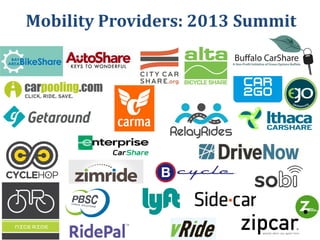
Mobility Providers: 2013 Summit
Next Steps
Acknowledgements

 Helen Bassham, Madonna Camel,
Nelson Chan, Matthew Christensen,
Adam Cohen, TSRC
 Sharon Feigon, Alternative
Transportation for Chicagoland
 Jason Pavluchuk, Pavluchuk &
Associates
 Scott Bernstein, Center for
Neighborhood Technologies
 Timothy Papandreou, SFMTA
 Sponsors and supporters of the SF
Summit
www.tsrc.berkeley.edu

Shared-Use Mobility Summit Highlights

  • 1.
    Shared-Use Mobility SummitHighlights Workshop 137, 93rd Transportation Research Board Annual Meeting Susan A. Shaheen, Ph.D. Adjunct Professor & Co-Director, Transportation Sustainability Research Center University of California, Berkeley January 12, 2014
  • 2.
  • 3.
    Shared-use mobility isdefined as mobility services that are shared among users including: Traditional public transportation services, such as buses and trains; Vanpools, carpools, shuttles, TNCs; Carsharing, bikesharing, scooter sharing in all its forms; and Flexible goods movement Definitions What is shared-use mobility?
  • 4.
    ownership The trend isclear: Access trumps possession. Access is better than - Kevin Kelly Paradigm Shift? Access trumps ownership
  • 5.
    Carpooling: Grouping of travelersinto a privately owned vehicle, typically for commuting Vanpooling: Commuters traveling to/from a job center sharing a ride in a van Real-time ridesharing services: Match drivers and passengers, based on destination, through app before the trip starts Ridesharing Evolving system of services and operators
  • 6.
    Roundtrip Carsharing: Round trip,pay by the hour/mile, non-profit and for profit fleet models Peer-to-Peer Carsharing: Shared use of private vehicle typically managed by third party One-Way Carsharing: Pay by the minute, point to point, fleet operated, street parking agreements Fractional Ownership Carsharing: Individuals sublease or subscribe to a vehicle owned by a third party Carsharing There are many flavors of carsharing
  • 7.
    Scooter Sharing: Round tripor one way, pay by the hour Smartphone access, operator fleet Scooter Sharing Fills the niche between cars and bicycles
  • 8.
    Public Bikesharing: Point topoint, pay by the ½ hr, fleet operated, docking stations Closed Community Bikesharing: Campuses and closed membership, mainly roundtrip, linking to carsharing Peer-to-Peer Bikesharing: Rent or borrow hourly or daily from individuals or bike rental shops Bikesharing Growing exponentially in urban centers
  • 9.
    Transportation Network Company: Prearrangedtrips, App to pay and connect passengers with drivers who use their personal vehicles Transportation Network Companies A new category of transportation services; need for study
  • 10.
    Privately-Owned Vehicles Public Transit,Rail, Bus, Ferry Regional & Intercity Services: Rail, HighSpeed Rail, Air Shared Mobility Services Employer Shuttles, Jitneys, Commercial Deliveries Taxi, Limousine & Transportation Network Companies Transportation Today Multiple modes, little or no integration
  • 11.
    “The Whole IsGreater Than The Sum of Its Parts.” -Aristotle
  • 12.
  • 13.
    Rapid Network BoardingIsland Shared Mobility Vision Integrated for customer access 13
  • 14.
    • October 10-11,2013 • Hilton San Francisco Financial District Hotel • ~300 attendees Shared-Use Mobility Summit Highlights – 105 companies, 62 governmental agencies, 17 universities – 26 affiliations from carsharing, 16 from bikesharing, 6 from ridesharing/TNCs • Dialogue among mobility providers, policymakers, public agencies, non-profits, technologists, academics, media, stakeholders, affiliated industries
  • 15.
    Key Sessions fromthe Summit • Setting the Stage: Trends, Definitions, and Policies • Shared-Use Mobility Success Stories • The Sharing Economy: Scaling the Shared-Use Mobility Marketplace • Bikesharing Mobile Workshop • Governance 2.0 (“Micro” Level): Shared-Use Policy Approaches for City and County Governance • The Impacts of Shared-Use Mobility Services • The Future of Mobility and Transportation Policy and Planning • Fostering Multi-Modal Integration and Public Transit Connections • Parallel Industry Breakout Sessions • Industry Policy Considerations • The Future of Shared-Use Mobility
  • 16.
    Key Takeaways • Governmentneeds to act as a facilitator • Social equity demands the “push” of some of these innovations to lower income areas and populations • Greater public subsidy needed • Integration with public transit should be a goal • Parking and insurance remain obstacles • Industry-wide standards are needed • Privacy efforts are important (individual, company level)
  • 17.
    Special Thanks: ThisTook A Village! TSRC/ITS Berkeley/UCB: Madonna Camel, Helen Bassham, Adam Cohen, Josh Steiner, Chris Cosgrove, Phyllis Orrick, Sarah Yang, Laura Melendy Summit Planning, Support & Advice: Dave Brook, Robert Cervero, Matthew Christensen, Adam Cohen, Melanie Crotty, Benjamin De La Pena, Rod Diridon, Sharon Feigon, Neal Gorenflo, Allen Greenberg, Guy Fraker, Karen Frick, Larry Filler, Lisa Gansky, Neal Gorenflo, Steve Gutmann, Rick Hutchinson. Donna Maurillo, Russell Meddin, Paul Minett, Jason Pavluchuk, Timothy Papandreou, Karen Philbrick, Jason Pavluchuk, Dan Sturges, John Williams, Alan Woodland, Sarah Yang, and Sue Zielinski Numerous sponsors and partners, as well as all our volunteers!
  • 18.
  • 19.
  • 20.
    Acknowledgements  Helen Bassham,Madonna Camel, Nelson Chan, Matthew Christensen, Adam Cohen, TSRC  Sharon Feigon, Alternative Transportation for Chicagoland  Jason Pavluchuk, Pavluchuk & Associates  Scott Bernstein, Center for Neighborhood Technologies  Timothy Papandreou, SFMTA  Sponsors and supporters of the SF Summit
  • 21.