Principles and
practices of
TOD
Carlosfelipe Pardo
Bogotá, July 11, 2013
Planning, paying, understanding
Yesterday’s discussions
• We need proper planning
– To reduce kms travelled
– To “balance” densities and urban development
– To improve sustainability and quality of life
• We need money
– To build needed infrastructure
– To “balance” financial difficulties (e.g. operation)
• We need to understand our cities
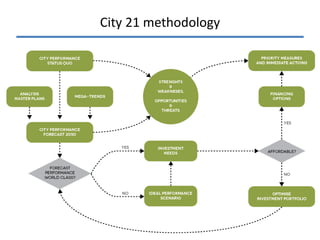
City 21 methodology
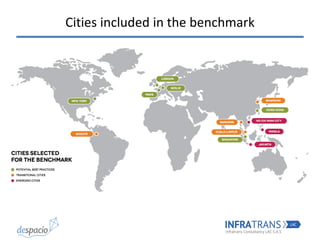
Cities included in the benchmark
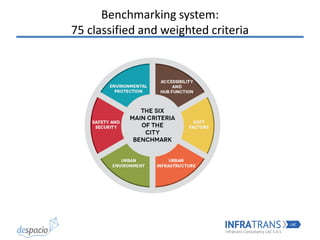
Benchmarking system:
75 classified and weighted criteria
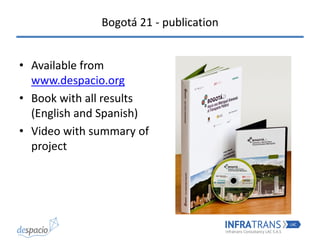
Bogotá 21 - publication
• Available from
www.despacio.org
• Book with all results
(English and Spanish)
• Video with summary of
project
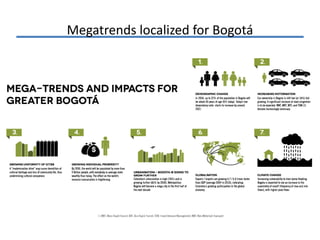
Megatrends localized for Bogotá
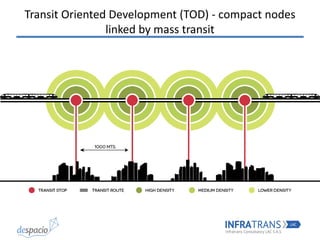
Transit Oriented Development (TOD) - compact nodes
linked by mass transit
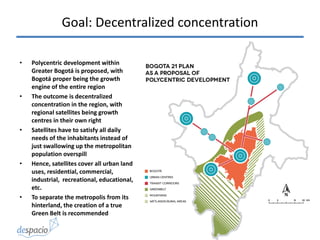
Goal: Decentralized concentration
• Polycentric development within
Greater Bogotá is proposed, with
Bogotá proper being the growth
engine of the entire region
• The outcome is decentralized
concentration in the region, with
regional satellites being growth
centres in their own right
• Satellites have to satisfy all daily
needs of the inhabitants instead of
just swallowing up the metropolitan
population overspill
• Hence, satellites cover all urban land
uses, residential, commercial,
industrial, recreational, educational,
etc.
• To separate the metropolis from its
hinterland, the creation of a true
Green Belt is recommended
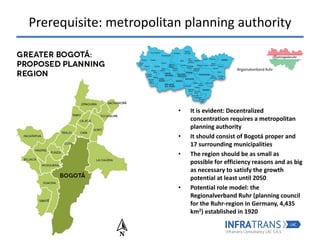
Prerequisite: metropolitan planning authority
• It is evident: Decentralized
concentration requires a metropolitan
planning authority
• It should consist of Bogotá proper and
17 surrounding municipalities
• The region should be as small as
possible for efficiency reasons and as big
as necessary to satisfy the growth
potential at least until 2050
• Potential role model: the
Regionalverband Ruhr (planning council
for the Ruhr-region in Germany, 4,435
km2) established in 1920
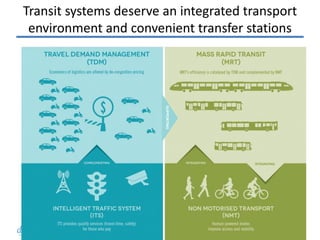
Transit systems deserve an integrated transport
environment and convenient transfer stations
SUPPORTING
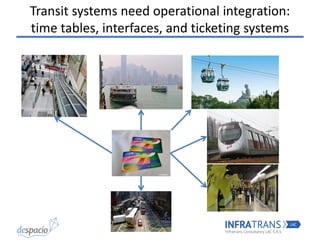
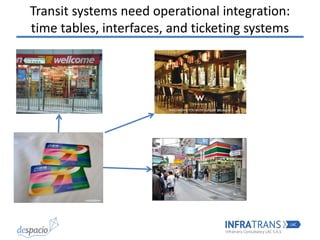
Transit systems need operational integration:
time tables, interfaces, and ticketing systems
Transit systems need operational integration:
time tables, interfaces, and ticketing systems
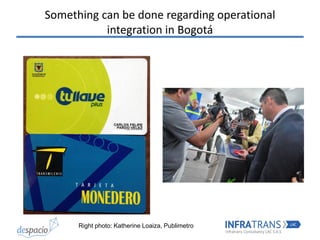
Something can be done regarding operational
integration in Bogotá
Right photo: Katherine Loaiza, Publimetro
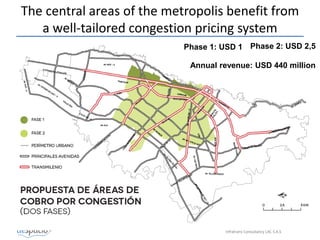
Phase 2: USD 2,5
Annual revenue: USD 440 million
Phase 1: USD 1
The central areas of the metropolis benefit from
a well-tailored congestion pricing system
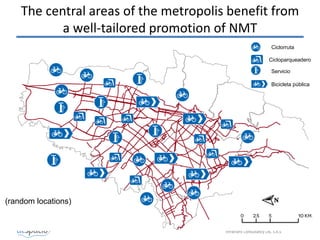
Cicloparqueadero
Servicio
Ciclorruta
Bicicleta pública
(random locations)
The central areas of the metropolis benefit from
a well-tailored promotion of NMT
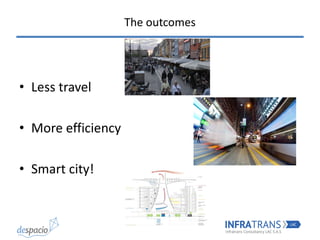
The outcomes
• Less travel
• More efficiency
• Smart city!
What to do now?
There are follow-up steps to be initiated:
– Conceptualize TOD application for Bogotá,
incorporating a component on social coherence
– Kick-start the process for establishing the
metropolitan planning authority for enabling
polycentric regional planning
– Implementation of the first step of the congestion
charging system
- Find a way to pay for all that stuff
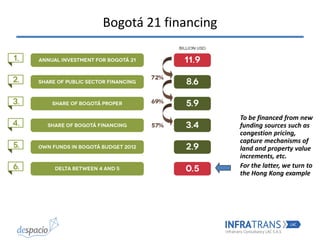
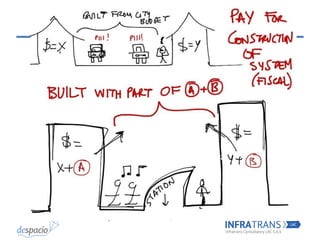
Bogotá 21 financing
To be financed from new
funding sources such as
congestion pricing,
capture mechanisms of
land and property value
increments, etc.
For the latter, we turn to
the Hong Kong example
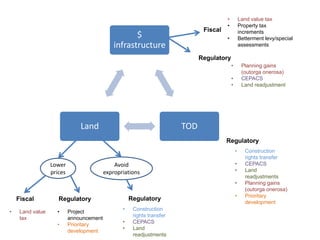
$
infrastructure
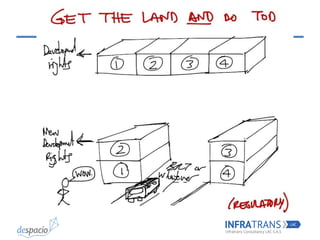
TODLand
Lower
prices
Avoid
expropriations
Fiscal Regulatory
Fiscal
Regulatory
Regulatory
• Land value
tax
• Land value tax
• Property tax
increments
• Betterment levy/special
assessments
• Project
announcement
• Prioritary
development
• Construction
rights transfer
• CEPACS
• Land
readjustments
Regulatory
• Planning gains
(outorga onerosa)
• CEPACS
• Land readjustment
• Construction
rights transfer
• CEPACS
• Land
readjustments
• Planning gains
(outorga onerosa)
• Prioritary
development
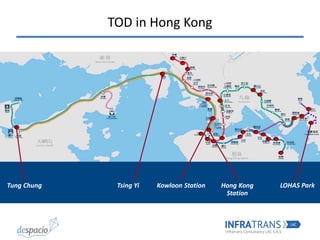
Tsueng Kwan O South
將軍澳南
LOHAS ParkHong Kong
Station
Tsing YiTung Chung Kowloon Station
TOD in Hong Kong
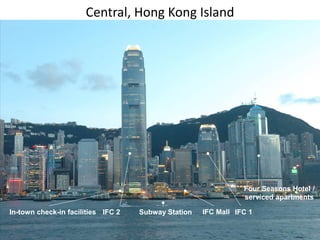
In-town check-in facilities IFC 2 Subway Station IFC Mall IFC 1
Four Seasons Hotel /
serviced apartments
Central, Hong Kong Island
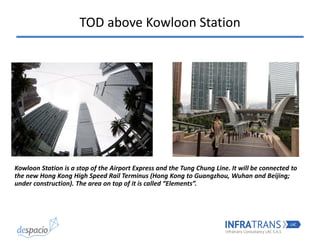
TOD above Kowloon Station
Kowloon Station is a stop of the Airport Express and the Tung Chung Line. It will be connected to
the new Hong Kong High Speed Rail Terminus (Hong Kong to Guangzhou, Wuhan and Beijing;
under construction). The area on top of it is called “Elements”.
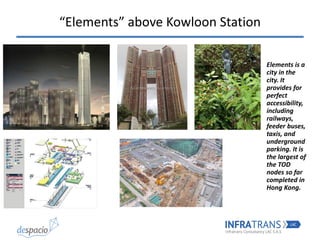
Elements is a
city in the
city. It
provides for
perfect
accessibility,
including
railways,
feeder buses,
taxis, and
underground
parking. It is
the largest of
the TOD
nodes so far
completed in
Hong Kong.
“Elements” above Kowloon Station
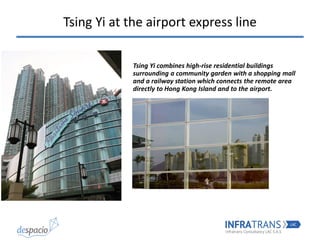
Tsing Yi combines high-rise residential buildings
surrounding a community garden with a shopping mall
and a railway station which connects the remote area
directly to Hong Kong Island and to the airport.
Tsing Yi at the airport express line
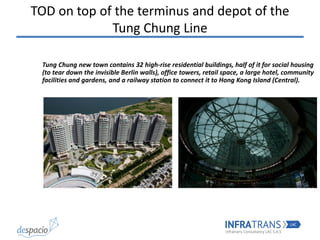
Tung Chung new town contains 32 high-rise residential buildings, half of it for social housing
(to tear down the invisible Berlin walls), office towers, retail space, a large hotel, community
facilities and gardens, and a railway station to connect it to Hong Kong Island (Central).
TOD on top of the terminus and depot of the
Tung Chung Line
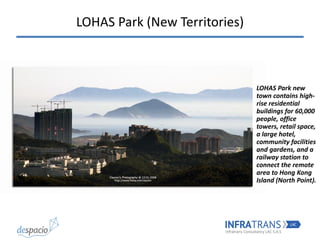
LOHAS Park new
town contains high-
rise residential
buildings for 60,000
people, office
towers, retail space,
a large hotel,
community facilities
and gardens, and a
railway station to
connect the remote
area to Hong Kong
Island (North Point).
LOHAS Park (New Territories)
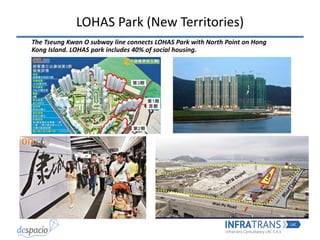
The Tseung Kwan O subway line connects LOHAS Park with North Point on Hong
Kong Island. LOHAS park includes 40% of social housing.
LOHAS Park (New Territories)
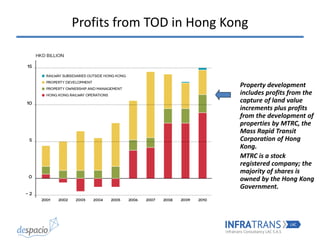
Profits from TOD in Hong Kong
Property development
includes profits from the
capture of land value
increments plus profits
from the development of
properties by MTRC, the
Mass Rapid Transit
Corporation of Hong
Kong.
MTRC is a stock
registered company; the
majority of shares is
owned by the Hong Kong
Government.
…we need to understand our cities…
Thank you
Carlosfelipe Pardo, MSc
pardo@despacio.org
Gregor Wessels, PhD
Gregor.Wessels@berlin.de
Infratrans Group + despacio
Hong Kong / Bogotá / Berlin / Bangkok
External sources of images
• http://www.besudesuabroad.com/2013/01/the-many-records-of-
hong-kong/
• http://www.flickr.com/photos/ronindunedin/8229472583/
• http://www.synotrip.com/hong-kong/tourist-attractions/ngong-
ping-----3274.shtml
• http://www.dailyventure.com/photo/Hong-Kong_Des-Voeux-Rd-
and-Queen-Victoria-St
• http://smithgill.com/work/masdar_headquarters/
• http://jasssharing.wordpress.com/2011/03/19/hong-kong-2010-
day-4-lan-fong-yuen-avenue-of-stars/
• http://www.nichemodern.com/blog/category/press-coverage-
about-modern-lighting/2009-press-coverage/
• http://commons.wikimedia.org/wiki/File:HK_Tin_Hau_Temple_Roa
d_Wellcome_Shop_3a.jpg

Principles and Practices of Tod

  • 1.
    Principles and practices of TOD CarlosfelipePardo Bogotá, July 11, 2013 Planning, paying, understanding
  • 2.
    Yesterday’s discussions • Weneed proper planning – To reduce kms travelled – To “balance” densities and urban development – To improve sustainability and quality of life • We need money – To build needed infrastructure – To “balance” financial difficulties (e.g. operation) • We need to understand our cities
  • 3.
  • 4.
    Cities included inthe benchmark
  • 5.
  • 6.
    Bogotá 21 -publication • Available from www.despacio.org • Book with all results (English and Spanish) • Video with summary of project
  • 7.
  • 8.
    Transit Oriented Development(TOD) - compact nodes linked by mass transit
  • 9.
    Goal: Decentralized concentration •Polycentric development within Greater Bogotá is proposed, with Bogotá proper being the growth engine of the entire region • The outcome is decentralized concentration in the region, with regional satellites being growth centres in their own right • Satellites have to satisfy all daily needs of the inhabitants instead of just swallowing up the metropolitan population overspill • Hence, satellites cover all urban land uses, residential, commercial, industrial, recreational, educational, etc. • To separate the metropolis from its hinterland, the creation of a true Green Belt is recommended
  • 10.
    Prerequisite: metropolitan planningauthority • It is evident: Decentralized concentration requires a metropolitan planning authority • It should consist of Bogotá proper and 17 surrounding municipalities • The region should be as small as possible for efficiency reasons and as big as necessary to satisfy the growth potential at least until 2050 • Potential role model: the Regionalverband Ruhr (planning council for the Ruhr-region in Germany, 4,435 km2) established in 1920
  • 11.
    Transit systems deservean integrated transport environment and convenient transfer stations SUPPORTING
  • 12.
    Transit systems needoperational integration: time tables, interfaces, and ticketing systems
  • 13.
    Transit systems needoperational integration: time tables, interfaces, and ticketing systems
  • 14.
    Something can bedone regarding operational integration in Bogotá Right photo: Katherine Loaiza, Publimetro
  • 15.
    Phase 2: USD2,5 Annual revenue: USD 440 million Phase 1: USD 1 The central areas of the metropolis benefit from a well-tailored congestion pricing system
  • 16.
    Cicloparqueadero Servicio Ciclorruta Bicicleta pública (random locations) Thecentral areas of the metropolis benefit from a well-tailored promotion of NMT
  • 17.
    The outcomes • Lesstravel • More efficiency • Smart city!
  • 18.
    What to donow? There are follow-up steps to be initiated: – Conceptualize TOD application for Bogotá, incorporating a component on social coherence – Kick-start the process for establishing the metropolitan planning authority for enabling polycentric regional planning – Implementation of the first step of the congestion charging system - Find a way to pay for all that stuff
  • 19.
    Bogotá 21 financing Tobe financed from new funding sources such as congestion pricing, capture mechanisms of land and property value increments, etc. For the latter, we turn to the Hong Kong example
  • 20.
    $ infrastructure TODLand Lower prices Avoid expropriations Fiscal Regulatory Fiscal Regulatory Regulatory • Landvalue tax • Land value tax • Property tax increments • Betterment levy/special assessments • Project announcement • Prioritary development • Construction rights transfer • CEPACS • Land readjustments Regulatory • Planning gains (outorga onerosa) • CEPACS • Land readjustment • Construction rights transfer • CEPACS • Land readjustments • Planning gains (outorga onerosa) • Prioritary development
  • 23.
    Tsueng Kwan OSouth 將軍澳南 LOHAS ParkHong Kong Station Tsing YiTung Chung Kowloon Station TOD in Hong Kong
  • 24.
    In-town check-in facilitiesIFC 2 Subway Station IFC Mall IFC 1 Four Seasons Hotel / serviced apartments Central, Hong Kong Island
  • 25.
    TOD above KowloonStation Kowloon Station is a stop of the Airport Express and the Tung Chung Line. It will be connected to the new Hong Kong High Speed Rail Terminus (Hong Kong to Guangzhou, Wuhan and Beijing; under construction). The area on top of it is called “Elements”.
  • 26.
    Elements is a cityin the city. It provides for perfect accessibility, including railways, feeder buses, taxis, and underground parking. It is the largest of the TOD nodes so far completed in Hong Kong. “Elements” above Kowloon Station
  • 27.
    Tsing Yi combineshigh-rise residential buildings surrounding a community garden with a shopping mall and a railway station which connects the remote area directly to Hong Kong Island and to the airport. Tsing Yi at the airport express line
  • 28.
    Tung Chung newtown contains 32 high-rise residential buildings, half of it for social housing (to tear down the invisible Berlin walls), office towers, retail space, a large hotel, community facilities and gardens, and a railway station to connect it to Hong Kong Island (Central). TOD on top of the terminus and depot of the Tung Chung Line
  • 29.
    LOHAS Park new towncontains high- rise residential buildings for 60,000 people, office towers, retail space, a large hotel, community facilities and gardens, and a railway station to connect the remote area to Hong Kong Island (North Point). LOHAS Park (New Territories)
  • 30.
    The Tseung KwanO subway line connects LOHAS Park with North Point on Hong Kong Island. LOHAS park includes 40% of social housing. LOHAS Park (New Territories)
  • 31.
    Profits from TODin Hong Kong Property development includes profits from the capture of land value increments plus profits from the development of properties by MTRC, the Mass Rapid Transit Corporation of Hong Kong. MTRC is a stock registered company; the majority of shares is owned by the Hong Kong Government.
  • 32.
    …we need tounderstand our cities…
  • 33.
    Thank you Carlosfelipe Pardo,MSc pardo@despacio.org Gregor Wessels, PhD Gregor.Wessels@berlin.de Infratrans Group + despacio Hong Kong / Bogotá / Berlin / Bangkok
  • 34.
    External sources ofimages • http://www.besudesuabroad.com/2013/01/the-many-records-of- hong-kong/ • http://www.flickr.com/photos/ronindunedin/8229472583/ • http://www.synotrip.com/hong-kong/tourist-attractions/ngong- ping-----3274.shtml • http://www.dailyventure.com/photo/Hong-Kong_Des-Voeux-Rd- and-Queen-Victoria-St • http://smithgill.com/work/masdar_headquarters/ • http://jasssharing.wordpress.com/2011/03/19/hong-kong-2010- day-4-lan-fong-yuen-avenue-of-stars/ • http://www.nichemodern.com/blog/category/press-coverage- about-modern-lighting/2009-press-coverage/ • http://commons.wikimedia.org/wiki/File:HK_Tin_Hau_Temple_Roa d_Wellcome_Shop_3a.jpg