State of Hawaii Office of Planning
Presentation to
Ashford &Wriston
Presentation by
Director Jesse K. Souki, Esq.
 The State Office of Planning
 TOD Definitions
 TOD Examples
 CityTOD Planning
 StateTOD Planning
 Resources
2
Key Policies that Guide
OP
•Hawaii State
PlanningAct
•State Land Use Law
•CoastalZone
ManagementAct
 Meet the physical, economic, and social
needs of Hawaii's people
 Provide for the wise use of Hawaii's resources
in a coordinated, efficient, and economical
manner
 Conserve natural, environmental,
recreational, scenic, historic, and other
limited and irreplaceable resources which are
required for future generations
Source: HRS §225M-1.
Hawaii State Planning
Act
 Guide for the future long-range
development of the State
 Goals, objectives, policies, and
priorities for the State
 Basis for determining priorities and
allocating limited resources
 Coordination of federal, state, and
county plans, policies, programs,
projects, and regulatory activities
 Planning system to integrate major
federal, state, and county activities
Hawaii Revised Statutes
Chapter 226 (1978)
State Land Use Law
 Purpose
 “preserve, protect and encourage
the development of the lands in the
State for those uses to which they
are best suited for the public
welfare[.]” See L. 1961, c 187, § 1.
 Implementation Mechanisms
 5-Year Boundary Review
 District Boundary Amendments
 ImportantAgricultural Lands
Designation
 State Special Use Permits
Hawaii Revised Statutes
Chapter 205 (1961)
U
5%
C
48%
A
47%
R
0%
CoastalZone
ManagementAct
 Purpose
 “provide for the effective
management, beneficial
use, protection, and development of
the coastal zone.” See L. 1977, c
188, § 1.
 Implementing Mechanisms
 Special Management Area Permits
 FederalConsistency
 Comprehensive Planning and
Coordination
Hawaii Revised Statutes
Chapter 205A (1977)
“TOD/TJD, successful projects do not happen
on their own, or just because government has
invested public money into transit and other
infrastructure. TOD and joint development
projects succeed, most
fundamentally, because there is a market for
those types of development.“
8
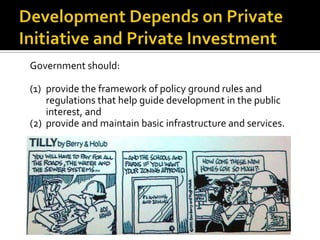
Government should:
(1) provide the framework of policy ground rules and
regulations that help guide development in the public
interest, and
(2) provide and maintain basic infrastructure and services.
What isTOD?
 Mixed-use development
 Development that is close to
and well-served by transit
 Development that is conducive
to transit riding
Transit-oriented development
(TOD) is compact, mixed-use
development near transit facilities
and high-quality walking
environments.The typicalTOD
leverages transit infrastructure to
promote economic development
and smart growth, and to cater to
shifting market demands and
lifestyle preferences. TOD is
about creating sustainable
communities where people of all
ages and incomes have
transportation and housing
choices, increasing location
efficiency where people can
walk, bike and take transit. In
addition,TOD boosts transit
ridership and reduce automobile
congestion, providing value for
both the public and private
sectors, while creating a sense of
community and place.
10
 Location efficiency
 Rich mix of residential and commercial
choices
 Value capture
 Place making
 Resolution of the tension between node and
place
11
 Comprehensive plans that utilize a combination of
zoning, public improvements, development financing
packages, and effective marketing programs
 Planning directly responds to the needs of the
surrounding community
 Pedestrian-Friendly Infrastructure
 Parking Management and Shared Parking
 Zoning that includes overlay districts, use
controls, building standards and requirements for
pedestrian amenities
 Expedited Development Review
 Successful Demonstration Projects
 Public Assistance
12
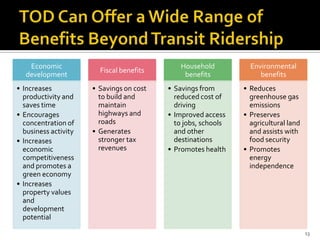
Economic
development
• Increases
productivity and
saves time
• Encourages
concentration of
business activity
• Increases
economic
competitiveness
and promotes a
green economy
• Increases
property values
and
development
potential
Fiscal benefits
• Savings on cost
to build and
maintain
highways and
roads
• Generates
stronger tax
revenues
Household
benefits
• Savings from
reduced cost of
driving
• Improved access
to jobs, schools
and other
destinations
• Promotes health
Environmental
benefits
• Reduces
greenhouse gas
emissions
• Preserves
agricultural land
and assists with
food security
• Promotes
energy
independence
13
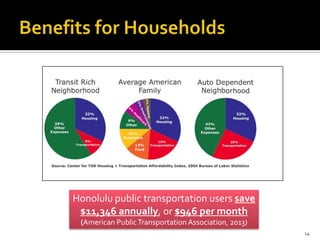
LOCATION MATTERS, BECAUSE TRANSPORTATION
IS A SIGNIFICANT HOUSEHOLD EXPENSE
14
Honolulu public transportation users save
$11,346 annually, or $946 per month
(American PublicTransportation Association, 2013)
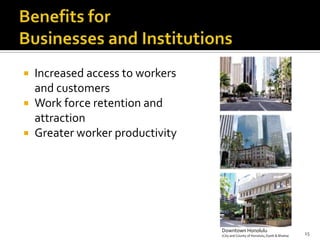
 Increased access to workers
and customers
 Work force retention and
attraction
 Greater worker productivity
Downtown Honolulu
(City and County of Honolulu, Dyett & Bhatia)
15
 Increased property
values
 Enhanced
development potential
 Studies show:
o Properties located near
transit experience a price
premium of 2 to 20%
o Homes in “walkable”
neighborhoods have higher
values. A one point
improvement in “Walk
Score” = $700 - $3,000
increase in home values
16
 Increased local spending and tax revenues
 Cost savings for roads, highways and other
infrastructure
 Savings from reduced health costs
 Enhanced economic competitiveness
 Assists in addressing affordable housing
needs and food security
17
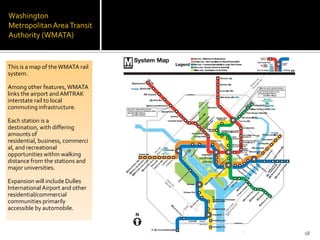
Washington
MetropolitanAreaTransit
Authority (WMATA)
This is a map of theWMATA rail
system.
Among other features, WMATA
links the airport andAMTRAK
interstate rail to local
commuting infrastructure.
Each station is a
destination, with differing
amounts of
residential, business, commerci
al, and recreational
opportunities within walking
distance from the stations and
major universities.
Expansion will include Dulles
InternationalAirport and other
residential/commercial
communities primarily
accessible by automobile.
18
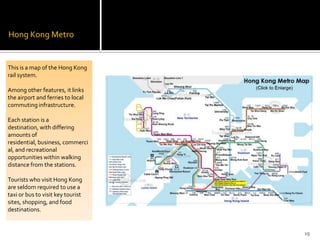
Hong Kong Metro
This is a map of the Hong Kong
rail system.
Among other features, it links
the airport and ferries to local
commuting infrastructure.
Each station is a
destination, with differing
amounts of
residential, business, commerci
al, and recreational
opportunities within walking
distance from the stations.
Tourists who visit Hong Kong
are seldom required to use a
taxi or bus to visit key tourist
sites, shopping, and food
destinations.
19
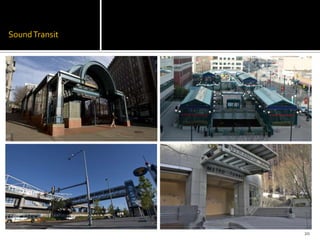
SoundTransit
20
21
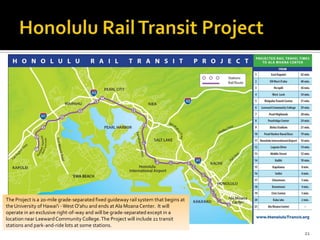
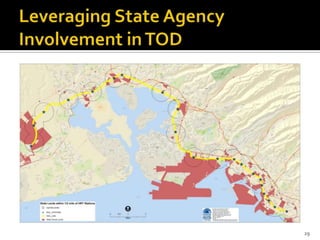
The Project is a 20-mile grade-separated fixed guideway rail system that begins at
the University of Hawai'i -West O'ahu and ends at Ala Moana Center. It will
operate in an exclusive right-of-way and will be grade-separated except in a
location near LeewardCommunity College.The Project will include 21 transit
stations and park-and-ride lots at some stations.
 City Council approves zone changes and new
special districts
 City’s Department of Planning and Permitting is
the land use permitting agency
 Current zoning tends to not maximize full
development potential of the station areas
 Development standards tend to favor auto use
and auto-oriented development
 e.g., strip malls, surface parking lots at the expense of
pedestrians, bicyclists and transit riders
22
 NeighborhoodTOD Plan
 May include one or more stations
 TOD development regulations foster and
encourageTOD and redevelopment of each
TOD zone
 After January 2012, Council may establish
TOD zones andTOD development
regulations withoutTOD Plans
23
 Minimum Considerations
 Overall economic revitalization, neighborhood character, and
unique community historic architecture
 Architectural and community design principles, open space
requirements, parking standards, and other modifications to
existing zoning requirements
 Affordable housing opportunities
 Gentrification issues
 Financing opportunities that should be pursued
 Population, economic, market and infrastructure analysis
 Community Involvement
 Consistent with the applicable regional development
plan, special area plan, or community master plan
 Approved by Council resolution
24
 Mix of land uses and affordable housing
 Density and building height limits
 Elimination or reduction of the number of required off-street
parking spaces
 Design provisions that encourage use of transit and other non-
auto forms of transport
 Building/parking/bicycle parking guidelines
 Identify/protect/enhance important historic, scenic, and cultural
landmarks
 Human-scale architectural elements
 Landscaping requirements that enhance the pedestrian
experience, support station identity, and complement adjacent
structures
 Incentives and accompanying procedures to encourageTOD
25
 Council approves NeighborhoodTOD Plan
 DPP submitsTOD Zones and Development
Regs ordinance to planning commission
 PlanningCommission reviews and makes
recommendations to Council
 Council adoptsTOD special district ordinance
 Development plans may need to be amended
26
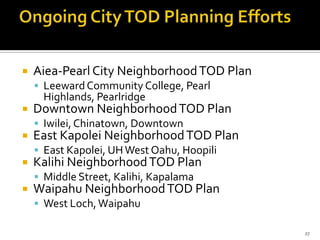
 Aiea-Pearl City NeighborhoodTOD Plan
 LeewardCommunity College, Pearl
Highlands, Pearlridge
 Downtown NeighborhoodTOD Plan
 Iwilei, Chinatown, Downtown
 East Kapolei NeighborhoodTOD Plan
 East Kapolei, UHWest Oahu, Hoopili
 Kalihi NeighborhoodTOD Plan
 Middle Street, Kalihi, Kapalama
 Waipahu NeighborhoodTOD Plan
 West Loch,Waipahu
27
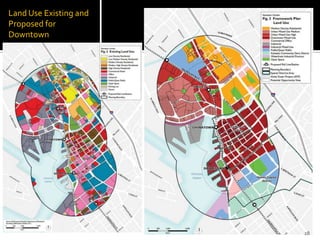
Land Use Existing and
Proposed for
Downtown
28
29
 Smart GrowthAmerica
 Grant funding awarded by the Rockefeller Foundation
 TOD from the State’s Perspective
 Land owner/ developer
 Service provider
 Employer
 Not duplicate ongoing efforts by the City &
County of Honolulu in the area ofTOD planning
 Recommendation to the Governor
30
31
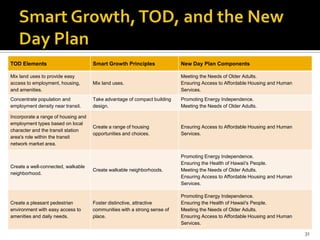
TOD Elements Smart Growth Principles New Day Plan Components
Mix land uses to provide easy
access to employment, housing,
and amenities.
Mix land uses.
Meeting the Needs of Older Adults.
Ensuring Access to Affordable Housing and Human
Services.
Concentrate population and
employment density near transit.
Take advantage of compact building
design.
Promoting Energy Independence.
Meeting the Needs of Older Adults.
Incorporate a range of housing and
employment types based on local
character and the transit station
area's role within the transit
network market area.
Create a range of housing
opportunities and choices.
Ensuring Access to Affordable Housing and Human
Services.
Create a well-connected, walkable
neighborhood.
Create walkable neighborhoods.
Promoting Energy Independence.
Ensuring the Health of Hawaii's People.
Meeting the Needs of Older Adults.
Ensuring Access to Affordable Housing and Human
Services.
Create a pleasant pedestrian
environment with easy access to
amenities and daily needs.
Foster distinctive, attractive
communities with a strong sense of
place.
Promoting Energy Independence.
Ensuring the Health of Hawaii's People.
Meeting the Needs of Older Adults.
Ensuring Access to Affordable Housing and Human
Services.
32
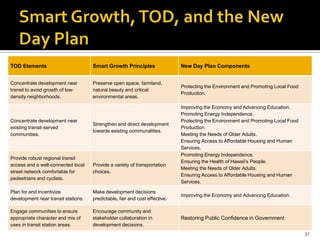
TOD Elements Smart Growth Principles New Day Plan Components
Concentrate development near
transit to avoid growth of low-
density neighborhoods.
Preserve open space, farmland,
natural beauty and critical
environmental areas.
Protecting the Environment and Promoting Local Food
Production.
Concentrate development near
existing transit-served
communities.
Strengthen and direct development
towards existing communalities.
Improving the Economy and Advancing Education.
Promoting Energy Independence.
Protecting the Environment and Promoting Local Food
Production.
Meeting the Needs of Older Adults.
Ensuring Access to Affordable Housing and Human
Services.
Provide robust regional transit
access and a well-connected local
street network comfortable for
pedestrians and cyclists.
Provide a variety of transportation
choices.
Promoting Energy Independence.
Ensuring the Health of Hawaii's People.
Meeting the Needs of Older Adults.
Ensuring Access to Affordable Housing and Human
Services.
Plan for and incentivize
development near transit stations.
Make development decisions
predictable, fair and cost effective.
Improving the Economy and Advancing Education.
Engage communities to ensure
appropriate character and mix of
uses in transit station areas.
Encourage community and
stakeholder collaboration in
development decisions.
Restoring Public Confidence in Government
 A significant proportion of state assets are in
public lands
 LeveragingTOD may mean reassessing the
best use of some properties to help the state
provide public services and amenities
 Improved transit access can reduce the need
for on-site parking; this can free up space for
other activities or additional facilities
33
 Transit can enhance access to government
services, education and health care
 Access to these services are key for creating
healthy, mixed-use neighborhoods
 Encouraging transit use can help the state meet other
goals and objectives
 PublicTransportation Saves 37 Million MetricTons of
CarbonAnnually and 4.2 Billion Gallons of Gasoline
(APTA, 2009)
 Riding PublicTransit Saves Honolulu Individuals
Approximately $11,346 annually (APTA, 2013)
 Affordable Housing Opportunities
 Addressing the Needs of Our Aging Baby Boomers
34
 The state is a major employer that can
benefit from improved access to workers and
increased productivity
 Lowers transportation costs for state workers
 The location of major employers can also
serve as a catalyst forTOD
35
 High development costs
 High land costs
 High construction costs
 A lack infrastructure
 In urban neighborhoods
 In areas planned for growth
 A lack of local examples of “walkable” mixed-
use neighborhoods
36
 A project site or sites must be identified
 Procurement requirements must be met
 A thorough environmental review must be
completed
 Community outreach and participation
process must
 planned and implemented
37
 Leveraging State Agency Involvement inTransit-Oriented Development to Strengthen Hawaii’s Economy, Final
Report, State Office of Planning, Dec. 12, 2012, at http://www.smartgrowthamerica.org/wp/wp-
content/uploads/HI-State-TOD-Strategies-Final-Report-1.pdf.
 Lesa Rair, Rising Gas Prices MeanTransit Riders Save MoneyWhile Car Drivers EmptyTheirWallets, American Public
TransportationAssociation, Feb. 23, 2012, at
http://www.apta.com/mediacenter/pressreleases/2012/Pages/120223_TransitSavingsReport.aspx.
 Transit-Oriented and Joint Development: Case Studies and Legal Issues,Transit Cooperative Research
Program, Aug. 2011, at http://onlinepubs.trb.org/onlinepubs/tcrp/tcrp_lrd_36.pdf.
 Policy, Planning, & Major Projects Station Area Planning -Transit-Oriented Development Case Studies, City of
Seattle, at http://www.seattle.gov/transportation/ppmp_sap_todstudies.htm.
 Review of Current City and State Ordinances Honolulu High-CapacityTransit Corridor Project, City & County of
Honolulu,Aug. 2011, at http://www.honolulutransit.org/media/80437/20110801-Review-of-Current-City-and-
State-Ordinances-HHCTCP.pdf.
 Request for Proposals - 690 PohukainaTransit-Oriented Development Project, Haw. Community Devel.
Authority, at http://hcdaweb.org/request-for-proposals-690-pohukaina-transit-oriented-development-project.
 Record of Decision on the Honolulu High CapacityTransit Corridor Project in Metropolitan Honolulu, Hawaii by the
FederalTransit Administration, FTA, Jan. 18, 2011, at http://www.honolulutransit.org/media/7351/20110701-rod-
and-transmittal-ltr-signed-dated-01182011.pdf.
 Revised Ordinances of Honolulu 1990 § 21-9.100, available at
http://www1.honolulu.gov/council/ocs/roh/rohchapter21art79.pdf.
 Downtown & Kalihi DraftTOD Framework Plans, City & County of Honolulu, Feb. 2012, at
http://honoluludpp.org/planning/TOD/NBPlans/Kalihi_Downtown_FrameworkPlan.pdf.
 Jesse K. Souki, TOD,TAD,TAJ:Transit Development Alphabet Soup, Haw. Land Use Law & Policy, Oct. 29, 2011 at
http://hilanduse.blogspot.com/2011/10/tod-tad-taj-transit-development.html.
 Jesse K. Souki, Transit Oriented Development and Affordable Housing, Haw. Land Use Law & Policy, Jan. 7, 2009 at
http://hilanduse.blogspot.com/2009/01/transit-oriented-development-and.html.
 Capturing theValue ofTransit, Center forTransit Oriented Development (2008).
 HowWalkability Raises HomeValues in U.S. Cities, CEOs for Cities (2009). 38
39
Jesse K. Souki, Director
Office of Planning
State of Hawaii
(808) 587-2846
E-Mail: jesse.k.souki@dbedt.hawaii.gov
Web Site: http://planning.hawaii.gov
Facebook: https://www.facebook.com/OfficeofPlanning.HIgov
Twitter: https://twitter.com/PlanningHIgov

Hot Topics: Transit Oriented Development

  • 1.
    State of HawaiiOffice of Planning Presentation to Ashford &Wriston Presentation by Director Jesse K. Souki, Esq.
  • 2.
     The StateOffice of Planning  TOD Definitions  TOD Examples  CityTOD Planning  StateTOD Planning  Resources 2
  • 3.
    Key Policies thatGuide OP •Hawaii State PlanningAct •State Land Use Law •CoastalZone ManagementAct
  • 4.
     Meet thephysical, economic, and social needs of Hawaii's people  Provide for the wise use of Hawaii's resources in a coordinated, efficient, and economical manner  Conserve natural, environmental, recreational, scenic, historic, and other limited and irreplaceable resources which are required for future generations Source: HRS §225M-1.
  • 5.
    Hawaii State Planning Act Guide for the future long-range development of the State  Goals, objectives, policies, and priorities for the State  Basis for determining priorities and allocating limited resources  Coordination of federal, state, and county plans, policies, programs, projects, and regulatory activities  Planning system to integrate major federal, state, and county activities Hawaii Revised Statutes Chapter 226 (1978)
  • 6.
    State Land UseLaw  Purpose  “preserve, protect and encourage the development of the lands in the State for those uses to which they are best suited for the public welfare[.]” See L. 1961, c 187, § 1.  Implementation Mechanisms  5-Year Boundary Review  District Boundary Amendments  ImportantAgricultural Lands Designation  State Special Use Permits Hawaii Revised Statutes Chapter 205 (1961) U 5% C 48% A 47% R 0%
  • 7.
    CoastalZone ManagementAct  Purpose  “providefor the effective management, beneficial use, protection, and development of the coastal zone.” See L. 1977, c 188, § 1.  Implementing Mechanisms  Special Management Area Permits  FederalConsistency  Comprehensive Planning and Coordination Hawaii Revised Statutes Chapter 205A (1977)
  • 8.
    “TOD/TJD, successful projectsdo not happen on their own, or just because government has invested public money into transit and other infrastructure. TOD and joint development projects succeed, most fundamentally, because there is a market for those types of development.“ 8
  • 9.
    Government should: (1) providethe framework of policy ground rules and regulations that help guide development in the public interest, and (2) provide and maintain basic infrastructure and services.
  • 10.
    What isTOD?  Mixed-usedevelopment  Development that is close to and well-served by transit  Development that is conducive to transit riding Transit-oriented development (TOD) is compact, mixed-use development near transit facilities and high-quality walking environments.The typicalTOD leverages transit infrastructure to promote economic development and smart growth, and to cater to shifting market demands and lifestyle preferences. TOD is about creating sustainable communities where people of all ages and incomes have transportation and housing choices, increasing location efficiency where people can walk, bike and take transit. In addition,TOD boosts transit ridership and reduce automobile congestion, providing value for both the public and private sectors, while creating a sense of community and place. 10
  • 11.
     Location efficiency Rich mix of residential and commercial choices  Value capture  Place making  Resolution of the tension between node and place 11
  • 12.
     Comprehensive plansthat utilize a combination of zoning, public improvements, development financing packages, and effective marketing programs  Planning directly responds to the needs of the surrounding community  Pedestrian-Friendly Infrastructure  Parking Management and Shared Parking  Zoning that includes overlay districts, use controls, building standards and requirements for pedestrian amenities  Expedited Development Review  Successful Demonstration Projects  Public Assistance 12
  • 13.
    Economic development • Increases productivity and savestime • Encourages concentration of business activity • Increases economic competitiveness and promotes a green economy • Increases property values and development potential Fiscal benefits • Savings on cost to build and maintain highways and roads • Generates stronger tax revenues Household benefits • Savings from reduced cost of driving • Improved access to jobs, schools and other destinations • Promotes health Environmental benefits • Reduces greenhouse gas emissions • Preserves agricultural land and assists with food security • Promotes energy independence 13
  • 14.
    LOCATION MATTERS, BECAUSETRANSPORTATION IS A SIGNIFICANT HOUSEHOLD EXPENSE 14 Honolulu public transportation users save $11,346 annually, or $946 per month (American PublicTransportation Association, 2013)
  • 15.
     Increased accessto workers and customers  Work force retention and attraction  Greater worker productivity Downtown Honolulu (City and County of Honolulu, Dyett & Bhatia) 15
  • 16.
     Increased property values Enhanced development potential  Studies show: o Properties located near transit experience a price premium of 2 to 20% o Homes in “walkable” neighborhoods have higher values. A one point improvement in “Walk Score” = $700 - $3,000 increase in home values 16
  • 17.
     Increased localspending and tax revenues  Cost savings for roads, highways and other infrastructure  Savings from reduced health costs  Enhanced economic competitiveness  Assists in addressing affordable housing needs and food security 17
  • 18.
    Washington MetropolitanAreaTransit Authority (WMATA) This isa map of theWMATA rail system. Among other features, WMATA links the airport andAMTRAK interstate rail to local commuting infrastructure. Each station is a destination, with differing amounts of residential, business, commerci al, and recreational opportunities within walking distance from the stations and major universities. Expansion will include Dulles InternationalAirport and other residential/commercial communities primarily accessible by automobile. 18
  • 19.
    Hong Kong Metro Thisis a map of the Hong Kong rail system. Among other features, it links the airport and ferries to local commuting infrastructure. Each station is a destination, with differing amounts of residential, business, commerci al, and recreational opportunities within walking distance from the stations. Tourists who visit Hong Kong are seldom required to use a taxi or bus to visit key tourist sites, shopping, and food destinations. 19
  • 20.
  • 21.
    21 The Project isa 20-mile grade-separated fixed guideway rail system that begins at the University of Hawai'i -West O'ahu and ends at Ala Moana Center. It will operate in an exclusive right-of-way and will be grade-separated except in a location near LeewardCommunity College.The Project will include 21 transit stations and park-and-ride lots at some stations.
  • 22.
     City Councilapproves zone changes and new special districts  City’s Department of Planning and Permitting is the land use permitting agency  Current zoning tends to not maximize full development potential of the station areas  Development standards tend to favor auto use and auto-oriented development  e.g., strip malls, surface parking lots at the expense of pedestrians, bicyclists and transit riders 22
  • 23.
     NeighborhoodTOD Plan May include one or more stations  TOD development regulations foster and encourageTOD and redevelopment of each TOD zone  After January 2012, Council may establish TOD zones andTOD development regulations withoutTOD Plans 23
  • 24.
     Minimum Considerations Overall economic revitalization, neighborhood character, and unique community historic architecture  Architectural and community design principles, open space requirements, parking standards, and other modifications to existing zoning requirements  Affordable housing opportunities  Gentrification issues  Financing opportunities that should be pursued  Population, economic, market and infrastructure analysis  Community Involvement  Consistent with the applicable regional development plan, special area plan, or community master plan  Approved by Council resolution 24
  • 25.
     Mix ofland uses and affordable housing  Density and building height limits  Elimination or reduction of the number of required off-street parking spaces  Design provisions that encourage use of transit and other non- auto forms of transport  Building/parking/bicycle parking guidelines  Identify/protect/enhance important historic, scenic, and cultural landmarks  Human-scale architectural elements  Landscaping requirements that enhance the pedestrian experience, support station identity, and complement adjacent structures  Incentives and accompanying procedures to encourageTOD 25
  • 26.
     Council approvesNeighborhoodTOD Plan  DPP submitsTOD Zones and Development Regs ordinance to planning commission  PlanningCommission reviews and makes recommendations to Council  Council adoptsTOD special district ordinance  Development plans may need to be amended 26
  • 27.
     Aiea-Pearl CityNeighborhoodTOD Plan  LeewardCommunity College, Pearl Highlands, Pearlridge  Downtown NeighborhoodTOD Plan  Iwilei, Chinatown, Downtown  East Kapolei NeighborhoodTOD Plan  East Kapolei, UHWest Oahu, Hoopili  Kalihi NeighborhoodTOD Plan  Middle Street, Kalihi, Kapalama  Waipahu NeighborhoodTOD Plan  West Loch,Waipahu 27
  • 28.
    Land Use Existingand Proposed for Downtown 28
  • 29.
  • 30.
     Smart GrowthAmerica Grant funding awarded by the Rockefeller Foundation  TOD from the State’s Perspective  Land owner/ developer  Service provider  Employer  Not duplicate ongoing efforts by the City & County of Honolulu in the area ofTOD planning  Recommendation to the Governor 30
  • 31.
    31 TOD Elements SmartGrowth Principles New Day Plan Components Mix land uses to provide easy access to employment, housing, and amenities. Mix land uses. Meeting the Needs of Older Adults. Ensuring Access to Affordable Housing and Human Services. Concentrate population and employment density near transit. Take advantage of compact building design. Promoting Energy Independence. Meeting the Needs of Older Adults. Incorporate a range of housing and employment types based on local character and the transit station area's role within the transit network market area. Create a range of housing opportunities and choices. Ensuring Access to Affordable Housing and Human Services. Create a well-connected, walkable neighborhood. Create walkable neighborhoods. Promoting Energy Independence. Ensuring the Health of Hawaii's People. Meeting the Needs of Older Adults. Ensuring Access to Affordable Housing and Human Services. Create a pleasant pedestrian environment with easy access to amenities and daily needs. Foster distinctive, attractive communities with a strong sense of place. Promoting Energy Independence. Ensuring the Health of Hawaii's People. Meeting the Needs of Older Adults. Ensuring Access to Affordable Housing and Human Services.
  • 32.
    32 TOD Elements SmartGrowth Principles New Day Plan Components Concentrate development near transit to avoid growth of low- density neighborhoods. Preserve open space, farmland, natural beauty and critical environmental areas. Protecting the Environment and Promoting Local Food Production. Concentrate development near existing transit-served communities. Strengthen and direct development towards existing communalities. Improving the Economy and Advancing Education. Promoting Energy Independence. Protecting the Environment and Promoting Local Food Production. Meeting the Needs of Older Adults. Ensuring Access to Affordable Housing and Human Services. Provide robust regional transit access and a well-connected local street network comfortable for pedestrians and cyclists. Provide a variety of transportation choices. Promoting Energy Independence. Ensuring the Health of Hawaii's People. Meeting the Needs of Older Adults. Ensuring Access to Affordable Housing and Human Services. Plan for and incentivize development near transit stations. Make development decisions predictable, fair and cost effective. Improving the Economy and Advancing Education. Engage communities to ensure appropriate character and mix of uses in transit station areas. Encourage community and stakeholder collaboration in development decisions. Restoring Public Confidence in Government
  • 33.
     A significantproportion of state assets are in public lands  LeveragingTOD may mean reassessing the best use of some properties to help the state provide public services and amenities  Improved transit access can reduce the need for on-site parking; this can free up space for other activities or additional facilities 33
  • 34.
     Transit canenhance access to government services, education and health care  Access to these services are key for creating healthy, mixed-use neighborhoods  Encouraging transit use can help the state meet other goals and objectives  PublicTransportation Saves 37 Million MetricTons of CarbonAnnually and 4.2 Billion Gallons of Gasoline (APTA, 2009)  Riding PublicTransit Saves Honolulu Individuals Approximately $11,346 annually (APTA, 2013)  Affordable Housing Opportunities  Addressing the Needs of Our Aging Baby Boomers 34
  • 35.
     The stateis a major employer that can benefit from improved access to workers and increased productivity  Lowers transportation costs for state workers  The location of major employers can also serve as a catalyst forTOD 35
  • 36.
     High developmentcosts  High land costs  High construction costs  A lack infrastructure  In urban neighborhoods  In areas planned for growth  A lack of local examples of “walkable” mixed- use neighborhoods 36
  • 37.
     A projectsite or sites must be identified  Procurement requirements must be met  A thorough environmental review must be completed  Community outreach and participation process must  planned and implemented 37
  • 38.
     Leveraging StateAgency Involvement inTransit-Oriented Development to Strengthen Hawaii’s Economy, Final Report, State Office of Planning, Dec. 12, 2012, at http://www.smartgrowthamerica.org/wp/wp- content/uploads/HI-State-TOD-Strategies-Final-Report-1.pdf.  Lesa Rair, Rising Gas Prices MeanTransit Riders Save MoneyWhile Car Drivers EmptyTheirWallets, American Public TransportationAssociation, Feb. 23, 2012, at http://www.apta.com/mediacenter/pressreleases/2012/Pages/120223_TransitSavingsReport.aspx.  Transit-Oriented and Joint Development: Case Studies and Legal Issues,Transit Cooperative Research Program, Aug. 2011, at http://onlinepubs.trb.org/onlinepubs/tcrp/tcrp_lrd_36.pdf.  Policy, Planning, & Major Projects Station Area Planning -Transit-Oriented Development Case Studies, City of Seattle, at http://www.seattle.gov/transportation/ppmp_sap_todstudies.htm.  Review of Current City and State Ordinances Honolulu High-CapacityTransit Corridor Project, City & County of Honolulu,Aug. 2011, at http://www.honolulutransit.org/media/80437/20110801-Review-of-Current-City-and- State-Ordinances-HHCTCP.pdf.  Request for Proposals - 690 PohukainaTransit-Oriented Development Project, Haw. Community Devel. Authority, at http://hcdaweb.org/request-for-proposals-690-pohukaina-transit-oriented-development-project.  Record of Decision on the Honolulu High CapacityTransit Corridor Project in Metropolitan Honolulu, Hawaii by the FederalTransit Administration, FTA, Jan. 18, 2011, at http://www.honolulutransit.org/media/7351/20110701-rod- and-transmittal-ltr-signed-dated-01182011.pdf.  Revised Ordinances of Honolulu 1990 § 21-9.100, available at http://www1.honolulu.gov/council/ocs/roh/rohchapter21art79.pdf.  Downtown & Kalihi DraftTOD Framework Plans, City & County of Honolulu, Feb. 2012, at http://honoluludpp.org/planning/TOD/NBPlans/Kalihi_Downtown_FrameworkPlan.pdf.  Jesse K. Souki, TOD,TAD,TAJ:Transit Development Alphabet Soup, Haw. Land Use Law & Policy, Oct. 29, 2011 at http://hilanduse.blogspot.com/2011/10/tod-tad-taj-transit-development.html.  Jesse K. Souki, Transit Oriented Development and Affordable Housing, Haw. Land Use Law & Policy, Jan. 7, 2009 at http://hilanduse.blogspot.com/2009/01/transit-oriented-development-and.html.  Capturing theValue ofTransit, Center forTransit Oriented Development (2008).  HowWalkability Raises HomeValues in U.S. Cities, CEOs for Cities (2009). 38
  • 39.
    39 Jesse K. Souki,Director Office of Planning State of Hawaii (808) 587-2846 E-Mail: jesse.k.souki@dbedt.hawaii.gov Web Site: http://planning.hawaii.gov Facebook: https://www.facebook.com/OfficeofPlanning.HIgov Twitter: https://twitter.com/PlanningHIgov

Editor's Notes

  • #9 Transit-Oriented and Joint Development: Case Studies and Legal Issues, Transit Cooperative Research Program, Aug. 2011, at http://onlinepubs.trb.org/onlinepubs/tcrp/tcrp_lrd_36.pdf.2010 ULI Presentation:Construction Costs are the MAJOR inhibitor to new development and especially TOD in Honolulu.As a result, most new development that does occur in Honolulu is focused on high value opportunities such as Big box or strip retail, High end condo development, and Single family homes.Opportunities for significant new development, community investment, economic growth, and increase in the tax base lie in the government’s ability to address the biggest cost -- infrastructure.Development cash flow analysis has shown that low to mid rise mixed use development with middle income housing can be a viable investment when infrastructure considerations are removed.Absent public investment and incentives – development projects will continue to ignore the return on investment opportunity that exists with TOD.Something “material” must change.
  • #11 Transit-oriented development (TOD) is compact, mixed-use development near transit facilities and high-quality walking environments. The typical TOD leverages transit infrastructure to promote economic development and smart growth, and to cater to shifting market demands and lifestyle preferences. TOD is about creating sustainable communities where people of all ages and incomes have transportation and housing choices, increasing location efficiency where people can walk, bike and take transit.  In addition, TOD boosts transit ridership and reduce automobile congestion, providing value for both the public and private sectors, while creating a sense of community and place.
  • #12 Location efficiencyDensity, transit accessibility, and pedestrian friendlinessRich mix of residential and commercial choicesPeople’s ability to not only have transport alternatives but also have choice in housing, retail, and employmentValue captureHousehold and community cost savings associated with transit useAccording to the American Public Transportation Association, Honolulu residents who ride public transportation instead of driving can save, on average, $11,388 annually.Place makingAbility for TOD to create attractive, pedestrian friendly neighborhoods with high-quality civic spaces The transit station should also be a place, a destination with work, live, and play opportunities within walkable distance from the transit station. Resolution of the tension between node and placeConverting railway termini and their surrounding areas into urban placesThe transit station should be more than a transportation mode, where riders convert to another mode of transportation before reaching their final destination.
  • #13 Transit Cooperative Research Program
  • #15 American Public Transportation Association (APTA), Honolulu public transportation users save $11,346 annually, or $946 per month
  • #21 SeaTac/Airport StationUniversity Street StationPioneer Square StationInternational District/Chinatown Station
  • #22 The Project is a 20-mile grade-separated fixed guideway rail system that begins at the University of Hawai'i - West O'ahu near the future Kroc Center and proceeds east via Farrington Highway and Kamehameha Highway adjacent to Pearl Harbor to Aolele Street serving the Airport, to Dillingham Boulevard, to Nimitz Highway, to Halekauwila Street, and ending at Ala Moana Center. The entire system will operate in an exclusive right-of-way and will be grade-separated except in a location near Leeward Community College. The Project will include 21 transit stations, a vehicle maintenance storage facility near Leeward Community College, park-and-ride lots at some stations, traction power substations, and the acquisition of rail vehicles and maintenance equipment.
  • #29 Figure 3: Framework Plan Land Use illustrates proposed land use designations. The Downtown and Chinatown stations maintain mixed use designations, but the Iwilei station is transformed from its current industrial mixed use designation (which only permits incidental residential uses) to a new “Urban Mixed Use” designation which permits a wider range of uses, such as medium- and high-density residential, retail and office.Potential development values reflect a realistic level of development that can be expected from transit-oriented development over the next 20 to 30 years, based on an assessment of market data and real estate conditions. As part of this planning process, the consultants estimated that the market in the Downtown TOD Plan area could support +/- 6,000 new dwelling units, +/- 485,000 square feet of retail, and +/- 910,000 square feet of office.Downtown Mixed Use. Mixed-use development in the central business district allowing office, government, retail, and multi-family residential uses, as well as public/quasi-public facilities and open spaces. Assumptions: Max FAR 7.5, Typical FAR 4.5, Mixed Use Allocations 60% Residential/20% Retail/20% Office/R&D, Public/Open Space 12%
  • #30 The Project is a 20-mile grade-separated fixed guideway rail system that begins at the University of Hawai'i - West Oahu and ends at Ala Moana Center. The Project will include 21 transit stations and park-and-ride lots at some stations.The State is the largest land owner within 1/2 mile of proposed transit stations, with approximately 2000 acres.
  • #31 TOD is a powerful tool that can ultimately deliver many of the benefits envisioned both in Governor Abercrombie’s New Day plan and the state Planning Act. The interagency workshops with SGA included representatives from a range of state agencies, along with representatives of the City and County of Honolulu and the private sector. The meetings focused on identifying ways that state activities can be aligned to support TOD and to identify strategies, tools and resources that will be effective in maximizing benefits to the state and in promoting the broader benefits associated with transit-supportive land use patterns.
  • #32 Hawaii’s historic planning goals – set forth in the Hawaii State Planning Act – reflect a longstanding commitment to the principles of what has come to be known as “Smart Growth.” Transit-Oriented Development is essentially a means of implementing Smart Growth since it incorporates compact development accessible by multiple transportation modes. Meanwhile, Governor Abercrombie’s New Day Plan incorporates a number of policy directions which are supported by Smart Growth and Transit-Oriented Development. “We will build livable communities that encourage walking, bicycling, carpooling, and using mass transit.”“[Mass Transit] Rail can incorporate senior and workforce housing adjacent to rail stations; help to contain urban sprawl into rural communities;incorporate small businesses, healthcare, child care and dependent care centers in transit-oriented development; safely transport students to school; andprovide an efficient and potentially green alternative to our overcrowded roadways.”“[The project should be powered] by clean, local sources [of energy].”
  • #35 According to Hawaii Business Magazine, "[t]he first wave of baby boomers—approximately 80 million Americans who were born between 1946 and 1964—is turning 65 in 2011."  "Hawaii has the fastest growing age 65-plus population in the nation, expected to grow by 81 percent by 2030."The World Health Organization (WHO) consulted with 35 cities from all continents (including, New York and Portland in North America).  Their work culminated in a 2007 report entitled, Global age-friendly cities: a guide. 
  • #36 US DOT relocated to waterfront in Anacostia, attracted lots of housing units