Types of Foundation and their Uses
Following are different types of foundations used in construction:
1. Shallow foundation
o Individual footing or isolated footing
o Combined footing
o Strip foundation
o Raft or mat foundation
2. DeepFoundation
o Pile foundation
o Drilled Shafts or caissons
Types of Shallow Foundations
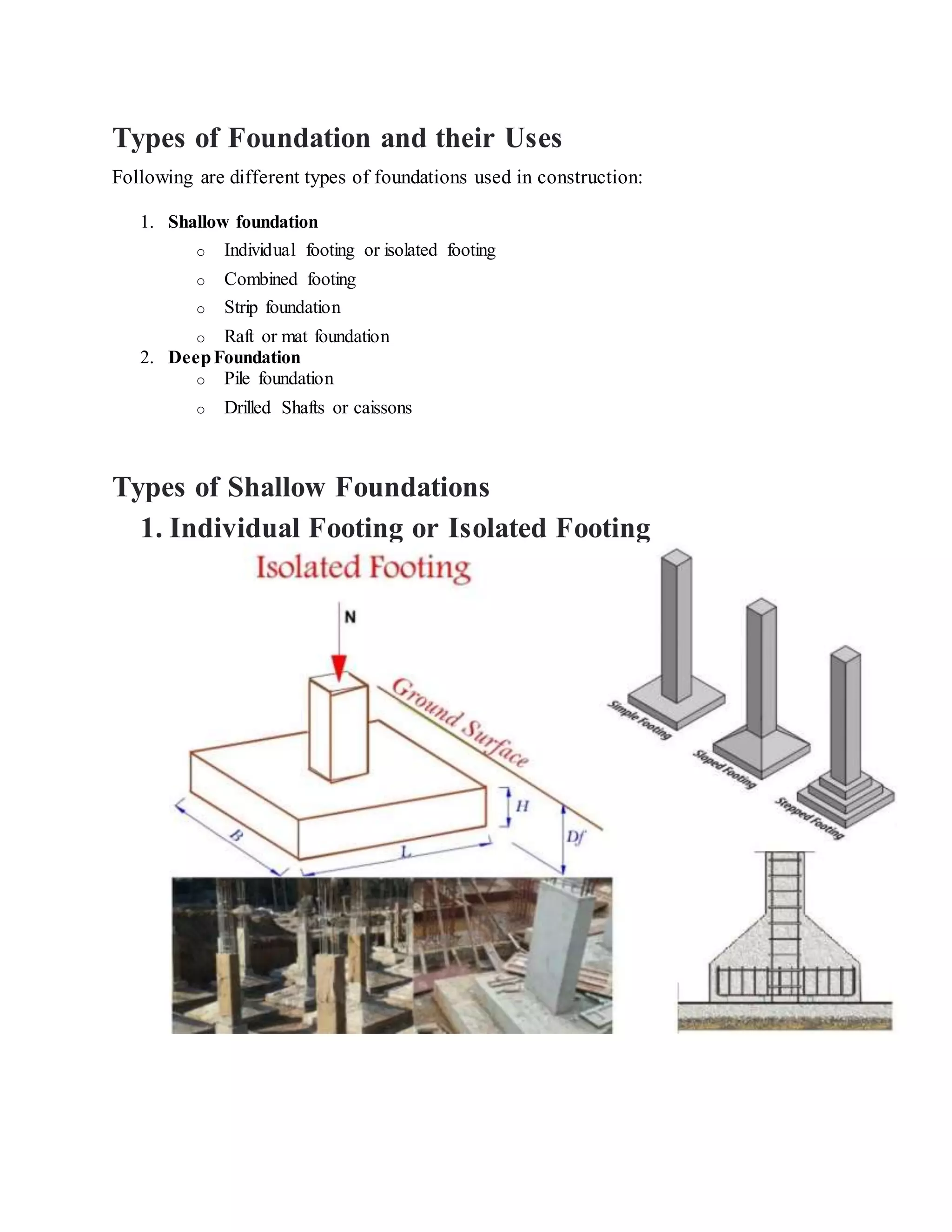
1. Individual Footing or Isolated Footing
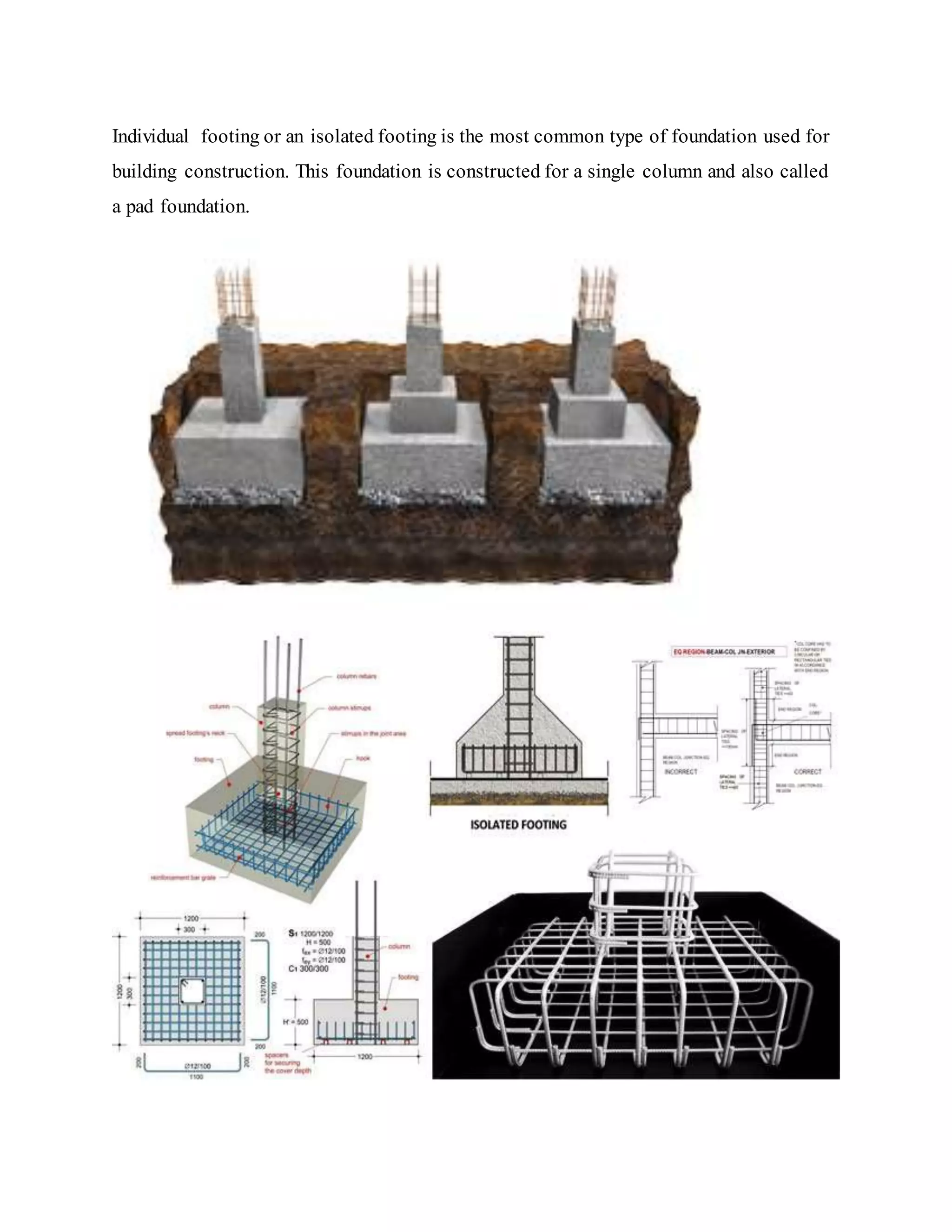
Individual footing or an isolated footing is the most common type of foundation used for
building construction. This foundation is constructed for a single column and also called
a pad foundation.
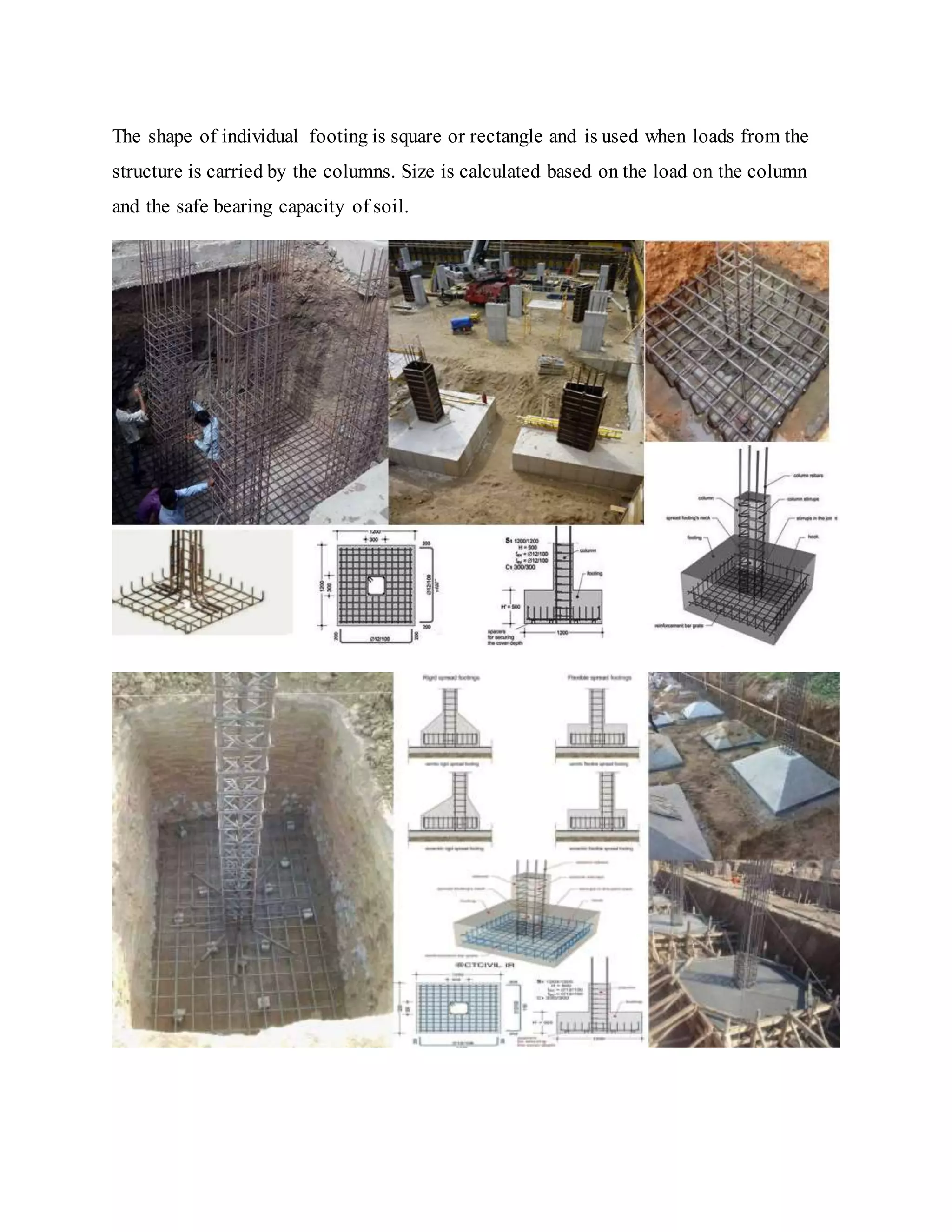
The shape of individual footing is square or rectangle and is used when loads from the
structure is carried by the columns. Size is calculated based on the load on the column
and the safe bearing capacity of soil.
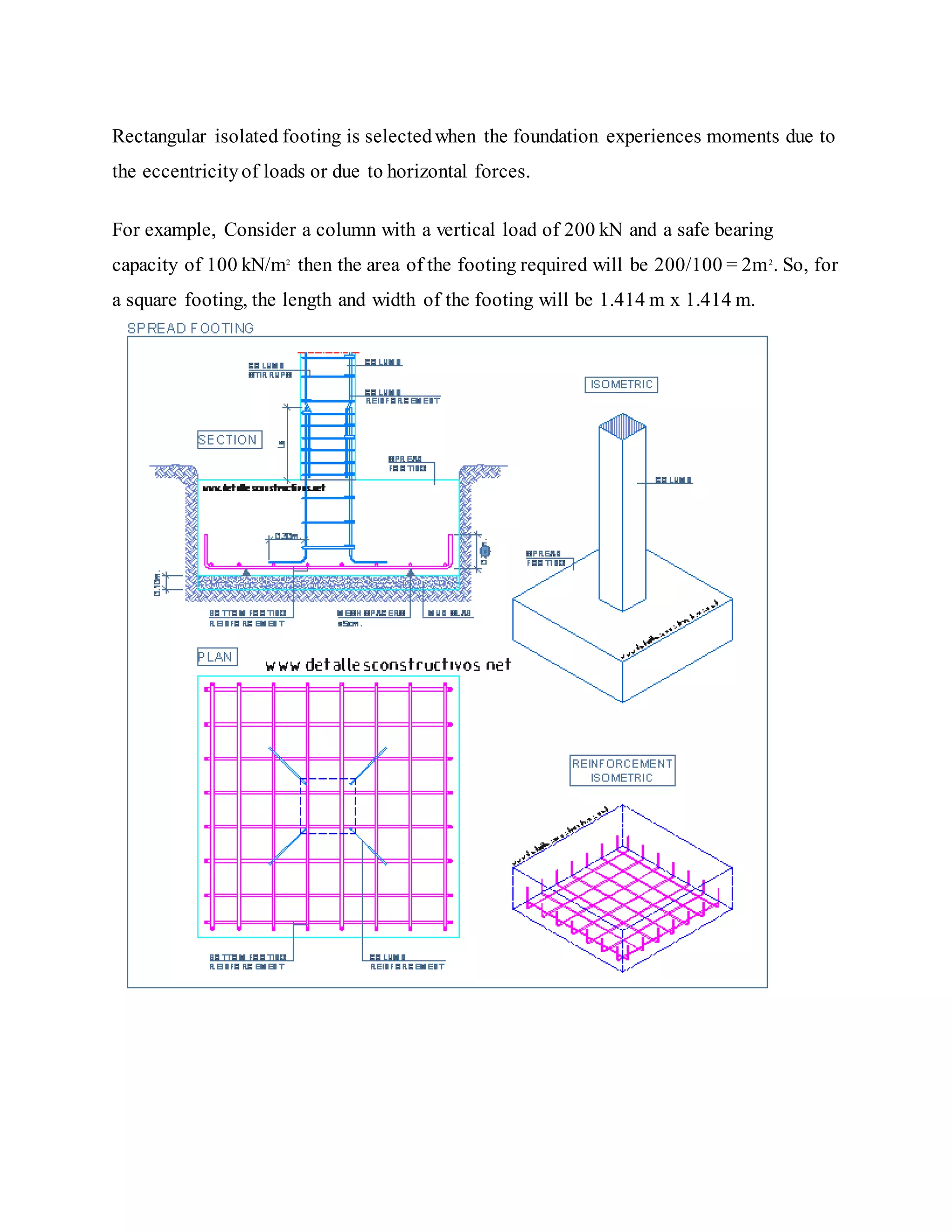
Rectangular isolated footing is selectedwhen the foundation experiences moments due to
the eccentricityof loads or due to horizontal forces.
For example, Consider a column with a vertical load of 200 kN and a safe bearing
capacity of 100 kN/m2
then the area of the footing required will be 200/100 = 2m2
. So, for
a square footing, the length and width of the footing will be 1.414 m x 1.414 m.
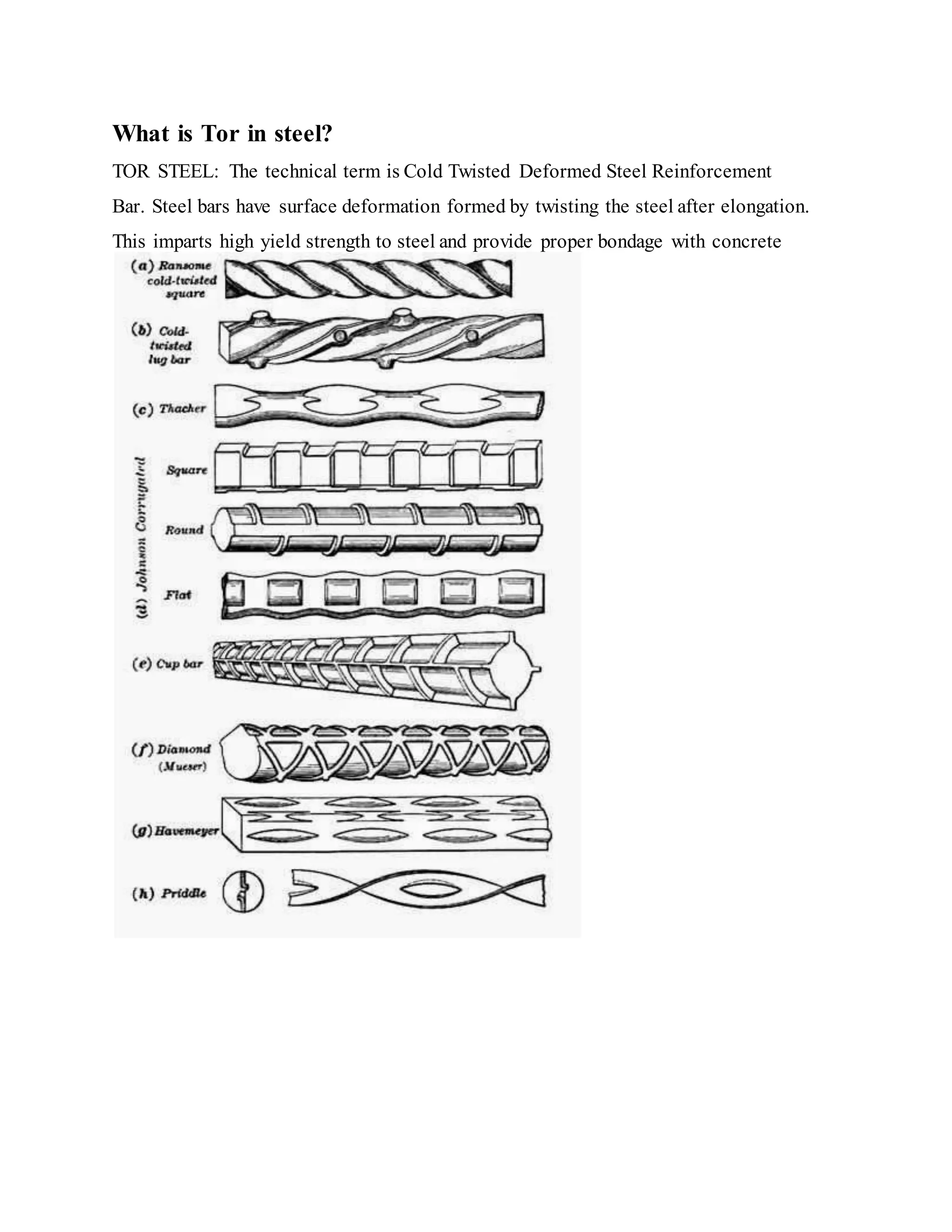
What is Tor in steel?
TOR STEEL: The technical term is Cold Twisted Deformed Steel Reinforcement
Bar. Steel bars have surface deformation formed by twisting the steel after elongation.
This imparts high yield strength to steel and provide proper bondage with concrete
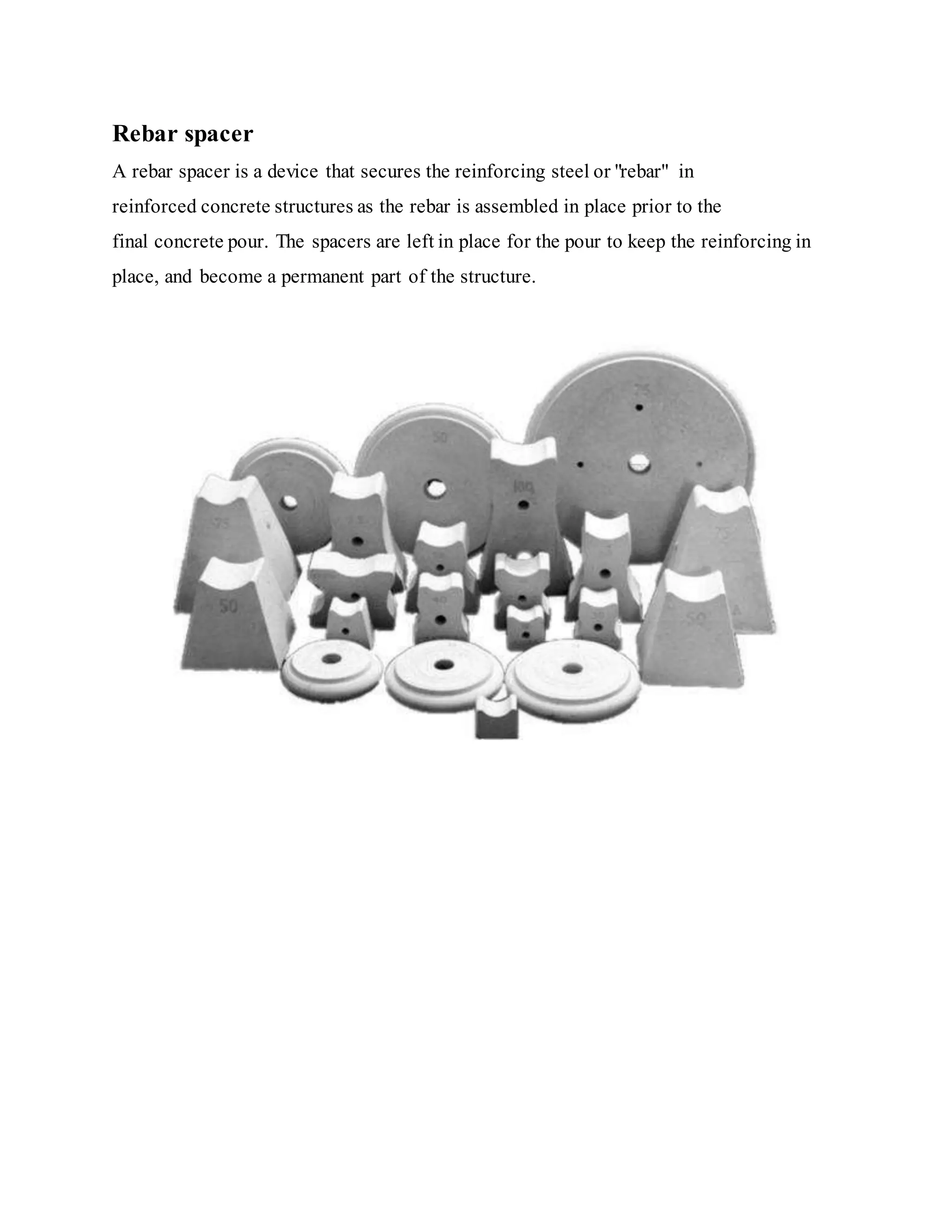
Rebar spacer
A rebar spacer is a device that secures the reinforcing steel or "rebar" in
reinforced concrete structures as the rebar is assembled in place prior to the
final concrete pour. The spacers are left in place for the pour to keep the reinforcing in
place, and become a permanent part of the structure.
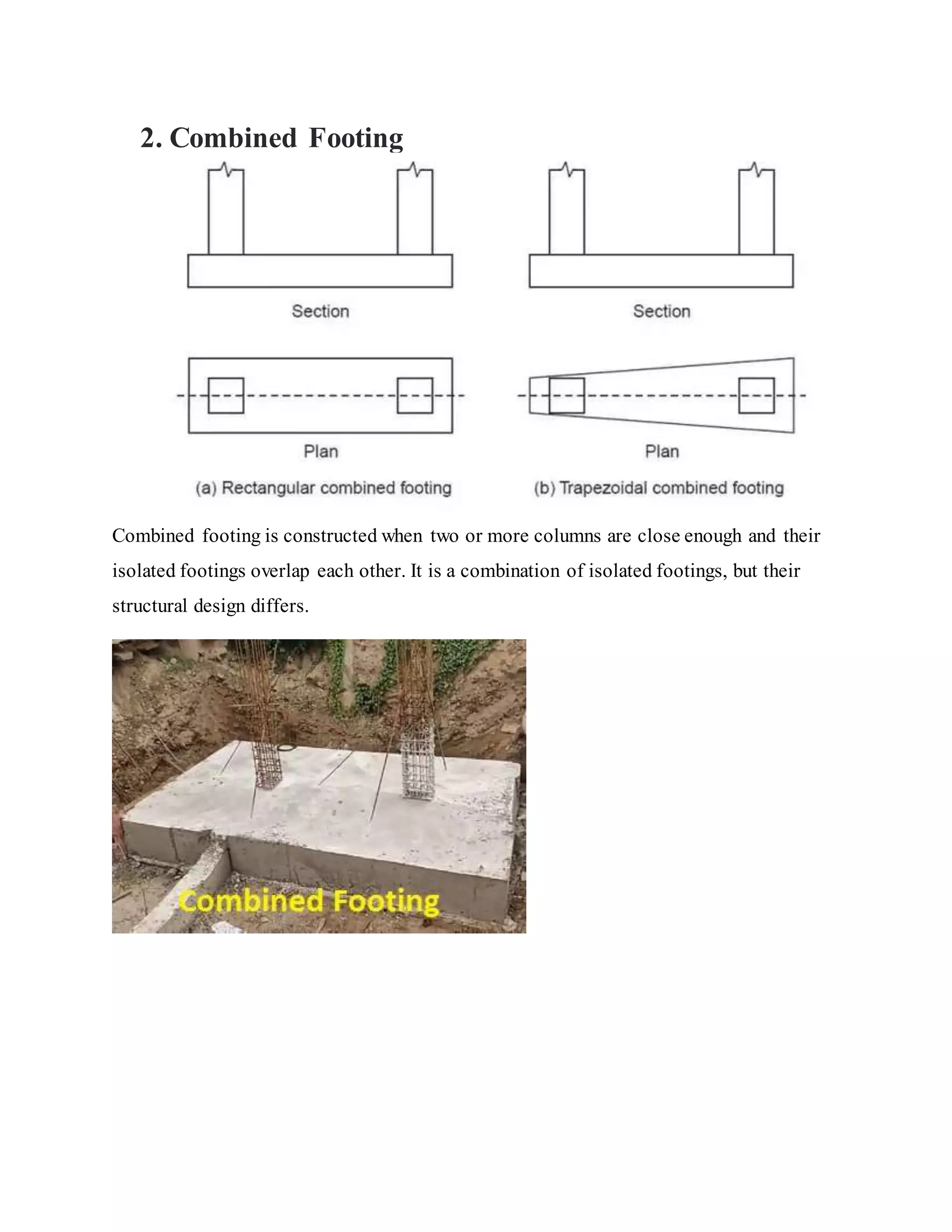
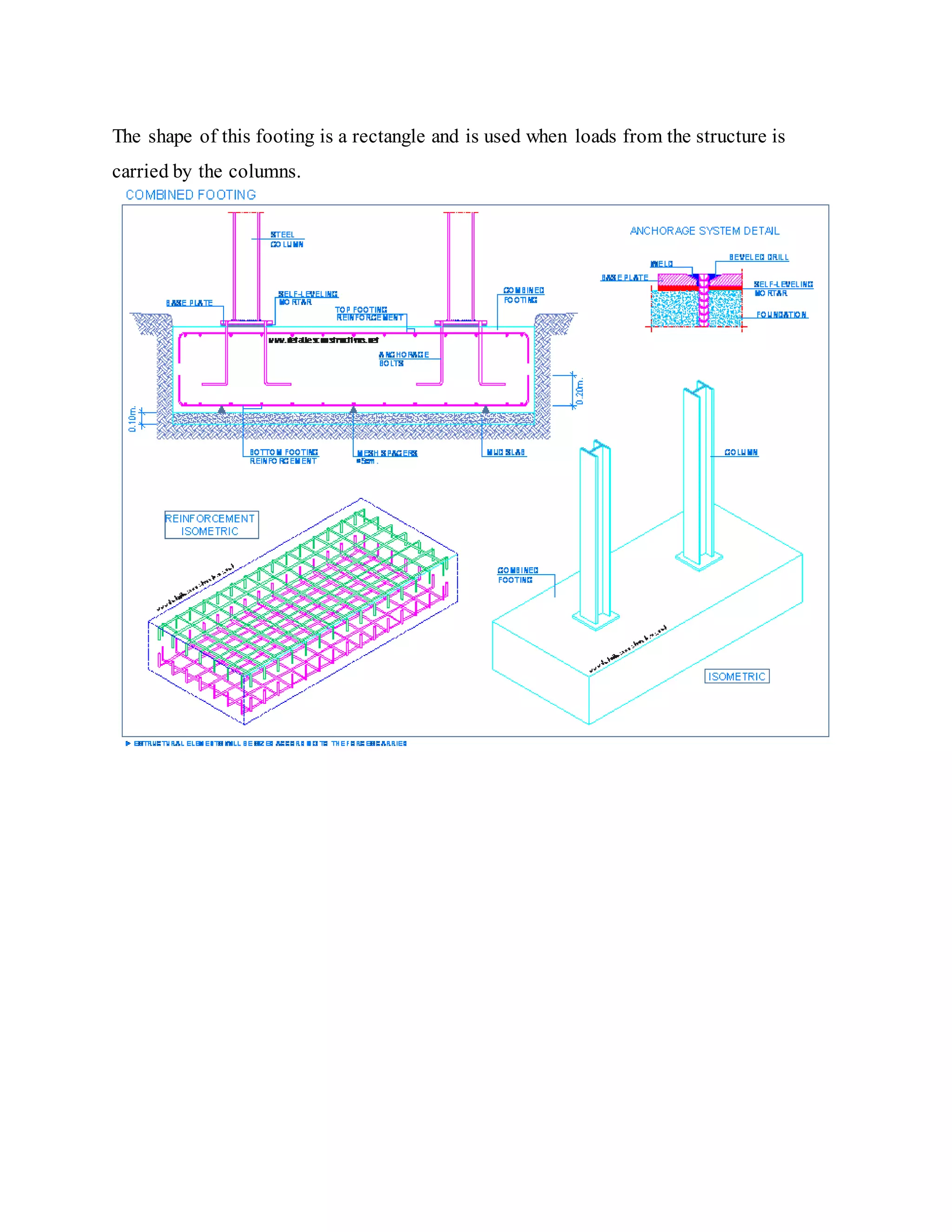
2. Combined Footing
Combined footing is constructed when two or more columns are close enough and their
isolated footings overlap each other. It is a combination of isolated footings, but their
structural design differs.
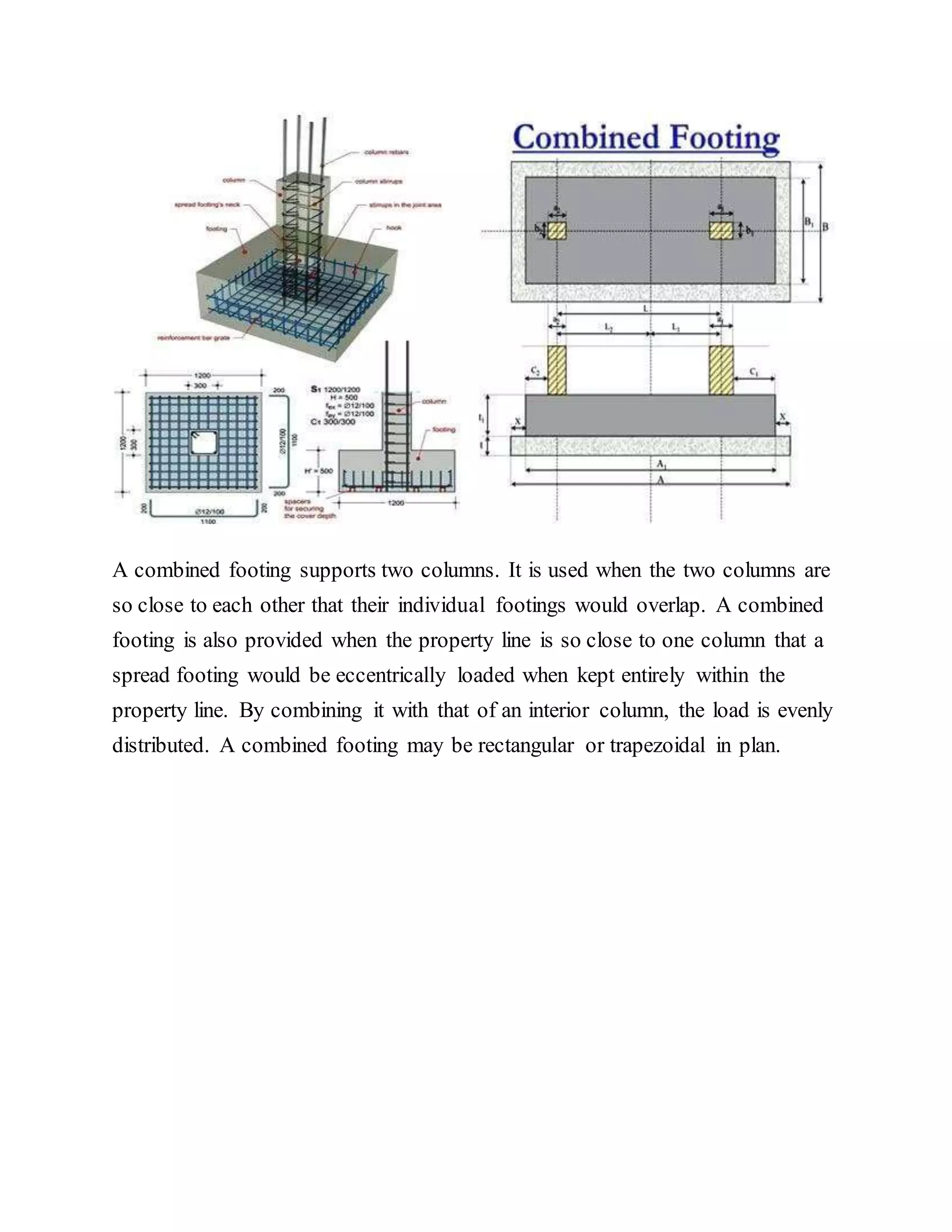
A combined footing supports two columns. It is used when the two columns are
so close to each other that their individual footings would overlap. A combined
footing is also provided when the property line is so close to one column that a
spread footing would be eccentrically loaded when kept entirely within the
property line. By combining it with that of an interior column, the load is evenly
distributed. A combined footing may be rectangular or trapezoidal in plan.
The shape of this footing is a rectangle and is used when loads from the structure is
carried by the columns.
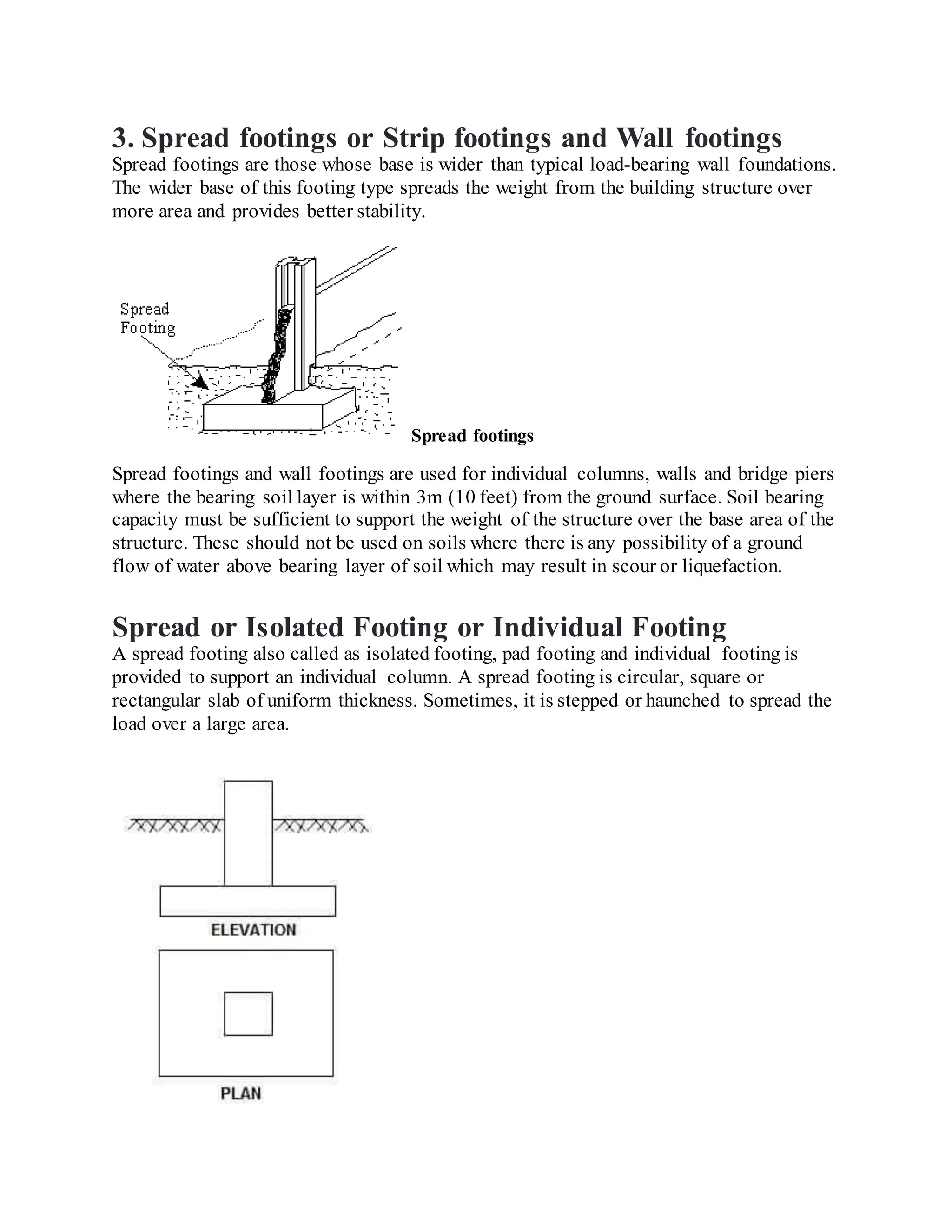
3. Spread footings or Strip footings and Wall footings
Spread footings are those whose base is wider than typical load-bearing wall foundations.
The wider base of this footing type spreads the weight from the building structure over
more area and provides better stability.
Spread footings
Spread footings and wall footings are used for individual columns, walls and bridge piers
where the bearing soil layer is within 3m (10 feet) from the ground surface. Soil bearing
capacity must be sufficient to support the weight of the structure over the base area of the
structure. These should not be used on soils where there is any possibility of a ground
flow of water above bearing layer of soil which may result in scour or liquefaction.
Spread or Isolated Footing or Individual Footing
A spread footing also called as isolated footing, pad footing and individual footing is
provided to support an individual column. A spread footing is circular, square or
rectangular slab of uniform thickness. Sometimes, it is stepped or haunched to spread the
load over a large area.
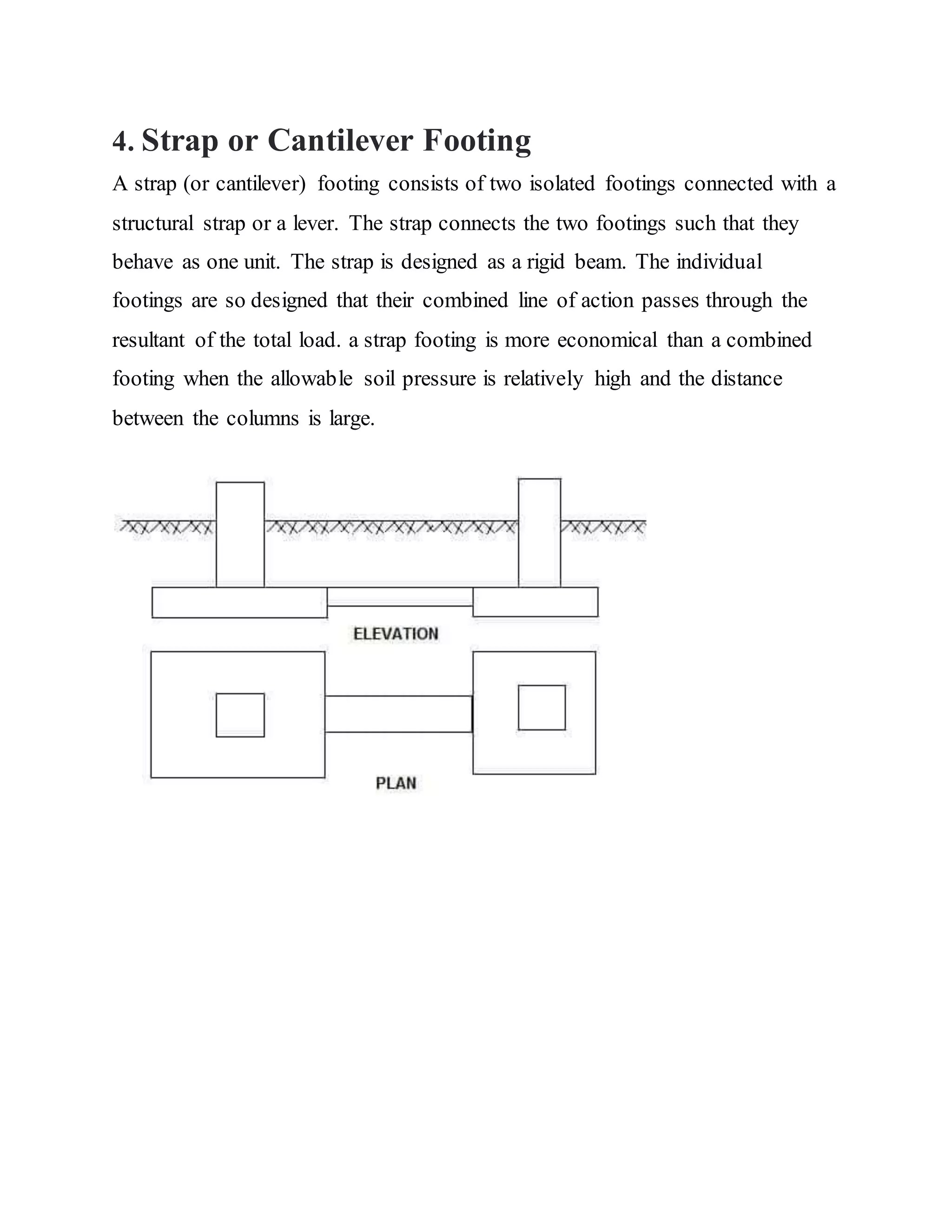
4. Strap or Cantilever Footing
A strap (or cantilever) footing consists of two isolated footings connected with a
structural strap or a lever. The strap connects the two footings such that they
behave as one unit. The strap is designed as a rigid beam. The individual
footings are so designed that their combined line of action passes through the
resultant of the total load. a strap footing is more economical than a combined
footing when the allowable soil pressure is relatively high and the distance
between the columns is large.
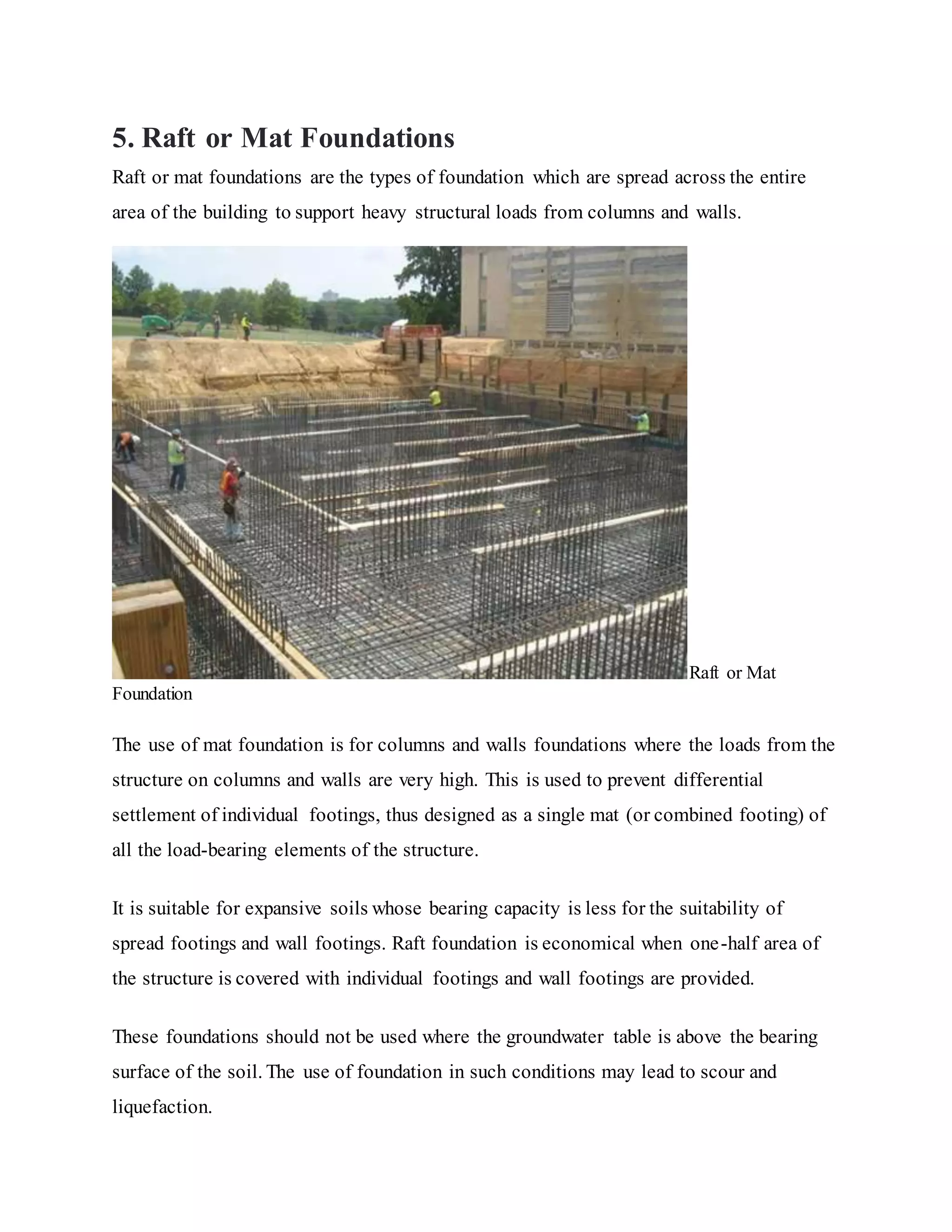
5. Raft or Mat Foundations
Raft or mat foundations are the types of foundation which are spread across the entire
area of the building to support heavy structural loads from columns and walls.
Raft or Mat
Foundation
The use of mat foundation is for columns and walls foundations where the loads from the
structure on columns and walls are very high. This is used to prevent differential
settlement of individual footings, thus designed as a single mat (or combined footing) of
all the load-bearing elements of the structure.
It is suitable for expansive soils whose bearing capacity is less for the suitability of
spread footings and wall footings. Raft foundation is economical when one-half area of
the structure is covered with individual footings and wall footings are provided.
These foundations should not be used where the groundwater table is above the bearing
surface of the soil. The use of foundation in such conditions may lead to scour and
liquefaction.
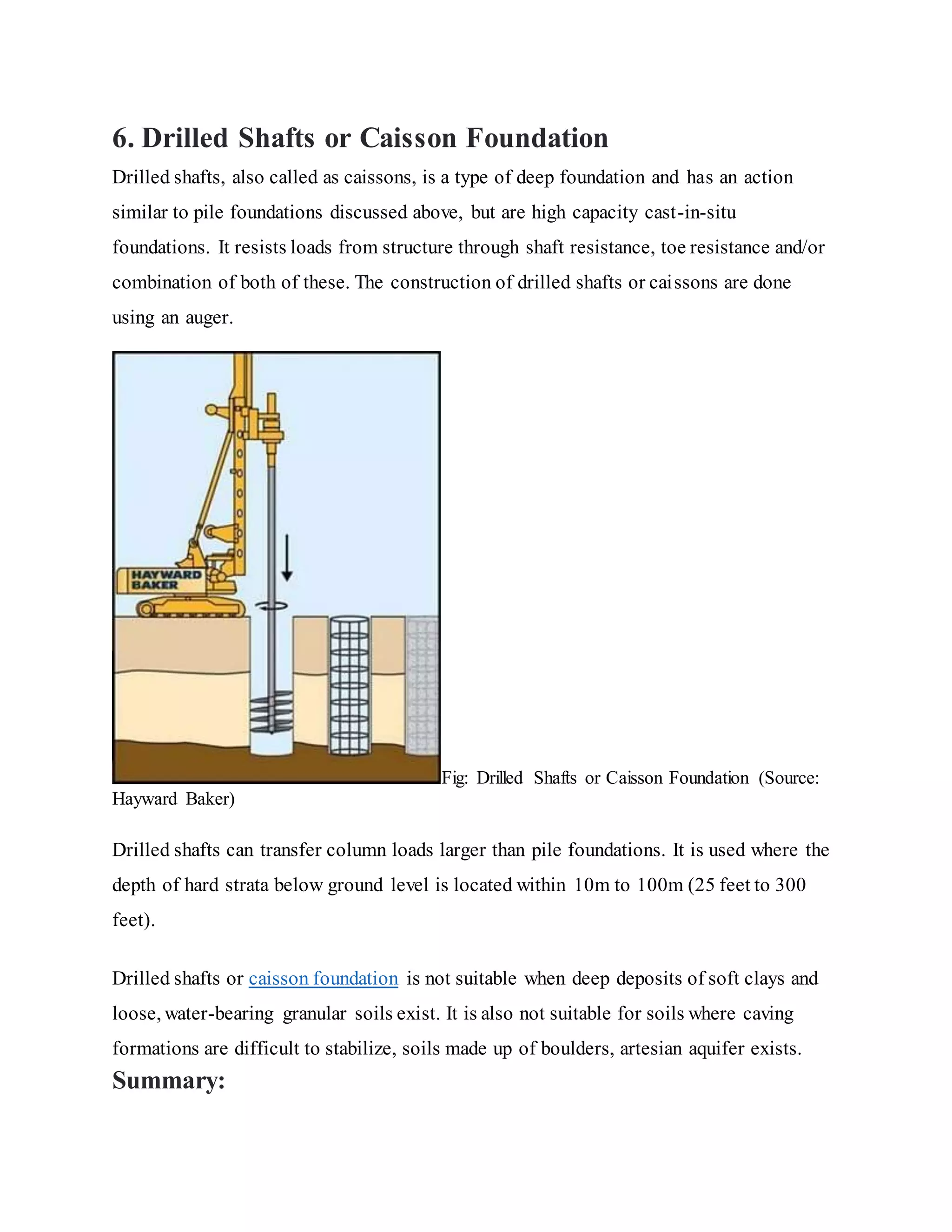
Types of Deep Foundation
5. Pile Foundations
Pile foundation is a type of deep foundation which is used to transfer heavy loads from
the structure to a hard rock strata much deep below the ground level.
Pile Foundation
Pile foundations are used to transfer heavy loads of structures through columns to hard
soil strata which is much below ground level where shallow foundations such as spread
footings and mat footings cannot be used. This is also used to prevent uplift of the
structure due to lateral loads such as earthquake and wind forces.
Read More on Deep Foundations
Pile foundations are generally used for soils where soil conditions near the ground
surface is not suitable for heavy loads. The depth of hard rock strata may be 5m to 50m
(15 feet to 150 feet) deep from the ground surface.
Pile foundation resists the loads from the structure by skin friction and by end bearing.
The use of pile foundations also prevents differential settlement of foundations.
Read More on Pile Foundation
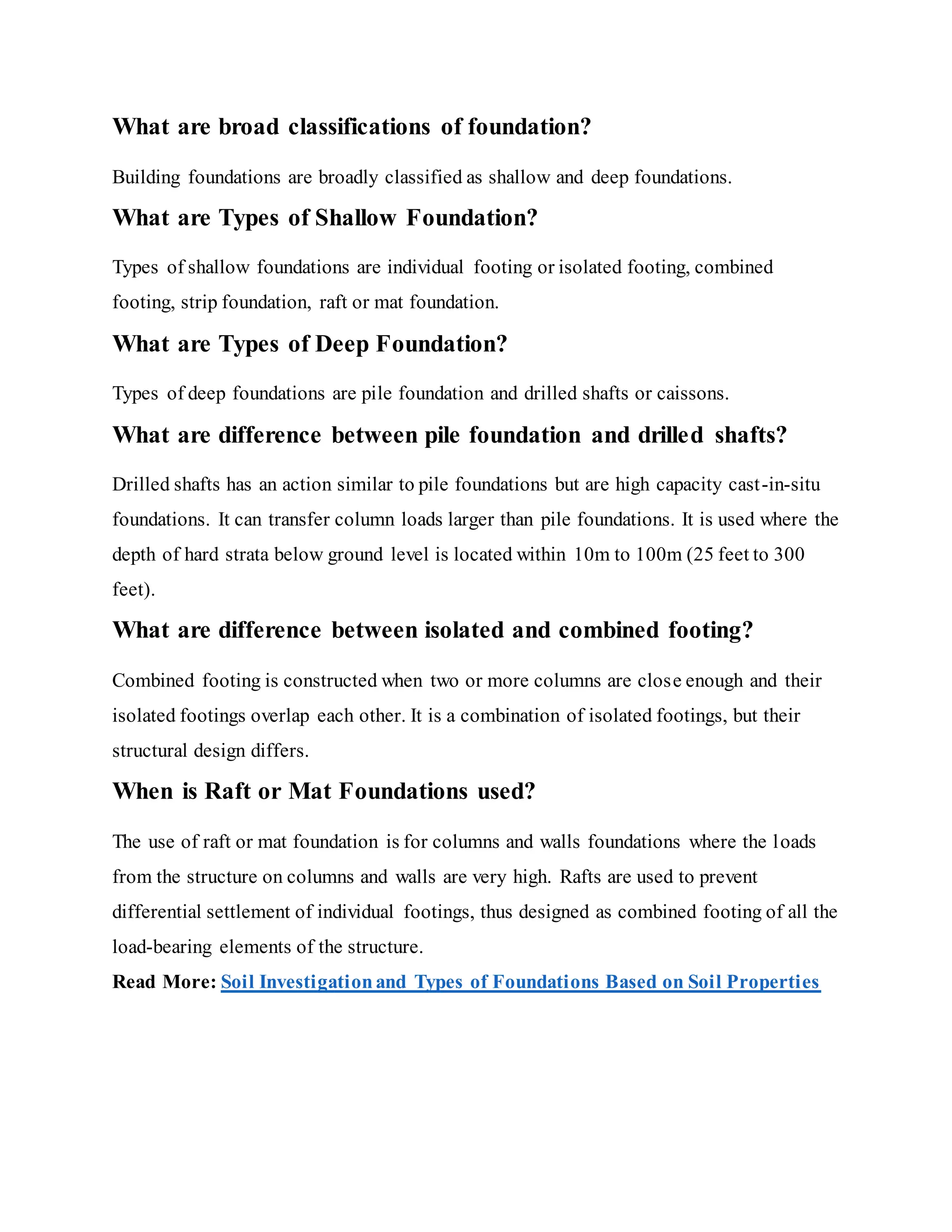
6. Drilled Shafts or Caisson Foundation
Drilled shafts, also called as caissons, is a type of deep foundation and has an action
similar to pile foundations discussed above, but are high capacity cast-in-situ
foundations. It resists loads from structure through shaft resistance, toe resistance and/or
combination of both of these. The construction of drilled shafts or caissons are done
using an auger.
Fig: Drilled Shafts or Caisson Foundation (Source:
Hayward Baker)
Drilled shafts can transfer column loads larger than pile foundations. It is used where the
depth of hard strata below ground level is located within 10m to 100m (25 feet to 300
feet).
Drilled shafts or caisson foundation is not suitable when deep deposits of soft clays and
loose, water-bearing granular soils exist. It is also not suitable for soils where caving
formations are difficult to stabilize, soils made up of boulders, artesian aquifer exists.
Summary:
What are broad classifications of foundation?
Building foundations are broadly classified as shallow and deep foundations.
What are Types of Shallow Foundation?
Types of shallow foundations are individual footing or isolated footing, combined
footing, strip foundation, raft or mat foundation.
What are Types of Deep Foundation?
Types of deep foundations are pile foundation and drilled shafts or caissons.
What are difference between pile foundation and drilled shafts?
Drilled shafts has an action similar to pile foundations but are high capacity cast-in-situ
foundations. It can transfer column loads larger than pile foundations. It is used where the
depth of hard strata below ground level is located within 10m to 100m (25 feet to 300
feet).
What are difference between isolated and combined footing?
Combined footing is constructed when two or more columns are close enough and their
isolated footings overlap each other. It is a combination of isolated footings, but their
structural design differs.
When is Raft or Mat Foundations used?
The use of raft or mat foundation is for columns and walls foundations where the loads
from the structure on columns and walls are very high. Rafts are used to prevent
differential settlement of individual footings, thus designed as combined footing of all the
load-bearing elements of the structure.
Read More: Soil Investigationand Types of Foundations Based on Soil Properties

Types of foundation and their uses

  • 1.
    Types of Foundationand their Uses Following are different types of foundations used in construction: 1. Shallow foundation o Individual footing or isolated footing o Combined footing o Strip foundation o Raft or mat foundation 2. DeepFoundation o Pile foundation o Drilled Shafts or caissons Types of Shallow Foundations 1. Individual Footing or Isolated Footing
  • 2.
    Individual footing oran isolated footing is the most common type of foundation used for building construction. This foundation is constructed for a single column and also called a pad foundation.
  • 3.
    The shape ofindividual footing is square or rectangle and is used when loads from the structure is carried by the columns. Size is calculated based on the load on the column and the safe bearing capacity of soil.
  • 4.
    Rectangular isolated footingis selectedwhen the foundation experiences moments due to the eccentricityof loads or due to horizontal forces. For example, Consider a column with a vertical load of 200 kN and a safe bearing capacity of 100 kN/m2 then the area of the footing required will be 200/100 = 2m2 . So, for a square footing, the length and width of the footing will be 1.414 m x 1.414 m.
  • 5.
    What is Torin steel? TOR STEEL: The technical term is Cold Twisted Deformed Steel Reinforcement Bar. Steel bars have surface deformation formed by twisting the steel after elongation. This imparts high yield strength to steel and provide proper bondage with concrete
  • 6.
    Rebar spacer A rebarspacer is a device that secures the reinforcing steel or "rebar" in reinforced concrete structures as the rebar is assembled in place prior to the final concrete pour. The spacers are left in place for the pour to keep the reinforcing in place, and become a permanent part of the structure.
  • 7.
    2. Combined Footing Combinedfooting is constructed when two or more columns are close enough and their isolated footings overlap each other. It is a combination of isolated footings, but their structural design differs.
  • 8.
    A combined footingsupports two columns. It is used when the two columns are so close to each other that their individual footings would overlap. A combined footing is also provided when the property line is so close to one column that a spread footing would be eccentrically loaded when kept entirely within the property line. By combining it with that of an interior column, the load is evenly distributed. A combined footing may be rectangular or trapezoidal in plan.
  • 9.
    The shape ofthis footing is a rectangle and is used when loads from the structure is carried by the columns.
  • 10.
    3. Spread footingsor Strip footings and Wall footings Spread footings are those whose base is wider than typical load-bearing wall foundations. The wider base of this footing type spreads the weight from the building structure over more area and provides better stability. Spread footings Spread footings and wall footings are used for individual columns, walls and bridge piers where the bearing soil layer is within 3m (10 feet) from the ground surface. Soil bearing capacity must be sufficient to support the weight of the structure over the base area of the structure. These should not be used on soils where there is any possibility of a ground flow of water above bearing layer of soil which may result in scour or liquefaction. Spread or Isolated Footing or Individual Footing A spread footing also called as isolated footing, pad footing and individual footing is provided to support an individual column. A spread footing is circular, square or rectangular slab of uniform thickness. Sometimes, it is stepped or haunched to spread the load over a large area.
  • 11.
    4. Strap orCantilever Footing A strap (or cantilever) footing consists of two isolated footings connected with a structural strap or a lever. The strap connects the two footings such that they behave as one unit. The strap is designed as a rigid beam. The individual footings are so designed that their combined line of action passes through the resultant of the total load. a strap footing is more economical than a combined footing when the allowable soil pressure is relatively high and the distance between the columns is large.
  • 12.
    5. Raft orMat Foundations Raft or mat foundations are the types of foundation which are spread across the entire area of the building to support heavy structural loads from columns and walls. Raft or Mat Foundation The use of mat foundation is for columns and walls foundations where the loads from the structure on columns and walls are very high. This is used to prevent differential settlement of individual footings, thus designed as a single mat (or combined footing) of all the load-bearing elements of the structure. It is suitable for expansive soils whose bearing capacity is less for the suitability of spread footings and wall footings. Raft foundation is economical when one-half area of the structure is covered with individual footings and wall footings are provided. These foundations should not be used where the groundwater table is above the bearing surface of the soil. The use of foundation in such conditions may lead to scour and liquefaction.
  • 13.
    Types of DeepFoundation 5. Pile Foundations Pile foundation is a type of deep foundation which is used to transfer heavy loads from the structure to a hard rock strata much deep below the ground level. Pile Foundation Pile foundations are used to transfer heavy loads of structures through columns to hard soil strata which is much below ground level where shallow foundations such as spread footings and mat footings cannot be used. This is also used to prevent uplift of the structure due to lateral loads such as earthquake and wind forces. Read More on Deep Foundations Pile foundations are generally used for soils where soil conditions near the ground surface is not suitable for heavy loads. The depth of hard rock strata may be 5m to 50m (15 feet to 150 feet) deep from the ground surface. Pile foundation resists the loads from the structure by skin friction and by end bearing. The use of pile foundations also prevents differential settlement of foundations. Read More on Pile Foundation
  • 14.
    6. Drilled Shaftsor Caisson Foundation Drilled shafts, also called as caissons, is a type of deep foundation and has an action similar to pile foundations discussed above, but are high capacity cast-in-situ foundations. It resists loads from structure through shaft resistance, toe resistance and/or combination of both of these. The construction of drilled shafts or caissons are done using an auger. Fig: Drilled Shafts or Caisson Foundation (Source: Hayward Baker) Drilled shafts can transfer column loads larger than pile foundations. It is used where the depth of hard strata below ground level is located within 10m to 100m (25 feet to 300 feet). Drilled shafts or caisson foundation is not suitable when deep deposits of soft clays and loose, water-bearing granular soils exist. It is also not suitable for soils where caving formations are difficult to stabilize, soils made up of boulders, artesian aquifer exists. Summary:
  • 15.
    What are broadclassifications of foundation? Building foundations are broadly classified as shallow and deep foundations. What are Types of Shallow Foundation? Types of shallow foundations are individual footing or isolated footing, combined footing, strip foundation, raft or mat foundation. What are Types of Deep Foundation? Types of deep foundations are pile foundation and drilled shafts or caissons. What are difference between pile foundation and drilled shafts? Drilled shafts has an action similar to pile foundations but are high capacity cast-in-situ foundations. It can transfer column loads larger than pile foundations. It is used where the depth of hard strata below ground level is located within 10m to 100m (25 feet to 300 feet). What are difference between isolated and combined footing? Combined footing is constructed when two or more columns are close enough and their isolated footings overlap each other. It is a combination of isolated footings, but their structural design differs. When is Raft or Mat Foundations used? The use of raft or mat foundation is for columns and walls foundations where the loads from the structure on columns and walls are very high. Rafts are used to prevent differential settlement of individual footings, thus designed as combined footing of all the load-bearing elements of the structure. Read More: Soil Investigationand Types of Foundations Based on Soil Properties