Deep foundation

Hamzah ali
b.arch. 3rd year
FOUNDATION
The part of a structure which is below the ground
and transmits all the loads from the super
structure
to the ground.
Foundations are broadly classified into two types:
 Shallow foundation
 Deep foundation
Shallow foundation
• Shallow foundations are those founded near to the finished ground
surface; generally where the founding depth is less than the width of
the footing and less than 3m.

• Shallows foundations are used when surface soils are sufficiently
strong and stiff to support the imposed loads; they are generally
unsuitable in weak or highly compressible soils, such as poorlycompacted fill, peat and alluvial deposits, etc.
Deep foundation
• Deep foundations are those founding too deeply below the finished
ground surface for their base bearing capacity to be affected by
surface conditions, this is usually at depths >3 m below finished
ground level.
Deep foundations are used when there are weak (“bad”) soils near
the surface or when loads are very high, such as very large
skyscrapers.
Deep foundations derive their support from deeper soils or bedrock.
Pile foundation
Pile foundations are the part of a structure used to carry and
transfer the load of the structure to the bearing ground located at
some depth below ground surface.
The main components of the foundation are the pile cap and the
piles.
Piles are long and slender members which transfer the load to
deeper soil or rock of high bearing capacity avoiding shallow soil of
low bearing capacity.
Pile caps are thick slabs used to tie a group of piles together to
support and transmit column loads to the piles.
Pile foundation
Advantages of pile foundation:
 Pile foundations are frequently needed because of the relative
inability of shallow footings to resist inclined, lateral, or uplift loads
and overturning moments.
 Pile foundations are used in areas of expansive or collapsible soils
to resist undesirable seasonal movements of the foundations.
types of pile

Displacement
piles
piles
Replacement
piles

Steel pile ,
concrete spun
piles etc.
Timber piles,
precast RC
pile etc.
Bored piles
types of pile
Displacement Piles
Piles which are driven are termed ‘Displacement Piles’ because their
installation methods displace laterally the soils through which they
are introduced.
Replacement Piles
Piles that are formed by creating a borehole into which the pile is
then cast or placed, are referred to as ‘Replacement Piles’ because
existing material, usually soil, is removed as part of the process.
Installation techniques
Dropping weight
The dropping weight or drop hammer is the most commonly used
method of insertion of displacement piles. A weight approximately
half that of the pile is raised a suitable distance in a guide and
released to strike the pile head.
Diesel hammer
Rapid controlled explosions can be produced by the diesel hammer.
The explosions raise a ram which is used to drive the pile into the
ground.
Installation techniques
• VIBRATORY METHODS can prove to be very effective in driving
piles through non cohesive granular soils. The vibration of the pile
excites the soil grains adjacent to the pile making the soil almost
free flowing thus significantly reducing friction along the pile shaft.
• JACKING PILES are the most commonly used methods in
underpinning existing structures. By excavating underneath a
structure short lengths of pile can be inserted and jacked into the
ground.
Types of Pile
Pre Cast Pile
R.C. Square/Round Piles
Size :150mm to 400mm
Lengths :3m, 6m, 9m and 12m
Structural Capacity :
25Ton to 185Ton
Joints : Welded
Installation Method :
Drop Hammer
Jack-In
Types of Pile
Pre-stressed Concrete Spun Piles









Size :
250mm to 1000mm
Lengths :
6m, 9m and 12m (Typical)
Structural Capacity :
45Ton to 520Ton
Joints: Welded
Installation Method :
Drop Hammer
Jack-In
Types of Pile
Advantage of Pre Cast /Pre Stress Piles…..
 Better Bending Resistance

 Higher Axial Capacity
 Better Manufacturing Quality
 Able to maintain Higher Driving Stresses

 Higher Tensile Capacity
 Similar cost as RC Square Piles
Types of Pile
Steel H Piles
• Size :200mm to 400m
• Lengths : 6m and 12m
• Structural Capacity :40-1000ton
• Joints: Welded
• Installation Method :
• Hydraulic Hammer
• Jack-In
Types of Pile
 Bored pile is another type of reinforced concrete pile which is used to support high
building and bridge work which has heavy vertical load.
 Bored pile is a cast-in-place concrete pile where the bored piles have to be cast on
construction site, while other concrete piles like Spun Pile and Reinforced Concrete
Square Pile are precast concrete pile which they’re cast in the factory.


it can be drilled upto 50metres depth of soil.

 The advantage of bored piling is its’ drilling method, little vibration and lower noise
level.
Types of Pile
Bored Piles
• Size : 450mm to 2m
• Lengths :

Varies

• Structural Capacity :
80Ton to 2,300Tons
• Installation Method :
Drill then Cast-In-Situ
Types of Pile
Wood piles :
Advantages
The piles are easy to handle and relatively
inexpensive.
Sections can be joined together and excess length
easily removed.
Disadvantages
The piles will rot above the ground water level. Have a limited
bearing capacity.
Can easily be damaged during driving by stones and
boulders.
The piles are difficult to splice and are attacked by marine borers in
salt water.
Types of Pile
End bearing piles
End bearing piles are
those which terminate
in hard, relatively
impenetrable material such
as rock or very dense sand
and gravel. They derive most
of their carrying capacity
from the resistance of the stratum
at the toe of the pile.
Types of Pile
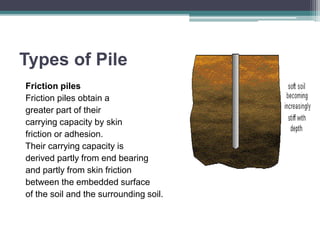
Friction piles
Friction piles obtain a
greater part of their
carrying capacity by skin
friction or adhesion.
Their carrying capacity is
derived partly from end bearing
and partly from skin friction
between the embedded surface
of the soil and the surrounding soil.
Types of Pile
Settlement reducing piles:
Settlement reducing piles
are usually incorporated
beneath the central part of
a raft foundation in order to
reduce differential settlement
to an acceptable level.
Such piles act to reinforce
the soil beneath the raft.
Types of Pile
Piles in fill:
Piles that pass through
layers of moderately- to
poorly-compacted fill will be
affected by negative skin friction,
which produces a downward drag
along the pile shaft and therefore
an additional load on the pile.

Deep foundation

  • 1.
  • 2.
    FOUNDATION The part ofa structure which is below the ground and transmits all the loads from the super structure to the ground. Foundations are broadly classified into two types:  Shallow foundation  Deep foundation
  • 3.
    Shallow foundation • Shallowfoundations are those founded near to the finished ground surface; generally where the founding depth is less than the width of the footing and less than 3m. • Shallows foundations are used when surface soils are sufficiently strong and stiff to support the imposed loads; they are generally unsuitable in weak or highly compressible soils, such as poorlycompacted fill, peat and alluvial deposits, etc.
  • 4.
    Deep foundation • Deepfoundations are those founding too deeply below the finished ground surface for their base bearing capacity to be affected by surface conditions, this is usually at depths >3 m below finished ground level. Deep foundations are used when there are weak (“bad”) soils near the surface or when loads are very high, such as very large skyscrapers. Deep foundations derive their support from deeper soils or bedrock.
  • 5.
    Pile foundation Pile foundationsare the part of a structure used to carry and transfer the load of the structure to the bearing ground located at some depth below ground surface. The main components of the foundation are the pile cap and the piles. Piles are long and slender members which transfer the load to deeper soil or rock of high bearing capacity avoiding shallow soil of low bearing capacity. Pile caps are thick slabs used to tie a group of piles together to support and transmit column loads to the piles.
  • 6.
    Pile foundation Advantages ofpile foundation:  Pile foundations are frequently needed because of the relative inability of shallow footings to resist inclined, lateral, or uplift loads and overturning moments.  Pile foundations are used in areas of expansive or collapsible soils to resist undesirable seasonal movements of the foundations.
  • 7.
    types of pile Displacement piles piles Replacement piles Steelpile , concrete spun piles etc. Timber piles, precast RC pile etc. Bored piles
  • 8.
    types of pile DisplacementPiles Piles which are driven are termed ‘Displacement Piles’ because their installation methods displace laterally the soils through which they are introduced. Replacement Piles Piles that are formed by creating a borehole into which the pile is then cast or placed, are referred to as ‘Replacement Piles’ because existing material, usually soil, is removed as part of the process.
  • 9.
    Installation techniques Dropping weight Thedropping weight or drop hammer is the most commonly used method of insertion of displacement piles. A weight approximately half that of the pile is raised a suitable distance in a guide and released to strike the pile head. Diesel hammer Rapid controlled explosions can be produced by the diesel hammer. The explosions raise a ram which is used to drive the pile into the ground.
  • 10.
    Installation techniques • VIBRATORYMETHODS can prove to be very effective in driving piles through non cohesive granular soils. The vibration of the pile excites the soil grains adjacent to the pile making the soil almost free flowing thus significantly reducing friction along the pile shaft. • JACKING PILES are the most commonly used methods in underpinning existing structures. By excavating underneath a structure short lengths of pile can be inserted and jacked into the ground.
  • 11.
    Types of Pile PreCast Pile R.C. Square/Round Piles Size :150mm to 400mm Lengths :3m, 6m, 9m and 12m Structural Capacity : 25Ton to 185Ton Joints : Welded Installation Method : Drop Hammer Jack-In
  • 12.
    Types of Pile Pre-stressedConcrete Spun Piles         Size : 250mm to 1000mm Lengths : 6m, 9m and 12m (Typical) Structural Capacity : 45Ton to 520Ton Joints: Welded Installation Method : Drop Hammer Jack-In
  • 13.
    Types of Pile Advantageof Pre Cast /Pre Stress Piles…..  Better Bending Resistance  Higher Axial Capacity  Better Manufacturing Quality  Able to maintain Higher Driving Stresses  Higher Tensile Capacity  Similar cost as RC Square Piles
  • 14.
    Types of Pile SteelH Piles • Size :200mm to 400m • Lengths : 6m and 12m • Structural Capacity :40-1000ton • Joints: Welded • Installation Method : • Hydraulic Hammer • Jack-In
  • 15.
    Types of Pile Bored pile is another type of reinforced concrete pile which is used to support high building and bridge work which has heavy vertical load.  Bored pile is a cast-in-place concrete pile where the bored piles have to be cast on construction site, while other concrete piles like Spun Pile and Reinforced Concrete Square Pile are precast concrete pile which they’re cast in the factory.  it can be drilled upto 50metres depth of soil.  The advantage of bored piling is its’ drilling method, little vibration and lower noise level.
  • 16.
    Types of Pile BoredPiles • Size : 450mm to 2m • Lengths : Varies • Structural Capacity : 80Ton to 2,300Tons • Installation Method : Drill then Cast-In-Situ
  • 17.
    Types of Pile Woodpiles : Advantages The piles are easy to handle and relatively inexpensive. Sections can be joined together and excess length easily removed. Disadvantages The piles will rot above the ground water level. Have a limited bearing capacity. Can easily be damaged during driving by stones and boulders. The piles are difficult to splice and are attacked by marine borers in salt water.
  • 18.
    Types of Pile Endbearing piles End bearing piles are those which terminate in hard, relatively impenetrable material such as rock or very dense sand and gravel. They derive most of their carrying capacity from the resistance of the stratum at the toe of the pile.
  • 19.
    Types of Pile Frictionpiles Friction piles obtain a greater part of their carrying capacity by skin friction or adhesion. Their carrying capacity is derived partly from end bearing and partly from skin friction between the embedded surface of the soil and the surrounding soil.
  • 20.
    Types of Pile Settlementreducing piles: Settlement reducing piles are usually incorporated beneath the central part of a raft foundation in order to reduce differential settlement to an acceptable level. Such piles act to reinforce the soil beneath the raft.
  • 21.
    Types of Pile Pilesin fill: Piles that pass through layers of moderately- to poorly-compacted fill will be affected by negative skin friction, which produces a downward drag along the pile shaft and therefore an additional load on the pile.