SURVEYING
SETTING OUT WORKS:- BRIDGES
PREPARED BY:- Waseem Raja
CONTENT...
 General introduction.
 Bridge.
 Setting out of bridge.
Setting Out:-
 It is a process of transferring the distance from the
plan already prepared, to the ground before starting
the construction. The plan as designed and prepared is
set out on the ground in the correct position.
 Setting out in a sense, is a reverse of the conventional
surveying plans are prepared by the designer using the
data from the site. While, in setting out the plans and
designs prepared by the designer are transffered
accurately onto the site.
Bridge
 A bridge is a structure built to span physical obstacles
without closing the way underneath such as a body of
water, valley, or road, for the purpose of providing passage
over the obstacle. There are many different designs that
each serve a particular purpose and apply to different
situations. Designs of bridges vary depending on the
function of the bridge, the nature of the terrain where the
bridge is constructed and anchored, the material used to
make it, and the funds available to build it.
Surveys
 Bridge surveying is necessary to locate a site, obtain
information for design, and furnish lines and grades for
construction. A reconnaissance survey is made at all
possible sites. A preliminary survey is made at the best site
to establish horizontal and vertical control and to obtain
information for the bridge design and construction
planning. A location survey is made to lay out the bridge
according to the bridge plans. During the actual
construction, the surveyor establishes any additional lines
and grades required by the construction foreman.
 The accuracy of measurements and the number and
type of survey markers vary with the degree of
precision demanded and the type of construction.
Variations may range from hand-level and sketch
board work for a tactical bridge to precise
measurements for a prefabricated steel bridge.
Setting out of bridges
 Setting out of structures like culverts is quite simple,
because there is only one span and also the flow of
water is less. Even if the flow of water is much, it
maybe easily diverted. But in case of bridges , the flow
of water can not be diverted. Also the bridge maybe
very long having more than one spans. Therefore, the
setting out of bridge involves:-
 Determination of length of the centre line.
 Determination of location of piers.
Determination of length of centre line
 The length of the centre line of a short bridge maybe
measured directly with the standard steel tape. But in
case of a long bridge the length is usually determined
by triangulation.
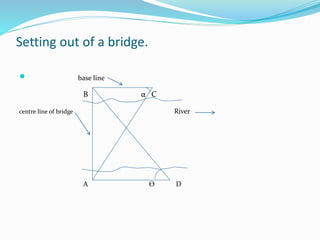
 Let A and B be the end points on centre line on ether
bank of the river and if it is required to determine the
length AB.
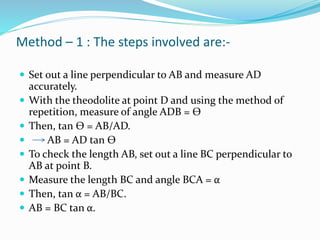
Method – 1 : The steps involved are:-
 Set out a line perpendicular to AB and measure AD
accurately.
 With the theodolite at point D and using the method of
repetition, measure of angle ADB = Ѳ
 Then, tan Ѳ = AB/AD.
 AB = AD tan Ѳ
 To check the length AB, set out a line BC perpendicular to
AB at point B.
 Measure the length BC and angle BCA = α
 Then, tan α = AB/BC.
 AB = BC tan α.
.
 If two distances are almost equal the mean of the two
is taken as the length of the centre line, otherwise the
procedure is repeated.
Setting out of a bridge.
 base line
B α C
centre line of bridge River
A Ѳ D
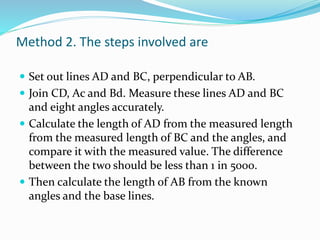
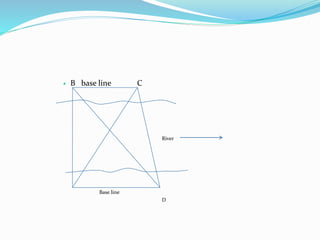
Method 2. The steps involved are
 Set out lines AD and BC, perpendicular to AB.
 Join CD, Ac and Bd. Measure these lines AD and BC
and eight angles accurately.
 Calculate the length of AD from the measured length
from the measured length of BC and the angles, and
compare it with the measured value. The difference
between the two should be less than 1 in 5000.
 Then calculate the length of AB from the known
angles and the base lines.
.
 B base line C
River
Base line
D
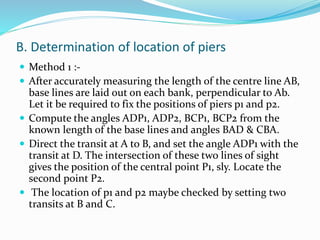
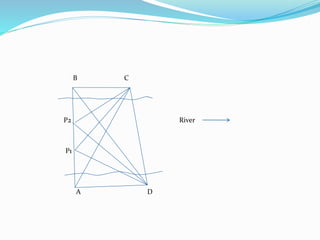
B. Determination of location of piers
 Method 1 :-
 After accurately measuring the length of the centre line AB,
base lines are laid out on each bank, perpendicular to Ab.
Let it be required to fix the positions of piers p1 and p2.
 Compute the angles ADP1, ADP2, BCP1, BCP2 from the
known length of the base lines and angles BAD & CBA.
 Direct the transit at A to B, and set the angle ADP1 with the
transit at D. The intersection of these two lines of sight
gives the position of the central point P1, sly. Locate the
second point P2.
 The location of p1 and p2 maybe checked by setting two
transits at B and C.
.
B C
P2 River
P1
A D
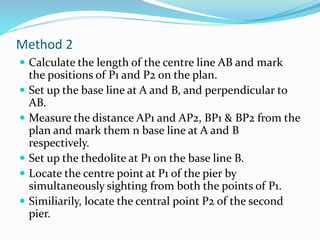
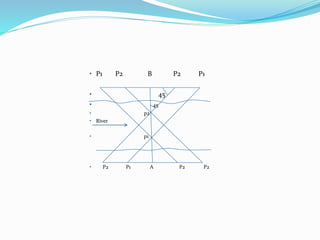
Method 2
 Calculate the length of the centre line AB and mark
the positions of P1 and P2 on the plan.
 Set up the base line at A and B, and perpendicular to
AB.
 Measure the distance AP1 and AP2, BP1 & BP2 from the
plan and mark them n base line at A and B
respectively.
 Set up the thedolite at P1 on the base line B.
 Locate the centre point at P1 of the pier by
simultaneously sighting from both the points of P1.
 Similiarily, locate the central point P2 of the second
pier.
.
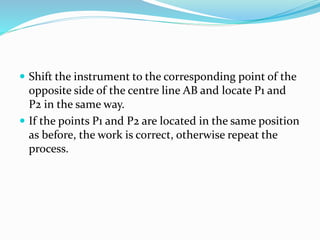
 Shift the instrument to the corresponding point of the
opposite side of the centre line AB and locate P1 and
P2 in the same way.
 If the points P1 and P2 are located in the same position
as before, the work is correct, otherwise repeat the
process.
.
• P1 P2 B P2 P1
• 45
• 45
• p2
• River
• p1
• P2 P1 A P2 P2
.
THANK YOU 

Setting out of bridges

  • 1.
    SURVEYING SETTING OUT WORKS:-BRIDGES PREPARED BY:- Waseem Raja
  • 2.
    CONTENT...  General introduction. Bridge.  Setting out of bridge.
  • 3.
    Setting Out:-  Itis a process of transferring the distance from the plan already prepared, to the ground before starting the construction. The plan as designed and prepared is set out on the ground in the correct position.  Setting out in a sense, is a reverse of the conventional surveying plans are prepared by the designer using the data from the site. While, in setting out the plans and designs prepared by the designer are transffered accurately onto the site.
  • 4.
    Bridge  A bridgeis a structure built to span physical obstacles without closing the way underneath such as a body of water, valley, or road, for the purpose of providing passage over the obstacle. There are many different designs that each serve a particular purpose and apply to different situations. Designs of bridges vary depending on the function of the bridge, the nature of the terrain where the bridge is constructed and anchored, the material used to make it, and the funds available to build it.
  • 5.
    Surveys  Bridge surveyingis necessary to locate a site, obtain information for design, and furnish lines and grades for construction. A reconnaissance survey is made at all possible sites. A preliminary survey is made at the best site to establish horizontal and vertical control and to obtain information for the bridge design and construction planning. A location survey is made to lay out the bridge according to the bridge plans. During the actual construction, the surveyor establishes any additional lines and grades required by the construction foreman.
  • 6.
     The accuracyof measurements and the number and type of survey markers vary with the degree of precision demanded and the type of construction. Variations may range from hand-level and sketch board work for a tactical bridge to precise measurements for a prefabricated steel bridge.
  • 7.
    Setting out ofbridges  Setting out of structures like culverts is quite simple, because there is only one span and also the flow of water is less. Even if the flow of water is much, it maybe easily diverted. But in case of bridges , the flow of water can not be diverted. Also the bridge maybe very long having more than one spans. Therefore, the setting out of bridge involves:-
  • 8.
     Determination oflength of the centre line.  Determination of location of piers.
  • 9.
    Determination of lengthof centre line  The length of the centre line of a short bridge maybe measured directly with the standard steel tape. But in case of a long bridge the length is usually determined by triangulation.  Let A and B be the end points on centre line on ether bank of the river and if it is required to determine the length AB.
  • 10.
    Method – 1: The steps involved are:-  Set out a line perpendicular to AB and measure AD accurately.  With the theodolite at point D and using the method of repetition, measure of angle ADB = Ѳ  Then, tan Ѳ = AB/AD.  AB = AD tan Ѳ  To check the length AB, set out a line BC perpendicular to AB at point B.  Measure the length BC and angle BCA = α  Then, tan α = AB/BC.  AB = BC tan α.
  • 11.
    .  If twodistances are almost equal the mean of the two is taken as the length of the centre line, otherwise the procedure is repeated.
  • 12.
    Setting out ofa bridge.  base line B α C centre line of bridge River A Ѳ D
  • 13.
    Method 2. Thesteps involved are  Set out lines AD and BC, perpendicular to AB.  Join CD, Ac and Bd. Measure these lines AD and BC and eight angles accurately.  Calculate the length of AD from the measured length from the measured length of BC and the angles, and compare it with the measured value. The difference between the two should be less than 1 in 5000.  Then calculate the length of AB from the known angles and the base lines.
  • 14.
    .  B baseline C River Base line D
  • 15.
    B. Determination oflocation of piers  Method 1 :-  After accurately measuring the length of the centre line AB, base lines are laid out on each bank, perpendicular to Ab. Let it be required to fix the positions of piers p1 and p2.  Compute the angles ADP1, ADP2, BCP1, BCP2 from the known length of the base lines and angles BAD & CBA.  Direct the transit at A to B, and set the angle ADP1 with the transit at D. The intersection of these two lines of sight gives the position of the central point P1, sly. Locate the second point P2.  The location of p1 and p2 maybe checked by setting two transits at B and C.
  • 16.
  • 17.
    Method 2  Calculatethe length of the centre line AB and mark the positions of P1 and P2 on the plan.  Set up the base line at A and B, and perpendicular to AB.  Measure the distance AP1 and AP2, BP1 & BP2 from the plan and mark them n base line at A and B respectively.  Set up the thedolite at P1 on the base line B.  Locate the centre point at P1 of the pier by simultaneously sighting from both the points of P1.  Similiarily, locate the central point P2 of the second pier.
  • 18.
    .  Shift theinstrument to the corresponding point of the opposite side of the centre line AB and locate P1 and P2 in the same way.  If the points P1 and P2 are located in the same position as before, the work is correct, otherwise repeat the process.
  • 19.
    . • P1 P2B P2 P1 • 45 • 45 • p2 • River • p1 • P2 P1 A P2 P2
  • 20.