
Author: Surajit Deb (University of Delhi, India)
Presenter: Marianna Papakonstantinou
(University of Groningen, The Netherlands)
IARIW 2014, Rotterdam, The Netherlands
Session: Labour Supply and Human Capital
Can Economic Growth Transform into
Human Capabilities in India?
Where do we Stand?
 Starting point: Importance of economic growth in poor
countries.
 Poverty reduction.
 Improvements in HDIs (e.g. health, education, social inclusion).
 But, there is also a different view. Capabilities approach:
 Is economic growth sufficient for progress in living conditions?
 Mixed evidence.
 This paper:
 Does economic growth correlate with human capability (e.g.
health, education, living conditions, quality of life)?
 Looking at state-level data in India.
Some Facts for India
 High growth and increases in real income (also, at the state-
level).
 But:
 Lagging in terms of social indicators (e.g. schooling, health
care, water, sanitation).
 Ranked 136th (out of 186 countries) in HDI.
Research Objectives
 Does economic growth correlate with different dimensions of
human capability?
 Level of analysis: 29 Indian states.
1. Construct 4 human capability dimensions.
a) Longevity and health;
b) Education;
c) Living conditions; and
d) Livelihood security.
2. Construct an aggregate index of human capability (captures
quality of life).
3. Examine the correlation between economic growth and
human capabilities in a cross-sectional framework.
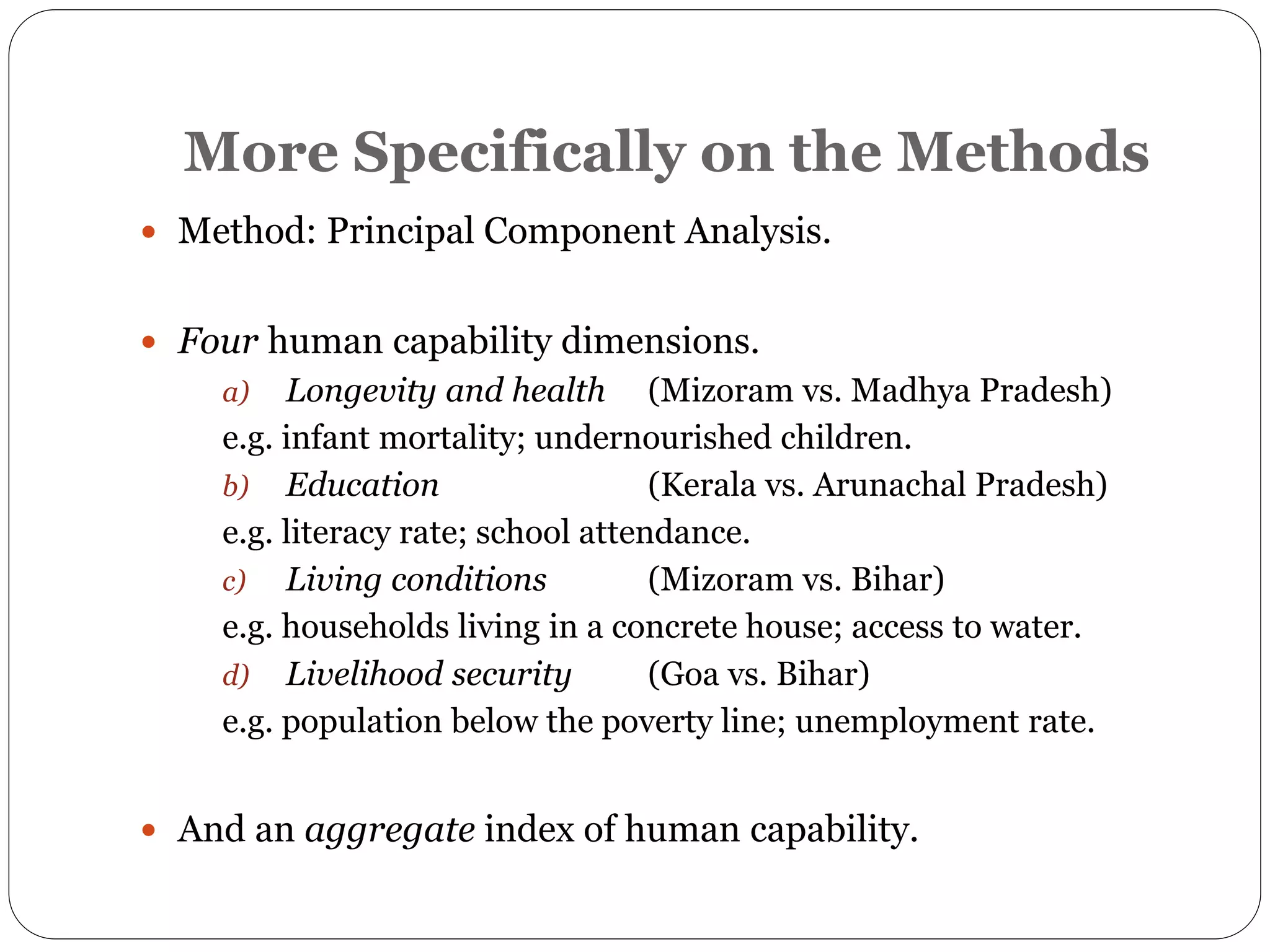
More Specifically on the Methods
 Method: Principal Component Analysis.
 Four human capability dimensions.
a) Longevity and health (Mizoram vs. Madhya Pradesh)
e.g. infant mortality; undernourished children.
b) Education (Kerala vs. Arunachal Pradesh)
e.g. literacy rate; school attendance.
c) Living conditions (Mizoram vs. Bihar)
e.g. households living in a concrete house; access to water.
d) Livelihood security (Goa vs. Bihar)
e.g. population below the poverty line; unemployment rate.
 And an aggregate index of human capability.
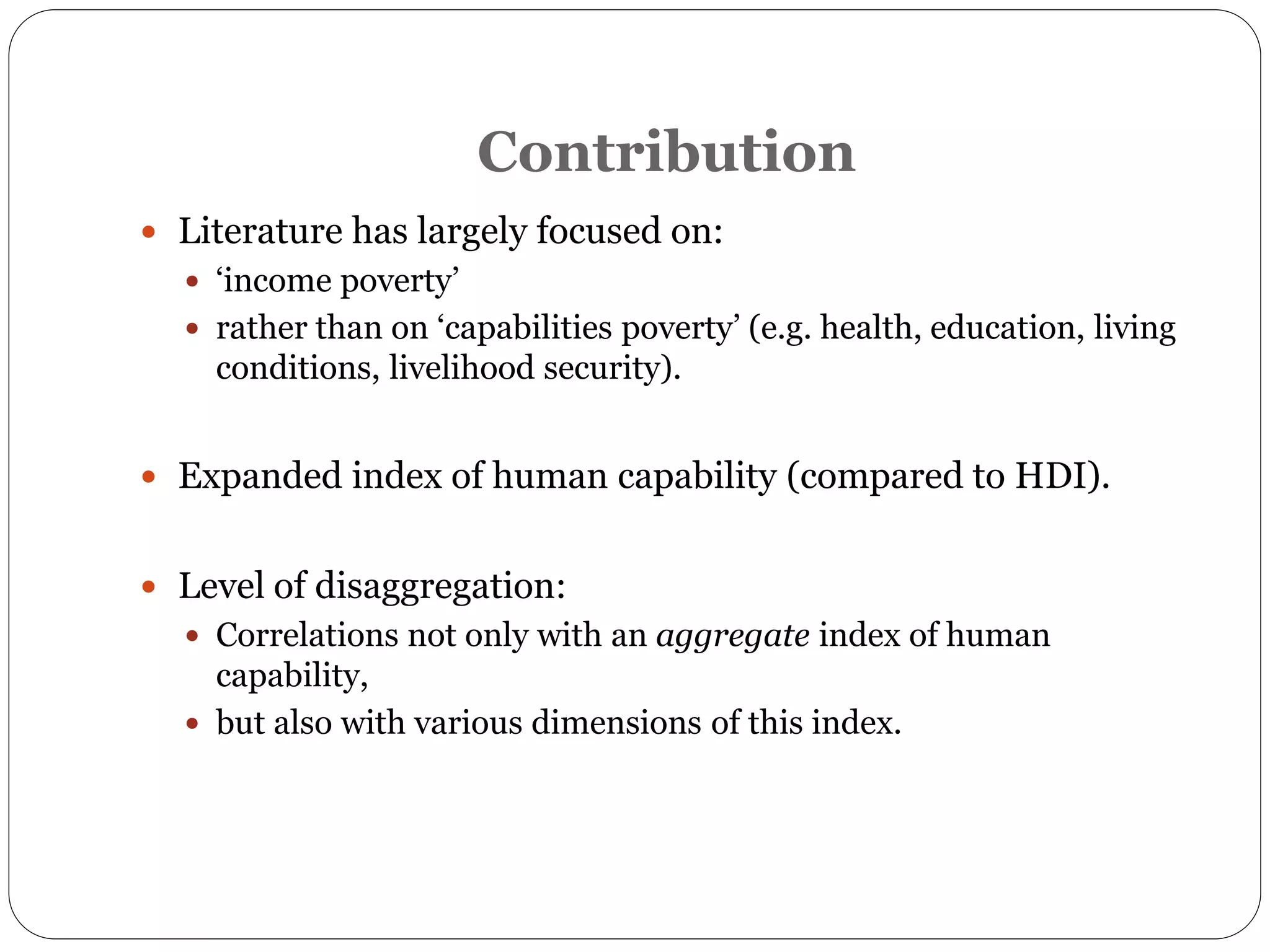
Contribution
 Literature has largely focused on:
 ‘income poverty’
 rather than on ‘capabilities poverty’ (e.g. health, education, living
conditions, livelihood security).
 Expanded index of human capability (compared to HDI).
 Level of disaggregation:
 Correlations not only with an aggregate index of human
capability,
 but also with various dimensions of this index.
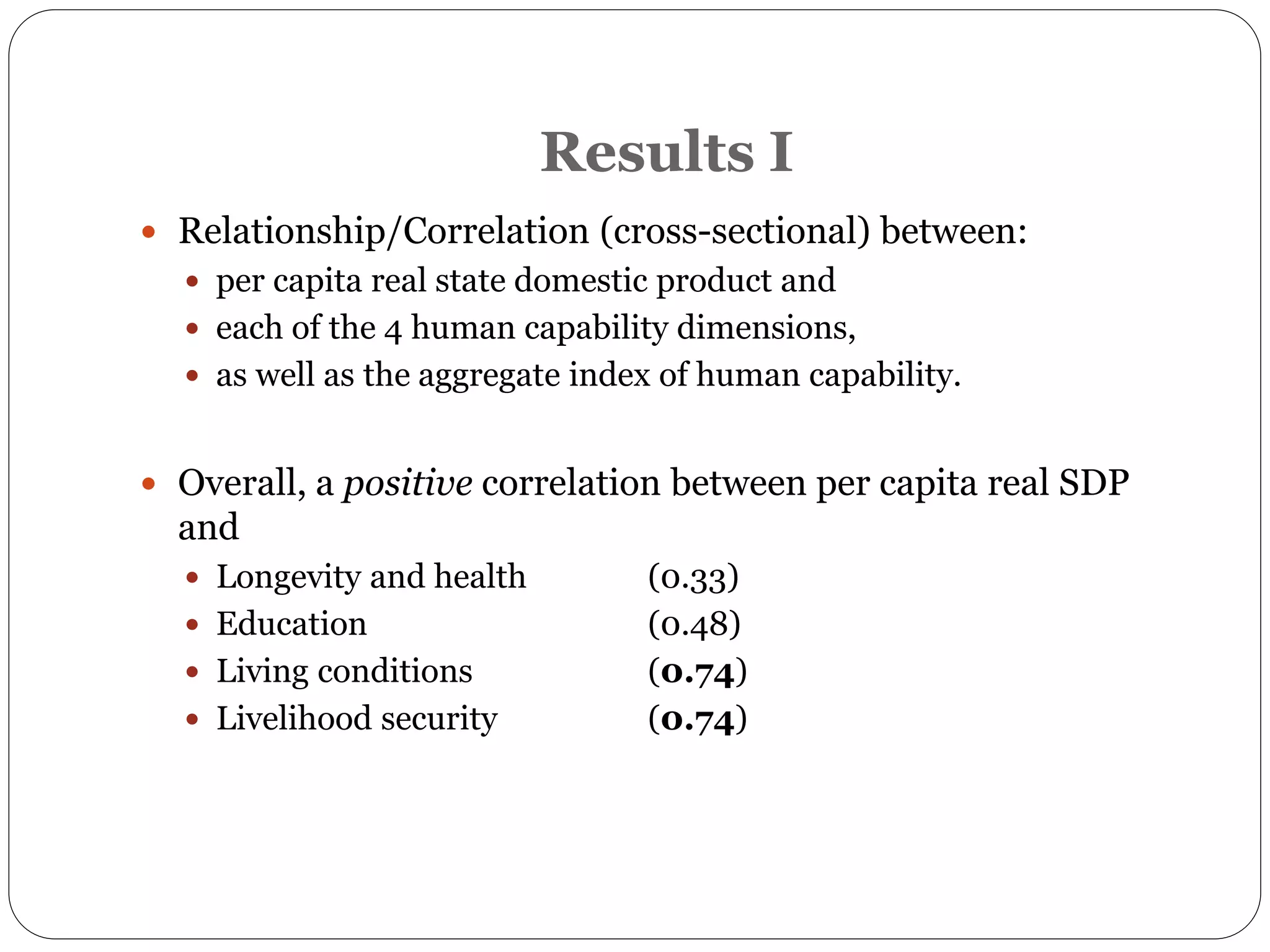
Results I
 Relationship/Correlation (cross-sectional) between:
 per capita real state domestic product and
 each of the 4 human capability dimensions,
 as well as the aggregate index of human capability.
 Overall, a positive correlation between per capita real SDP
and
 Longevity and health (0.33)
 Education (0.48)
 Living conditions (0.74)
 Livelihood security (0.74)
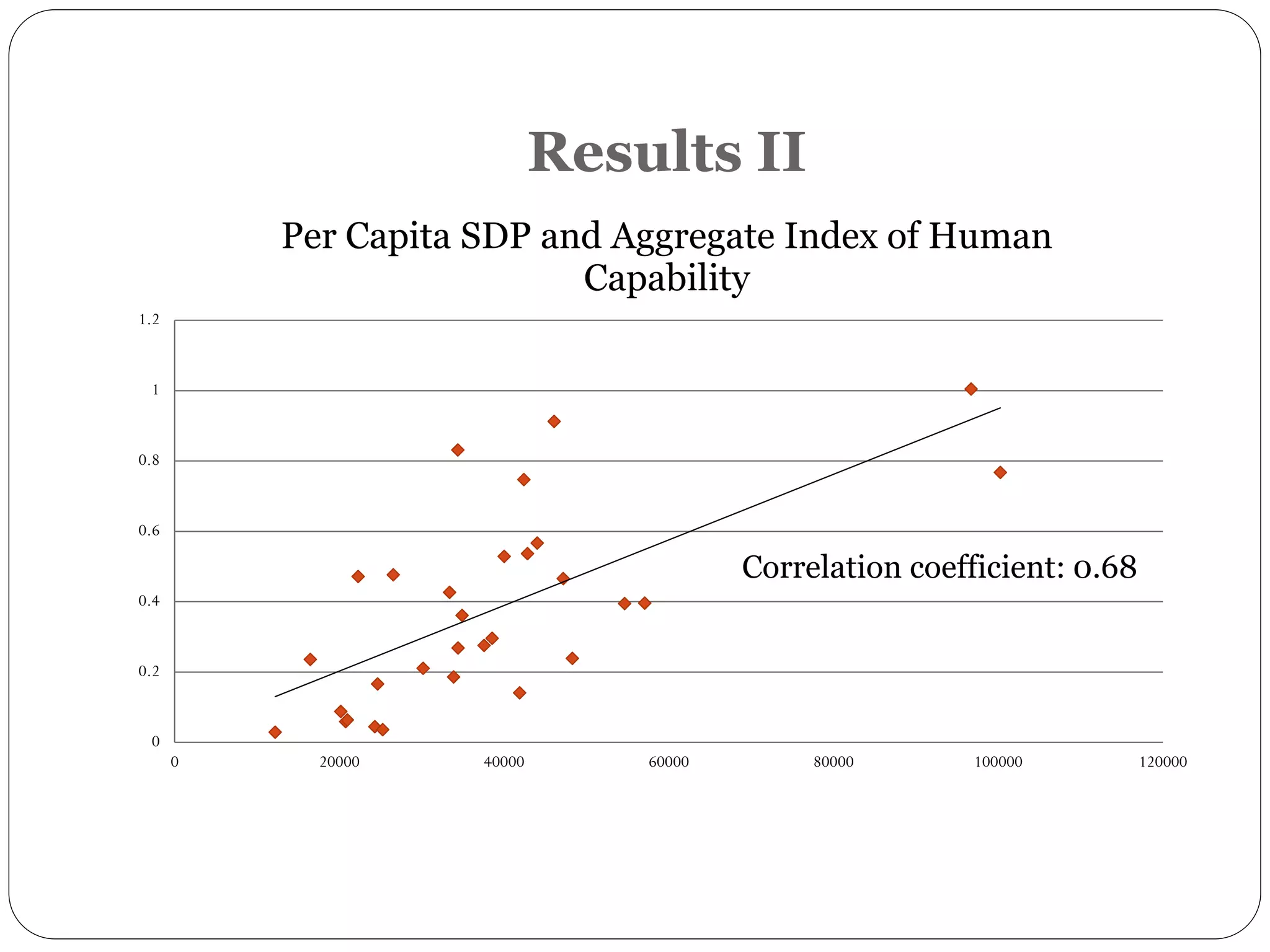
Results II
0
0.2
0.4
0.6
0.8
1
1.2
0 20000 40000 60000 80000 100000 120000
Correlation coefficient: 0.68
Per Capita SDP and Aggregate Index of Human
Capability
Summing up
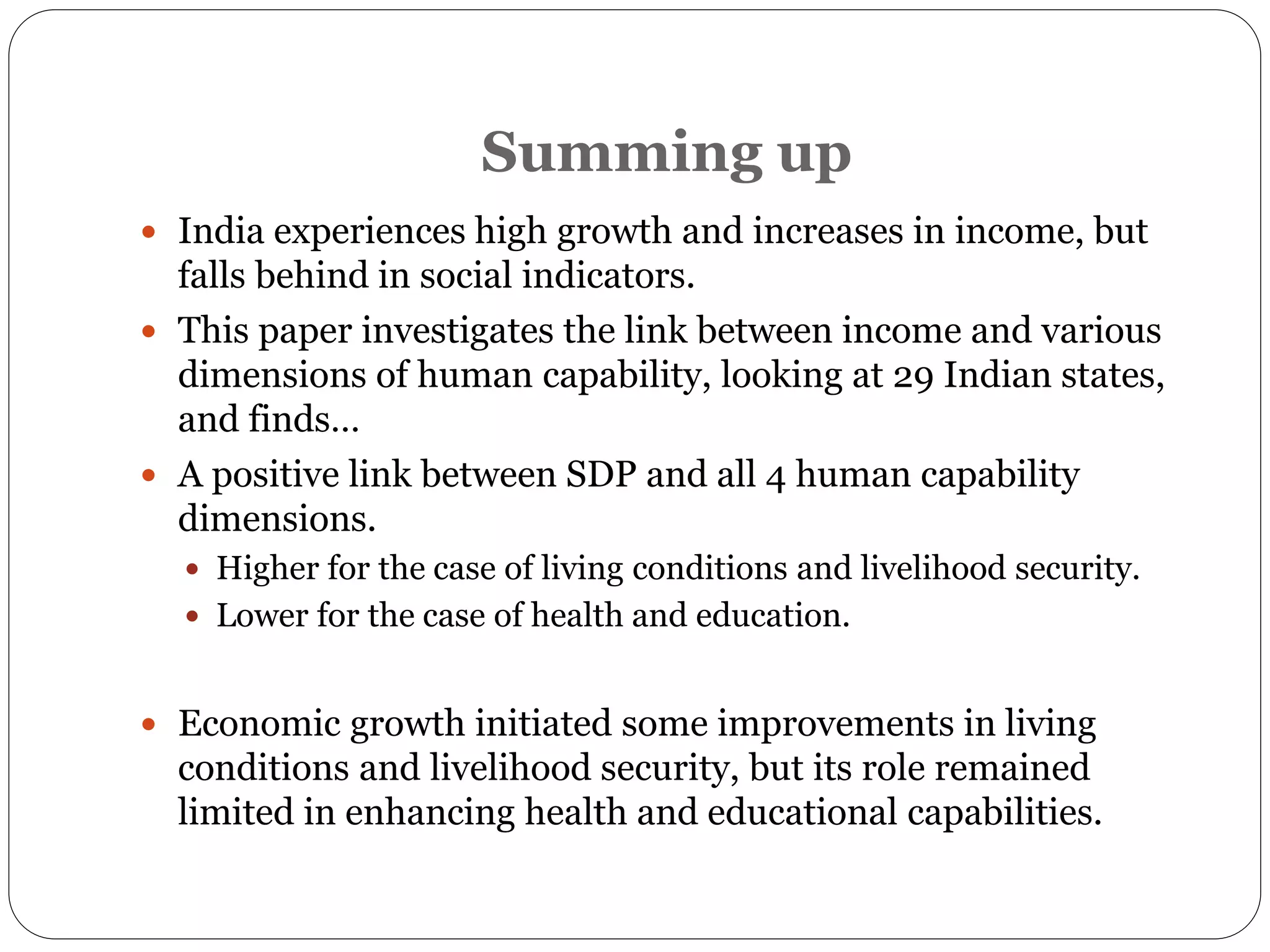
 India experiences high growth and increases in income, but
falls behind in social indicators.
 This paper investigates the link between income and various
dimensions of human capability, looking at 29 Indian states,
and finds…
 A positive link between SDP and all 4 human capability
dimensions.
 Higher for the case of living conditions and livelihood security.
 Lower for the case of health and education.
 Economic growth initiated some improvements in living
conditions and livelihood security, but its role remained
limited in enhancing health and educational capabilities.
Points for Discussion
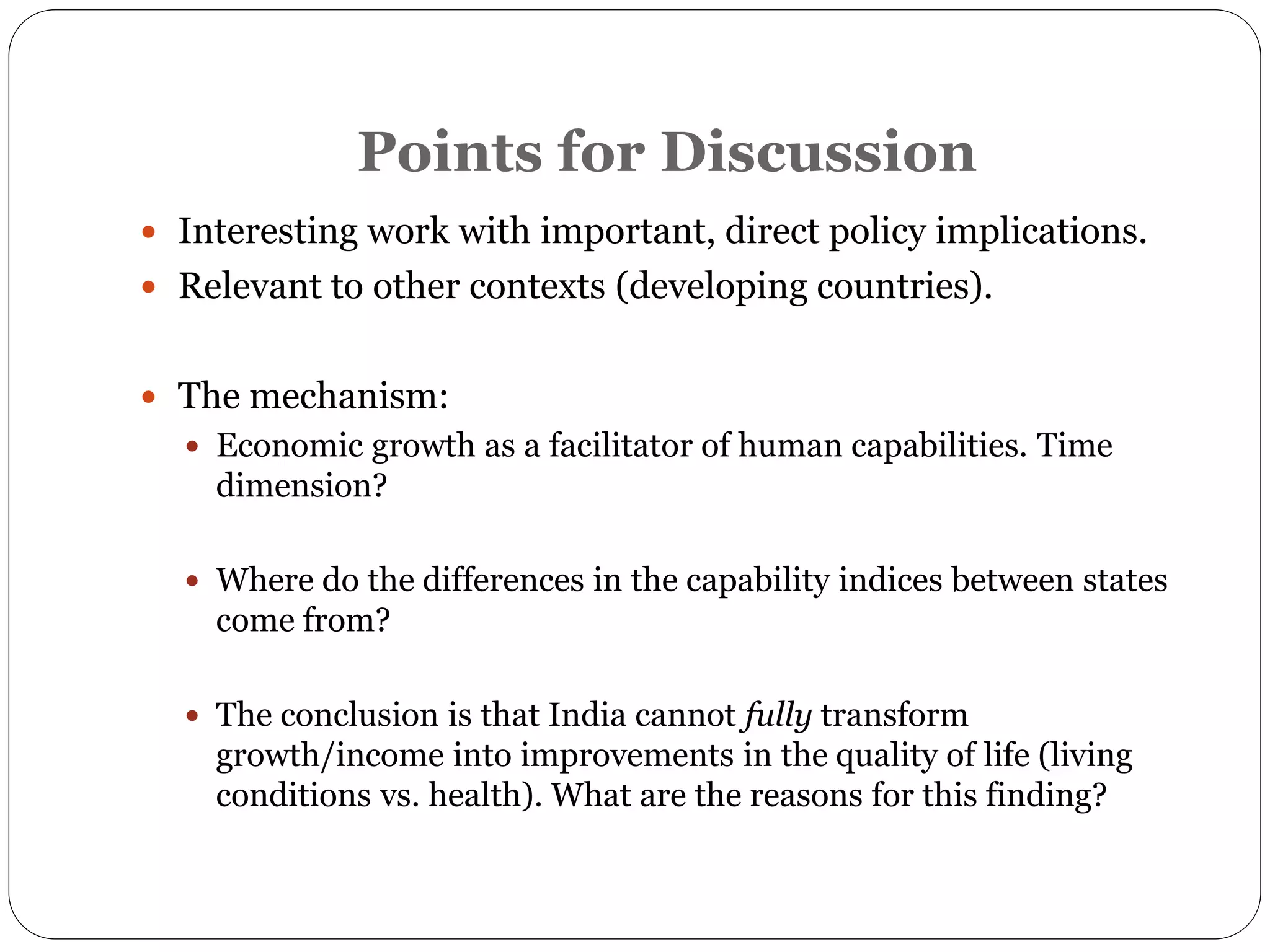
 Interesting work with important, direct policy implications.
 Relevant to other contexts (developing countries).
 The mechanism:
 Economic growth as a facilitator of human capabilities. Time
dimension?
 Where do the differences in the capability indices between states
come from?
 The conclusion is that India cannot fully transform
growth/income into improvements in the quality of life (living
conditions vs. health). What are the reasons for this finding?
Points for Discussion
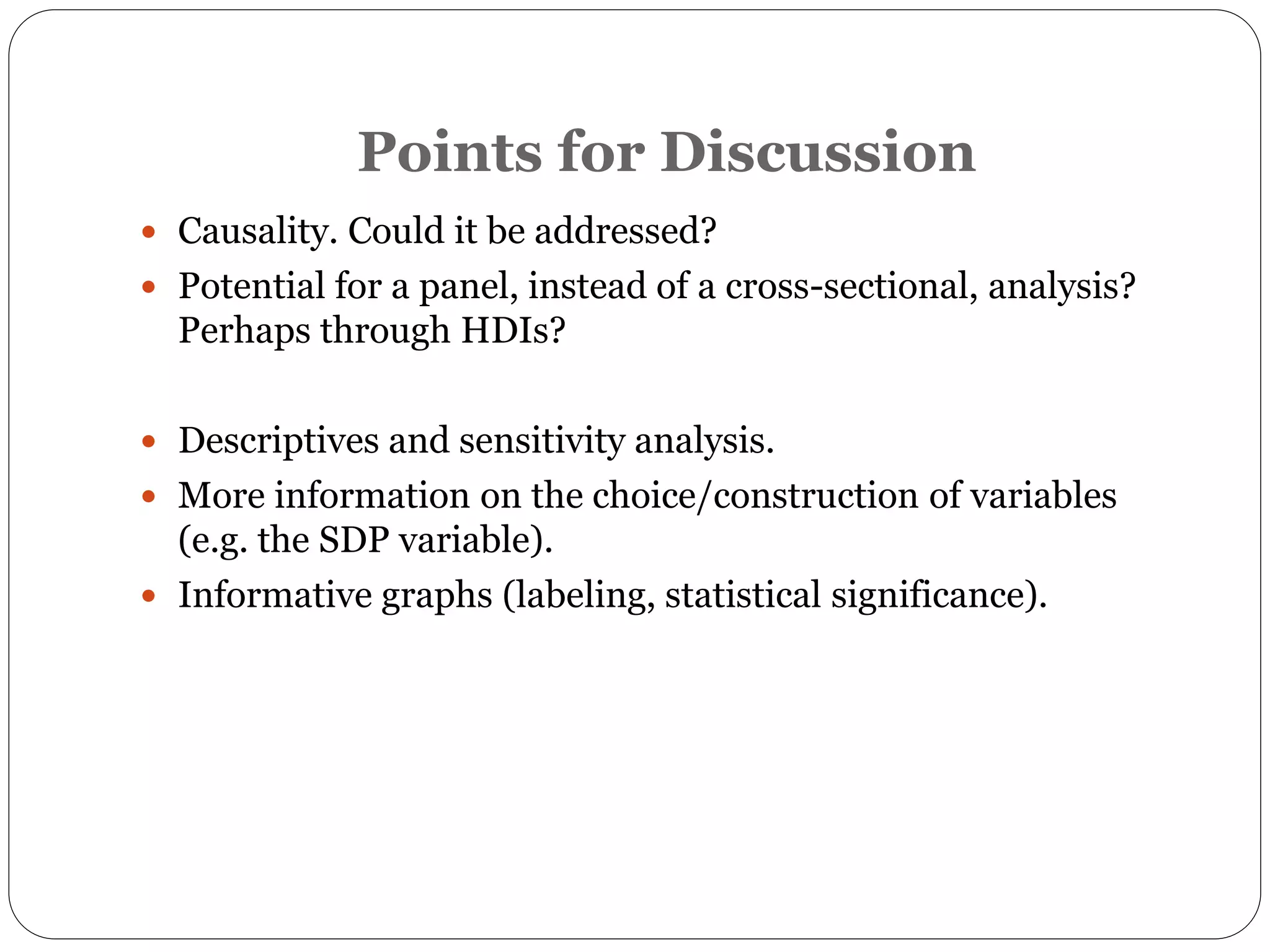
 Causality. Could it be addressed?
 Potential for a panel, instead of a cross-sectional, analysis?
Perhaps through HDIs?
 Descriptives and sensitivity analysis.
 More information on the choice/construction of variables
(e.g. the SDP variable).
 Informative graphs (labeling, statistical significance).
Thank you for your Attention!
Any Questions?

Session 2 d deb presentation

  • 1.
    Author: Surajit Deb(University of Delhi, India) Presenter: Marianna Papakonstantinou (University of Groningen, The Netherlands) IARIW 2014, Rotterdam, The Netherlands Session: Labour Supply and Human Capital Can Economic Growth Transform into Human Capabilities in India?
  • 2.
    Where do weStand?  Starting point: Importance of economic growth in poor countries.  Poverty reduction.  Improvements in HDIs (e.g. health, education, social inclusion).  But, there is also a different view. Capabilities approach:  Is economic growth sufficient for progress in living conditions?  Mixed evidence.  This paper:  Does economic growth correlate with human capability (e.g. health, education, living conditions, quality of life)?  Looking at state-level data in India.
  • 3.
    Some Facts forIndia  High growth and increases in real income (also, at the state- level).  But:  Lagging in terms of social indicators (e.g. schooling, health care, water, sanitation).  Ranked 136th (out of 186 countries) in HDI.
  • 4.
    Research Objectives  Doeseconomic growth correlate with different dimensions of human capability?  Level of analysis: 29 Indian states. 1. Construct 4 human capability dimensions. a) Longevity and health; b) Education; c) Living conditions; and d) Livelihood security. 2. Construct an aggregate index of human capability (captures quality of life). 3. Examine the correlation between economic growth and human capabilities in a cross-sectional framework.
  • 5.
    More Specifically onthe Methods  Method: Principal Component Analysis.  Four human capability dimensions. a) Longevity and health (Mizoram vs. Madhya Pradesh) e.g. infant mortality; undernourished children. b) Education (Kerala vs. Arunachal Pradesh) e.g. literacy rate; school attendance. c) Living conditions (Mizoram vs. Bihar) e.g. households living in a concrete house; access to water. d) Livelihood security (Goa vs. Bihar) e.g. population below the poverty line; unemployment rate.  And an aggregate index of human capability.
  • 6.
    Contribution  Literature haslargely focused on:  ‘income poverty’  rather than on ‘capabilities poverty’ (e.g. health, education, living conditions, livelihood security).  Expanded index of human capability (compared to HDI).  Level of disaggregation:  Correlations not only with an aggregate index of human capability,  but also with various dimensions of this index.
  • 7.
    Results I  Relationship/Correlation(cross-sectional) between:  per capita real state domestic product and  each of the 4 human capability dimensions,  as well as the aggregate index of human capability.  Overall, a positive correlation between per capita real SDP and  Longevity and health (0.33)  Education (0.48)  Living conditions (0.74)  Livelihood security (0.74)
  • 8.
    Results II 0 0.2 0.4 0.6 0.8 1 1.2 0 2000040000 60000 80000 100000 120000 Correlation coefficient: 0.68 Per Capita SDP and Aggregate Index of Human Capability
  • 9.
    Summing up  Indiaexperiences high growth and increases in income, but falls behind in social indicators.  This paper investigates the link between income and various dimensions of human capability, looking at 29 Indian states, and finds…  A positive link between SDP and all 4 human capability dimensions.  Higher for the case of living conditions and livelihood security.  Lower for the case of health and education.  Economic growth initiated some improvements in living conditions and livelihood security, but its role remained limited in enhancing health and educational capabilities.
  • 10.
    Points for Discussion Interesting work with important, direct policy implications.  Relevant to other contexts (developing countries).  The mechanism:  Economic growth as a facilitator of human capabilities. Time dimension?  Where do the differences in the capability indices between states come from?  The conclusion is that India cannot fully transform growth/income into improvements in the quality of life (living conditions vs. health). What are the reasons for this finding?
  • 11.
    Points for Discussion Causality. Could it be addressed?  Potential for a panel, instead of a cross-sectional, analysis? Perhaps through HDIs?  Descriptives and sensitivity analysis.  More information on the choice/construction of variables (e.g. the SDP variable).  Informative graphs (labeling, statistical significance).
  • 12.
    Thank you foryour Attention! Any Questions?