Alternative Approaches to Commercial Property 
Price Indexes for Tokyo 
W.Erwin Diewert and Chihiro Shimizu 
Discussant: Alicia N. Rambaldi
Overview 
Overall Price Index 
Components Indexes 
Further Issues 
Coments 
Outline 
1 Overview 
2 Overall Price Index 
3 Components Indexes 
4 Further Issues 
5 Coments 
A. N. Rambaldi CPPI
Overview 
Overall Price Index 
Components Indexes 
Further Issues 
Coments 
Overview 
Construct overall commercial property price indexes. 
Three approaches: 
An accounting based index 
A "repeat sales" type of index 
Time-dummy hedonic type of indexes 
Construct indexes for the structure and land components. 
Objective: Construct industry balance sheets and measure TFP of 
commercial buildings 
Accounting based index 
Time-Dummy Hedonic modelling based approach: 
1 Geometric model of structure depreciation 
2 Geometric depreciation that changes with age 
Adding the components provides an overall price index 
A. N. Rambaldi CPPI
Overview 
Overall Price Index 
Components Indexes 
Further Issues 
Coments 
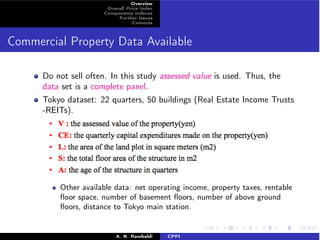
Commercial Property Data Available 
Do not sell often. In this study assessed value is used. Thus, the 
data set is a complete panel. 
Tokyo dataset: 22 quarters, 50 buildings (Real Estate Income Trusts 
-REITs). 
Other available data: net operating income, property taxes, rentable 
floor space, number of basement floors, number of above ground 
floors, distance to Tokyo main station. 
A. N. Rambaldi CPPI
Overview 
Overall Price Index 
Components Indexes 
Further Issues 
Coments 
A. N. Rambaldi CPPI
Overview 
Overall Price Index 
Components Indexes 
Further Issues 
Coments 
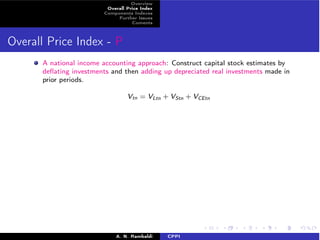
Overall Price Index - P 
A national income accounting approach: Construct capital stock estimates by 
deflating investments and then adding up depreciated real investments made in 
prior periods. 
Vtn = VLtn + VStn + VCEtn 
A. N. Rambaldi CPPI
Overview 
Overall Price Index 
Components Indexes 
Further Issues 
Coments 
Overall Price Index - P 
A national income accounting approach: Construct capital stock estimates by 
deflating investments and then adding up depreciated real investments made in 
prior periods. 
Vtn = VLtn + VStn + VCEtn 
Value = Price ⇥ Quantity 
A. N. Rambaldi CPPI
Overview 
Overall Price Index 
Components Indexes 
Further Issues 
Coments 
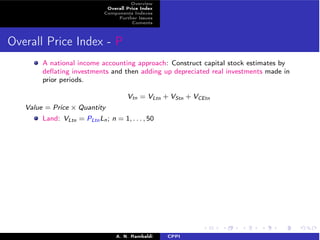
Overall Price Index - P 
A national income accounting approach: Construct capital stock estimates by 
deflating investments and then adding up depreciated real investments made in 
prior periods. 
Vtn = VLtn + VStn + VCEtn 
Value = Price ⇥ Quantity 
Land: VLtn = PLtnLn; n = 1, . . . , 50 
A. N. Rambaldi CPPI
Overview 
Overall Price Index 
Components Indexes 
Further Issues 
Coments 
Overall Price Index - P 
A national income accounting approach: Construct capital stock estimates by 
deflating investments and then adding up depreciated real investments made in 
prior periods. 
Vtn = VLtn + VStn + VCEtn 
Value = Price ⇥ Quantity 
Land: VLtn = PLtnLn; n = 1, . . . , 50 
Structure: VLtn = PSt 
⇥ 
0.3Sn(1 − !S )Atn 
⇤ 
; 
PSt = construction price index for Tokyo; 
0.3 is cost of a SqMt of new commercial property in millions of Yen; 
!S = 0.005 quarterly depreciation rate 
A. N. Rambaldi CPPI
Overview 
Overall Price Index 
Components Indexes 
Further Issues 
Coments 
Overall Price Index - P 
A national income accounting approach: Construct capital stock estimates by 
deflating investments and then adding up depreciated real investments made in 
prior periods. 
Vtn = VLtn + VStn + VCEtn 
Value = Price ⇥ Quantity 
Land: VLtn = PLtnLn; n = 1, . . . , 50 
Structure: VLtn = PSt 
⇥ 
0.3Sn(1 − !S )Atn 
⇤ 
; 
PSt = construction price index for Tokyo; 
0.3 is cost of a SqMt of new commercial property in millions of Yen; 
!S = 0.005 quarterly depreciation rate 
Capital Expenditures: VCEtn = PStQCEtn 
QCEtn = [(1 − !CE )QCE,t−1,n] + real average CEtn; t = 2, . . . , 22 
Starting Stock = depreciated investment for 5 years; !CE = 0.10 
A. N. Rambaldi CPPI
Overview 
Overall Price Index 
Components Indexes 
Further Issues 
Coments 
Overall Price Index - P 
A national income accounting approach: Construct capital stock estimates by 
deflating investments and then adding up depreciated real investments made in 
prior periods. 
Vtn = VLtn + VStn + VCEtn 
Value = Price ⇥ Quantity 
Land: VLtn = PLtnLn; n = 1, . . . , 50 
Structure: VLtn = PSt 
⇥ 
0.3Sn(1 − !S )Atn 
⇤ 
; 
PSt = construction price index for Tokyo; 
0.3 is cost of a SqMt of new commercial property in millions of Yen; 
!S = 0.005 quarterly depreciation rate 
Capital Expenditures: VCEtn = PStQCEtn 
QCEtn = [(1 − !CE )QCE,t−1,n] + real average CEtn; t = 2, . . . , 22 
Starting Stock = depreciated investment for 5 years; !CE = 0.10 
Solve for the price of land 
A. N. Rambaldi CPPI
Overview 
Overall Price Index 
Components Indexes 
Further Issues 
Coments 
Overall Price Index - P 
A national income accounting approach: Construct capital stock estimates by 
deflating investments and then adding up depreciated real investments made in 
prior periods. 
Vtn = VLtn + VStn + VCEtn 
Value = Price ⇥ Quantity 
Land: VLtn = PLtnLn; n = 1, . . . , 50 
Structure: VLtn = PSt 
⇥ 
0.3Sn(1 − !S )Atn 
⇤ 
; 
PSt = construction price index for Tokyo; 
0.3 is cost of a SqMt of new commercial property in millions of Yen; 
!S = 0.005 quarterly depreciation rate 
Capital Expenditures: VCEtn = PStQCEtn 
QCEtn = [(1 − !CE )QCE,t−1,n] + real average CEtn; t = 2, . . . , 22 
Starting Stock = depreciated investment for 5 years; !CE = 0.10 
Solve for the price of land 
Construct overall chained Fisher price index by forming aggregate price and 
quantity for each quarter, P 
A. N. Rambaldi CPPI
Overview 
Overall Price Index 
Components Indexes 
Further Issues 
Coments 
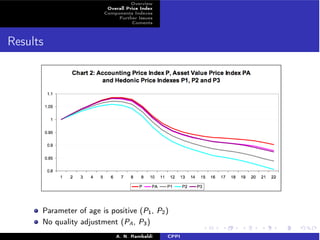
Overall Price Indexes - PA,P1,P2,P3 
A "repeat Psales" type of index - Asset Value Price Index (a Lowe index): 
50 
Pt 
A = 
n=1 Vtn P50 
n=1 V1n 
cannot identify the depreciation, assumes constant quality 
Time-dummy hedonic type of indexes 
No fixed effects 
lnVtn = ↵t + " ln Ltn + # ln Stn + $Atn + ✏tn; Pt 
1 = exp(ˆ↵t ) 
with fixed dummy effects and age 
lnVtn = ↵t + !n + $Atn + ✏tn; Pt 
2 = exp(ˆ↵t ) 
only dummy effects (a type of CPD) 
lnVtn = ↵t + !n + ✏tn; Pt 
3 = exp(ˆ↵t ) 
A. N. Rambaldi CPPI
Overview 
Overall Price Index 
Components Indexes 
Further Issues 
Coments 
Results 
Parameter of age is positive (P1, P2) 
No quality adjustment (PA, P3) 
A. N. Rambaldi CPPI
Overview 
Overall Price Index 
Components Indexes 
Further Issues 
Coments 
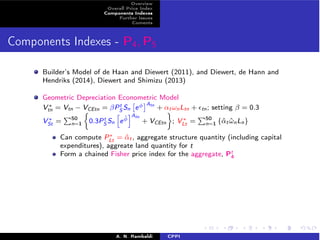
Components Indexes - P4,P5 
Builder’s Model of de Haan and Diewert (2011), and Diewert, de Hann and 
Hendriks (2014), Diewert and Shimizu (2013) 
A. N. Rambaldi CPPI
Overview 
Overall Price Index 
Components Indexes 
Further Issues 
Coments 
Components Indexes - P4,P5 
tS 
Builder’s Model of de Haan and Diewert (2011), and Diewert, de Hann and 
Hendriks (2014), Diewert and Shimizu (2013) 
Geometric Depreciation Econometric ⇥ 
⇤Model 
V⇤ = Vtn − VCEtn = "PSn 
e 
Atn tn + ↵t!nLtn + ✏tn; setting  = 0.3 
V⇤ St = 
P50 
n=1 
⇢ 
0.3PtS 
Sn 
h 
e ˆiAtn 
+ VCEtn 
 
; V⇤ Lt = 
P50 
n=1 {ˆ↵t ˆ!nLn} 
A. N. Rambaldi CPPI
Overview 
Overall Price Index 
Components Indexes 
Further Issues 
Coments 
Components Indexes - P4,P5 
tS 
Builder’s Model of de Haan and Diewert (2011), and Diewert, de Hann and 
Hendriks (2014), Diewert and Shimizu (2013) 
Geometric Depreciation Econometric ⇥ 
⇤Model 
V⇤ = Vtn − VCEtn = PSn 
e 
Atn tn + ↵t!nLtn + ✏tn; setting  = 0.3 
V⇤ St = 
P50 
n=1 
⇢ 
0.3PtS 
Sn 
h 
e ˆiAtn 
+ VCEtn 
 
; V⇤ Lt = 
P50 
n=1 {ˆ↵t ˆ!nLn} 
Can compute P⇤Lt = ˆ↵t, aggregate structure quantity (including capital 
expenditures), aggreate land quantity for t 
Form a chained Fisher price index for the aggregate, Pt 
4 
A. N. Rambaldi CPPI
Overview 
Overall Price Index 
Components Indexes 
Further Issues 
Coments 
Components Indexes - P4,P5 
tS 
Builder’s Model of de Haan and Diewert (2011), and Diewert, de Hann and 
Hendriks (2014), Diewert and Shimizu (2013) 
Geometric Depreciation Econometric ⇥ 
⇤Model 
V⇤ = Vtn − VCEtn = PSn 
e 
Atn tn + ↵t!nLtn + ✏tn; setting  = 0.3 
V⇤ St = 
P50 
n=1 
⇢ 
0.3PtS 
Sn 
h 
e ˆiAtn 
+ VCEtn 
 
; V⇤ Lt = 
P50 
n=1 {ˆ↵t ˆ!nLn} 
Can compute P⇤Lt = ˆ↵t, aggregate structure quantity (including capital 
expenditures), aggreate land quantity for t 
Form a chained Fisher price index for the aggregate, Pt 
4 
Geometric Depreciation Econometric Model interacted with Age 
V⇤ tn = Vtn − VCEtn = PtS 
Sng(Atn) + ↵t!nLtn + ✏tn; ˆ ⇡ 0.3 
A. N. Rambaldi CPPI
Overview 
Overall Price Index 
Components Indexes 
Further Issues 
Coments 
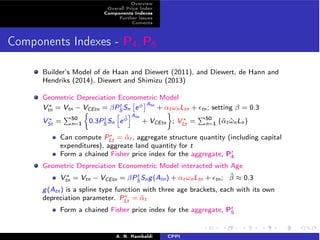
Components Indexes - P4,P5 
tS 
Builder’s Model of de Haan and Diewert (2011), and Diewert, de Hann and 
Hendriks (2014), Diewert and Shimizu (2013) 
Geometric Depreciation Econometric ⇥ 
⇤Model 
V⇤ = Vtn − VCEtn = PSn 
e 
Atn tn + ↵t!nLtn + ✏tn; setting  = 0.3 
V⇤ St = 
P50 
n=1 
⇢ 
0.3PtS 
Sn 
h 
e ˆiAtn 
+ VCEtn 
 
; V⇤ Lt = 
P50 
n=1 {ˆ↵t ˆ!nLn} 
Can compute P⇤Lt = ˆ↵t, aggregate structure quantity (including capital 
expenditures), aggreate land quantity for t 
Form a chained Fisher price index for the aggregate, Pt 
4 
Geometric Depreciation Econometric Model interacted with Age 
V⇤ tn = Vtn − VCEtn = PtS 
Sng(Atn) + ↵t!nLtn + ✏tn; ˆ ⇡ 0.3 
g(Atn) is a spline type function with three age brackets, each with its own 
depreciation parameter. P⇤Lt = ˆ↵t 
Form a chained Fisher price index for the aggregate, Pt 
5 
A. N. Rambaldi CPPI
Overview 
Overall Price Index 
Components Indexes 
Further Issues 
Coments 
Results - I 
A. N. Rambaldi CPPI
Overview 
Overall Price Index 
Components Indexes 
Further Issues 
Coments 
Results - II 
A. N. Rambaldi CPPI
Overview 
Overall Price Index 
Components Indexes 
Further Issues 
Coments 
Issues for further research/discussion 
CE = 10% per quarter has not been backed by any econometric 
work. 
how one deals with buildings that are demolished early 
Komatsu, Kato and Yashiro collected date of construction and date 
of retirement data for reinforced concrete office buildings in Japan 
A. N. Rambaldi CPPI
Overview 
Overall Price Index 
Components Indexes 
Further Issues 
Coments 
Conditional probabilities of demolition are very small for the first 20 years or so 
of building life. 
From 20 to 42 years, increase from 1.4% to about 11%; t fluctuate around the 
10% level from age 43 to 67. 
After age 67, the conditional probabilities of demolition increase rapidly to end 
up close to unity at age 75. 
A. N. Rambaldi CPPI
Overview 
Overall Price Index 
Components Indexes 
Further Issues 
Coments 
Comments 
Constructing an index of price change for commercial buildings is a much 
more complicated task than that needed for residential property. 
Given the use of assessed values, why only use 50 buildings and not all 
buildings in Tokyo? 
Accounting based index. Is P higher partly due to the $CE = 10% per 
quarter? 
How can we combine selling prices with the valuations? 
It would be useful to have some indication of how they relate. 
Which are the relevant hedonics to predict the value of a commercial 
building? 
For instance, the rentable floor space would seem to be an obvious 
indicator of how valuable the building is 
What do professional valuators take into account when producing a 
valuation? 
Might not matter if all we want to do is decompose the valuation 
into the proportion due to land and that due to the structure 
A. N. Rambaldi CPPI

Session 7 b d s rambaldi

  • 1.
    Alternative Approaches toCommercial Property Price Indexes for Tokyo W.Erwin Diewert and Chihiro Shimizu Discussant: Alicia N. Rambaldi
  • 2.
    Overview Overall PriceIndex Components Indexes Further Issues Coments Outline 1 Overview 2 Overall Price Index 3 Components Indexes 4 Further Issues 5 Coments A. N. Rambaldi CPPI
  • 3.
    Overview Overall PriceIndex Components Indexes Further Issues Coments Overview Construct overall commercial property price indexes. Three approaches: An accounting based index A "repeat sales" type of index Time-dummy hedonic type of indexes Construct indexes for the structure and land components. Objective: Construct industry balance sheets and measure TFP of commercial buildings Accounting based index Time-Dummy Hedonic modelling based approach: 1 Geometric model of structure depreciation 2 Geometric depreciation that changes with age Adding the components provides an overall price index A. N. Rambaldi CPPI
  • 4.
    Overview Overall PriceIndex Components Indexes Further Issues Coments Commercial Property Data Available Do not sell often. In this study assessed value is used. Thus, the data set is a complete panel. Tokyo dataset: 22 quarters, 50 buildings (Real Estate Income Trusts -REITs). Other available data: net operating income, property taxes, rentable floor space, number of basement floors, number of above ground floors, distance to Tokyo main station. A. N. Rambaldi CPPI
  • 5.
    Overview Overall PriceIndex Components Indexes Further Issues Coments A. N. Rambaldi CPPI
  • 6.
    Overview Overall PriceIndex Components Indexes Further Issues Coments Overall Price Index - P A national income accounting approach: Construct capital stock estimates by deflating investments and then adding up depreciated real investments made in prior periods. Vtn = VLtn + VStn + VCEtn A. N. Rambaldi CPPI
  • 7.
    Overview Overall PriceIndex Components Indexes Further Issues Coments Overall Price Index - P A national income accounting approach: Construct capital stock estimates by deflating investments and then adding up depreciated real investments made in prior periods. Vtn = VLtn + VStn + VCEtn Value = Price ⇥ Quantity A. N. Rambaldi CPPI
  • 8.
    Overview Overall PriceIndex Components Indexes Further Issues Coments Overall Price Index - P A national income accounting approach: Construct capital stock estimates by deflating investments and then adding up depreciated real investments made in prior periods. Vtn = VLtn + VStn + VCEtn Value = Price ⇥ Quantity Land: VLtn = PLtnLn; n = 1, . . . , 50 A. N. Rambaldi CPPI
  • 9.
    Overview Overall PriceIndex Components Indexes Further Issues Coments Overall Price Index - P A national income accounting approach: Construct capital stock estimates by deflating investments and then adding up depreciated real investments made in prior periods. Vtn = VLtn + VStn + VCEtn Value = Price ⇥ Quantity Land: VLtn = PLtnLn; n = 1, . . . , 50 Structure: VLtn = PSt ⇥ 0.3Sn(1 − !S )Atn ⇤ ; PSt = construction price index for Tokyo; 0.3 is cost of a SqMt of new commercial property in millions of Yen; !S = 0.005 quarterly depreciation rate A. N. Rambaldi CPPI
  • 10.
    Overview Overall PriceIndex Components Indexes Further Issues Coments Overall Price Index - P A national income accounting approach: Construct capital stock estimates by deflating investments and then adding up depreciated real investments made in prior periods. Vtn = VLtn + VStn + VCEtn Value = Price ⇥ Quantity Land: VLtn = PLtnLn; n = 1, . . . , 50 Structure: VLtn = PSt ⇥ 0.3Sn(1 − !S )Atn ⇤ ; PSt = construction price index for Tokyo; 0.3 is cost of a SqMt of new commercial property in millions of Yen; !S = 0.005 quarterly depreciation rate Capital Expenditures: VCEtn = PStQCEtn QCEtn = [(1 − !CE )QCE,t−1,n] + real average CEtn; t = 2, . . . , 22 Starting Stock = depreciated investment for 5 years; !CE = 0.10 A. N. Rambaldi CPPI
  • 11.
    Overview Overall PriceIndex Components Indexes Further Issues Coments Overall Price Index - P A national income accounting approach: Construct capital stock estimates by deflating investments and then adding up depreciated real investments made in prior periods. Vtn = VLtn + VStn + VCEtn Value = Price ⇥ Quantity Land: VLtn = PLtnLn; n = 1, . . . , 50 Structure: VLtn = PSt ⇥ 0.3Sn(1 − !S )Atn ⇤ ; PSt = construction price index for Tokyo; 0.3 is cost of a SqMt of new commercial property in millions of Yen; !S = 0.005 quarterly depreciation rate Capital Expenditures: VCEtn = PStQCEtn QCEtn = [(1 − !CE )QCE,t−1,n] + real average CEtn; t = 2, . . . , 22 Starting Stock = depreciated investment for 5 years; !CE = 0.10 Solve for the price of land A. N. Rambaldi CPPI
  • 12.
    Overview Overall PriceIndex Components Indexes Further Issues Coments Overall Price Index - P A national income accounting approach: Construct capital stock estimates by deflating investments and then adding up depreciated real investments made in prior periods. Vtn = VLtn + VStn + VCEtn Value = Price ⇥ Quantity Land: VLtn = PLtnLn; n = 1, . . . , 50 Structure: VLtn = PSt ⇥ 0.3Sn(1 − !S )Atn ⇤ ; PSt = construction price index for Tokyo; 0.3 is cost of a SqMt of new commercial property in millions of Yen; !S = 0.005 quarterly depreciation rate Capital Expenditures: VCEtn = PStQCEtn QCEtn = [(1 − !CE )QCE,t−1,n] + real average CEtn; t = 2, . . . , 22 Starting Stock = depreciated investment for 5 years; !CE = 0.10 Solve for the price of land Construct overall chained Fisher price index by forming aggregate price and quantity for each quarter, P A. N. Rambaldi CPPI
  • 13.
    Overview Overall PriceIndex Components Indexes Further Issues Coments Overall Price Indexes - PA,P1,P2,P3 A "repeat Psales" type of index - Asset Value Price Index (a Lowe index): 50 Pt A = n=1 Vtn P50 n=1 V1n cannot identify the depreciation, assumes constant quality Time-dummy hedonic type of indexes No fixed effects lnVtn = ↵t + " ln Ltn + # ln Stn + $Atn + ✏tn; Pt 1 = exp(ˆ↵t ) with fixed dummy effects and age lnVtn = ↵t + !n + $Atn + ✏tn; Pt 2 = exp(ˆ↵t ) only dummy effects (a type of CPD) lnVtn = ↵t + !n + ✏tn; Pt 3 = exp(ˆ↵t ) A. N. Rambaldi CPPI
  • 14.
    Overview Overall PriceIndex Components Indexes Further Issues Coments Results Parameter of age is positive (P1, P2) No quality adjustment (PA, P3) A. N. Rambaldi CPPI
  • 15.
    Overview Overall PriceIndex Components Indexes Further Issues Coments Components Indexes - P4,P5 Builder’s Model of de Haan and Diewert (2011), and Diewert, de Hann and Hendriks (2014), Diewert and Shimizu (2013) A. N. Rambaldi CPPI
  • 16.
    Overview Overall PriceIndex Components Indexes Further Issues Coments Components Indexes - P4,P5 tS Builder’s Model of de Haan and Diewert (2011), and Diewert, de Hann and Hendriks (2014), Diewert and Shimizu (2013) Geometric Depreciation Econometric ⇥ ⇤Model V⇤ = Vtn − VCEtn = "PSn e Atn tn + ↵t!nLtn + ✏tn; setting = 0.3 V⇤ St = P50 n=1 ⇢ 0.3PtS Sn h e ˆiAtn + VCEtn ; V⇤ Lt = P50 n=1 {ˆ↵t ˆ!nLn} A. N. Rambaldi CPPI
  • 17.
    Overview Overall PriceIndex Components Indexes Further Issues Coments Components Indexes - P4,P5 tS Builder’s Model of de Haan and Diewert (2011), and Diewert, de Hann and Hendriks (2014), Diewert and Shimizu (2013) Geometric Depreciation Econometric ⇥ ⇤Model V⇤ = Vtn − VCEtn = PSn e Atn tn + ↵t!nLtn + ✏tn; setting = 0.3 V⇤ St = P50 n=1 ⇢ 0.3PtS Sn h e ˆiAtn + VCEtn ; V⇤ Lt = P50 n=1 {ˆ↵t ˆ!nLn} Can compute P⇤Lt = ˆ↵t, aggregate structure quantity (including capital expenditures), aggreate land quantity for t Form a chained Fisher price index for the aggregate, Pt 4 A. N. Rambaldi CPPI
  • 18.
    Overview Overall PriceIndex Components Indexes Further Issues Coments Components Indexes - P4,P5 tS Builder’s Model of de Haan and Diewert (2011), and Diewert, de Hann and Hendriks (2014), Diewert and Shimizu (2013) Geometric Depreciation Econometric ⇥ ⇤Model V⇤ = Vtn − VCEtn = PSn e Atn tn + ↵t!nLtn + ✏tn; setting = 0.3 V⇤ St = P50 n=1 ⇢ 0.3PtS Sn h e ˆiAtn + VCEtn ; V⇤ Lt = P50 n=1 {ˆ↵t ˆ!nLn} Can compute P⇤Lt = ˆ↵t, aggregate structure quantity (including capital expenditures), aggreate land quantity for t Form a chained Fisher price index for the aggregate, Pt 4 Geometric Depreciation Econometric Model interacted with Age V⇤ tn = Vtn − VCEtn = PtS Sng(Atn) + ↵t!nLtn + ✏tn; ˆ ⇡ 0.3 A. N. Rambaldi CPPI
  • 19.
    Overview Overall PriceIndex Components Indexes Further Issues Coments Components Indexes - P4,P5 tS Builder’s Model of de Haan and Diewert (2011), and Diewert, de Hann and Hendriks (2014), Diewert and Shimizu (2013) Geometric Depreciation Econometric ⇥ ⇤Model V⇤ = Vtn − VCEtn = PSn e Atn tn + ↵t!nLtn + ✏tn; setting = 0.3 V⇤ St = P50 n=1 ⇢ 0.3PtS Sn h e ˆiAtn + VCEtn ; V⇤ Lt = P50 n=1 {ˆ↵t ˆ!nLn} Can compute P⇤Lt = ˆ↵t, aggregate structure quantity (including capital expenditures), aggreate land quantity for t Form a chained Fisher price index for the aggregate, Pt 4 Geometric Depreciation Econometric Model interacted with Age V⇤ tn = Vtn − VCEtn = PtS Sng(Atn) + ↵t!nLtn + ✏tn; ˆ ⇡ 0.3 g(Atn) is a spline type function with three age brackets, each with its own depreciation parameter. P⇤Lt = ˆ↵t Form a chained Fisher price index for the aggregate, Pt 5 A. N. Rambaldi CPPI
  • 20.
    Overview Overall PriceIndex Components Indexes Further Issues Coments Results - I A. N. Rambaldi CPPI
  • 21.
    Overview Overall PriceIndex Components Indexes Further Issues Coments Results - II A. N. Rambaldi CPPI
  • 22.
    Overview Overall PriceIndex Components Indexes Further Issues Coments Issues for further research/discussion CE = 10% per quarter has not been backed by any econometric work. how one deals with buildings that are demolished early Komatsu, Kato and Yashiro collected date of construction and date of retirement data for reinforced concrete office buildings in Japan A. N. Rambaldi CPPI
  • 23.
    Overview Overall PriceIndex Components Indexes Further Issues Coments Conditional probabilities of demolition are very small for the first 20 years or so of building life. From 20 to 42 years, increase from 1.4% to about 11%; t fluctuate around the 10% level from age 43 to 67. After age 67, the conditional probabilities of demolition increase rapidly to end up close to unity at age 75. A. N. Rambaldi CPPI
  • 24.
    Overview Overall PriceIndex Components Indexes Further Issues Coments Comments Constructing an index of price change for commercial buildings is a much more complicated task than that needed for residential property. Given the use of assessed values, why only use 50 buildings and not all buildings in Tokyo? Accounting based index. Is P higher partly due to the $CE = 10% per quarter? How can we combine selling prices with the valuations? It would be useful to have some indication of how they relate. Which are the relevant hedonics to predict the value of a commercial building? For instance, the rentable floor space would seem to be an obvious indicator of how valuable the building is What do professional valuators take into account when producing a valuation? Might not matter if all we want to do is decompose the valuation into the proportion due to land and that due to the structure A. N. Rambaldi CPPI