Amartya Sen's Capability
Approach
HUMAN DEVELOPMENT
YOLA PACIENTE
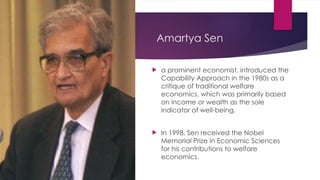
Amartya Sen
 a prominent economist, introduced the
Capability Approach in the 1980s as a
critique of traditional welfare
economics, which was primarily based
on income or wealth as the sole
indicator of well-being.
 In 1998, Sen received the Nobel
Memorial Prize in Economic Sciences
for his contributions to welfare
economics.
 Amartya Sen’s Capability
Approach offers a profound
rethinking of human
development, emphasizing
individual freedoms, choices,
and opportunities rather than
purely economic measures
like income or wealth.
CAPABILITY APPROACH
 Sen’s framework shifts the focus from material
wealth to a broader consideration of people’s
capabilities.
 This shift allows for a more inclusive approach to
development, one that takes into account the
qualitative aspects of life such as freedom,
dignity, and the ability to make choices.
Key Concepts:
Capabilities and Functionings
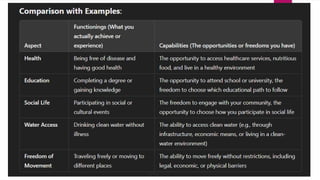
 Functionings refer to the various things a person may value
doing or being, such as being healthy, being educated, or
having a good job.
 Capabilities are the freedoms or opportunities to achieve these
functionings. Sen emphasized that individuals should have the
real freedom to choose among different functionings, as this
reflects their ability to live the life they value.
TIMELINE OF CAPABILITY APPROACH
 1985:
 In his paper “Well-Being, Agency, and Freedom,” Sen
laid the groundwork for the Capability Approach,
arguing that we should focus on what people are
able to do (capabilities) rather than just their income
or utility.
Agency and Freedom in the Capability Approach
 Agency refers to an individual’s capacity to pursue their own goals
and make choices that affect their life.
 Sen distinguishes between positive freedom and negative freedom.
 Negative freedom refers to the absence of constraints or
interference (e.g., freedom from oppression).
 Positive freedom involves the capacity to act and realize one’s
potential (e.g., having access to education, health care, or political
participation).
TIMELINE OF CAPABILITY APPROACH
 1992: In "Inequality Reexamined", Sen
deepened his analysis, arguing that
inequality should be assessed by looking
at differences in people’s capabilities to
function, not just by economic indicators
like income or wealth.
TIMELINE OF CAPABILITY APPROACH
 1999: Sen published "Development as Freedom,"
which became a seminal text in the field of
human development. In this book, Sen
expanded on how freedom, as the capability
to function in various domains (economic,
political, social), is central to development.
TIMELINE OF CAPABILITY APPROACH
 1993: Nussbaum proposed a list of central human
capabilities in her work "Capabilities and
Functionings", suggesting that certain capabilities
should be universally protected as part of a just
society. These included abilities such as bodily
health, practical reason, and affiliation (the
ability to engage in social relationships).
Nussbaum’s list of capabilities has
been widely used in policy-making
and human rights frameworks,
advocating for a universal set of
human rights based on the capability
to function in specific areas of life.
Expansion and Application
 The Capability Approach has been applied across various
fields, including development economics, social policy,
human rights, and political philosophy. It challenges traditional
measures of development, such as GDP or income per capita,
by focusing on human empowerment and the freedoms that
individuals can enjoy.
 In the Human Development Index (HDI), used by the United
Nations Development Programme (UNDP), the Capability
Approach influenced the shift away from purely economic
indicators to a broader focus on education, health, and living
standards.
Expansion and Application
 The 2000 UN Millennium Development
Goals (MDGs) and their successor, the
Sustainable Development Goals (SDGs),
have incorporated principles related to the
Capability Approach, emphasizing the
importance of human capabilities and
freedoms in global development.
Sen’s Critique of Traditional Development Indicators
 On Gross Domestic Product (GDP) and
the Human Development Index (HDI)
While these metrics provide useful data, they
fail to capture the true diversity of human
lives.
Practical Applications of the Capability Approach
 The Capability Approach has profound implications for policy
and development practices.
 It has been used to assess poverty not just in terms of income
but in terms of the capabilities people have to live a full life.
 This can include access to education, healthcare, political
freedoms, and social participation.
 Sen’s framework is influential in areas like gender equality
and social justice, where the empowerment of marginalized
groups is seen as a crucial component of human
development.
Criticism and Limitations of the Capability Approach
Lack of a Clear Metric
Challenges in Policy Implementation
Practical Challenges
Lack of Specificity
Defenders’ Response
Proponents argue its flexibility and
focus on individual freedom offer a
valuable alternative to rigid
economic models.
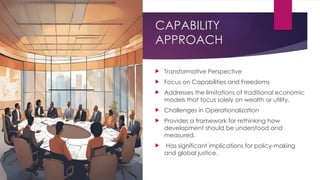
CAPABILITY
APPROACH
 Transformative Perspective
 Focus on Capabilities and Freedoms
 Addresses the limitations of traditional economic
models that focus solely on wealth or utility.
 Challenges in Operationalization
 Provides a framework for rethinking how
development should be understood and
measured.
 Has significant implications for policy-making
and global justice.
END
THANK YOU!

Capability approach Theory Amartya Sen

  • 1.
    Amartya Sen's Capability Approach HUMANDEVELOPMENT YOLA PACIENTE
  • 2.
    Amartya Sen  aprominent economist, introduced the Capability Approach in the 1980s as a critique of traditional welfare economics, which was primarily based on income or wealth as the sole indicator of well-being.  In 1998, Sen received the Nobel Memorial Prize in Economic Sciences for his contributions to welfare economics.
  • 3.
     Amartya Sen’sCapability Approach offers a profound rethinking of human development, emphasizing individual freedoms, choices, and opportunities rather than purely economic measures like income or wealth.
  • 4.
    CAPABILITY APPROACH  Sen’sframework shifts the focus from material wealth to a broader consideration of people’s capabilities.  This shift allows for a more inclusive approach to development, one that takes into account the qualitative aspects of life such as freedom, dignity, and the ability to make choices.
  • 5.
    Key Concepts: Capabilities andFunctionings  Functionings refer to the various things a person may value doing or being, such as being healthy, being educated, or having a good job.  Capabilities are the freedoms or opportunities to achieve these functionings. Sen emphasized that individuals should have the real freedom to choose among different functionings, as this reflects their ability to live the life they value.
  • 7.
    TIMELINE OF CAPABILITYAPPROACH  1985:  In his paper “Well-Being, Agency, and Freedom,” Sen laid the groundwork for the Capability Approach, arguing that we should focus on what people are able to do (capabilities) rather than just their income or utility.
  • 8.
    Agency and Freedomin the Capability Approach  Agency refers to an individual’s capacity to pursue their own goals and make choices that affect their life.  Sen distinguishes between positive freedom and negative freedom.  Negative freedom refers to the absence of constraints or interference (e.g., freedom from oppression).  Positive freedom involves the capacity to act and realize one’s potential (e.g., having access to education, health care, or political participation).
  • 9.
    TIMELINE OF CAPABILITYAPPROACH  1992: In "Inequality Reexamined", Sen deepened his analysis, arguing that inequality should be assessed by looking at differences in people’s capabilities to function, not just by economic indicators like income or wealth.
  • 10.
    TIMELINE OF CAPABILITYAPPROACH  1999: Sen published "Development as Freedom," which became a seminal text in the field of human development. In this book, Sen expanded on how freedom, as the capability to function in various domains (economic, political, social), is central to development.
  • 11.
    TIMELINE OF CAPABILITYAPPROACH  1993: Nussbaum proposed a list of central human capabilities in her work "Capabilities and Functionings", suggesting that certain capabilities should be universally protected as part of a just society. These included abilities such as bodily health, practical reason, and affiliation (the ability to engage in social relationships).
  • 12.
    Nussbaum’s list ofcapabilities has been widely used in policy-making and human rights frameworks, advocating for a universal set of human rights based on the capability to function in specific areas of life.
  • 13.
    Expansion and Application The Capability Approach has been applied across various fields, including development economics, social policy, human rights, and political philosophy. It challenges traditional measures of development, such as GDP or income per capita, by focusing on human empowerment and the freedoms that individuals can enjoy.  In the Human Development Index (HDI), used by the United Nations Development Programme (UNDP), the Capability Approach influenced the shift away from purely economic indicators to a broader focus on education, health, and living standards.
  • 14.
    Expansion and Application The 2000 UN Millennium Development Goals (MDGs) and their successor, the Sustainable Development Goals (SDGs), have incorporated principles related to the Capability Approach, emphasizing the importance of human capabilities and freedoms in global development.
  • 15.
    Sen’s Critique ofTraditional Development Indicators  On Gross Domestic Product (GDP) and the Human Development Index (HDI) While these metrics provide useful data, they fail to capture the true diversity of human lives.
  • 16.
    Practical Applications ofthe Capability Approach  The Capability Approach has profound implications for policy and development practices.  It has been used to assess poverty not just in terms of income but in terms of the capabilities people have to live a full life.  This can include access to education, healthcare, political freedoms, and social participation.  Sen’s framework is influential in areas like gender equality and social justice, where the empowerment of marginalized groups is seen as a crucial component of human development.
  • 17.
    Criticism and Limitationsof the Capability Approach Lack of a Clear Metric Challenges in Policy Implementation Practical Challenges Lack of Specificity
  • 18.
    Defenders’ Response Proponents argueits flexibility and focus on individual freedom offer a valuable alternative to rigid economic models.
  • 19.
    CAPABILITY APPROACH  Transformative Perspective Focus on Capabilities and Freedoms  Addresses the limitations of traditional economic models that focus solely on wealth or utility.  Challenges in Operationalization  Provides a framework for rethinking how development should be understood and measured.  Has significant implications for policy-making and global justice.
  • 20.

Editor's Notes

  • #9  For instance, two people might have the same income, but one might have better access to healthcare, education, or social connections, which enhances their ability to lead a fulfilling life. Another person might have high income but lack access to basic needs like clean water or a safe living environment. Simply comparing income or wealth doesn’t capture these inequalities in opportunity or freedom.
  • #15 For instance, GDP measures economic output but overlooks issues like income inequality, social justice, and access to basic services. HDI, while incorporating health and education indicators, is still limited in capturing the full complexity of human development.